Feeds:
Posts
Comments

Archive for July, 2012

LouisianaVoice has obtained a letter from a New Orleans law firm demanding payment of almost $7.9 million owed by the Recovery School District (RSD) of New Orleans to an Illinois company contracted to provide transportation to RSD students.

The letter confirms earlier reports by LouisianaVoice that RSD was in arrears by nearly $6.6 million in payments to Durham School Services.

At the same time, LouisianaVoice also received a copy of a July 13 letter from Durham notifying about 170 bus drivers and monitors that their jobs were being terminated, effective Aug. 6 as a result of failure of RSD and the Louisiana Department of Education (DOE) to remit contractual payments to Durham.

The letter from Jones Walker Law Firm, dated June 27, was addressed to DOE Superintendent John White and RSD Superintendent Patrick Dobard. In addition, copies were also mailed to each member of the Board of Elementary and Secondary Education.RSD – Durham Letter

“On Feb. 24, 2012, Durham advised DOE and RSD of their breach of the agreements for failing to timely pay for invoiced transportation services,” the letter said. “At that time, the past due amount was $4,494,291.44. Since then, not only have DOE and RSD failed to remedy this breach, but the past due balance has significantly increased.”

The total past due amount quoted in that letter was $6,568,694.81.

“Durham has attempted to engage in good faith discussions with representatives from RSD regarding this matter, but so far a satisfactory resolution has not been reached,” attorney Michael DePetrillo said in the letter. “Durham has also tried to meet with representatives from DOE, who have not yet committed to meeting with Durham on these issues.

“It is my understanding that DOE and RSD have proposed in writing to pay $3.5 million to Durham by July 6 with the remaining balance owed for the 2011-2012 school year paid to Durham by Dec. 31, 2012. Durham, however has not been provided with any assurance regarding these payments nor an indication as to the confirmed source of funding for these payments.”

DePetrillo also cited the outstanding balance of nearly $217,000 due from the defunct Sojourner Truth Academy. “Durham was forced to file a lawsuit and recently obtained a judgment for $216,835.42,” he said. “The problem Durham now faces, in light of Sojourner Truth Academy’s closure, is whether Durham will be able to collect for this debt.”

He said two other invoices not yet billed—for $1,200,594.30 and $108,288.40 bring the total owed by RSD and DOE to $7,877,577.51.

White has said that a payment agreement has been reached with Durham but that has not prevented the loss of 170 jobs.

Part of the loss could stem from the drop in enrollment at RSD schools by nearly 2,000 students.

The letter from Durham to drivers and monitors, however, would seem to indicate that the delinquent payments are largely to blame and that, contrary to White’s claims, no formal agreement for a payment schedule has been reached.
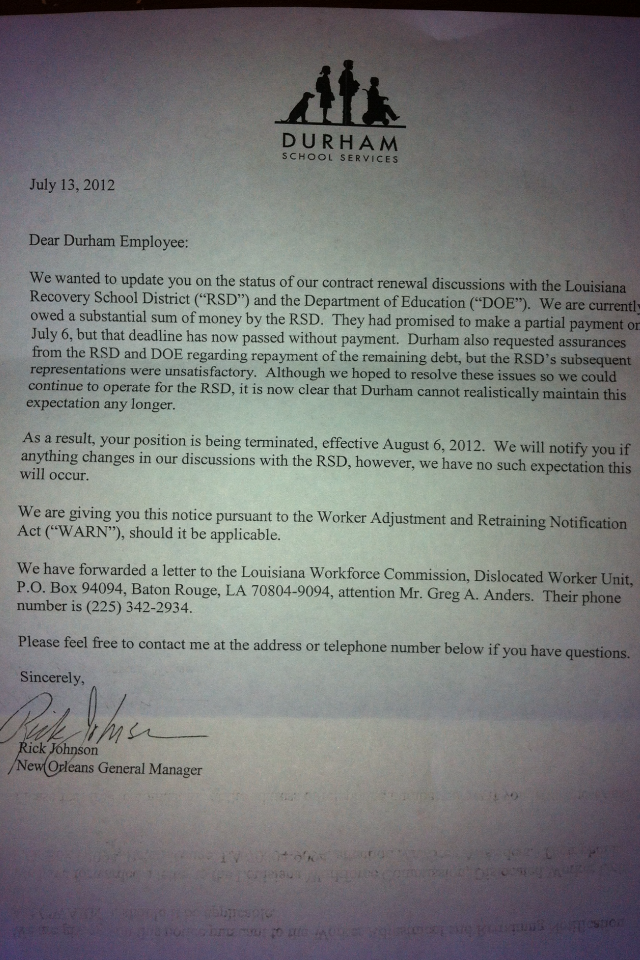
“We wanted to update you on the status of our contract renewal discussions with the Louisiana Recovery School District and the Department of Education,” it said. “We are currently owed a substantial sum of money by the RSD. They had promised to make a partial payment on July 6, but that deadline has now passed without payment.

“Durham also requested assurances from the RSD and DOE regarding repayment of the remaining debt, but the RSD’s subsequent representations were unsatisfactory. Although we hoped to resolve these issues so we could continue to operate for the RSD, it is now clear that Durham cannot realistically maintain this expectation any longer.

“As a result, your position is being terminated, effective August 6, 2012. We will notify you if anything changes in our discussions with the RSD; however, we have no such expectation this will occur.”

Could this be yet another attempt by White to “fill the room with air” as a means of deflecting attention from the real problems?

Stay tuned.

Read Full Post »

“Rep. Harrison informs that his assistant will return Monday (July 16) & send the list of recipients of the letter.”

–E-mail to LouisianaVoice from House Clerk Albert “Butch” Speer on Thursday, July 12, in response to request for the names of recipients of a letter from Rep. Joe Harrison (R-Gray) soliciting $1,000 contributions to help “over thirty” legislators attend an ALEC conference.

“My opinion is that the solicitation of donations for ALEC does not create a public record.”

–E-mail from Speer on Monday, July 16, explaining that there had been a 180-degree flip-flop over the weekend.

“I know you work for the House and have little choice but to do the bidding of its membership. I attribute that to your sudden change in position on this matter.”

–E-mail from LouisianaVoice to Speer as a result in the change in position over what is and what is not public record.

Read Full Post »

There has been an interesting turn of events concerning LouisianaVoice’s attempts to obtain the names of recipients of Rep. Joe Harrison’s letter soliciting contributions of $1,000 to help defray the expenses of “over thirty” state legislators to attend a national conference of the American Legislative Exchange Council (ALEC) in Salt Lake City next week.

Harrison (R-Gray) mailed out a form letter on July 2 that opened by saying, “As State Chair and National Board Member of the American Legislative Exchange Council, I would like to solicit your financial support to our ALEC Louisiana Scholarship Fund.” ALEC Letterhead

The letter was printed on state letterhead, which would appear to make the document a public record so LouisianaVoice immediately made a public records request of Harrison to provide:

• A complete list of the recipients of his letter;

• A list of the “over thirty” Louisiana legislators who are members of ALEC.

ALEC membership, of course, is a closely-guarded secret but once the letter was printed on state letterhead—presumably composed on a state computer in Harrison’s state-funded office, printed on a state-purchased printer and mailed using state-purchased postage—the request for a list of members was included in the request for recipients of the letter.

Harrison never responded to the request despite state law that requires responses to all such requests.

LouisianaVoice then contacted House Clerk Alfred “Butch” Speer to enlist his assistance in obtaining the records and last Thursday, July 12, Speer responded:

“Rep. Harrison informs that his assistant will return Monday (July 16) and send the list of recipients of the letter.

“The names of legislators who serve on the task forces of ALEC is not a record of the state. Because joining ALEC is an individual decision for each legislator and does not involve expenditure of public funds, no record of the House is maintained relative to this membership.

“Monday, I will forward you the list of recipients.”

But when Monday came, things had changed dramatically.

On Monday, LouisianaVoice received an e-mail from Speer:

“I have looked further into your records request.” (Notice he omitted the word “public” as in “public records.”)

“Rep. Harrison composed the letter of which you possess a copy. Rep. Harrison sent that one letter to a single recipient,” Speer’s email continued.

“If that letter was distributed to a larger audience, such distribution did not create a public record.

“R.S. 44:1 defines a public record as a record: ‘…having been used, being in use, or prepared, possessed, or retained for use in the conduct, transaction, or performance of any business, transaction, work, duty, or function which was conducted, transacted, or performed by or under the authority of the constitution or laws of this state…’

“My opinion is that the solicitation of donations for ALEC does not create a public record. The courts have been clear in providing that the purpose of the record is determinative of its public nature, not the record’s origin.”

It seems questionable, at best, to contend that the letter went out to only recipient. First of all, the letter’s began with, “Dear Friend:” It would seem logical to assume that if it went to only one person, Rep. Harrison would have at least extended the courtesy to make the salutation a bit more personal, as say, “Dear John:” or “Dear Mr._____:.”

Moreover, it would also seem highly doubtful that Harrison would be soliciting a single $1,000 contribution to cover the expenses of an entire contingent of “over thirty” legislators to attend the conference.

Still, Speer persisted, saying, “…it is my responsibility to consult with Representatives and make the determinations as to what records are or are not public in nature.

“…The contents of (Harrison’s) letter speak for itself….The origin of a document is not the determining factor as to its nature as a public record. The purpose of the record is the only determining factor. Whether the letter was or was not ‘composed on state letterhead, on a state computer, printed on a state-owned printer and mailed in state-issued envelope(s)’ (a list of assertions I do not agree with and which you cannot substantiate) does (sic) not, per force, create a public record. If the letter were concerning ‘any business, transaction, work, duty, or function which was conducted, transacted, or performed by or under the authority of the constitution or laws of this state,’ then such a letter is a public nature.”

That interpretation flies in the face of past requests for records that included e-mail messages and jokes—and in at least one case, pornography—by state employees that had no relation to state business but which news media have obtained and subsequently published and/or broadcast.

Speer then offered a most curious interpretation of the public records statute when he said, “The fact that an official may be traveling does not place the travel or its mode of payment or the source of the resources used to travel ipso facto within the public records law. The purpose of the travel is the determining factor.”

Speer was asked by LouisianaVoice, “What changed between your e-mail of last Thursday (July 12) and today’s (July 16) decision?”

Again, Speer responded:

“I did as I promised. What information I gathered resulted in my e-mail to you.

“What Rep. Harrison was attempting is of no moment unless he was attempting some business of the House or pursuing some course mandated by law. Anyone’s attempts to raise money for a private entity is (sic) not the business of the House nor is it an activity mandated by law.

“Your personal interpretation of the law is not determinative of the actual scope of the law.”

Speer apparently was overlooking the fact that the House and Senate combined to pay 34 current and former members of the two chambers more than $70,000 in travel, lodging and registration fees for attending ALEC functions in New Orleans, San Diego, Washington, D.C., Phoenix, Atlanta, Chicago, Dallas and Austin between 2008 and 2011.

Of that amount, almost $30,000 was paid in per diem of $142, $145, $152 or $159 per day, depending on the year, for attending the conferences. The per diem rates corresponded to the rates paid legislators for attending legislative sessions and committee meetings.

ALEC advertises in pre-conference brochures sent to its members that it picks up the tab for legislators attending its conferences. That would raise the question of why legislators were paid by the House and Senate for travel, lodging and registration costs if ALEC also pays these costs via its ALEC Louisiana Scholarship Fund.

Read Full Post »

“Because the facilities master plan was in a period of decision-making, and thus not finalized, FEMA delayed payments.”

–State Superintendent of Education John White, explaining how the Recovery School District (RSD) in New Orleans ran up a debt of $7.8 million to a private contractor, $6.6 million of which was delinquent, for the transportation of RSD students in post-Katrina New Orleans. White did not explain why the facilities master plan remained in a period of “decision-making” six years after Hurricane Katrina.

Read Full Post »

The Recovery School District (RSD) is in denial about a demand letter from a transportation contractor demanding payment of $7.8 million, including $6.6 million now considered delinquent.

A member of the Board of Elementary and Secondary Education, however, claims to have a copy of the letter.

The contractor, Durham School Services of Warrenville, Illinois, isn’t talking.

State Superintendent of Education John White, who was the RSD superintendent during much of the time for which Durham says it has not been paid, says it’s not his fault and that payment was supposed to come from FEMA funds. White further said that a payment agreement has been reached.

Meanwhile, those most affected, about 140 school bus drivers and 30 monitors employed by Durham are about to be laid off.

But part of the layoff could be attributed to the fact that RSD has nearly 2,000 fewer students to be transported—which raises the question: where did they go?

A New Orleans television station recently aired a story that showed RSD’s $10.5 million contract with Durham School Services is costing the district up to three times as much per student for transportation of RSD students as in some other parts of the country.

Considering all the money wasted on FEMA trailers, blue tarps and cleanup costs following Katrina’s destruction of New Orleans, could the transportation contract be yet another example of the cavalier manner in which federal dollars have been sucked into a black hole of corruption with few of the benefits actually going to the victims of the storm?

Durham retained the services of the politically-connect Jones Walker Law Firm of New Orleans and Jones Walker attorney Michael DePetrillo in February sent a letter of demand to the Louisiana Department of Education (DOE) and RSD for payment of $7.8 million, of which $6,568,694 was said to be past due. The last payment made to the company was on September 20, 2011, and the past due amount is now said to be $6.6 million.

DePetrillo did not return a call to his office.

Nor has Durham returned phone calls even though one spokesman for its New Orleans office promised that someone from its corporate office would “call right back.”

RSD public information officer Kizzy Payton has denied that the district is in possession of any such February letter from Durham or Jones Walker.

Former RSD Superintendent Paul Vallas said he inherited a “terrible” bus transportation system when he was hired in 2007 and he promptly hired Durham which, in the 2008-09 school year bused 7,500 children. For the school year just completed, only 5,700 children were transported by Durham, placing the cost at $1,800 per student.

The Hinds County (Jackson) Mississippi School District contracts with Durham to bus 4,000 students at a cost of $3.6 million, or $900 per student—half of what the RSD-NO pays, or is contracted to pay. Indianapolis also contracts with Durham, as does Memphis. In Indianapolis Durham transports 28,000 under a $15 million contract ($535 per student) and in Memphis, it buses 35,000 students at a contract price of $18 million ($514 per student).

So this means in Memphis, Durham is being paid 58.3 percent more to transport more than six times as many students as it does for the RSD.

Put another way, the company is being paid 65.7 percent less to transport 29.8 percent fewer students in Hinds County.

In addition to its $10.5 million contract with Durham, RSD-NO also has a $500,000-a-year contract with Transpar Group of Memphis to design bus routes and to provide oversight.

Transpar, a Missouri company, worked with Vallas when he was chief of schools in Chicago and questions arose then about inflated contracts with the company.

Transpar, in addition to receiving $500,000 a year to draw up bus routes and to provide oversight, also is housed in the RSD New Orleans offices.

School officials in Memphis, Indianapolis and Hinds County, Mississippi, said oversight and route planning is either handled in-house or worked out with Durham and that the additional services of a company like Transpar are not needed.

The controversy over the money Durham says it is owed by RSD raises an even bigger question about the state’s Minimum Foundation Program (MFP) funding for the Recovery School District.

Transportation costs are factored into the MFP appropriation for each school district, meaning the state appropriated funds to be used for the transportation of students in the RSD.

Capitol News Service has submitted public records requests to DOE in an attempt to ascertain what happened to the funds appropriated to RSD for transportation and why those funds were not used to pay the Durham contract.

White, in an email to CNS on Monday said, “You would have to ask Durham directly whether there have been layoffs and to what any layoffs are attributable. Durham has not informed the RSD of the state of any such action.”

Then, addressing the transportation costs, White said, “FEMA covers transportation costs for transporting students being served in modular campuses, such as is the case for many schools in post-Katrina New Orleans.

“Because the facilities master plan was in a period of decision-making, and thus not finalized, FEMA delayed payments.

“They have since re-started payment and the RSD and Durham have arrived at a payment agreement.”

He did not explain why the facilities master plan was still in a period of “decision-making” six years after Katrina hit New Orleans.

Read Full Post »

« Newer Posts - Older Posts »

