Feeds:
Posts
Comments

By Robert Burns

(Special to LouisianaVoice)

In the 10 years immediately prior to my December 31, 2012 retirement, I held a real estate brokerage license in Louisiana primarily because the only thing I auctioned in my auction career was real estate.  During that time, I took numerous real estate courses and one thing that was repeatedly emphasized regarding property taxes in Louisiana was that “Orleans Parish is a whole different animal.”

LouisianaVoice readers may recall that, prior to Hurricane Katrina, Orleans Parish was unique in that it had seven assessors, each overseeing a different taxing district in New Orleans.  Orleans Parish already receives its taxes one year in advance while all other parishes collect at the end of the year.  In other words, Orleans Parish is already living on borrowed time.  Many changes were advocated after Katrina, and one proposal was the consolidation of those tax assessors into one.  It required an amendment to Louisiana’s Constitution, which overwhelmingly passed on a statewide vote in November of 2006.

LouisianaVoice has learned that considerable frustration and consternation has ensued among many Orleans Parish taxpayers since Orleans Parish Assessor Erroll Williams became the first parish-wide solo assessor in Orleans Parish and was sworn into office in January of 2011.  Before addressing these taxpayer frustrations, however, a brief primer is necessary regarding property tax appeals in Orleans Parish.

Let’s begin with the hypothetical taxpayer who receives notice in the mail from Williams’ office that his property value has been reassessed to a value significantly higher than the taxpayer believes can be justified.  First, those reassessments in other parishes in Louisiana occur only every four (4) years as per Louisiana’s Constitution (the next year for reassessment is 2016); however, LouisianaVoice has learned that a significant number of taxpayers in Orleans Parish are receiving reassessments throughout the four-year timeframe.

One taxing official spoke with LouisianaVoice and relayed that Assessor Williams justifies the practice of annual reassessments by virtue of the fact Louisiana’s Constitution states such assessments shall take place “at least” every four years.  Some irate Orleans Parish taxpayers, however, have suggested that Assessor Williams is engaging in a practice called “sale chasing,” in which his office learns of a property that sells on a given street, and then he begins reassessments of other properties in the same vicinity immediately.

Taxpayers have the right to file an appeal of assessments. To use a judiciary analogy, let’s consider Assessor Williams the judge who rendered his ruling. Unhappy with the ruling, the litigant appeals. In the case of a legal case, it would be the appeals court who would hear the appeal. For an Orleans Parish property tax appeal, it is the New Orleans Board of Review that hears the appeal. Who is the New Orleans Board of Review? It’s the New Orleans City Council (NOCC). So, in the legal analogy, the NOCC is the appeals court.

This is where things become interesting. The NOCC is literally flooded with appeals of property tax notices every year; furthermore, the NOCC lacks the technical expertise to ascertain whether the taxpayer or Assessor Williams is correct in the asserted value. Accordingly, for years, the NOCC has contracted out with a firm named Hammerman and Gainer (HGI) to ascertain a valuation and see if an agreement can be reached between the taxpayer and Williams.  LouisianaVoice noted that, after obtaining sizable contracts post-Hurricanes Katrina and Sandy (likely due to political connections and contributions to the campaigns of Gov. Jindal and New Jersey Gov. Chris Christy), the New Jersey Sandy contract was cancelled six (6) months later due to substandard performance. https://louisianavoice.com/2014/12/31/louisianavoice-2014-year-in-review-part-dieu-it-just-gets-weirder-and-weirder-as-we-barrel-with-abandon-into-2015/

HGI subcontracts with licensed real estate appraisers to ascertain a valuation for the appellant. By subcontracting its work and not doing its own appraisals, HGI is adding a layer of cost to the process. Once HGI obtains a valuation from the appraiser, a mini-appeal hearing of sorts transpires with Williams, the taxpayer and HGI. It is unclear how many cases are resolved at this level, but what is known is that a substantial volume of cases winds up in the hands of the NOCC (serving as the first appeals court in our legal analogy) to resolve.

At an NOCC hearing, spreadsheets are distributed among council members, and they literally make an up-or-down vote on literally hundreds of these tax appeals after any individual recommendations are discussed regarding whether to go with HGI’s appraiser estimate or Williams’ valuation. LouisianaVoice has learned that, historically, the NOCC typically has sided with the HGI valuation from the appraiser rather than Williams’ valuation.

Once the decision is made, the NOCC is responsible for notifying both Assessor Williams and the taxpayer of its decision. The taxpayer is notified by certified mail, and NOCC has historically notified Williams via email (which Williams admits) with the entirety of its decisions from the meeting.

What is critical, however, is the timing of notification: By Louisiana Statute, both Williams and the taxpayer have 10 days from receiving notice to appeal the NOCC decision to the Louisiana Tax Commission (LTC) who, to carry our legal analogy a step further, serves as the Louisiana Supreme Court in that their decision typically constitutes the end of the matter.  However, if a taxpayer is still dissatisfied with the LTC’s decision, he can seek judicial review in a Louisiana District Court and simultaneously file a second lawsuit with the taxes being paid under protest.

Sources tell LouisianaVoice that, while taxpayers have been obtaining their certified mailings in a timely fashion, Williams’ notifications have consistently been delayed (one individual has stated the delays have been at Williams’ urging) until after the taxpayers’ 10-day appeal window has closed. Remember, the NOCC has historically tended to favor HGI’s (i.e. the appraiser’s number) which has been in the taxpayer’s favor and not Williams’ favor.  So, the taxpayer gets a warm and fuzzy feeling that everything is over and he can move on with his life because the 10-day window (from when he received notice) has passed.

Well, not exactly.

Sources tell LouisianaVoice that the fact that Williams’ notice has historically been delayed until after the taxpayer appeal period has lapsed has provided him with a “double-secret appeal” window, and he has exercised his appeal rights to the LTC.  The following table derived from stats provided by the LTC would seem to bear this out.

Property Tax Year LTC Appeals Filed by Orleans Parish Taxpayers LTC Appeals Filed by Assessor Williams Total LTC Appeals Filed for Orleans Parish Percentage of Appeals Filed by Assessor Williams
          2012    515    509    1,024   49.71%
          2013    175    421       596   70.64%


Now the taxpayer is notified of a third hearing (including the mini-hearing with HGI). This hearing is in Baton Rouge before the LTC.  Worse yet, the taxpayer who thought everything was okay suddenly finds that he is literally among hundreds of other taxpayers, all of whom have traveled to Baton Rouge to have their cases argued before members of the LTC which faces a crowded docket, thanks to Williams’ appealing so many Orleans Parish taxpayer assessments.

Worse yet, Williams reportedly sends no representative to the LTC hearing to defend his office’s valuation, nor is any evidence put on to support his valuation, the same tactic he uses in cases heard at the NOCC appeal hearings as well. Using the legal case analogy, this would be akin to an attorney filing an appeal with the Louisiana Supreme Court and then declining to attend the court’s hearing to argue his points.

Accordingly, the LTC has little choice but to rule in favor of the taxpayer and that concludes the matter. The result is significant time, energy, and financial resources shelled out by the taxpayer all to wind up where he was before Williams began this whole process, which some have characterized as a blatant abuse of power on Williams’ part.

Nevertheless, a certain number of taxpayers either just give up or accept Williams’ assessment (and that may well be exactly what he’s banking on with the theory that some money gained is better than none).  Obviously, to the extent some taxpayers opt not to appeal to the LTC, the result is in fact increased revenues for the City of New Orleans.

As a result, some New Orleans power brokers reportedly are demanding that notifications be sent by the NOCC simultaneously to taxpayers and to Williams (thus eliminating Williams’ double-secret appeal window). A NOCC high-level staffer confided that he is now “personally hand delivering” the spreadsheet nearly immediately after the NOCC approves the valuations.

Nevertheless, like many public officials who don’t like an infringement upon their fiefdoms delay notifying Williams (again, said to be at Williams’ urging). Williams sought an opinion from Attorney General Buddy Caldwell’s office regarding when the NOCC is required to send notifications. Assistant Attorney General Emalie Boyce released this Louisiana AG’s Opinion on the matter on November 24, 2014, which said that notification must transpire contemporaneously or “within the same period of time.” Thus, Williams’ tactic has effectively been eliminated.  Further, by the wording of the opinion, it appears that Williams blames the NOCC for the delay in notification to him and also criticized the NOCC for merely sending email notice rather than certified mail notice (the AG opinion states certified mail is required).  Interestingly enough, when we spoke with the NOCC staffer, he had no idea Williams had even requested the opinion, much less that one had been released by the AG’s Office.

Orleans Parish property tax appeals by Williams for 2014 are down substantially (dropping from 421 in 2013 to only 33 in 2014). LouisianaVoice delved extensively into the reason for the decline by making inquiries of numerous sources providing us with information for this article. Those sources, including the NOCC staffer, relayed that the huge decline is attributable to one at-large councilman who, sensing an opportunity to shore up New Orleans’ finances, acquiesced to Williams’ valuations for 2014 rather than the HGI, appraiser-backed valuations. Thus, Williams has essentially been left with nothing to appeal (at least for 2014) given that his valuations, in an about-face by the NOCC for 2014 vs. prior years, have largely been upheld by the NOCC.

Now, while conducting research for this article, LouisianaVoice was informed by an individual with extensive knowledge of the process that it would be “quite revealing” to seek the legal expenses of the Orleans Parish Assessor and to view copies of litigation initiated against that office over the last several years. Accordingly, we made public records requests of Williams’ office for those records, only to have him attempt to “educate” us on Public Records Laws in that, Louisiana Statutory rate of $0.25 per page notwithstanding, Williams relayed that “our rate is $1 per page.” Again, without citing a Louisiana Statute, we were informed that we’d be responsible for paying all personnel costs for redacting out “attorney-client privileged information” (including the bizarre inclusion of material stated to be in the lawsuits themselves, which are already public record for the world to see!).

We decided that, since Williams is so willing to educate us on Louisiana’s Public Records laws, we’d offer him an opportunity to educate us on a few other matters, such as whether his office attends appeals hearings and, if so, whether his office puts on any evidence in support of his office’s valuations at those hearings. Williams, apparently miffed at our line of questioning, fired off this letter dated January 5, 2015 which said our inquiries were not public records requests (we never asserted that they were but merely relayed in writing that he could feel free to further educate us) but rather “interrogatories,” to which “no answer will be forthcoming to your interrogatories.”

It appears as Jindal’s term nears its end, so too may have the HGI contract to handle Orleans Parish property tax appeals.  Our contact at NOCC said HGI’s status for 2015 is “unclear.”  When we added we’d sent public records request to their New Orleans post office box, he said, “I think you’ll find they’ve quit manning that P. O. Box.”  Another source, when told of our public records request of HGI said, “It’s probably better I not say anything.”

Having laid off about all the personnel he can, after cutting higher education and health care to the bone, and after selling all the state property he can and privatizing state agencies and hospitals to benefit political allies, Gov. Bobby Jindal has finally turned to his only recourse in making even deeper cuts in the state budget to cover an ever-widening deficit: state contracts.

Meanwhile, LouisianaVoice has learned that a Jindal “policy advisor” recently appointed as an Assistant Secretary at the Department of Environmental Quality will remain in that post only about nine months before enrolling in law school.

Chance McNeely, who has served as a $65,000-a-year policy analyst for the governor’s office since last March, began in his new position of Assistant Secretary for Environmental Compliance this month but is already making plans to leave.

Jindal, you may recall, has issued two hiring freezes and two expenditure reductions and even issued a directive last April that “no agency use employee transfers, promotions, reallocations or the creation of new positions in such a manner as to exceed a ceiling” imposed by the administration.

State Treasurer John Kennedy and others have been calling on the governor to cut contract expenses across the board as a means of saving money for the state but those calls have largely been ignored by Jindal who no doubt will now claim this decision as his own.

The state issued 3,576 contracts or contract amendments in Fiscal Year 2014 (July 1, 2013 through June 30, 2014) totaling a little more than $3.6 billion, according to figures provided by the Office of Contractual Review.

The Office of Group Benefits accounted for 17 contracts totaling nearly $1.5 billion, the most of any state agency. Blue Cross Blue Shield of Louisiana has a $1.1 billion contract to administer the health benefits program for state employees, retirees and dependents, which accounts for most of that $1.5 billion figure.

The governor’s office, through the Division of Administration, was second highest with 807 contracts or amendments costing more than $744.2 million.

The Department of Health and Hospitals (DHH) normally has the highest amount of active contracts in terms of value at any given time, but the 730 contracts/amendments approved by DHH during Fy-14 accounted for $454.9 million, third highest among state agencies.

In fiscal 2007 (July 1, 2006 through June 30, 2007), the year before Jindal took office, there were 6,621 active contracts totaling $3.3 billion, up from the $2 billion in contracts during the 2005-06 (FY-07) fiscal year because of hurricanes Katrina and Rita that year. The next year’s total increased to $4.72 billion. Jindal took office in January of 2008, halfway through that fiscal year. In and to $5 billion in FY-2008-09. The number of contracts decreased from 7,286 to 6,781 that year but the cumulative amount of those contracts increased to $5 billion.

The number of state contracts continued to decline through the 2013-14 fiscal year but they increased to a high of $6.55 billion in 2011-12 even though the actual number of contracts continued to decrease to fewer than 4,800.

Across the board cuts will most likely not work as some state contracts necessarily must remain intact. Those would include contracts funded in whole or part by federal dollars in such areas as highway construction, Medicaid benefits and community development projects.

But in many other contracts it will be interesting to see if the cuts will be carried out since many of the contractors are major contributors to the campaigns of Jindal and other state politicians.

Jeez, how will the administration decide which contracts to cut?

Those contractors who don’t pony up with campaign cash are the obvious candidates.

Then there are those who give only token contributions to the governor’s political campaigns. Cuts, yes, but perhaps not so much.

But those who open up their wallets and bank accounts? No way. Gotta dance with who brung you (apologies to the late University of Texas coach Darrell Royal).

A random check by LouisianaVoice turned up 26 companies with state contracts totaling nearly $1.4 billion which, either through the companies themselves or through corporate representatives, have combined to pour more than $283,000 into one or more of Jindal’s state campaigns. That means that for every dollar contributed, the donor receives a contract of nearly $4,947. A 10 percent net profit on those contracts would mean a bottom line return of $495 for every dollar contributed—a nice investment by anyone’s standards.

Having said that, let’s take a look at some major contractors, the amount of their contracts and their campaign contributions (in parenthesis) to Jindal:

  • CSRS, Inc.: $5 million ($10,000);
  • DB Sysgraph, Inc.: $1.2 million ($5,000);
  • United Healthcare: $14.86 million ($20,000);
  • Coastal Estuary Services: $18.87 million ($18,000);
  • Vantage Health Plan: $45 million ($11,000);
  • Louisiana Health Service (Blue Cross Blue Shield of Louisiana): $1.1 billion ($7,500);
  • Alvarez & Marsal: $7.4 million ($5,000);
  • Acadian Ambulance: $4.3 million (13 contracts) ($15,000);
  • Van Meter & Associates: $8.7 million ($17,500);
  • Fitzgerald Contractors: $655,400 ($2,500);
  • Global Data Systems: $1.74 million ($5,000);
  • Sides & Associates: $4.4 million ($6,000);
  • GCR, Inc.: $10 million ($2,000);
  • GCI Technologies & Solutions: $32.5 million ($5,000);
  • SAS Institute, Inc.: $630,000 ($6,000);
  • Hammerman & Gainer, LLC: $67 million ($20,000);
  • Rodel, Parson, Koch, Blanche, Balhoff & McCollister: $3.7 million ($26,500);
  • CH2M Hill: $3 million ($13,500);
  • Burk-Kleinpeter, Inc.: $7 million ($17,500);
  • CDM Smith, Inc.: $6 million (two contracts) ($2,500);
  • Eustis Engineering Services: $3 million ($1,000);
  • Sigma Consulting: $3 million ($21,250);
  • MWH Americas, Inc.: $3 million ($5,000);
  • McGlinchey, Stafford, PLLC: $2.8 million ($17,000);
  • Faircloth, Melton & Keiser, LLC: $4.1 million ($19,000);
  • Adams & Reese, LLP: $1.33 million ($3,350);

In addition to the contributions to Jindal, four contractors also contributed to the Louisiana Republican Party: DB Sysgraph ($5,000), GCR, Inc. ($6,000), CGI Technologies and Solutions ($5,000), and Blue Cross/Blue Shield ($2,000). Blue Cross also contributed $15,500 to Insurance Commissioner Jim Donelon and $2,500 to Speaker of the House Chuck Kleckley (R-Lake Charles).

Vantage Health also contributed $10,000 to Donelon and $3,500 to Kleckley and United Health Care contributed $3,000 to Kleckley.

Another firm, Hunt-Guillot of Ruston, held a three-year, $20 million contract to perform grant management activities in connection to hurricanes Katrina, Rita, Gustav and Ike. That contract expired last June 30. Hunt-Guillot also held a five-month, $3 million contract in 2011 for additional grant management of recovery projects related to Katrina and Rita.

Hunt-Guillot made two contributions totaling $4,750 to Jindal’s campaign in 2007. Additionally, Hunt-Guillot principal Trot Hunt made two contributions of $2,500 each to Jindal during his 2007 campaign for governor.

And Jindal made a $5,000 campaign contribution to Hunt-Guillot principal Jay Guillot during his successful run for the Board of Elementary and Secondary Education in 2011, campaign finance records show.

As the vise tightens around Jindal, who is striving desperately to hold things together until he leaves town a year from now in his quest for the presidency, hard decisions will have to be made. He can’t keep firing employees and he’s run out of state property to sell.

After seven years, it may be in Jindal’s final year that the legislature finally stands up to his amateurish manner of handling the state’s finances. Speaker Kleckley, heretofore one of Jindal’s staunchest allies in the House, has come out publicly in opposition to any additional cuts to higher education. The Public Service Commission earlier refused to surrender its automobile fleet to Jindal who wanted to sell them at auction. It’ll be interesting to see who will be the next to grow a pair.

Jindal is rarely in the state these days and when he is, he is too busy taking potshots at President Obama and planning prayer meetings when he should be minding the store and doing the job to which he was twice elected. There is more than ample evidence by now that Jindal is having trouble holding things together by remote control.

To continue on his course of self-promotion at the expense of four million Louisiana citizens is the worst kind of duplicity and deceit and he most certainly deserves his near certain future of political obscurity.

U.S. Rep. Steve Scalise’s claim that he did not know who he was talking to when he spoke to that meeting of the Workshop on Civil Rights hosted by the European-American Unity and Rights Conference (EURO) back in May of 2002 is coming unraveled like a cheap suit.

And so too, are the cover stories concocted by participants of that meeting who are trying to pull Scalise’s fat out of the fire.

And those accounts, with their unsavory associations and bizarre twists, constitute some of the most sordid stories imaginable, complete with bombing plots, pornography, escort services, mailing lists and dozens of politicians who subsequently went into scramble mode.

Mark Twain once said, “If you tell the truth, you don’t have to remember anything” and because of conflicting memories of those involved, the coverups appear to be spinning out of control.

Thanks to stellar investigative reporting by blogger Lamar White, Scalise’s position as House Majority Whip could go the same way as that of former Sen. Trent Lott (R-MS) who resigned his post as Senate Majority Leader following his association with a similar white supremacy group, the Council of Conservative Citizens (CCC). Lott resigned from the Senate five years later and now works, along with former U.S. Sen. John Breaux (D-LA) in the powerful Washington lobbying firm Squire Patton Boggs.

CCC and EURO have cross-pollinated over the years to the point where it’s difficult to distinguish one from the other with certain individuals having been—and remaining—members of both organizations.

One of those with just such dual membership is Kenny Knight of Prairieville.

Knight has publicly taken credit for issuing the invitation to Scalise to speak to the Jefferson Heights Civic Association at the Landmark Hotel in Metairie 12 years ago, but not, he said, to EURO, which was scheduled to meet in the same room later that day.

There are several problems with that story.

One, Scalise himself has made no such claim, choosing instead to plead ignorance that he was addressing a white supremacy group in 2002 while he was a member of the Louisiana House of Representatives. He makes no mention of any such civic association. http://www.businessreport.com/article/scalise-defending-amid-rising-scandal-regarding-2002-speech-white-supremacist-event

But claiming ignorance is a pretty weak defense given his comment years ago to New Orleans Times-Picayune reporter Stephanie Grace that he was “like David Duke without the baggage.” http://www.theneworleansadvocate.com/news/state/11213737-123/stephanie-grace-scalises-pitch-to

Duke, of course, was—and is—President of EURO and also addressed the Landmark gathering via teleconference hookup from Europe.

The second inconvenient snag in the failure to communicate (with apologies to the late Strother Martin of Cool Hand Luke) occurred when Knight told the Times-Picayune that he was not a member of EURO http://www.nola.com/politics/index.ssf/2014/12/david_duke_adviser_kenny_knigh.html

Barbara Noble, whom the Times-Picayune  said “was dating Knight” at the time of Scalise’s address (the implication being they might no longer be dating), backed up his claim. “Neither of us were members of EURO,” she said.

But while technically, Knight may not have a member of EURO, a quick check of the Louisiana Secretary of State’s corporate records reveals that he was not only a member of the organization’s predecessor, the National Organization for European American Rights (NO FEAR), he was the organization’s treasurer. (Duke changed the name to EURO after being sued for trademark infringement by No Fear, Inc.)

And what would be Noble’s motivation in having his back if she is a former girlfriend?

A further check of the Secretary of State’s web page also reveals that she and Knight both were officers of or affiliated with five separate corporate entities, three of which are still in good standing with the Secretary of State’s office.

All-American Health & Life Insurance of Metairie is not in good standing for failure to file its annual report with the Secretary of State, records show but both were listed as officers. Knight was the firm’s president she was vice president.

Southeast Solar Distributors likewise is listed as inactive by the Secretary of State. She was the company’s president and Knight its vice president when it was active, records show.

While she is not listed as an officer of T-Mart, Inc. of Prairieville, a telephone call to the business by LouisianaVoice reached her voice mail. Other active businesses in which the two are involved include Axcess Medical Clinic, Inc., of Prairieville (Knight is Director and she is Secretary) and Louisiana Men’s Clinic, Inc. of Mandeville (both are directors).

Louisiana Men’s Clinic is a facility that specializes in the treatment of erectile dysfunction http://louisianamensclinic.com/ while Axcess Medical Clinic appears to be an office complex for physicians owned by the pair.

Two months following Scalise’s address to EURO, Knight was on the Mississippi Gulf Coast representing CCC in its celebration after the Gulfport City Council voted to keep flying the confederate flag.

KENNY KNIGHT

(That’s Kenny Knight in the middle with the white shirt, brown shorts and white beard.)

Accompanying Knight at that rally was Vincent Breeding, one-time resident of Duke’s home and keeper of the EURO flame as its president while Duke served a federal prison term for fraud and tax evasion.

VINCE BREEDING

(Vincent Breeding is on the right wearing the slacks and tie. Kenny Knight is at the far left. And as one reader pointed out, these aren’t Ole Miss frat boys waving the Rebel flag.)

But Breeding, it turns out, had a much darker side. In addition to espousing the virtues of white supremacy, Christian beliefs and conservative values, he hosted an internet website which, in addition to offering graphic pornography, also provided an escort service that catered to all tastes, including black women. That would seem rather difficult to square with the EURO philosophy.

But then Duke himself once published a sexual self-help book for women entitled Finders Keepers under the pseudonym Dorothy Vanderbilt.

In 2003, Breeding was ousted from his leadership role in EURO and was succeeded by Knight but four years later, on Aug. 2, 2007, both Knight and Breeding, along with Barbara Noble, would participate in ribbon-cutting ceremonies for the Ascension Parish Chamber of Commerce.

Breeding, in addition to his porn web page and escort service and his previous employment at a Tampa strip club, once shared an apartment with one Todd Vanbiber who authorities thwarted in his plot to place 14 bombs along two major highways, I-4, the major access route to Walt Disney World, and U.S. 441. The bombings were planned for April 19, 1997, the second anniversary of the Oklahoma City bombing.

Another Duke associate, Don Black, was once shot while attempting to steal the mailing list of the National States’ Rights Party. The man who shot him was Jerry Ray, brother of James Earl Ray. Ironically, Black not only survived the gunshot, but later worked closely with Duke through his web page Stormfront and along the way, married Duke’s ex-wife.

Mailing lists, it turns out, constitute the life blood of organizations such as EURO, CCC, and the KKK. It is those mailing lists that allow the leaders of the organizations to solicit funds from those of like minds and it was just such a list that supported Duke’s lavish lifestyle that finally caught up with him.

And it was that same list that was sold to then-gubernatorial candidate Mike Foster in 1995 for $150,000. Foster failed to report the purchase as a campaign expenditure and would become the first Louisiana governor to be fined for violating the state’s code of ethics for elected officials.

But Foster was not the first by any stretch—nor the last—to be linked to such white supremacy groups. Louisiana Congressman John Rarick and Georgia Gov. Lester Maddox both were members of the old White Citizens Council, forerunner to the CCC.

Former Mississippi Supreme Court Chief Justice Kay Cobb addressed CCC on two occasions and Trent Lott five times, once telling its members that they stood “for the right principles and the right philosophy,” only to later claim he had “no idea” what the organization stood for (we’re beginning to detect a trend here). As nice saves go, Senator, not so much.

Lott also spoke at the 100th birthday celebration of Sen. Strom Thurmond of South Carolina, proclaiming that if the rest of the country had followed Mississippi’s lead in voting for the segregationist “Dixiecrat” when he ran for president in 1943, “we wouldn’t have had all these problems over all these years…” When Lott later apologized for his remarks, the CCC labeled him as “little more than a political prostitute.”

Former Mississippi Gov. Haley Barbour was elected largely on the strength of support from CCC and his photo even appeared with CCC officers on the organization’s website and former Georgia Congressman Bob Barr delivered the keynote speech at the CCC national convention in June of 1998.

Byron De La Beckwith, the man who in 1963 murdered civil rights activist Medgar Evers, was a CCC member as was Charles Sharpe. While serving as South Carolina’s Commissioner of Agriculture, Sharpe was arrested for accepting $20,000 in bribes to protect an illegal cockfighting ring.

And then there is Tony Perkins who, like Lott and Judge Cobb, addressed the Louisiana CCC. His appearance was on May 19, 2001 (almost exactly a year before Scalise’s appearance), when he was serving as a Republican state representative from Baton Rouge. Perkins currently serves as President of the Family Research Council in Washington, D.C.

These are only the more prominent public officials who have affiliated themselves with these groups. There are others. http://www.splcenter.org/get-informed/intelligence-report/browse-all-issues/2004/fall/communing-with-the-council

So we have the CCC, EURO, and the KKK, which are pretty much synonymous with their interchangeable memberships, rubbing shoulders with right-wing, family-values politicians who run for cover the moment the glare of public scrutiny is shone upon them. The only thing missing from the picture are the 30 pieces of silver.

All of which must, by necessity, raise this burning question: Is the price of political fraudulence worth the wear and tear on an elected official’s integrity?

In our lowlights review for the first six months of 2014, we were reminded by State Rep. Jerome “Dee” Richard (I-Thibodaux) that we had omitted a major low point in Louisiana politics.

Accordingly, we will preface our second half with the June veto by Gov. Bobby Jindal of HB 142 by Richard and Sens. Francis Thompson (D-Delhi) and Mack “Bodi” White (R-Central) which was pass unanimously by both the House (84-0) and Senate (37-0).

Called by Richard as the only “piece of legislation that would’ve done anything in the form of reform,” HB142 called for a reduction in consulting contracts. Richard said the bill also “would’ve provided transparency in the way the state hands out contracts” and would have provided savings that would have been dedicated to higher education.

“It just made too much sense to Bobby,” Richard said.

Jindal, on the other hand, said the bill would “hinder the state’s efforts to continue to provide its citizens with timely, high-quality services.”

Such high-quality services as paying $94,000 to a firm to assistant students to learn to play during recess; paying consulting fees to Hop 2 It Music Co. or to the Smile and Happiness Foundation.

Jindal also said the bill would “cause significant delays and introduce uncertainty to executing a contract” and would “discourage businesses from seeking opportunities to provide services to the people of Louisiana.”

Which now brings us to the second half of political news that could only occur in Louisiana.

JULY

Troy Hebert back in the news:

Three former ATC supervisors, all black, have filed a federal lawsuit in the Baton Rouge’s Middle District claiming a multitude of actions they say Hebert took in a deliberate attempt to force the three to resign or take early retirement and in fact, conducted a purge of virtually all black employees of ATC.

Baton Rouge attorney J. Arthur Smith, III filed the lawsuit on behalf of Charles Gilmore of Baton Rouge, Daimian T. McDowell of Bossier Parish, and Larry J. Hingle of Jefferson Parish.

The lawsuit said that all three plaintiffs have received the requisite “right to sue” notice from the U.S. Department of Justice pursuant to Equal Employment Opportunity Commission (EEOC) complaints.

So, where are all those savings we were promised?

To probably no one’s surprise except a clueless Gov. Bobby Jindal, the takeover of the Louisiana Office of Group Benefits (OGB) by Blue Cross Blue Shield of Louisiana a scant 18 months ago has failed to produce the $20 million per year in savings to the state.

Quite the contrary, in fact. The OGB fund balance, which was a robust $500 million when BCBS took over as administrators of the Preferred Provider Organization (PPO) in January of 2013, now stands at slightly less than half that amount and could plummet as low as an anemic $5 million a year from now, according to figures provided by the Legislative Fiscal Office.

There is no tactful way to say it. This Jindal’s baby; he’s married to it. He was hell bent on privatizing OGB and putting 144 employees on the street for the sake of some hair-brained scheme that managed to go south before he could leave town for whatever future he has planned for himself that almost surely does not, thank goodness, include Louisiana.

So ill-advised and so uninformed was Jindal that he rushed into his privatization plan and now has found it necessary to have the consulting firm Alvarez and Marcel, as part of their $5 million contract to find state savings, to poke around OGB to try and pull the governor’s hand out of the fiscal fire. We can only speculate as to why that was necessary; Jindal, after all, had assured us up front that the privatization would save $20 million a year but now cannot make good on that promise.

We can save, but we have to let you go…

The Jindal administration announced plans to jettison 24 more positions at the Office of Group Benefits (OGB) as a cost cutting measure for the cash-strapped agency but is retaining the top two positions and an administrator hired only a month ago.

Affected by layoffs are eight Benefits Analyst positions, three Group Benefits Supervisory spots, one Group Benefits Administrator, seven Administrative Coordinators, an Administrative Assist, two Administrative Supervisors, one IT Application Programmer/Analyst and one Training Development Specialist.

All this takes place at a time whe OGB’s reserve fund has dwindled from $500 million at the time of the agency’s privatization in January 2013 to about half that amount today. Even more significant, the reserve fund is expected to dip as low as $5 million by 2016, just about the time Jindal leaves town for good.

Completing the trifecta of good news, we also have learned that health benefits for some 200,000 state employees, retirees and dependents will be slashed this year even as premiums increase.

Neil Riser helps Edmonson revoke the irrevocable:

One of the single biggest state political stories of the year was the surreptitious attempt of State Sen. Neil Riser to slip an amendment into an otherwise nondescript bill ostensibly addressing procedures in handling claims against police officers that would have given State Police Superintendent Mike Edmonson an illegal $55,000 per year retirement boost.

Events quickly began to spin out of control after Riser first denied, then admitted his part in the ruse and as retired state police opposed the move and public opinion mounted against the move, Edmonson, after first claiming he was entitled to the raise, finally relented and said he would not accept the increase.

Meanwhile, Jindal, who signed the bill, was eerily quiet on the issue despite speculation he was behind the attempt to slip the increase into the bill.

State Sen. Dan Claitor, just to make sure Edmonson didn’t go back on his word, filed suit to block the raise and a Baton Rouge judge agreed that the bill was unconstitutional.

The bill, which quickly became known as the Edmonson Amendment, along with the Office of Group Benefits fiasco, constituted the most embarrassing moments for a governor who wants desperately to run for president.

AUGUST

Selective—and hypocritical—moral judgments

Gov. Bobby Jindal weighed in early on the kissing congressman scandal up in Monroe. When rookie U.S. Rep. Vance McAllister was revealed on video exchanging amorous smooches with a female aide, Jindal was all over him like white on rice, calling for his immediate resignation.

Jindal’s judgmental tone was dictated more by the philosophical differences between the two (McAllister wanted the state to expand Medicaid, Jindal most assuredly did not) than any real issues based on morals as Jindal’s silence on the philandering of U.S. Sen. David Vitter who did a tad more than exchange affectionate kisses.

Edmonson Amendment spawns other state police stories:

LouisianaVoice, in its continuing investigation of the Department of Public Safety (DPS), learned that a number of DPS employees enjoy convenient political connections.

  • Dionne Alario, Senate President John Alario’s daughter-in-law, is a DPS Administrative Program Manager;
  • Alario’s son, John W. Alario, serves as a $95,000 per year director of the DPS Liquefied Petroleum Gas Commission.
  • DPS Undersecretary Jill Boudreaux retired on April 28 from her $92,000 per year salary but the day before, she double encumbered herself into the position and reported to work on April 30 in the higher position of Undersecretary. Commissioner of Administration Angéle Davis ordered her to repay the 300 hours of annual leave (about $46,000) for which she had been paid on her “retirement,” but Davis resigned shortly afterward and the matter was never pursued.
  • DPS issued a pair of contracts, hired the contractor as a state employee, paid her $437,000 to improve the Division of Motor Vehicles and ponied up $13,000 in airfare for trips to and from her home in South Carolina. The contractor, Kathleen Sill, heads up a company called CTQ but the company’s web page lists Sill as its only employee.
  • Boudreaux’s son-in-law Matthew Guthrie was simultaneously employed in an offshore job and was on the payroll for seven months of the State Police Oil Spill Commission.
  • Danielle Rainwater, daughter of former Commissioner of Administration Paul Rainwater was employed as a “specialist” for State Police.
  • Tammy Starnes was hired from another agency at a salary of $92,900 as an Audit Manager. Not only was her salary $11,700 more than state trooper Jason Starnes, but she is in charge of monitoring the agency’s financial transactions, including those of her husband.

Thanks, retirees; here’s your bill for medical coverage:

LouisianaVoice was first to break the news that the Jindal administration was planning to force retirees out of the Office of Group Benefits by raising premiums astronomically and slashing benefits.

The news sparked waves of protests from employees and retirees alike, prompted legislative hearings at which Commissioner of Administration Kristy Nichols looked more than foolish in their attempts to defend the ill-conceived plan.

The entire fiasco was the result of the Jindal administrations foolish decision to cut premiums, which allowed the state to be on the hook for lower contributions as well. The money the state saved on matching premiums went to help patch those recurring holes in the state budget. Meanwhile, because of the lower premiums, the $500 million OGB reserve fund shrank to about half that amount as OGB spent $15 million per month more than it received in premiums.

All this occurred just three years after then-Commissioner of Administration Paul Rainwater, in a letter on the eve of the privatization of OGB, promised the continuation of quality service, rates that would be “unaffected” with any increases to be “reflective of medical market rates.” More importantly, he emphatically promised that benefits “will NOT change.”

HHS_2013_SNPS_35_Day

OCTOBER

What premium decrease?

Contrary to the testimony of Commissioner of Administration Kristy Nichols that Buck Consultants recommended that the Office of Group Benefits reduce premiums for members, emails from Buck Consults said exactly the opposite. State Rep. John Bel Edwards (D-Amite) had asked Nichols during legislative committee hearings who recommended the decrease and she replied that the recommendation came from Buck. All witnesses before legislative committees are under oath when they testify.

Surplus, deficit, tomato, to-mah-to:

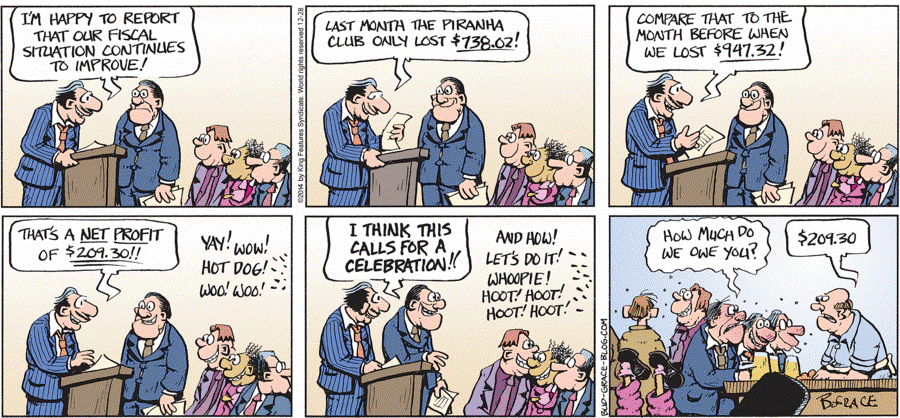
Nichols “discovered” a previously unknown “surplus” of $320 million in mystery money that set off a running dispute between her office and State Treasurer John Kennedy—an argument that eventually made its way before the Joint Legislative Committee on the Budget.

With a tip of our hat to cartoonist Bud Grace, we are able to show you how that surplus was discovered:

JINDAL SURPLUS SECRET

(CLICK ON IMAGE TO ENLARGE)

Murphy Painter vindicated, Jindal humiliated:

Jindal’s attempted prosecution persecution of fired Director of the Office of Alcohol and Tobacco Control Murphy Painter blew up in the governor’s face when Painter was first acquitted of criminal charges, costing the state nearly half a million dollars in reimbursement of Painter’s legal fees, but Painter subsequently won a defamation suit against his accuser.

Secret survey no longer a secret but “no one” more popular than Jindal:

A survey to measure state employee satisfaction in the Division of Administration (DOA) should be an eye opener for Commissioner of Administration Kristy Kreme Nichols and agency heads within DOA.

Meanwhile, LouisianaVoice has learned that Gov. Bobby Jindal (R-Iowa, R-New Hampshire, R-Anywhere but Louisiana) received some exciting news this week when a new poll revealed that no one was more popular among Republican contenders for the GOP presidential nomination.

The excitement was short-lived, however, when the actual meaning of the numbers was revealed.

It turns out that in a CNN poll of New Hampshire voters, Jindal tied with Rick Santorum with 3 percent, while “No one” polled 4 percent, prompting Comedy Central’s Stephen Colbert to joke that Jindal should adopt the slogan “Jindal 2016: No one is more popular.”

To shred or not to shred:

The controversy surrounding the sweeping changes being proposed for the Office of Group Benefits just got a little dicier with new information obtained by LouisianaVoice about the departure of Division of Administration executive counsel Liz Murrill and the possibly illegal destruction of public records from the Office of Group Benefits (OGB) and the involvement of at least two other state agencies.

While it was not immediately clear which OGB records were involved, information obtained by LouisianaVoice indicate that Murrill refused to sign off on written authorization to destroy documents from OGB.

We first reported her departure on Oct. 14 and then on Oct. 22, we followed up with a report that Murrill had confided to associates that she could no longer legally carry out some of the duties assigned to her as the DOA attorney.

But now we learn that the issue has spilled over into two other agencies besides OGB and DOA because of a state statute dealing with the retention of public documents for eventual delivery to State Archives, a division of Secretary of State Tom Schedler’s office.

Reports indicate that Schedler became furious when he learned of the destruction or planned destruction of the records because records should, according to R.S. 44:36, be retained for three years and then delivered to the state archivist and director of the division of Archives, records management and history.

NOVEMBER

Secret grand jury testimony of Greenstein made public:

The Louisiana Attorney General’s office, in an unprecedented move, released the 100-plus pages of testimony of Bruce Greenstein, former Secretary of the Department of Health and Hospitals but the testimony did little in revealing any smoking gun related to the state’s $180 million contract with CNSI. About the only thing to come out of his testimony was the indication of an incredible bad memory in matters related to his dealings with his former bosses at CNSI and a razor-sharp recall of other, more insignificant events.

Approval? We don’t need no stinkin’ approval:

The very first state agency privatized by Gov. Bobby Jindal was the Office of Risk Management (ORM) and after the state paid F.A. Richard and Associates (FARA) $68 million to take over ORM operations and then amended the contract to $75 million after only a few months, the agency was subsequently transferred three times to other firms. The only hitch was a specific clause in the original contract with FARA that no such transference was allowable without “prior written approval” from the Division of Administration. The problem? When LouisianaVoice made an FOIA request for that written approval, we were told no such document existed.

Edwards’ Last Hurrah:

Former Gov. Edwin Edwards, one of the most successful, colorful and charismatic politicians in Louisiana history, lost—decisively. Republican Graves Garrett rode the Republican tide to easily hand Edwards his first political defeat, dating back to his days on the Crowley City Council. Some may remember when Buddy Roemer led the field in 1987, forcing Edwards into a runoff. Technically, though, Edwards did not lose that election because he chose not to participate in the runoff, thus allowing Roemer to become governor. But he would return in 1991 to win his unprecedented fourth term.

DECEMBER

Friends of Bobby Jindal seeking donations:

A new web page popped up seeking donations for the Friends of Bobby Jindal, raising speculations of an attempt at a higher office (president?) since Jindal can’t run for governor again.

The new web page cited a speech by Jindal at a foreign policy forum at which he called for increased military spending.

Gimme the keys to the cars:

The Public Service Commission (PSC) became the second state agency (the State Treasurer’s office was the first) to openly defy Jindal when the administration demanded that the PSC relinquish possession of 13 vehicles as part of the administration’s cost-cutting measures.

We have already examined State Rep. Jerome “Dee” Richard’s attempt to cut consulting contracts which was passed unanimously by both the House and Senate but vetoed by Jindal.

But there was another veto that should be mentioned in context with Jindal’s penny wise but pound (dollar) foolish fire sale approach to state finances.

Earlier this year, State Sen. Jack Donahue (R-Mandeville) managed to get overwhelming passage of a bill that called for more oversight of the tax break programs by the state’s income-forecasting panel.

But Jindal, who never met a tax break he didn’t like, promptly vetoed the bill, saying it could effectively force a tax increase on businesses by limiting spending for the incentive programs.

Only he could twist the definition of removal of a tax break for business into a tax increase even while ignoring the fact that removal of those tax breaks could—and would—mean long-term relief for Louisiana citizens who are the ones shouldering the load. And for him to willingly ignore that fact borders on malfeasance.

Another (yawn) poor survey showing:

24/7 Wall Street, a financial news and opinion company, released a report which ranked Louisiana as the 11th worst-run state in America.

Louisiana, in ranking 40th in the nation, managed to fare better than New Jersey, which ranked 43rd, or eighth worst, something Jindal might use against Gov. Christ Christie if it comes down to a race between those two for the GOP nomination.

Louisiana had “one of the lowest median household incomes in the nation,” at just $44,164, the report said “and 10.7 percent of all households reported an income of less than $10,000, a higher rate than in any state except for Mississippi. Largely due to these low incomes, the poverty rate in Louisiana was nearly 20 percent (19.8 percent) and 17.2 percent of households used food stamps last year, both among the highest rates in the nation. The state’s GDP grew by 1.3 percent last year, less than the U.S. overall.

May we pray?

Meanwhile, Jindal prompted more controversy by having his favorite publisher and LSU Board of Supervisors member Rolfe McCollister run interference in securing the LSU Maravich Center for a political prayer event in January of 2015. The event will be sponsored by the controversial American Family Association and will not (wink, wink) be a political event, Jindal said.

And that, readers, is where we will leave you in 2014.

For 2015, we have an election campaign for governor to look forward to.

Just when you thought it couldn’t get any worse.

           As 2014 winds down, we decided that everyone else does a year-end wrap-up of the year’s significant events, so why not us?

            Accordingly, here is our review of the first six months of LouisianaVoice installments. The last six months will appear on Wednesday (Dec. 31).

JANUARY

IT Contractor linked to Obamacare, other problems:

A company holding two contracts with the State of Louisiana worth $32.8 million was the lead IT contractor of the ill-fated Affordable Health Care enrollment web page rolled out late last year.

CGI Technologies and Solutions, headquartered in Quebec, has experienced problems with other contracts in Canada and the U.S. even before the Obamacare debacle.

CGI Technologies and Solutions was awarded a $32.5 million contract with the Office of Community Development’s (OCD) Disaster Recovery Unit (DRU) on March 2, 2012 to provide computer software hosting, support and training for OCD’s Hazard Mitigation Grant Program (HMGP), small rental programs.

That contract is scheduled to run out on March 1, 2015.

CGI executives have been involved with at least 20 other troubled government IT projects, including one contract to automate retirements for millions of federal employees that went $60 million over budget and despite $2.3 billion in contracts with two dozen federal agencies, the company was rejected by the Center for Medicare and Medicaid Services (CMS) because of “performance issues” in carrying out an earlier contract.

HGI ties to Jindal, Christie:

MSNBC and the Wall Street Journal have begun focusing attention on a Louisiana firm with more than $200 million in contracts with both the Chris Christie and Jindal administrations for federally-funded relief to hurricane victims.

Hammerman & Gainer, Inc., or HGI, of Lutcher, was awarded a $68 million contract in May of 2013 to oversee two programs distributing $780 million in federal money to Sandy victims. That contract was cancelled only six months later, on Dec. 6, 2013, because of mounting complaints about delays in processing claims.

New Jersey homeowners say they have been unable to get answers, paperwork has been misplaced and HGI employees, most of whom are temporary employees, could not be reached by phone and that the company’s recovery centers change rules midstream and that no reconstruction program grants to thousands of applicants already approved have yet been awarded.

HGI also just happens to hold a $60 million contract with the Louisiana Office of Community Development’s Disaster Recovery Unit to administer the state’s Road Home Program. That contract began on March 20, 2012, and ends on March 19, 2015. Prior to that contract, HGI had a similar contract for $83.3 million which ran from March 20, 2009 to March 19, 2012. The $83.3 million contract replaced a $912 million contract with ICF Emergency Management Services of Baton Rouge.

In New Jersey, HGI hired Glenn Paulsen, former chief of the Burlington County Republicans, as its legal counsel when it submitted its bid to run the two Sandy relief programs. Paulsen’s law firm Capehart Scatchard, made a $25,000 contribution to the Republican Governors Association which Christie now heads.

HGI contributed $15,000 to Jindal in three equal contributions in 2007, 2008 and 2009. The company also gave $7,500 to Robert Wooley ($2,500 in 2003 and $5,000 in 2002), $5,000 to the Republican Party of Louisiana, $5,000 in 2011, to New Orleans mayor Ray Nagin in March of 2006, only months after Hurricane Katrina, and $7,500 to his successor Mitch Landrieu in equal contributions of $2,500 in 2010, 2011 and 2012. In addition, HGI President Larry Oney gave $5,000 to Jindal’s campaign in 2008.

Alvarez & Marsal gets fat at state trough:

Jindal also awarded a four-month contract to Alvarez & Marsal for a tad more than $5 million that called for the firm to deliver $500 million in savings to the state.

A & M’s cozy if disastrous relationship with state government goes back further than Jindal. In December of 2005, the Orleans Parish School Board adopted Resolution 59-05 on the advice of the consulting firm.

The resolution, passed in the aftermath of disastrous Hurricane Katrina was specifically cited in the ruling earlier this week by the 4th Circuit Court of Appeal that upheld a lower court decision the school board was wrong to fire 7,500 teachers, effective Jan. 31, 2006.

Then-State Superintendent of Education Cecil Picard chose Alvarez & Marsal to prevail upon the school board to replace acting parish Superintendent Ora Watson with an Alvarez & Marsal consultant.

So, Watson was replaced, 7,500 teachers were fired, the teachers sued and won, leaving the Orleans School Board and the state liable for a billion-five and the firm that started it all is hired by Jindal to find a $500,000 savings.

Alvarez & Marsal is specifically cited—by name—no fewer than six times in the first 51 pages of a 2009 report calling for the privatizing the state’s charity hospital system. Alvarez & Marsal performed that bit of work under a $1.7 million contract that ran for nine months in 2009, from Jan. 5 to Sept. 30.

The firm also received a $250,000, contract of a much shorter duration (10 days) from Jindal on April 9, 2013, to develop Jindal’s proposal to eliminate the state income taxes in favor of other tax increases. That plan was dead on arrival during the legislative session and Jindal quickly punted before a single legislative vote could be taken.

The obvious next step for Jindal was to

Problems continue at OGB:

Charles Calvi and Patrick Powers are out at the Office of Group Benefits (OGB) and Susan West, late of the Office of Risk Management has been named Interim CEO—the fourth person to head OGB in less than three years.

Meanwhile, that $540 million reserve fund balance OGB had on hand to pay benefits at the time of Gov. Bobby Jindal’s infamous raping of the agency now sit at $240 million and is dwindling at a rate of $20 million per month, no doubt the result of Jindal’s 7 percent premium reduction six months before the January 2013 takeover of OGB by Blue Cross Blue Shield (BCBS) of Louisiana.

FEBRUARY

Adley’s not-so-hidden agenda:

State Sen. Robert Adley (R-Benton) filed Senate Bill 79 which was designed to give Jindal even more power by giving him greater freedom in appointing members of a levee board, specifically the Southeast Louisiana Flood Protection Authorities of both the east and west banks.

The bill was a counteroffensive to attempts by the east bank authority to push for a historic lawsuit that would hold oil and gas companies responsible for damages to coastal wetlands.

The Southeast Louisiana Flood Protection Authority East (SLFPAE) was attempting to force the oil and gas companies to pay for the state’s coastal restoration efforts.

The lawsuit claimed that the companies destroyed the state’s coastal wetlands by dredging canals that contributed to erosion. The marshes had served as a natural buffer that mitigated storm surge. The suit, if successful, could cost the companies billions of dollars.

Adley’s bill should come as no surprise, given his opposition to the lawsuit but some might question why Adley would oppose the legal action against the companies in the first place.

One consideration could be that he has owned pelican Gas Management Co. since 1993, was president of ABCO Petroleum from 1972 to 1993, is affiliated with the Louisiana Oil and Gas Association, and has been the recipient of more than $150,000 in campaign contributions over the years from companies, political action committees, and individuals affiliated with or controlled by oil and gas interests.

Adley’s bill was assigned to the Senate Transportation, Highways & Public Works Committee. The chairman of Transportation, Highways & Public Works?

Robert Adley.

Jindal tantrum goes national:

Jindal’s outburst upon exiting a meeting between the nation’s governors and President Barack Obama Monday was a petulant display of immaturity that only served to underscore his disgraceful scorn for Louisiana’s working poor in favor of pandering to the mega-rich Koch brothers in the apparent hope that some of their Americans for Prosperity (AFP) money might find its way into his campaign coffers.

His shameless promotion of the proposed Keystone XL pipeline project coupled with his criticism of Obama’s push for a minimum wage increase comes on the heels of word that Jindal is literally stealing from the blind in drawing down more than half of a trust fund established to assist blind vendors in state buildings to purchase equipment, to pay for repairs and to pay medical bills.

That trust fund shrank from $1.6 million to about $700,000, apparently because of yet another lawsuit the administration found itself embroiled in over the delivery of food services at Fort Polk in Leesville that sucked up $365,000 just for the state’s 21 percent share of attorney fees.

Jindal said of Obama’s push for an increase in the minimum wage that the president “seems to be waving the white flag of surrender” and that Obama’s economy “is now the minimum wage economy.”

CIA kidnap accomplice locates in Bossier City

A photo in the Shreveport Times shows a grinning Gov. Bobby Jindal shaking hands with David Zolet, executive vice president and general manager of the North American Sector of Computer Sciences Corp. (CSC) as the two jointly announced that the company plans to open a technology center at CSC’s national Cyber Research Park in Bossier City.

CSC will be the anchor tenant of the research park and will partner with Louisiana Tech University to account for 1,600 new jobs over the next four years, thanks in part to $14 million in state funding over the next decade to expand higher education programs to increase the number of computer science graduates per year.

CSC customers, meanwhile, were being urged to boycott the company over allegations that it took part in illegal CIA rendition flights in the U.S. “war on terror.”

Court documents have linked CSC to the rendition of German citizen Khaled El-Masri who was abducted on Dec. 31, 2003, after being mistaken for a known terrorist by the CIA.

El-Masri was blindfolded, beaten, imprisoned for 23 days, stripped, sodomized, chained, drugged, flown to Afghanistan where he was again beaten and imprisoned for another four months, interrogated, threatened, denied legal representation, force fed and finally flown in a CSC-chartered plane to Albania, where he was left on a remote road in the middle of the night some 1500 kilometers from his home.

CSC was contracted for the flight as well as for other illegal CIA renditions, according to human rights charity Reprieve. CSC has so far refused a request by Reprieve to sign a pledge of “zero tolerance to torture,” and has also declined to respond to questions from Computer Weekly about the allegations.

Germany has paid the company some $405 million since 1990 and over the past five years, the country has awarded more than 100 contracts to CSC and its subsidiaries.

The story said it is “no coincidence” that the company’s various German offices are often located near U.S. military bases.

Barksdale AFB, home of the U.S. Air Force’s 2nd Bomb Wing and Global Strike Command, and Cyber Research Park are nearly adjacent in their proximity to each other, with the proposed CSC facility and Barksdale separated only by I-20.

MARCH

Jindal contributor benefits from state road work

The controversy over that 55,000 hunting lodge that straddles three central Louisiana parishes has taken a new and curious twist as the result of a $1.7 million highway resurfacing project that conveniently runs right past the entrance to the lodge that is owned by a major contributor to Gov. Bobby Jindal and to unsuccessful congressional candidate State Sen. Neil Riser.

The overlay of LA. 127, also known locally as the Olla-Sikes Highway, started on Feb. 20 at the Caldwell Parish line and run 5.5 miles east in Winn Parish to LA. 1238, according to an announcement by the Louisiana Department of Transportation and Development (DOTD).

The LA. 127 project ends at the camp entrance and at the property of TV reality show Swamp People star Troy “Choot ‘em” Landry, whose campsite is located within the hunting camp.

A search of political campaign contributions show that camp owner Bill Busbice and his wife, Beth each contributed the maximum allowable $2,600 ($5,200 total) to State Sen. Neil Riser’s campaign for the 5th Congressional District seat won by Vance McAllister.

Jindal also picked up $20,000 from Busbice and Alfred Lippman of Morgan City, the registered agent for Olla Productions, LLC., one of Busbice’s may business entities.

Busbice contributed $5,000 to Jindal in April of 2009 and Beth Busbice gave another $5,000 in December of that same year, while Lippman contributed $5,000 in October of 2003, $3,500 in April of 2009 and his firm, Lippman, Malfouz, Tranchina & Thorguson of Morgan City gave another $1,500 in September of 2010.

Additionally, one of Lippman’s law partners, David Thorguson and his wife contributed $1,300 to Jindal, Jindal campaign records show.

Appel’s shrewd investments:

State Sen. Conrad Appel (R-Metairie) purchased Discovery Communications stock in 2010 a week before a major announcement of a partnership between Discovery Education and the Louisiana Board of Elementary and Secondary Education, Capitol News Service has learned.

On Dec. 7, 2010, Discovery Education, a division of Discovery Communications, announced that Louisiana and Indiana had joined Oregon in adopting the Discovery Education Science Techbook as a digital core instructional resource for elementary and middle school science instruction.

Appel is Chairman of the Senate Education Committee and was in a unique position to know not only of the pending deal between Discovery Education and the Louisiana Board of Elementary and Secondary Education (BESE) but also of the company’s recent agreement with Indiana and Oregon, as well as Texas and Florida.

Appel’s financial disclosure form obtained from the State Board of Ethics indicates his Discovery Communications stock purchase was for “between $5,000 and $24,999.”

Discovery Communications is traded on NASDAQ and on the date of Appel’s purchase, the company’s shares opened at $40.96 and closed at $40.78.

And while there was no significant movement in the stock’s prices on the date of and on the day’s following Discovery’s announcement of the agreement with BESE, the stock hit a high of $90.21 per share on Jan. 2 of this year, meaning Appel’s on-paper profit after a little more than three years was in excess of 100 percent. The stock closed on March 27 at $75.72, still an 85 percent gain for Appel.

Appel’s 2012 financial report reveals that he also purchased between $5,000 and $24,999 of Microsoft stock on June 4, 2012, the same date that the Louisiana Legislature adjourned its 85-day session.

Ten days earlier, on May 25, the Louisiana Legislature approved the implementation of Common Core in Louisiana after a major push by the Bill and Melinda Gates Foundation which poured more than $200 million to develop, review, evaluate, promote and implement Common Core.

APRIL

Deputy Sheriff dabbles in private background checks:

A former DeSoto Parish sheriff’s deputy may have violated state law by using his office to run background checks for a company in which he owned a major interest, according to a report by the Legislative Auditor’s office in Baton Rouge.

Lagniappe and Castillo Research and Investigations ran 41,574 background checks through the sheriff’s office during an 11-month period between April 1, 2012, and February 28, 2013, the report says. Robert Davidson, retired chief investigator for the DeSoto Parish Sheriff’s Office, is 50 percent owner of Lagniappe and Castillo. He was employed by DPSO from 1980 until his retirement in May of 2013.

The report, released on Monday, also noted that three DeSoto Parish Sheriff’s Office (DPSO) employees were paid nearly $2,000 by Lagniappe and Castillo Research and Investigations for running the background checks between January 2011 and May 2013, duties they would normally perform as part of their jobs with the sheriff’s office.

The company charged its customers $12 for each background report and paid the sheriff’s office $3 for each report. That represents an income of more than $374,000 and a profit of more than $372,000 for owners Robert Davidson and Allan Neal Castillo.

Extortion claimed on state highway project:

A six and one-half-year-old lawsuit took a dramatic turn following a Mangham contractor’s claim that the Louisiana Department of Transportation and Development (DOTD) denied payments for work performed by his company because he resisted shake-down efforts by a DOTD inspector.

Jeff Mercer owner of the now-defunct construction company that bears his name, worked as a subcontractor to several prime contractors on six different projects for which he has not been paid. He first filed his lawsuit against DOTD on Sept. 7, 2007, in state district court in Monroe, claiming that the state owes him nearly $9 million for actual work done for which he was never paid, plus interest and delay costs which bring the total to more than $11.6 million.

The $500 million savings report by Alvarez & Marsal (A&M) was finally released on Monday only minutes before adjournment of the 2014 legislative session.

The 425-page report, produced under a $5 million contract, while projecting a savings of $2.7 billion over five years (an average of $540 million a year).

Most of the projected cost savings were based on assumptions for which A&M offered little or no supporting data other than arbitrary estimates and suppositions that could have been produced at a fraction of the report’s $11,760 per-page cost.

MAY

It pays to play I:

If there are any lingering doubts that politicians are beholden to the special interest who bankroll their campaigns, consider the money that has been spread among our state lawmakers—just from the oil and gas interests:

  • The 144 incumbent legislators have received more than $5.8 million in campaign contributions by a single special interest group—oil and gas. That comes to an average of $40,357 per legislator.
  • For the 39 current members of the Louisiana Senate, the aggregate is a little north of $2.8 million, or $51,100 each.
  • A total of $2.99 million was distributed among the 105 House members—an average of $40350 each, the figures show.

So, by obtaining a dismissal of litigation that could conceivably cost oil companies several hundred million dollars—before it ever goes to trial or even to the discovery stage—by spreading $5.8 million around represents a nice return on investment.

And make no mistake about it: campaign contributions are just that—investments.

It pays to play II:

The Senate Finance Committee on Sunday (Sen. Dan Claitor discarded their oaths of office—their sworn duty to protect the interests of the people of Louisiana—in favor of political expedience of the very lowest sort by ripping $4.5 million from the budget for Louisiana’s developmentally disabled and allocating the money for a Verizon IndyCar Series race at the NOLA Motorsports Park in Jefferson Parish.

LouisianaVoice conducted a search of the Secretary of State’s web page to learn the identities of the NOLA Motor Club corporate officers and whose name should pop up as one of the principals? Laney Chouest, that’s who.

So, who is Laney Chouest, you ask?

Well, he also showed up as an officer in a few other corporations run by the politically active Chouest family of Galliano. Their main business is in shipbuilding and Laney Chouest was listed as an officer in Edison Chouest Offshore, Inc., Alpha Marine Service Holdings, LLC. and Beta Marine Services, LLC., to name only three.

So, armed with that information we did a campaign contribution search of only the last name of Chouest and we hit the mother lode.

Between 2007 and 2010, members of the Chouest family and their various businesses contributed $106,500 to Jindal.

JUNE

Legislator’s firm cited for environmental infractions:

A citation and a cease order issued to Dual Trucking Co. by the Montana Department of Environmental Equality for dumping oilfield radioactive waste from the nearby Bakken Oilfield, it turns out, is not the only problem State Rep. Gordon Dove (R-Houma) has experienced with environmental authorities, Capitol News Service has learned.

Vacco Marine, Inc., a company owned by Dove, who chairs the House Committee on Natural Resources and Environment, has been the subject of several investigations, negative reports, citations, and compliance orders by and from the Louisiana Department of Environmental Quality (DEQ) over a period of several years, records show.

Last week, while presiding over a meeting of the Natural Resources Committee, he joined 12 other members in passing an amendment to SB 469 that made the prohibition against suing oil companies for damages to the state’s wetlands and marshes retroactive.

Dove also serves as a member of the Louisiana Coastal Protection and Restoration Authority.

Lobbyists swarm to protect BP:

By now, most people who have followed the bill authored by Sen. Bret Allain (R-Franklin) but inspired by Sen. Robert Adley (R-Benton) know that big oil poured money and thousands of lobbying man hours into efforts to pass the bill with it accompanying amendment that makes the prohibition against such lawsuits retroactive to ensure that the SLPFA-E effort was thwarted.

Most followers of the legislature and of the lawsuit also know that up to 70 legal scholars, along with Attorney General Buddy Caldwell, strongly advised Jindal to veto the law because of the threat to the pending BP litigation.

Altogether, the 144 current legislators received more than $5 million and Jindal himself received more than $1 million from oil and gas interests. Allain received $30,000 from the oil lobby and Adley an eye-popping $600,000.

So, when BP lobbyists began swarming around the Capitol like so many blow flies around a bloated carcass, the assumption was that BP somehow had a stake in the passage of SB 469 and that infamous amendment making the bill retroactive.

John Barry, a former SLFPA-E who was given the Jindal Teague Treatment but who stuck around to pursue the lawsuit, said, “During the last few days of the session, we were very well aware that the BP lobbyists were extraordinarily active. They were all over the place. We all assumed there was definitely something it in for them.”

Something in it for them indeed.

Blogger Lamar White, Jr. observed that former Gov. Edwin Edwards spent eight years in a federal prison for accepting payments from hopeful casino operators for his assistance in obtaining licenses—all after he left office. New Orleans Mayor Ray Nagin was similarly convicted of using his position to steer business to a family-owned company and taking free vacations meals and cell phones from people attempting to score contracts or incentives from the city.

So what is the difference between what they did and the ton of contributions received by Adley and Jindal? To paraphrase my favorite playwright Billy Wayne Shakespeare, a payoff by any other name smells just as rank.

And while big oil money flowed like liquor at the State Capitol (figuratively of course; it’s illegal to make or accept campaign contributions during the legislative session), what many may not know is that Jindal may have had an ulterior motive in going against sound legal advice to sign the bill into law, thus protecting the interests of big oil over the welfare of Louisiana citizens who have seen frightening erosion of the state’s shoreline and freshwater marshes.

The Washington, D.C., law firm Gibson, Dunn & Crutcher is one of the firms that represented BP in negotiating a $4.5 billion settlement that ended criminal charges against the company. Included in that settlement amount was a $1.26 billion criminal fine to be paid over five years.

An associate of Gibson, Dunn & Crutcher who has defended clients in government audit cases and in several whistleblower cases is one Nikesh Jindal.

He also is assigned to the division handling the BP case.

Nikesh Jindal is the younger brother of Gov. Piyush, aka Bobby Jindal.

Suddenly, John Barry’s words take on a little more significance: “We all assumed there was definitely something it in for them.”

Something in it for them indeed.

By now, most people who have followed the bill authored by Sen. Bret Allain (R-Franklin) but inspired by Sen. Robert Adley (R-Benton) know that big oil poured money and thousands of lobbying man hours into efforts to pass the bill with it accompanying amendment that makes the prohibition against such lawsuits retroactive to ensure that the SLPFA-E effort was thwarted.

Most followers of the legislature and of the lawsuit also know that up to 70 legal scholars, along with Attorney General Buddy Caldwell, strongly advised Jindal to veto the law because of the threat to the pending BP litigation.

Altogether, the 144 current legislators received more than $5 million and Jindal himself received more than $1 million from oil and gas interests. Allain received $30,000 from the oil lobby and Adley an eye-popping $600,000.

So, when BP lobbyists began swarming around the Capitol like so many blow flies around a bloated carcass, the assumption was that BP somehow had a stake in the passage of SB 469 and that infamous amendment making the bill retroactive.

John Barry, a former SLFPA-E who was given the Jindal Teague Treatment but who stuck around to pursue the lawsuit, said, “During the last few days of the session, we were very well aware that the BP lobbyists were extraordinarily active. They were all over the place. We all assumed there was definitely something it in for them.”

Something in it for them indeed.