
THE ANONYMOUS CARTOONIST STRIKES AGAIN!
(Click on image to enlarge)
THE ANONYMOUS CARTOONIST STRIKES AGAIN!
(Click on image to enlarge)
Posted in Cartoon, Cartoons | 10 Comments »
I am certain that I will not agree with every move John Bel Edwards makes as governor. The re-appointment of Mike Edmonson as Superintendent of State Police comes immediately to mind. Such is the nature of politics. No man alive can please everyone every time.
And when I do disagree, as in the Edmonson re-appointment, I will say so. I believe Edwards understands and respects that.
In the meantime, I am willing give him a chance. He has a monumental task before him in his efforts to help the state overcome eight years of Bobby Jindal’s reign of error. He must form coalitions with Republicans in the legislature in order to even approach a successful administration. But I certainly don’t expect legislators to be the whipped puppies they were during Jindal’s misrule.
I gave Jindal that same benefit of the doubt. If I am to be honest, I have to admit that I voted for Jindal not once, but twice. I voted for him in 2003 when he lost to Kathleen Blanco and again in 2007 when he won. I honestly thought he meant it when he said he supported state employees and that he stood for transparency and a high ethical bar. I believed him when he said his appointments would be based on “what you know, not who you know.”
Well, we all know how that went down. He tried to gut state retirement, he destroyed the Office of Group Benefits, gave away the state charity hospital system, drove higher education to the brink of exigency (bankruptcy), and worse, he set a new low in the areas of transparency and ethics. And one only has to examine his appointments to the myriad state boards and commissions. They are dominated (and that’s putting it lightly) with major donors to his various political campaigns. http://www.huffingtonpost.com/entry/bobby-jindals-biggest-donors-benefited-from-his-administration_55e9e976e4b002d5c075fb17
https://louisianavoice.com/category/campaign-contributions/
Moreover, “what you know” didn’t go too far in other areas, either. The number of state employees and legislators he teagued for daring to disagree with him is a very long list. And his “deliberative process” catch-all denial of public records threw a heavy blanket on any hopes of transparency.
So, it was with some surprise that I read Rolfe McCollister’s diatribe in his Baton Rouge Business Report this week. https://www.businessreport.com/article/publisher-whats-big-secret
Of all the ones to whine about any lack of transparency on the part of the governor-elect who has yet to even take office, Rolfe stands alone as the singular standard-bearer of double standards.
He contributed $17,000 to Jindal’s campaigns in 2003, 2006, and 2008. He was treasurer of Jindal’s 2007 gubernatorial campaign and served as chairman of Jindal’s transition team after his 2007 election. He served as director of Jindal’s first fundraising organization, super PAC Believe in Louisiana, and most recently served as treasurer of Believe in Louisiana as it raised funds for Jindal’s presidential campaign.
His Louisiana Business, Inc. partner, Julio Melara also was a player. Melara and his wife contributed an additional $8,500 to Jindal campaigns
And what did Rolfe and Julio get in return for all that?
Well Julio wound up with a pretty nice appointment to the Louisiana Stadium and Exposition District (Superdome Board), complete with all the perks that go with the appointment.
McCollister was named to the LSU Board of Supervisors and that’s where the hypocrisy really boils to the surface. Board members get choice tickets to LSU sporting events (including a private suite in Tiger Stadium). http://forgotston.com/2013/07/16/need-a-lsu-tuition-break/
And until the quota was reduced earlier this year, each member could award up to 20 tuition-free scholarships to LSU. Even after the reduction, they still get 15 scholarships each. http://theadvocate.com/news/11898955-123/lsu-board-revamps-number-of
Those perks could mean more than $100,000 per year per board member. In 2012 alone, the board handed out $1.3 million in scholarships to their friends—even as college tuition was skyrocketing for the average student with no contacts on the board. http://thelensnola.org/2013/07/11/lsu-board-of-supervisors-awards-1-3-million-through-little-known-scholarship-program/
Rolfe didn’t invent the perks and though he tied with two other members for the fewest scholarships awarded—five. But you never heard him raise a single objection to their abuse.
Rolfe, as publisher of the Business Report, purports to be an objective chronicler of political news. You would think that as such, he would champion all efforts to obtain records of a public body.
You would think wrong. He, along with four other members, did not respond to an email from reporter Tyler Bridges, then writing for The Lens of New Orleans, seeking comment. How’s that for transparency?
He certainly came off as a bit petulant this week when he went on a rampage about Edwards’s education transition team’s meeting in private “at least four times.”
There’s more. “McCollister notes it was Edwards who proclaimed at a Public Affairs Research Council forum in April that his administration would be more transparent than previous administrations, saying ‘a scope of secrecy’ has been allowed to exist,” his staff wrote today (Wednesday, Dec. 23). https://www.businessreport.com/article/publisher-gov-elect-edwards-transition-committees-discussing-public-education-big-issues-behind-closed-doors?utm_campaign=dr_pm-2015_Dec_23-15_05&utm_medium=email&utm_source=dr_pm
“But what does conducting all of the discussions of the transition committees behind closed doors in secret do for the citizens? What I haven’t seen yet is an editorial from The Advocate or The Times-Picayune objecting to the discussion of ‘public’ education in private. Why not? I thought transparency was their big issue.
Rolfe has a very short memory. I can’t recall the Jindal transition team over which Rolfe presided ever holding a public meeting prior to Jindal’s taking office. And when The Advocate, the Times-Picayune and the LSU Reveille were demanding the release of the names of all the candidates for the LSU presidency, where was he?
It’s hard to tell because the very one who should have been front and center in championing the right of the public to know who those candidates were, was strangely mute.
Not a peep out of Rolfe who was in a unique position to reason with the boy blunder to release the names.
Likewise, when the LSU Board agreed to that hospital privatization contract with the 50 blank pages, he should have been the first one on his feet shouting that a blank contract was not just questionable, but also not a legal document. Instead, he sat quietly as the contract was approved, laying the groundwork for the litigation over state hospitals in Shreveport and Monroe now winding its way through the courts.
Likewise, not one word of protest when the contract was awarded to a foundation in Shreveport whose CEO was…(wait for it)…a fellow member of the LSU Board.
“The public knows very little in specifics about what Gov.-elect John Bel Edwards will propose and how far he will take some issues,” McCollister wrote. “Transition teams are made up of a majority of his friends, advisers and supporters—or those who think like he does (and Jindal’s wasn’t, Rolfe?). While this exercise is often ceremonial, it can reflect the views and direction of the new governor—and his closest friends and allies who will be whispering in his ear for the next four years (and of course, you never once “whispered in Jindal’s ear, right?). The public education committee has had five meetings in secrecy. What did they talk about, and who said what? We won’t read or hear about it in the media because they weren’t allowed inside—and the press never uttered a peep (Perhaps they learned from your example on the LSU Board, Rolfe.).
To those who don’t know your history, you sound like a champion of pure, open government.
Unfortunately, your words fall far short of matching your actions. Those indignant protests would carry a lot more weight if you had the track record to back them up.
That’s called hypocrisy, Rolfe. And that’s unfortunate, though not necessarily unexpected.
Posted in Boards, Campaign Contributions, Education, Ethics, Governor's Office, Legislature, Legislators, LSU, Media, OGB, Office of Group Benefits, Politicians, Privatization, Public Records, State Police, Transparency | 27 Comments »
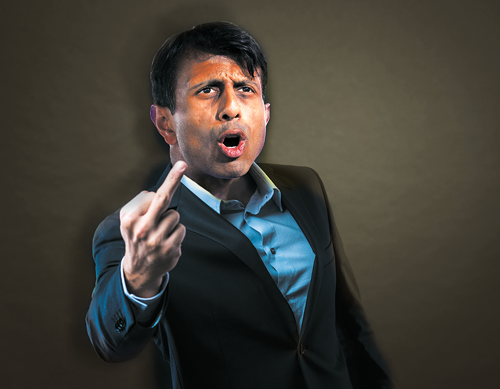
Didn’t we really know deep down how he feels about Louisiana all along?
(With appreciation to Gambit magazine of New Orleans) http://www.bestofneworleans.com/gambit/bobby-jindals-f-word-tour-of-louisiana/Content?oid=2837182
Don’t forget you may now pre-order a signed copy of my latest book, Bobby Jindal: His Destiny and Obsession. The revised publication date is now mid-February.
Also, we have an update on our Bye-Bye Bobby Bash, the gala that will celebrate the end of the Bobby Jindal eight-year reign of error.
The date of the event, originally scheduled for Jan. 9 (a Saturday), has been changed to Sunday, Jan. 10 because of a personal conflict.
The party will be held at popular Baton Rouge eatery/watering hole Superior Grill at 5435 (appropriately enough) Government Street from 2 p.m. to 4 p.m. http://batonrouge.superiorgrill.com/
The only cost will be your drinks and/or food. We are charging nothing for this event. We wish only to have a gathering of people with one important agenda in common: witnessing the exodus of Bobby Jindal from the governor’s office.
Bobby’s got one foot out the door, but the effect of his carnage will linger for years. That’s why I wrote a book about him. We should never forget what he has done to this state. The book can also serve as an important guide to the political platforms of future candidates.
The book covers such Jindal disasters as the Office of Group Benefits, higher education, public education, health care, hospital privatization, and of course, his delusional quest for the Republican presidential nomination.
And don’t think for a moment we have forgotten Jindal’s supporting cast. Also examined are his staff members and a complicit, compliant legislature, the American Legislative Exchange Council, Grover Norquist, and the Koch brothers, among others.
If you order by clicking on the book cover’s image at the right, your order will be placed through Cavalier House Books of Denham Springs, a locally-owned independent bookstore.
Remember, I encourage you to order through Cavalier House?
Two reasons.
If you opt to purchase through Amazon or a big chain store, you’re hurting local business owners—much like shopping at Walmart instead of patronizing locally-owned stores. Moreover, you won’t get signed copies through those outlets.
Unless otherwise instructed, each signed book will be personalized to the name of the person ordering it. If you wish your copy signed to someone else (if it is a gift, for instance), please email me at:
louisianavoice@cox.net
DO NOT ORDER YOUR BOOK FROM THIS EMAIL ADDRESS. Order through Cavalier by clicking on Jindal’s photo at right and email me separately on signing instructions.
Posted in Governor's Office | 2 Comments »
The moving van at the Governor’s Mansion. Yes, folks, Bobby’s moving out. Kinda brings a tear to your eyes, doesn’t it?
Posted in Governor's Office | 13 Comments »
It looks as though Bobby Jindal’s former commissioner of administration Kristy Nichols will finally have to comply with state regulations. Or maybe not.
The Louisiana Board of Ethics, in typical fashion first put the kibosh on any effort by Kristy Kreme to lobby state government on behalf of her new employer—and then promptly withdrew the opinion.
The board was essentially neutered by Jindal during his rush for ethics “reform” in his first days in office back in 2008. Because of those “reforms,” the board lost considerable steam and all its enforcement powers and it now appears it is missing a spine.
And one has to wonder if the Jindalistas had any influence on the decision to withdraw the unfavorable opinion.
Nichols served as Jindal’s commissioner of administration for three years, from October 2012 to October 2015. Those years were marked by consistent budgetary shortfalls, cuts to higher education and health care, the contentious revamping of premiums and benefits for state employees, retirees and dependents through the Office of Group Benefits and the equally controversial privatization of the state charity hospital system.
She also was sued twice by LouisianaVoice over her failure to produce public records in a timely manner. It was in that area that she enjoyed her greatest success by breaking even. She prevailed in the first lawsuit but lost the second one. She still owes a judgment of $800, plus attorney fees and court costs. She chose to spend even more state money in appealing the decision to the First Circuit Court of Appeal.
She announced in September that she would be going to work for Ochsner Health System as a lobbyist. Well, technically, her new title is vice president of government and corporate affairs. While state law precludes her lobbying the legislative or executive branches for two years, there appears to be no prohibition to her lobbying local governments (parishes and municipalities) on the part of Ochsner.
She contacted the ethics board on Nov. 5 through attorney Kimberly Robinson of the Baton Rouge law firm Jones Walker.
Robinson was recently named by Gov-elect John Bel Edwards to be the new secretary of the Department of Revenue and Taxation.
The board last Thursday (Dec. 17) addressed six specific areas about which Robinson sought opinions. The board shot down four of those and took no position on the remaining two because of what it termed insufficient information, according to Walter Pierce of the INDReporter Web site. http://theind.com/article-22377-Ethics-Board-blocks-Nichols.html
A spokesman for the ethics board, however, told LouisianaVoice on Monday that the opinion has been “withdrawn” and the entire matter re-scheduled for the board’s Feb. 19, 2016, meeting.
The opinion initially would have barred Nichols for two years from:
There was no immediate explanation of what the remaining two questions from Robinson concerned.
There are several areas of concern in allowing Nichols to lobby state government on behalf of Ochsner, not the least of which is the agreement between the state and Ochsner during her term that allowed Ochsner to partner with the state in running the Leonard J. Chabert Medical Center in Houma.
In 2013, the LSU Board of Supervisors signed off on the contract containing 50 blank pages. That contract handed over operation of state-owned hospitals in Lake Charles, Houma, Shreveport and Monroe. The blank pages were supposed to have contained lease terms. Instead, the LSU board left those details to the Jindal administration (read Commissioner of Administration Kristy Nichols).
Eventually details emerged about the contracts, including that of the Leonard J. Chabert Medical Center in Houma. And, thanks to the Louisiana Public Affairs Research Council, the picture began to come into focus.
Leonard Chabert Medical Center was opened in 1978 as a 96-bed facility with 802 employees but by the time it was privatized, it was down to 63 beds.
In 2008, a hospital-based accredited Internal Medicine residency program was begun. In 2011, the hospital’s revenue was 47 percent uncompensated care for the uninsured, 29.5 percent Medicaid, 13 percent Medicare, 5.5 percent state general fund and 6 percent interagency transfer from other departments with only 1 percent being self-generated.
When the Jindal administration moved to unload state hospitals, Chabert was partnered with Southern Regional Medical Corp., a nonprofit entity whose only member is Terrebonne General Medical Center (TGMC).
TGMC is slated to manage Chabert with assistance from a company affiliated with Ochsner Health System, Louisiana’s largest private not-for-profit health system with eight hospitals and forty health centers statewide. Terms of the agreement call for a five-year lease with an automatic renewal after the first year in one-year increments to create a rolling five-year term.
Though Southern Regional is not required to pay rent under terms of the agreement, the Terrebonne Parish Hospital Service District No. 1 is required to make annual intergovernmental transfers of $17.6 million to the Medicaid program for Southern Regional and its affiliates.
The cooperative endeavor agreement (CEA) calls for supplemental payments of $31 million to Ochsner. Small wonder then that the Houma Daily Courier described the deal as “a valuable asset to Ochsner’s network of hospitals” and that the deal expands Ochsner’s business profile.
Between 2009 and 2013, Ochsner’s revenue doubled from $900 million to $1.8 billion and the deal would mean more revenue for Ochsner, the Daily Courier said. http://www.houmatoday.com/article/20140325/articles/140329692?p=3&tc=pg
There has never been a reasonable explanation as to why the LSU Board signed off on a blank contract that the Jindal administration would fill in after the fact. Was it just by chance that Nichols, as Commissioner of Administration, was responsible for that task? And was it just happenstance that two years after Ochsner received that $31 million, it saw the need to bring Nichols aboard just as her employment with the Jindal administration was winding down?
LSU Board of Supervisors handed over University Medical Center in Shreveport and E.A. Conway Medical Center in Monroe to the Biomedical Research Foundation (BRF) even though the CEO of BRF was a sitting member of the LSU board at the time.
Within two years, that deal fell apart and the board and BRF are now involved in complicated litigation.
Meanwhile, the Center for Medicare and Medicaid Services has yet to approve the Jindal/Nichols privatization plan.
Posted in Boards, DOA, Ethics, Governor's Office, Health Care, Legislature, Legislators, Lobbyist, LSU, Privatization, Public Records, Transparency | 13 Comments »





