Feeds:
Posts
Comments

2afcaf0c0afe188f9f42fa0ecf7fe5b5_3167_ltll[1]

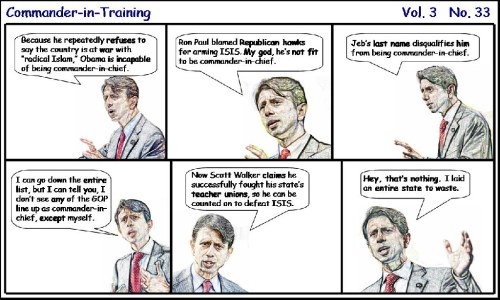
(CLICK ON IMAGE TO ENLARGE)

Our fund raiser continues and we still need the assistance of our regular readers to help us continue in our efforts to pursue the stories the other media continue to ignore.

If you like the editorial cartoons like the special Halloween-themed one above or find stories like the one below informative and have not yet made a contribution, you may do so by credit card by clicking on the yellow Donate icon on the right hand side of this page. Then click on Continue immediately above the display of credit card logos. There is an option for you to make an automatic monthly donation, if you so desire.

Some of our readers have complained that the Donate button does not appear on their page. If you are experiencing that problem, it may be because you are receiving our posts via email subscription. Please click on this link to go to our actual web page and look for the yellow Donate button: https://louisianavoice.com/

If you prefer not to conduct an internet transaction (and many people don’t like paying online), you may mail a check to:

Capital News Service/LouisianaVoice

P.O. Box 922

Denham Springs, Louisiana 70727-0922

When Jeff Skilling took over as President and Chief Operating Officer of Enron in June of 1990, he did so only after insisting that the company convert from conventional accounting principles to a method preferred by his former employer, McKinsey & Co.

In 2001, hedge fund manager Richard Grubman said to Skilling, “You are the only financial institution that can’t produce a balance sheet or cash flow statement with their earnings.” By October of that same year, Enron had begun its death spiral in a historic collapse that would pull the giant accounting firm Arthur Andersen down with it.

The key to Enron’s failure was the mark-to-market accounting method, where anticipated revenues and profits are entered into the company’s books before they are ever received. The system allowed Enron to conceal losses and to inflate profits for nearly 11 years before its house of cards came crashing down.

On Thursday (Oct. 8), nearly seven years into his administration, Gov. Bobby Jindal (R-Iowa, R-New Hampshire, R-Anywhere but Louisiana) rolled out a new accounting formula with an alarmingly familiar ring to it.

Jindal, like Skilling, is a McKinsey alumnus.

Commissioner of Administration/Surrogate Gov. Kristy Kreme Nichols announced that the state, instead of having a deficit of $141 million as claimed by State Treasurer John Kennedy, will suddenly have a surplus of $178.5 million, a gaping difference of $319.5 million.

Nichols did not reveal how the $178.5 million was arrived at but Kennedy said the administration is switching to a cash balance form of accounting instead of the modified accrual basis employed by state governments. “If we use the methodology we have always used,” he said, “we don’t have a surplus. We have a $141 million deficit.

“The commissioner says the calculation has been inaccurate for years and it needs to be changed,” he said. “They have to explain why we have been doing it wrong all these years and why the Revenue Estimating Conference is doing it wrong.”

Nichols, an appointed state employee, was less than deferential to Kennedy, a statewide elected official when she sniped back at Kennedy, saying, “I’m surprised the treasurer is not reporting this.” She added that Kennedy is obligated to report available revenue. “He should probably do a review of the accounts to ensure there are no more outstanding revenues he is not reporting.”

Kennedy and Jindal have been at odds for years over fiscal policy, so it was no surprise to see Kristy Kreme, with her super-sized ego, get a little mouthy with the state treasurer. After all, she bolted from a House Appropriations Committee hearing on the Office of Group Benefits on Sept. 25 to take her daughter to a One Direction boy band concert at the New Orleans Smoothie King Arena where she watched from the comfort of Jindal’s executive suite.

Just as Enron misrepresented its finances for years, it now appears that the Jindal administration may be attempting the same tactic, prompting one political observer to say, “If cooking the books isn’t malfeasance, what is? The bond rating agencies and others rely on the CAFR (Comprehensive Annual Financial Report), where the year-end position is officially reported in decision making and they are not going to like this.”

Another Jindal critic asked rhetorically, “What happens when a state ends a fiscal year with a deficit of $141 million but the administration of the day pretends that there is actually a surplus of $178 million? I don’t think there is any precedent for such a thing ever happening anywhere. This is starting to sound like Enron!”

Odd as it may seem to make that comparison, the similarities between Jindal and Enron run much deeper than the latest developments surrounding the new accounting methods. Here are some points about Enron lifted from The Smartest Guys in the Room: the Amazing Rise and Scandalous Fall of Enron (Penguin Books, 2003), a probing book by Bethany McLean and Peter Elkind about the failed energy company: http://www.goodreads.com/book/show/113576.The_Smartest_Guys_in_the_Room

  • The Deutsche Bank once described Enron as “the industry standard for excellence.” Jindal boasted of instituting the “gold standard for ethics” in Louisiana.
  • When the chief accounting officer of Enron Wholesale expressed concern about wholesale electricity sales, she was reassigned. When another employee questioned Skilling on his claim that Enron was going to make $500 million, she was laid off that same day. When state employees or legislators complain or do not vote with the administration, they are teagued.
  • Pollster Frank Luntz said instability and chaos were defining features at Enron and the six company reorganizations in just 18 months were a “running joke” and that Enron’s lack of discipline was “destructive and demoralizing.” Jindal’s penchant for reorganization and reform has created a similar atmosphere within state government.
  • Enron sold assets and booked the one-time proceeds as recurring earnings. Nearly 40 percent of Enron’s 1998 and 1999 earnings came from sales of assets rather than from ongoing operations. Jindal over the past several years has sold state property, buildings, and entire agencies and turned state hospitals over to private entities.
  • Both Skilling and Jindal are alumni of the blue-chip consulting firm, McKinsey & Co., which wrote the Enron business plan and as far back as 1986, advised AT&T there was no future in the market for cell phones. McKinsey also was an advocate of mark-to-market accounting practices.
  • Both Skilling and Jindal thought—and think—like a consultant. Skilling felt that a business should be able to declare profits at the moment of the signing of an agreement that would earn those profits. But just because traders were reporting earnings under mark-to-market accounting, it did not necessarily follow that the money was in hand. See this link: http://theadvocate.com/news/10494146-123/jindal-budget-surplus-questioned
  • A Wall Street banker said of Skilling: “He’s either compulsively lying or he’s refusing to recognize the truth.” Another banker worried that Enron executives were not carrying out their fiduciary duties and questioned “sweetheart deals” negotiated by them.
  • Skilling believed that social policies designed to temper the markets were “wrongheaded” and counterproductive. “Wrongheaded” has been a favorite term invoked by Jindal whenever he has suffered setbacks at the hands of the courts on issues ranging from education reform to a revamp of state retirement plans.
  • When asked a question he didn’t like, Skilling, in a tactic learned from his days at McKinsey, responded by dumping “a ton of data on you.” Jindal’s one outstanding skill is to spew statistics and factoids in rapid-fire fashion that can overwhelm and confuse challengers.
  • Skilling, like Jindal, was considered brilliant and extremely articulate. He, like Jindal, always seemed to have the right answer and whenever he was asked about problems it was always someone else’s fault.
  • Skilling displayed no remorse for his own actions, nor did he have any sense that he hired the wrong people or emphasized the wrong values. (See above.)
  • Enron founder Ken Lay saw himself as a business visionary, much as Jindal portrays himself as a policy guru. Lay traveled the world to offer his wisdom on everything from energy deregulation to corporate ethics to the future of business. (Ditto)
  • At the end, Enron employees’ accounts were frozen even as top executives were walking away with fortunes.
  • Efforts by Enron and Arthur Andersen to avoid reporting $500 million in losses “only pushed the problem further off and added another tangle to the fragile web of accounting deceptions.” Do we really need to elaborate here?
  • Enron executives accepted the argument that wealth and power demanded no sense of broader responsibility which in turn led them to embrace the notion that ethical behavior requires nothing more than avoiding the explicitly illegal, that refusing to see the bad things happening in front of you makes you innocent and that telling the truth is the same thing as making sure no one can prove you lied.
  • Enron’s mission was nothing more than a cover story for massive fraud, much as Jindal’s administration is being exposed almost daily as a sham. The story of Enron, like that of Jindal, was a story of human weakness, of hubris and greed and rampant self-delusion, of ambition run amok, of a business model that didn’t work and of smart people who believed their next gamble would cover their last disaster—and most of all, of people who couldn’t—or wouldn’t—admit they were wrong.
  • Enron once aspired to be “the world’s greatest company” but rather became a symbol for all that was wrong with corporate America, exposing Lay’s flaws as a businessman that could no longer be hidden behind Enron’s impressive but misleading façade and Skilling’s glib rhetoric.
  • Despite Enron’s efforts to camouflage the truth, there was more than enough in the public record to raise the hackles of any self-respecting analyst (read: reporter). Analysts (read: reporters) are supposed to dive into a company’s financial records, examine footnotes and even elbow their way past accounting obfuscations. Their job, in short, is to analyze (re: report).

In the end, of course, Enron crumpled under the weight of its own corruption and mismanagement, destroying thousands of lives and even taking down one of the big five accounting firms in the process.

The Jindal administration with each passing day, with every revelation of some new scandal (the Edmonson Amendment, CNSI, the Murphy Painter fiasco, et al) and with each new flawed policy (the Office of Group Benefits debacle), is looking more and more like a train wreck that will adversely affect Louisiana citizens for years to come.

Just call it Enron East.

If you like what we do, please help us do a better job by contributing whatever you feel you can afford to underwrite our efforts to report stories no one else will cover.

When we began, our efforts were limited to the immediate Baton Rouge area and there were few issues with which we dealt.

Today, we travel the state, from New Orleans to Shreveport, from Slidell to Lake Charles, from Morgan City to Monroe and the number of issues we’ve tried to address has continued to grow as evidenced by the greater assortment of coverage we provide.

While not every lead or tip that we follow produces a story, we still devote considerable time, energy and expenses in an effort to determine if there is a story. Even though there may be no initial story, we file away the information and often that information surfaces at a later date to fill in gaps in subsequent stories.

Some contributors in our last fund raising effort gave $50, $100 and even more. We’re not asking everyone to do that because we know many of you cannot afford these types of expenditures. We only ask that you please give what you can, even if it’s only $5 or $10.

You may contribute by credit card by clicking on the yellow Donate icon on the right hand side of this page. Then click on Continue immediately above the display of credit card logos. There is an option for you to make an automatic monthly donation, if you so desire.

Some of our readers have complained that the Donate button does not appear on their page. If you are experiencing that problem, click on this link and look for the yellow Donate button: https://louisianavoice.com/

If you prefer not to conduct an internet transaction (and many people don’t like paying online), you may mail a check to:

Capital News Service/LouisianaVoice

P.O. Box 922

Denham Springs, Louisiana 70727-0922

While we have had no trouble unearthing double standards, misrepresentations, distortions and outright lies in our coverage of the Jindal administration, political campaigns often take the practice to a new level.

The mind-numbing campaign for the U.S. Senate comes to mind. At this point in the campaign, voters just wish Mary Landrieu and Bill Cassidy would both shut up and leave us alone. But those TV ads from both camps keep pounding away at us, each accusing the other of distortions, lies, misrepresentations, pro-this, and anti-that.

The comic strip Non Sequitur would well have been referencing either candidate with this submission:

nq141010[1]

Or it could have been alluding to the recently ramped-up campaign of 6th Congressional District candidate Garrett Graves, former chairman of the Louisiana Coastal Protection and Restoration Authority (CPRA) and director of the Governor’s Office of Coastal Activities, who only recently kicked off his media blitz.

Of course most observers are accustomed to grandiose promises.

For at least the past 20 years or so, the challenger in the Baton Rouge mayor-president’s election without fail has promised to improve public education in East Baton Rouge Parish—never mind the fact that the mayor’s office has absolutely nothing to do with the East Baton Rouge Parish School Board. Zero. Zilch. They are two entirely separate political entities.

And we’re all used to congressional candidates saying they are going to fight waste, work to improve infrastructure, and vote to defend the Constitution blah, blah, blah.

But Graves has taken the rhetoric to a new extreme. He has one TV spot running on the Baton Rouge in which he says not that he will “work to” or “vote to,” but that he “will” repeal Obamacare, he “will” cut spending, he “will” stop illegal immigration, and he “will” eliminate terrorism.

Those are pretty big promises, folks, and unless he’s Clark Kent in disguise, we just can’t see how one freshman tea party congressman can impose his will on 434 other members of the House and 100 senators, not all of whom are tea partiers.

And while we are on the subject of political rhetoric, there has been much said about U.S. Sen. Mary Landrieu’s ownership of an $800,000 home in Washington, D.C. while not owning a home outright in Louisiana (though she is part owner, along with her siblings, of her parents’ home in New Orleans).

But not a peep has been said about Graves’ 2005 purchase of a home at 210 11th Street SE in Washington, also appraised at more than $800,000. Nothing on his federal financial disclosure statement for Jan. 1, 2013 through July 15, 2014, indicates ownership of a home in Louisiana—not even part ownership of his father’s home—although he does list ownership of property in Gulf Shores, Alabama. And Graves has never been elected to any office, let alone one that demands his presence in Washington.

He apparently purchased the home during his tenure in Washington. He worked as a policy adviser to former U.S. Sen. John Breaux and U.S. Congressman Billy Tauzin and worked for the Senate Commerce, Science and Transportation Committee and the House Energy and Commerce Committee. He also served as staff director of the U.S. Senate Subcommittee on Climate Change and Impacts. http://www.epa.gov/gcertf/bios/graves.html

Apparently he liked Washington well enough to plan on returning because he did not sell the home when he grabbed onto Gov. Bobby Jindal’s coattails in 2008 to head up CPRA at $135,000 per year through 2012. His salary was bumped up to $147,300 in 2013, according to his financial disclosure records.

Even though he left the state’s employ on February 28, his financial statement indicates he still received $52,961 in salary from the state this year and another $31,346 from Evans-Graves Engineers, the firm owned by his father, John Graves.

Graves flew pretty much under the radar until he became a high-profile opponent of the lawsuit filed by the Southeast Louisiana Flood Protection Authority-East against 97 oil and gas companies for damage to the state’s wetlands while at the same time carping at the U.S. Coast Guard for its failure to force BP to be more responsive to the Deepwater Horizon oil disaster. http://theadvocate.com/home/8290180-125/graves-to-step-down-from

His opposition to the lawsuit seeking to hold big oil responsible for the damage it has done to the state’s coastline for the past century notwithstanding, the real story of Garrett Graves is the awarding of more than $130 million in government contracts to his father’s engineering firm while he was head of CPRA, which oversees such contracts.

That figure represented an 1800 percent increase over contracts awarded to Evans-Graves for all years prior to Garrett Graves’ tenure at CPRA.

Some might call this old news, given the fact that Jeremy Alford first reported on this as far back as 2008. http://www.houmatoday.com/article/20080203/news/659908125

But the practice went unabated for years after his story and even more curious, when an ethics opinion was sought as to the propriety of the contracts, it was not the Louisiana Board of Ethics that was consulted, but attorney Jimmy Faircloth.

Faircloth, who was Jindal’s first executive counsel before running unsuccessfully for the Louisiana Supreme Court, has done extensive legal work for the administration, collecting fees in excess of $1 million defending losing positions that Jindal has championed.

But his issuing an ethics opinion in the case of Evans-Graves Engineering appears to have been a conflict in itself: Faircloth at the time was the legal counsel for Evans-Graves.

“As we discussed, Governor Jindal has asked that we disclose and commit to avoiding even the appearance of conflict,” Faircloth said in his opinion. “Thus, as we agreed, out of an abundance of caution, the appropriate solution is that your father’s company not pursue an interest in or receive any state contract that involves coastal restoration, levees or hurricane protection while you serve in the administration. This would explicitly include such contracts overseen by DOTD (Department of Transportation and Development) and DNR (Department of Natural Resources).”

Even though Garrett Graves in February of 2008 agreed to cease pursuing projects that could cause a conflict of interest, Evans-Graves kept receiving lucrative contracts from the U.S. Army Corps of Engineers, CPRA’s primary partner. And while Garrett Graves did not actually sign the contracts, his agency did set priorities for the state on corps-related work.

“I said from the beginning there was a potential conflict of interest, and apparently that fell on deaf ears,” said John Graves when the issue first arose more than six years ago. Jindal’s office professed to know nothing of the potential conflict.

And even though Garrett Graves was working for the state and his father’s company was receiving millions of dollars in contracts with the Corps of Engineers through Garrett Graves’ agency, Garrett Graves was given a Toyota Tundra truck by the elder graves in 2009, a clear violation of state ethics rules against state employees accepting gifts from vendors.

And while Evans-Graves was receiving millions of dollars in CPRA-approved contracts with the Corps of Engineers, Evans-Graves was subcontracting nearly $66.5 million in work to 18 construction and contract companies, compared to only $3.5 million prior to Garrett Graves’ appointment. Those 18 subcontractors have combined to contribute more than $250,000 to Graves’ congressional campaign.

Additionally, 11 of those 18 companies, along with corporate officers and family members, have combined to contribute nearly $316,000 to various political campaigns of Jindal.

Here is the list of subcontractors and the amounts they and/or their corporate officers and families contributed to Jindal:

  • Daybrook Fisheries—$1,000;
  • Industrial Specialty Contractors—$29,500;
  • Bollinger Shipyards—$65,850;
  • Major Equipment and Remediation—$50,000;
  • Arkel Constructors—$4,500;
  • Delta Launch Services—$11,000;
  • Cajun Constructors—$52,000;
  • Coastal Environments—$30,500;
  • Performance Contractors—$41,500;
  • H. Fenstermaker & Associates—$20,500;

JNB Operating—$5,000.

And now Garrett Graves just wants to move back into his $800,000 home in D.C.

Not only does Troy Hebert berate, intimidate, harass and even fire personnel, he keeps the pressure on even after they’re gone.

Hebert, director of the Office of Alcohol and Tobacco Control, has already been shown to be an egotistical administrator who insists that his underlings rise and greet him with a cheery “Good morning, Commissioner,” whenever he enters a room.

He has contracted with 17-year-old girls in efforts to entrap bar owners into selling alcohol to underage patrons.

He has said he would rid his agency of all black employees and indeed, has already had to settle one lawsuit with an African-American former agent whom he fired and is currently facing litigation from three others.

He has ordered an investigation into the background of LouisianaVoice’s Editor and even boasted that he could have LouisianaVoice’s computer hacked if he so desired.

He even threatened criminal trespass charges against a woman who took his crippled Great Dane dog home in the belief it had been abandoned.

But most demeaning of all, he forced agents to write essays as punishment as if they were school children.

In short, he has run his agency with the impunity of an out of control despot, instilling fear in his staff…because he can. And he has done so without the slightest fear of restraint or discipline from his boss, Gov. Bobby Jindal (R-Iowa, R-New Hampshire, R-Anywhere but Louisiana).

Take the case of former agent Jeffery McDonald.

A veteran of 18 years in law enforcement, McDonald was summarily fired by Hebert for failure to answer charges against him that included a claim that his GPS indicated he was in one place for two hours when in fact he had been riding for five hours with another agent.

His fate was sealed, apparently, in a staff meeting in Baton Rouge when he disagreed with the ATC attorney who indicated she thought it unfair that ATC agents could have a take-home vehicle and she could not. Hebert at the time was attempting to institute a competition whereby top-rated agents would get a take-home vehicle. “They were pitting agents against each other in an unfriendly manner that was detrimental to morale,” McDonald said.

But prior to that, about two years ago, is when the real trouble started and typical Louisiana politics entered the picture.

McDonald and a Tensas Parish sheriff’s deputy raided a restaurant that was selling liquor without benefit of having obtained a permit to sell alcohol.

McDonald wisely turned the liquor over to the deputy for safekeeping at the sheriff’s office. Later, after a local mayor and a state legislator got involved, McDonald was contacted by his superiors and told “to return the evidence and to not file misdemeanor charges” against the owner of the establishment.

“I told them I didn’t have the liquor, that I had turned it over to the sheriff’s office,” he said.

State law says a law enforcement officer must be given 30 days in which to obtain legal counsel if he desires before his final termination. “But they didn’t do that,” he said. “They notified me on May 16 and ordered me to meet them on May 22 for an internal investigation,” he said. “I told them my attorney was out of town and I asked for a later meeting. I was on sick leave with a heart condition at the time. They never got back with me until they sent him his recommended termination notice on June 4. “It was hand delivered by state police on the 5th and they gave me until June 10 to respond but I was undergoing treatment was unable to respond by their deadline. They came to get my equipment on the 11th without providing the legally required seven days from receipt of notification,” he said.

“When they terminated me, they said I had not responded in a timely manner even though they did not give me the legally-required seven days.”

Frustrated with dealing with Hebert and his rules which seemed to change daily, McDonald put in for retirement. His retirement was approved on Aug. 22.

On Aug. 30, he wrote Hebert and the human resources departments of the Department of Revenue and ATC to request a retired ID commission card as allowed under state law.

A retiring agent is supposed to receive the commission upon retirement and McDonald did so eight days after his retirement went through.

Hebert, reportedly upset that McDonald was allowed to retire before he could fire him, has not responded to McDonald’s request.

Without his commission, McDonald cannot legally qualify to carry a firearm as a retired peace officer.

It’s not the first time a commission has been held up. Hebert’s policy regarding the commissions is all over the road; he issued one on the same day one agent retired while another who retired at the end of 2011 was forced to make several phone calls before getting his commission. A third waited eight months and before being given instructions to follow a vague, non-existent policy that including writing a letter to Hebert. Even after writing the letter and sending Hebert a copy of the federal Law Enforcement Officers Safety Act which explains the right to the commission, it still took intervention on the part of a state senator to finally obtain the commission.

Such is the manner in which Troy Hebert runs his shop.

