Feeds:
Posts
Comments

We’ve seen how the Office of Inspector General has a travel budget for out-of-state conferences and conventions that is more than twice the amount budgeted for in-state investigations of official corruption. (See story HERE)

Now, LouisianaVoice has learned that even though Inspector General Stephen Street receives $230.77 per two-week pay period—$6,000 per year, or $500 per month—in addition to his regular salary of $132,620, he also makes generous use of state vehicles while traveling on state business.

Mileage allowances for certain state officials is optional and is paid in lieu of their use of state vehicles.

One former employee said Street was told that it was improper for him to use state vehicles when he was receiving the mileage allowance. As a result of that exchange, the former employee said, Street would have subordinates check cars out in their names and accompany Street on trips.

Two of those, the ex-employee said, were former agency attorney Robert Collins and current legal counsel Joe Lotwick.

Records obtained from OIG show Collins and Lotwick each checked out state vehicles on numerous occasions in 2013 and 2014 and Lotwick also checked out a vehicle on three occasions in May of this year.

Street, contacted by LouisianaVoice, said, “Whoever told you that Joe Lotwick and Robert Collins checked out vehicles in their name so that I could drive them in order to ‘circumvent’ a ‘prohibition’ is an unequivocal liar. Robert and Joe are both honorable and honest men with distinguished legal careers and impeccable reputations. Neither I nor they would do such a thing.”

Street’s name was not listed as checking out a state vehicle in either 2013 or 2014.

In 2015, however, Street is shown as having used a state vehicle on 10 separate occasions over five months.

Those trips and the dates in 2015 they were made included:

  • January 21: Trips to the New Orleans FBI offices and to the Louisiana District Attorney Association in Baton Rouge;
  • March 2: To Covington, New Orleans and back to Baton Rouge;
  • March 3: From his home to the OIG office;
  • March 3 and 4: Destinations for three trips redacted but mileage driven was two miles for each trip—the same district as the mileage reported for the trip from his home to the office;
  • March 9: Baton Rouge to Crowley, Crowley to Port Allen, Port Allen to Baton Rouge;
  • March 16: Baton Rouge to Opelousas, Opelousas to Port Allen, Port Allen to Baton Rouge;
  • August 28: New Orleans FBI offices;
  • September 3: New Orleans and return to Baton Rouge;
  • November 2: Trips of 2.6 and three miles to destinations that were redacted;
  • November 10: To New Orleans and return to Baton Rouge and an additional trip of two miles, destination also redacted;
  • November 17: Trip of three miles to destination that is also redacted.

So why the destination on a two-mile trip be redacted?

“On the occasions you asked about in 2015 when I used an OIG vehicle, I had time-sensitive OIG official business and my personal vehicle was not available,” Street said. You have the records that show the combined fuel cost for those trips was $95.88.”

If he was taking the state vehicle home and driving it to work, he would be in violation of the provision prohibiting him from both using a state vehicle and receiving an allowance for mileage.

In the past, the OIG’s office has steadfastly refused to pursue a matter concerning a state board employee who turned in time sheets showing she was working in the office while simultaneously posting Facebook photos of her and her family on vacation trips. The investigator on that case was ordered to re-write his entire report.

The office also refused to even investigate complaints of two board members each claiming mileage to meetings even though they rode together.

LouisianaVoice has also learned of other apparent illegal activity that OIG failed to pursue or issued reports of no wrongdoing.

Of course, the office spared no expense or effort in attempting to prosecute former Alcohol and Tobacco Control office director MURPHY PAINTER at the express wishes of Bobby Jindal. Jindal desperately wanted to discredit Painter over Painter’s refusal to grant a liquor permit that would have benefitted New Orleans Saints owner and generous Jindal campaign supporter Tom Benson.

That PROSECUTION fell flat and the state ended up having to pick up Painter’s legal expenses.

“I‘m glad that you decided to contact me before posting another column,” Street said. “Had you done that before posting last week’s column on OIG travel, you would have learned quite a bit.”
Okay, class, listen up. Today’s lesson is about a place called the Mount Weather Emergency Operations Center—so called because it originally was constructed as a weather station..

For the sake of simplicity (and because I’m too lazy to write it out every time) we will hereafter refer to it as M-WEOC.

If you are of my generation and you read the book or saw the 1964 movie Fail Safe, featuring Henry Fonda, Larry Hagman, Walter Matthau and Dom Deluise, among others, it  was called Mount Thunder, but the reference was obvious.

M-WEOC is a civilian command facility located in Virginia and is a major relocation site (read: a place to run and hide) for high-level (not you and me, noooo) civilian and military officials in the event of a national disaster so there may be a continuity of government. (Some—any—continuity of government would be pretty nice right now.)

The underground component—the bunker—contains 600,000 square feet. Following the 9-11 attacks, most of the congressional leadership (read: cowards) was evacuated to Mount Weather by helicopter. Being elected Speaker of the House does carry certain privileges.

The National Gallery of Art from 1979 to 1981 developed a plan to transport valuable paintings in its collection to Mount Weather via helicopter. (Are you kidding me?). While I approve of the arts, there are a lot of things I would be trying to save before some painting of a limp pocket watch or a Campbell soup can or something painted by a guy with only one ear. Apparently those high-level civilian and military functionaries plan to sell the artworks when they emerge from the underground bunker at M-WEOC—if there’s anyone left to sell them to.

Would you like to hear who else is included among the A-list to be evacuated to M-WEOC?

FEMA. That’s right, the Federal Emergency Management Agency, the same people who brought you those splendid recovery efforts for Katrina and more recently the devastating floods of Southeast Louisiana.

M-WEOC, it seems serves as FEMA’s center of operations.

If an enemy ever attacked this country, FEMA, with its unprecedented record of ineptitude, might be spared just so it could finish off what the bombing missed. Given its performance record, that scenario may be closer to the truth than we would like to believe.

A friend and regular reader of LouisianaVoice observed somewhat caustically, “If we have a nuclear attack or other disaster that takes most of the rest of us out. High-ranking FEMA officials will be among those saved. What a waste.”

The Baton Rouge Advocate’s REBEKAH ALLEN wrote on Tuesday (Dec. 12): “For the amount of money FEMA is spending on temporary mobile homes for flood victims, the federal agency could buy displaced residents modest houses in some parts of Baton Rouge.”

The basis on which she wrote that was a document provided to U.S. Rep. Garrett Graves which revealed that FEMA’s typical cost for the purchase, transport and installation of each FEMA trailer placed on the property of a flood victim is a cool $129,200.

If the “manufactured housing unit” (a FEMA euphemism for trailer but hey, a rose by any other name…) is placed in an existing commercial mobile home or travel trailer park, the cost of leasing the site pad increases the tab to $149,000 and if placed in FEMA designated group sites, then the price jumps to $170,000.

That’s for a living space of a whopping 980 square feet. My 2,300-square-foot home cost me less than $129 thou.

(And John Kennedy thinks the state has a spending problem.)

“You’re saying, ‘We may be slow, but at least we’re more expensive,’” Graves said.

Here’s the breakdown, according to Allen:

  • Cost of FEMA trailer: $62,500;
  • Installation: $23,000;
  • Maintenance: $15,400
  • Transportation: $5,000
  • FEMA’s administrative overhead cost: $23,000.

Tito Hernandez, FEMA’s federal coordinating officer (how’s that for a snappy title?), had a well-reasoned, logical explanation.

Of course he did.

The FEMA trailers meet strict safety standards set by the federal government.

Well, Tito, every doublewide mobile home sold on every commercial lot in America meets “strict safety standards” set by the federal government. “The FEMA unit is strong, it’s a higher quality, it’s more solid than many being sold commercially,” he said.

Sure they are, Tito. And we still remember those pieces of crap foisted off onto those wretched Katrina victims. Weren’t we also told then what a great deal those were?

Borrowing the mantra of former Wisconsin Democratic Sen. William Proxmire, Graves calls the money spent on the trailers the “fleecing of America, example no. 10,000.”

That same friend/reader that I alluded to earlier experienced his own FEMA nightmare when his 33-year-old rental trailer flooded in Central:

“We had little choice but to get a new one at 100 percent our expense or walk away from the property entirely. Why didn’t we have flood insurance you might well ask?  Even if we had, we would have gotten nothing because a 33-year-old trailer has no value. We replaced this old trailer with a brand-new, but smaller one (1,000 sf living area) – ordered it a week after the flood and it still is not ready for occupancy since we still don’t have it plumbed so there is no water.

“Everything about this has been a nightmare from permitting through trying to get people over there to do site prep, electrical, etc.  We are very lucky to have finally convinced the City of Central to give us a “temp to perm” electrical connection so the air conditioning could be installed last Thursday. I could go on and on and on, but to get to the cost:

“I had a slab poured, lot work done, including demolition of the old trailer, paid extra to have the new trailer elevated to 2 feet above the basic flood elevation, paid and engineer to do two flood elevation certificates during the permitting, have done extra work on the trailer, including adding two porches at a cost of $7,000 and doing other extras like fence repairs, putting in blinds, buying new hardware for the washer/dryer, etc. I project with all this, my total cost will be about $62,000.

“This whole FEMA thing is utterly and completely stupid. With all the extras I did that FEMA isn’t even doing, it cost me less than half what they paid for doing a piss-poor job of installing some trailers. And what are they going to do with them when they get them back in 18 months? FEMA is another of the many fine reasons people have absolutely no faith their government can do anything right. Everybody would have been a lot better off if FEMA had simply given them $129,000 and, based on the total costs, it would have probably cost taxpayers less and would certainly have been less hassle for everybody. Don’t you think somebody could rent a pretty nice place for $7,166.67 per month for the 18 months they are allegedly loaning people the ridiculous trailers for? I am disgusted and angry about this whole thing. I don’t know what the answer is at FEMA, but some ass-chewing and firing might help.”

But not to worry. When the next national disaster hits, our critical congressmen, generals and FEMA will be safely ensconced in that underground bunker at M-WEOC (with sufficient food and drink) while the rest of us kick into survival mode.

We can only hope FEMA has a better contingency plan for that disaster than it does for hurricanes and floods.

  • Theft of seized drugs and cash.
  • Shakedowns of drug dealers.
  • Selling confiscated drugs.
  • Witness tampering.
  • And just for good measure, sex and violence.

Plot lines out of the Denzel Washington movie Training Day or Martin Scorese’s movie The Departed?

Nope and nope. Some or all of the above are possible reasons behind a massive RAID on the Hammond Police Department and the Tangipahoa Parish Sheriff’s Hammond substation by upwards of 100 FBI agents on Thursday.

The raid was conducted as part of an ongoing—and widening—investigation of members of the joint Tangipahoa Sheriff’s Office and Drug Enforcement Agency (DEA) drug task force, several of whom had earlier been either arrested or suspended.

The New Orleans Advocate last month published a story about former task force member and Tangipahoa Parish deputy sheriff KARL E. NEWMAN who is charged by a federal indictment with robbery, possession with intent to distribute cocaine and Oxycodone. He and fellow task force member Johnny Domingue are slated for trial in February after Domingue pleaded guilty to drug conspiracy charges and agreed to cooperate with investigators.

Domingue told authorities that he and Newman split several thousands of dollars from the sale of narcotics, as well as cash seized in raids by the task force.

Newman is also accused of using violence against a woman following a sexual liaison with her.

The leader of the task force, DEA agent Chad Scott, a 17-year DEA veteran, has been suspended and stripped of his badge and security clearance in connection with the far-reaching investigation.

Tangipahoa Sheriff Daniel Edwards, brother to Gov. John Bel Edwards, and Hammond Police Chief James Stewart were said to be cooperating with the FBI and the DEA as the investigation continues.

Stewart was employed by the FBI for 30 years before retiring to become Hammond police chief last June.

Under our system of justice, of course, the accused are considered innocent in the eyes of the law unless and until convicted by a jury of their peers.

But still, one has to wonder about those who are entrusted with the responsibility and placed in the position of protecting us.


In the parlance of the criminal justice system, money laundering is sometimes called “washing” or “scrubbing.”

But dirty money is always dirty money, no matter what efforts are taken to make it appear legitimate.

The same is true of politics. Having just gone through a gut-wrench senatorial campaign, we’ve seen up close and personal how political ads come in all manner of misleading half-truths and outright lies. Case in point: the absurd promises of State Sen. Bodi White (R-Central), who ran ads during his recent unsuccessful campaign for Mayor-President of Baton Rouge about how he was going to improve schools, cut the dropout rate, and attract better teachers.

The problem? Neither City Hall nor the mayor have squat to do with public education; that’s the East Baton Rouge Parish School Board’s turf. What’s more, White was fully aware of this, so his ads amounted to nothing more than pure B.S., or, to be more blunt: bald face lies.

And now, thanks to Stephen Winham, our human Early Warning System who often tips us off to interesting stories, we have the laundering of Bobby Jindal’s image by some groupie/writer for the National Review named Dan McLaughlin.

The scrubbing, however, comes a tad early; even in Louisiana, the citizens aren’t likely to forget the carnage wreaked by Jindal so quickly.

McLaughlin, it seems, is an attorney who practices securities and commercial litigation in New York City. He also is a contributing columnist at National Review Online (Go figure). He is a former contributing editor of RedState (No surprise there), a columnist at the Federalist and the New Ledger. During his spare time he is a baseball blogger at BaseballCrank.com.

McLaughlin has written at least a dozen or so insipid pro-Jindal pabulum-laden claptrap-filled columns, all of which could just as easily have been written by Timmy Teepell.

In his most recent contribution to National Review (the entire story is not contained at this link because I’m too cheap to subscribe), McLaughlin WRITES that “Jindal took on the enormous challenge of cutting government in a state that is culturally deep-red but economically populist, and he paid a great political cost for his efforts.”

Apparent, he wrote that garbage with a straight face.

There’s more from McLaughlin who wrote in an earlier column for RedState that Jindal was the BEST CANDIDATE for the Republican presidential nomination and that (get this) Jindal ruled in one of the presidential debates (never mind Jindal never got past the undercard debates in which all participants were weak also-runs).

McLaughlin wrote that Jindal’s low approval ratings “and the desperate wails of his Democratic successor over the condition of the state’s budget seem to support” the view that Jindal left the state in financial disarray.

Seriously? McLaughlin conveniently overlooks the fact that the “view” that Jindal’s leaving the state in disastrous shape took shape long before John Bel Edwards and long before Jindal abandoned his post for his delusional pursuit of the presidency.

McLaughlin made no mention of Jindal’s administration coming up with a contract to give away two of the state’s learning hospitals that contained 50 blank pages.

He ignores the matter of how Jindal doled out plum board and commission positions to big contributors to his campaign, how he rolled over anyone who disagreed with him by either firing or demoting them, how he took tainted campaign contributions from felons and refused to return the money, or how he gutted the reserve fund of the Office of Group Benefits in order to try to close gaping budget deficits that occurred every single year of his governorship.

“The path to smaller government requires persistence, backbone, and a willingness to accept compromises and a lot of defeats,” he wrote.

Correction, Mr. McLaughlin: the path to Bobby Jindal’s version of smaller government requires ruthlessness, vindictiveness, and unparalleled selfishness.

While one might justifiably think that Jindal’s political career is dead and buried, is it even remotely possible that he might be plotting a comeback?

Already, there are the first rumblings that Jindal is eying the 2019 gubernatorial campaign.

Just in case, perhaps someone should send McLaughlin a copy of my book, Bobby Jindal: His Destiny and Obsession. Not that he would change his mind, but at least he would have no excuse for not knowing.

And just in case you’ve not ordered your copy yet, click on the image of the book at upper right and place your order immediately.

Nearly 60 years ago, back in 1958 when the LSU Chinese Bandits, the Go Team and the White Team won their first national championship and the Baltimore Colts won the NFL championship in the league’s first sudden death overtime, the game was a little different. There were only 12 NFL teams back then and it was common for players to play both on offense and defense. All-pro quarterback Sammy Baugh also played defensive back and punted.

George Blanda was a quarterback who played an astounding 27 years and who completed 1,911 passes for 236 touchdowns before the NFL evolved into the current pass-oriented game. He also made 335 of 639 field goal attempts and 943 extra points—again before soccer-style kickers revolutionized the kicking game.

Cleveland Browns offensive tackle Lou Groza was the league’s first preeminent place kicker. A Baltimore kicker, Bert Rechicar, also played on the offensive line and for years held the NFL record for the longest field goal of 54 years until it was broken by New Orleans Saints kicker Tom Dempsey’s 63-yarder against Detroit in old Tulane Stadium.

There were no multi-million contracts for mediocre players or for the stars, for that matter. John Unitas laid floor tile in the off-season and Colts punter David Lee worked in a Ruston bank. Times were tough and the players tougher and playoff money was a motivation for players who needed the money.

The old-school players had nothing but contempt for the kicking specialist. Detroit Lion Alex Karras once described how players beat each other’s brains out until finally, on fourth down, “they send in some little guy about five-foot-six who can’t speak English (he was referring to Garo Yepremian) and he comes into the huddle in his clean uniform and says, ‘I’m going to keek a touchdown.’”

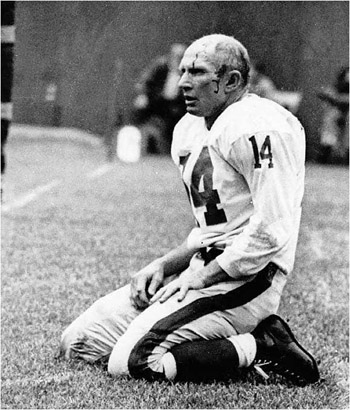
Football in those days was played on grass and some of the fields, like Yankee Stadium doubled as baseball fields. Sometimes during games, plays were run on the dirt infield. There was no artificial turf and no instant replay to slow the game down. There was no such thing as face mask penalties because… well, helmets had no face masks to protect teeth, eyes and noses. Remember that classic photo of Y.A. Tittle on his knees in Yankee Stadium with blood running down his face?

y-a-tittle

Later, players like Dion Sanders would take themselves out of the game because of something called turf toe.

All of which brings me to my point. Back then, there were only five football bowl games—the Rose, Cotton, Orange, Sugar and to a lesser extent, the Tangerine (if memory serves, the Liberty Bowl in Memphis was one of the first of the new wave of games). When teams were chosen for one of those bowls, it meant something. It actually mattered. They had stellar seasons.

Besides, there were only three networks back then and the third, ABC was generally left out as CBS and NBC grabbed the bowls.

In 1969, LSU, coached by Charles McClendon, put together an outstanding 9-1 record, losing by only three points to Archie Manning and Ole Miss. McClendon jockeyed for a trip to Dallas and the Cotton Bowl to play number-one Texas. But when Notre Dame (8-1-1) decided to end a 45-year moratorium on playing in bowls, it was the Fighting Irish who went to Dallas and LSU spent New Year’s at home, smarting from an idiotic snub.

That would never happen today. Not with the proliferation of meaningless bowl games now scattered across the horizon.

At last count there were no fewer than 40 bowl games. If a team wins six games, it is considered “bowl eligible.” And sometimes a team doesn’t even have to break even to go bowling.

As Mike Tyson would say, it’s ludicrous. Bowl games have become the equivalent of the participation trophy. Show up, stay off probation, beat up on six hapless opponents and you get to play in some half-empty stadium in a televised game called by a couple of second rate announcers who know nothing—and care less—about the teams other than what they read a few days before the game and who, when the game gets out of control, resort to meaningless blather that has nothing to do with the game.

Finally, announcers, out of sheer boredom, begin to talk of how such and such player will be “playing on Sundays next year,” or “will shine at the next level.”

A cursory check of the bowl lineup reveals that there will be 20 teams in those 40 bowls who failed to achieve a winning record. That’s half the teams playing, folks and some of ‘em are paired against each other. Even worse, only 17 of those 20 teams won the requisite six game. The other three, two with 5-7 records and one with a 6-7 record, must’ve won a conference championship game or were selected when the selection committee just flat ran out of eligible teams.

I mean, do you really want to spend three hours watching Miami of Ohio (6-6) play Mississippi State (5-7) in something called the St. Petersburg Bowl?

How about Army (6-5) vs. North Texas State (5-7) in the Heart of Dallas Bowl? Death by Boredom Bowl would be more like it.

Here’s a real thriller match-up that’s certain to leave you breathless: North Carolina State (6-6) vs. Vanderbilt (6-6) in Shreveport’s Independence Bowl.

At least, Middle Tennessee State (8-4) will take a winning record when it goes up against Hawaii (5-7) in the prestigious Hawaii Bowl.

And be sure to check all those games out for all the people in the stands disguised as empty seats. Of course, the networks make every effort to keep the cameras off the stands in those games.

Crowd cheering? More likely if you listen closely, you may actually pick up snippets of individual conversations in the stands.

I’m sorry, folks, but a team without a winning record does not deserve to be in a bowl game. Bowl games are supposed to be a reward for an outstanding season—for actually accomplishing something. Sadly, though, they’ve become TV filler (like the cream in a Twinkie) for the glut of networks or simply a vehicle for corporate sponsorship.

And don’t even get me started on all those corporate-sponsored bowl games. Some of those are difficult to say with a straight face.

There’s the Famous Idaho Potato Bowl in Boise with Idaho (8-4) pitted against Colorado State (7-5). (You want your potato fully loaded?)

And there is the Dollar General Bowl in Mobile between Ohio (8-5) and Troy (9-3). (I wonder if tickets to that heart-stopper really are just a dollar.)

The Independence Bowl was once the Poulan Weed Eater Bowl, if you can believe that. That lasted for six years until the sponsors got weary of its being called the “Weedwhacker Bowl.”

This bowl season, we will be treated to (or have been in the past) the Nokia Sugar Bowl (now the Allstate Sugar Bowl), the Belk Bowl, the Foster Farms Bowl, the Russell Athletic Bowl, the Taxslayer Bowl, the Outback Bowl, the Quick Lane Bowl, the GoDaddy.com Bowl, the Bacardi Bowl, the Meineke Car Care Bowl, the uDrove Humanitarian Bowl, the Salad Bowl (seriously), the Little Caesar’s Pizza Bowl (officials wore all white uniforms under Little Caesar orange and white vests—no striped zebra uniforms for these guys), the Chick-Fil-A Bowl (at least no one was required to dress like those black and white cows in Chick-Fil-A’s TV ads), and the Olive Garden Bowl.

With only 80 of the 128 Division I NCAA football teams playing in those 40 games this year (not counting, of course the three national championship playoff games involving Alabama, Michigan State, Oklahoma and Clemson), there’s bound to be an opening for at least one more corporate-sponsored bowl game.

And I’ve got just the name and sponsor:

The Kohler Toilet Bowl to be played in Flushing New York.

Image result for football toilet bowl

