Feeds:
Posts
Comments

Archive for the ‘Governor’s Office’ Category

Just when you think Bobby Jindal is AWOL, we learn that he’s still on the job.

Sort of.

Jindal recently went off on the father of Umpqua Community College shooter Chris Harper Mercer’s father for being an “absentee dad” in yet another of his futile attempts to bring attention to his faltering president campaign.

Never mind that as governor, he is something of a titular head of     a family of 4.6 million souls but has been an “absentee dad” for much of his term while he pursues his own selfish interests, leaving us to our own devices.

But hey, it’s good to know that he’s not too busy to see to the needs of his favorite contributors children.

Take his latest scam plan, for example. Last month Jindal announced that he wanted to rip surplus money from the $700 million in coastal restoration funds from the BP Deepwater Horizon spill settlement to use on the $350 million LA. 1 project.

While there is no prohibition against the use of coastal restoration funds on infrastructure, it is something that has never been done in the 10-year history of the Louisiana Coastal Authority prior to Jindal’s latest brainstorm.

Two gubernatorial candidates, Democrat John Bel Edwards and Republican Jay Dardenne are opposed to the idea while Republican Scott Angelle declined to state a position for or against while Republican U.S. Sen. David Vitter typically did not respond to an inquiry by the New Orleans Times-Picayune. http://www.nola.com/politics/index.ssf/2015/10/louisiana_gubernatorial_coasta.html#incart_river

LA. 1 runs from the Arkansas line in Caddo Parish to Grand Isle but more importantly, it runs right past a handful of businesses enterprises owned and operated by the mega-wealthy Chouest family of Lafourche Parish. Improvements to LA. 1 would necessarily enhance the bottom line of those businesses which are concentrated primarily in the shipbuilding industry. https://www.google.com/maps/embed?pb=!1m16!1m12!1m3!1d361617.85208354063!2d-90.43452757962136!3d29.350605373288044!2m3!1f0!2f0!3f0!3m2!1i1024!2i768!4f13.1!2m1!1sedison+chouest!5e0!3m2!1sen!2sus!4v1444571122922

Don’t buy into our skepticism? Well, consider this. Barely a year into his first term of office, Jindal announced that the state would invest $10 million into the Port of Terrebonne to accommodate LaShip, an Edison Chouest company. http://www.bestofneworleans.com/gambit/deep-pockets/Content?oid=1255831

At the time of Jindal’s announcement, the Chouest family and affiliated businesses had coughed up $85,000 to Jindal’s campaigns to that point. Since then, an additional $45,000 has found its way from the Chouest family and businesses into Jindal’s campaign coffers.

Last year, Jindal pulled $4.5 million from the developmentally disadvantaged and gave it to Laney Chouest for repairs to his $75 million Indy racetrack. The inaugural—and last Indy race was held last spring and was an unqualified bust that resulted in litigation filed by race sponsors.

So, weren’t the $10 million for the Port of Terrebonne and the $4.5 million for a one and done racetrack sufficient payback for $130,000 in contributions?

Well, perhaps, but consider this:

Boatbuilder Gary Chouest in July contributed a cool $1 million to Bobby’s Believe Again super PAC.

So while Jindal blithely allows the state’s fiscal condition to metastasize from neglect, abuse and absenteeism, it’s good to know that he’s looking out for the welfare of his favorite children.

It’s refreshing to know that while he parties in Iowa, protected by taxpayer-funded state police security, he has not forgotten those who have been good to him. The Chouest family should be so proud of their sugar daddy.

In real estate, the three most important words are location, location, location.

In politics, the three most important phrases are follow the money, follow the money, follow the money.

It’s also important to understand that no political contribution is ever given without an ulterior motive. People don’t throw money away for high ideals; they invest in a big payoff down the road.

Whether it’s a port improvement project, a racetrack or a $350 million improvement project for a major highway that runs by its myriad businesses, a million dollars isn’t tossed around lightly.

Read Full Post »

With all that’s going on with the Louisiana State Police, it has become easy to overlook the fact that we will be voting in a little more than two weeks for someone to try to undo the damage done by eight years of the Jindal carnage inflicted upon this state. (Don’t worry, we’ll get back to the State Police in a day or so.)

The governor’s race, unlike those of past years, has failed to generate a lot of interest among voters. That’s probably because the media has convinced us that U.S. Sen. David Vitter is a lock to be our next governor. I mean, who could possibly get excited over an election when we’re being told that it’s inevitable that the pariah of femininity will be our next governor?

Speaking of the media, the questions posed in the televised debates thus far have been nothing short of disgraceful. It’s no wonder that people are turned off by this year’s election. How, after all, does Kim Davis even begin to figure in the issues facing Louisiana’s next governor? That question was just plain stupid and a huge waste of time.

And who put the media in charge of anointing winners even before an election? Do our votes actually count anymore? (We will be addressing those questions shortly.)

First of all, what self-respecting Republican woman in Louisiana would ever cast a vote for someone like Dave Vitter? For that matter, what Republican woman would ever allow her husband to vote for this man who has only contempt for women as exhibited by the fact that:

  • He frequented prostitutes in Washington, D.C. and New Orleans;
  • He kept an aide, Brent Furer, on his payroll for more than a year after Furer held his ex-girlfriend hostage, threatened to kill her and in fact, attacked her with a knife. Vitter denied Furer was assigned to women’s issues. Furer’s title? Legislative Assistant on Women’s Issues.
  • He voted a year ago to block the Paycheck Fairness Act despite the fact that Louisiana ranks second-worst in the nation in gender pay disparity.

We say Republican women only because we feel it’s a foregone conclusion no Democrat woman would ever vote for this man who continues to refuse to address his personal and public issues with women.

But all that aside, let’s look at the real reason that Vitter is considered a favorite to make the runoff against Democrat John Bel Edwards.

Money. Lots of money.

And that brings us to the questions we posed earlier: Who anoints the winners and do our votes really count?

First of all, a super PAC is established for his benefit. Super PACs are the scourge of the democratic process, folks. End of discussion. And his Super PAC, ironically dubbed The Fund for Louisiana’s Future in what must have been someone’s idea of a cruel joke, had more than $3 million on hand at the end of 2014. And that doesn’t even count the money he has raised directly in corporate and special interest contributions.

The very existence of the Super PAC teetered on the edge of legality and was approved only after a court fight. Super PACs are barred from coordinating with candidates’ campaigns but if you believe Vitter has not involved himself in the decision-making process of The Fund for Louisiana’s Future, I’ve got some beautiful beachfront property near that Bayou Corne sinkhole in Assumption Parish for sale really cheap.

If you trust Vitter even for a nano-second, I’ve got a straitjacket in just your size.

His Super PAC aside, Vitter has another $4 million on hand as we head into the final stretch for the first primary on Oct. 24. As anyone not in a coma must surely know, The Fund for Louisiana’s Future has already initiated a media blitz attacking Vitter’s two Republican opponents, Lt. Gov. Jay Dardenne and Public Service Commissioner Scott Angelle on the assumption that he must eliminate them to get into the runoff. He apparently is holding off on attacking State Rep. John Bel Edwards until the second primary.

Compare that to $1.6 million for Darden who has yet to crank up his TV ad campaign, $1.4 million for Edwards, and $1 million for Angelle.

Far more telling, however, is an examination of who contributes and where those contributions are coming from.

For that, we pulled only the contributions of those giving the maximum allowable $5,000. To go deeper would have just taken far too much space.

Before we begin our look into the contributions, ask yourself this question: If you give $100 or even $250 to a candidate and he is elected and down the road your interests conflict with a donor who coughed up the $5,000 maximum, who do you think will get the politician’s ear? What chance would you have in such a scenario? We thought so.

This is not a hypothetical, folks. This is real. It’s not Monopoly money. It’s money poured into campaigns by special interests who have a reason for parting with their money—and the reason is not their hunger for good, honest government that motivates them.

Remember that if you remember nothing else when you walk into that voting booth on Oct. 24.

You are a moving part in a very large machine that is being lubricated with cash in order to turn out legislation that benefits any number of special interests, none of whom even knows who you are. When you exit the voting booth, that big money has no more use for your services—until the next election cycle.

Cold? Callused? Jaded? Yes, yes, and yes. But we at LouisianaVoice are pragmatists, not idealists. We as a society do not pledge allegiance to the flag; we pledge allegiance to the oil companies, the banks, Wall Street, and major contractors. Sorry if we burst anyone’s bubble, but facts are facts, unpleasant though they may well be. Here’s another little factoid: the Pledge of Allegiance was written by a socialist. Chew on that for a while, tea partiers.

Looking just at $5,000 contributions, we find that Vitter had 970 donors putting up the maximum, or $4.85 million. That’s a huge—very huge—chunk of his total contributions. Of that 970, there were 164 (17 percent) from out of state. That’s $820,000—more than the total of all the $5,000 contributions to Edwards and only $30,000 less than those of Dardenne.

Angelle barely had a third as many $5,000 contributors (340 for $1.7 million). Of those 340, no fewer than 81 (24 percent) were from out of state. Like Vitter, the $5,000 contributors made up a sizable block of his total campaign contributions. Where does that leave the $5, $10 and $20 contributors in the overall scheme of things?

From those figures, the numbers dropped precipitously for Dardenne and Edwards. Dardenne received 170 contributions of $5,000 each for a total of $850,000, about half of his total contributions, according to records obtained from the State Ethics Commission. Sixteen, or 9.4 percent, were from out of state.

Edwards recently issued a press release touting the low number of out-of-state contributors to his campaign. Records show that he received 114 contributions of $5,000 each for a total of $570,000. Only three of those, or 2.6 percent, were from out-of-state, in his case, all three from Texas.

This is an important election and Louisiana citizens need to get up off the couch, put down that bag of chips and forget about football for the few minutes that it takes to act on this state’s future.

No matter who wins, it is going to be difficult, if not impossible, to get this state back on the course of recovery after eight years of neglect, abuse, and outright corruption. The new governor is going to inherit a massive deficit, all manner of problems from higher education and public education, the state hospital privatization mess, a world-leading incarceration rate, corporate welfare (Stephen Waguespack’s protestations notwithstanding), and one of the highest poverty rates in the country, to name but a few.

So here is one last question to ask yourself before you enter that voting booth:

Do you vote for the candidate who had the most money to saturate the television airwaves with ads containing half-truths and outright lies, a candidate who is bought and paid for by Wall Street, the pharmaceutical firms, big oil, the major banks and similar special interests or do you vote for the candidate who you truly feel will devote his efforts to addressing the state’s problems head-on?

The state’s future dos not belong to The Fund for Louisiana’s Future. That vote-buying Super PAC is not even in Louisiana; it’s in Washington, D.C.

The state’s future instead belongs to you.

The choice is yours.

Read Full Post »
In a state drowning in consulting contracts, what’s one more?

Bobby Jindal is a lame duck governor who long ago set his sights on bigger and better things. He has abdicated every aspect of his office except the salary, free housing and state police security that go with the title. In reality, he has turned the reins of state government over to subordinates who are equally distracted in exploring their own future employment prospects.

His only concerns in almost eight years in office, besides setting himself up to run for President, have been (a) appointing generous campaign donors to positions on state boards and commissions and (b) privatizing state agencies by handing them over to political supporters.

To that end there has been a proliferation of consulting contracts during the Jindal years. The legislative auditor reported in May that there were 19,000 state contracts totaling more than $21 billion.

So as his term enters its final months and as Commissioner of Administration Kristy Nichols has less than a month before moving on to do for Ochsner Health System what she’s done for the state, what’s another $500,000?

LouisianaVoice has learned that Nichols signed off on a $497,000 contract with ComPsych Corp. and its affiliate, FMLASource, Inc. of Chicago, to administer the state’s Family and Medical Leave Act (FMLA) program. FMLA CONTRACT

It is no small irony that Nichols signed off on the contract on May 19, less than two weeks after the legislative auditor’s report of May 6 which was highly critical of the manner in which contracts are issued with little or no oversight.

The latest contract removes the responsibility for approving FMLA for state employees and hands it over to yet another private contractor.

Apparently FMLA was just one more thing the Jindal administration has determined state employees are incapable of administering—even though they have done so since the act was approved by Congress in 1993.

Because no state employees stand to lose their jobs over this latest move, the contract would seem to simply be another consulting contract doled out by the administration, obligating the state to more unnecessary expenditures.

Whether it’s farming out the Office of Risk Management, Office of Group Benefits, funding voucher and charter schools, or implementing prison or hospital privatization—it’s obvious that Jindal has been following the game plan of the American Legislative Exchange Council (ALEC) to the letter. That plan calls for privatizing virtually every facet of state government. If you don’t think the repeated cuts to higher education and health care were calculated moves toward ALEC’s goals, think again.

The contract runs from May 17, 2015 through May 16, 2016, and the state agreed to pay FMLAServices $1.45 per state employee per month up to the yearly maximum of $497,222.

Agencies for which FMLAServices will administer FMLA include the:

  • Division of Administration;
  • Department of Economic Development;
  • Department of Corrections;
  • Department of Public Safety;
  • Office of Juvenile Justice;
  • Department of Health and Hospitals;
  • Department of Children and Family Services;
  • Department of Revenue;
  • Department of Transportation and Development.

The legislative auditor’s report noted that there is really no way of accurately tracking the number or amount of state contracts. STATE CONTRACTS AUDIT REPORT

“As of November 2014, Louisiana had at least 14,693 active contracts totaling approximately $21.3 billion in CFMS. However, CFMS, which is used by OCR to track and monitor Executive Branch agency contract information, does not contain every state contract.

“Although CFMS, which is a part of the Integrated Statewide Information System (ISIS), tracks most contracts, primarily Executive Branch agencies use this system. For example, Louisiana State University obtained its own procurement tracking system within the last year, and most state regulatory boards and commissions do not use CFMS (Contract Financial Management System). As a result, there is no centralized database where legislators and other stakeholders can easily determine the actual number and dollar amount of all state contracts. Therefore, the total number and dollar amount of existing state contracts as of November 2014 could be much higher.”

The audit report also said:

  • State law (R.S. 39:1490) requires that OCR (Office of Contractual Review) adopt rules and regulations for the procurement, management, control, and disposition of all professional, personal, consulting, and social services contracts required by state agencies. According to OCR, it reviews these types of contracts for appropriateness of contract terms and language, signature authorities, evidence of funding and compliance with applicable laws, regulations, executive orders, and policies. OCR also reviews agencies’ procurement processes against competitive solicitation requirements of law. The contracting entity is responsible for justifying the need for the contract and conducting a cost-benefit analysis if required.
  • However, state law does not require that a centralized entity approve all state contracts.
  • According to the CFMS User Guide, OCR is only required to approve seven of the 20 possible contract types in CFMS. The remaining 13 types accounted for 8,068 contracts totaling approximately $6.2 billion as of November 2014. Exhibit 2 lists the 20 types of contracts in
  • CFMS and whether or not OCR is required to approve each type, including the total number and dollar amount of these contracts.
  • In fiscal year 2014, 72 agencies approved 4,599 contracts totaling more than $278 million.

The Office of Contractual Review was since been merged with the Office of State Procurement last Jan. 1.


Read Full Post »

When LouisianaVoice attempted through a public records request to obtain an unredacted version of the disciplinary records of a trooper in State Police Troop D, our request was denied. Louisiana State Police Attorney Supervisor Michele Giroir explained that the individual’s rights to privacy outweighed the public’s right to know.

Specifically, her letter of Aug. 18 said:

  • The Department has reviewed your request. It remains the Department’s position that you are not entitled to review the redacted information. The individuals’ rights to privacy established by Article 1, Section 5 of the Louisiana Constitution of 1974, as amended, outweigh the public’s right to know the personal information in this matter….The substance of the matter is personal in nature and not related to (the trooper’s) duties as a state trooper. The information that you reviewed in the letter (in the redacted document we were provided) contains the substance of the conduct for which (the trooper) was disciplined as it related to his duties as state trooper. Providing further information would violate the involved parties’ rights to privacy.

Her decision left us disappointed but at the same time, we understand there are certain rights to privacy that must be upheld.

Apparently Troy Hebert did not get the memo. And now he is being sued for making just such private information public.

Moreover, it appears he may have violated an order from a Civil Service hearing referee not to discuss the matter with anyone, “including the media.”

Actually, his actions only provided cause for the filing of an amendment to a lawsuit already filed in Federal District Court in Baton Rouge over Hebert’s retaliation against former ATC agent Brette Tingle.

One day after Giroir’s letter, on Aug. 19, Hebert, Director of the Louisiana Office of Alcohol and Tobacco Control (ATC), issued a news release that was disseminated widely over television and print media in which Hebert leaked the contents of private cell phone text messages and emails.

Though Tingle’s communications on his state-issued cell phone contained sexually and racially-charged messages, the messages were to friends and family members, some of them African-American. Such messages are considered private under the Louisiana Constitution, as Giroir said in her letter. Moreover, LouisianaVoice learned in interviewing two African-American agents that some of the racial remarks were made to them but were said in jest. “I say some of the same things he said,” said one African-American agent, a female. “We joke back and forth with each other that way.”

Another African-American who worked with Tingle, Larry Hingle, said he understood the context in which Tingle’s messages were made and that he had no problem with him.

Tingle, in fact, contends that Hebert’s vendetta against him stems from his (Tingle’s) testimony on behalf of Charles Gilmore, one of three African-American ATC agents who filed Equal Employment Opportunity Commission (EEOC) complaints against Hebert. The three, Gilmore, Hingle, and Daimian T. McDowell subsequently filed suit against Hebert in Baton Rouge Federal District Court. https://louisianavoice.com/2014/07/14/forcing-grown-men-to-write-lines-overnight-transfers-other-bizarre-actions-by-troy-hebert-culminate-in-federal-lawsuit/

In his amended lawsuit, Tingle cites the same Article 1, Section 5 of the Louisiana Constitution which says, “Every person shall be secure in his person, property, communications, houses, papers, and effects against unreasonable searches, seizures, or invasions of privacy.” That pretty much tracks the Fourth Amendment which prohibits unreasonable search and seizure.

The search and seizure of the text messages in this case was (sic) unreasonable because, at the search’s inception, there was (sic) no reasonable grounds to believe that the search would reveal any employee misconduct and because Troy Hebert provoked this search in bad faith, in an arbitrary and maximally intrusive manner, and in retaliation for Brette Tingle’s exercise of protected activity,” Tingle says in his amended petition.

“The plaintiff (Tingle) never consented to Troy Hebert or anybody else searching his private text messages with his friends and family in an intrusive fishing expedition to search for any evidence that Troy Hebert could try to use to avoid the consequences of his overt race discrimination against African-American employees by discrediting Brette Tingle as a witness,” it said.

Moreover, the petition says, Hebert laid out false allegations of payroll fraud against Tingle in his news releases “even though an extensive investigation by the Louisiana Office of Inspector General (OIG) had found no probable cause for the payroll fraud accusation…”

(Both Hebert and the OIG’s Inspector General are appointed by the governor.)

Even more egregious, Tingle says, Hebert read Tingle’s communications aloud to 12 female ATC employees on Aug. 21.

“The extracts of these conversation, which were widely publicized by Troy Hebert, constitute defamation by innuendo and the embarrassing disclosure of personal and private facts,” the petition says. “This is particularly so since these alleged conversations have nothing whatsoever to do with Brette Tingle’s job performance and thus, Troy Hebert had no legitimate interest in publicly broadcasting these alleged private conversations.”

Hebert even hinted that Tingle may have been guilty of setting fire to Hebert’s state vehicle, Tingle said. “In an interview with a New Orleans news outlet, WVUE-TV, on Aug. 19, Troy Hebert…stated that if a person was (sic) to ‘connect the dots,’ it would be clear who vandalized the vehicle.

“While it is apparently true that Troy’s vehicle had been set on fire, Troy Hebert had no evidence that the plaintiff had committed this crime,” Tingle said. “Troy Hebert did know, or certainly should have known, that the temporal proximity of his statements and the termination of the plaintiff carried false and defamatory implications.”

The petition said the communications from his cellphone were “taken out of context and do not accurately reflect Brette Tingle’s attitudes toward persons of color.” He said he is “well-respected” by persons of color for his “fair-minded attitudes and conduct. Indeed, it is only because Brette Tingle took a firm and courageous stand against Troy Hebert’s race discrimination and retaliation against former fellow employees that Troy Hebert has gone to great lengths to destroy his (Tingle’s) career and reputation,” it said.

We at LouisianaVoice have followed Troy Hebert’s ham-handed manner of running his agency since he was named to replace Murphy Painter who was fired on bogus charges by the Jindal administration.

If there is anything that can be said of Hebert, it’s that he appears to be as inept and clueless as his boss. He has managed to run a once-fine investigative agency into the ground with his petty insistence on requiring agents rise and greet him with an enthusiastic “Good morning, Commissioner” upon his entering a room. We were dismayed to learn that he has forced agents, fully grown adults, to literally write lines. We were incredulous when he ordered Gilmore transferred from Baton Rouge to Shreveport literally overnight with no opportunity for him to make plans for such a move. And we were shocked to the point of disbelief upon learning that he had ordered a female agent to return to a New Orleans bar in full uniform—after she had purchased drugs while working as a plainclothes undercover agent in that same bar only days before.

We were puzzled when Jindal snatched him from the Legislature to serve as the top enforcement agent for ATC with no qualifications other than the fact that his wife is the Jindals’ children’s pediatrician.

But now, somehow we are unable to be shocked at anything this man does. Apparently no underhanded tactic is beneath him—even when it comes to violating the same State Constitution that the chief legal counsel for the Louisiana State Police was sufficiently cognizant to uphold in denying our access to personal records.

Hebert apparently has no problem violating a direct order from a Civil Service hearing referee who presided over an appeal of Tingle’s firing in July. The referee was quite specific in admonishing witnesses not to discuss the Tingle matter “with each other or anyone else, including the media.” That order was issued when Tingle’s hearing was continued by the referee who said a violation of her dictum “could result in disciplinary action, including dismissal” from their jobs. https://louisianavoice.com/2015/07/10/civil-service-hearing-for-fired-atc-agent-continued-to-sept-after-settlement-talks-break-down-troy-didnt-want-us-there/

In an otherwise competent, transparent and ethical administration, we would have expected Hebert to have been fired months ago. Under the Jindal administration, we harbor no such hope. In fact, Jindal did quite the opposite in naming Hebert his office’s legislative liaison.

Read Full Post »

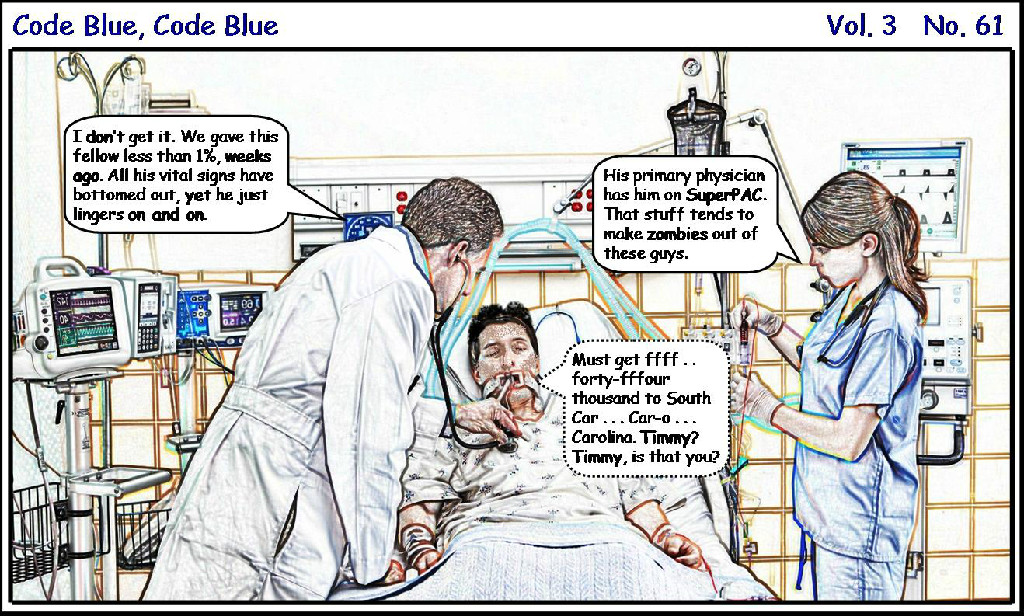
JINDAL ON LIFE SUPPORT

We couldn’t resist this one from our favorite cartoonist. (CLICK ON IMAGE TO ENLARGE)

The timing could not have been better—or worse, depending upon your perspective.

But all things considered, Wednesday was a bad day for a certain Louisiana governor flailing away in a doomed quest for the Republican presidential nomination.

If he posed so much as a remote threat against any of his Republican opponents for the Republican presidential nomination, today’s events would surely be used against him in an campaign ad blitz. But he doesn’t and they won’t.

On the one hand, there was the survey released Wednesday (Sept. 24) by 24/7 Wall Street, the service that publishes all sorts of survey results from the best-selling cars to the worst-performing state governments. The latest survey shows Louisiana to be the fifth worst-educated state in the nation.

On the other, there was the story, also on Wednesday, that said Louisiana’s public colleges and universities have been told to “be prudent” with their current budgets—a not-so veiled way of saying get ready for more budget cuts.

The U.S., in case you haven’t been paying attention, has some of the most expensive college educations in the world—and the expenses have risen to record highs, the survey said. In fact, the cost of a college education has increased faster than the rate of inflation—24 percent just since 2012,

Only 22.9 percent of adults in Louisiana hold at least a bachelor’s degree, which ranks 46th in the nation and well below the national average of more than 30 percent. That puts the state two notches behind Alabama’s 23.5 percent and ranked higher than only Kentucky (22.2 percent), Arkansas (21.4 percent), Mississippi (21.1 percent), and West Virginia (19.2 percent). Massachusetts had the highest with 41.2 percent of its adults having attained at least a bachelor’s degree.

In fact, Louisiana ranks just ahead of our next door neighbor in so many surveys that rumor has it there may be a bill introduced in the next legislative session to change the state’s motto from “Union, Justice and Confidence” to “Hey, At Least We Aren’t Mississippi.”

Louisiana had the fourth lowest percentage (83.6 percent) of high school graduates.

Louisiana also ranked seventh lowest with a median household income of $44,555 in 2014 and even those among the 22.9 had the seventh lowest median earnings ($46,903) for bachelor degree holders. Even more depressing is the fact that the median income for holders of bachelor’s degrees managed to pull the overall median average up by less than $2,500 per year.

Nearly one in five Louisianians live below the poverty line, the third highest poverty rate in the nation. This, in a state with three of the 10 busiest ports in the nation (including the busiest, the Port of South Louisiana, and the 4th and 10th busiest, New Orleans and Baton Rouge) and three of the nation’s largest refineries (Marathon in Garyville, Exxon in Baton Rouge, and Citgo in Lake Charles).

Moreover, the state is embarrassingly rich in chemical plants, oil and gas reserves, sulfur, agriculture and seafood. But still we consistently lag behind the rest of the nation in every conceivable measure of progress and prosperity.

And yet, here we are, teetering at the edge of yet another midyear budget shortfall, or as State Treasurer John Kennedy said, “We have hit the trifecta, but not in a good way.” He was talking about the news that we have just learned that we’re going to have to make up for last fiscal year which ended June 30 with a deficit (though Bobby Jindal and Commissioner of Administration Kristy Nichols won’t say how much). Together, Kennedy said, the combined shortfalls for last fiscal year and the current year combine to paint a bleak picture for next year as well, as the combined deficit is expected to approach $1 billion.

(Note to Kristy: Don’t let the door hit you on the backside as you exit next month on the way to grab your golden parachute with Ochsner Health System.)

Though the Jindal administration isn’t saying much about the latest crisis (you have to wonder how Bobby will spin this in his fiscal responsibility message on the GOP presidential campaign trail), Kennedy at least doesn’t duck the issue. He estimates it to be more than $100 million.

This budgetary news comes on top of the Medicaid shortfall of more than $300 million, a TOPS fund which is projected to be $19 million short and word that Jindal’s ill-fated hospital privatization plan has hit yet another major setback.

LSU, citing a breach of the public purpose, terminated its cooperative endeavor agreement with the Biomedical Research Foundation of Northwest Louisiana (BRF) barely two years after the foundation took over operation of two north Louisiana hospitals.

Saying all avenues to resolve differences had been exhausted, LSU President F. King Alexander said that Academic Health of North Louisiana Hospital Management Co., Inc., will take over operation of University Health Shreveport and University Health Conway.

It was so bad for Jindal that he missed a golden opportunity when the Pope spoke to a joint session of Congress on Wednesday.

When President Obama visited New Orleans on the 10th anniversary of Hurricane Katrina last month, Jindal sent a message asking that the President not talk about climate change when he came here. But when he had the opportunity to offer that same advice to Pope Francis, Jindal, a Roman Catholic, remained mute.

Perhaps he was just too busy traveling around Iowa telling anyone who would listen (that would be Timmy Teepell and Kyle Plotkin) what a great job he has done as governor of Louisiana and how he is uniquely qualified to run the country.

We are reminded of the Winston Churchill quote about Clement Atlee that could be adapted so easily to our governor: An empty taxi pulled up in front of the Iowa caucus and Bobby Jindal got out.

Read Full Post »

« Newer Posts - Older Posts »

