Feeds:
Posts
Comments

Archive for 2015

Friday traditionally is a slow news day around the State Capitol and observers know that most controversial announcements or bad news releases by the administration of Gov. Bobby Jindal will be issued late on Fridays in the hope that most reporters have gone home for the day.

The timing of the mundane and not-so-good news releases also is such that people just don’t follow events as closely over the weekend.

Accordingly, LouisianaVoice has pulled together some of the stories that are not likely to make the local six o’clock news or cause much stir in the state’s daily newspapers. But they are, nevertheless, stories that we feel deserve at least some attention, so here we go:

Mike Edmonson Retirement Redux

Regular readers will remember our story of last July 11 which launched the major controversy coming out of last year’s legislative session. That was the story about Senate Bill 294 (SB 294) by State Sen. Neil Riser that was signed into law by Gov. Bobby Jindal as Act 859 which gave State Police Superintendent Mike Edmondson that otherwise illegal hefty retirement boost of about $55,000.

The LouisianaVoice story created quite an uproar and culminated with a judicial ruling on a lawsuit by State Sen. Dan Claitor (R-Baton Rouge) that the requirement increase was unconstitutional, which seemed at the time to end the matter.

But not so fast. Claitor, not altogether trusting the system to prevail, has pre-filed a bill which he hopes will tie up any remaining loose ends.

Senate Bill 2 (SB 2) by Sens. Claitor and Barrow Peacock (R-Bossier City) have pre-filed the bill which “repeals provisions for payment to certain DROP (Deferred Retirement Option Plan) participants of a retirement benefit calculated as if the person had not participated in DROP.”

The very title of the bill puts Edmonson—along with one other state trooper who by sheer coincidence qualified for the increase under the Riser bill amendment that was snuck through an unsuspecting legislature on the last day of the 2014 session—squarely in the crosshairs of the Claitor-Peacock bill.

The Riser amendment created one of the uglier moments of the entire legislative session as slowly details leaked out of how Riser, acting on the directions of Gov. Bobby Jindal, attached the amendment to the bill that ostensibly dealt with police disciplinary procedures and once passed, was quickly signed into law by Jindal.

Had the amendment gone undetected, it would have bumped Edmonson’s retirement from $79,000 per year to $134,000 yearly.

Here is the link to the Claitor-Peacock bill by title, followed by a link to the actual bill:

https://www.legis.la.gov/legis/BillInfo.aspx?i=226443

STATE POLICE BILL

Exceptional Jindal profile by Tyler Bridges

And speaking of Jindal, it appears that the national media are beginning to catch on to the Jindal Traveling Road Show, prompted it seems, by his hysterical claim of Islamic enclaves of “no-go” zones in Europe, followed in quick fashion by a silly response to the mention by blogger Lamar White that the governor’s official portrait in his fourth floor office gives the appearance of something like 50 shades of white. It turns out that portrait is a loaner and not the “official” portrait. The “official” portrait gives of a decidedly pinkish hue, making it appear that the white one got a bit too much sun.

Be that as it may, Tyler Bridges, a New Orleans writer, has penned an excellent piece on Jindal’s failed fiscal policies (much more important in the long run than his skin tones) for Politico, a Washington, D.C. news service widely read by political junkies—especially in Iowa, New Hampshire and South Carolina, where Jindal hopes (almost to the point of desperation, it seems) to make early headway in his clumsy efforts to grab the GOP presidential nomination. Here is the link to that superb piece by Bridges:

http://www.politico.com/magazine/story/2015/02/bobby-jindal-campaigning-114948.html?ml=m_t1_2h#.VNTyL005Ccy

LR3 Contract with Economic Development

Last February we dissected the events surrounding the awarding of a $717,000 no-bid contract awarded to LR3 Consulting LLC of Baton Rouge by the Louisiana Office of Economic Development (LED).

That contract, which runs through Sept. 30 of this year, calls for the “development, establishment and/or delivery of a database of potential trainees for continued pre-hire training using a customized assessment instrument to determine skills proficiencies based on individual company requirements.”

We are not altogether sure why a $717,000 contract needed to be awarded to a firm to perform the same duties already being done by the Louisiana Workforce Commission but hey, who are we to question good government?

The contract was broken down into three yearly amounts—$169,999 for the first year (Oct. 12, 2012 through Sept. 30, 2013) and $249,999 for each of the ensuing two years. This was done, according to an LED spokesman, so as to avoid the necessity of issuing a request for proposals (RFP) and thus avoid “competitive bidding or competitive negotiation.”

The issuing of service contracts is permissible so long as the “total contract amount is less than $250,000 per twelve-month period,” according to Title 39, Section 1494.1 of the Louisiana Revised Statutes which then goes on to say, “Service requirements shall not be artificially divided so as to exempt contracts from the request for proposal process.” Hmmm. Seems to us a real proponent of good government would want competitive bidding.

Nevertheless, it has come to our attention that LR3 may well not be a viable entity and thus, ineligible to contract with the state.

A check of the Secretary of State’s corporate web page reveals that LR3 Consulting LLC is “not in good standing for failure to file (an) annual report.”

With nearly eight months left on the LR3 contract, the loss of standing with the Secretary of State should be a concern to Lionel Rainey, III, the agent and sole officer of LR3:

The term “not in good standing” means that a limited liability company is delinquent in filing the annual report required by R.S. 12:1308.1.

The statute goes on to say that each limited liability company which is not in good standing “shall be prohibited from engaging in commercial business operations with the state or its boards, agencies, departments, or commissions.  Any contract between the state or its boards, agencies, departments, or commissions and a limited liability company which is not in good standing may be declared null and void by the board, agency, department, commission, or the division of administration.”

Here is the link to the Secretary of State’s corporate records page which shows that LR3 is not in good standing:

https://coraweb.sos.la.gov/CommercialSearch/CommercialSearchDetails.aspx?CharterID=1001456_F5D52

Our favorite news blog, too?

And speaking of corporate records, one of our favorite political web blogs also turns up as “inactive,” according to the Secretary of State.

We particularly enjoy The Hayride, a Jindal support group blog run by Scott McKay for the off the wall advertisements that are featured daily on his blog. Recently, we’ve seen ads for products that feature a cure baldness almost immediately, a cure for cancer through a Biblical verse, a cure for Alzheimer’s, and even tips on how to invest in gold “form the former director of the U.S. mint,” for a military grade “steroid alternative,” and of course, secret weight loss measures.

But alas, the Secretary of State now tells us that Hayride Media, LLC is no longer active as a corporate entity.

That won’t change the flow of wonderful material coming from the blog, but it does remove any legal protection from litigation that might be lurking in the bushes, ready to pounce on any actual error by The Hayride. We’re just sayin’…

Here is The Hayride’s corporate record entry on the Secretary of State’s web page:

https://coraweb.sos.la.gov/CommercialSearch/CommercialSearchDetails.aspx?CharterID=878951_J6D52
Read Full Post »

What should Louisiana citizens know about a $12 million real estate deal in Iberville Parish between the Louisiana Department of Economic Development (LED) and a Russian Oligarch involving a proposed fertilizer plant on property surrounding a Louisiana National Guard facility?

Apparently nothing, if one judges from the status updates coming from the Jindal administration since the deal was made back in June of 2013.

Throw in a curious buy-back clause contained in the agreement between the state and EuroChem Louisiana LLC, an option for EuroChem to purchase a second tract in St. John the Baptist Parish, and talk about environmental emission credits that were supposedly promised to Eurochem but then appear to have evaporated into…well, thin air, and you have the makings of political intrigue with an international flavor.

Readers may remember our post last October 20 in which we revealed what appeared to be a sweetheart deal between the state and Vantage Health Plan whereby Vantage was allowed to purchase the former Virginia Hotel in Monroe for $881,000 without having to bother with a pesky public auction and sealed bids.

That transaction was made possible (even though there was another party interested in purchasing the building that had been serving as the State Office Building in Monroe) by Senate Bill 216 (SB 216) by Sens. Mike Walsworth (R-West Monroe), Rick Gallot (D-Ruston), Neil Riser (R-Columbia), and Francis Thompson (D-Delhi).

Well, it turns out there was considerably more to SB 216 (which became Act 127 upon the signature of Gov. Bobby Jindal). We saw the bill in its entirety at the time we wrote our story last October but did not understand the significance of a part of the bill entitled Section 3.

Until now.

Section 3 called for the sale of 2,150 acres of land within the town of St. Gabriel in Iberville Parish to a then unidentified “business entity that enters into a cooperative agreement” with the Department of Economic Development.

Not only was the prospective buyer not named in the bill (contrary to the other part of the bill that clearly identified Vantage Health and the purchase price of the Virginia Hotel), but the bill also contained no mention of a purchase price for the Iberville property. Neither the name EuroChem nor a purchase price is contained anywhere in the bill.

It is understandable that the buyer’s name might be left out of the bill, especially if the sale is still pending and nothing has been finalized. But when considering a proposal to dispose of a 2,150-acre tract of property for industrial purposes, one might be reasonably expected to ask how much money is involved before casting a vote on such a measure.

The bill passed the House by a 96-1 vote and by a 31-1 vote in the Senate. Voting against the bill in the House was Rep. Marcus Hunter (D-Monroe) while the lone dissenting vote in the Senate was cast by Sen. Dan Claitor (R-Baton Rouge). Seven senators and eight House members were absent or did not vote.

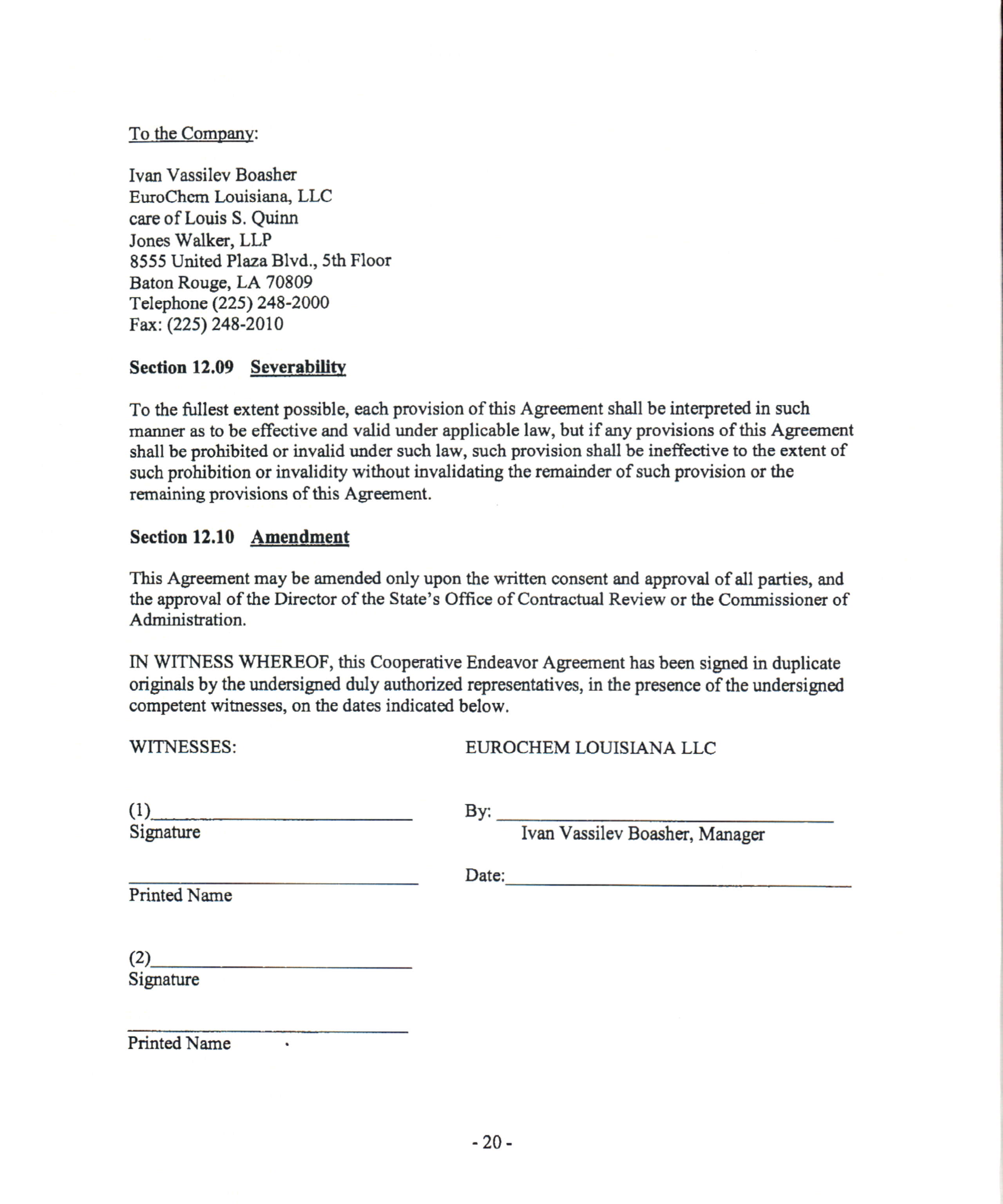
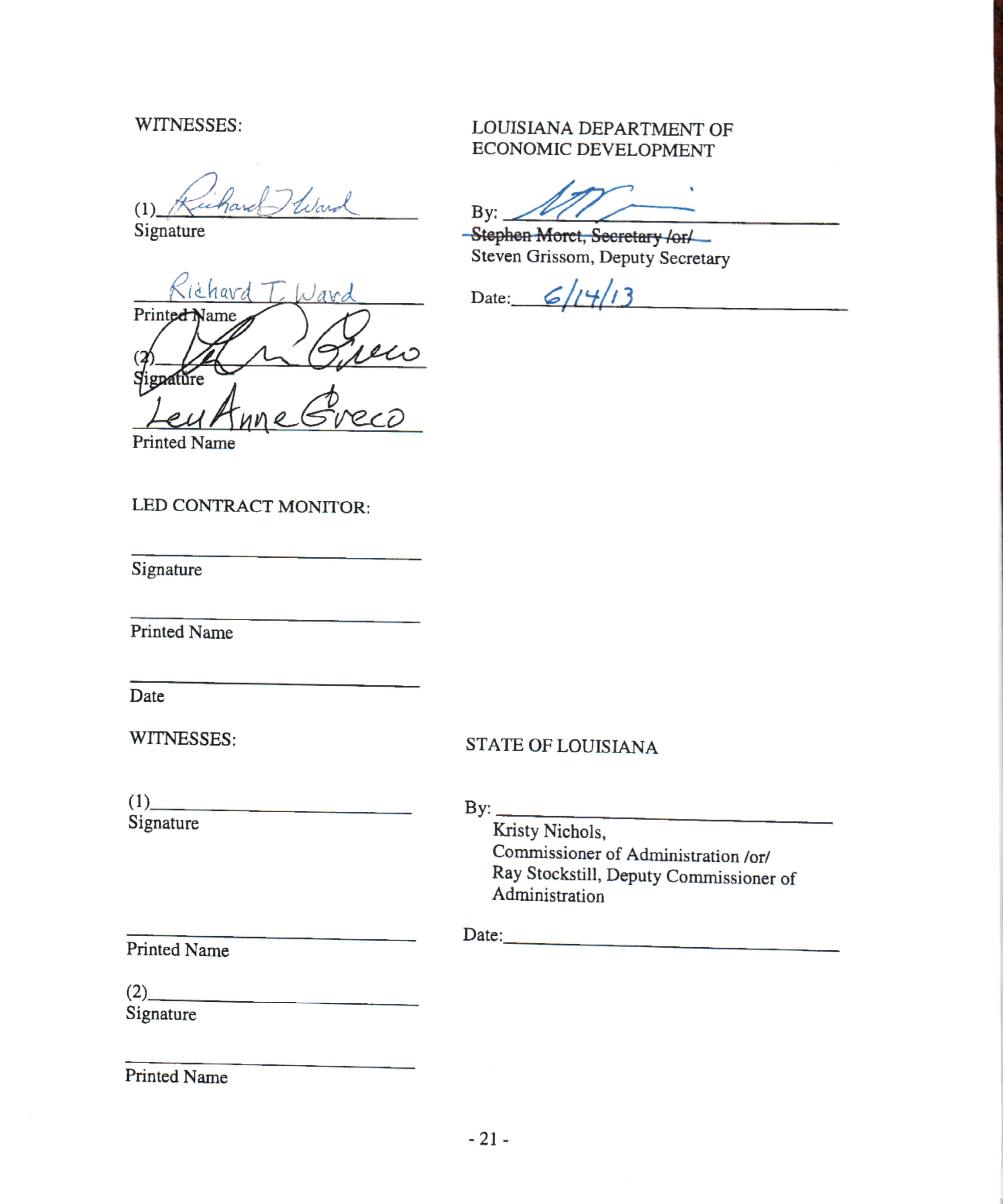
The Senate vote was on April 24, 2013, and the House approval followed on May 22. Gov. Bobby Jindal signed the bill on June 5 and the cooperative endeavor agreement was signed on June 14 by LED Deputy Secretary Steven Grissom—even though the bill did not become law until Aug. 1, 2013. PTDC3577

(CLICK ON IMAGE TO ENLARGE)

The name of the Eurochem representative on the state documents obtained from LED was Ivan Vassilev Boasher, identified only as “Manager.”PTDC3576

(CLICK ON IMAGE TO ENLARGE)

EuroChem, founded in 2001, is a Russian company owned jointly by Melnichenko (92.2 percent of shares) and CEO Dmitry Strezhnev, who owns the remaining 7.8 percent. It was Strezhnev, and not Melnichenko, who joined with Jindal in announcing plans for the $1.5 billion facility.

To secure the project, the state offered the company a competitive incentives package that includes a $6 million performance-based grant to offset the costs of site infrastructure improvements, the announcement said. In addition, EuroChem will receive the services of LED FastStart—the state’s workforce training program. “The company also is expected to utilize Louisiana’s Quality Jobs and Industrial Tax Exemption programs,” Jindal said in making the announcement on July 10, 2013.

“EuroChem is evaluating two final sites for its Louisiana plant,” he said. The Iberville Parish property had been on the market for more than two years through the Office of State Lands, and EuroChem deposited $12 million in an escrow account to buy the property. At the same time, EuroChem also secured an option to purchase a 900-acre, privately-owned tract in St. John the Baptist Parish. “Both Mississippi River sites are being evaluated for construction and logistics suitability, and the company will make a final site decision within the next year,” Jindal said. http://gov.louisiana.gov/index.cfm?md=newsroom&tmp=detail&articleID=4141&printer=1

Well, a year has come and gone and the option on the St. John property, identified by sources as the Goldmine Plantation in the Mississippi River’s east bank near the town of Edgard, which was for 330 days, has expired and was not renewed. No documents requesting permits have been filed with the parishes of St. John or Iberville, the town of St. Gabriel or the U.S. Army Corps of Engineers.

Meanwhile, during the 2014 legislative session—a year after approval of the sale of the Iberville Parish land to an unknown buyer for an undisclosed price—State Rep. John Bel Edwards apparently decided the deal was not a good one in light of the Ukraine crisis which erupted after approval of the cooperative endeavor agreement.

Edwards pushed through House Concurrent Resolution 209 (HCR 209) which requested that LED Secretary Stephen Moret “reevaluate and explore rescinding the cooperative endeavor agreement with the Russian-based company EuroChem.”

Of course the administration promptly ignored the resolution.

The 2,150 acre parcel in Iberville Parish is surrounded on three sides by the Mississippi River and the tract in turn surrounds the Carville Historic District that houses the National Hansen’s Disease Museum, the Gillis W. Long Military Center (Louisiana National Guard facility), and the U.S. Department of Labor’s Carville Job Corps Center. There are no exiting shipping terminals on the tract and the property is prone to flooding during times of high water.

One Iberville Parish official told our sources that he did not believe the project was going to move forward because of relations between the U.S. and Russia over the Ukraine crisis and because of current restrictions in Iberville on air emissions from existing plants which limits the amount of air emission credits available.

And it is those air emission, or carbon, credits that appear to be the key in the entire deal.

One person close to the St. John transaction, told our source that while the prospect of Eurochem’s building a plant in Louisiana is “still alive,” the purchase of the Iberville property “had to do with environmental credits.”

The credits, he said, were available from another company at the time they purchased the Iberville tract but are now gone. He refused to identify the company from whom credits were supposed to be available nor did he say what happened to those credits. “One was the deal (for construction) and one was about emission credits,” he said. “They purchased the Iberville land and continued to do business with us like it never happened.”

A spokesman for the Department of Environmental Quality explained that there are basically two geographic categories when considering air quality standards for permitting: attainment or nonattainment. When an area is considered to be in the nonattainment area, DEQ works with businesses to lower emissions to meet standards through “emissions credits.”

These “credits,” which are provided by the state, are gained by companies that make improvements to their current physical plants in order to reduce oxide and volatile organic compound (VOC) emissions. The credits can be bought and sold much like a commodity on the open market, he explained.

The credits also have to be acquired from companies within that particular designated geographic area that is considered in the nonattainment area.

Because Iberville Parish is within a nonattainment area, Eurochem would have to acquire the credits if planning to make an application for construction and would be required to demonstrate it had sufficient oxide and VOC credits to meet the application approval.

While no one is making any accusations, there is a flourishing international black market for emissions credits that has come under scrutiny by several investigative agencies, including Interpol, which calls carbon trading the “world’s fasting growing commodities market.” Guide to Carbon Trading Crime

http://www.interpol.int/en/News-and-media/News/2013/PR090/

Larry Lohmann, writing for New Scientist, says that the larger carbon markets are “poised on the edge of breakdown.” https://www.academia.edu/3152549/Regulation_as_Corruption_in_the_Carbon_Offset_Markets

Deloitte Forensic, Australia, calls carbon credit fraud “the white collar crime of the future.”

carbon_credit_fraud

Carbon credits also have become a favorite vehicle for money laundering schemes, according to investigative agencies. http://www.redd-monitor.org/2013/08/06/itv-series-fraud-squad-investigates-carbon-credit-criminals/

http://www.marymonson.co.uk/fraud-solicitors/carbon-credit-fraud/

There are too many unknowns about the Iberville Parish land sale, according to retired Gen. Russel Honoré, leader of the Louisiana Green Army coalition. “The state is broke and we’re making deals with foreign entities who are polluters in their own countries,” he said of the Iberville Parish land sale as well as a recent deal with a Chinese company that has had a poor environmental record.

“As much pollution problems and erosion problems as we have in this state, we don’t need to be bringing in these companies from other countries unless they have clean safety and environmental records,” Honoré said.

Still another unanswered question concerns that buy-back clause in the cooperative endeavor agreement between Eurochem and LED. The side of the ledger favoring EuroChem is the $6 million grant the state gave EuroChem, along with all the other tax incentives it is receiving—should the plant be built. But on the plus side for Louisiana is the clause that says if the fertilizer plant is not built, the state has the option of buying the land back at a reduced price or approving the buyer for re-sale.


Read Full Post »

“Jindal has done nothing in seven years. It’s time the Legislature re-asserted itself as an equal partner in governing this state.”

—State Rep. Jerome “Dee” Richard (I-Thibodaux), in discussing bills he plans to pre-file for the 2015 legislative session that begins on April 13.

Read Full Post »

State Rep. Jerome “Dee” Richard (I-Thibodaux) has revealed an ambitious set of bills he will be pre-filing preparatory to the 2015 legislative session, a couple or which are almost certain to be vetoed by Gov. Bobby Jindal should they survive both chambers intact.

The 60-day 2015 session convenes at noon on April 13 and will adjourn at 6 p.m. on June 11.

Vetoes are nothing new to Richard and in fact, one of his bills rejected by Jindal last years in hindsight represents a moral victory for Richard and something of an embarrassment for Jindal.

House Bill 142 (HB-142) passed both the House and Senate unanimously last year and was vetoed by Jindal only to see Jindal find it necessary to implement at least part of the bill through an executive order last month.

Passing 84-0 in the House (with 20 members not voting) and 37-0 in the Senate (with two not voting), HB-142 would have provided for a 10 percent reduction of all state professional, personal and consulting service contracts. The bill further provided that the savings from the cuts be deposited into the Higher Education Financing Fund.

State Treasurer John Kennedy, Richard was quick to point out, has been recommending slashing state contracts for several years and has been all but ignored by the administration but now even Jindal has ordered that state contracts be cut but not so higher education could be funded but instead to attempt to plug the growing chasm that is the state budget deficit.

Jindal, for his part, says he will offer legislators “suggested solutions” to ease the budget crisis which now is projecting a deficit of $1.6 million. http://theadvocate.com/sports/preps/11454861-123/jindal-says-hell-suggest-options

First of all, wasn’t that why he hired Alvarez and Marsal (A&M) Consulting for a cool $7 million? We were under the impression that A&M was going to find all these wonderful ways for the state to save money.

Second, the governor is the state’s CEO and as such, is charged with the leadership of the state. After all, Gov. Kathleen Blanco came under withering criticism for the manner in which she handled the crisis of Katrina. Jindal appears no less befuddled and clueless in his approach to the state’s budgetary crisis and now, after seven years of telling lawmakers what he wanted done, he punts to them.

Of course, it’s difficult to fight Islam in Europe, run for president and hold prayer meetings that fail miserably in filling all the seats in the venue while governing the state.

Only yesterday (Monday, Feb. 2), Kennedy broke the news that Moody’s Investors Service had issued a warning that reductions in revenue estimates by the Revenue Estimating Conference constituted a “credit negative for the state” and that the ratings service may downgrade the state’s credit outlook from stable to negative.

https://www.dropbox.com/s/7el18uxosj11pi1/Louisiana%20Oil%20Plunge%2002%2002%202015.pdf?dl=0&utm_source=Moody’s+Press+Release++020215&utm_campaign=Moody’s+2-2-15&utm_medium=email

Kennedy said the next procedural step would be a rating downgrade that would make it more difficult for the state borrow money and cost the state higher interest for money it does borrow.

And lest Jindal attempt to blame the latest fiscal woes on the drop in oil prices, Moody’s pointedly noted that the state’s problems pre-date the fall in oil prices—by several years. “As the U.S. economy picked up steam,” the Moody’s analysis said, “Louisiana had muted job growth even before the oil price decline.”

“This is what happens when you spend more than you take in,” Kennedy said. “Moody’s is telling us that we’d better get our fiscal house in order or we are going to be downgraded, which will cost taxpayers dearly in higher interest rates on our bonded indebtedness.”

The Moody’s news comes on top of earlier reports that health care and higher education will probably suffer even deeper cuts than the $180 million in reductions made over the past two months. The state’s colleges and universities have been told to expect at least $300 million in further budget cuts during the next fiscal year even as the Department of Health and Hospitals is expected to have $250 million slashed from its budget.

Jindal has even had to renege on his pledge last year to create a $40 million incentive fund to pay for college programs that provide graduates for high-demand jobs in Louisiana. Once considered one of his highest priorities, he has yanked that money away before the ink was dry on the bill that created the program.

All this has had a cumulative effect leading up to what promises to be a tumultuous legislative session as lawmakers grope for ways to keep from cutting services while at the same time being able to keep the lights on.

One trial balloon, already rejected by Jindal, would be for the state to roll back some of the billions of dollars in corporate and industrial tax breaks but Richard is not ready to accept the governor’s dismissal of that idea just yet.

This year, Richard has an agenda even more ambitious than his across-the-board 10 percent cut in contracts last year. Remember, that bill, HB-142 was passed unanimously in each chamber but vetoed by Jindal because, the governor said, the bill “could hinder the state’s efforts to continue to provide its citizens with timely, high quality services.”

In hindsight, however, it would appear his signing that bill into law would not have hindered the delivery of services nearly so much as not having the funds to pay for the services in the first place. The only thing not hindered by his veto was uninterrupted payments to the contractors.

Among Richard’s bills to “re-establish the legislative branch of government” are bills:

  • For an automatic veto session. Currently, legislators are mailed forms to complete and return indicating whether or not they want to hold a special session to consider overriding the governor’s veto(es). “If a bill passes with a two-thirds vote or better and the governor vetoes it, there would be an automatic veto session convened and legislators wouldn’t have to vote for it,” he said.
  • To eliminate the line item veto. “This will be a hard row to hoe,” Richard admitted. “But the governor has always held the line item veto over legislators’ heads as a means of getting what he wanted. This bill would change that.” Former President Bill Clinton pushed through a bill giving him the line item veto during his administration but the U.S. Supreme Court ruled that law unconstitutional.
  • To establish a capital outlay oversight committee. “We need to eliminate all NGOs,” he said, referring to the tradition of the legislature appropriating funds for NGOs, or non-government organizations such as baseball parks, golf courses, local court houses, city halls, councils on aging, etc. “These should be financed at the local level. If the local people want these things, they will pass bond issues to pay for them. That should not be the responsibility of the legislature. Before we look at raising more revenue, we need to cut spending,” he said. “John Kennedy has said many times that we don’t have a revenue problem, we have a spending problem, and he’s correct.”
  • To change the makeup of the House Appropriations Committee. “Appropriations has 27 members. That’s way too many,” he said. Richard said he would like to see it reduced in size to 15 members with three members from each of the five Public Service Districts in the state. “That would guarantee representation from each area of the state,” he said.
  • To eliminate the Homestead Exemption. “We need to get rid of all tax exemptions,” he said. “We give away $2 billion a year in industrial and corporate tax exemptions.”

Richard said he knows his bills will be fought by special interests and by the governor. “But Jindal has done nothing in seven years,” he said. “It’s time the Legislature re-asserted itself as an equal partner in governing this state.”

Read Full Post »

The Baton Rouge Advocate last December ran an excellent eight-part series on Giving Away Louisiana in which the paper examined inventory tax rebates, movie tax credits, Enterprise Zone tax credits, solar energy subsidies, fracking incentives and the state’s 10-year property tax exemptions, all of which combine to gut the state treasury of billions of dollars in tax revenue.

We took a little different approach.

Sometimes all one has to do to illustrate the folly of Louisiana’s corporate tax exemptions and tax credits is do the math.

The theory in Baton Rouge is that such tax breaks create jobs which in turn produce taxes for the state coffers through consumer spending and state income taxes, thus making the exemptions and credits a win-win for everyone concerned.

Take the five-year tax credit awarded in 2013 to Lakeview Regional Medical Center in St. Tammany Parish for an upgrade to its hospital facilities, for example. In exchange for the creation of five new jobs with a new five-year payroll of $1 million, Lakeview was awarded $330,000 in Enterprise Zone tax credits. (A tax credit is a dollar for dollar reduction of a tax liability meaning a $1 tax credit reduces one’s taxes by a full dollar.)

Broken down, that comes to $200,000 per year in new payroll, or an average of $40,000 per new employee per year against a tax credit of $66,000 per year.

At Louisiana’s 4 percent tax rate for that income bracket for a family of three, that means the state will rake in $4,000 per year total for all five employees ($800 each). http://www.tax-brackets.org/louisianataxtable

For a single employee, the state income tax revenue increases to $5,650 for all five employees ($1,130 each), still a far cry from the $66,000 per year in tax credits awarded to the hospital.

Obviously, the new employees will spend money locally which will generate local and state sales tax revenues, but it will take a lot of income and sales taxes from five employees to make up for the loss of $66,000 per year over that five-year period.

Louisiana, meanwhile continues to offer inducements to business and industry that defy logic—projects like the $152,000 Enterprise Zone five-year tax credit for Wal-Mart. Enterprise Zone credits are awarded ostensibly for businesses to locate in areas of high unemployment.

This Wal-Mart, however, was built in St. Tammany Parish, one of the most affluent areas of the state. And Wal-Mart pays low wages, has been cutting back on offering medical benefits for its employees and last March, the EEOC filed a an age and disability discrimination lawsuit against Wal-Mart stores in Texas.

In this case, the total five-year payroll for the 65 new jobs created by the new Wal-Mart was $2.78 million, or about $8,550 per year per employee. The federal poverty level for a single person is $11,670 per year and $19,790 for a family of three. That means the typical Wal-Mart employee in Louisiana is eligible for food stamps and Medicare/Medicaid–at state expense. The 2014 That salary for a family of three produces a state income tax of $21 ($41 for a married person with no children or $61 for a single employee claiming only him/herself).

The total taxes owed, depending on marital status and number of dependents, would range from $1,365 to $3,965 for all 65 employees, or between $6,825 and $19,825 for the five years of the Enterprise Zone tax credit—a far cry from the $152,000 tax credit awarded Wal-Mart.

In 2013 alone, Entergy, the electric-utility holding company with total assets of $43.4 billion and which provides electricity throughout south Louisiana and parts of Arkansas, Mississippi and Texas, received 21 separate 10-year property tax exemptions totaling $115 million while creating….not a single new job.

Entergy CEO J. Wayne Leonard received $27.3 million in compensation in 2009 and that same year, Entergy directors awarded him an additional $15,871 to pay part of his 2008 federal income taxes. The question here might be: how many Entergy employees did the directors help with their federal income taxes?

All this from a company that, after independent audits of charges, had to refund nearly $3.4 million to the New Orleans Sewer and Water Board in 1992 ($1 million), the City of New Orleans in 1993 and 1994 ($2.2 million), the New Orleans Superdome Mall ($70,000) and LSU ($90,000).

While state income taxes are not the only barometer in calculating the impact of corporate tax breaks (state and local sales taxes paid by those employed as a result of the incentives, for example, would add to the equation), but just taking state income taxes for a typical family of three or four, this what LouisianaVoice found:

  • The state gave 10-year Quality Job payroll rebates of an estimated $40.85 million in 2013 against projects creating 1,357 new jobs with a combined new 10-year payroll of $680.85 million. That comes out to an average salary of $49,700 per year. For an employee married, filing jointly and with 3 exemptions (including him/herself) that comes to an average state income tax of $1,008 per year—or a 10-year total of $13.7 million total for all 1,357 employees. So, the state collects somewhere between $13.7 million and $20.6 million (depending on marital status and dependents) against payroll rebates of $40.85 million over 10 years—a net loss to the state of about $20 million.
  • The state gave five-year Enterprise Zone tax credits totaling $19.6 million during 2013 for projects producing 4,857 new jobs with a combined five-year, new job payroll of $658.3 million, an annual average salary of only $26,900—an average state income tax liability of $400 per employee which, over a five-year period, produces about $9.7 million to $10 million in state income taxes—against tax credits of $19.6 million, or a net loss of $9.6 million to $9.9 million to the state over the five year life of the tax credit.
  • But the real kicker is the 10-year property tax exemption of $790 million in 2013. For that, 3,696 new jobs were created with a new 10-year payroll of $1.84 billion, or about $184 million per year, which comes out to $49,780 per new employee per year. That salary would produce an average state income tax liability of about $1,200 per year per new employee, or about $44.4 million over 10 years, a loss to the state of more than $750 million over 10 years. By these calculations, it would take something like 17.5 years of state income taxes from these 3,696 employees to make up for the $790 million in lost property taxes.

These three programs combined for a net loss to the state of about $80 million per year just in state income and property taxes. And that doesn’t even include the movie and TV credits or tax abatements, the inventory tax rebates, and the other incentives. So, since Jindal has been in office, the state has given away well over $5 billion dollars in Enterprise Zone, Quality Jobs, and 10-year property tax exemption programs without coming anywhere near recovering that amount in individual taxes paid by employees of those corporations who nevertheless are called upon to shoulder a disproportionate share of the cost of government not borne by their employers.

Read Full Post »

« Newer Posts - Older Posts »