
Feeds:
Posts
Comments

JINDAL PRAYER BREAKFAST(CLICK ON IMAGE TO ENLARGE)

You’ve got to hand it to Gov. Bobby Jindal. If he ever knew when to shut up, he’s doing a dandy job of concealing that knowledge.

Team Jindal is an e-mail blast by an outfit calling itself Friends of Bobby Jindal providing those of us lucky enough to be on the mailing list a timely update on the governor’s travels, TV appearances, and op-ed writings. We’re not altogether certain how we managed to get on the mailing list but we’re glad we did.

Before we go any further, let the record show that there is no Google link to any such organization but there is a link at the bottom of the e-mail to this web page: www.bobbyjindal.com. It even has a prominent “Donate” button at the top of the page, just to right of the imposing—and more than a little official-looking—“Bobby Jindal Governor” banner.

As we said in an earlier post, we’re not sure why he needs donations given the fact that he is term limited and cannot run for governor for another five years and he remains an unannounced candidate for the Republican presidential nomination (though few doubt that is his intent).

But we digress.

Whoever sends out these e-mails does a much better job of keeping current than the person responsible for the web page. The e-mails come at least on a weekly basis while the last blog posting on www.bobbyjindal.com was on Aug 22 of this year. Given that, you’re just going to have to take our word for what we are about to quote Jindal on in the latest e-mail release.

Along with stories about Jindal’s most recent appearances on Fox News, there was a story about the governor’s welcoming Education Secretary Arne Duncan to New Orleans, a video of him promoting his upcoming prayer rally at the Pete Maravich Arena on the LSU campus, an announcement of a new plant to be built in Cameron Parish, a release about his executive order to better protect sexual assault victims, his participation in the opening of a new section of the National World War II Museum in New Orleans, and this quote from Jindal calling the CIA Report a partisan attempt to attack the record of President George W. Bush:

  • “It is clear that the Democrats wrote and released this report in an attempt to once again attack President Bush. I remain very proud to have worked for him, and proud that he kept America safe in the aftermath of 9/11. This report is one-sided and partisan. The Left hates the former President, they always have, and now, six years after he left office they are still campaigning against him. The undeniable truth of the matter is this – President Bush kept America safe after 9/11 from terrorists that wanted to kill us. This is simply a fact. President Bush is a good man and I am honored to have served in his Administration.”

Naturally, we were curious as to how the governor of Louisiana, who admittedly was smart enough to be a Rhodes Scholar but who has never served in the military, could be so knowledgeable about the methods employed to extract military intelligence from detainees.

So, fueled by that curiosity and lucky enough to catch Jindal in Baton Rouge between trips to Iowa, New Hampshire and the Fox News studios, we requested—and got—an interview with him. And anyone who knows of his reluctance to grant interviews to local media has to know what a journalistic coup that was.

We wanted to know his position on other controversial issues involving Republican presidents and he graciously agreed. Without bothering to go into lengthy explanations of our questions, we instead will simply list the name of the president (or other individual) and the issue most closely associated with him (in bold), followed by the governor’s take on that topic (in italics).

Abraham Lincoln and the Emancipation Proclamation:

  • “Look, as much as everyone seems to think of Lincoln, he was really overrated as a president. Two things: First, he got us into an ugly war that produced more casualties than any other war in our history, a war that took years for us to recover from. He had Gen. Sherman burn Atlanta to the ground and what did Atlanta ever do to the country besides to give us Tara, Rhett Butler and Scarlett O’Hara? Second, he freed the slaves who already had good homes and were taken care of by their kindly masters. That was just another example of federal overreach. Look, Phil Robertson said it best when he said a year ago, and I’m quoting now: ‘I never, with my eyes, saw the mistreatment of any black person, not once. Where we lived was all farmers. The blacks worked for the farmers. I hoed cotton with them. I’m with the blacks, because we’re white trash. We’re going across the field…. They’re singing and happy. I never heard one of them, one black person, say, ‘I tell you what: These doggone white people’—not a word! Pre-entitlement, pre-welfare, you say: Were they happy? They were godly; they were happy; no one was singing the blues.’ Now that’s Phil Robertson speaking, not Bobby Jindal, and we know how smart Phil is…” http://www.huffingtonpost.com/2013/12/19/phil-robertson-black-people_n_4473474.html

Theodore Roosevelt and trust busting:            

  • “I just want to say this: Theodore Roosevelt was a RINO—a Republican in Name Only. He was the Democrats’ best friend. Make no mistake, he was a Roosevelt and a cousin to that other Roosevelt. And let me say this: Theodore Roosevelt was the true father of the welfare state. He is personally liable for the ill effects of the Sherman Anti-Trust Act. He had the audacity to try and browbeat a great American, J. P. Morgan, and even told Mr. Morgan right there in the Oval Office that any interest of his that had done anything wrong was in danger of being prosecuted. How can capitalism and American Exceptionalism function with that kind of pressure? http://www.ushistory.org/us/43b.asp 
  • And if you thought Roosevelt stopped there, you would be wrong. He had the taste of runaway power that only Washington can administer. He made Washington the nanny state for meat inspections just because a few pounds of bad hamburger meat made it to market. I say if you don’t like tainted meat, don’t eat it. That’s the American way.”

Warren G. Harding and the Teapot Dome scandal:

 Herbert Hoover and the Great Depression:

  • “Two things you have to understand: The Great Depression was unfortunate but those are the breaks. Stuff happens. And those displaced homeowners living in those Hoovervilles? What would you expect the President to do? Give them a handout and make them even more dependent on government? No! You have to make people self-reliant, instill pride in their determination to rise above their circumstances. There were New York stockbrokers to worry about; they’re the ones who make the country go. And while the situation with the Okies was certainly dire, the President must first concern himself with the captains of industry.” https://www.google.com/search?q=hoovervilles&hl=en&biw=1280&bih=607&tbm=isch&tbo=u&source=univ&sa=X&ei=WD-OVNwMw_OgBIfSgvAJ&sqi=2&ved=0CDYQsAQ

Sen. Joe McCarthy:

  • The liberal media killed him. He was a great American who had the commies in the State Department running scared until they framed him with that Edward R. Murrow interview.

Richard Nixon and Watergate:

  • “Two words: national security. Pentagon Papers. Nixon was a patriot. He was a member of the House Un-American Activities Committee and brought down Alger Hiss.”

Republican deregulation agenda:

  • “The Dodd-Frank bill was a disaster. When you tie the hands of Wall Street, you tie the hands of the American economy. What could be more un-patriotic? The financial collapse of 2008 was all Obama’s fault; everyone knew he was running for the Democratic nomination and it caused a panic. Wall Street needs to be encouraged, not hog-tied. Wall Street is a microcosm of American capitalism. Where else can a CEO make $300 million a year and retire with a $200 million cash-out of his stock options and still draw $100 million a year. That’s the American dream.
  • Look, if it’s good for the Koch brothers, it’s got to be good for America. Why do you think they have invested so much of their personal fortunes into getting the right people elected? It’s because deep down, they care. Like former director of the Office of Management and Budget Gary Bass, I look at the current trend toward Republican control of Congress and the move toward deregulation and rollbacks of stifling regulation as the Contract with America on steroids. And that’s a good thing.

 President Obama’s energy policy:

Climate change:

(The last two quotes regarding Obama’s energy policy and climate change are verbatim utterances by Jindal—grammar, syntax and all.)

Thank you for your time, Governor.

“Any time. Well, not anytime…unless you’re Fox News.”

(Disclaimer: Although some quotes in this attempt at satire are accurately attributed, the actual interview never occurred and is not to be taken seriously. Do not read this while operating heavy machinery. May cause nausea, weak knees, enlarged ego, skin rash, or dizziness. Other possible side effects include rickets, diarrhea, constipation, blurred vision, temporary anger, swollen tongue, sudden increase or decrease in a desire for real news or unexpected or unusual stimulation of previously suppressed sense of humor. If you are up laughing more than four hours, consult a doctor. If you believed this was a real interview, see a shrink.)       
Baton Rouge Mayor Kip Holden has formally announced his candidacy for lieutenant governor to succeed Jay Darden in next fall’s election. And even though the field for the state’s second highest office is starting to get a little crowded, it’s expected to attract little attention.

That’s because all eyes will be focused on the battle to succeed Bobby Jindal as governor. Already, we have Lt. Gov. Jay Dardenne, Public Service Commissioner Scott Angelle, U.S. Sen. David Vitter, and State Sen. John Bel Edwards vying for the state’s top job with more anticipated between now and next year’s qualifying.

Whoever your favorite candidate for governor, you may wish to reconsider wishing the job on him. In sports, there is a saying that no one wants to be the man who follows the legend. Instead, the preference would be to be the man who follows the man who followed the legend.

No one, for example, could ever have stepped in as Bear Bryant’s immediate successor at the University of Alabama and succeeded. That person was former Alabama receiver Ray Perkins who in his four years, won 32 games, lost 15 and tied one. He was followed by Bill Curry who went 26-10 in his three years. Gene Stallings was next and posted a 62-25 record that included a national championship over seven years before he retired.

Then came in rapid succession five coaches over the next nine years who combined to record a composite losing record of 51-55 before Nick Saban came along in 2007 to pull the program from the ashes.

No one in his right mind should wish to follow Jindal. It is not because of Jindal’s success as governor; just the opposite. When he walks out of the Governor’s Mansion for the final time, Jindal will leave this state in such a financial and functional mess that no one can succeed in righting the ship in a single term—and that may be all the patience Louisiana’s citizens will have for the new governor. Bottom line, voters are weary of seven years of budget cuts and depleted services. Ask anyone waiting and DMV to renew their driver’s license.

The electorate, at least those who pay attention to what’s going on, are bone tired of a governor who is never in the state but instead is flitting all over the country trying to pad his curriculum vitae for a run at the Republican nomination for president.

They are jaded at the hypocrisy of a first-term Gov. Jindal who kept popping up in Protestant churches (he’s Catholic) to pander the Baptists, Methodists and Pentecostals when he was facing re-election compared to a second-term and term-limited Gov. Jindal who has not shown his face in a single Protestant church anywhere in the state.

Some, though admittedly not all, are unhappy with the manner in which he has consistently rejected federal Medicaid expansion and $80 million in federal grants for broadband internet and $300 million for a high-speed rail line between Baton Rouge and New Orleans—money state taxpayers have already paid into the system and now have to chance to recoup that money. (It’s sort of like refusing your federal tax refund because you feel it’s not free money. Well, no, it’s not free money but it is money you’ve already paid it in and now you have a chance to get some of it back.)

And there are those who are not at all pleased with the salaries paid Jindal appointees (not to mention raises they’ve received while rank and file employees have gone five years without raises). The administration has been free and loose with salaries paid top unclassified employees in every state agency, from Division of Administration on down. Those salaries are a huge drain on the state retirement systems. That’s one of the reasons there was so much controversy over Jindal’s attempted backdoor amendment to an obscure Senate bill that would have given State Police Superintendent Mike Edmonson an annual retirement increase of $55,000—more than many full time state employees make.

With that in mind, we have what we feel would be a meaningful proposal for some enterprising gubernatorial candidate. It’s an idea that we feel has considerable merit and one we feel would resonate with voters.

With the state facing a billion-dollar shortfall for next year, the suggestion is more symbolic that a real fix, but what if a candidate would pledge publicly that he would draw on the pool of retired educators and executives for his cabinet? And what if he purposely avoid appointing anyone with political ambitions such as Angelle, who went from Secretary of Natural Resources to Public Service Commission and who is now an announced candidate for governor?

If a candidate said he could immediately save the state in excess of $2 million a year by hiring retired executives to head state agencies at salaries of $1 per year each, that would strike a chord with every registered voter in the state—or it should.

If a candidate would say, “I will not appoint any member of my cabinet who is dependent upon the position for his living, nor will I appoint any member who has aspirations of public office for himself,” what a refreshing breath of air that would be, vastly different from the standard hot air rhetoric of the typical political campaign.

Where would he find these types of people willing to give of their time? That would be for the candidate himself to recruit but James Bernhard would be a good start. Bernhard certainly has the experience, having founded and built up the Shaw Group to the point that he was able to sell the company for $3 billion while selling off some of his personal company stock for another $45 million.

That spells success by every definition of the word. And Bernhard certainly would have no need for a salary. He would be a logical choice for Commissioner of Administration.

And then there is his father-in-law, retired Louisiana Tech University President Dan Reneau. What better choice could a governor have for Commissioner of Higher Education?

There are scores of others, from retired doctors and hospital administrators, to retired military personnel like Gen. Russel Honoré to head up the Department of Veterans Affairs to retired federal and state law enforcement personnel to retired scientists and educators, and the list goes on and on.

This would by no means be a guaranteed ticket to success for Jindal’s successor; there is just too much mess he will be leaving behind.

But it would be a huge psychological advantage for anyone wishing to take on that unenviable job of being the one to follow Jindal.


A group of state employees and retirees is attempting to raise funds to finance a lawsuit against Gov. Bobby Jindal and the Division of Administration over the pirating of nearly a quarter-billion dollars of the Office of Group Benefits (OGB) reserve fund.

LA VERITE (French for Truth, but also an acronym for Louisiana Voices of Employees and Retirees for Insurance Truth and Equity) is soliciting donations to help pay the legal fees required to file and to pursue the litigation to prevent Jindal from dipping further into what once was a reserve fund of more than $500 million in order to balance his perpetually out-of-kilter state budget.

Below is a letter LouisianaVoice received from LA VERITE which is self-explanatory:

GIVE YOURSELF A CHRISTMAS GIFT –

INVEST IN YOUR FUTURE

 DONATE TODAY TO SUE BOBBY JINDAL AND

STOP THE OGB HEALTH PLAN CHANGES THAT WILL KEEP YOU AND YOUR FAMILY FROM HAVING AFFORDABLE INSURANCE AND HEALTH CARE

Are you ready to join the fight to stop Bobby Jindal’s illegal destruction of the Office of Group Benefits?  You can be a part of the challenge to Bobby Jindal’s plan to prevent state employees and retirees from having decent, affordable, comprehensive health insurance.

 PLEASE DONATE WHATEVER YOU CAN AFFORD TO LA VERITE’ SO WE CAN FILE A LAWSUIT TO STOP THE CRIPPLNG INCREASES IN OUT-OF-POCKET (YOUR POCKET) COSTS OF THE NEW HEALTH INSURANCE PLANS TAKING EFFECT ON MARCH 1, 2015. 

 We cannot file the lawsuit until funds have been raised to do so.

 Please send a check or money order as soon as possible to:

LA VERITE’

7575 Jefferson Hwy. #35

Baton Rouge, LA  70806

 HELP STOP THE ILLEGAL AND IMMORAL THEFT OF

YOUR HARD EARNED MONEY.

Jindal plans to balance the state budget on us – state employees and retirees.  Can you afford to pay for his giveaways to his rich friends through tax breaks that have drained the state budget?  We will be paying for Jindal’s corrupt practices long after he is gone.  See the news story below:

From The Advocate: ‘State budget saving report brings questions’:

Marsha Shuler Dec. 08, 2014

The Jindal administration is two-thirds of the way toward achieving savings called for in the state’s $25 billion budget for the current fiscal year, officials told a legislative committee Monday….The administration updated the committee on goals contained in the Governmental Efficiencies Management Support report released in June. The overall report, submitted by private consultants Alvarez & Marsal, identifies more than $2.7 billion savings or revenue generating ideas that the state will implement over the next five years across all areas of operations…. About $1 billion of the savings is expected to come from the state Office of Group Benefits which provides insurance to some 230,000 state employees, teachers, retirees and their dependents. Changes are currently underway, including increased premiums and shifting more out-of-pocket expenses to plan members.

*****************************

After years without merit increases, some state employees finally received a raise last year, and most received a four percent raise Oct. 1. Our paychecks would be approximately 20 percent more if we had received regular merit increases during the Jindal years. While Jindal pretends not to raise taxes, we state employees are being taxed in effect, to fund tax breaks for the very wealthy.

THERE WILL BE NO RAISE IN 2015 DUE TO THE CURRENT FISCAL CRISIS – A HUGE DEFICIT THIS FISCAL YEAR. Drastic mid-year budget cuts will soon be announced to attempt to deal with THE LOOMING $1.4 BILLION DEFICIT NEXT FISCAL YEAR.

Jindal has privatized OGB and raided the trust fund, so now we are facing increased premiums, imposition of deductibles where none existed before, and confusing plans that have been repeatedly changed so we cannot understand the coverage….all designed to further punish hardworking, dedicated public servants.  After withholding our merit increases for years Jindal now plans to impose crippling increases in our healthcare costs that most of us cannot afford.

Jindal and Kristi Nichols have refused to abide by the requirements of the Louisiana Administrative Procedures Act (APA) – actions which the Attorney General has ruled illegal, meaning their OGB agenda is not legal. They are thumbing their noses at the law, and jeopardizing the wellbeing of almost a quarter of a million Louisiana citizens. Help stop the most corrupt administration in modern state history from carrying out their plan to cause further financial harm to you and your family.

*********************

LA VERITE’ is a group of state employees and retirees seeking to bring a lawsuit to prevent Jindal and Kristi Nichols from forcing us into poorly designed, expensive health plans that we cannot afford.  Anyone can join LA Verite’ – in fact, you already belong if you are an active or retired Louisiana state employee.

LA Verite’ is French for TRUTH, and stands for LouisianA Voices of Employees and Retirees for Insurance Truth and Equity.

Contact us at LA.Verite2015@outlook.com

Remember: as a civil servant, you have the right to participate in activities concerning issues that impact you.  You may publicly support or oppose issues other than support of candidates or political parties (Civil Service General Circular Number 2014-021).  We have also consulted a state ethics attorney who assures that we are within our rights.  This effort is legal and ethical.

However, be assured that your donation to LA VERITE’ to help fund the OGB lawsuit will be kept confidential.  Your identity will not be made public.  Donations are not tax deductible.

Please share this information with co-workers.  Forward the email or print it out and pass it on.  Truth and equity in 2015!


Every journalism student in America should be making a pilgrimage to Ferriday, Louisiana, on this date to sit at the feet of and learn from Stanley Nelson, 59-year-old Editor of the Concordia Sentinel, a small weekly newspaper (circulation about 5,000) that serves up mostly local news, wedding announcements, obituaries and sports to the residents of Concordia Parish. http://chroniclingamerica.loc.gov/lccn/sn87090135/

For those of you unfamiliar with the geography of Louisiana, Concordia Parish lies directly across the river from historic Natchez, Mississippi. Vidalia (not the home of the onion by the same name—that’s Vidalia, Georgia) is the parish (county) seat and Ferriday sits a little more inland in the heart of the rich delta that provides a living for the area’s soybean and cotton farmers.

Ferriday is the home of Jerry Lee Lewis, Jimmy Swaggart, Mickey Gilley, network television news anchor Howard K. Smith and Gen. Claire Chennault—quite a résumé for a town of fewer than 3500 residents (3,453 to be precise).

Clayton is another small town in the mostly farming-reliant parish and is best known as the home of the family cemetery of Jerry Lee Lewis, who son is buried there.

Nelson, a native of nearby Sicily Island, is a 1977 graduate of Wiley Hilburn’s journalism program at Louisiana Tech University in Ruston. That was just about the time the late John Hays, who would become a pretty fair investigative reporter in his own right, was getting cranked up with his controversial Morning Paper in Ruston.

Nelson began his newspaper career at the Hammond Daily Star before moving back home to work at the Sentinel, the quintessential hometown paper. He could not have chosen a better mentor in the person of the late Sam Hanna, a legendary name in Louisiana newspaper lore (his son Sam Jr. now runs the family newspapers in Ferriday, West Monroe, and Winnsboro).

But make no mistake, Stanley Nelson has put his own indelible mark on the Sentinel.

In 1964, prodigal son Jerry lee, whose  marriage to his 13-year-old cousin caused a scandal that temporarily derailed his promising rock and roll career, had begun an improbable comeback by re-branding himself as an equally adept country music artist with songs like How’s My Ex Treating You?, What Made Milwaukee Famous Has Made a Loser Out of Me and She Even Work Me up to Say Goodbye. Nelson was eight years old at the time.

Jerry Mitchell, writing for the Clarion-Ledger in Jackson, Mississippi, wrote last April that shortly after midnight on Dec. 10, 1964, exactly 50 years ago today, Frank Morris, a black shoe repair shopkeeper, was asleep on a cot in the back of his store when he heard glass breaking. http://www.clarionledger.com/story/news/2014/04/26/small-town-editor-compelled-solve-mystery/8235145/

“He bolted to the front of the store and saw two men, one pouring gasoline on the outside of the building and the other holding a shotgun,” Mitchell wrote.

As a lit match dropped into the gasoline instantly turned the little shop into an inferno, the man behind the shotgun ordered Morris back into the building. By the time he exited the rear of the building, his feet were bleeding, his hair was on fire and the only remnants of clothing remaining were the elastic waistband of his boxer shorts and the shoulder straps of his undershirt.

Morris lived long enough to talk to the FBI but told agents he didn’t know his attackers.

The Justice Department, however, was too preoccupied with three earlier civil rights murders to actively pursue Morris’s killers. Only a few months earlier, the bodies of three civil rights workers had been discovered buried in a levee at Philadelphia, Mississippi (Neshoba County), and Attorney General Robert Kennedy directed the FBI’s efforts to solving those murders.

So why was Frank Morris killed? A couple of theories exist and both are plausible for the time. One says because he was the only shoe repair shop in town and because families then could generally afford only a single pair of shoes, both blacks and whites patronized his shop. He waited on whites, particularly white women, outside, on the porch of his store. Still rumors started by local Ku Klux Klan members said he flirted with the white female customers. Another story has it that Morris refused to repair a deputy sheriff’s boots at no charge and in so doing, offended the white lawman.

In February of 2007, Nelson who by then was editor of the Sentinel, heard the name of Frank Morris for the first time when the Justice Department released a list of victims’ names from unsolved killings during the civil rights era.

He wrote what he believed at the time would be his only story about the killing. Two hundred stories later, he is still writing. http://coldcases.org/category/publication/concordia-sentinel

Along the way, Nelson in 2010 was named one of three finalists for the Pulitzer Prize. He was nominated by LSU in the category of Local Reporting. His own book deal is now in the works after a novel based on his dogged pursuit of the killers of Frank Morris as well as at least four other victims in Concordia Parish and in nearby Natchez hit the bookstores earlier this year. Dr. Charles Colvin, the physician who treated Morris, also died when the airplane in which he was a passenger collided in mid-air with another aircraft at the Concordia airport in 1970.

The 784-page book, Natchez Burning, was written by Natchez resident Greg Iles and is the first of what is scheduled to be a trilogy by the author.

Nelson, while flattered that Iles based his book’s character on him, says there is little in common between himself and the book’s protagonist Henry Sexton, editor of the fictional Concordia Beacon. “He has a much more adventurous life than me,” Nelson was quoted in the Clarion-Ledger article. “He is a musician, has a girlfriend and is tech savvy—that’s something I don’t know a damn thing about.”

Frank Morris becomes Albert Norris in Natchez Burning and another murder victim, Joe-Ed Edwards, killed on July 12, 1964, is Joe Louis Lewis in the book. Similarly, the Silver Dollar Group, a real-life Klan offshoot, shows up in Iles’ book as the Double Eagles, from gold dollars known by that name.

“I thought that 2007 story would be my only one on the subject,” Nelson told LouisianaVoice. “But then the FBI reopened the case and the Southern Law Poverty Center got involved as did the Syracuse University College of Law, LSU journalism students, the Center for Investigative Reporting in San Francisco, and civil rights attorney Janis McDonald.”

Nelson said “scores of people,” including Jay Shelley of the Manship School of Mass Communications at LSU, have helped him in his pursuit of the killers, most of whom died as suspects before charges could be brought against them. One exception is Silver Dollar Group member James Ford Seale who, in 2007, was finally convicted in connection with the deaths of the three civil rights workers in Neshoba County, Mississippi. Seale was the only member of the Silver Dollar Group to spend a day in prison.

“All of the sheriffs and district attorneys have had these as cold cases all this time and did nothing,” Nelson said. “It’s their responsibility to investigate cold cases. One could also blame the FBI for not being more diligent, but thank God for the FBI or nothing would have ever been done. We tend to blame others but we all are to blame for this,” he said.

But when all is said and done, everything done in these cases comes back to a single person: Stanley Nelson. http://www.hannapub.com/concordiasentinel/frank_morris_murder/

Some local residents were not pleased with his digging up old bones—literally and figuratively—but Nelson said the Hanna family stood behind him all the way. “Yes, I’ve been threatened,” he said, “but that goes with the territory. I’ve been cursed and called more creative things than I thought were possible. But the vast majority have been either silent or supportive.”

Iles said the inspiration for his Henry Sexton character was the idea of a lone journalist, covering all the local news that a small-town editor must cover and at the same time outpacing the FBI with his own investigations. “Stanley Nelson picked up the torch that was dropped all those years ago and continued the search for justice,” he said. “That’s true heroism.”

Robert Rosenthal, head of the Center for Investigative Journalism, calls Nelson “one of my heroes. He combines tenacity, courage and a special level of integrity that makes me proud to be associated with him.”

Wiley Hilburn and John Hays, were they still with us, would be pretty proud themselves.

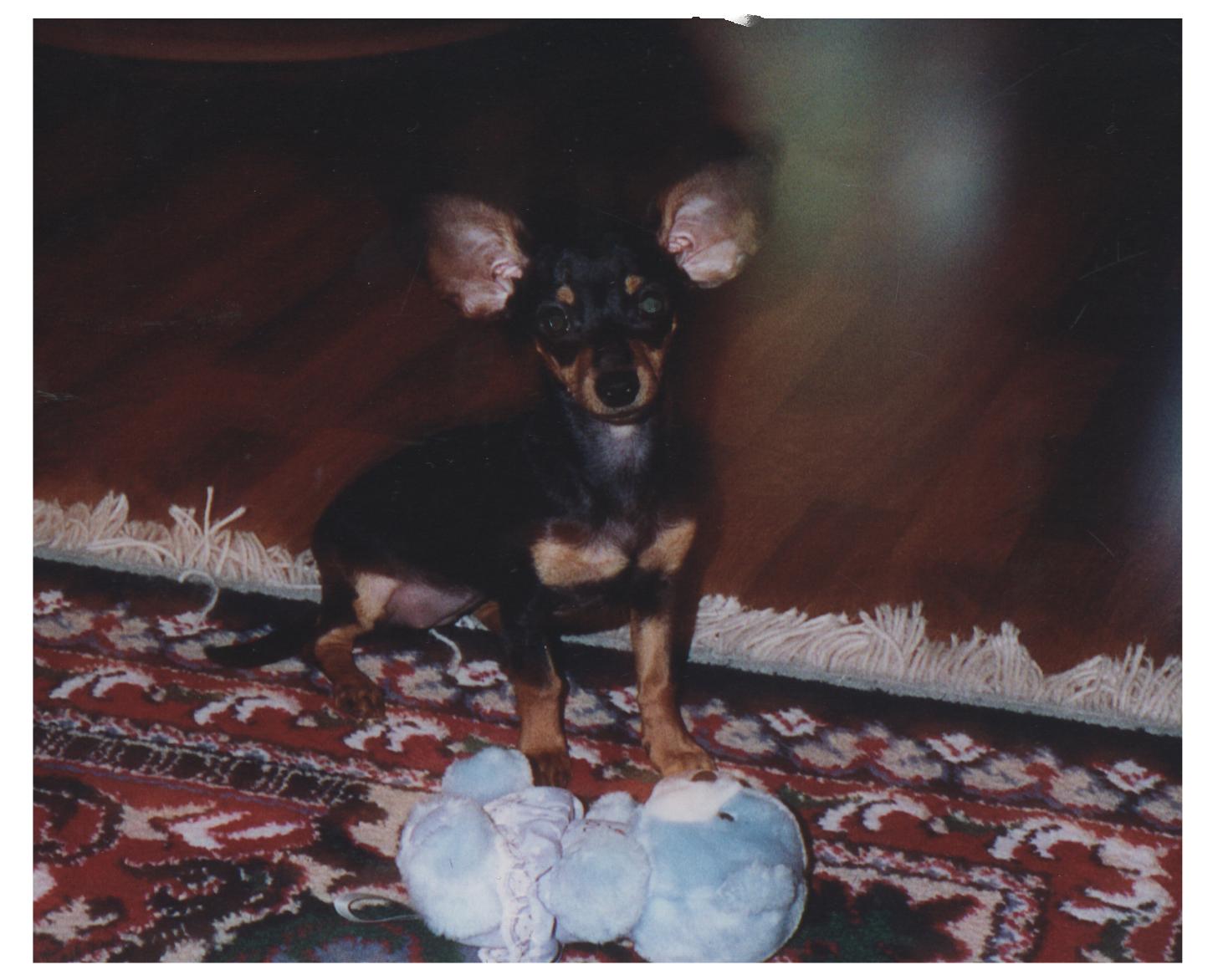
I found her in the middle of Range Avenue, aka LA. 16, the busy north-south thoroughfare that runs by my house in Denham Springs. She was a tiny black and tan puppy, probably no more than eight to 10 weeks old and her most prominent feature were those enormous ears.

At first we thought she might be a miniature pinscher but her ears were not trimmed nor had her tail been snipped as is common for the breed. Neither were her legs nearly long enough for a min-pin.

After considerable research, we finally determined she was a chiweenie, one of those so-called designer, or hybrid breeds—a cross between a Chihuahua and a Dachshund. She had the body of a Chihuahua and the ears of a Dachshund except instead of being floppy, they stood erect, large enough for a gust of wind to cast her airborne or so it seemed.

PENNY2

PENNY AT TWO YEARS, WITH FAVORITE TOY (CLICK ON IMAGE TO ENLARGE)

When I married Betty more than 46 years ago, I told her I would always have a dog—and I have. But Penny, as we soon named her, became our very first indoor dog. As a puppy, she would leap repeatedly, attempting vainly to jump onto our sofa and the day she finally made it was a breakthrough for her as she was no longer content with lying on the floor.

That was 15 years ago and she was eventually diagnosed with a heart murmur and our veterinarian, Dr. Michael Whitlock started her on a regimen of heart medicine and diuretics to help keep fluid from building up in her lungs.

With advancing age and with her weakened condition, she eventually became unable to jump onto the sofa so I would lift her up and she would wrestle with a blanket until she could burrow under it to keep warm. She hated thunderstorms. Trembling, she would seek refuge from the storms under that blanket.

We used to laugh at my uncle Pete for the manner in which he would walk around holding his beloved Pomeranians but soon my daughters were laughing at me as I walked around the house with Penny cradled on her back, perfectly relaxed, in the crook of my arm. And I long ago lost count of the times I would take my afternoon nap on the sofa with her curled up asleep on my stomach, usually under that blanket.

Her healthiest weight was around 12 pounds but the combination of the heart murmur and the medication pulled her weight down to about half that. Dr. Whitlock wanted her weight around five of six pounds to keep the fluids down, so that was okay.

When those fluids would build up, she would develop a cough that wracked her tiny body, so he prescribed even more medication that created a new problem: dehydration. For that, he occasionally had to inject fluids, which seems contrary to her best interests. But as Dr. Whitlock explained time and again, we were walking a fine line between too much fluid and dehydration—plus whatever damage the necessary drugs might be doing to her kidneys and liver.

Dr. Whitlock, it must be said, was—and is—one of the most compassionate, caring veterinarians I could have ever found for Penny. He would even call me at home to check on her and it was his dedication to her care and wellbeing that prolonged her life for at least a year—maybe two or three—beyond what she normally might have lived. There were times when I was certain the end was near but he would give her a steroid shot that would pick her up for weeks or months at a time. I will forever be grateful to him and his staff for giving us that extra time together.

Up until about last Thursday, she remained in good spirits and had a healthy appetite. But on Friday, she had begun to slip into a more lethargic state and by Sunday she seemed almost catatonic and unusually weak. When I took her outside to take care of her business, I could see after a few minutes that she was too weak to even walk back into the house, so I gently picked her up and carried to her bed in my office. She refused to eat all day and simply sat up, staring into space as if she was afraid to lie down.

Around 1:30 p.m. I picked her up to take her to the sofa for our customary nap. As I held her—on her back in the crook of my arm as usual—she let out three quick yelps. Then her weakened little body, reduced to about four, maybe five pounds and simply too feeble to continue the fight, jerked twice and she was gone. Apparently, she’d had a heart attack.

I laid her on her bed and stroked her head as she continued twitching for a few minutes even though I knew she was dead. And yes, I cried. We grow attached to these trusting little companions that depend on us for their care and though I have almost always had special connections to my dogs, I had grown to love her as no pet before. And as someone once said, their love is unconditional: they don’t care about social status, race or gender. Treated with kindness, they return the loyalty and devotion tenfold. We could all learn from that.

Daughter Leah, upon learning of Penny’s death, sent me this poem:

IMG_5336

Nine-year-old granddaughter Baylee has already added to her Christmas list a request for a puppy “that looks like Penny because Grandma and Granddaddy are sad.” But there’s no way I would ever try to replace Penny. I couldn’t. Besides, I have a 17-year-old Chihuahua, Tia, which I inherited from daughter Jennifer and an outside dog, Blaze, a gift from granddaughter Lauren. Blaze is a chow-golden retriever mix and one of the friendliest dogs ever. He’s about two now. I’m 71 and if he lives a normal lifespan he could—and well might—outlive me, so I won’t be bringing any more dogs into my home.

The pain of losing Penny is just too great.

