Feeds:
Posts
Comments


LouisianaVoice needs your support—moral and financial—now more than ever.

The trial on our lawsuit against the Division of Administration begins on Monday (May 4) as we try to hold the administration accountable on the production of public records so that we may keep you informed on events as they take place.

Unfortunately, this administration is trying to see to it—deliberately, we are convinced, that we are not able to provide vital information about the machinations of your state government in a timely manner.

We have already told you about the records request we submitted simultaneously with an identical request by the House Legislative Service Office. The legislature got its records—the same ones we requested—within 10 days; we didn’t get ours until three months later and then only after we filed our lawsuit.

The Division of Administration (DOA) is currently sitting on another request or ours. We again made simultaneously requests of DOA and an office under DOA. The office in question responded with the records within three days or our request. It’s been nearly two weeks and we’re still waiting for DOA to comply.

This is the battle we fight almost daily with the Jindal administration—and they have said in their response to our lawsuit that they do not deliberately delay complying with our requests, that they do not single us out for delay.

That simply does not square with what a former DOA employee told us: DOA routinely gets our requested records and simply stacks them in a corner for weeks at a time before notifying us that we may inspect them.

DOA has—and continues to—open defy us in violation of the state’s public records laws (R.S. 44:1 et seq.).

But even more absurd, in its response to our petition, DOA claims that I have not suffered monetary loss, so the court should not assess damages against the state. That is in direct contradiction to the statute which sets fines of $100 per day for non-compliance. Period. The statute makes no mention of any requirement that the one requesting the records suffer monetary loss as a prerequisite for the assessment of a fine.

Were it not for quick access to the legislature’s public records (which are readily available, with no delay tactics or word games) by LouisianaVoice, that $55,000-a-year retirement pay raise for State Police Col. Mike Edmonson would have gone through.

Were it not for acquisition of public records from the Department of Education (in another, successful lawsuit) by LouisianaVoice, private records of hundreds of thousands of Louisiana public school students would have been made available to Rupert Murdoch of Fox News.

This is what we do.

And it costs money and untold hours of dogged research.

To continue our legal fight, we need your help.

If we win on Monday, DOA is certain to appeal.

If DOA wins, we most certainly will appeal. They believe they can starve us out with legal costs but we won’t back down.

Either way, the costs are going to continue to climb from what we’ve already laid out in expenses.

Please click on the Donate Button with Credit Cards button (not here, but near the top right part of our web page) to donate by credit card.

If your receive e-mail notices to our posts, you will need to click on Read more of this post or pull up the full web site by clicking on https://louisianavoice.com/

If you prefer to mail checks or money orders, please make payable to:

Capitol News Service/LouisianaVoice

P.O. Box 922

Denham Springs, LA. 70727


Whichever way you choose to contribute, your help in our fight to make state government more transparent and accountable is both needed and appreciated.

Thank you.

Tom Aswell, editor

When Bobby Jindal’s presidential aspirations are finally dashed against the hard rocks of political reality—as they most assuredly will be—he will still have career options available to him, including one obscure choice conspicuously overlooked by all the pundits thus far.

While there has been some speculation that Jindal may be trolling for a vice presidential spot or even a cabinet position while positioning himself for a run four or eight years down the road, no one has even broached the possibility that his true calling may be that as a member of the Catholic order Opus Dei.

The Opus Dei order, featured in Dan Brown’s The Da Vinci Code, is known for its use of “corporal mortification,” or “mortification of the flesh,” the act of voluntarily punishing one’s own body as a form of spiritual discipline.

God knows Jindal has honed the art of self-inflicted pain to an art form.

Whether or not it is a form of penance for him is another story but there is no question that the man has the discipline to keep putting himself on display as an object of public ridicule and it’s got to be painful.

It’s certainly painful to those of us on the sidelines as we watch this train wreck of a politician who came on the scene eight years ago with so much promise only to plunge the State of Louisiana into its own version of the Great Depression.

It’s only appropriate, since he has already performed an exorcism, and given what he has done to our state, that he move on to the next logical step—self-flogging with metaphoric cattail whips on the national stage so the rest of the country can learn, at long last, who the real Bobby Jindal is.

The most blatant example of what we are talking about here is his weekly email blast by the Friends of Jesus Bobby Jindal that he sends out highlighting (if you want to call it that) Jindal’s activities for the previous week. http://click.bsftransmit7.com/ViewInBrowser.aspx?pubids=393%7c445%7c721821%7c9278&digest=qSZxfCGR0e%2bH%2fH85ZQu3zg&sysid=1

If one were to set out to combine self-abuse with self-aggrandizement in a single document, this would be the pattern to use.

Never in our career of watching and writing about politics (which spans more than four decades) have we seen such a sophomoric attempt at promoting oneself. The web page reminds us of the social misfit who has an uncanny knack of saying and doing the most inappropriate things at the most awkward moments even as the rest of the party tries its best to ignore him.

This week’s dispatch featured a list of what appeared to be favorable reviews of Jindal’s most recent appearance in Iowa. Here are some of the headlines from that email:

            Bobby Jindal is barely breaking 2 percent in Iowa polls — but you’d never know it from the way he wowed the crowd at the Iowa Faith and Freedom Coalition summit on Saturday. The Republican governor from Louisiana is one of nine presidential hopefuls speaking at the Des Moines-area confab, which gathers evangelical Christians together to judge the GOP candidates’ social conservative bona fides.

            Jindal brought to the stage a fast-talking, folksy, preacher-like quality that immediately resonated with the crowd.

            “Our God is an awesome God, can I get an amen?!” he began, spreading his arms wide and striding away from the podium. “Amen!” the audience responded loudly.

            Veering away from policy specifics, Jindal instead spoke at length about his personal journey to Christ – thanking his high school friend for giving him his first Bible and describing the moment he came to Jesus during a choir performance at LSU. Moving seamlessly from soul-searching spirituality to tongue-in-cheek quips about himself and his family, the governor’s speech was interrupted more frequently by raucous laughter than applause.

            Even after shifting from his own spiritual experience to the politics of religious liberty, Jindal kept the audience in rapt attention. “Here’s my message for Hollywood and the media elite,” he shouted, in the first standing ovation of the evening. “The United States of America did not create religious liberty. Religious liberty created the United States of America!”

            In another winning line echoing a promise he made in a Thursday New York Times op-ed, Jindal promised evangelicals that – unlike in Indiana — he would not be swayed from his support of a new religious freedom law working its way through the Louisiana legislature.

            “We saw corporate America team up with the radical left to come after our religious liberty rights,” he said, referring to Indiana Governor Mike Pence’s fight against gay rights groups after he signed a religious freedom law last month. “They might as well save their breath, because corporate America is not gonna bully the governor of Louisiana!”

            The discrepancy between Jindal’s knockout performance and his dismal Iowa poll numbers is noteworthy, a sign that perhaps the Louisiana governor should invest more time in the state.

            Iowa City resident Patrick Nefzger, who called Jindal’s speech “wonderful,” had a straightforward answer when asked when asked why Jindal’s poll numbers didn’t reflect the strong response he received Saturday night. “That’s because they don’t know who he is,” he said simply.

As to why Jindal’s poll numbers are so abysmal in Louisiana? We know who he is.

  • Bloomberg: “Jindal, The Louisiana Governor, May Have Helped His Standing With A Speech That Received One Of The Strongest Reactions Of The Night” (in focusing on recent events in Indiana, where Republican lawmakers modified new religious-freedom laws after critics said they could be used to discriminate against gays).

            “We saw corporate America team up with the radical left,” Jindal said, drawing applause.

            “They might as well save their breath because corporate America is not going to bully the governor of Louisiana,” he said. “The real discrimination that is being faced today are Christians—individuals, families, and business owners—that shouldn’t have to choose between operating their business and following their conscience, their traditional views, and their religious beliefs.”

This from a guy who owes his political soul to corporate America.

  • The Hill:


            “Jindal also reiterated on Thursday that he would not create his own exchange if the Supreme Court ruled against healthcare subsidies, which could put millions in his state at risk of losing their coverage.

“‘We would not set up an exchange,’” he said.

  • Bloomberg again (quoting from voter Jeff Ortiz, a wind energy company supervisor, commenting on Jindal):


            “He’s heard every one of the ’16 GOP hopefuls speak already, he says, and is leaning toward Louisiana Governor Bobby Jindal, ‘but I don’t know how he’d sell to the farmers.’ Last time, he backed Texas Governor Rick Perry, ‘but he didn’t give intelligent answers in the debates—doesn’t have a quick enough mind.’”

All this from Jindal’s very own self–promoting self-flagellation weekly email blast.


LouisianaVoice is launching its third fundraiser during the month of May and while past support has been appreciated more than you could ever know, this one has a greater sense of urgency to it than before.

Where the previous fundraisers helped defray the costs of travel and paying for public records, etc., this one will be used for an even more expensive—and more important—endeavor: covering mounting legal costs.

We are currently engaged in a court battle with the Division of Administration (DOA) over DOA’s pattern of delay in complying with the state’s public records laws (R.S. 44:1 et seq.).

To illustrate DOA’s tactics, here is one glaring example:

Last October 14, we made an official FOIA request for information pertaining to the $350 million contract between the Office of Group Benefits and a California company called MedImpact.

Believing DOA was deliberately stalling in complying with our requests, we had a friendly (but unidentified) legislator make the identical request through the House Legislative Services Office. That request was submitted the same day (Oct. 14, 2014) as our request.

On Oct. 21, 2014, we received the following response to our request:

  • Pursuant to your public records request, we are still searching for records and/or reviewing them for exemptions and privileges. Once finished with the review process, all non-exempt records will be made available to you. It is estimated the records will be available on or before October 31, 2014.

The House Legislative Services Office spokesperson received the following response to its request from DOA two days later, on Oct. 23, 2014:

  • You requested the MedImpact contract, Notice of Intent to Contract, ratings, and recommendations for awarding the contract. Please note the contract contains some proprietary and/or confidential information that has been redacted under La. R.S. 44:3.1. We have scanned these records. They are too large to email, so I can bring a CD over. I heard you’re out of the office. Do you want me to drop it off for you or wait until you get back?

So we were promised the records eight days later than the House Legislative Services Office and while that illustrates a deliberate delay on DOA’s part, it was not completely unreasonable and was hardly a basis for litigation. It didn’t even upset us that DOA would hand deliver the records to the legislature but require that I drive in from Denham Springs to review them.

But the fact is we never received the records—until, that is, after we filed our lawsuit in January of 2015. Once the lawsuit was filed, of course, they were immediately delivered to our attorney’s office—nearly three months after they had been delivered across the street to the legislature.

That was just the most egregious case, but we actually filed our lawsuit on the basis of  shorter but nevertheless unnecessary—and purposeful—delays in compliance with other several other requests.

The records we have requested are for actions by agencies of the state which affect you, the taxpayer. Because most media outlets are concerned with only the surface treatment of news stories, we attempt to pry deeper into the cause and effect aspect of state government—relationships between vendor and vendee, between elected officials and campaign donors, between contributions and contracts and board appointments. In short, we follow the money.

Government in general is uncomfortable with this and this administration in particular abhors scrutiny. That’s why DOA had instituted a deliberate strategy of delay when it comes to complying with our records requests. One former employee of DOA told us that it was common practice for DOA to get the records we request and then simply let them sit in a corner for weeks at a time before finally allowing us to inspect them. This is not the way to build trust between the government and the governed.

And it is not acceptable to us.

That is the reason we filed suit.

Our lawsuit is scheduled for trial this month and no matter which way the judge rules, the decision is quite likely to move to the First Circuit Court of Appeal. It’s that important to us if we lose and apparently, it’s equally important that the administration hide its actions from public examination.

Either way, it has already cost us a lot of money in terms of legal fees. And an appeal is going to cost a lot more. If we win, DOA will appeal in an attempt to make it cost-prohibitive to fight them by forcing us to continue paying legal costs until our resources are exhausted and we allow the case to abandon. That’s what happened with the case of a dentist who was pursuing legal action against the State Dentistry Board. DOA has attorneys on staff being paid with your tax dollars; it’s not costing Kristy Nichols a dime to stay in the game.

That is why we need your help now more than ever.

Please click on the Donate Button with Credit Cards button near the top right part of our web page to donate by credit card.

If your receive e-mail notices to our posts, you will need to click on Read more of this post or pull up the full web site by clicking on https://louisianavoice.com/

If you prefer to mail checks or money orders, please make payable to:

Capitol News Service/LouisianaVoice

P.O. Box 922

Denham Springs, LA. 70727

Whichever way you choose to contribute, your help in our fight to make state government more transparent and accountable is both needed and appreciated.

It’s funny in a sick, perverted kind of way when you think about it.

Come to think of it though, that’s entirely appropriate; the Bobby Jindal administration has been nothing but seven years of sick, perverted exercises in futility and failed policies. It’s enough to make other states laugh at us—and they probably are.

Foremost among his many efforts at “reform” preached by this incoherent governor is his insistence on something he refers to as “freedom of choice” for parents of students in grades K-12. http://www.breitbart.com/big-government/2015/02/10/jindal-urges-parental-choice-limited-government-and-end-to-teacher-tenure-in-sweeping-education-policy-plan/

Speaking at the Brookings Institute in 2012, he said the U.S. does not provide equal opportunity in education. https://www.youtube.com/watch?v=nDCU-VlSgX0

Yet, when it comes to freedom of choice and equal opportunity for students in Louisiana’s colleges and universities, Jindal appears perfectly willing to “let them eat cake.”

Even as LSU and other universities and colleges face financial exigency in the face of another round of budget cuts, this time as much as $600 million and as more than 1,000 LSU students marched on the State Capitol on Thursday in protest, where was Jindal?

Out of state, as usual.

Damn him.

Damn his blasé attitude toward doing his job as the elected governor of Louisiana at a time when the state is in dire need of leadership.

Damn his resolve not to repeal corporate tax breaks, his administrations’ failure to properly audit severance tax payments to the oil and gas companies who have bankrolled his campaigns to the tune of about $1 million.

JINDAL SWINDLE

Following the rally Thursday, dozens of students converged on the Senate Education Committee which was meeting in the bowels of the Capitol. The five committee members, who for the most part, talked among themselves instead of listening as a witnessed testified on a bill about student records, paid the obligatory lip service in welcoming the students and then politely suggested they move up one floor to the Senate Finance Committee “because that’s where the money is,” according to one member.

Except it isn’t there. There is no money because of Jindal’s haphazard, slipshod, snow-cone stand brand of administration.

One Education Committee member even suggested that the students keep going—up “to the fourth floor.”

“Except no one’s there,” said another member, eliciting laughter at probably the most accurate statement made thus far this session.

It’s not, of course, as though Jindal is solely to blame for this fiasco. The legislature is complicit in allowing him to run roughshod over the citizens of this state on his way out the door and (he somehow still believes) to the White House.

If you don’t believe the legislators must share the blame in this, then explain how an attempt this week to finally accept Medicaid funds to help provide health care for 240,000 low-income Louisianians never got out of committee. Explain how attempts to increase the minimum wage and close the gender wage gap fail time after time but somehow legislation to allow the teaching that the earth is only 9,000 years old passes muster.

Therefore, the protest by the LSU students, one of those demonstrations inspired by social media, was the perfect opportunity for the four announced candidates for governor in this fall’s election.

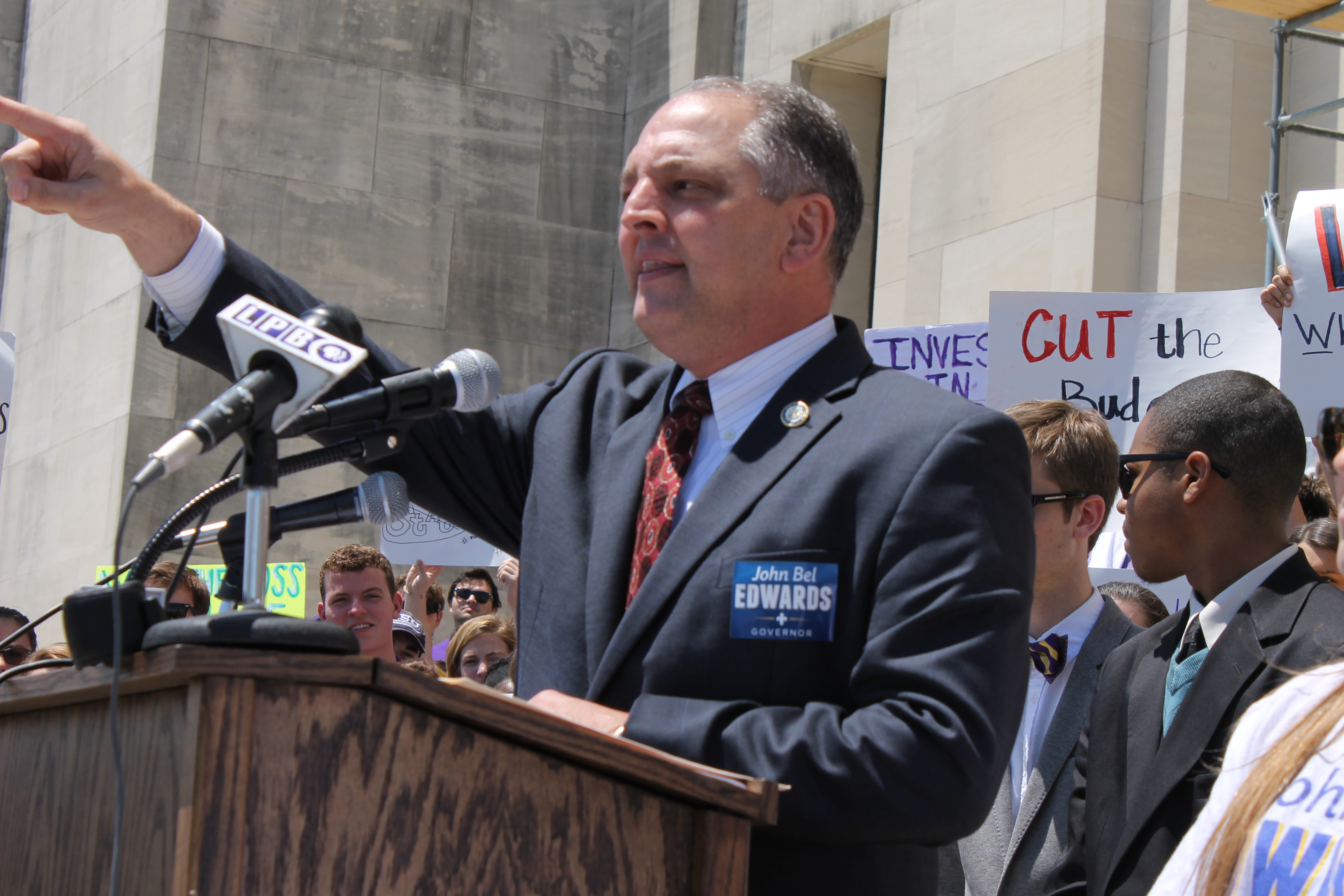
It would have been if they had all showed up. Perhaps that’s why State Representative John Bel Edwards (D-Amite) and the lone Democrat among the four candidates, got such an enthusiastic response from the students crowded onto the steps in front of the Capitol.

JOHN BEL EDWARDS

Rep. John Bel Edwards addresses LSU students on Thursday (click on image to enlarge).

Lt. Gov. Jay Dardenne, the only one of the four to hold an undergraduate degree from LSU and a former LSU Student Government President was apparently so busy he could only send a representative from his office. A missed opportunity if there ever was one.

Edwards tried to downplay the significance of that. “Well, to be fair, I was already in the building,” he laughed. “I didn’t have to go far.”

But neither did Dardenne. His office is across the street from the Capitol and LSU’s right fielder could probably peg a strike to his office window from the Capitol steps.

But Public Service Commission member Scott Angelle and U.S. Sen. David Vitter also were conspicuously absent. Nor was a single member of the LSU Board of Supervisors in attendance.

Of course, it would have been a sham for Angelle to make an appearance. He is, after all, joined at the hip with Jindal. Granted, Angelle was a Kathleen Blanco holdover, but held over he was and Jindal even made him his legislative liaison. Jindal also named him as interim Lieutenant Governor when Mitch Landrieu was elected mayor of New Orleans, and then appointed him to the LSU Board of Supervisors (that’s the same board that fires LSU presidents on a whim, costs the state hundreds of thousands of dollars defending a defenseless attempt to deny access to public records, and which gives away state hospitals in a deal that had been rejected by the federal government). http://www.nola.com/opinions/index.ssf/2015/03/lsu_board_jindal_resign.html

But why Vitter didn’t show is something of a mystery; there were so many attractive co-eds at the protest, after all.

Edwards told the students that he has “spent seven years fighting Jindal’s budgets. I did not vote for the budget last year and my solemn promise to you is that I will never vote for a budget that cuts funding for higher education.”

Edwards, who holds his undergraduate degree from West Point, received his law degree from LSU Law School. He told the students they are facing the potential of a 90 percent increase in tuition this fall. As expected, that was met with a chorus of boos. “No state has cut funding to higher education more than Louisiana,” he said. “I have a personal interest in seeing higher education fully funded. My daughter is a freshman at LSU.

“If you look behind you, you see a statue of Huey Long,” he said. “Say what you will about Huey Long, but at a time this state was in the throes of the Great Depression, Huey Long found money to build LSU, build roads and bridges throughout the state and to establish a great state hospital system. If he could find money to do all that during the Depression, we should be able to fund education today.”

But as Jindal prattles on about choice for students of K-12, he seems to have forgotten about the choice of post-secondary students: the choice to obtain an affordable education, the choice to remain in Louisiana and attend a tier 1 university, the choice to avoid devastating student loans that put graduates in deep financial holes even before their careers begin.

By MIKE STAGG (Independent filmmaker, citizen activist, political strategist – Special to LouisianaVoice)

For the past seven years, as Louisiana has lurched from one fiscal crisis to another, the State of Louisiana has paid the oil and gas industry $2.4 Billion in severance tax exemptions. Despite that massive transfer of public wealth into private hands, the oil and gas industry used its influence inside the Department of Natural Resources and the Jindal administration, to limit—and for three years shut down—audits that would have revealed whether the industry’s severance taxes and royalty payments to the state were accurate.

These facts have been hiding in plain sight, contained in five performance audits of the Department of Natural Resources and the Louisiana Department of Revenue conducted by the Legislative Auditor since 2010. Two of those audits focused on royalty collections from oil and gas produced on state-owned lands and water bottoms. Another focused on severance tax collections; yet another dealt with mineral leases handled by the State Mineral and Energy board, while the fifth audit examined how the Office of Conservation has handled the orphaned and abandoned well cleanup program.

The cozy relationship between DNR and the oil and gas industry is explicit in the department’s regulation of the industry. That coziness, when extended to state finances, has proven disastrous for the Louisiana treasury and its residents. DNR is responsible for collecting oil and gas royalties, which account for roughly seven percent of state General Fund dollars, or approximately $800 million per year.

For a three-year period, between July 2010 and July 2013, DNR had jurisdiction to determine the accuracy of severance taxes and royalty payments.

And DNR let industry have its way.

Audits on royalty revenue dropped. Audits on severance tax revenue all but stopped, even as the state’s financial condition continued to worsen. In short, when it came to providing rigorous oversight to ensure that the royalty and severance tax payments were accurate, DNR’s Office of Mineral Resources deferred to the oil and gas industry while programs that serve the citizens of Louisiana were cut, primarily in healthcare and higher education, the unprotected portions of the state General Fund.

DNR’s relationship with the oil and gas industry is a blatant example of regulatory capture. Regulatory Capture is a form of political corruption that occurs when an agency, created to act in the public interest, advances instead the special concerns of the industry it is charged to regulate.

Severance taxes are the constitutional expression of our, as Louisiana citizens, shared claim on our state’s vast mineral wealth. Exempting severance taxes negates the public claim on that mineral wealth and undermines our ability to invest in ourselves as a state.

Severance tax exemptions are direct payments from the state to the oil and gas producers after the companies have submitted their exemption certificates. Royalties are the property owners’ share of the proceeds from the sale of oil and gas produced from wells on their land. For purposes of this story, royalties are the state’s share of the revenue from oil and gas produced on state-owned lands and water bottoms after severance taxes have been paid.

Since the mid-1980s, Louisiana Department of Revenue has published an annual report on tax exemptions called “The Tax Exemption Budget.” In that document, the department identifies each tax exemption and quantifies the cost of each exemption to the state.

It makes clear that tax exemptions are in fact a spending of state funds — here’s how the LDR explains it in every report: “Tax exemptions are tax dollars that are not collected and result in a loss of state tax revenues available for appropriation. In this sense, the fiscal effect of tax exemptions is the same as a direct fund expenditure.”

Between 2008 and 2014, according to the Tax Exemption Budget, the State of Louisiana paid oil and gas companies more than $2.4 Billion in severance tax exemptions. Those checks went out at the exact same time that our legislature cut funding for programs like aid to families of children with disabilities, behavioral health programs, home health care, and programs that assisted victims of domestic violence. During that same period, state funding for higher education was also cut by more than $700 million as the tuition and fees paid by those attending technical colleges, community colleges, and state universities were jacked up to cover the difference.

The first performance audit on royalty collections was released in July 2010. Royaltieshttps://app.lla.state.la.us/PublicReports.nsf/B6B5DE331E9D48818625776E005CFDA5/$FILE/00018070.pdf The Legislative Auditor found that DNR’s Office of Mineral Resources took a lackadaisical approach to verifying the accuracy of royalty payments from the 1,888 active mineral leases on state-owned lands and water bottoms.

The Legislative Auditor noted that severance taxes and royalties are connected, that both are dependent on the amount of oil and gas produced, as well as the price of the resource.

Desk audits compared the volume of oil and gas sold to the volume of oil and gas produced, which ensures that royalty payments are properly calculated. These audits also help ensure that production wells on state lands are submitting properly calculated royalty payments.

The Legislative Auditor found that the Office of Mineral Resources (OMR) had not conducted a single such audit in a decade. Despite the Auditor’s recommendation that it resume these audits, OMR waited another three years before getting around to doing so.

The Legislative Auditor also found that OMR did not compare royalty reports against severance tax reports filed with the state Department of Revenue, nor did it compare royalty reports to production reports submitted elsewhere in DNR.

In its response to the Legislative Auditor’s Royalty performance audit findings, on June 24, 2010, DNR announced that “As part of the Streamlining Commission’s recommendations, OMR will take over LDRs severance tax field audit program and the two audits will be integrated beginning July 1, 2010.”

In September of 2013, the Legislative Auditor released a follow-up performance audit on royalty collections. https://app.lla.state.la.us/PublicReports.nsf/DB918AD8E33411F286257B490074B82A/$FILE/00031C97.pdf

The auditors were dismayed to find that the revenue produced by OMR’s audits had fallen below the levels reported in 2010.

The Auditor also found that that the State Mineral and Energy Board had waived 45% of the $12.8 million in penalties that were assessed against companies by OMR for late payment of royalties.

Neither the Office of Mineral Resources nor the State Mineral and Energy Board seemed at all concerned about the fiscal impact their indifference to generating revenue had on the programs that Louisiana residents depend on. Their primary concern was with not inconveniencing their friends in the oil and gas industry.

The Legislative Auditor conducted an audit on severance tax collection procedures in the

Louisiana Department of Revenue in 2013 but, because severance tax audit functions had been transferred to the DNR in 2010, auditors had to return to the Office of Mineral Resources close on the heels of the second royalty collections audit. https://app.lla.state.la.us/PublicReports.nsf/AC044A6D3709B90C86257BE30065348B/$FILE/000351F7.pdf

In this audit, the Legislative Auditor found that oil and gas industry complaints about the LDR’s use of GenTax software (which identified possible nonpayers of severance taxes) led first, to LDR shutting off the software, and second, audit power being transferred to DNR.

The scale of the oil and gas production not audited as a result of that shift was staggering. DNR’s field audits ignored oil and gas production on private lands — which comprises 98.1% of all oil and gas leases in Louisiana — for a three-year period.

Revenue from severance tax audits fell 99.8% from the levels produced by the Department of Revenue once responsibility was transferred to the Office of Mineral Resources. The actual dollar amount fell from $26 Million in 2010 to $40,729 in Fiscal Year 2012.

For the three-year period that DNR’s Office of Mineral Resources had responsibility for severance tax audits, the industry essentially operated under an honor system.

Prior history shows why this was a problem. In the late 1990s, the Mike Foster administration filed lawsuits against more than 20 oil and gas companies claiming they had shortchanged the state by as much as $100 million on severance tax payments. Now, for three years as recurring revenue shortfalls continued, the Office of Mineral Resources ignored that history.

During this time, the Haynesville Trend emerged as the most productive shale gas field in the country.

Even though the severance tax exemption on horizontal drilling meant that the state was denied severance tax revenue for much of that play, companies still managed to game the exemption system at taxpayer expense.

Under the rules for severance tax exemptions, the state pays back the taxes already paid once it receives the exemption certificate from the company — plus “Judicial Interest” which in the period covered by the audit averaged about 4.5%.

That is, the state had to dip into non-exempt severance tax payments in order to cover the interest costs on those certificates that the companies chose to sit on for several months.

The Audit found that over the course of four fiscal years running from 2009 through 2012, the Department of Revenue issued 13,818 severance tax refund checks totaling $360,190,583. An extra $23,859,012 in interest was tacked on to that. https://app.lla.state.la.us/PublicReports.nsf/CF6244B77E3A958686257C30005E80B1/$FILE/000368DA.pdf

In addition, the Auditor found that the Department of Revenue overpaid severance tax exemption refunds by $12.9 million between July 2010 and May 2012.

The decline in audit revenue, the interest paid to companies on the gaming of the severance tax exemption process, the overpayment of severance tax exemption refunds, the decision by the State Mineral and Energy Board to waive 45% of fines for late payment of royalties combined to benefit the industry at taxpayer expense to the tune of $68 million.

These gifts to the oil and gas industry were made at a time when the industry was already receiving $2.4 Billion in tax exemptions and at a time when every dollar the state did not collect translated into a cut to programs that Louisiana residents depended on.

The Auditor also pointed out that hiring additional auditors within DNR and LDR would produce a great return on the state’s investment. Each auditor costs a department between $50,000 and $60,000 per year, but they bring in an average of $1.3 million per year. LDR said it had requested additional auditors in its budgets but they were never approved by the Jindal administration.

Oil and gas companies control all of the information used in the severance tax and royalty payment process. The industry has used this power to its advantage and to the state’s detriment.

Vigilant auditing can close that information gap.

The Office of Mineral Resources has shown little interest in that kind of work. DNR’s abdication of its oversight role on royalty revenue has had an outsized impact on Louisiana because of the role that revenue plays in state finances. When added to the three-year period when DNR failed to perform severance tax audits, the agency has likely cost the state hundreds of millions of dollars over the past seven years.

That is corruption.

Not all of this went unnoticed. In the 2014 legislative session, Sen. Rick Gallot (D-Ruston) and Rep. Joe Harrison (R-Gray) introduced concurrent resolutions to order LDR, DNR and the Legislative Auditor to agree upon a means to conduct a thorough audit of oil and gas production, severance taxes and royalty payments. Gallot’s resolution passed the Senate by a vote of 35-0. https://app.lla.state.la.us/PublicReports.nsf/D6A0EBE279B83B9F86257CE700506EAD/$FILE/000010BC.pdf

But by the time the resolution reached the House floor in early June, the oil and gas industry and the Jindal administration recognized the threat the audit posed, so they joined forces to kill it. SCR 142

The resolution had to be killed to keep the secret.

In the midst of a prolonged and deepening fiscal crisis, the Jindal administration and the industry did not want legislators and the public to question whether the severance taxes and royalties paid to the state were accurately calculated.

The Department of Natural Resources betrayed the trust of the people of this state. It failed its fiduciary responsibility twice; first, as collector of royalty payments, and again during the time it served as chief auditor of severance tax collections. It has repeatedly put the needs of the industry above the needs of the people of this state.

For the oil and gas industry, $2.4 Billion in severance tax exemption payments were not enough. Its greed is so great that, in a time of fiscal constraints on state government, it went out of its way to cheat the state out of still more money. It used its power and influence in the Department of Natural Resources and its ties to the Jindal administration to do so.

By these acts, the oil and gas industry has shown itself to be unworthy of the trust we have placed in it.

For Looting Louisiana in our time of fiscal need, the oil and gas industry must be stripped of its severance tax exemptions. Under the Louisiana Constitution, we are entitled to the full benefits of this state’s mineral wealth.