Feeds:
Posts
Comments

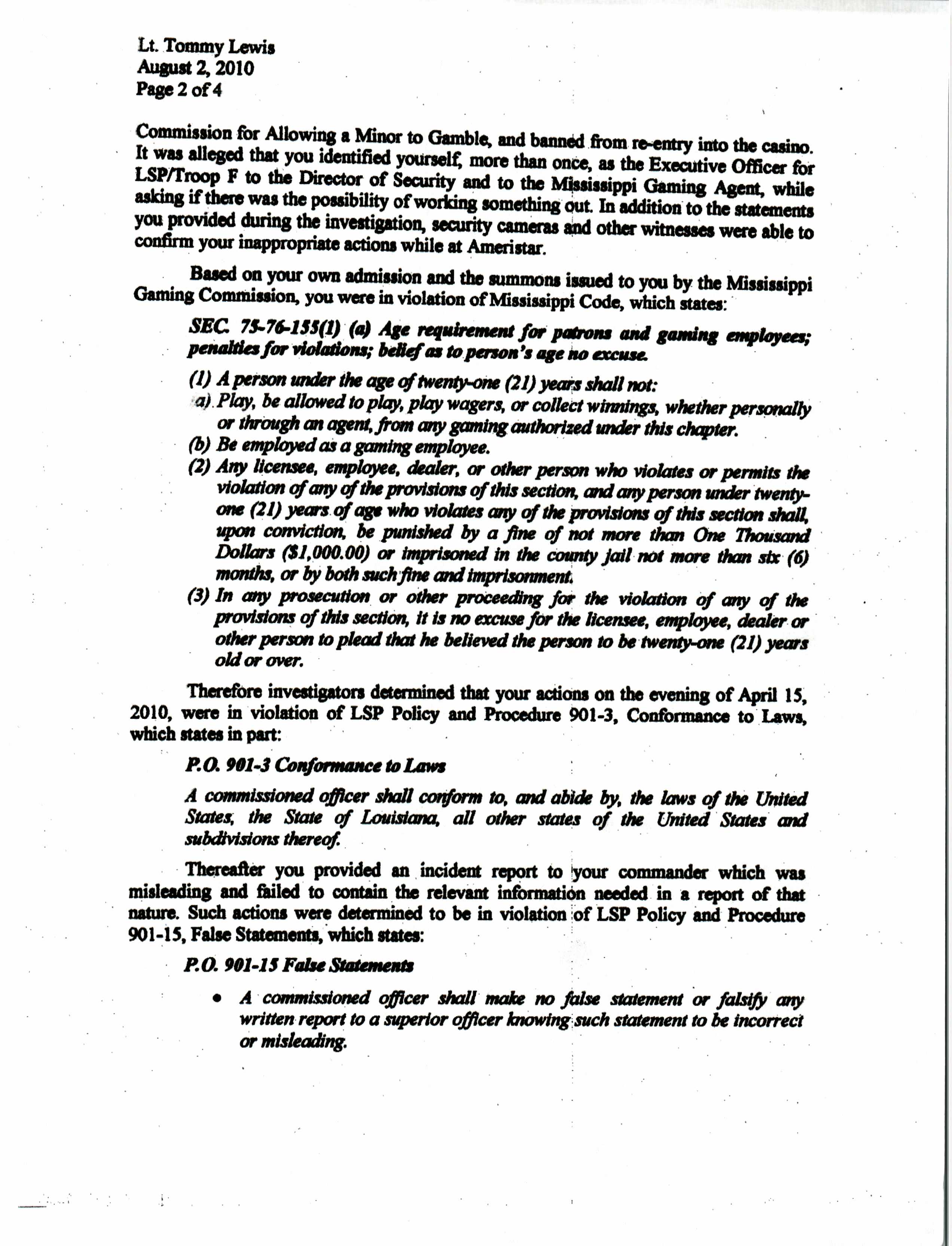
“It was alleged that you identified yourself more than once as the Executive Officer for LSP/Troop F to the Director of Security and to the Mississippi Gaming Commission agent while asking if there was the possibility of working something out.”

—Col. Mike Edmonson, in a letter dated August 2, 2010, in which he suspended Lt. Tommy Lewis for 40 hours for accompanying an underage woman into the gaming area of a Mississippi casino after having been instructed that she was not allowed in the area.

LSP TOMMY LEWISTOMMY LEWIS

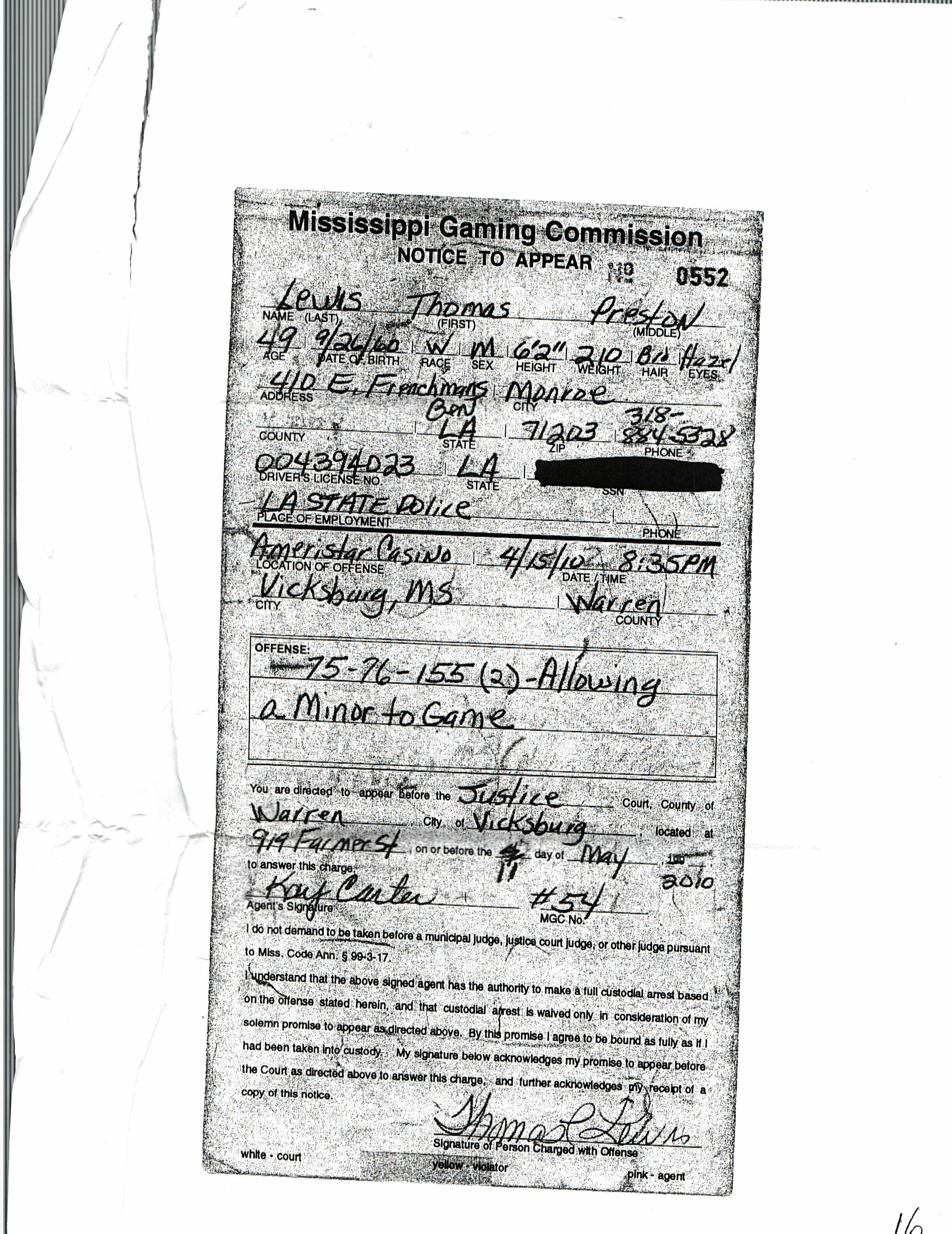
Tommy Lewis, a high-ranking state police lieutenant in Troop F in Monroe was cited by the Mississippi Gaming Commission in April of 2010 for sneaking an underage woman who was not his wife into the gaming area of Ameristar Casino in Vicksburg. He apparently did so in defiance of state law barring anyone under the age of 21 from entering the playing area, according to documents obtained from both Louisiana State Police, the Mississippi Gaming Commission, and from Warren County (Mississippi) Justice Court.

He was subsequently promoted to commander of Troop F by State Police Superintendent Mike Edmonson.

Lewis, who upon being caught, attempted to use his position as a law enforcement officer to “work something out,” was fined $627 by a Vicksburg justice of the peace and was suspended 40 hours without pay by Edmonson.

A trip to Vicksburg by LouisianaVoice turned up nothing. A Helpful deputy we encountered at the courthouse there, however, made several calls on our behalf and learned that the court record had been expunged. But the Mississippi Gaming Commission in Jackson still had records of the citation and Lewis’s court appearance at which he entered a guilty plea. Those documents were mailed to us pursuant to our public records request.

Expunging court records is a costly process. The person seeking the action must pay attorney fees and court costs which, together, can total several hundred dollars.

Three years later, Edmonson promoted Lewis to the rank of captain and named him commander of Troop F. He currently makes $131,000 per year in that position. Lewis was among higher ranking state police officers whom Edmonson assured legislators earlier this year would not be among those getting 30 percent pay increases as a result of two separate pay raise bills for state police passed within six months of each other.

In fact, Lewis, a native of Ferriday and a distant relative of rock and roll singer Jerry Lee Lewis, went from $83,640 per year at the first of the year to $124,150 with the first pay raise on March 1 and then to his current salary on June 24, an overall pay increase of 56.6 percent.

Troop F includes the 12 northeast Louisiana parishes of Jackson, Lincoln, Union, Ouachita, Caldwell, Morehouse, East and West Carroll, Madison, Richland, Tensas and Franklin.

LouisianaVoice obtained a four-page letter of August 2, 2010, in which Edmonson reviewed the events of April 15, 2010, when Lewis, then making $74,200 per year as Executive Officer of LSP Troop F, traveled with seven friends by limousine on a “guys” trip from Monroe to the Ameristar Casino in Vicksburg.

Also obtained were records of the Mississippi State Gaming Commission and Warren County (Vicksburg) Justice Court. Those records were damaged in the mail and at first, only a damaged but empty envelope was received. Days later, the damaged but still readable letter arrived.

Copies of all documents may be examined at the bottom of this story. The damages to the Mississippi documents is readily discernable.

The Edmonson letter further noted that the men were “accompanied by three young ladies hired by the owner of the limo to tend bar during the trip.”

A check of four separate companies in Baton Rouge and New Orleans by LouisianaVoice failed to turn up any limousine services that provide bartenders, female or otherwise. “None of the limo services that I’m aware of provide that service,” said a representative of a New Orleans limo service. “The bars in the limos are very small. That sounds more like escorts than bartenders,” she added.

“Upon entering the casino it was announced that one of the young ladies…was 20 years old and underage, with regard to admission into the casino,” Edmonson wrote. Lewis would have been in his early to mid-40s at the time, according to one source.

Edmonson said Lewis admitted to drinking “during the limo ride and at least two more times in the casino” and that he further admitted that he was aware that the woman was only 20 and that he “accepted the ‘Under 21 minor card’ that was provided for her at the entrance of the casino.

Edmonson said Lewis told investigators that he and the woman “pretended to comply with the security officer’s instructions” regarding the woman’s not being allowed in the playing area of the casino but that the two “had full intentions to enter the playing area anyway” and that they subsequently threw the minor card away “while moving onto the casino floor” with the woman where she proceeded to play blackjack for “a couple of hours” before proceeding to the slot machines “where you inserted money and encouraged her to play the machine.”

Here is where things really got sticky:

After being issued a summons by an agent of the Mississippi Gaming Commission for allowing a minor to gamble and being banned from re-entry into the casino, “it was alleged that you identified yourself more than once as the Executive Officer for LSP/Troop F to the Director of Security and to the Mississippi Gaming Commission agent while asking if there was the possibility of working something out,” Edmonson wrote (emphasis ours). “In addition to the statements you provided during the investigations, security cameras and other witnesses were able to confirm your inappropriate actions while at Ameristar,” he said.

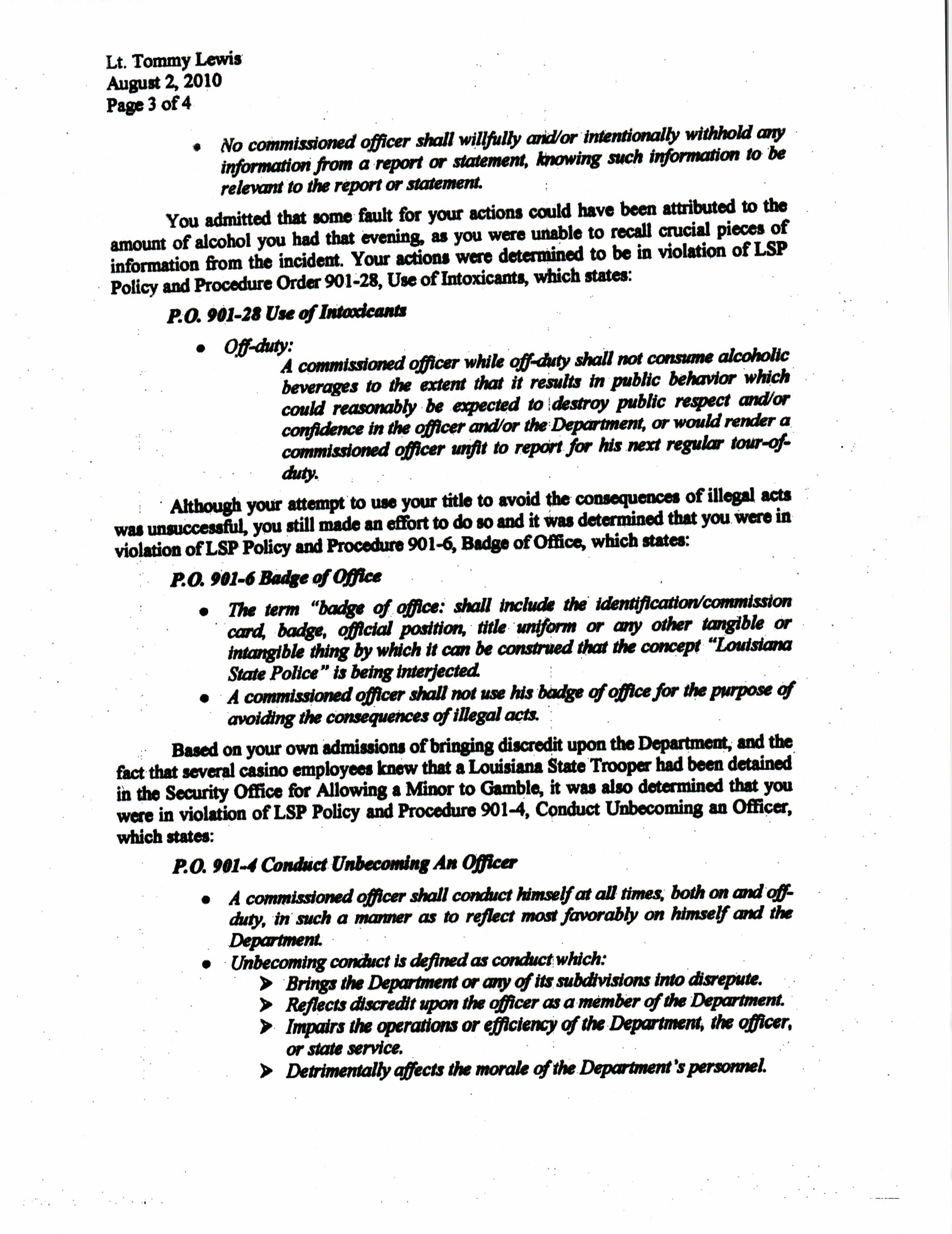
Lewis subsequently “provided an incident report to your commander which was misleading and (which) failed to contain the relevant information needed in a report of that nature,” Edmonson wrote, adding that his false statements placed Lewis in violation of LSP policy which says, “No commissioned officer shall willfully and/or intentionally withhold any information from a report or statement, knowing such information to be relevant to the report or statement.” (Emphasis Edmonson’s).

Edmonson said investigators sustained each of five allegations against Lewis, including:

  • (Failure) of conformance to laws;
  • Making false statements to his commander,
  • Use of intoxicants;
  • (Use of his) Badge of Office (for the purpose of avoiding the consequences of illegal acts);
  • Conduct unbecoming an officer.

“Investigators sustained all five allegations against you,” Edmonson said in his letter. Lewis was also ordered to appear before the Justice of the Peace in Vicksburg, Mississippi, where he was fined $627 for the summons he received from the Mississippi Gaming Commission.

“You are hereby suspended without pay and allowances for 40 hours,” Edmonson wrote. “Your suspension will begin at 0800 (8 a.m.) on Monday, August 30, 2010, and end at 1630 hours (4:30 p.m.) on Friday, September 3, 2010. You will report back to your assigned duty station at 0800 hours on Tuesday, September 7, 2010.

Less than three years later, on July 11, Edmonson promoted Lewis to captain and installed him as commander of Troop F in Monroe in much the same manner that he promoted Lt. Harlan Chris Guillory to captain and made him commander of Troop D after it was learned that Guillory was abusing prescription drugs while on duty. https://www.facebook.com/LouisianaStatePolice/posts/676564355693491


Below are documents from LSP and the Mississippi Gaming Commission received by LouisianaVoice. Click on the documents to enlarge them for easier reading:

TOMMY LEWIS LETTER PAGE 1TOMMY LEWIS LETTER PAGE 2TOMMY LEWIS LETTER PAGE 3TOMMY LEWIS LETTER PAGE 4IMAG1521IMAG1522IMAG1523

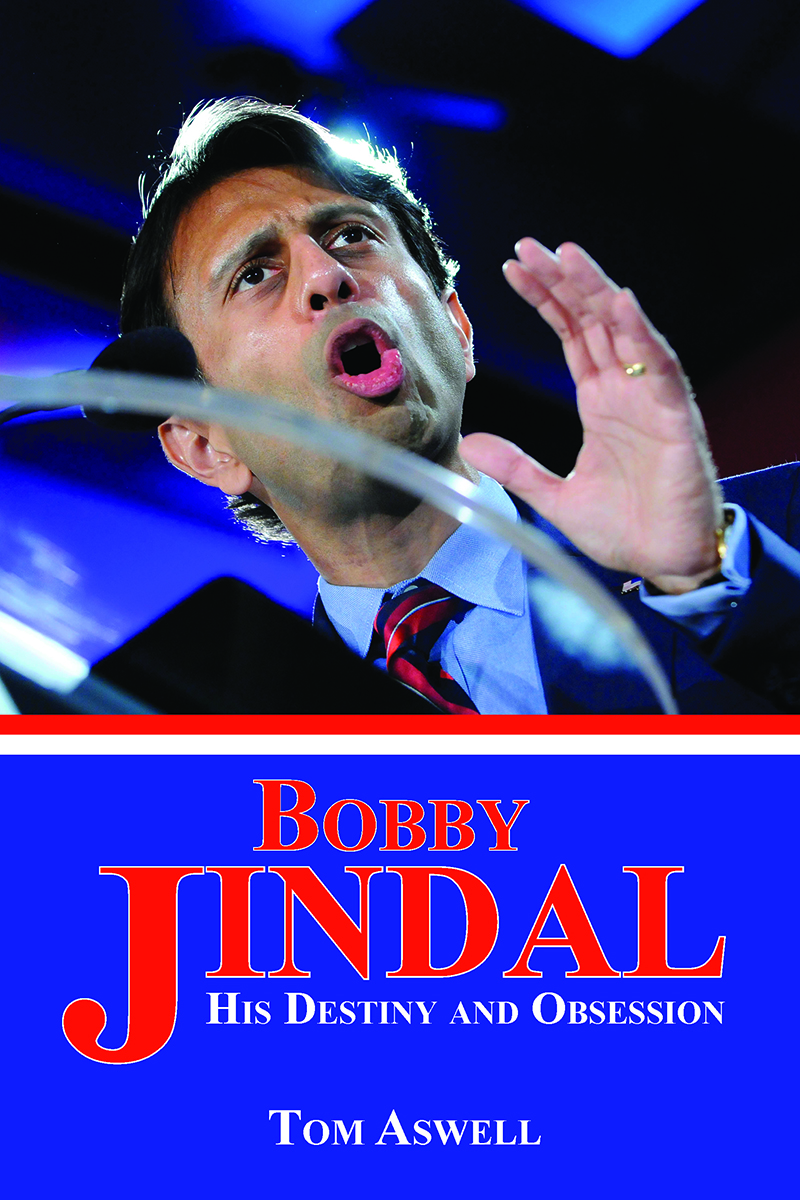
JINDAL BOOK COVER

            We have a book cover!

Just a reminder that my latest book, Bobby Jindal: His Destiny and Obsession, is scheduled for publication in early January but you may pre-order your copy now.

To make the deal a little more enticing, we have a cover for the book. The photo of Jindal is just as unflattering as the contents of the book which presently appears to be about 500 pages.

If you order by clicking on the book cover’s image at the right, your order will be placed through Cavalier House Books of Denham Springs, a locally-owned independent bookstore.

Why would I encourage you to order through Cavalier House?

Two reasons.

  • First, by placing your order this way, you support a local independent book store, a cause I strongly endorse.
  • Second, because I live only about two blocks from Cavalier House Books, proprietor John Cavalier will summon me to sign each copy before he ships them out.

If you opt to purchase through Amazon or a big chain store, you’re hurting local business owners—much like shopping at Walmart instead of patronizing locally-owned stores. Moreover, you won’t get signed copies through those outlets.

Unless otherwise instructed, each signed book will be personalized to the name of the person ordering it. If you wish your copy signed to someone else (if it is a gift, for instance), please email me at:

louisianavoice@cox.net

DO NOT ORDER YOUR BOOK FROM THIS EMAIL ADDRESS. Order through Cavalier by clicking on Jindal’s photo at above right and email me separately on signing instructions.

If you were to seek two cases that stand as glaring testimony to the way in which the Jindal administration employs a double standard in addressing legal and ethical issues, you need look no further than the cases involving Murphy Painter and Jeff Mercer.

Though the men never met and while one was a state employee and the other a private contractor, together, the two represent the composite poster child for victims of political favoritism and corruption. Both fell prey to unethical behavior and of the way political priorities have been set by the Jindal administration for the past eight years.

We have chronicled the manner in which Jindal and his henchmen made Painter a scapegoat by firing him from his post as director of the State Office of Alcohol and Tobacco Control (ATC). We have shown how, when he refused to knuckle under and bend the rules for the benefit of Anheuser-Busch distributor Southern Eagle, SMG (the Louisiana Superdome management company), the Louisiana Stadium and Exposition District (LSED) Board, and Tom Benson, Jindal not only fired Painter but even tried (unsuccessfully) to prosecute him in federal district court on bogus criminal charges of computer fraud.

Not only was Painter acquitted of all (there were 42 counts, none of which stuck) charges, but the state then was required to repay Painter’s legal costs of $474,000.

Another embarrassment for Jindal: ex-ATC commissioner Murphy Painter wins defamation suit against his accuser

LouisianaVoice was the first—and only—news service to suggest (correctly, it turned out) that Painter, instead of a criminal, was the victim of a political scheme intended to remove him from his position after he refused to approve an incomplete application by SMG for a permit to erect a large tent at Benson’s Champions Square adjacent to Benson Towers across from the Superdome. The tent was to house beer sales by Southern Eagle on Saints game days. https://louisianavoice.com/2013/02/06/emerging-claims-lawsuits-could-transform-murphy-painter-from-predator-to-all-too-familiar-victim-of-jindal-reprisals/

Jindal executive counsel Stephen Waguespack, now President of the Louisiana Association of Business and Industry (LABI), insisted—twice—that the permit be expedited, Painter asked that he put his concerns in writing but Waguespack responded that he was far too busy to reduce his demands to writing (which would’ve left a paper trail, don’t you see).

Instead, Painter was simply fired and SMG got its permit. Of course, it was mere coincidence that the Benson family, SMG, its law firm, Southern Eagle and members of the LSED Board had combined to dump more than $207,000 into Jindal’s campaigns between 2002 and 2012.

Quick as the Jindal crowd was to administer justice (read reprisals) in the Painter case, it was painfully slow in ferreting out reports of corruption in one of the largest agencies in the state—the Department of Transportation and Development—and even slower in addressing those reports with the proper corrective measures. The fact is, nothing was ever done about reports of attempted shakedowns of a DOTD contractor and the subsequent harassment of that same contractor that eventually put him out of business.

It turned out to be an expensive oversight on the state’s part.

On Friday, a 12-person jury returned a unanimous verdict in which it awarded Jeff Mercer of Mangham $20 million, plus eight years (and counting) of judicial interest for allowing DOTD supervisors to condone demands of cash and equipment from Mercer by a DOTD inspector (we call that extortion where I come from; the inspector allegedly threatened Mercer with inspection problems with his work). Moreover, Mercer was able to prove that DOTD deliberately withheld payments for work performed by Mercer as payback for his whistleblowing, first reported by LouisianaVoice in April of 2012. https://louisianavoice.com/2014/04/09/contractor-claims-in-lawsuit-that-dotd-official-attempted-shake-down-for-cash-equipment-during-monroe-work/

Story of attempted contractor shakedown broken 2 years ago by LouisianaVoice results in $20 million verdict against state

Mercer had even taken his complaint to the governor’s office, but nothing was ever done. No referral to the Inspector General’s office. The IG, by the way, works directly for and answers only to the governor and was prompt enough to bring charges against Painter three years ago.

So, the question must be asked: why was the governor’s office not front and center in taking appropriate action on reports of extortion, threats of federal prosecution against Mercer, and refusals to pay for work performed by him?

Why was the demand for compliance so urgent in the Painter case and the concern so lacking in the Mercer case?

To paraphrase Jindal: two words.

Campaign contributions.

Benson, SMG, and members of the LSED Board were major Jindal campaign contributors. Mercer was not.

Benson and his associates were friends of Jindal and as such, they possessed massive political power that the governor could not ignore—nor did he wish to.

Mercer was a small contractor from the small North Louisiana town of Mangham, situated about halfway between Winnsboro and Rayville—and smaller than each of those. He was not influential.

He was, they thought, an insignificant little nobody who could be ignored because he had neither the influence nor the political muscle to make himself heard over the rattle of dinner plates at the governor’s mansion or over the lofty, self-serving campaign rhetoric about Jindal’s gold standard of ethics.

The administration, it turns out, committed the worst tactical error possible in warfare and politics: it vastly underestimated the determination of a little man when he is truly pissed and it woefully underestimated the indignation and ire of a 12-person jury upon their hearing of the injustice heaped upon one of their own by an uncaring bureaucracy and of the unscrupulous actions of those within that same bureaucracy.

And boy, does it ever feel good when the underdog wins one!


Nearly two years ago, LouisianaVoice broke a story about a Mangham contractor’s claims that the Louisiana Department of Transportation and Development (DOTD) had bankrupted his company when it denied payments for his work. https://louisianavoice.com/2014/04/09/contractor-claims-in-lawsuit-that-dotd-official-attempted-shake-down-for-cash-equipment-during-monroe-work/

The reasons payment were denied? Because, contractor Jeff Mercer said, he resisted shake-down efforts by a DOTD inspector who demanded cash and equipment from him.

On Friday, after eight years of legal battles, Mercer won a unanimous $20 million judgment from a 12-person jury in 4th Judicial District Court in Monroe.

Work for which Mercer says he was not paid included:

  • Two projects on I-49 in Caddo Parish ($1.6 million);
  • A Morehouse Parish bridge project ($7.1 million);
  • Louisville Avenue in Monroe ($79,463);
  • Well Road in West Monroe ($50,568);
  • Airline Drive in Bossier City ($57,818);
  • Brasher Road in LaSalle Parish ($70,139).

While the Monroe News-Star gave substantial coverage to the court decision, LouisianaVoice was the first media outlet to give Mercer the time of day back in April of 2014 when we first learned of his troubles with DOTD. Monroe television station KTVE did a brief interview with Mercer following our initial story, but that was it—until yesterday’s decision. http://www.thenewsstar.com/story/news/local/2015/12/04/contractor-wins-20m-suit-against-dotd/76813444/

In our 2014 story, Mercer said that three of his employees filed sworn affidavits with the court in which all four say DOTD inspector Willis Jenkins demanded that Mercer either “put some green” in his hand or that Mercer place a new electric generator “under his carport” the following day.

One employee, John Sanderson, said he was approached by Jenkins who informed him that he “could make things difficult” on Mercer. “He indicated that this burden would not necessarily be on the Louisville Avenue project but on future jobs awarded to Jeff Mercer, LLC,” Sanderson said. “I replied, ‘You didn’t mean to say that,’” whereupon, Sanderson said, Jenkins repeated his threat. “During that conversation, I heard Willis tell Jeff that he ‘wanted green,’” Sanderson said.

Incredibly, Jenkins admitted making the comment but said it was a joke. Despite getting complaints about the shakedown attempt, DOTD never investigated the allegations. (Note to Jenkins: don’t joke like that in airports.)

Another Mercer employee, Bennett Trip, said in a signed statement that he heard Jenkins tell Mercer he “wanted some green.” He said he also heard Jenkins tell another Mercer employee that Jenkins, pointing to a generator in Tripp’s truck, said he “wanted one of those under his carport.”

Following complaints by Mercer, Jenkins was subsequently removed from the Louisville Avenue project by DOTD Engineer Marshall Hill who said it was not the first time he’d heard such claims about Jenkins. But Tripp said the shakedown continued when another state official told Mercer employees, “Y’all had my buddy removed and we’re going to make the rest of the job a living hell.”

Mercer claimed in his lawsuit there was collusion among DOTD officials to “make the jobs as costly and difficult as possible” for him. He told LouisianaVoice in April of 2014 that after receiving verbal instructions on the way in which one project was to be done, it was subsequently approved but later, DOTD officials, including defendant John Eason, advised that the work was not acceptable.

He said that DOTD officials provided false information to federal investigators; that he was forced to perform extra work outside the contract specifications; that a prime contractor, T.J. Lambrecht was told if he continued to do business with Mercer, closer inspections of his jobs would result, and that job specifications were routinely changed which in turn made his work more difficult.

Doughty said DOTD officials in Baton Rouge threatened his client with federal prosecution when he asked for payments for work he’d done. An FBI investigation initiated by DOTD was subsequently dropped.

Mercer eventually was forced to shutter the doors on his construction firm which had employed 20 to 40 people.

DOTD interoffice emails obtained by LouisianaVoice seem to support Mercer’s claim that he was targeted by DOTD personnel and denied payment on the basis that the agency was within its rights to “just say no.”

One email from DOTD official Barry Lacy which was copied to three other DOTD officials and which stemmed from a dispute over what amount had been paid for a job, made a veiled threat to turn Mercer’s request for payment “to the U.S. Department of Transportation’s Office of Inspector General.”

Still another suggested that payment should be made on a project “but never paid to Mercer.”

“I did everything they told me to do,” Mercer told LouisianaVoice. “But because I refused to allow one DOTD employee to shake me down, they put me out of business. They took reprisals and they ostracized me and broke me but now I’m fighting back.”

Both Mercer and his Rayville attorney David Doughty indicated they had reported the events to the governor’s office but no one in the Jindal administration, which has spent eight years touting its ethics record, offered to intervene or even investigate his allegations.

Not only did the jury hold DOTD liable for damages, but it also held four individual DOTD employees—Willis Jenkins, Michael Murphy, Eason and Barry Lacy—personally liable.

That, of course raises the obvious question of will there now—finally—be a criminal investigation of the four individuals? After all, the jury’s verdict centered on Mercer’s claims of extortion, bribery and plain old shakedowns in the purest sense of old-time Louisiana politics.

Granted, civil and criminal trials are vastly different. In a civil trial, a verdict can be reached on the lower standard of a “preponderance of the evidence” while criminal charges must be proven “beyond a reasonable doubt.”

In a civil suit, the plaintiff must only prove that there was a greater than 50 percent chance, based on all reasonable evidence, that the defendant committed the action that caused damages. In criminal matters, however, there is a higher standard. The prosecutor must prove that the accused committed the crime beyond a reasonable doubt.

But even with required higher standard of proof, the fact that a civil jury was unanimous in its decision should be sufficient to prompt at least a criminal investigation by the Ouachita Parish District Attorney’s office. Because federal funds were involved in the construction projects, and because Mercer was a contractor under the federal Disability Business Enterprise (DBE), a federal grand jury probe should ensue. “Who protects the DBE from the DOTD?” Doughty asked. “The people who are supposed to guard DBE companies are within DOTD itself (and) he didn’t get any help from them.”

Additionally, offenses committed under the funds from the American Recovery and Reinvestment Act (ARRA) of 2009 carry even stiffer penalties. ARRA funds were used on the I-49 projects.

The civil award puts the Louisiana Attorney General’s Office in an awkward position. The AG’s office defended the state’s interests in Mercer’s lawsuit and now that the jury has cited public corruption in its award, the office now finds itself in the unenviable position of being required to investigate public corruption in a case it had just defended in civil court. http://www.ag.state.la.us/Article.aspx?articleID=6&catID=8

“It’s been a long fight,” Mercer told the News-Star. To LouisianaVoice, he exulted, “We waxed their butts.”

He still has two more suits for more than $10 million in contractual losses pending in Baton Rouge district court.

Doughty told the News-Star that people “are tired of corruption and tired of reading about this type of thing” and that the jury “was sending a message.”

DOTD is expected to appeal the jury verdict to the Second Circuit Court of Appeal and if the state court decision is upheld, most likely the state will apply for writs with the Louisiana Supreme Court. If the decision is upheld in the higher courts, the State Legislature would then have to appropriate the payment.

All that means it could be years before Mercer sees a dime but judicial interest continues to run from the date the lawsuit was filed and the state ultimately could be forced to pay as much as an additional 50 percent.