It was suspicious enough when Stewart Cathey was arrested and handcuffed for a six-year-old seat belt violation exactly a month before the 2015 primary election for State Senate. But taken with events that have transpired with Louisiana State Police (LSP) and the agency’s former superintendent since that time, it seems less and less likely to have been mere coincidence.
Incumbent State Sen. Bob Kostelka (R-Monroe) was term-limited in 2015. Three-term Rep. Jim Fannin, a Jonesboro Democrat-turned-Republican, then serving as Chairman of the House Appropriations Committee, was also term-limited and looking to move to the upper chamber.
Cathey, a Monroe native, a graduate of the University of Louisiana Monroe, and managing partner of the Cathey Group, an information technology management consulting firm in Monroe, also had his eye on the District 35 Senate seat. The district includes all or parts of the parishes of Rapides, Grant, Winn, Ouachita, Lincoln, and Jackson.
A captain in the U.S. Army Reserve, the Republican Cathey had received a ticket for a seat belt violation in 2009 but soon after was deployed to Afghanistan where he managed more than $250 million in infrastructure development projects and, he says, he forgot about the ticket.
Fast forward to the 2015 campaign. Fannin, endorsed by Kostelka and a heavy favorite for the Senate, is pressed by the upstart Cathey. They are only a few percentage points apart when Cathey was arrested and HANDCUFFED on a bench warrant issued by Monroe City Judge Tammy D. Lee.
His arrest was on Sept. 24, exactly one month before the primary election. Cathey said he attempted to pay the ticket, if belatedly, but was denied the opportunity. He said he was told he would have to turn himself in, be arrested and bonded out. Quite naturally, considering the timing and all, Cathey quite naturally suspected that mischief was afoot.
“This is the ugly side of politics,” he said. “Career politicians will stop at nothing to get back to the good old boys’ club in Baton Rouge. This is nothing new to Jim Fannin and Bob Kostelka and their team. I’ve seen them do it in the past.”
But Kostelka, who retired as a state district judge before his own election to the District 35 seat back in 2007, was quick with a sincere “Who, me?” denial, saying he had “no control over Monroe City Court or Judge Lee.”
Fannin subsequently defeated Cathey by 6 percentage points to take the election.
Granted, all that has been written here to this point is old news that got plenty of ink at the time. The story might well have ended there had not Cathey gone one step further with something called a Freedom of Information Act (FOIA) request, better known in Louisiana simply as the garden variety public records request.
And that’s where the questions regarding actions by LSP, certain other unknown municipal and/or parish law enforcement agencies, and former LSP Superintendent Mike Edmonson come in.
On October 12, 2015, just 12 days before the primary election, Cathey submitted a public records request to State Police Lt. J.B. Slaton in which he requested:
- Any and all emails with regards to the account: stacey.barrett@la.gov from September 28, 2015 through October 10, 2015.
- Any and all emails, memos, or other writings discussing the findings from a Background Audit performed between September 28, 2015 and October 10, 2015 into the searches of Stewart Cathey, Jr.’s driving record as well as searches into the NCIC system for Stewart Cathey, Jr.’s record.
(LouisianaVoice has copies of Cathey’s request and the LSP response but because some of Cathey’s personal information is included on both documents, it was decided not to display copies of either.)
On Oct. 21, three days before the primary, LSP attorney Adrienne E. Aucoin responded—somewhat.
After recapping his request, Aucoin said any such searches on the Louisiana Law Enforcement Telecommunications System (LLETS) are privileged, “which exempts from the public view” records collected and maintained by the Louisiana Bureau of Criminal Identification and Information (LBCII).
A spokesperson for the LSP Legal Department explained to LouisianaVoice that it was LSP policy not to release information on searches. She implied there was usually a good reason for someone checking to see if they were being investigated. She said releasing such information could alert a suspect to an otherwise confidential ongoing investigation of criminal activity. “We would thank them for the tip, though,” she said.
Aucoin’s letter went on to say, “Attached hereto, please find emails that are responsive to your request. Please note that a section of these emails has been redacted. The redacted information pertains to records maintained by the Bureau of Criminal Identification and Information.”
(NOTE: The email chain below begins with the most recent communication and reads backward to the earliest. The text of the messages also makes it obvious that Cathey initiated his inquiries about the background checks almost a month before his formal FOIA request.)
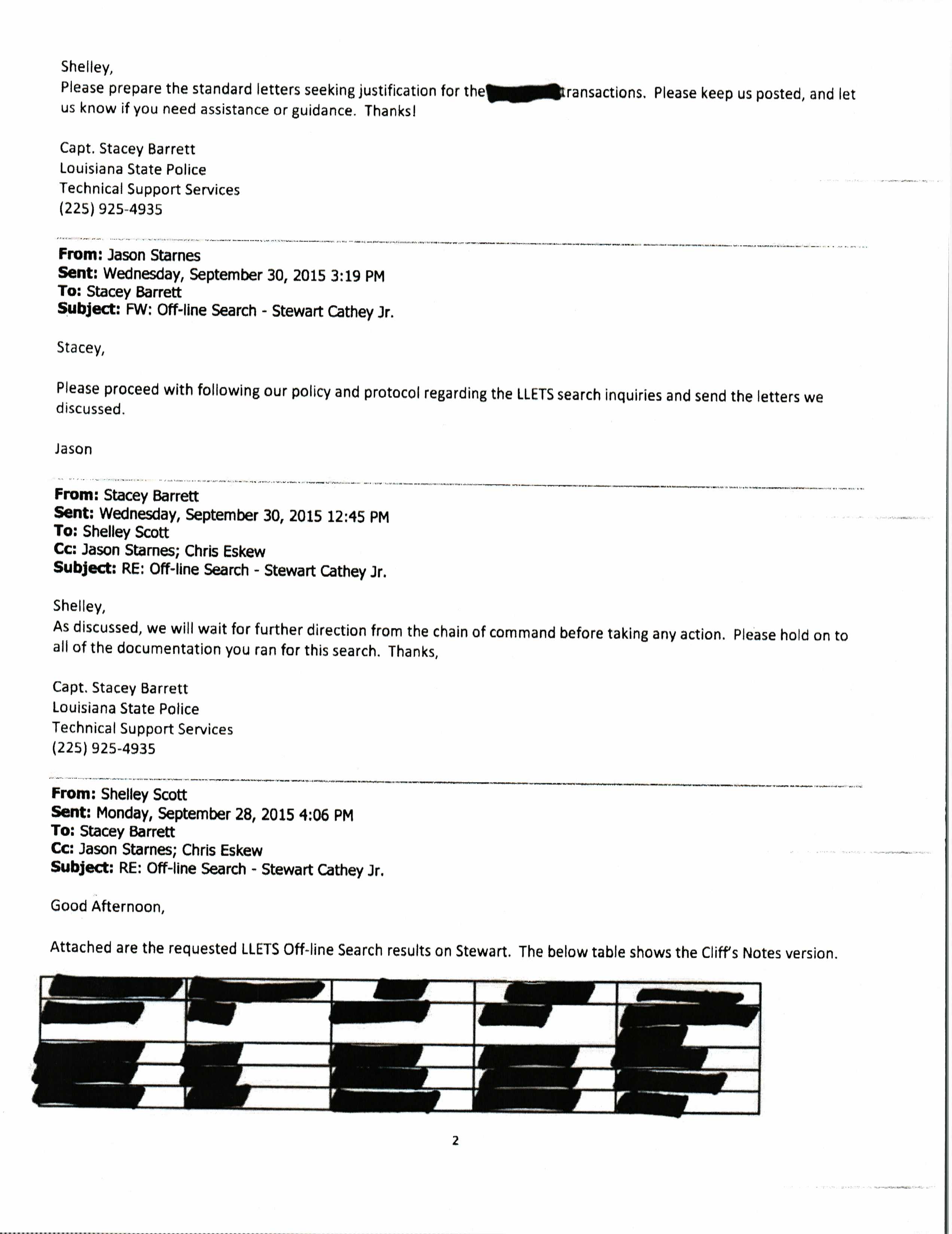
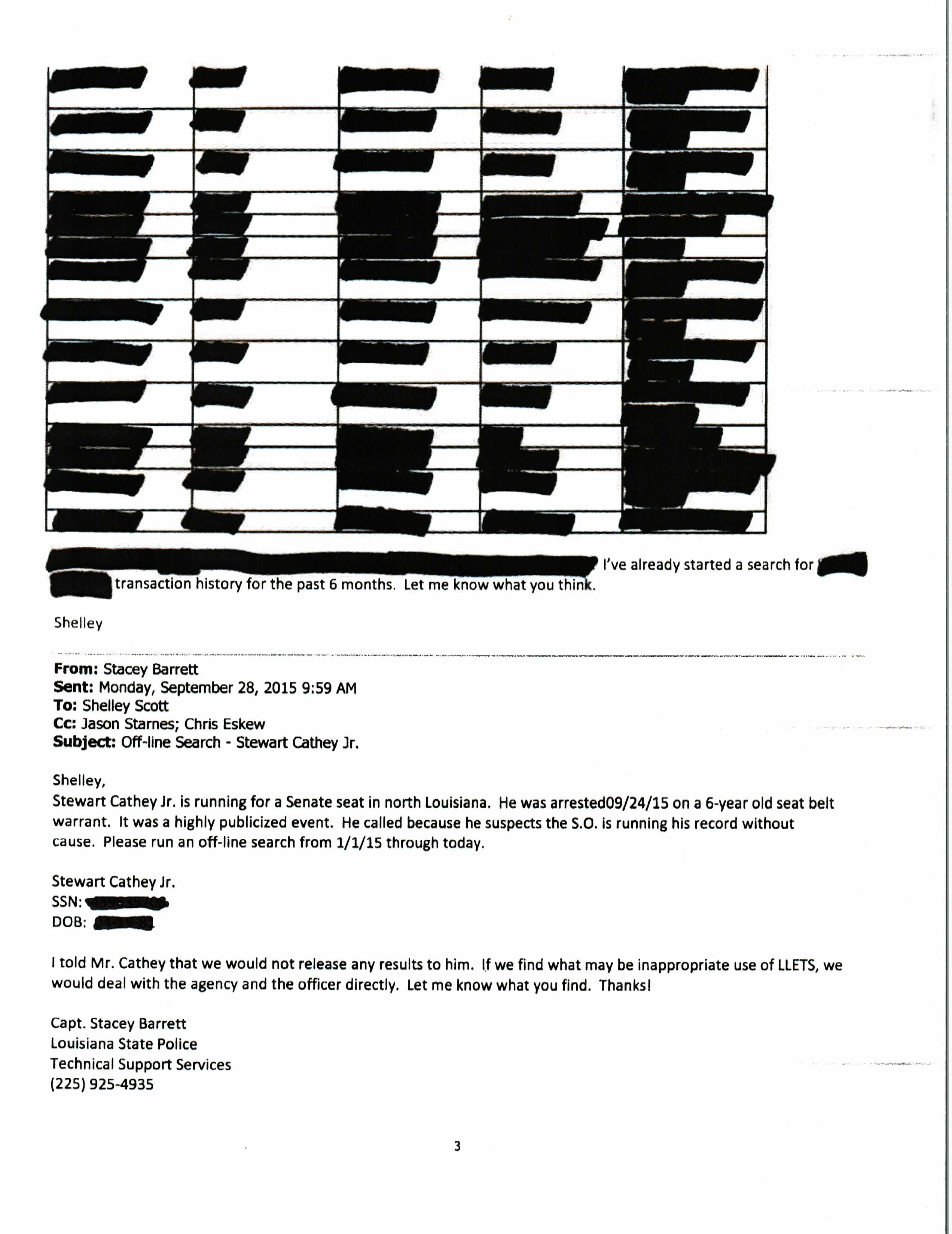
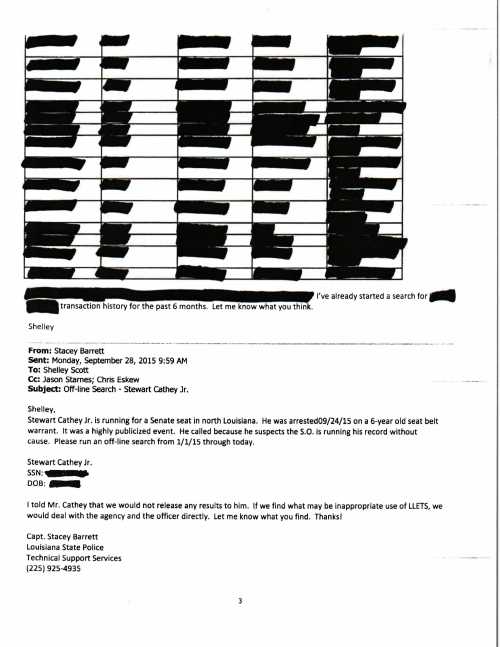 The email chain started with a message at 9:59 a.m. on Sept. 28 to criminal records analyst Shelley Scott from Capt. Stacey Barrett of LSP Technical Support Services:
“Stewart Cathey, Jr. is running for a Senate seat in north Louisiana. He was arrested on 09/24/15 on a 6-year-old seat belt warrant. It was a highly publicized event. He called because he suspects the S.O. (sheriff’s office) is running his record without cause. Please run an off-line search from 1.1.15 through today.
“I told Mr. Cathey that we would not release any results to him. If we find what may be inappropriate use of LLETS, we would deal with the agency and the officer directly. Let me know what you find.”
Maj. Jason Starnes and LSP Lt. Chris Eskew were also copied on that email.
At 4:06 p.m. that same day, Scott emailed Barrett, Starnes, and Eskew:
“Attached are the requested LLETS off-line results on Stewart. The below table shows the Cliff’s (sic) Notes version.”
What followed was the “section” alluded to by Aucoin as redacted. The redacted portion was a transaction history for a six-month period comprising about three-quarters of a page and containing 20 redacted lines which appeared to represent background searches or requests for same.
At 12:45 p.m. on Sept. 30, Barrett wrote to Scott, Starnes, and Eskew:
“As discussed, we will wait for further direction from the chain of command before taking any action. Please hold on to (sic) all of the documentation you ran for this search.”
At 3:19 p.m., Starnes responded to Barrett:
“Please proceed with following our policy and protocol regarding the LLETS search inquiries and send the letters we discussed.”
Finally, at 3:45 p.m., also on Sept. 30, Barrett emailed Scott and Eskew:
“Please prepare the standard letters seeking justification for the (redacted) transactions. Please keep us posted and let us know if you need assistance or guidance.”
The cryptic nature of the email communications is curious since routine public records requests do not normally attract such attention up and down the chain of command.
The timing of Cathey’s arrest, the reported discipline of an Alexandria municipal police officer for running a background check on Cathey, and the LSP emails and redacted reports, taken together, would seem to indicate there was some legitimacy to Cathey’s suspicions that someone deliberately sought to undermine his election campaign by initiating widespread background checks and even his arrest—complete with handcuffs—for an otherwise minor offense.
To add icing on the proverbial cake, Cathey said on Monday, Oct. 26, just two days after the Oct. 24 election, he was contacted by Monroe City Court and informed the charges against him for the seat belt violation were being dropped. He also said an investigation begun by the Office of Inspector General (OIG) was abruptly shut down with no explanation given.
No disrespect to the late Gertrude Stein, but there certainly appears to be a there there.
Edmonson had a reputation during his nine years at the helm of LSP as one who would dole out favors to legislators in efforts to ingratiate himself to lawmakers. A relay by state troopers to deliver football tickets to a legislator in New Orleans for an LSU national championship football game when she accidentally left her tickets in Shreveport is one example of that mindset.
Ordering background checks by LSP and/or requesting checks by other law enforcement agencies could be another example.
When contacted by LouisianaVoice about the possibility of an investigation into whether or not Edmonson had taken such action, Public Information Officer Doug Cain said unless a formal complaint was lodged by Cathey, LSP would not initiate an investigation.
After the OIG investigation was suddenly terminated, Cathey did not follow up with a formal complaint to LSP.
He is currently deployed to Puerto Rico where his unit is working on hurricane relief.