Feeds:
Posts
Comments

ALUMNI?

Among all the things in state government we could (and do) point out and complain about, this might seem a bit trivial.

But why, at an institution of higher learning, would someone attach this license plate frame to his vehicle when he is the only occupant?

“Alumni” necessarily implies multiple occupants, all of whom are proud graduates. The proper term should be “alumnus,” which is the singular form.

And lest you think I’m picking on LSU, be assured that other schools are equally guilty. Louisiana Tech, ULL, ULM, Southern, Nicholls State, Grambling, McNeese, Southeastern….all of ’em sell these frames in their gift shops.

So do Alabama, Mississippi State, Ole Miss, Auburn, Arkansas, Texas, Texas A&M, Georgia and most likely every other college and university in America—probably even the Ivy League schools.

Speaks wonders for higher education, does it not?

Oh well, just something I’ve wanted to get off my chest for quite a while.

By Stephen Winham, Guest Columnist

A Year After North Louisiana Flooded, seven Months after South Louisiana flooded, and while many are still trying to sort out their FEMA claims and other flood-related issues, we see the following headline about the much-touted “Restore Louisiana” program intended to bring additional aid the victims:

Louisiana scraps bids for flood recovery contract; governor’s office says redo shouldn’t cause delay [The Advocate, 3/18/2017]

http://www.theadvocate.com/baton_rouge/news/politics/article_a8f924c6-0b38-11e7-ad7b-3b13d83a0953.html

The day before, we saw much the same reported in the Greater Baton Rouge Business Report Daily Report PM.

 https://www.businessreport.com/article/state-cancels-250m-contract-award-flood-relief-program-will-restart-contract-procurement-process?utm_campaign=dr_pm-2017_Mar_17-15_16&utm_medium=email&utm_source=dr_pm

 Reading these reports and remembering that the first state program for flood victims, “Shelter at Home”, ended with decidedly mixed reviews, we might well ask what my headline does.

In addition to our governor, our congressional delegation has fought long and hard for the approximately $1.7 billion in federal support secured for our state’s “Restore Louisiana” program.  And, the governor is seeking even more federal funding for the program, despite the fact no money has yet been distributed.

The Restore Louisiana Task Force was created by executive order of the governor on September 2, 2016, to provide the program’s framework.  That was a good start, coming only 3 weeks after the south Louisiana Flood.  This 21-member panel held its first meeting in mid-September and our congressional delegation was able to get a commitment of some $500 million right away, something many considered remarkable.

The U. S. Department of Housing and Urban Development announced in mid-October the imminent release of 88% of the first $500 million grant.  About that same time, Hurricane Matthew struck other southeastern states, but that crisis was not expected to delay Louisiana’s grant.  By late October it was announced the initial $438 million would come in the form of semi-flexible HUD grants to be used for housing and small business needs.

In late October, the task force delayed making recommendations due to infighting among the members on fair distribution of the first $438 million while the governor was still promising to go for a total of $4 billion.  Basically, the members couldn’t decide who should get money first and how much they should get.  Sound familiar?  Surely politics was not at play here.

By the time Gov. Edwards went back to D. C. to beg for more money in early November (one of a total of 7 times he would do so), our congressional delegation was finding support difficult in light of the fact nothing had come of the initial $438 million to address purportedly emergency needs.  U. S. Rep. Garrett Graves (R-Baton Rouge) was particularly vocal about this.

In mid-November, the task force came up with a plan for $405 million of the money with priority on needs of the poor, elderly and disabled.  They correctly projected that jumping the many bureaucratic hurdles to implementation would likely require several months before the first dollar was actually used to repair or replace flood-damaged homes.

In early December, an additional $1.2 billion in funding began to make its way through Congress.  The estimated flood damage in the state totaled $8.7 billion with damage to over 113,000 homes.  The task force published an action plan for the initial aid to HUD to be submitted the first week of January 2017.

At the end of December HUD awarded the additional $1.2 billion, bringing the total to almost $1.7 billion available for the Restore Louisiana program.  All the money came with bureaucratic strings attached.  These strings were blamed for the continued delay.

In late January, the task force met to present a breakdown of how the money would be distributed.  Many people questioned the fact that 19%, or $315 million, was allocated for administrative costs.  Pat Forbes, director of the state office of Community Development said the 19% was a cap and that administrative costs would be kept as low as possible.  He also pointed out that administrative costs associated with Hurricane Sandy in 2012 were 45% of the total.

Now, consider that paragraph again.  Are we to believe we are getting a bargain if administrative costs are only 19%.  And, how can anybody justify administrative costs of 45% attributed to Hurricane Sandy?

In early March, the state awarded a contract for $250 million (about 15%) which was $65 million less than the second-place bidder (what a coincidence that this $315 million equaled the cap in the task force report).  Then, the second-place bidder filed a protest claiming the winner did not have the commercial contractor’s license required by law.  Other losing bidders were expected to follow suit.  Oddly enough, the State Licensing Board for Contractors pointed out in its ruling that neither the first nor second place bidders had the required license at the time they made the bids.  Imagine that.

The administration claims re-bidding will not further slow the program down because it will be possible to make a new award quickly.

A quote from the Greater Baton Rouge Business Report PM on March 17 by Rep. Graves:

“This is very disappointing news,” Graves says. “This will further delay the allocation of badly needed flood relief funds that we appropriated in September. It is impossible to explain to flood victims why $1.6 billion in recovery dollars are stuck in the bureaucracy, while homes remain gutted, moldy and uninsulated.”

I’m with Congressman Graves on this one. He has been rightly critical of the failure to implement this program for months. It doesn’t take a rocket scientist to know that it is utterly ridiculous to hold up funding for over a year for some people for an EMERGENCY from which they are still suffering.  To say the people needing this assistance are long overdue is to grossly understate the situation.

We all deserve to know what will be done for the $250 million (or more) in the management contract – What, exactly, is the contractor going to do and at what hourly and other rates? Have we considered it might be cheaper for the state to do this, even if it had to hire people on a temporary basis? The state already has at least some of the things in place the contractor may charge for based on responses to the original RFP.  I realize we have all been led to believe the state is incapable of doing anything cheaper than the private sector, but I’ve not seen enough evidence to convince me.

Examining the records of the task force shows it never actually predicted the money would start to flow to the people who need it before about now.  I honestly thought the timeline was much shorter and that we were willing to pay the exorbitant costs of the management contract because we needed the swiftest action possible. I certainly did not realize nothing was going to happen before now, so I clearly was not paying enough attention.  I have to believe I was not alone.

Since we are now going to start over with the award of the contract, I sincerely hope somebody will look very closely at the proposals to ensure we are paying a fair price for what we will be getting.  We’ve already wasted this much time on bureaucratic B. S. so why not spend at least a few days more before rushing into another contract.   Meeting HUD requirements would seem to be the current major holdup, so it’s not like taking a little more time now would be wasted and it could result in more money for those in need.

Note:  I must credit the excellent reports in The ADVOCATE by Elizabeth Crisp and Mark Ballard and in the Greater Baton Rouge Business Report by Stephanie Riegel upon which I based most of my research for this column.

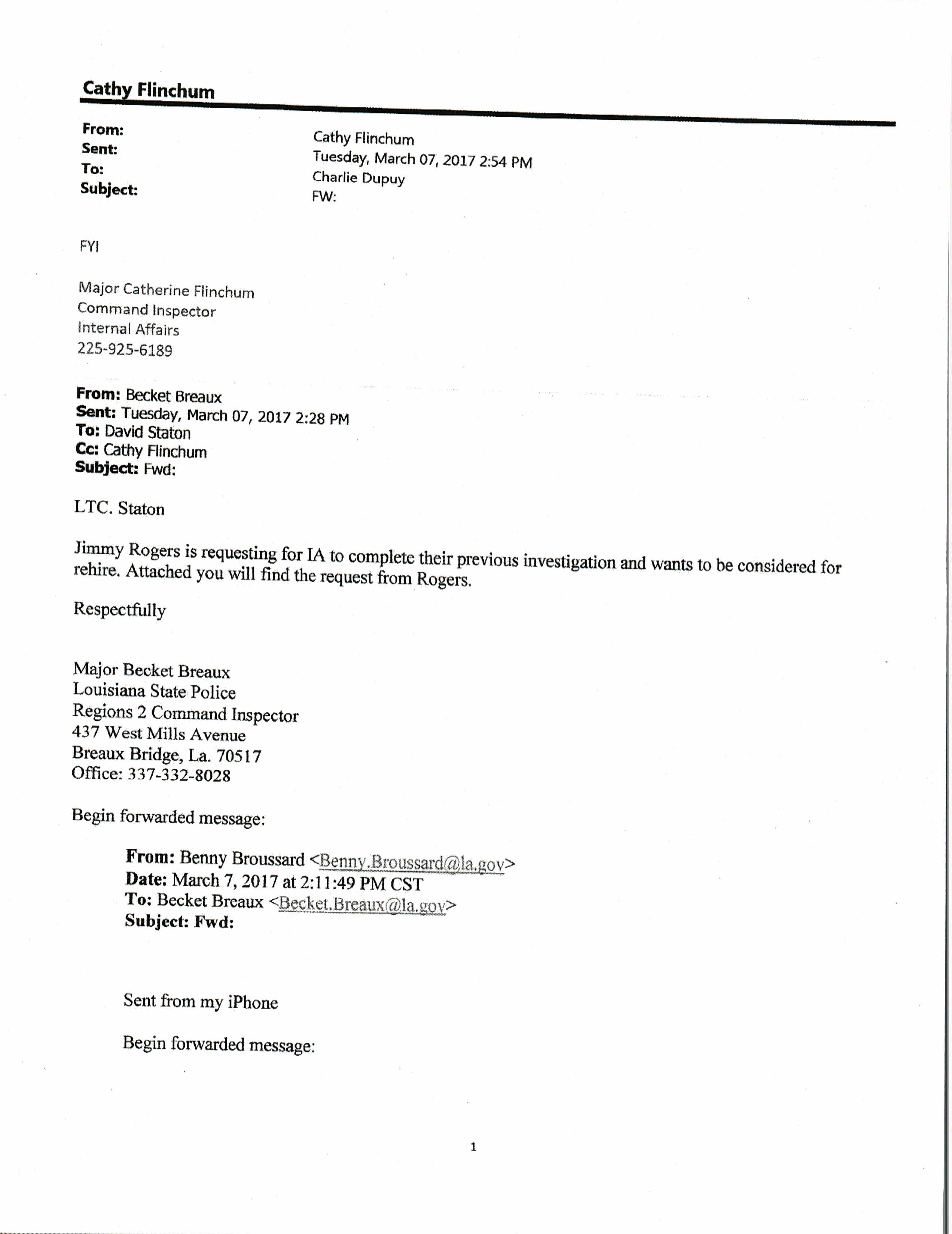
If there is one thing we’ve learned in the six-year existence of LouisianaVoice, it’s that if there is a political rumor floating around out there, there is generally at least a grain of truth to it.

That’s why there was no great surprise at the faint rumblings that the Louisiana Sheriffs’ Association might be making a quiet push for the appointment of Lt. Col. Charles Dupuy to succeed Mike Edmonson as Superintendent of State Police.

Never mind that in Wednesday’s meeting during which Edmonson told his staff he was stepping down, he is said to have accused Dupuy of undermining him in the aftermath of that ill-fated trip to San Diego that ultimately proved to be Edmonson’s undoing.

(Incidentally, that schmaltzy six-paragraph formal statement issued by Edmonson on Wednesday as he announced his retirement was written not by Edmonson, but by Ronnie Jones, Chairman of the Louisiana Gaming Control Board. Apparently, Edmonson was more comfortable with a ghost writer than in formulating his own, heartfelt statement.)

But back to the appointment of a successor to Edmonson.

Gov. John Bel Edwards will make the appointment and if he’s adept at political hindsight, he will proceed very carefully with making this decision. He has already been publicly embarrassed by bending to the will of the sheriffs in reappointing Edmonson. He should be extremely careful about heeding the advice of the sheriffs a second time.

If Edwards chooses to listen to the Louisiana Sheriffs’ Association (LSA) again without giving thorough and careful consideration to the qualifications of a number of capable, better qualified candidates, he will have proven himself as much of a political hack as anyone who has ever occupied the governor’s office.

There are several things the governor should consider before rushing in to anoint Dupuy as the next superintendent:

  • Dupuy is Edmonson’s second in command and as such, is very much a part of the overall problems of low morale now plaguing LSP—brought on by the proliferation of the good-ole-boy fraternity of upper management.
  • It was the state vehicle assigned to Dupuy—a Ford Expedition, that was driven by four troopers to that San Diego conference. That necessarily means Dupuy had to have approved the use of the vehicle for that purpose.
  • One of the occupants of that vehicle, Maj. Derrell Williams submitted expense reports that contained Dupuy’s signature of approval.

Dupuy was already a captain when Edmonson was appointed superintendent by Bobby Jindal in 2008. He was promoted to major on Jan. 28, 2010, two years after Edmonson’s appointment. Less than a year later, on Jan. 10, 2011, Dupuy was moved up to Deputy Superintendent for Operations Planning and Training.

Edmonson kept Dupuy on the career fast track, promoting him again on April 9, 2012, to Assistant Superintendent and Chief of Staff. Over that timeframe, Dupuy’s salary went from $80,000 to $161,300, an increase of 101.6 percent even as state civil service employees have been denied 3 percent cost of living increases.

Nor has that largesse been limited to Dupuy. His wife, Kelly Dupuy, was a sergeant making $59,800 when Edmonson was appointed top cop. Her acceleration through the ranks has been equally impressive. She was promoted to lieutenant on Oct. 27, 2009, just three months before her husband was promoted to major. She made captain on Oct. 25, 2014, and today makes $117,000 per year. That computes to a 95.6 percent pay increase since 2009.

Moreover, the current positions held by Kelly Dupuy and Edmonson’s brother, Maj. Paul Edmonson, did not exist before their respective promotions; their positions were created especially for them to be promoted into in the same manner in which a lieutenant colonel’s position was created last August at the specific request of Mike Edmonson on behalf of Jason Starnes.

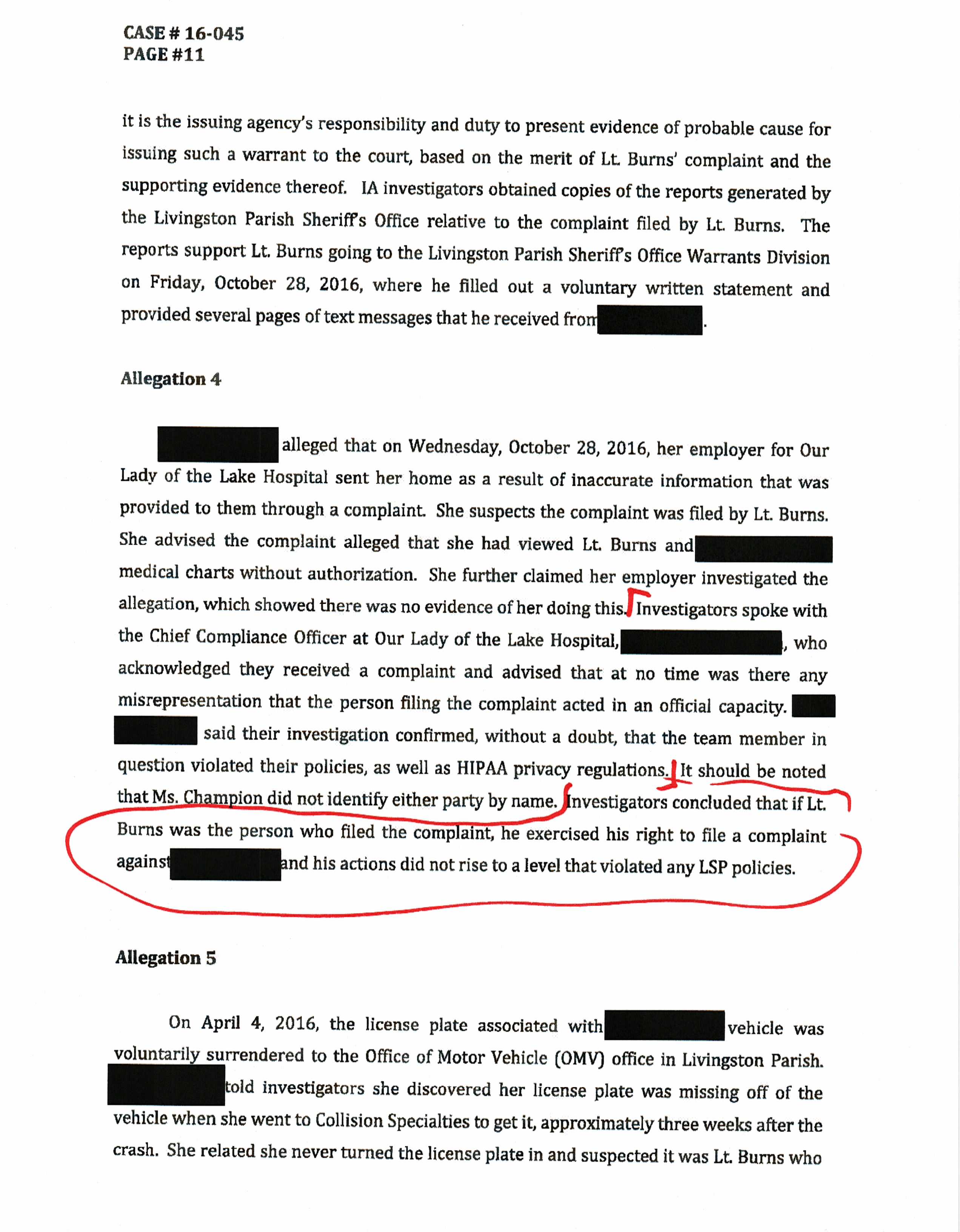
If all that is not reason enough to give pause to Edwards in his decision on a successor to Edmonson, consider that Dupuy was Edmonson’s hatchet man when Edmonson literally tried to destroy the career of one of his troopers over a largely manufactured incident in 2010—all because the trooper had been involved in a previous confrontation with Dupuy. https://louisianavoice.com/2014/08/21/a-word-of-caution-to-state-troopers-dont-anger-the-powers-that-be-if-you-dont-want-legal-problems-like-case-from-2010/

So now the apparent frontrunner for Edmonson’s job is Charles Dupuy. He is being supported by the sheriffs and the sheriffs have the ear of the governor. From our vantage point, it would seem that Dupuy is positioned perfectly to move into Edmonson’s chair and to wreak havoc on those he thinks may have been our sources.

And while it’s a point of some smug satisfaction to know that the people he suspects are not our sources (he’s not even close), it concerns us that he would use his newfound power and his vindictiveness to go after innocent people who have done nothing more grievous than to try to do their jobs in an honest, straightforward manner.

And nothing will have changed. The for sale sign will still be a fixture at LSP headquarters.

So, Gov. Edwards, be very careful. You have already made two serious mistakes in listening to the LSA and by acceding to its wishes in reappointing Edmonson and Secretary of the Department of Public Safety and Corrections Jimmy LeBlanc. The situation there is every bit as much a ticking time bomb as LSP. You can ill-afford another Angola scandal and you certainly do not need to appoint someone at LSP who is just going to be a continuation of the current problems.

Without cleaning house at LSP and without making a wise appointment of a new reputable colonel with no political baggage, you will only be setting yourself up for more political problems that you don’t need and which will doubtless be exploited by those who want to see you fail.

Even as the so-called mainstream media (and we’re not really certain what qualifies as “mainstream” anymore) shifts into its sympathetic mode for Superintendent of State Police Mike Edmonson, there are lots of loose ends still lying around that LouisianaVoice will continue to report.

As we wrote in Wednesday’s post, the controversy swirling around Louisiana State Police (LSP) headquarters in Independence Boulevard was never just about a trip to San Diego.

It’s about the overall atmosphere permeating the agency and trooper morale which is said to be at an all-time low. That’s because in spite of generous pay raises bestowed upon troopers, the rank and file feel the administration has put its own interests ahead of those of the agency and its personnel.

The parties, inconsistent discipline dictated by whether or not a trooper is a member of the elite clique, distinguished troopers passed over for promotions in favor of lesser qualified candidates, trips, many trips, taken by LSP management and not all strictly for business; and we have received reports of free trips, which would be in violation of regulations set forth by the State Ethics Board.

GENERAL PROHIBITIONS (R.S. 42:1111 – 1121)

  1. 1115 – Elected officials and public employees are prohibited from soliciting or accepting a gift from the following persons: persons who have or are seeking to obtain a contractual or other business or financial relationship with the public servant’s agency; or persons who are seeking, for compensation, to influence the passage or defeat of legislation by the public servant’s agency. Public employees, not elected officials, are also prohibited from soliciting or accepting a 4 gift from the following persons: persons who conduct operations or activities regulated by the public employee’s agency; or persons who have substantial economic interests which may be substantially affected by the performance or non-performance of the public employee’s official duties.

There are events and conditions not yet reported but which will be. And they are scattered throughout the organization, from LSP to the Louisiana State Troopers Association (LSTA), and the Louisiana State Police Commission (LSPC). Especially LSPC, which is charged with overseeing State Police in the same manner as the Civil Service Commission oversees the rights of state civil service employees. That one commission, chaired by a State Trooper, has purged its membership if all but one member who is not easily identified as an Edmonson supporter and has morphed into something of a secretive club now rumored to be carrying on extra-curricular activities far outside the scope of its mission.

And one other facet of operations at LSP largely overlooked up to now is the issue of overtime hours. While troopers charged with carrying out investigations of criminal activity are finding it next to impossible to get overtime approved from their superiors and are forced to conduct investigations on their own time, others are finding it much easier to pad their paychecks.

Take Master Trooper Thurman D. Miller, for example.

Miller, who serves as President of the CENTRAL STATE TROOPERS COALITION, which is affiliated with the National Black State Troopers Coalition, is called the “One Man Overtime Machine” by his fellow troopers, though probably not to his face.

It’s a title well-earned.

From last June 20, 2016, through March 12 of this year, Miller has reported working 1,066 hours of overtime. Of that amount, he was paid time-and-a-half for 951 hours with the balance of 115 hours taken as compensatory, or K-time, meaning he gets paid leave for a like number of hours worked.

That works out to nearly 60 hours of combined overtime and K-time for every two-week pay period since last June—75 percent of a regular two-week, 80-hour pay period.

Miller, who makes $72,600 in regular salary, earned $50,400 in straight time during that period and nearly matched that amount in overtime earnings of another $45,900. Plus, he accumulated almost three weeks extra paid vacation.

So, not quite having worked 70 percent of a year since last June, he already has been paid 131 percent of his base yearly salary.

But the real kicker is found in his daily time sheets.

For example, during one stretch last August when his time sheet shows that he was assigned to disaster relief while working the South Louisiana floods, he logged 24-hour days for four consecutive days.

But that’s nothing. The month before, working extra security in the wake of the Alton Sterling shooting in Baton Rouge, iron-man Miller logged 24-hour shifts for nine consecutive days.

State Police Public Information Officer Maj. Doug Cain said there are provisions for allowing troopers to be called in on emergency duty and not allowed to go home. “They sleep 20 or 30 minutes and go back on duty,” he said.

And on that infamous drive to San Diego in October, Miller initially reported two consecutive 24-hour shifts on Oct. 11 and 12 followed by a 22-hour shift on the 13th, but was forced to trim 12 hours off each of the 24-hour claims of Oct. 11 and 12 and to eliminate altogether the 14-hours overtime claimed for Oct. 13 in a revised timesheet. It was not immediately known if he was paid for the excessive hours and required to repay the state or not.

Here are a few samples of Miller’s timesheets (Click on images to enlarge):

Cain said that during the flood, state offices were closed and Miller and other officers were compensated for hours state offices were closed and for hours actually worked.

The LSP Policy Manual specifically addresses the issue of excessive overtime:

Officers/Civilians shall not work more than a total of 16 cumulative hours without having a rest period of 8 consecutive hours off-duty. An 8 hour rest period shall be required following 16 cumulative work hours before returning to regular duty or an overtime assignment. Exceptions to the 16 hour rule require the approval of the Troop/Section Commander or designee. Cumulative hours are defined as any combination of regular work hours and/or overtime/details.

Commanders and supervisors are urged to exercise caution and sound judgment when considering whether to allow an officer/civilian to work more than 16 cumulative hours.

Troop/Section Commanders, Region Commanders and Unit Supervisors are responsible for effectively managing work schedules to minimize overtime.

 Reasonable justification shall mean that the work could not be performed by other on-duty personnel or that time constraints require that the work be immediately performed.

 If overtime is necessary, every effort to minimize the total accumulation shall be made by all supervisory personnel.

Miller, it should be pointed out, works in Operations and not Investigations. And while he’s racking up all that overtime, there are troopers spread across the state who need overtime to complete ongoing investigations but cannot get approval for it.

They do their investigations on their own time which somehow makes the whole picture seem a little out of kilter.

Yet another symptom of a much large problem that is plaguing LSP.

“According to Edmonson, the new governor told him on the night of the election, at a party at the Hotel Monteleone, that he had never even considered another candidate for superintendent.”

Baton Rouge Advocate story of March 15, 2017.


“Please tell me your intentions as to the re-appointment of Mike Edmonson.”

Tom Aswell

From: John Bel Edwards Sent: Tuesday, October 27, 2015 12:50 PM To: Tom Aswell Subject: Re: QUESTION

I don’t intend one way or the other.


Email exchange between LouisianaVoice Publisher Tom Aswell and gubernatorial candidate John Bel Edwards on Oct. 27, 2015.

BOTTOM LINE? Someone’s lying.