Feeds:
Posts
Comments

No sooner than we post our story about Public Service Commissioner MIKE FRANCIS lobbying for a return of the free lunch for PSC members than we get an anonymous tip about another of those furtive bills sneaked through on the final day of last year’s legislative session—a-la the infamous 2014 Edmonson Amendment—which apparently renders Francis’ effort moot.

Put another way, the most expensive free lunch in Louisiana history is now the order of the day.

An amendment tacked onto an otherwise innocuous bill goes much further than even Francis intended, however.

While the bill itself was not initially identified by our source, it was passed unanimously by both the House and Senate and signed into law by Gov. John Bel Edwards, we’re told. More specific information will be forthcoming as we learn more about the amendment.

Details are still sketchy at this point but all elected state officials, as well as appointed members of boards and commissions, will receive gourmet lunches catered by two of Baton Rouge’s most expensive restaurants whenever they convene in Baton Rouge. The menu will range from prime steaks to prime rib to lobster—and more, much more.

That includes not only the 144 members of the legislature for every day the legislature is in session and when members attend committee meetings throughout the year, but the LSU Board of Supervisors, the University of Louisiana System Board, the Board of Elementary and Secondary Education (BESE), the PSC, the Insurance Rating Commission, and hundreds of other boards and commissions as well.

The amendment also increased the cap on the amount that can be spent on meals by 70 percent, from $50 to $85. That does not include the cost of drinks, which also will be provided gratis for elected and appointed officials.

The new law, while exempting those officials from the $50 cap, leaves the limits in place for state employees.

The cost of this newest perk is expected to easily exceed $1 million per year just for legislators. The countless members of boards and commissions who meet throughout the year in Baton Rouge who also will be eligible for the new perk will increase that cost even more, though there is no way to calculate how much that will be.

But there apparently will be no cost to taxpayers since lobbyists will be responsible for payment of the cost of the meals and drinks. Various special interests will pick up the tabs on a rotating basis with Oil and Gas interests buying one day, banks the next, then private prisons, etc., for legislators.

For the individual boards and commissions, those interests with the most to gain from legislation will be participating. Utility, pipeline, cable TV and trucking companies, for example, will split the costs for PSC members with insurance companies sharing the cost for the Insurance Commissioner and the Insurance Rating Commission, private prisons will be treating members of the Pardon and Parole Board, and charter and voucher schools will strap on the feedbag with BESE members.

Opposition, albeit nearly a year too late, was nevertheless easy to find. Attorney General Jeff Landry blamed Gov. John Bel Edwards for letting the amendment slip through. “I am dedicated to protecting the interests of the voters on matters such as this and the governor obviously is not. That’s why when I’m elected governor, I will work diligently to repeal this amendment. I’m putting legislators on notice right now: if you sponge off lobbyists and take advantage of senior citizens, children, conservative, patriotic, anti-Islamic Republican voters, I’m coming after you.”

His words were echoed by U.S. Sen. John Kennedy, who said, “I supported Donald Trump from day one and you oughta carry a handgun. I have also always said we don’t have a revenue problem in Louisiana, we have a spending problem. This proves it. Legislators make between $32,000 and $66,000 a year, including their $159 per diem for each day they’re in Baton Rouge. When I’m governor, they’ll buy their own damn lunch. And they can drink weed killer.”

Legislators contacted by LouisianaVoice were surprisingly candid in their support of the amendment.

“Look, we have to eat, too,” said Rep. Carl Spackler of Shongaloo. “We come down here every year and in the past we’ve had to scramble to find lobbyists who will buy us dinner. Lunch is usually out of the question because we’re tied down at the Capitol during the day and we have to settle for the lousy food in the cafeteria. And a lot of evenings, it’s raining out and we get soaked running from our cars to the restaurant. And don’t even talk to me about the Baton Rouge traffic. It’s hardly worth the free steak and Merlot Cabernet Franc.”

Sen. William J. Le Petomane of Mamou agreed. “We come here and listen to all the whining from state agencies about budget cuts. I only get to see my girlfriend when I’m here in Baton Rouge and my constituents really cut into my time with her. I got her a job with the state but she’s pretty high-maintenance, so these meals will free up per diem money that I can spend on little gifts to keep her happy. In that regard, the amendment will be added incentive for us to do our jobs when we’re in town.”

Lobbyist Al Cverzik, who represents the Louisiana Nutria Preservation League, said the easing of restrictions on meals and drinks will give lobbyists greater access to legislators. “We have to compete with all these ordinary citizens to get our message across. Well, we have a right to be heard, too. Having a sit-down with them over a porterhouse steak and a glass or two of whatever will help us immensely.”

The bill goes into effect today—just in time for the upcoming legislative session which kicks off on April 10, a week from this Monday.

The shakeup continued at Louisiana State Police (LSP) Friday afternoon with the reduction in rank of former Superintendent Mike Edmonson’s top aid and heir-apparent and the promotion and reassignment of two others, according to the email below that was sent out to all LSP personnel:

From: Rhonda Fogleman On Behalf Of Deputy Secretary
Sent: Friday, March 31, 2017 2:45 PM
To: _DPS_Personnel
Subject: Transfer & Promotion Effective March 31, 2017
Importance: High

The following personnel changes are made effective at close of business on Friday, March 31, 2017:

Major Mike Noel transferred and promoted to Lieutenant Colonel, Interim Assistant Superintendent/Interim Chief of Staff

LTC Charlie Dupuy transferred and reassigned as Major, Command Inspector, Training

Major Frank Ducote transferred and reassigned as Major, Command Inspector, Patrol Operations/Region I

Authority of:   Colonel Kevin Reeves, Superintendent

In another development, LouisianaVoice has learned that Lt. Stephen Lafargue has resigned his position as trustee for the Louisiana State Police Retirement System. He was considered one of six Edmonson supporters on the board which will take up Edmonson’s retirement later in April.

Dupuy, once the odds-on favorite to eventually move into Edmonson’s position, was implicated in that October trip to San Diego by Edmonson and 16 subordinates to see Edmonson receive a national award. The four who drove to San Diego via Las Vegas and the Grand Canyon did so in the state vehicle assigned to Dupuy.

Maj. Noel, who previously served as a command inspector for the Gaming Division, will take over as lieutenant colonel in the position of Interim Assistant Superintendent and Interim Chief of Staff to Col. Kevin Reeves who assumed Edmonson’s duties last Saturday.

Noel, a veteran of 27 years with LSP was earning $140,900 as a major but will receive a significant pay increase to $161,300 as lieutenant colonel as he takes over the day-to-day operations of LSP.

Those at LSP who are familiar with Noel told LouisianaVoice he was a good choice for the position. “He’s an excellent choice,” said one trooper who asked not to be identified. “He’s even-handed and has a great disposition. Col. Reeves couldn’t have picked a better person for the job.

Ducote’s reassignment to the position previously held by Reeves was described as a lateral transfer. He presently earns $140,900.

Dupuy, on the other hand, will realize a significant reduction in pay to $140,900 from his current level of $161,300 as he returns to the position he held at the State Police Training Academy before being tapped by Edmonson as his chief of staff.

It may not be the last change at LSP as Reeves settles into his position One State Police insider said the transfer of Dupuy could signal that the Reeves appointment by Gov. John Bel Edwards and the Noel appointment are permanent instead of interim and that more demotions, transfers and retirements could be in the offing.

Others who might yet be transferred to other positions include Master Trooper Thurman Miller, Lt. Col. Jason Starnes who now presides over the Management and Finance Section, and Trooper T.J. Doss who currently serves as the State Trooper representative and as chairman of the Louisiana State Police Commission. Doss has been considered by some as Edmonson’s plant on the commission. Doss, from Ruston, has been TDY’d (assigned temporary duty) to Baton Rouge and presently resides at the State Police Academy.

The shakeup at LSP has been a long time coming as the agency has been buffeted by one damaging story after another—all reflecting on Edmonson’s leadership and administration of some 1,500 troopers statewide.

The San Diego trip was the tipping point as Edwards seemed determined to stick by his decision to reappoint Edmonson following his election in 2015 despite the controversy swirling around LSP. Edmonson had the support of the Louisiana Sheriffs’ Association which had endorsed Edwards in his runoff against former Sen. David Vitter.

Even before the San Diego trip, there were disciplinary problems, illegal campaign contributions and other issues that proved to be a source of constant embarrassment to the governor.

LSP is currently under investigation by the Division of Administration, the Legislative Auditor’s Office, and the FBI, all of which eventually forced Edwards to make the decision to allow Edmonson to announce his retirement, which took effect March 24.

When Edwards appointed Reeves to succeed Edmonson, there was speculation within the department that Edwards had prevailed upon Reeves to retain Dupuy as chief of staff to mollify the sheriffs but with Dupuy’s demotion and transfer, that now appears not to have been the case.

LSP public information officer Maj. Doug Cain said Reeves has had a busy first week in his new leadership role. “He’s been meeting with (Department of Public Safety) unit heads and senior staff within LSP in an effort to communicate his agenda for the department.”

Maybe it’s just us, but it seems a lot of meetings weren’t necessary to know there is a real problem at LSP. But the first step in resolving problems is to first acknowledge them.

While much has been written lately here and by other news outlets about overtime abuse by Louisiana State Police (LSP), particularly on that infamous trip to San Diego back in October, there is a program whereby State Troopers may legitimately accrue overtime through an agreement with local district attorneys

The Local Agency Compensated Enforcement (LACE) detail is a program established pursuant to an agreement between LSP and the district attorneys whereby fines collected by the local criminal court fund may be used to pay State Troopers overtime pay for additional highway patrols for traffic enforcement.

Prior to implementing a LACE program, the local law enforcement, judges and district attorneys must agree to implement the program, and the criminal court fund authorized by Louisiana R.S. 15:571.11(L) may be used to fund the overtime pay off-duty police officers to provide law enforcement services.

In 2011, the latest year for which figures are available, Louisiana State Police issued 120,437 speeding citations on LACE and 68,932 on regular duty, according to the 2012 annual report of the Louisiana Highway Safety Commission. With these combined resources, Louisiana experienced a 10.46 percent decrease in speed-related fatalities in 2011.

The program has not been without controversy as LouisianaVoice has found troopers, particularly in Troop D in Lake Charles, who were allowed to work LACE while suspended from regular duty for disciplinary reasons.

But what happens when a local district attorney signs on to the program and then doesn’t pay State Police for the overtime?

Well, since the troopers performed the work, they must be paid so the money comes from the LSP budget instead of from fines collected by the local jurisdiction as was the original intent.

That’s exactly what has happened in St. Landry Parish where the parish is in arrears by more than $290,000 for 11 months, from March 2016 through January of this year.

Because of the district attorney’s failure to pay, LSP has suspended LACE activity for St. Landry Parish.

The monthly amounts owed LSP by St. Landry District Attorney Earl Taylor range from $17,870 for August 2016 to $39,392 for January of this year, according to a month-by-month accounting provided by LSP pursuant to a LouisianaVoice public records request.

Charles Cravins, formerly the regional director for the Fourth Congressional District, serves as Taylor’s Chief Administrative Officer, lending credence to the idea that he would be the one to see that the bills are paid. The District Attorney’s Web page boasts, that Cravins’ “extensive administrative experience” and his background in public service “makes him well equipped to handle the day-to-day operations of the D.A.’s office.”

So how did St. Landry manage to get 11 months in arrears (not counting February or March of this year)?

“I have no idea,” said LSP public information officer Maj. Doug Cain.

Could it be because so many cases are nolle prossed?

“No way,” says a retired State Trooper. “With the income they generate from tickets, they have plenty of money to pay LSP.”

He’s probably right, considering I-49 runs through St. Landry which provides a ready-made money machine for traffic courts from Lafayette to Shreveport.

Perhaps a better question is why did LSP allow Taylor to ignore his obligations for long while continuing to assign troopers to LACE duty in St. Landry?

Perhaps Taylor is about to make efforts to finally bring his account current.

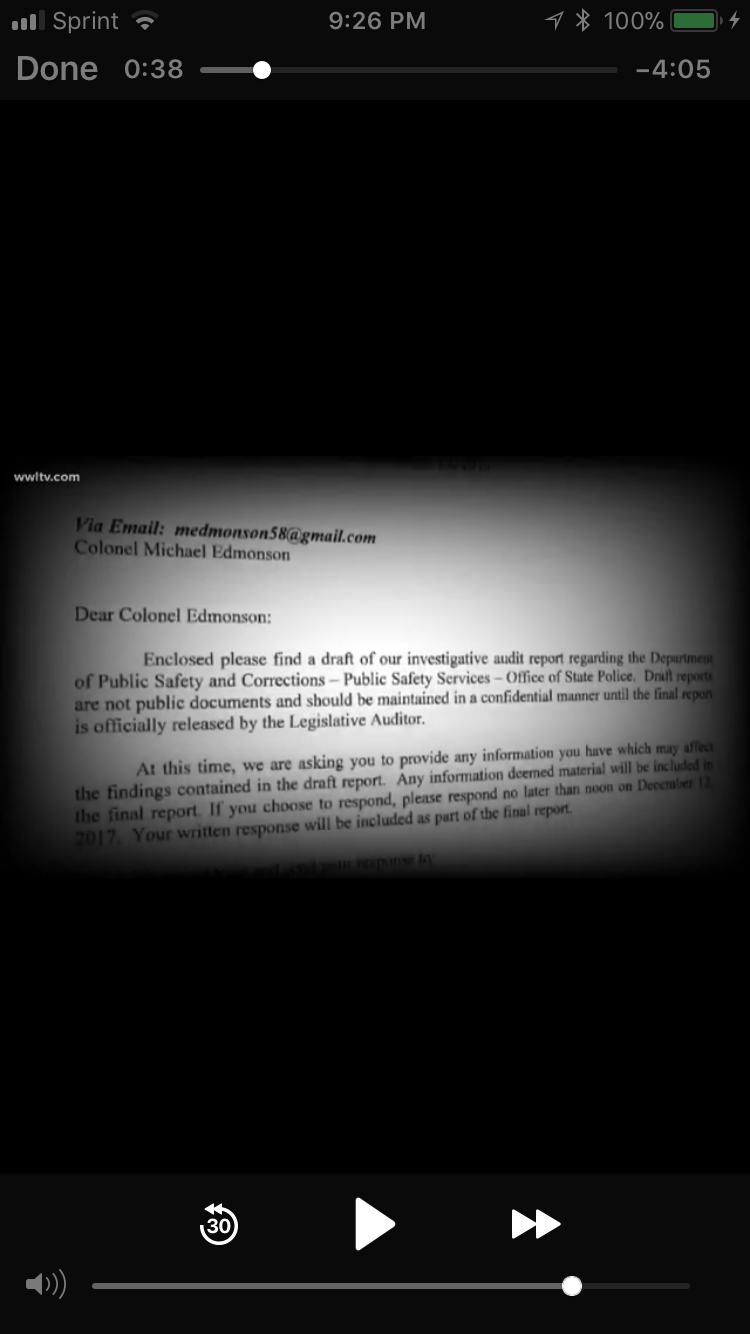
In a two-page letter to Taylor dated March 22—two days before State Police Superintendent Mike Edmonson’s retirement took effect—LSP Assistant Secretary and General Counsel Gene Cicardo referenced a payment schedule the district apparently has agreed to. Cicardo asked that Taylor sign and return a copy of the letter “to memorialize our agreement” so that LSP may be paid for its work and so that it may reinstate the LACE program for St. Landry.

It must be nice when you can get the rules written just for you.

There must come a time when even the most disinterested, blasé, apolitical person living has to look up from whatever else occupies his interest and say, “Wait a damned minute. This just ain’t right and we’re not gonna do it.”

Or, as Peter Finch as Howard Beale in the classic movie Network would say: “I’m mad as hell and I’m not going to take it anymore!”

Just when you think you heard the last of Mike Edmonson, the erstwhile Superintendent of State Police, he comes back to haunt us and taunt us.

Remember way back in 2014 when LouisianaVoice first made you aware of SB 294, signed into law by Bobby Jindal as ACT 859? The bill, authored by Sen. Jean-Paul J. Morrell (D-New Orleans),  appeared only to deal with procedures for formal, written complaints made against police officers.

But thanks to a little back room deal between Edmonson Chief of Staff Charles Dupuy and State Sen. Neil Riser (R-Columbia and an announced candidate for State Treasurer), a last-minute amendment was tacked onto that bill that, contrary to verbal assurances to legislators that the bill would cause no financial impact, would have actually given Edmonson an additional $50,000 or so in retirement income.

Thanks to a timely anonymous letter informing us of the amendment, we were able to break the story and the resulting furor over that was such that State Sen. Dan Claitor (R-Baton Rouge) filed suit in 19th Judicial District Court to block the raise that Edmonson was already being forced to disavow. District Court Judge Janice Clark threw out the law.

Why?

Because Edmonson voluntarily and of his own free will chose some years earlier to lock his retirement in at $76,000 by entering into the state’s Deferred Retirement Option Plan (DROP) while he was still at the rank of captain. That decision, which is considered irrevocable, locked in his retirement at a rate based on his captain’s pay while netting him a higher salary at the time.

But now he’s back and because of a rather complicated quirk in the law—applicable, apparently, only to State Police—it appears he will get that extra retirement income after all—not $76,000 as dictated by his decision to enter DROP way back when, but $128,559, according to Jim Mustian’s Baton Rouge ADVOCATE online story.

Here is the way Retirement says it’s calculated, according to one retired Trooper:

Act 1160 relative to the re-computation of the pre-DROP benefit and the pre-DROP final average compensation applies to you if (1) you participated in DROP on or before June 30, 2001, 2) continued in state police employment after participation in DROP without a break in service, and (3) remained in such continuous employment on or after July 1, 2001. These special provisions do not apply to members who retired on or before July 1, 2001.

If You Entered DROP With 25 Years or More of Hard State Trooper Service:

Pre-DROP Benefit – If you meet the criteria set forth in (1), (2), and (3) above, and you entered DROP with 25 years or more of hard state trooper service, you are eligible for a re-computation of your pre-DROP benefit at 3 1/3% multiplied by the number of years of service to your credit prior to your effective date of participation in DROP, and further multiplied by your final average salary as computed when you entered DROP.

Post-DROP Benefit – Your post-DROP benefit will be calculated at 31/3% multiplied by the number of years of service to your credit after DROP participation, and further multiplied by your final average compensation. The final average compensation used will be the average determined at the beginning of DROP, or, a new current final average if you worked for an additional 12 or 36 months (based on your hire date).

If You Entered DROP With Less Than 25 Years of Hard State Trooper Service:

Pre-DROP Benefit – If you meet the requirements stated above and you entered DROP with less than 25 years of hard state trooper service, you may also be eligible for a re-computation of your final average compensation based on your hard 25th year of trooper service (or your highest 12-month average if you have not reached your 25th year) for the purpose of determining your new pre-DROP benefit. This re-computation of the final average salary will be based on any 12-month period of service (but limited to the first 25 years) while a member of LSPRS regardless of hire date.

Post-DROP Benefit – Your Post-DROP benefit will be calculated at 3 1/3% multiplied by the number of years of service to your credit after DROP participation, and further multiplied by the greater of 1) your final average salary as determined when we recomputed your pre-DROP benefit, or 2) your current final average compensation based on a 12-month average regardless of hire date.

The sum of any re-computed pre and post DROP retirement benefit shall not exceed 100% of your current final average compensation.

For purposes of determining the average compensation based on the first 25 years, (1) “state trooper service” does not include military service purchased, actuarially transferred service, or reciprocally recognized service, or any form of purchase of service credit, and (2) “average salary” does not include overtime, expenses, clothing allowances, or any remuneration resulting from military service.

If you are eligible for a re-computation under Act 1160, this does not change the amounts credited to your DROP account. The re-computation is for the monthly benefit amount you receive upon retirement only.

Got it?

Didn’t think so.

But the overriding question that’s impossible shake is this: If this rule existed, why was it necessary back in 2014 to try and sneak the benefit increase through the legislature as an amendment to an otherwise harmless bill?

Something doesn’t pass the smell test here and when you take a look at the makeup of the State Police Retirement System’s Board of TRUSTEES, six of whom are either active or retired State Troopers, the odor doesn’t get any better.

The bottom line here is this:

Whether or not special provisions are in place for State Troopers to circumvent the irrevocable provisions of DROP, if the State Police Retirement System’s Board of Trustees goes forward with giving Edmonson this $128,559, every single state employee who ever opted to enter DROP at any time should retain legal counsel and go after the additional retirement funds to which he or she is entitled.


“As an outsider (not living in Louisiana) doing disaster work in Louisiana, corruption is one element that defines Louisiana’s culture. There are many beautiful elements to your culture; corruption is not one of them. The voters talk about corruption as most people talk about their favorite sports team. You need to change it.”

—A reader whose comment says more about the ethos of corruption and the resignation to low expectations of our state leaders than anything anyone else could ever write. We should all be embarrassed and outraged over the manner in which the flood recovery is being handled.