Feeds:
Posts
Comments

First and foremost, there is nothing in the job description requirements that says the Secretary of the Louisiana Department of Health (LDH) must—or should—be a physician.

Nor does the state receive any benefit from the secretary’s maintaining a medical license or credentials and board certifications.

So, why should the head of the state’s largest department devote so much time, effort, and manpower on attempts to secure her professional credentials outside her state job?

Dr. Rebekah Gee was appointed Secretary of LDH by Gov. John Bel Edwards in January 2016 as he came to office. Prior to that, she was employed by the LSU HEALTH SCIENCES CENTER (LSUHSC) in New Orleans where she served as an obstetrician/gynecologist and as assistant professor of health policy and management.

So, it stands to reason that any attempt by LDH Secretary Dr. Rebekah Gee to pursue negotiations with LSU to retain her medical license, credentials, and board certifications through continued part-time employment as a physician at LSUHSC would be done on her own behalf and at her personal legal expenses.

Certainly, rank-and-file state employees must adhere to strict guidelines regarding the use of state computers, email addresses and telephone numbers—not to mention the taboo of calling on state attorneys to do private legal work on state time and state equipment.

Instead, following her appointment as secretary, she apparently directed the department’s legal counsel to pursue negotiations with LSU on her behalf on state time and using his state email address and signing off on his email correspondence with LSU as the executive counsel for the department.

Included in the email thread were negotiations on Dr. Gee’s behalf for her to retain her tenure at LSU (pretty difficult, considering her status was reduced to unpaid volunteer) and for LSU to pony up the premiums to keep her medical malpractice insurance from lapsing—a pretty generous financial windfall in its own right.

And all that doesn’t even address the apparent conflict of interest in her performing work for an agency overseen by—and which receives funding from—the department which she now heads.

As they say, rank does have its privileges and the series of emails back and forth between executive counsel Stephen Russo and LSU officials appears pretty rank.

Gee’s APPOINTMENT was announced on Jan. 5, 2016, and before she could even get settled into her office, the email campaign by Russo had begun in earnest.

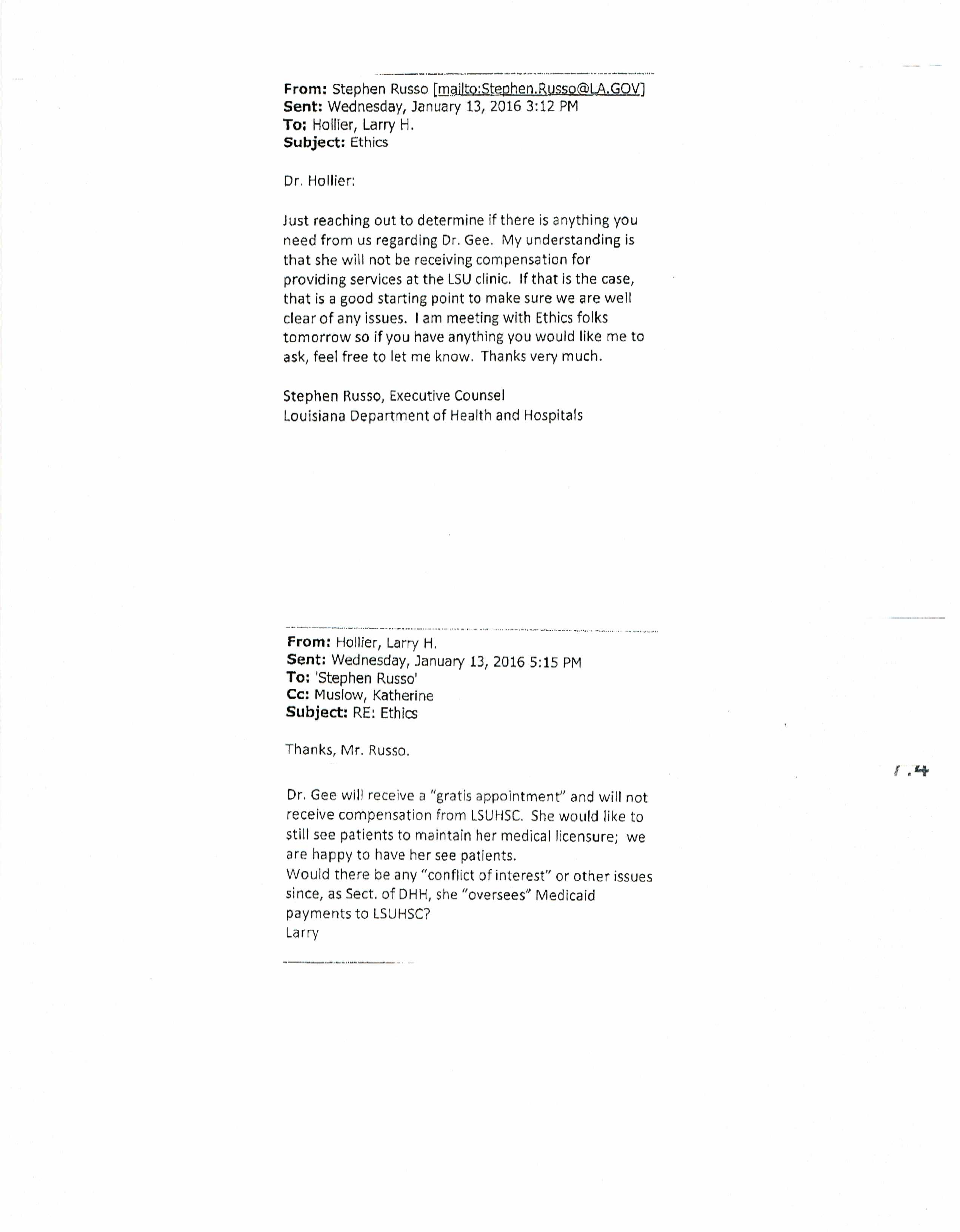
At 3:12 p.m. on Jan 13, Russo emailed LSUHSC Chancellor Dr. Larry Hollier to ask “if there is anything you need from us regarding Dr. Gee. My understanding is that she will not be receiving compensation for providing services at the LSU clinic. If that is the case, that is a good starting point to make sure we are well clear of any issues…”

At 5:15 p.m. that same day, Hollier responded: “Dr. Gee will receive a ‘gratis appointment’ and will not receive compensation from LSUHSC. She would like to still see patients to maintain her medical licensure; we are happy to have her see patients. Would there be any ‘conflict of interest’ or other issues since, as Sect. of DHH (since renamed LDH), she ‘oversees’ Medicaid payments to LSUHSC?”
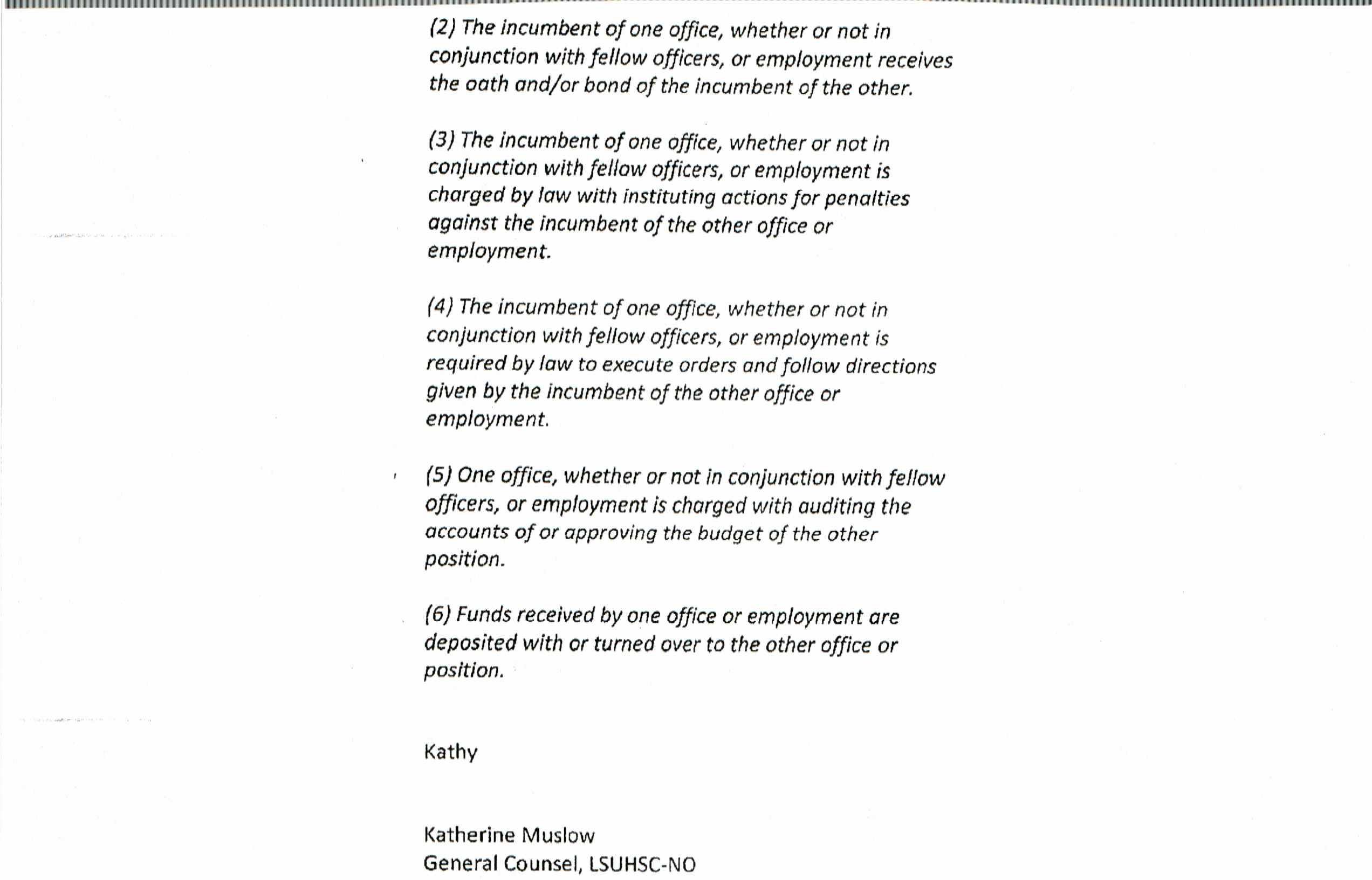
The following day, Jan. 14, LSUHSC General Counsel Katherine Muslow emailed Russo at 1:36 p.m. to say, “In addition to the prohibitions provided in the Governmental Code of Ethics, the incompatibility provisions of (state statutes) should also be reviewed for applicability.”

She then went on to list six “incompatibility provisions” which she seemed to feel would prohibit Dr. Gee from working even as a volunteer for an agency partially funded by the department that she headed.
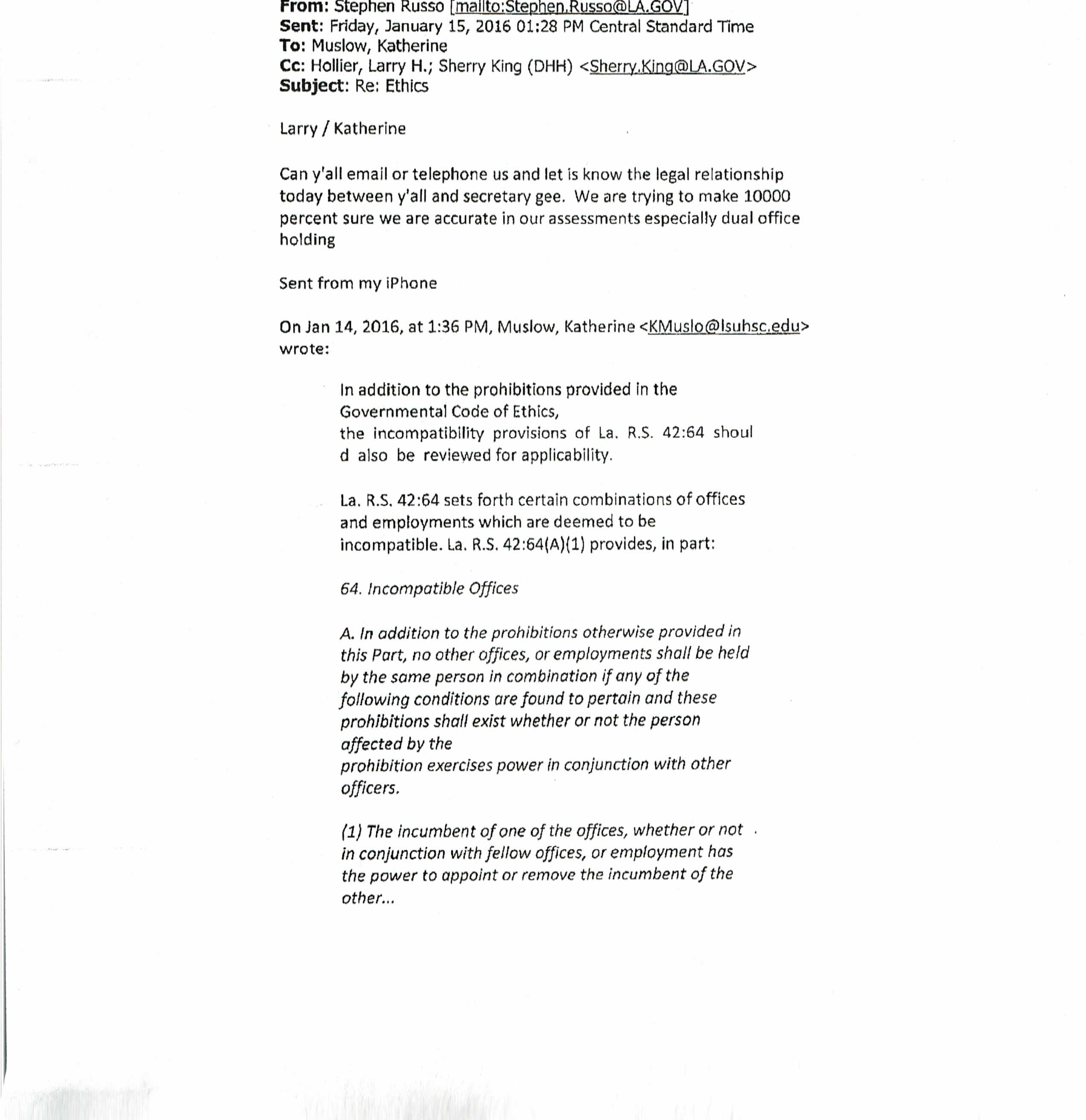
On Jan. 15, Russo, still on the state clock at 1:28 p.m. and still on a state computer, wrote LSUHSC General Counsel Katherine Muslow and others from his state email account to ask that “y’all email or telephone us and let is (sic) know the legal relationship today between y’all and secretary gee (sic).”

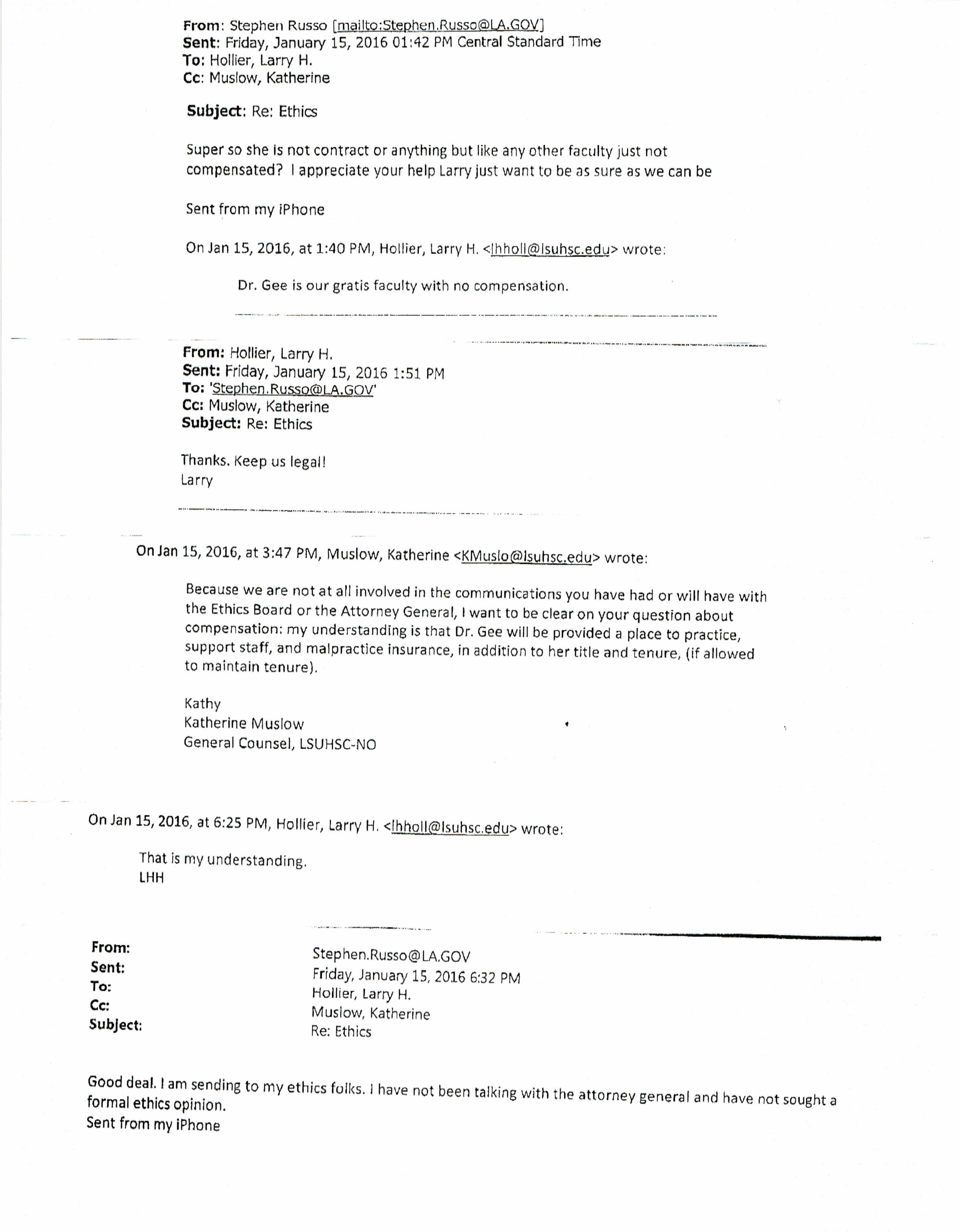
At 1:40 p.m., Dr. Hollier emailed Russo to reiterate that Dr. Gee “is our gratis faculty with no compensation.”

Two minutes later, Russo, apparently having not fully digested the content of Muslow’s list of reasons why Dr. Gee could not work for LSU (and too excited to bother with punctuation), responded to Hollier: “Super so she is not contract or anything but like any other faculty just not compensated?”

He finally got around to responding to Muslow at 6:32 p.m. that day: “Good deal. I am sending to my ethics folks. I have not been talking with the attorney general and have not sought a formal ethics opinion.”
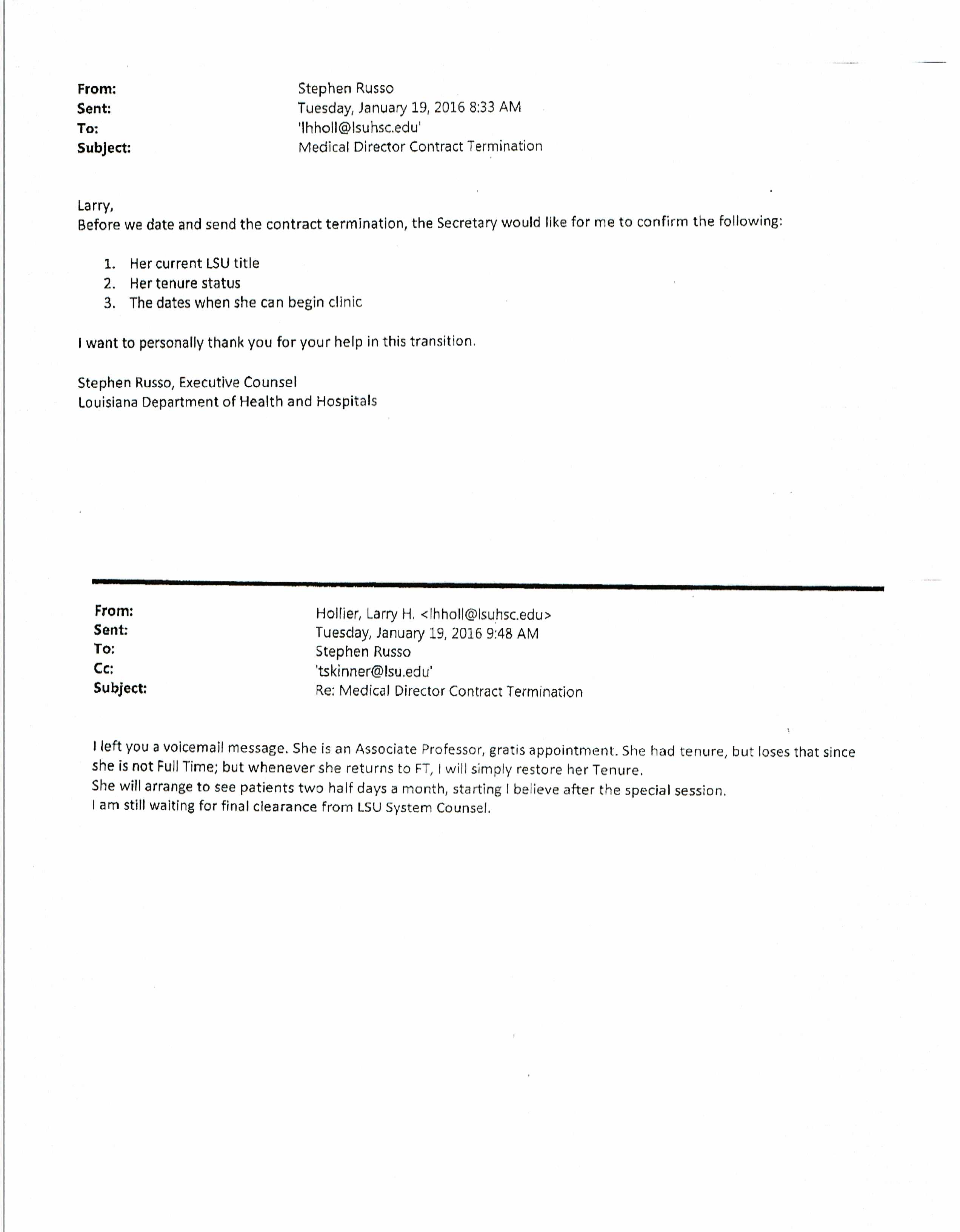
On Jan. 19, Russo was back at it early, emailing Hollier at 8:33 a.m. to discuss the termination of the contract between LDH and LSUHSC for the Medicaid Medical DIRECTOR position, the position Dr. Gee had held at LSUHSC. “Before we date and send the contract termination,” he wrote, “the Secretary (Dr. Gee) would like for me to confirm the following:

  1. Her current LSU title;
  2. Her tenure status;
  3. The dates when she can begin clinic.”

At 9:48 a.m., Hollier responded: “She is an Associate Professor, gratis appointment. She had tenure but loses that since she is not Full Time; but whenever she returns to FT (full time), I will simply restore her Tenure. She will arrange to see patients two half-days a month, starting I believe after the special session. I am waiting for final clearance from LSU System Counsel.”
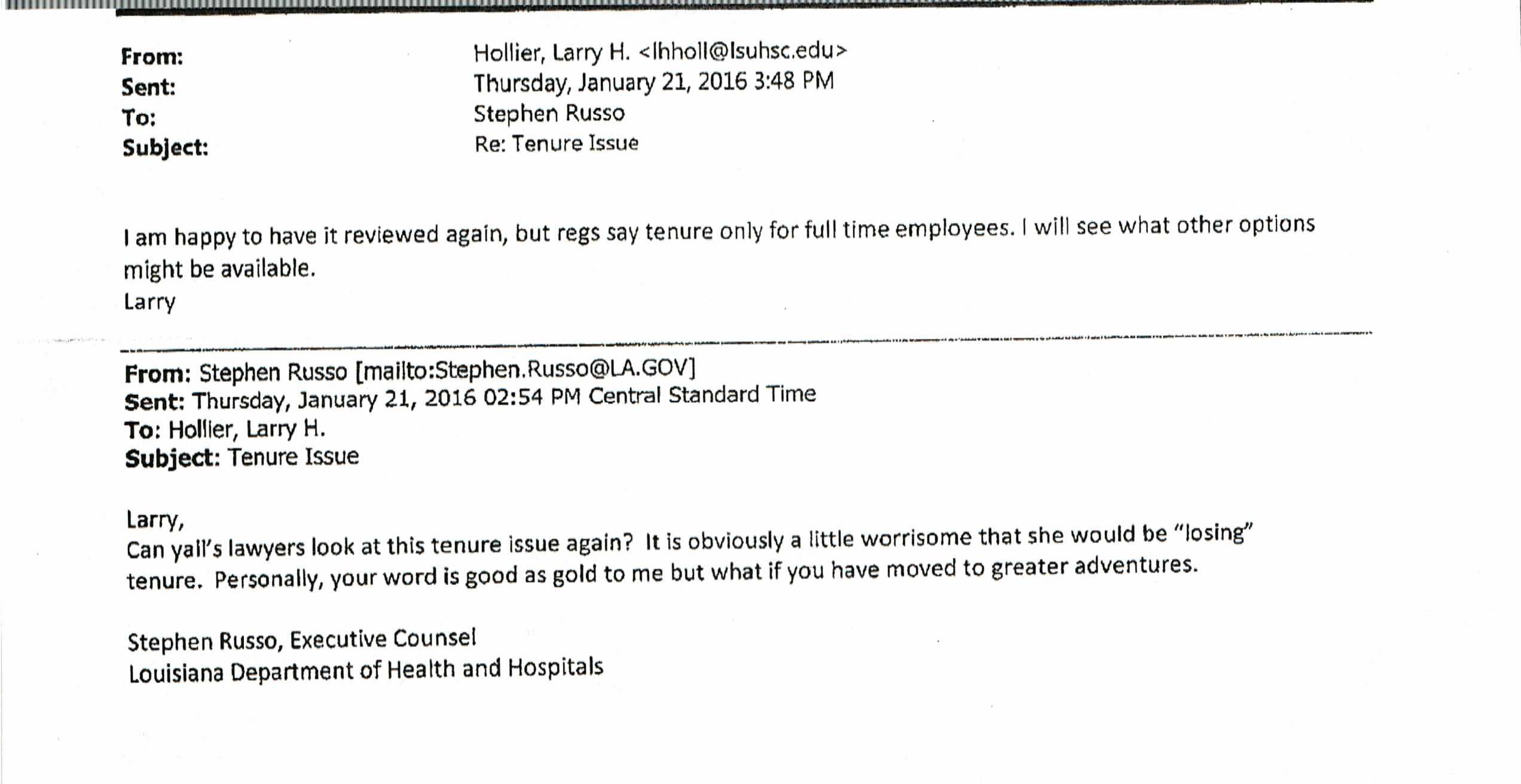
The news about Gee’s loss of tenure must’ve thrown Dr. Gee and by extension, Russo, into a tizzy. On Jan 21 at 2:54 p.m., Russo emailed Hollier: “Can yall’s (sic) lawyers look at this tenure issue again? It is obviously a little worrisome that she would be ‘losing’ tenure. Personally, your word is good as gold to me but what if you have moved to greater adventures.”

“I am happy to have it reviewed again,” answered Hollier at 3:48 p.m., “but regs say tenure only for full time employees. I will see what other options might be available.”
So, bottom line, what we have here is the secretary of a state department:

  • Working for an agency over which her department has jurisdiction;
  • Attempting to retain tenure from her old job even though state regulations clearly say an employee must be full time to earn or keep tenure;
  • Attempting to have the state pay for her medical malpractice insurance;
  • Instructing a subordinate (legal counsel Stephen Russo) perform private legal work on state time and on state equipment on behalf of her efforts to retain private part time employment.

As the late C.B. Forgotston would say, you can’t make this stuff up.

LouisianaVoice makes an effort to give a voice to the people who go about their lives every day trying to pay bills, educate their kids, make their lives a little better and plan for retirement honestly and without taking advantage of others.

It is you who have made this a great country, not the politicians, the bankers, the oil and pharmaceutical companies. My job at LouisianaVoice is to keep that message in front of those who think their money and power gives them the right to decide our lives.

My heroes are not the ones who make movies, throw touchdown passes, or scream political slogans—from either side of the aisle. My heroes are teachers, honest cops who have compassion, Doctors Without Borders, those who fight for the rights of women, minorities and anyone else who is discriminated against or taken advantage of by those in position to do so just because they can. No one has the right to attack another’s dignity or self-worth.

None of you will agree with everything I write. We’re human and we’re not going to agree all the time. But one donor said he nevertheless supported what I am doing. That is the spirit with which I hope my readers will always approach LouisianaVoice just as I defend every reader’s right to disagree with me.

If you agree with what I try to accomplish—informing readers about our elected and appointed officials who try to use their offices to further their own interests—please do what you can to help us during our April fundraiser.

I come to you, hat in hand, twice a year—April and October. Your assistance helps me pursue public records, ward off the occasional lawsuit filed to shut me up (I’ve won two of those and lost none, but it costs money to do so), pay for gasoline and vehicle maintenance for those road trips that have become more regular as I have expanded my coverage throughout the state.

Anything you can afford is appreciated more than you know—no matter how large or small. Please help by clicking on the yellow DONATE button to the right or send your check to:

LouisianaVoice

P.O. Box 922

Denham Springs, Louisiana 70727

Thank you.

Tom Aswell


With a flurry of (count ‘em) 37 bills dealing with gambling gaming, there is probably none more interesting to the folks in Tangipahoa Parish than identical bills introduced in the Senate (SB-417) and House (HB-438) that would facilitate the move of a Bossier Parish casino to property along the Tangipahoa River.

Brent Stephens is owner of the current license for Diamond Jacks in Bossier City. He and his company, Peninsula Pacific, acquired the license for Diamond Jacks in June 2016 after Legends, the previous owner, was released from bankruptcy the previous year. Stephens operates at least two other gaming properties in Louisiana—the Amelia Belle in Amelia in St. Mary Parish following Hurricane Katrina, and Evangeline Downs in Opelousas in St. Landry Parish.

His first choice for relocating Diamond Jacks was Lake Pontchartrain in St. Tammany Parish but he encountered a couple of insurmountable snags: he couldn’t get political support and he couldn’t find any landowners willing to sell.

He then turned his attention to Tangipahoa Parish and was initially looking at sites around Manchac adjacent to I-55 but abandoned that idea for reasons known only to him.

He then settled on an area south and west of Hammond along I-12.

And though the governor has made a point of staying out of all the gaming legislation (with the exception of two: a non-gaming-related proposal involving Harrah’s Casino in New Orleans and one to permit gaming on land within 1200 feet of an authorized berthing site, both of which he supports, he has said he would sign the Tangipahoa Parish bill if it made it to his desk.

And that is one great big IF—as in, not likely.

Despite strong support from Parish President Robby Miller, the parish council, and 48 percent and a large contingent still undecided among Tangipahoa Parish voters, there remains two chances—slim and none—that the Tangipahoa River will become a Mecca for casino gamblers.

That’s because of the formation of a rather unique alliance against the proposal: Tangipahoa Parish churches and video poker.

Whoever coined the phrase that politics makes strange bedfellows was dead right. There can be no stranger bedfellows than fire-and-brimstone-breathing protestant ministers and video poker operators.

And while ministers can exert considerable influence, video poker operators are every bit as powerful, if not more so. That’s because while casino operators are prohibited from making political contributions, there are no such restrictions on the video poker industry.

Video poker interests are well-represented on both sides of the legislative aisles, meaning they spread a lot of campaign money around and enjoy substantial influence at the capitol.

Throw in State Rep. Sherman Mack and you have some formidable opposition.

  • Mack, from the Livingston Parish town of Albany, just happens to be Chairman of the House Criminal Justice Committee.
  • Mack is casting a lustful eye at the district attorney’s office for the 21st Judicial District which includes the parishes of Livingston, St. Helena and….Tangipahoa.
  • That office is currently occupied by four-term DA Scott Perrilloux who is considered vulnerable.
  • Mack does not want to be labeled as a “pro-gaming” legislator should he decide to challenge Perrilloux.

HB-438 was introduced by Rep. Stephen Pugh (R-Ponchatoula) and SB-438 by Sen. Bodi White (R-Central). Only White’s bill has made it out of committee (on March 20) and it now awaits debate on the Senate floor. Should it pass the full Senate, it will then be sent to Sherman’s committee where in all likelihood, it will die an ugly death.

And therein lies the real political story.

The bill does two things:

  • It authorizes the Tangipahoa River as a designated waterway on which gaming may be conducted, and
  • It calls for a parish-wide referendum.

But in case it passes the full Senate, makes it out of Mack’s Criminal Justice Committee, and gains approval by the full House, then and only then does the proposal move onto the State Gaming Board which would have to approve the move.

Because the Tangipahoa is barely large enough to entertain tubers and the occasional Bateau boat, it ain’t about to accommodate a full-blown floating casino. The alternative would be a “free-standing” casino and the odds of that getting approved are pretty long.

Just another example of the interesting political issues that color Tangipahoa Parish.


“Extending the doctrine of judicial immunity to include civil liability for alleged criminal conduct, as in this case, risks undermining the public’s trust in the judiciary, which I cannot countenance.”

—First Circuit Court of Appeal Judge William Crain, in his dissent in Wednesday’s decision that 4th JDC judges were entitled to “absolute judicial immunity” even though a lawsuit said all five judges were complicit in protecting a court clerk who was said to have destroyed court records.

“Judicial immunity is of the highest order of importance in maintaining an independent judiciary, free of threats or intimidation. But it is a judge-created doctrine policed by judges.”

—More of Judge Crain’s dissent.

Anyone remember Allyson Campbell?

If not, that’s understandable. After all, it’s been a couple of years since we had a STORY about her exploits in the 4th Judicial Court in Monroe. She’s the Monroe News-Star society columnist who showed up occasionally at her supposed full-time job as law clerk for 4th JDC Judge Wilson Rambo (gotta love that name; wonder if they have a judge named Rocky?).

On Wednesday, 12 of the 13 judges of the First Circuit Court of Appeal (only Judge Curtis Calloway did not hear arguments) dealt the self-promoting columnist/clerk a major setback when it ruled in an en banc (full court) decision that she does not enjoy “absolute immunity” from her actions in destroying court files and that a lawsuit against her may go forward.

But it was the dissenting opinion of one of the three judges who gave written opinions that makes for the best reading.

The ruling comes nearly two years after Louisiana Inspector General STEPHEN STREET found there was no “sufficient cause” to bring charges against Campbell for what witnesses said were repeated instances of her destroying or concealing trial briefs. For that matter, Louisiana State Police and the Louisiana Attorney General’s office also declined to pursue the matter, leaving only one state official, Legislative Auditor Daryl Purpera, with the integrity and courage to call Campbell out for her actions.

She was also the central figure in:

  • The controversy that erupted when the Ouachita Citizen made a legal request for public records from the court—and was promptly sued by the judges for seeking those same public records.
  • The filing of a lawsuit by Judge Sharon Marchman against four fellow judges and Campbell over Campbell’s claiming time worked when she was actually absent—including time when she was in restaurants and/or bars for which she claimed time—and the four judges who Judge Marchman said were complicit in covering for her.
  • A complaint by Monroe attorney Cody Rials that Campbell had boasted in a local bar that she had destroyed Rials’ court document in a case he had pending before Judge Carl Sharp so that Sharp could not review it. One witness interviewed by Judges Sharp and Ben Jones quoted Campbell as saying that she had “taken great pleasure I shredding Rials’ judgment” and that she had given Rials a “legal f—ing.”

Now a DECISION by the First Circuit Court of Appeal, in overturning a lower court’s 2015 decision, has held that a lawsuit by Stanley Palowsky, III, against Campbell for damages incurred when she “spoliated, concealed, removed, destroyed, shredded, withheld, and/or improperly handled” his petition for damages against former business partner Brandon Cork may proceed.

At the same time, the First Circuit ruled that the five judges he added as defendants—Stephens Winters, Sharp, Rambo, Frederic Amman and Jones—for allowing Campbell “free rein to do as she pleased and then conspiring to conceal (her) acts” enjoyed “absolute immunity” from being sued and were dismissed as defendants despite their repeated denials that any documents were missing from the Palowsky file.

Palowsky argued that Campbell undertook her acts with malice and to obtain advantages for his opponents in the lawsuit. Moreover, he argued that Campbell’s supervising judges, Amman and Rambo, “did not just sit back quietly and let Campbell commit such acts, they actively worked and schemed to cover up her actions.”

Palowsky also said that Campbell’s wrongdoings “have been reported time and again by different attorneys in different cases and investigated time and again by defendant judges but have nevertheless been allowed to continue. It is now painfully apparent that not only has Campbell been unsupervised and uncontrollable for years, but defendant judges have actively schemed to allow her conduct to continue unabatedly (sic).”

Campbell, who doubles as a society columnist of sorts (if one really stretches the definition of the term) for the News-Star, is obviously her own biggest fan—unless you count her stated infatuation for Cork’s attorney Thomas Haynes, III, about whom she wrote in one of her columns that he…had the “IT” factor, “a somewhat undefinable quality that makes you and everyone else around stand taller when they enter the room, listen a little more closely, encourage you to take fashion or life risks, make each occasion a little more fun and generally inspire you to aim to achieve that ‘IT’ factor for yourself.”

If they taught that method of courtroom coverage in my Louisiana Tech journalism classes, I must have been absent that day.

Needless to say, the First Circuit upheld the lower court in expunging that paragraph from Palowsky’s petition.

In fact, the lower court struck 46 paragraphs from his lawsuit against Campbell and the five judges, but the First Circuit restored 21 paragraphs to the petition. The 25 it allowed to remain removed involved matters not directly related to Campbell’s alleged destruction of files, the judges said.

In 2014, Campbell published a column entitled, “A Modern Guide to Handle Your Scandal,” in which she wrote, “Half the fun is getting there, and the other half is in the fix.” She then went on to advise her readers to “keep the crowd guessing. Send it out—lies, half-truths, gorilla dust, whatever you’ve got.” She told readers, “You’re no one until someone is out to get you.”

(There’s a line in there somewhere about Trump, but it’s just too easy.)

In July 2015, she wrote in her column, “It’s not cheating if it’s in our favor.”

That paragraph was removed from Palowsky’s petition as was one that noted that on one occasion, 52 writ applications went missing for more than a year before it was discovered that Campbell had used the applications as an end table in her office.

Say what?!!?

One paragraph left in the petition was one in which Palowsky pointed out that the five judges might not be out of the woods yet, if the Louisiana Judiciary Commission does its job. The Louisiana State Constitution provides as follows: “On recommendation of the judiciary commission, the (Louisiana) Supreme Court may censure, suspend with or without salary, remove from office, or retire involuntarily a judge for willful misconduct relating to his official duty, willful and persistent failure to perform his duty, persistent and public conduct prejudicial to the administration of justice that brings the judicial office into disrepute, conduct while in office which could constitute a felony, or conviction of a felony.”

It would appear in consideration of the judicial protection of Campbell, a case could be made that the judges are guilty at least of slipshod management at best and criminal malfeasance at worst.

All the judges in the 4th JDC recused themselves when Palowsky sued and his case was heard by Ad Hoc Judge Jerome Barbera, III, who cited in his Dec. 11, 2015, ruling dismissing the five judges as defendants an 1871 ruling that said, “It is a general principle of the highest importance to the proper administration of justice that a judicial officer, in exercising the authority vested in him, shall be free to act upon his own convictions, without apprehension of personal consequences to himself.”

Even though Palowsky was claiming that the judges protected Campbell despite their full knowledge of what she had done, Barbera said, “Allegations of bad faith or malice are not sufficient to overcome judicial immunity.”

Another way of putting it is that the judges are untouchable and that their edicts, like those of the Pope, are infallible, divinely inspired.

Barbera extended the immunity to Campbell but the First Circuit opinion, written by  Judge Page McClendon, overturned Barbera on that point. While two of the Appeal Court judges, Vanessa Whipple and Guy Holdridge upheld immunity for the five district court judges in their written opinions, all three rejected the idea of immunity for Campbell and all three voted to reinstate 21 of the paragraphs in Palowsky’s petition.

But it was that third judge, William Crain, who wrote that none of the defendants deserved immunity from events in the 4th JDC.

“Judicial immunity is of the highest order of importance in maintaining an independent judiciary, free of threats or intimidation. But it is a judge-created doctrine policed by judges.” (emphasis mine)

He also said that when judicial actors “perform non-judicial acts, they are not protected by this otherwise sweeping immunity doctrine.

“The duty to maintain records in cases involves many non-judicial actors and can only be considered a ministerial, not judicial act,” he wrote.

“For the same reasons (that) the law clerk is not immunized for her non-judicial acts related to maintaining court records, the judges are not immunized for allegedly aiding, abetting, then concealing those acts. Failing to supervise a law clerk relative to a non-judicial act is not a judicial act for purposes of immunity.

“The doctrine of judicial immunity does not shield judicial actors from civil liability for criminal acts (and) while later cases suggest judicial immunity extends even to judicial acts performed with malice, those cases do not immunize judicial actors from criminal conduct grounded in malice or corruption.

“Extending the doctrine of judicial immunity to include civil liability for alleged criminal conduct, as in this case, risks undermining the public’s trust in the judiciary, which I cannot countenance.”

So, how, you might ask, has Campbell managed to withstand the barrage of charges of payroll fraud, absenteeism, records destruction, and critical audit reports and still keep her job?

And continue to flaunt her actions in a newspaper column?

That can be explained in one word: Connections.

Campbell’s father is George Campbell, an executive with Regions Bank. George Campbell is married to the daughter of influential attorney Billy Boles who was instrumental in the growth of Century Telephone and who is a major contributor to various political campaigns.

Allyson Campbell is also the sister of Catherine Creed of the Monroe personal injury law firm of Creed and Creed. Christian Creed, Campbell’s brother-in-law, contributed $5,000 to Attorney General Jeff Landry’s 2015 campaign, which could explain, in part, why the AG backed off its investigation of Campbell the following year.

In a town the size of Monroe, those connections are sufficient, apparently.