Feeds:
Posts
Comments

Archive for the ‘Media’ Category

Cue Aretha Franklin.

R.E.S.P.E.C.T

What does the Louisiana Tech baseball team have to do to earn a little respect from The Baton Rouge Advocate?

It’s nothing new, of course. Years ago, before e-mail and other electronic media, we were told by The Advocate Sports Department that Tech wasn’t calling in results of its football game—only we happened to know they were.

And then we’ve heard the latest excuse for ignoring the Bulldogs: Tech is out of The Advocate’s coverage area, followed by the logic that Tech is the only Louisiana team in Conference USA.

That’s pretty lame, guys. Guess it never occurred to you that the Tech roster contains a couple of names that just might generate a little local interest.

Kelby Blalock is a senior left-handed pitcher and Cody Daigle is a junior infielder. Both are from Baton Rouge. Brennan Grant is a freshman infielder from St. Amant, Adam Derouen, a senior right-handed pitcher is from Lafayette.

It might even be of some interest to check out some of the stats for Tech. Raphael Gladu from Quebec is batting .362. Chase Lunceford of Clinton, Miss., is batting .333 and leads the team with 10 home runs, 47 RBI, and has a slugging percentage of .585. J.D. Perry of Birmingham, AL., is hitting .328 and has an on-base percentage of .506.

Pitcher Adam Atkins of Cedar Hill, Texas, is 6-0 with an earned-run average of a paltry 1.10. In 41 innings pitched he has struck out 53 while walking only 10 and allowing only six runs. Casey Sutton of Monroe is 7-1 with an ERA of only 1.63. In 77.1 innings, he has struck out 42, walked 20 and given up only 17 runs.

As a team, Tech is batting .291 with 40 home runs while opponents are hitting .248. Tech’s team ERA is a healthy 3.64 to 5.65 for opponents. Tech pitchers have issued 190 walks against 247 for opponents.

Click to access season_stats.pdf

So, what was the headline in today’s online edition of The Advocate after the NCAA tournament pairings were announced? http://theadvocate.com/sports/lsu/15950061-172/live-updates-ncaa-baseball-tournament-bracket-release-at-11-am-see-where-lsu-tulane-ul-lafayete-ot

Typical. With the exception of LSU, which lost the same number but won two more, Tech had better records than each of the other three teams heralded in The Advocate headline.

The Advocate at one time was known as the Louisiana newspaper, providing in-depth coverage to all the state’s sports teams—even high schools. It’s pretty obvious that title has been abdicated.

Okay, so The Advocate has no obligation to provide the same coverage afforded Southeastern, ULL, Southern and, of course, LSU. We get that. We don’t expect that. But the paper could at least keep readers informed that Tech does have an athletic program, and a pretty good one at that. A five-or six-paragraph story would be nice once in a while. Instead, we get the agate scores and Tech is not even always included in those.

Harking back that excuse of Tech being “out of the coverage area” of The Advocate, we found these relevant headlines in The Advocate over the weekend. They must have had a lot of Baton Rouge readers waiting on the edge of their collective seats to hear these riveting stories:

Friday, May 27:

Team Forfeits One Week of Workouts (Baltimore Ravens apparently violated a labor agreement by holding a week of offseason practices.)

Second-Round Pick Kevin Dodd Undergoes Foot Surgery (Tennessee Titans’ second-round pick is going to be out of action until the start of training camp.)

Saturday, May 28:

Michigan Spent over $346K on football trip (Well, Les Miles did once play for Michigan.)

Man United hires Mourinho as manager (Vital soccer news from Manchester, England.)

Champions League final set Saturday (So important they don’t even specify what sport.)

Sunday, May 29:

Real Madrid wins Champions League (Ah. Turns out it was soccer—from Milan, Italy.)

Former NC State, BC assistant dies at 58 (NC State and Boston College are farther from Baton Rouge than Tech, right?)

Monday, May 30:

Hamilton wins thrilling Monaco Grand Prix (Monaco? Really?)

Soccer star kidnapped, police mount hunt (Kidnappings in Ciudad Victoria, Mexico, are always more relevant than Louisiana schools, right?)

But Try finding the results of the Conference USA tournament results anywhere in The Advocate. Give up? So did we.

But, it turns out, a Conference USA team that Tech defeated a three times this year, including once in the Conference USA tournament, will be in Baton Rouge this week for the LSU Regional. Rice, which won a national championship not too many years ago, will be paired with LSU, Southeastern and Utah Valley at LSU’s Alex Box Stadium this week.

Tech, meanwhile, will be in the Starkville Regional, paired with Mississippi State, Cal State Fullerton, and Southeast Missouri. Should Tech prevail in that tournament, the Bulldogs will be paired in the Super Regional with the winner of the Lafayette Regional that includes ULL, Arizona, Sam Houston State and Princeton.

And Tech may well go two and through in Starkville. But that by no means the Bulldogs are deserving of the shabby treatment afforded Tech by The Advocate on such a consistent and long-running basis.

Granted, Tech baseball has been pretty awful in recent years. It was difficult watching them win only 15 wins in 2014. But then they went out and got themselves a coach. Greg Goff, only 39, chalked up 10 more wins in 2015 than the previous year’s team, going 25-27—the second-highest winning percentage of any first-year baseball coach in Tech history. Moreover, the ‘Dogs ran off 12 consecutive non-conference wins to end the 2015 season, a program record.

Yeah, yeah, we know. A 25-27 record is nothing to write home about, given the stellar seasons put together by LSU, Southeastern, and ULL in 2015. So what about this year?

Well, in 2016, Tech upped its game by another 15 wins, going 40-18 overall and 19-11 in the conference. That’s a 25-game improvement in only two years—equivalent to half a season improvement.

Following a fifth-place finish in the 12-team Conference USA, Tech opened the conference tournament by dropping a 13-12 decision to Rice (fourth place in Conference USA) before routing Charlotte, 13-3, and defeating Florida Atlantic (the overall Conference USA champion), 5-4, to set up a rematch with Rice. Tech took the first game, 13-10 before being eliminated by Rice in the nightcap, 11-9. Southern Miss (which finished third in Conference USA) edged Rice, 3-2 to win the conference tournament.

This year, LSU was 19-11 in SEC play and 42-18 overall, including a 6-3 win over Tech. Granted, the SEC is much stronger than Conference USA but still, Tech managed an identical conference record and was 40-18 overall. The 40-18 overall record, by the way, was second in the conference, a half-game ahead of Southern Miss, which was 39-18 and a half-game ahead of Florida Atlantic, though Florida Atlantic’s won-loss percentage squeaked by Tech, .691 to .690 (try figuring that out).

Tech’s conference record (.633, same as LSU), was a half-game behind Rice’ 19-10 (.655) and a game back of Southern Miss (20-10, .667). So, while finishing fifth in its conference, the final standings were very close.

Here’s how Tech stacked up against LSU, conference foes and the rest of Louisiana’s schools:

LSU                                        19-11   .633                 42-18   .700


CONFERENCE USA

FLORIDA ATLANTIC         21-8     .724                 38-17   .691

LOUISIANA TECH             19-11   .633                 40-18   .690

SOUTHERN MISS                20-10   .667                 39-18   .684

RICE                                       19-10   .655                 35-21   .625


SOUTHLAND CONFERENCE

SOUTHEASTERN                22-8     .733                 39-18   .684

NORTHWESTERN               20-10   .667                 33-24   .579

McNEESE                              14-16   .467                 31-25   .554

UNO                                       14-16   .467                 31-26   .544

NICHOLLS STATE               14-16   .467                 26-30   .464


SUNBELT CONFERENCE

ULL                                        21-9     .700                 40-19   .678

ULM                                       10-20   .333                 20-35   .364


AMERICAN ATHLETIC CONFERENCE

Tulane                                     16-7     .682                 39-19   .672


SWAC

GRAMBLING                       15-8     .652                 22-27   .449

SOUTHERN                          6-14     .300                 14-32   .304

TOTAL (Excluding Tech)      152-124    .551            295-255    .536

LOUISIANA TECH             19-11   .633                 40-18   .690

But you’d never know that from reading The Advocate.

R.E.S.P.E.C.T

Read Full Post »

Editor’s note: Just when you think good, old-fashioned investigative reporting has gone the way of LINOTYPE MACHINES and hot lead typesetting, the Baton Rouge Advocate conducts a thorough probe of operations at the Louisiana State Penitentiary that has resulted in a wave of resignations if no indictments.

And then there is a twice-weekly publication up in West Monroe called The Ouachita Citizen headed by Publisher Sam Hanna, Jr. His paper’s ongoing investigation into the Fourth Judicial District Court is making a lot of people very uncomfortable and with good reason. So uncomfortable, in fact, that several judges in the 4th JDC actually filed a lawsuit against Hanna and The Citizen to prevent the publication from seeking public records to which they were legally entitled. Such action by the judges is unprecedented and appears frighteningly Nixonesque in its brazen attempt to thwart legitimate efforts to inform the citizens of Ouachita Parish. It’s the kind of action that should send chills down the spine of the electorate. Hanna has vowed to refuse to pay court costs assessed in that litigation. He has lost advertising revenue as a result of his coverage of the court.

Following is a lengthy story by Citizen reporters Zach Parker and Johnny Gunter published yesterday (Thursday, May 26) by the paper. One major point raised is the apparent conflict of interest in the Attorney General’s office conducting an investigation of the 4th JDC while at the same time defending four of the judges in a lawsuit brought against them by a fifth judge.

By Zach Parker and Johnny Gunter

The Citizen

Inquiries by The Ouachita Citizen into Fourth Judicial District Attorney Jerry Jones’ involvement in an investigation of Fourth Judicial District Court show the district attorney offered a false account of his communications with investigators, filed misleading court documents and did not refer this newspaper’s criminal complaint to authorities involved in the investigation.

Those activities formed part of Jones’ efforts to downplay the investigation into possible wrongdoing at the court as well as his involvement in the probe.

The investigation concerned allegations that law clerk Allyson Campbell committed payroll fraud and destroyed or concealed court records. Those accusations also are the focus of separate lawsuits, one filed in district court by Monroe businessman Stanley R. Palowsky III and the other in federal court by Fourth Judicial District Court Judge Sharon Marchman.

Jerry Jones restricts probe’s scope

In July 2015, Jerry Jones called on the Office of State Inspector General and Louisiana State Police to investigate public corruption. At that time, he was tight-lipped about the scope of the investigation, at first refusing to comment though he later clarified the investigation concerned Fourth Judicial District Court.

As revealed in comments to The Ouachita Citizen as well as to other media outlets, Jerry Jones restricted the scope of the investigation to an audit of the court’s finances released March 2, 2015 by the Louisiana Legislative Auditor’s Office. That audit said some court employees may have earned pay for hours not worked. As first reported by The Ouachita Citizen and later confirmed in open court, Campbell was the subject of auditors’ comments.

However, there were other allegations concerning Campbell that Jerry Jones sidestepped during interviews, repeatedly claiming the probe concerned the audit only. During interviews, he downplayed any outcome of an investigation into payroll fraud since Campbell was a salaried employee, not hourly, in spite of the allegations concerning falsified time sheets approved by court judges.

In March 2015, Ouachita Citizen reporter Johnny Gunter submitted a criminal complaint to Jones’ office, asking the district attorney to investigate not only allegations that Campbell had committed payroll fraud but also accusations by Palowsky and Monroe attorney Cody Rials that Campbell had destroyed or concealed documents they had filed with the court in their separate legal matters.

Little more than a week before the Inspector General and State Police launched their joint investigation, The Ouachita Citizen learned Jones had not begun an investigation, requested any documents or information from court officials in response to the newspaper’s criminal complaint.

Through The Ouachita Citizen‘s inquiries and reports, more details emerged concerning the scope of the court investigation. In a June 30, 2015 interview, retired Judge Ben Jones, who is the court’s administrator, informed The Ouachita Citizen that he had discussed the newspaper’s criminal complaint with Jerry Jones.

“He (Jerry Jones) indicated to us (the court) that he would respond to your criminal complaint and take appropriate action at such time that he thought appropriate,” Ben Jones said. “We are prepared, should he act on that criminal complaint, we are prepared to cooperate, and that’s what we’ll do. But at this point, he has not asked us for any information, any documents, or initiated any investigation.”

During that interview, Ben Jones repeatedly said Jerry Jones would conduct an investigation into the matters raised by The Ouachita Citizen‘s criminal complaint “with integrity” and would show court officials no special privileges.

Ben Jones was one of five district court judges named defendants along with Campbell in Palowsky’s lawsuit. In his lawsuit, Palowsky accused Ben Jones and judges Carl Sharp, Wilson Rambo, Fred Amman and Stephens Winters of covering up Campbell’s activities, a claim reiterated in Marchman’s lawsuit in U.S. District Court.

In the district attorney’s interviews with the press, Jerry Jones said the investigation into the court did not involve any judges.

Jerry Jones gives false account of communications with investigators

The Ouachita Citizen learned Jerry Jones concealed his communications with investigators as well as offered the newspaper conflicting accounts of a report on the investigation’s findings.

When asked in an April 25 interview whether he had engaged in any communications with the Inspector General or the State Police concerning the investigation, he said, “No. None at all.”

The District Attorney further distanced himself from the investigation at that time and said, “I haven’t had any communication with them other than having my assistant ask (Inspector General) Stephen Street about the status of the report,” referring to whether a report had been prepared on any findings in the court investigation.

He made that statement to the newspaper in spite of the fact that his office had received a letter from Street 10 days before, a letter which represented a report on the investigation’s findings. Street’s April 15 letter claimed there was no “sufficient cause” to file criminal charges against Campbell on the accusations of payroll fraud or document destruction was first reported by The Ouachita Citizen. According to that letter, Street was concluding his office’s investigation into the matter.

“Because the available facts do not provide sufficient cause for the arrest of Ms. Campbell for any criminal offense, we are closing our file and taking no further action on this matter,” Street wrote. “Ms. Campbell was interviewed and denied destroying or hiding any court records or pleadings. She stated that her work schedule was approved by her supervisor and that she worked the hours for which she was paid. Judge Carl Sharp supported her claim that all court documents were always available to him. He also confirmed that Ms. Campbell was a salaried employee whose hours were sometimes irregular.”

In a May 11 interview, The Ouachita Citizen asked Jerry Jones why he had misinformed the newspaper by saying he’d had no communications with investigators though he’d received the April 15 letter from Street. In response to that query, he again denied he had engaged in any communications with investigators.

The Ouachita Citizen then asked Jerry Jones about his written correspondence with Street: He declined to comment, saying he couldn’t answer that question and had referred his office’s investigation to the Attorney General’s office.

The Ouachita Citizen then informed him that the newspaper had obtained a copy of the April 15 letter revealing correspondence between Street and Jerry Jones on the investigation, at which point the district attorney paused and then said, “Okay, I made a mistake. You’re not getting another word out of me.”

Throughout the investigation Jerry Jones sought to distance himself from the court probe though the Inspector General’s letter as well as The Ouachita Citizen‘s inquiries to State Police all referred to the district attorney’s involvement. According to the newspaper’s inquiries, he was calling the shots in the investigation though he said he wasn’t investigating and didn’t have the manpower in his office to conduct such an investigation.

“We keep it separate,” he said in the April 25 interview. “I’m not investigating.”

Following The Ouachita Citizen‘s May 11 interview, Jerry Jones informed the newspaper that State Police had completed a written report that contradicted the findings revealed in Street’s April 15 letter. He said he would ensure the newspaper was provided with a copy of the State Police report he claimed existed.

The Ouachita Citizen submitted an inquiry and a public records request to State Police about the purported report, asking to obtain a copy. However, State Police authorities informed the newspaper that Jerry Jones had told them the investigation should be considered open, a status that would bar the release of documents pertaining to the investigation, including the unseen State Police report.

According to a May 11 statement from State Police spokesman Maj. Doug Cain, State Police investigators were awaiting clearance from Jones to release the investigative report.

Later that day, State Police informed The Ouachita Citizen that record would not be released, per instructions from Jerry Jones.

“The district attorney for the 4th JDC is awaiting additional information and the matter is considered still open at this time,” wrote Michele M. Giroir, State Police attorney supervisor in a May 11 email. “Therefore, pursuant to R.S. 44:3(A)(1), the records are exempt from disclosure at this time.”

Records dispute DA’s claim he transferred case to AG

Since early last year, Jerry Jones has repeatedly told The Ouachita Citizen he was not investigating but had referred that responsibility to the Attorney General’s office.

“You people keep saying I’m investigating, but I’m not,” he said. “I sent that to the AG’s office.”

At that time, Buddy Caldwell was Attorney General and had appointed a taxpayer-paid defense for Campbell in spite of questions raised by The Ouachita Citizen about the legality of that appointment. Caldwell’s involvement in the defense of Campbell later was cited as grounds for naming him a defendant in Marchman’s lawsuit.

In support of his claim he had transferred the responsibility of investigating to the Attorney General, Jerry Jones produced last year a motion to recuse he had filed at the Ouachita Parish Clerk of Court’s office in the court record for Stanley R. Palowsky III v. W. Brandon Cork and others, the lawsuit in which the allegations against Campbell first surfaced.

His Dec. 5, 2014, Motion to Recuse said, “Now into this Honorable Court comes Jerry L. Jones, Fourth Judicial District Attorney, who, with respect, represents: The District Attorney recuses himself and his office in the above captioned case and moves that same be sent to the Attorney General’s Office.”

However, Jerry Jones’ motion to recuse has laid untouched in the court record and was never sent to the Attorney General’s office, according to Ouachita Parish Clerk of Court Louise Bond.

Earlier this week, The Ouachita Citizen asked to review the court record for Palowsky v. Cork, which is secured in Bond’s office since, she said, it’s a “high profile case” and she did not want any parties claiming their documents had gone missing from it, referring to accusations from Palowsky that Campbell had either destroyed or concealed documents he filed in that same case.

After a review of the record by Bond and The Ouachita Citizen, there was no indication that Jerry Jones’ motion to recuse had ever been sent to the Attorney General’s office.

“I don’t see anything that shows we sent anything, but there’s nothing on there that shows where it should be sent,” she said.

Bond confirmed with her deputy clerks that the DA’s document had not been sent there. It hadn’t been sent because Jerry Jones’ document didn’t indicate who or where the motion should be sent, though it asked the Clerk of Court’s office to handle the matter.

“I checked and nothing was sent,” Bond said. “But there’s nothing on here showing us who at the Attorney General’s office should receive it or where even to send it.”

Bond told The Ouachita Citizen that the deputy clerk, B.J. Graham, who accepted Jerry Jones’ filing no longer worked at the Clerk of Court’s office. Graham had quit, according to Bond.

According to Bond, normally a mover in a legal matter will either indicate they have sent copies of the filing to other parties in the matter. If the filing does not bear the name, address or contact information of the person it should be sent to, like the DA’s filing, then the mover will attach a cover sheet with instructions, Bond said.

“Most of the time they say please serve to so-and-so, or it shows that they’ve already sent copies, but there are no instructions, either on a cover sheet or on the motion itself,” Bond said.

Jones’ motion to recuse was later signed as a judicial order by Judge Carl Sharp: “It is ordered that the Fourth Judicial District Attorney’s Office is recused from the above captioned case and same be sent to the Attorney General’s Office.”

Sharp is a defendant in both Palowsky’s and Marchman’s lawsuits. He is accused of covering up Campbell’s activities. Sharp also is one of the judges for whom Campbell clerks. Additionally, Sharp defended Campbell against the payroll fraud allegations during an interview with Inspector General investigators, according to Street’s letter.

Jerry Jones’ motion to recuse and Sharp’s order are available for viewing at www.ouachitacitizen.com

The Ouachita Citizen contacted the Attorney General’s office on numerous occasions, through telephone and email, to ask whether they had received any correspondence from Jerry Jones, including his recusal. Attorney General spokesperson Ruth Wisher suddenly ceased all communications with The Ouachita Citizen last week in spite of earlier pledging to answer the newspaper’s questions by Thursday, May 19. Attorney General Jeff Landry and Assistant Attorney General Shannon Dirmann also did not respond to communications from The Ouachita Citizen.

Two days after the Attorney General office’s last communication with The Ouachita Citizen concerning its questions, Landry’s office filed a pleading in Marchman’s federal lawsuit on behalf of Caldwell, the former Attorney General and defendant in the judge’s lawsuit.

Absence of investigation a key point in public records dispute

The Ouachita Citizen recently learned Jones did not refer the newspaper’s criminal complaint to some authorities investigating the court. Inspector General Stephen Street said state law protecting Inspector General records meant he could not reveal whether Jerry Jones had sent his office the newspaper’s criminal complaint or not.

“Due to OIG (Office of Inspector General) statutory confidentiality, I am unable to confirm or deny the receipt of the complaint to which you refer,” Street wrote in an email.

However, State Police did not receive the newspaper’s criminal complaint, according to Cain, the State Police spokesman.

“We are unaware of any complaint from The Ouachita Citizen through the DA’s office,” Cain said.

The Attorney General’s office did not respond to questions from The Ouachita Citizen about whether Jerry Jones had sent them this newspaper’s criminal complaint.

The Ouachita Citizen‘s criminal complaint was prompted by the district court’s refusal to produce public records from Campbell’s personnel file that could shed light on the allegations of payroll fraud and document destruction. The day after The Ouachita Citizen submitted its criminal complaint, the court sued the newspaper, asking for an ad hoc judge to determine whether Campbell’s right to privacy outweighed the public’s right to know.

In spite of The Ouachita Citizen submitting its criminal complaint with Jones in March 2015, there was no investigation called to target the court until after an ad hoc judge had ruled against this newspaper, declaring Campbell’s personnel file off-limits to public records requests.

During a court hearing before the ad hoc judge, The Ouachita Citizen argued the public should be granted access to Campbell’s personnel file since its public records requests – stemming from the allegations of payroll fraud – concerned public tax dollars (referred below as the “public fisc”). In response, the court argued there was no need for judicial intervention to make Campbell’s personnel file available to the public since the district attorney could exert his office’s authority to investigate if there were any reasonable grounds present in the newspaper’s criminal complaint.

Delivering the court’s argument was Monroe attorney Jon Guice, who also represented the five district court judges in Palowsky’s lawsuit and is a defendant in Marchman’s lawsuit.

“The response to his argument about the protection of the public fisc is it is handled by the law and you need not intervene in that,” Guice continued during the May 19, 2015 hearing on the public records requests. “His client (The Ouachita Citizen) is well aware that the legislative auditor sent a copy of its findings to the district attorney.

“They have also asked the district attorney to avail himself of that report and to do his duties to investigate, and if there is an issue there for him to address it. So, this court need not feel as though it has a duty of protection of the public fisc when there is an expressed officer, i.e., the district attorney who the legislative auditor has provided its findings and whom the paper has asked to honor his obligation. So if there is something there then that’s the way that is to be handled.”

After the ad hoc judge ruled against The Ouachita Citizen, details in Palowsky’s and Marchman’s lawsuits have suggested Guice, Ben Jones, the court administrator, and other court officials manipulated the documents present in Campbell’s personnel file before the ad hoc judge reviewed it to determine whether it was subject to The Ouachita Citizen‘s public records requests.

Jerry Jones later told The Ouachita Citizen he had agreed with Ben Jones to postpone acting on The Ouachita Citizen‘s criminal complaint until after the ad hoc judge had ruled in the court’s case against the newspaper.

When Ben Jones was asked about that arrangement during a June 30, 2015 interview, he said, “I am not prepared to say I had any agreement with Jerry Jones to wait until after the final judgment but he has elected, obviously, to delay any action until, I mean, to my knowledge, no action has been taken so far.”

“I have no idea when any action might be taken, but I take him at his word that he will respond to the complaint, and he has indicated that he would honor his obligation to respond to the complaint,” Ben Jones continued. “That’s all I can tell you about that. I have talked to him, but I’m not at liberty to say everything about that conversation.

“But I will say this to you. I know Jerry Jones and I am convinced that any investigation that he initiates will be one done with integrity. I absolutely believe that to be the case. He will go wherever the findings take him. That’s how he is, and that’s a good thing. It is our expectation that he will show us no special privileges or special deference. I expect him to respond to the request that he investigate with integrity, and I don’t fear that at all.”


Read Full Post »

Below is a guest column by retired investigative reporter Ken Booth, formerly of Monroe and KNOE-TV but now living in sun-drenched retirement in Arizona.

A bit of explanation for this column is in order. For some time now, a feud has been brewing in 4th Judicial District Court which includes the parishes of Ouachita and Morehouse.

The dispute, which has been covered extensively by the Ouachita Citizen but largely ignored by other media in North Louisiana, is between Judge Sharon Ingram Marchman and four other judges of the 4th JDC and centers around a clerk for the 4th JDC, Allyson Campbell, whose attendance at her job has been brought into question by Judge Marchman.

Here is a copy of the MARCHMAN LAWSUIT filed in U.S Federal Court, Western District of Louisiana.


By Ken Booth

Guest columnist

This is troubling stuff indeed. When the Ouachita Parish court system not only fails to make sure justice is served fairly but goes so far as to allegedly try to cover up destruction of public documents which might prove such failure…. Well, we have more than just irony. Much more.

In what is believed to be an unprecedented move, a sitting 4th Judicial District Court judge has sued four fellow judges and their law clerk in federal court for “cover-up” of law clerk Allyson Campbell’s “history of wrong doing” as well as attempts to expose it all.

Judge Sharon Marchman’s suit grows from a report from the Louisiana Legislative Auditor last year which found some employees of the Court may have been paid for work never performed with time sheets submitted indicating they were there working when in fact they were somewhere else. If that happened that’s payroll fraud, the kind that got former Monroe City Engineer Sinyale Morrison and one of her employees in deep legal trouble.

The relevant part of the audit is found on page 41:

Condition

 Our audit procedures disclosed that some employees may have received compensation when they were not working. It appears that hours reported to payroll on time sheets might have been mis-classified as time worked instead of leave time used. This condition was detected by management and investigated internally before the audit. However, the control system did not detect the condition.

Criteria

Various state statues including, but not limited to, La. R.S. 14:138, govern the payment of public employees.

Internal control procedures must be designed to reduce to an acceptable level the risk that employees could be compensated for time not actually worked.

Cause

Internal control procedures may have failed to detect inaccuracies on time sheets submitted by employees.

Effect

The condition has at least the following effects:

  1. State law may have been violated.
  2. The Court may have compensated some employees for time that they did not work.
  3. If the Court compensated an employee(s) for time that was not worked, that employee also accumulated leave time that was not earned.

41

Here is the full AUDIT report.

State police were reported last June to be investigating the 4th JDC, but no report has ever been issued by LSP on that investigation.

http://www.knoe.com/home/headlines/LSP-investigating-4th-Judicial-District-Court-317689071.html

But it’s the subsequent attempt to squelch any attempt by the public to gain access to these and other related court records that is at the heart of Judge Marchman’s petition who asserts her efforts toward full disclosure have made her a “pariah” in the courthouse, hated and rejected by fellow judges and others.

But that audit and the Marchman suit are but parts of the court saga that seemingly continues to write itself while unfolding like a long-legged crane trying to land in deep soft mud.

If law clerk Allyson Campbell was ever disciplined for misfiling time sheets for leave time taken is not known. Those records have been blocked from release by judicial order of the 4th JDC citing “privacy concerns.” The Ouachita Citizen newspaper had sought these public records and once refused, filed a criminal complaint with the District Attorney.

The Court then sued the newspaper for seeking the release of records which under Louisiana law should be available for public copying or inspection.

A search has revealed nowhere else can be found a case in which a state District Court has sued the news media for seeking to publish public documents. That development, as stunning as it might have been, went completely unreported by other Ouachita Parish media, including two television stations and a daily newspaper owned by Gannett.

In the meantime, District Attorney Jerry Jones requested the Louisiana State Police look into the audit’s finding of possible payroll fraud. Their probe was joined by the state Inspector General. Their findings, turned over to Jones, were forwarded to the Louisiana Attorney General.

Highly partisan scuttlebutt among the higher-ups around the courthouse has it that no wrongdoing was uncovered by the joint investigation but no official report or statement verifying that has to this date been released by the Attorney General.

Whether Judge Wilson Rambo’s law clerk Allyson Campbell got paid for work not performed is but one issue.

Rather, the preponderance of allegations appearing in lawsuits stemming from this mess is that the law clerk involved is demonstrated to have been beyond supervision “let alone discipline, and furthermore defendant Judges were covering up her actions.”

A litigant in matters already before the court, Stanley R. Palowsky, III sued her individually along with five 4th District Court Judges last July accusing Campbell of hiding or shredding filings in his case(s) before Judge Rambo.

Palowsky’s suit alleged the Clerk of Court could not locate as many as 52 different writ applications which had been “missing” for over a year and that Campbell “who was clerking for Defendant Sharp at the time, had used the applications as an end table in her office.”

BROKEN GAVEL?

After the missing 52 writ applications were discovered in Campbell’s office she was reassigned to law clerk duties for Judge Fred Amman who – the Palowsky suit charges—“is her close friend and personal confidant” and Rambo, who was at the time presiding over a Palowsky civil suit before the court, a case in which the missing documents had figured.

Curiously, when your correspondent sought an extra copy of this suit quoted here from the Clerk of Court’s office, the suit had been ‘sealed’ and removed from public view. Fortunately, for the public’s interest, that horse was already out of the barn, so as to speak.

The Palowsky lawsuit asserted that Campbell was apparently the only subject of the Auditor’s report on suspected payroll fraud and that “her office reportedly went vacant for days, if not weeks, at a time.”

The petition went on to allege that Campbell had posted several photos on her Facebook page which “indicated that she…did her job in restaurants and/or bars” while drinking.

Palowsky accused her of identifying her food and drink as having been consumed “at the office.

The ‘sealed’ petition alleged that Campbell “…has a history of destroying and /or concealing court documents and Defendant Judges have covered this up” to protect her.

In one case cited as far back as 2012, Monroe Attorney Cody Rials was said to have complained to Judge Carl Sharp that he had “observed Campbell bragging in a local bar that she had destroyed Rials’ court document” in a case he had pending before Judge Sharp. Although Sharp was said to have found Rials’ story credible, the matter went no further according to the petition.

Campbell, at the time a society columnist for the daily newspaper, wrote a 2014 column called “A modern guide to handle your scandal,” according to the Palowski pleadings.

The court document quoted the Campbell column as having declared that “half the fun is getting there and the other half is in the fix.”

When Rials put his complaint about records destruction in writing, Judges Jones and Sharp interviewed an “unbiased disinterested witness who personally saw and heard Campbell sitting in a bar boasting about shredding Rials’ document so that Sharp would not review it.”

The witness told Sharp and Jones that Campbell told him directly that she had “taken great pleasure in shredding Rials’ judgement” and that she had given Rials a “legal _ _ _ _ ing.”

Courthouse workers have confided that during this approximate time frame they once hauled three roller cans filled with bagged shredded papers to the dumpster located between the courthouse and its annex. There is no way, of course, to know exactly what may have been in those bags which had been retrieved from the basement of the courthouse. However, when the shredding claims surfaced last Summer, the workers discussed whether some or all of it had been what they had disposed of.

That eyewitness to the alleged barroom bragging  has been identified to your correspondent as Monroe attorney Joey Grassi, who was deemed by Jones and Sharp, according to the Palowsky suit, to be “credible.“ However, that investigation also was shut off.

Key fob and in-house videos have reportedly showed that Campbell had not entered the courthouse on any of seven different days in the first part of 2014 even though her time sheets indicated she was there working. Those apparent false time sheets had been approved by Judges Rambo and Amman, which at most private businesses would be considered a firing offense.

THE MARCHMAN LAWSUIT

Judge Sharon Marchman has exposed what she says is a continued cover-up of law clerk Campbell’s actions. To that end she has filed a 33-page federal court civil lawsuit against Campbell, Campbell’s attorney, four fellow jurists and their attorney, and the former Louisiana Attorney-General Buddy Caldwell and his attorney.

In it she claims the named Judges of the 4th District Court, acting under color of law, have retaliated against her because she has opposed their plan to continue their “long-time protection of defendant Campbell,” who has been at the pertinent times mentioned supervised by Judges Rambo, Sharp and Amman.

She calls it a concerted action and conspiracy to hide Campbell “has committed payroll fraud and has destroyed or concealed court documents.” Her suit alleges the defendants have “intentionally withheld information and production of documents from authorities and persons making public records requests.”

Since they were all acting in an administrative capacity, none of them are entitled judicial immunity, she said.

Marchman outlined a pattern of retaliation she says has been carried out against her including “threatening, intimidating, coercing, ridiculing, taunting, harassing, alienating and making false accusations of wrongdoing” against her.

On one occasion last September, according to the Marchman lawsuit, Judge Rambo intentionally walked into her as he as getting off the elevator. The exact words in the petition: “The physical contact was done intentionally.”

By the end of last year after some favorable articles about Judge Marchman appeared, the Judges meeting as a group or en banc ruled the chief judge had to approve all videos and photographs taken in the courthouse. Marchman maintains that was part of a vendetta against her to deny to her any positive press attention, all of this growing out of the alleged unlawful actions of Campbell regarding payroll and documents and its subsequent cover-up.

Shreveport Federal Judge S. Maurice Hicks has been assigned to preside over Marchman’s lawsuit. Whether it will be heard at the federal courthouse in Monroe or Shreveport is not known at this time.

Ironically, Judge Hicks previously presided over a case called “Broken Gavel” in which two Caddo Parish judges were convicted of taking bribes for judicial favors. He sentenced one of them to ten years in the pen and the other five years.

All of this stew of controversies has prompted more than one lawsuit alleging repeated attempts to impede the administration of justice at the Ouachita Parish Louisiana Courthouse. With the exception of the Ouachita Citizen -which until recently was alone in reporting any of it- it all appears to have been too intellectually challenging for other local media.

These developments, however, have attracted newspaper and other coverage outside Ouachita Parish and in some national legal blogs such as ABOVE THE LAW, an American blog that gives news and commentary about the U.S. legal industry, which observed on September 3, 2015:

“Drinking on the job -especially while employed by the taxpayers- is not something you do just because you can. It’s something you do to numb soul-crushing ennui, something that Campbell seems to lack based on excerpts from her famed society column cited in the (Palowsky) complaint.”

Lack of local attention given highly questionable behavior by elected officials is bad enough but when it draws statewide as well as national eyebrows that can trigger potential economic fallout from lack of new investment.

Another 4th District Court Judge in Ouachita, Larry Jefferson, ruled a robbery-kidnap-carjack suspect ‘not guilty’ after a bench trial the other day in spite of DNA evidence which conclusively tied him to his crime against a 71-year-old female victim.

The 24-year-old perp, already a career criminal with an arm-long rap sheet of violent crime had held a pistol to the head of this live-alone grandmother and tried to cash her account out at an ATM where the blood from his cut hand was left and matched a mouth swab taken later, was free again—courtesy of Judge Jefferson—to share the community with his victim.

Certainly, it was not Ouachita Judiciary’s finest hour. Nor was it Jefferson’s first time in an unflattering spotlight. In 1999, the Louisiana Judiciary Commission concluded, “His actions cannot be said to promote public confidence in the integrity and impartiality of the judiciary” and in fact his actions had eroded both. After Jefferson unilaterally dismissed more than 40 cases before his then-City Court bench, the state Supreme Court suspended him from office for two years.

His ruling in the case of the robbery of the elderly grandmother came within a few days of handing a dirty state police trooper one year and some community service after the man was convicted of stealing drugs from an evidence room and selling about $1-million worth of the dope on the street. The ex-cop could have drawn a maximum sentence of 92 years in prison and fines totaling $76,000.

That non-jewel of judicial behavior reaped headlines across the nation. Veteran Capitol newspaperman Tom Aswell wrote: “If there’s anything dirtier than a rogue cop, it would have to be a rogue Judge.”

“Put the two together,” he wrote, “and an epic miscarriage of justice is bound to occur.”

These glaring cases serve readily to underline the need for public accountability and transparency to which the 4th Judicial District Court should rededicate itself. It’s a standard which sadly these cases suggest strongly has been ignored lately.


Read Full Post »

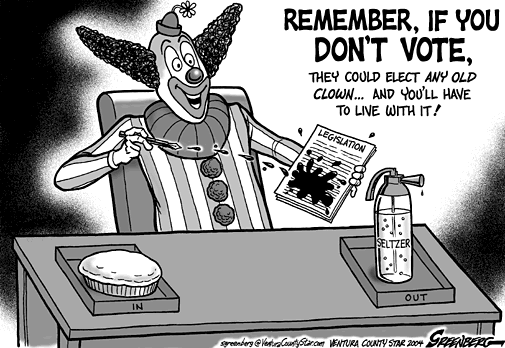
CONSEQUENCES OF VOTING

LIEUTENANT GOVERNOR:

Melvin L. “Kip” Holden (DEM)             Defeated         506640            45%

“Billy” Nungesser (REP)                     Elected            628876            55%

Turnout: 40.2% 

We’re not yet halfway through the 2016 legislative session in which lawmakers and Gov. John Bel Edwards are struggling to close a $2 billion budget gap for the coming fiscal year but attention has been diverted from that knotty problem by one of the most bizarre political behavior since Earl Long’s mental crash of 1959, accompanied by a whirlwind tour of the Southwest and his fling with stripper Blaze Starr.

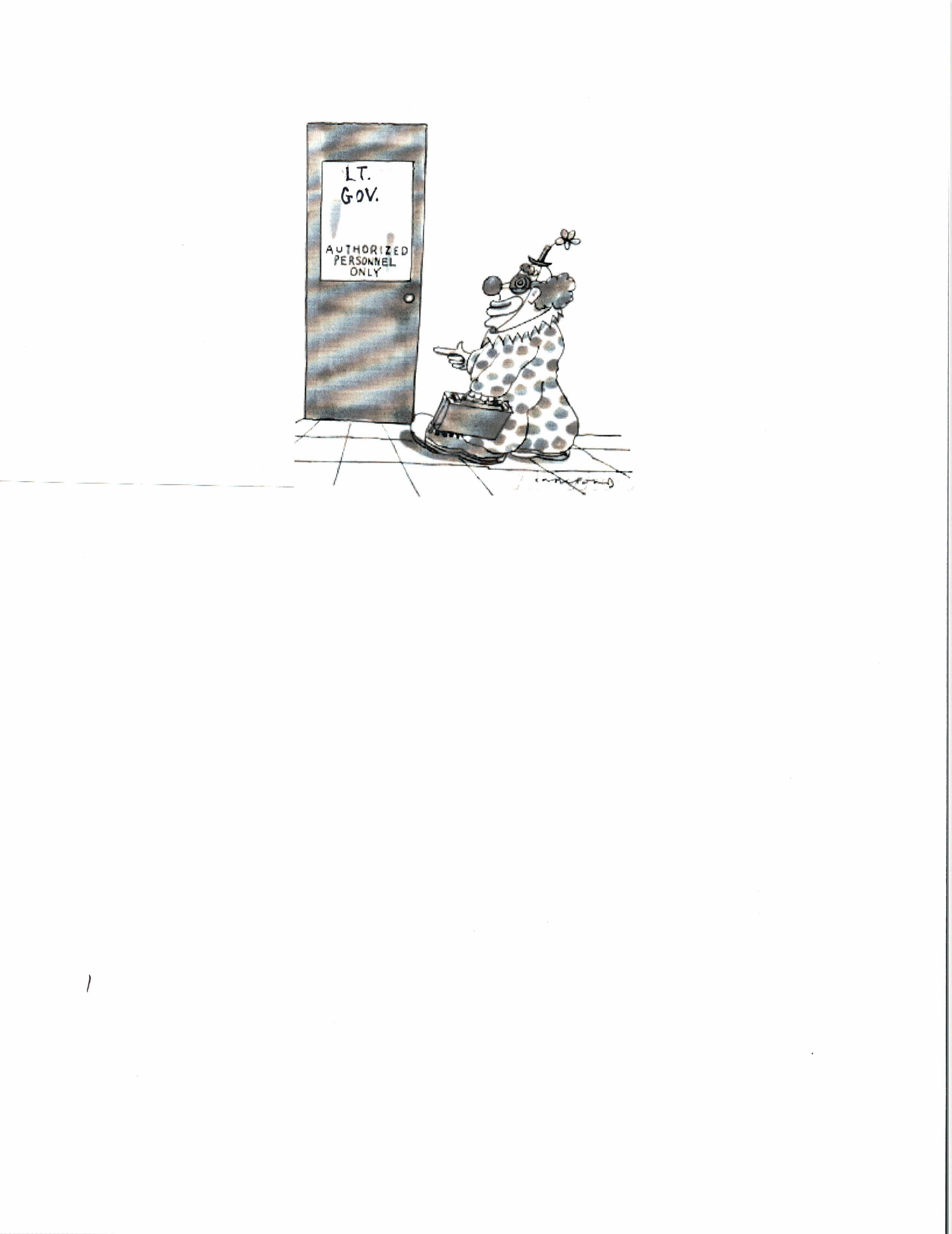
Lt. Gov. Billy Nungesser fell for a phishing scam that’s been around at least three years and in doing so, proved beyond any shadow of a doubt that Louisiana’s electoral legacy of a revolving door for scalawags, con men, thieves and clowns is securely intact. And while we’re at it, let’s not leave out outright idiots and demagogues.

You’d think we had at least partially rid ourselves of that ilk with the exit of Bobby Jindal, but you’d be oh, so wrong. There apparently is no shortage of egos or stupidity to go around and sadly, we keep electing them. The legislature is riddled with those who have set themselves apart from reality.

Thanks to the diligence of Baton Rouge Advocate reporters Rebekah Allen and Richard Thompson, we are now assured that Billy Nungesser is heir-apparent to the title of Chief Clown in residence—a worthy successor to Jindal, we might add.

The two reporters on Sunday (April 10) broke an astonishing story that Nungesser, abetted by state Republican Chairman Roger Villere, not only fell for a huge scam involving a supposed agreement between a Delaware-based corporation, a Lake Charles refinery, and the Iraqi government, but he did it without the knowledge or consent of Gov. John Bel Edwards on whose behalf he claimed he was acting. http://theadvocate.com/news/politics/15398751-125/lt-gov-billy-nungesser-gop-chairman-roger-villere-work-to-recruit-unlikely-iraq-to-louisiana-busin

For sheer audacity, it even surpassed Huey Long’s classic “Round Robin” pledge by 15 senators to block his impeachment back in 1929. Huey, after all, was battling for his political life while Nungesser was only feeding his inflated ego like a ravenous wolf devouring a fresh deer carcass. And he fed it with a story that had no basis in fact. And he did it for all the world to see. And then he apologized. Sort of.

While Baton Rouge was metaphorically wiping its eyes and laughing at this buffoon, we did a quick Internet search and found that a former East Baton Rouge parish councilman and failed mayoral candidate fell for a variation of the same scheme involving the same Delaware corporation three years ago. More about that later.

First, here is what has transpired thus far:

  • Villere, the state GOP brain bust…er, trust, apparently approached Nungesser for a new billion-dollar deal that involved a plan by Alexandros, Inc. http://alexandrosinc.com/index.html to partner with Pelican Refinery of Lake Charles http://www.pelican-refinery.com/index.html in signing a 25-year agreement to become the exclusive shipping company for the Iraqi government’s oil marketing arm, interchangeably called the State Organization for Marketing Oil and the State Oil Marketing Organization (SOMO). The plan called for the transporting of up to 150 million barrels of Iraqi oil each month. http://www.alexandrosinc.com/shipping.html
  • Alexandros, headed by CEO Markos Fuson of California, proposed reopening the former Avondale Shipyard on the Mississippi River near New Orleans. The facility shut down in 2014.
  • Alexandros also proposed building more than 40 new ships, “super-tankers,” capable of hauling 200 million barrels of oil per month.
  • Fuson supposedly committed to investing 100 percent of his profits from the venture in Louisiana’s motion picture industry and to then invest his share of film profits into an as-yet-to-be-created charitable foundation that would provide education, health care and housing assistance to Louisiana’s minorities.
  • Pelican Refining’s role in the scenario was unclear, given the fact the Lake Charles facility only produces asphalt and road oil. It has not processed sweet or heavier crude oil in more than a decade, The Advocate quoted the Louisiana Department of Natural Resources as saying.

If all that sounds implausible enough, consider this: Nungesser, salivating over the prospects of establishing himself as the state’s economic emancipator, then took matters into his own hands. In quick succession, he:

  • Issued a press release in March saying that Iraqi’s export agency had signed off on Alexandros’s request to partner with Pelican Refining to purchase light and heavy crude oil from SOMO.
  • Inexplicably sent the press release only to the Washington Post which, recognizing a con when it saw one, chose not to publish the release.
  • Represented himself in the news release as well as in letters to representatives of the Department of State and to Iraqi officials as Louisiana’s economic development recruiter (he’s not; that duty falls to the Secretary of Economic Development, in this case, Donald Pierson). “The honorable governor of Louisiana, John Bel Edwards, has given me a directive to expedite economic stimulus for the state of Louisiana,” Nungesser lied in his letter to Iraqi Prime Minister Haider al-Abadi, adding, “This request for Your Excellency’s advocacy is part of my office’s effort to fulfill that directive.”
  • Wrote similar letters to Stuart Jones, ambassador to Iraq, and to Secretary of State John Kerry in which he again passed himself off as the state’s key economic development leader. “It is with sincere gratitude that I, Billy Nungesser, as the lieutenant governor of the state of Louisiana, respectfully request the Department of State’s additional advocacy to the Republic of Iraq on behalf of the state of Louisiana,” he wrote to Kerry and Stuart.
  • Said in his letters that he copied Edwards with all correspondence. Not so, said a spokesman for the governor’s office, who said Edwards never received a copy.
  • With egg all over his face, denied reading, let alone writing the letters that he signed. Instead, he officially kicked off the blame game, saying first that Villere, an old friend and political ally, had told him he wanted a letter expressing the state’s interest.
  • In the lowest of lows, blamed his staff, saying the letters should never have made their way to his desk. “We’re changing the way some things flow in my office to make sure this doesn’t happen again,” he was quoted as saying by The Advocate.
  • Apologized to Edwards. “I would have never used the governor’s name without his permission,” he added.

Falah Alamri, SOMO director general, said the entire deal was a scam, “a hundred percent not real,” The Advocate story says.

But wait. Jeff DeRosia, operations manager for Grand Isle Shipyard in Galliano, says otherwise. “I know they’re real. One hundred percent,” he said. DeRosia, it should be noted also is executive vice president of domestic sales for Alexandros, according to Alexandros documents.

So just where does Villere figure in this entire sordid mess? Who knows? He did, however write his own letter back in February to the Iraqi prime minister and the minister of Oil, Adil Abd al-Mahdi in which he laid out the “urgent next steps that the state of Louisiana and the United States insist upon.” Some of those steps included SOMO’s granting legal authority and the issuing of contracts to Pelican Refining.

It’s still unclear how Villere considered himself in a position to insist on anything on behalf of the United States or Louisiana governments.

The three—Nungesser, Villere and DeRosia—would have been wise to do even the slightest bit of investigation before going off the reservation the way they did.

Our own quick search found a Web site called Ripoff Report in which a Baton Rouge writer in February 2013 warned of a similar scheme by Alexandros. http://www.ripoffreport.com/r/Alexandros-Inc/Highland-California-92346/Alexandros-Inc-Attempt-to-Defraud-with-Fake-Documents-Highland-California-1053139

In that report, Terry Easley produced a letter purportedly from the Iraqi State Oil Marketing Organization attesting to a professional relationship between Alexandros, Inc., Fuson, and the Iraqi government. The letter was signed, supposedly by Sarmad H. Abd, SOMO general manager of contracts, and John Percy de Jongh, Jr., governor of the U.S. Virgin Islands.

Easley pointed out discrepancies in the letterhead of that sham letter, comparing it to one he received on April 29, 2013, from SOMO Director General Alamri. The Alamri letter, he said, was on the correct letterhead, complete with correct logos, addresses and contact information in both English and Arabic. Here are the contents of that letter:

TO: Mr. Terry L. Easley

Email: [REDACTED]

Subj./Fraud Document

Reference to you letter dated 26th April 2013.

Please note the following:

1-The Document attached to your above letter is fraud and has never been issued by SOMO.

2-SOMO has no business relationship whatsoever neither with a company named “Alexandros, Inc.” nor with a person called “Sarmad H. Abd”.

3-Our policy is to deal directly and exclusively with End Users (refining system owners) and not through traders or middlemen.

Best Regards,

Dr. Falah J. Alamri

Director General

/04/2013

Oil Marketing Organization (SOMO) Fax: + 964 1 7726 574 / + 964 1 7742 979

PO Box 5118 Email: info@somooil. Gov. Iq

Baghdad – Iraq Web: www.somooil. Gov. Iq

The fake letter that precipitated the above response from Alamri, Easley said, was also copied to one Darrell Glasper of Baton Rouge. Glasper, for those outside the Baton Rouge area, was a member of the Baton Rouge Metro Council and ran for mayor-president against incumbent Kip Holden in 2008. He later admitted to paying for a campaign flier during that election which included doctored photos depicting Holden after being severely beaten by the husband because of an affair between the two.

Ironically, seven years later Nungesser would defeat Holden in an election for the lieutenant governor’s office.

The Baton Rouge media and a prominent blogger lost no time jumping all over the hapless and apparently clueless Nungesser.

Reporter Stephanie Grace, saying on Tuesday (April 12) that Nungesser had gone rogue, pointed out that in a 2011 forum between lieutenant governor candidates, Jay Dardenne pounded Nungesser on the duties of the office while Nungesser countered by saying he was one who followed his gut and “thinks outside the box.” http://theadvocate.com/news/opinion/15457076-133/stephanie-grace-nungesser-goes-rogue-on-whacky-economic-deal

Grace said in his first big move after taking office in January, he “proved he’s thinking much further outside the box than anyone could have imagined.”

Saying that Nungesser “has no authority over economic development, no right to speak for the governor, and no place contacting the U.S. government, a national news organization, or a foreign head of state” on behalf of Edwards, she did give him a backhanded compliment in noting that he “basically fessed up to have had no idea what he was doing.”

She suggested that Nungesser make a call to Dardenne, who now serves as Commissioner of Administration. “I’m guessing he’d (Dardenne) would be perfectly happy to, once again, school Nungesser on what the day job entails—and what it doesn’t.”

Political blogger Lamar White wasn’t quite as kind.

In his post today (April 12), White suggested that far from being funny, Nungesser’s actions are impeachable. https://cenlamar.com/2016/04/12/lt-gov-nungessers-scam-deal-isnt-funny-its-impeachable/

I disagree. I think to save himself further humiliation, he should take it upon himself to resign.

Even more biting, however, was White’s quote from Jan Moller, director of the Louisiana Budget Project, another political blog: “I always used to wonder what kind of person fell for those Nigerian prince email scams. This says a lot.”

White called Nungesser’s actions “an enormous embarrassment to Louisiana, a blatant usurpation of the statutory power of the Lt. Governor’s office.” He said it also “demonstrates both an enormous disrespect to Gov. John Bel Edwards, for whom Nungesser deliberately misrepresented as working under his authority and blessing, and a fundamental and damaging misunderstanding of the duties of his office.”

He referred to Nungesser’s claim of never having read the letters he signed and his blaming of his staff as “pathetic.”

Not overlooking the role of the state GOP chairman in the fiasco, White said Villere’s “intimate involvement, at the very least, warrants an investigation into criminal conspiracy.”

But then he observed, perhaps correctly that Nungesser need not fear the consequences. “Louisiana is too busy laughing at him to worry about actually holding him accountable.”

There is a lot of stupid to go around in Baton Rouge but with this stunt, Nungesser may have laid claim to franchise rights.

And that is particularly pathetic.

CLOWN IN CHIEF

Read Full Post »

Third of four-part series:

Given the reluctance to impose meaningful fines in cases of blatant public records compliance violations, one has to wonder:

  • What is the purpose of going through the time consuming procedure of passing laws if they are not going to be enforced?
  • What is the purpose of a judge donning a robe and sitting on the bench if he/she has no intention of upholding so even the minimum penalty for violations of the law?
  • Is there some sort of unwritten agreement among certain judges and public officials that says judges must merely wink at violations and hand down only token penalties?

Louisiana laws, we can only assume, were enacted for a reason and that reason was to ensure strict compliance and to lay out proper punishment for violators. To that end, Louisiana Revised Statute (L.R.S.) 44:35 (E) (1) clearly says:

  • If the court finds that the custodian arbitrarily or capriciously withheld the requested record, it may award the requester any actual damages proven by him to have resulted from the actions of the custodian. It may also award the requester civil penalties not to exceed $100 per day, exclusive of Saturdays, Sundays and legal public holidays, for each such day of such failure….

That’s certainly clear enough but L.R.S.) 44:35 (E) (2) then goes on to say:

  • The custodian shall be personally liable for the payment of any such damages and shall be held liable in solido with the public body for the payment of the requester’s attorney’s fees and other costs of litigation, except where the custodian has withheld or denied production of the requested record or records on advice of legal counsel representing the public body in which the office of such custodian is located. In the event the custodian retains private legal counsel for his defense in connection with the request for records, the court may award attorney’s fees to the custodian. (Emphasis added.)

LOUISIANA PUBLIC RECORDS ACT

We have already seen in earlier posts this week how judges, through some form of convoluted rationale, are able to substantially reduce that $100 per day fine to insignificant amounts and in at least one case, to nothing at all.

First there was the case of the Baton Rouge Advocate and the LSU Daily Reveille. The two publications sued the LSU Board of Supervisors over its refusal to provide a list of candidates for LSU President. They won and the district court judge awarded more than $50,000 in penalties calculated on the $100-a-day formula for non-compliance only to see the monetary award overturned and negated in full by the Louisiana First Circuit Court of Appeal.

Then came our own lawsuit against the Division of Administration and Commissioner Kristy Nichols. DOA delayed responses to numerous requests by LouisianaVoice for several months only to be hit with a penalty of only $800 plus court costs and attorney fees.

Louisiana’s Public records laws being routinely ignored by officials; lawsuits, fines increase – all at taxpayer expense

And in the case of Barbara Ferguson and Charles J. Hatfield and their lawsuit against the Department of Education on behalf of their non-profit research organization, Research on Reforms, the court’s ruling was even more egregious. Three full years of non-compliance came to 684 days by the plaintiffs’ estimation (we calculated the number to be closer to 745 days) and they requested the full application of the penalty of $100 per day, or $68,400 plus attorney fees ($29,779) and court costs ($3,121).

FERGUSON REQUESTED JUDGMENT

Baton Rouge District Judge William Morvant first denied the plaintiffs’ claim outright but was overturned by the First Circuit which remanded the case back to Morvant for the imposition of penalties. Morvant not only cut the attorney fees in half to $15,000, but he completely disregarded the penalties for DOE’s—and Morvant’s apparently—disregard of the law.

FIRST CIRCUIT RULING ON FERGUSON

Louisiana Department of Education does poorly combating public records requests; Rep. Richard bill seeks trasparency

So now comes Mike Deshotels and his public records lawsuit against veteran defendant John White and his Department of Education.

This one is pretty easy except for one minor snag:

Deshotels filed his lawsuit on April 10, 2015, after two months of back and forth communications between him and DOE failed to produce the requested Multi Stat report for all public schools in Louisiana which contained the actual total number of students enrolled in each grade.

MICHAEL DEHOTELS PETITION

Even though Deshotels never requested any personal information, DOE ultimately refused his request “because of their obligations to protect the personal information of the students pursuant to FERPA (Family Education Rights and Privacy Act),” according to Deshotel’s petition.

The case finally made its way to trial in Baton Rouge on Oct. 19, 2015, before 19th Judicial District Judge Todd Hernandez.

Hernandez broke with the pack when he held John White personally liable. More than that, he assessed White with attorney fees and court costs of $11,988.84. And then, applying the letter of the public records law he ordered the payment of $100 per day “from Feb. 16, 2015, until the requested records were produced.

DESHOTEL JUDGMENT

Despite his order, those records were not produced until more than five months later, when they were submitted along with a March 31, 2016, settlement offer. That additional delay brought the total cost, including attorney fees and court costs, to about $49,000, according to Deshotels’s Baton Rouge attorney J. Arthur Smith.

And Judge Hernandez, as if sending his own message, held John White personally liable, an indication that Hernandez had reason to believe White had withheld the records on his own volition and without the advice of legal counsel.

(Parenthetically, if more judges followed the example set by Hernandez, public officials might be more cognizant of the importance of complying with the law.)

Still White persisted in his state of denial. That March 31 settlement letter from DOE legal counsel G.M. Millet, Jr., was little more than an insult to Smith and Deshotels.

“After careful consideration, the Department of Education has decided to provide an unsuppressed copy of the October 2014 Multi-Stats Report to Michael Deshotels and to pay him $9,292.74 for attorney’s fees and litigation expenses pursuant to Judge Hernandez’s judgment,” the letter said.

SETTLEMENT OFFER

He then added the traditional legal verbiage that nevertheless appeared particularly absurd: “By complying with those portions of the judgment, in lieu of appeal, the Department is not admitting fault.” Not admitting fault? Really?

Millet also said that DOE planned to appeal the “portion of the judgement (sic) imposing fines against the Department for being arbitrary and capricious.”

Smith now says that the appeals have run, meaning the deadline has passed for White and DOE to appeal the judgment. Still, no payment has been made.

So Smith is now preparing to take matters to the next level.

He has prepared a Motion for Judgment Debtor Examination as the first step toward seizure of White’s assets, including his 2013 Infiniti and garnishment of his state wages.

In that motion, yet to be filed pending Hernandez’s ruling on a separate DOE motion, Smith asks “to examine John White, Defendant/Judgment Debtor and his income records, pay check stubs, W-2 forms, last year’s income tax returns, business papers, automobile titles and registration certificates (pink slips), records of accounts in banks and other financial institutions (checking and savings) on all matters pertaining to his income or property, in order that Plaintiff (Deshotels) may find means to execute the Judgment, and that the said Defendant (White) should be ordered to appear before this Honorable Court at such time as the Court assigns for said examination.”

MOTION FOR DEBTOR EXAMINATION

Now that should get someone’s attention, especially if Smith’s motion is granted.

If that’s what it takes to change the mindset of bureaucrats and elected officials, to hold them accountable to the laws of this state, to force them to cease furtive actions away from public observation, then so be it.

Tomorrow: Lafayette City Marshal Brian Pope has learned an expensive lesson for his refusal to make available 588 pages of emails Lafayette-based newspaper The Independent. Besides monetary penalties totaling almost $100,000, a state district judge tacked on seven days’ house arrest for contempt of court. That sentence has been postponed pending the outcome of Pope’s appeal of the conviction.

Read Full Post »

« Newer Posts - Older Posts »