Feeds:
Posts
Comments

Archive for the ‘Media’ Category

quid pro quo

ˌkwid ˌprō ˈkwō/

noun

A favor or advantage granted or expected in return for something.

Unless decisive action it taken over the next few days, our theory that nothing gets done about official chicanery, shady dealings and outright corruption will have been validated at the highest levels of state government.

And lest there are those who think I’m beginning to sound like a broken record, let me assure them that I will keep pounding the keyboard as long as I am physically and mentally able to put the glare of the spotlight on them and their deeds.

At one point in 2015, someone said to me, “Once Bobby Jindal leaves office, you won’t have anything to write about.”

Not a chance.

Unfortunately, as long as politicians are intoxicated by money and power, there will be plenty to write about. And, as Johnny Mathis sang his song The Twelfth of Never, “that’s a long, long time.”

Take Kristy Nichols, for example. Someone, please. (Sorry, Henny Youngman.)

Or, just for fun, compare the strikingly similar cases of Ascension Parish President Kenny Matassa and Louisiana Attorney General Jeff Landry.

Kristy, as LouisianaVoice reported last September, jumped the Jindal ship to join Ochsner Health System as Vice President of Government and Corporate Affairs (read: lobbyist).

https://louisianavoice.com/2015/09/17/more-on-kristys-new-job-it-seems-ochsner-gets-17-6-million-for-running-chabert-hospital/

The only problem with that was that as Commissioner of Administration for Jindal, she presided over virtually every facet of state government except the legislative and judicial branches, but worked closely with those as well. State law prohibited her from lobbying the administrative and legislative branches but apparently there was nothing to prevent her from lobbying local governmental entities.

On November 5, 2015, less than two months following our story, Kimberly L. Robinson, an attorney with the Jones Walker law firm, acting on behalf of Ochsner, requested an advisory opinion on the question of whether or not Kristy could legally lobby the state.

A month later, Gov.-elect John Bel Edwards named Robinson as the new Secretary of the Department of Revenue, prompting her resignation from Jones Walker.

http://www.nola.com/politics/index.ssf/2015/12/john_bel_edwards_appoints_kimb.html

Robinson was replaced by R. Gray Sexton as counsel for Kristy.

Sexton was an obvious choice, given his years as Chief Administrator for the Louisiana Board of Ethics. His knowledge of the system was so keen that in 2007, he pulled his own end-run when he resigned and the board immediately rehired him in a new capacity which allowed him to skirt a requirement under a newly-passed ethics law that he disclose clients in his private law practice (how’s that for irony?).

http://blog.nola.com/times-picayune/2007/07/ethics_administrator_quits_the.html

But back to Kristy’s dilemma.

On December 16, Sexton submitted a request to the ethics board to withdraw the request for an advisory opinion. Then, on January 22, 2016, Sexton submitted an Application for Declaratory Opinion on behalf of Kristy. That was followed by a request to withdraw the Application for Declaratory Opinion on March 31. The board granted the request to withdraw at its April 15 meeting.

The chronology was provided to LouisianaVoice in an e-mail Tuesday (Aug. 2) from Deborah S. Grier, Executive Secretary for the Board of Ethics. Here is that email:

——– Original message ——–

From: Deborah Grier <Deborah.Grier@LA.GOV>

Date: 8/2/16 9:14 AM (GMT-06:00)

To: azspeak@cox.net

Subject: RE: Opinion on Kristy Nichols: Public Records Requests

Good morning, Mr. Aswell:

Pursuant to your public records request of July 29, 2016 regarding an opinion issued by the Board with respect to former Commission of Administration Kristy Nichols’ employment as a lobbyist by Ochsner Health System, please be advised of the following:

A request for an advisory opinion dated November 5, 2015 was submitted by Kimberly L. Robinson with the Jones Walker law firm on behalf of Ochsner Health System and Kristy Nichols.  Ms. Robinson subsequently left the private practice of law and was replaced by R. Gray Sexton as counsel for Ms. Nichols as indicated in correspondence to our office from Mr. Sexton dated December 11, 2015.  On December 16, 2015, a request to withdraw the request for an advisory opinion was submitted to our office.  The Board considered and granted the request to withdraw the request for an advisory opinion at its December 18, 2015 meeting.

 Mr. Sexton, by correspondence dated January 22, 2016, submitted to the Board an Application for Declaratory Opinion on behalf of Ms. Nichols.  A request to withdraw the Application for Declaratory Opinion was received by this office on March 31, 2016.  The Board considered and granted the request to withdraw the Application for Declaratory Opinion at its April 15, 2016 meeting.
No opinion has been rendered by the Board with respect to this issue.
Should you have any questions or need additional information, please do not hesitate to contact me.

Sincerely,
Deborah

Deborah S. Grier
Executive Secretary
Louisiana Board of Ethics

So, what does all that mean?

Could it be that Ochsner and Kristy have decided to let sleeping dogs lie? After all, if she proceeds with lobbying efforts and no one files an official complaint, then it’s no harm, no foul, right? That would certainly run true to form for Jindal’s Gold Standard of Ethics.

A quick check by LouisianaVoice, however, revealed that Kristy is not registered among any of Ochsner Health System’s 10 lobbyists. Sexton told LouisianaVoice today that Ochsner had apparently decided not to pursue the matter and it was his understanding that the company was pursuing “other plans” for Nichols. “Ochsner has a number of other lobbyists,” he said.

So if she is not a registered lobbyist, then just what is it that she does to earn her keep as Vice President of Government and Corporate Affairs?

Or was her employment simply some form of payback as we initially suggested in light of the $31 million Ochsner received in takeover of the Leonard Chabert Medical Center by Southern Regional Medical Corp. and Ochsner as part of Jindal’s haphazard state hospital privatization plan?

https://louisianavoice.com/wp-content/uploads/2015/09/terms-of-the-ochsner-deal-at-leonard-chabert-medical-center.pdf

We’d no sooner received Ms. Grier’s email on Tuesday than the Baton Rouge Advocate posted a couple of stories, also on Tuesday, that caught our eye.

The first involved a claim by Gonzales City Council candidate Wayne Lawson that Ascension Parish President Kenny Matassa and Gonzales businessman Olin Berthelot attempted to bribe him not to seek a city council seat against incumbent Neal Bourque.

The Pelican Post news website first published the report that Matassa and Berthelot had offered Lawson $1,200 and a parish job if he would withdraw from the race. The deadline to withdraw was last Friday (July 29) at noon. Lawson, after posing for a photograph with the cash, a parish job application form and candidate withdrawal forms, returned the money and documents to Berthelot’s office without completing either of the forms.

http://www.theadvocate.com/baton_rouge/news/communities/ascension/article_d9fda80a-58df-11e6-884c-d3779607197c.html

Ricky Babin, District Attorney for the 23rd Judicial District, said his office would investigate Lawson’s claims. He said the Ascension Parish Sheriff’s Office and the Louisiana Attorney General’s Office are also investigating the allegations.

The Attorney General’s Office may be in something of a quandary as it embarks on that investigation, however.

The second Baton Rouge Advocate story, by reporter Gordon Russell, conjured up the ethics complained filed against Iberia Parish Sheriff Louis Ackal.

http://www.theadvocate.com/baton_rouge/news/politics/article_6f7a7990-58e9-11e6-9cd1-a36f0eb42bbf.html

https://louisianavoice.com/wp-content/uploads/2016/03/ethics-complaint.pdf

https://louisianavoice.com/2016/03/03/between-beating-guilty-pleas-sexual-harassment-lawsuit-and-ethics-complaint-iberia-sheriff-louis-ackal-has-his-plate-full/

https://louisianavoice.com/2016/03/09/one-week-after-louisianavoice-story-feds-hand-down-three-count-indictment-of-iberia-parish-sheriff-ackal-top-deputy/

In his story, Russell said that Landry, after trailing incumbent Buddy Caldwell by two percentage points in the primary election for Attorney General last October, received the endorsement of third place finisher Geri Broussard Baloney of Garyville in St. John the Baptist Parish, who had polled 18 percent.

With her endorsement in his back pocket, Landry, a former U.S. Representative, easily won the November runoff over Caldwell (who can forget Caldwell’s concession speech?). Soon thereafter, Baloney’s daughter, Quendi Baloney, was given a $53,000-a-year job by Landry.

At the time of her hire, all would-be employees of the AG’s office were required to sign a form agreeing to background checks and were also asked, in writing, if they had any criminal record.

In her case, she did. In 1999, she was charged with 11 felony counts of credit card fraud and theft, eventually pleading guilty to three counts, according to court records from Henrico County, Virginia. She was sentenced to six years in prison, all of it suspended.

Her new job? Well, it’s in the AG’s fraud section. More irony.

But in the end, her background is of less interest, given that her conviction was 17 years ago, than the fact that she was given her job as apparent payback for her mom’s endorsement of Landry following the first primary election in October.

A spokesperson for the AG’s office, Russell wrote, did not respond to questions about whether other candidates had applied for Quendi Baloney’s job or whether Landry had hired any other convicted felons.

For her part, Quendi Baloney told The Advocate that her arrest and conviction were “devastating,” but had made her a “stronger, harder-working ethical adult…”

She forwarded to The Advocate a link to the state’s new “Ban the Box” law which prevents state agencies from asking applicants about their criminal records. That law, however, did not take effect until after she was hired.

It’s going to be more than a little interesting to see how Landry’s investigation of Matassa and Berthelot unfolds in light of the same day’s revelations about his own actions.

But we’re willing to wager that when the dust settles on the issues of Matassa, Berthelot, Nichols, Ackal (the state ethics complaint, not the federal indictment) and Baloney, we’ll still be able to say:

Nothing gets done.

Read Full Post »

For the embodiment of what has happened to the newspaper industry and to erstwhile good, hard-hitting investigative reporting, one need look no further than the Alexandria Town Talk.

It’s not that The Town Talk, one of five Gannett-owned newspapers in Louisiana and one of 123 Gannett publications in the U.S., Guam, and the United Kingdom, is necessarily the poster child for the fast-food media genre. But when a newspaper ignores a major news story all but gift-wrapped and dropped in its lap, it unavoidably becomes a microcosm for all that’s ailing the once robust medium.

So, what’s this big story that The Town Talk and other area media were repeatedly called about but chose not to pursue?

That would be the Veterans Administration Medical Center in Alexandria.

It’s not that the problems of veterans obtaining medical treatment from the VA has been hiding under a rock. It’s a national disgrace and it’s well documented that while the rest of the country is politely offering an empty, robotic “Thank you for your service” to our military, it begins to take on a hollow ring as our nation’s leaders continue to send our young men and women into harm’s way only to discard them when they return with missing limbs, closed head injuries, psychological disorders and PTSD. They’re quietly shunted aside and forgotten. The Pentagon, it seems, has little use for damaged merchandise—unless it’s a billion-dollar aircraft that won’t fly built by a defense contractor (read: campaign contributor) favored by some powerful member of Congress.

When a friend, a career soldier, was diagnosed with pancreatic cancer a few years ago, he was promptly discharged before he could qualify for his pension. Thank you for your service.

The horror stories of long waits for treatment and refusals of benefits and medication are by now well-known and it is no different at the Alexandria VA Medical Center.

But it is at that medical center that the stories become almost macabre in nature. And they all seem to revolve around a single doctor, Dr. Shivani Negi.

Here’s what we know about Dr. Negi:

  • The families of several patients have signed affidavits attesting to her callous treatment of patients and her insistence that family members allow patients to die without attempts at resuscitation;
  • Those same grief-laden affidavits describe in detail how abusive and non-communicative Dr. Negi becomes when families refused to sign “Do Not Resuscitate” (DNR) forms;
  • Some family members said in their affidavits that they believed Dr. Negi allowed their loved ones to die deliberately and that she purposely removed them from the intensive care unit (ICU) to a remote room on another floor without benefit of one-on-one care normally given critical patients;
  • Other doctors and nurses have provided written statements or testified in depositions as to her inappropriate remarks in the presence of family members and patients;
  • The same doctors and nurses describe her violent temper and her threats to “kick butts” of subordinates;

The Commonwealth of Virginia granted her license to practice medicine after she testified she had never been refused a license elsewhere and that she had withdrawn her application in Florida. The only problem was Florida had actually refused her application a full two months prior to Virginia’s awarding her a license. Her Florida application, however, was not withdrawn until 2006.

The minutes of the Florida Board of Medicine’s Credential Committee of Sept. 13, 2003, provide little insight as to the reasons for the  denial of her license application but do hint at some problem in Dr. Negi’s professional past.

“The applicant (Negi) was present and sworn in by the court reporters,” the minutes begin. “The applicant gave a brief history of events. The Committee discussed in length the seriousness of the issue. Dr. Tucker made a motion to deny the (application). The motion was seconded by Dr. Avila. The motion failed with Dr. Miguel, Dr. Davies and Mr. Dyches opposing. Dr. Davies made a new motion to deny the application…and allow 14 days to withdraw. The motion was seconded by Dr. Miguel. The motion passed unanimously.” REFUSED HER APPLICATION

The Florida statutes on which the application rejection was based were identical in both motions with only the provision to allow 14 days for Dr. Negi to withdraw added to the second motion.

There was no explanation of the “history of events” given by Negi, nor the circumstances of those “events.” Nor was there any explanation of the “issue” described deemed by the committee to be a serious sticking point in the consideration of her application.

The problem, however, could have been with the medical school she attended, Ross University School of Medicine (RUSM) in the Caribbean island nation of Dominica which was not accredited by the Association of American Medical Colleges, the body that approves medical programs in the U.S. as of September 2013, according to a story by Bloomberg Markets. http://www.bloomberg.com/news/articles/2013-09-10/devry-lures-medical-school-rejects-as-taxpayers-fund-debt

RUSM has since been taken over by Illinois-based DeVry University which Bloomberg says accepts students rejected by U.S. medical colleges. And even though it is a for-profit school, U.S. taxpayers pick up the tab for about 34 to 48 percent of students who default on their student loans which average about $250,000 compared to $170,000 for graduates of U.S. medical schools.

On her Florida application, a copy of which was obtained by LouisianaVoice, there were a series of questions and blocks to check for the appropriate “yes” or “no” answers.

For the question “Have you ever been dropped, suspended, placed on probation, expelled or requested to resign from any school, college or university,” she first checked “Yes” but scratched that answer out and checked “No.”

On another page further into her Florida application, she also checked “No” to the question: “Have you had any application for professional license or any application to practice medicine denied by any state board or other governmental agency of any state, territory, or country?”

Virginia apparently asks a similar question on its application forms because Dr. Negi submitted an “Addendum to questions 14 and 15” which said, “I had applied for a Florida license but changed my mind and did withdraw my application.” APPLIED FOR A FLORIDA LICENSE

There is a problem with the timeline on that answer, however. LouisianaVoice has copies of a document from Florida Regulatory Specialist Cherise Davis which indicates Dr. Negi did not withdraw her application until June 8, 2006, nearly three years after her license was issued by Virginia.

In the case of Floyd Hamilton, Jr., a Bronze Star recipient who died in 2009, there are many questions but few answers.

Hamilton, 85 died at the hospital in 2009, nearly three years after Dr. Negi removed him from ICU to a room on another floor and far from the nurses’ station and without the ventilator support necessary, in the view of one physician who was involved in a verbal exchange with Dr. Negi when he attempted to treat Hamilton. Hamilton’s son claims his father suffered irreparable brain damage from the removal of the ventilator.

At least two other doctors at the VA hospital, as well as other staff members, have taken issue with both Dr. Negi’s medical decisions and her attitude toward patients and co-workers.

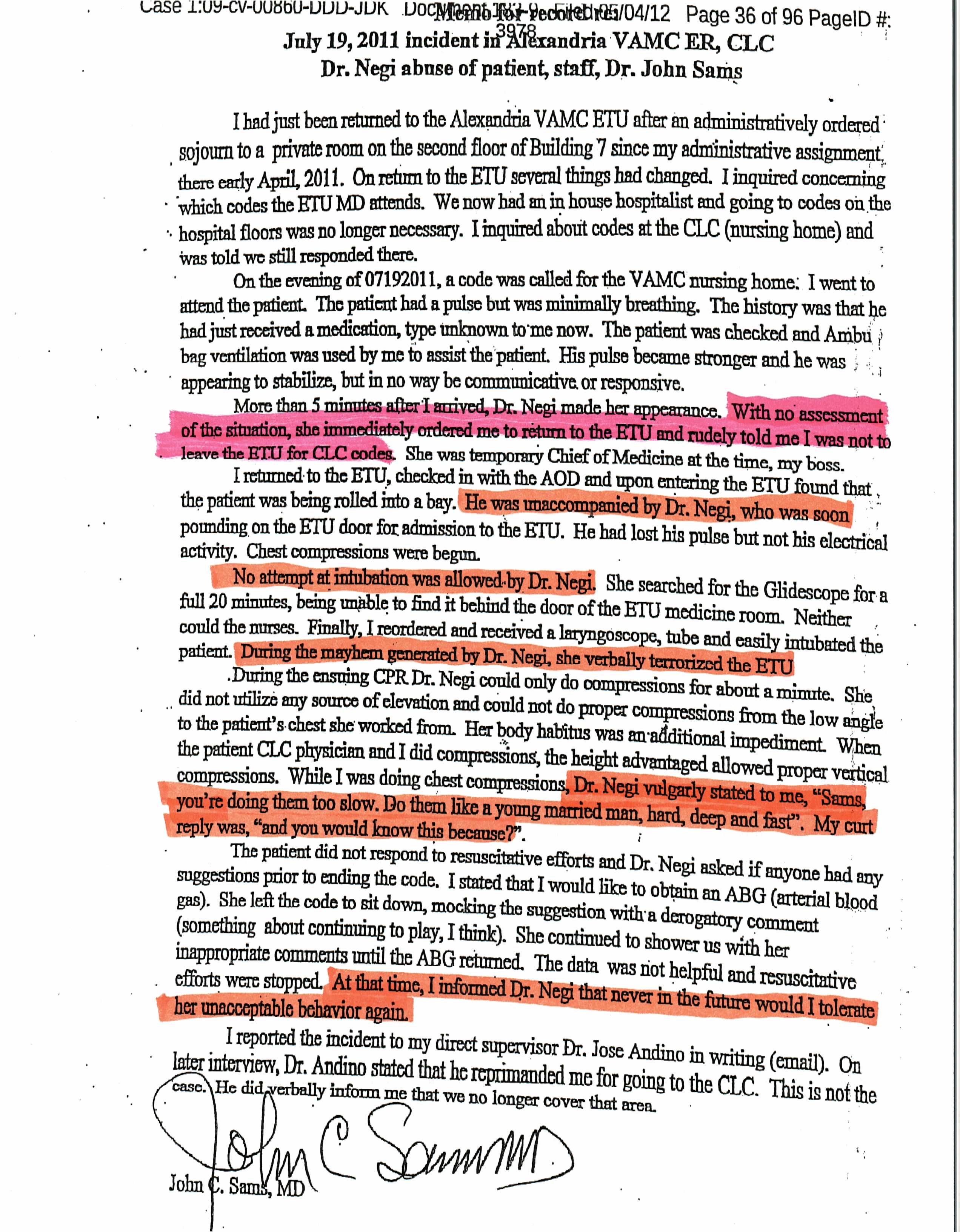
Dr. John Sams said he responded to a code for another patient on July 19, 2011, and found him “minimally breathing.” He initiated treatment and the patient’s pulse became stronger and he began to stabilize. SIGNED REPORT

“More than five minutes after I arrived, Dr. Negi made her appearance,” he wrote in his signed report. “With no assessment of the situation, she immediately ordered me to return to the (Express Treatment Unit) and rudely told me I was not to leave the ETU for CLC (Community Living Center, or VA nursing homes) codes. She was temporary Chief of Medicine at the time, my boss,” he wrote.

“I returned to ETU…and upon entering found that the patient was being rolled into a bay. He was unaccompanied by Dr. Negi, who was soon pounding on the ETU door for admission. He (Hamilton) had lost his pulse. Chest compressions were begun.

“No attempt at intubation was allowed by Dr. Negi. Finally, I reordered and received a laryngoscope tube and easily intubated the patient. During the mayhem by Dr. Negi, she verbally terrorized the ETU. While I was doing the chest compressions, Dr. Negi vulgarly stated to me, ‘Sams, you’re doing them too slow. Do them like a young married man—hard, deep and fast.’”

Dr. Sams wrote that Hamilton did not respond to resuscitative efforts and Dr. Negi “asked if anyone had any suggestions prior to ending the code.” Sams said he said he would like to obtain an arterial blood gas (ABG)—a procedure to determine how well the lungs are moving oxygen into the bloodstream. “She left the code to sit down, mocking the suggestion with a derogatory comment. She continued to shower us with her inappropriate comments until the ABG returned. The date was (sic) not helpful and resuscitative efforts were stopped. At that time, I informed Dr. Negi that never in the future would I tolerate her unacceptable behavior.”

Dr. Sams said he reported the incident in writing to his director supervisor who, instead of taking action against Dr. Negi, reprimanded Sams for responding to the CLC code.

Dr. Mark St. Cyr, an emergency room contract physician, testified in a deposition that he had a conflict with Dr. Negi from the first moment they met. He said Dr. Negi threatened to “kick my butt” after he sought permission to admit an ER patient into the hospital. His deposition was given in a lawsuit by Floyd Hamilton, III, the deceased patient’s son.

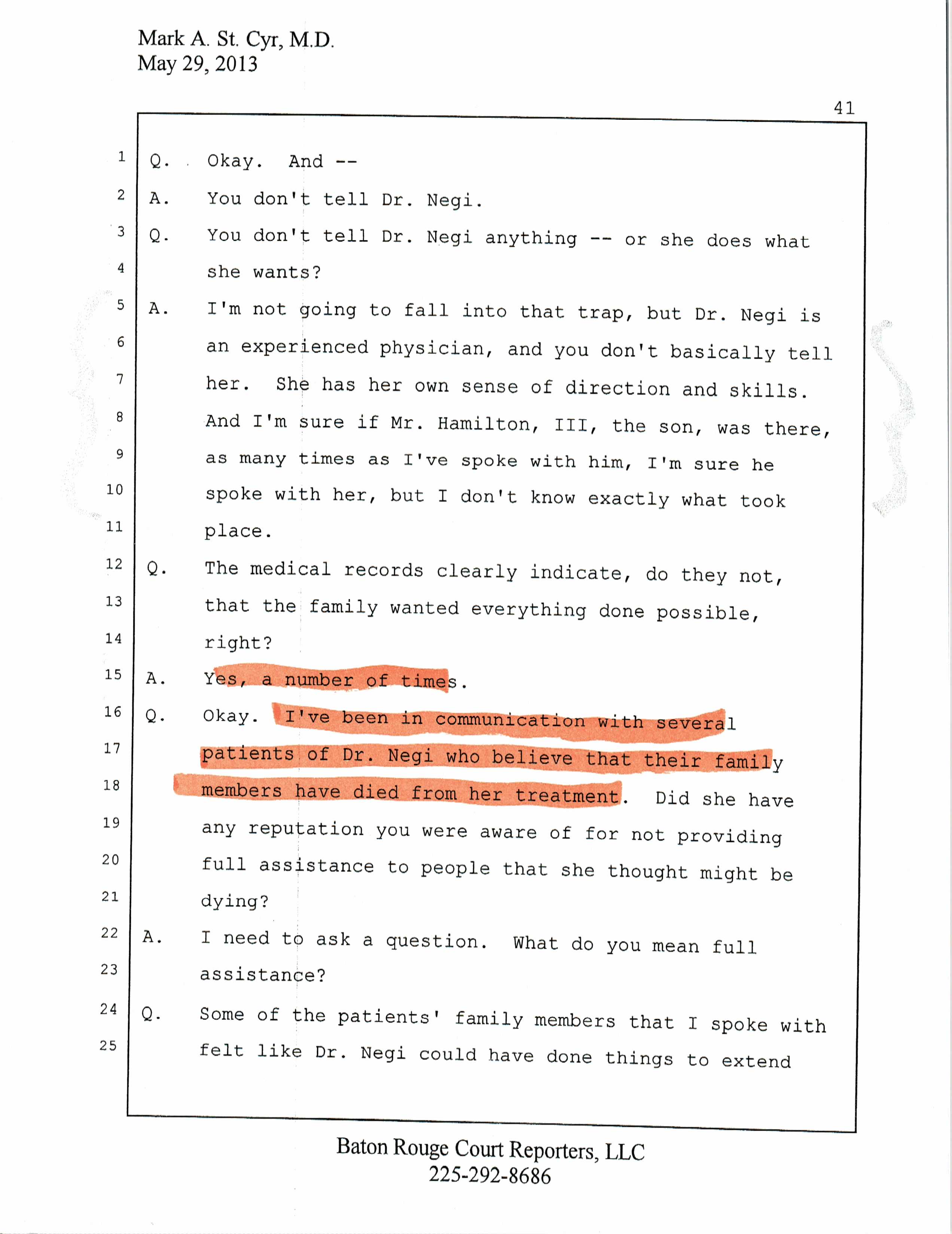
He said the younger Hamilton gave specific instructions that he wanted his father kept in ICU and that the family “wanted everything possible done” to keep his father alive—and that he did not wish to sign a Do Not Resuscitate (DNR) order.

Attorney Robert Evans, III, indicated in the deposition of Dr. St. Cyr that he had been in communication with the families of several patients of Dr. Negi “who believe that their family members have died from her treatment.” COMMUNICATION WITH FAMILIES

Floyd Hamilton, III, as did family members of other patients, said Dr. Negi became incensed and abusive when her requests for DNR orders were not signed by family members. Hamilton said she even stopped communicating with him and would not return his calls.

Documents showed that Dr. Negi even sent a $50 money order to one woman in Leesville so that she could travel to Alexandria to sign a DNR order.

Dr. St. Cyr said Dr. Negi’s decision to remove a tube protecting his airway was not consistent with the family’s wishes. Asked in his deposition of removing the tube was not consistent with the family’s request to do everything possible, Dr. St. Cyr responded, “That’s a fair statement.” THAT'S A FAIR STATEMENT

St. Cyr described Dr. Negi as “aggressive” in terms of “getting patients in and getting them out” of the hospital. “(If) she doesn’t feel like something is worth it, she may not be quite as aggressive medically in terms of performing certain actions,” he said.

When asked by attorney Evans if “she might put him somewhere and take out the tube to expedite his demise,” Dr. St. Cyr again replied, “It’s a fair statement.” EXPEDITE HIS DEMISE

That line of questioning developed over St. Cyr’s description of how Dr. Negi removed the elder Hamilton from ICU to another floor at the end of a hall furthest from the nurses’ station. “Why would he (Hamilton) go to the floor, the last room at the end of the hallway (when he) can’t press a button, can’t call a nurse, or anything, and he’s not even responsive?” he asked. “You’re literally putting the person out there to die.”

Asked if any other hospital personnel were involved in the removal of the intubation of Hamilton, Dr. St. Cyr said, “No, sir. That’s solely Dr. Negi. When a person’s in the intensive care unit, Dr. Negi was in charge and you don’t go against Dr. Negi.”

Two nurses also filed written reports of the confrontation involving Dr. Negi and Dr. Sams, both claiming that Dr. Negi was yelling, belligerent, unprofessional, and throwing her gloves. “…She stated, ‘You never stop CPR,’” one of the nurses quoted her as saying. “CPR was never stopped on the vet other than when Dr. Negi was doing CPR.” The same nurse said Dr. Negi “continued to berate Dr. Sams” because Dr. Sams wanted a blood gas. Dr. Negi made the comment to respiratory, ‘Well I guess you will get to practice your collection of blood gases.’”

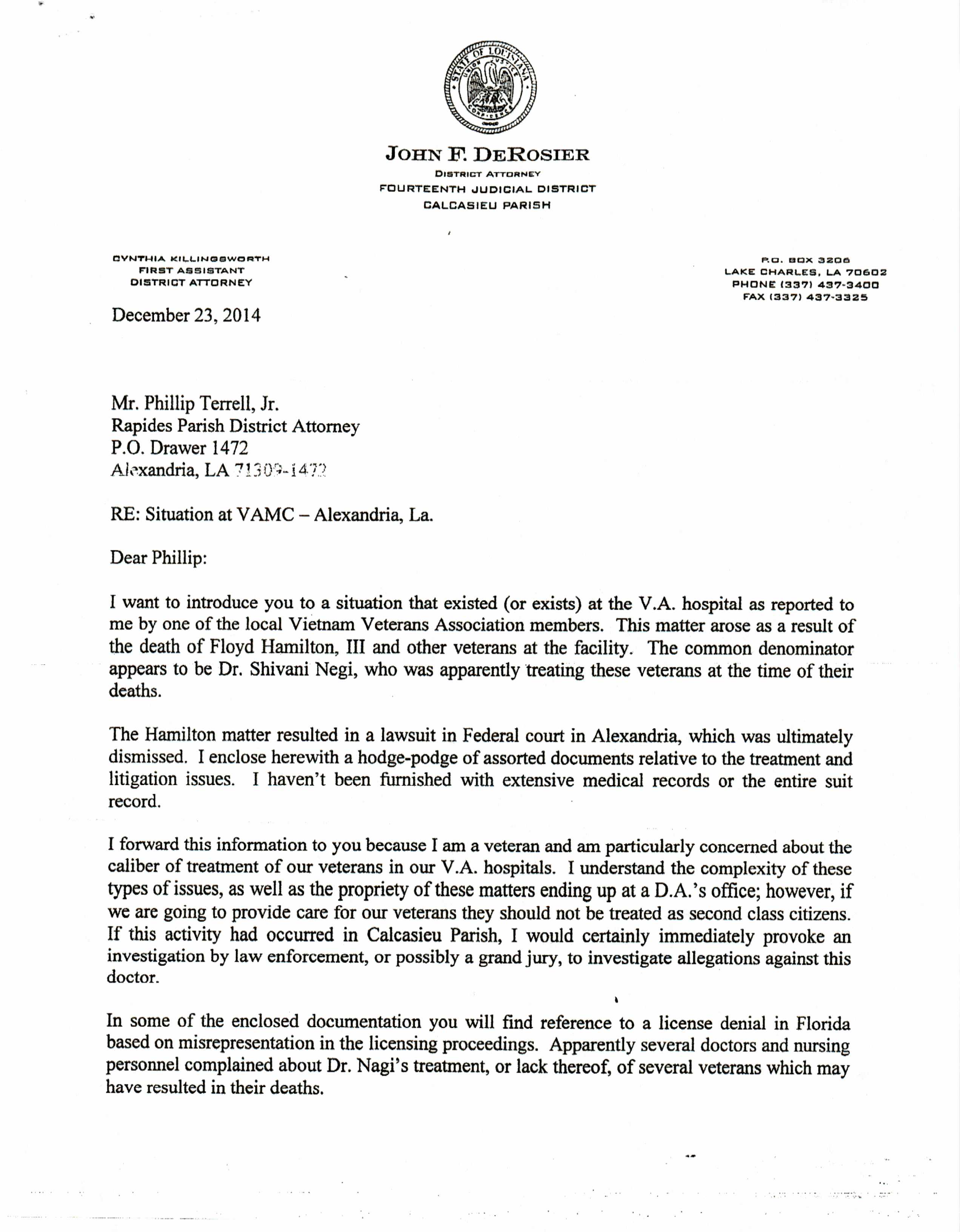
The Calcasieu Parish District Attorney, in a letter to his counterpart in Rapides, intimated that had the events involving Hamilton occurred in Calcasieu, “I would certainly immediately provoke an investigation by law enforcement, or possibly a grand jury, to investigate allegations against this doctor.”

D.A. John Derosier, in his Dec. 23, 2014, letter to Rapides D.A. Phillip Terrell, Jr., wrote, “Please have someone…determine whether or not there is sufficient basis to move forward with a formal investigation.”


LETTER TO HIS COUNTERPART

D.A. LETTER PAGE 2

Terrell, claiming his office was not equipped for such an extensive investigation, asked for assistant from then-Attorney General Buddy Caldwell’s office and Assistant Attorney General Arthur Ogea of Lake Charles was given the assignment.

Jeff Landry, upon taking office as Caldwell’s successor, however, fired Ogea and seized all his records on the Hamilton case. Contacted by LouisianaVoice, Ogea agreed to talk in more detail about his thoughts in the coming days but did say he felt there was sufficient evidence for a grand jury investigation and possible charges of negligent homicide against Negi.

It will be interesting to see how Louisiana’s new attorney general proceeds with this investigation.

Floyd Hamilton, III, meanwhile, kept applying pressure by picketing the hospital and by notifying members of Louisiana’s congressional delegation and VA officials.

Because he took photographs of his father that showed the stark contrast between the elder Hamilton’s condition before and after being removed from ICU, there is now a sign posted at the VA Hospital in Alexandria proclaiming an absurd—and unenforceable—rule that photographs are no longer allowed at the facility.

The Department of Veterans Affairs, Office of Inspector General, conducted an investigation of “suspicious deaths” at the Alexandria VA hospital. In its executive summary dated Feb. 14, 2008, the OIG repeatedly—and predictably—said that investigators “did not substantiate” any of the allegations involving Hamilton or any of several other patients who died while in the care of Dr. Negi.

Five days later, Christina Lavine, director of the VA’s Hotline Division, wrote Hamilton’s son, Floyd Hamilton, III to say that the VA OIG had closed his father’s case. “As we advised you when we opened this case, our decision to close a Hotline case is final, and there are no appeal rights,” she wrote.

Instead of definitive, meaningful action, all we’re received so far are insincere apologies and empty promises that conditions will improve. But they never do.

A congressional subcommittee held hearings on the Alexandria VA Hospital only last week. Even though subcommittee members were well aware of irregularities pointed out by Floyd Hamilton, III, and even though he was in attendance at the hearing, he was never allowed to testify. Perhaps, to borrow a phrase from Al Gore, Hamilton’s claims constituted “an inconvenient truth” to officials who should be infuriated at the manner in which our veterans are treated upon their return from duty.


Read Full Post »

When John Georges purchased the Baton Rouge Advocate three years ago, he set about on an ambitious program of expansion into New Orleans and Lafayette.

Taking advantage of the New Orleans Times-Picayune’s contraction to publishing on three days a week, he began hiring reporters and editors from the New Orleans newspaper and it looked as though The Advocate might actually buck the trend of newsroom cutbacks plaguing publications across the country.

It looked for a while as if it might actually work but it turns out that a retired Advocate reporter was most probably correct when he recently said, “We’re all dinosaurs now.”

There’s no joy in this latest trend or in the retired reporter’s assessment of an industry in indisputable decline. And after having entered the profession 50 years ago at the Ruston Daily Leader, I certainly took no pleasure in watching the New York Times as it first sold its office building in 2004 and only last week announced buyouts to encourage early retirement in order to further cut costs.

The Advocate had already laid off some very good reporters and now LouisianaVoice has learned that additional cutbacks are expected to be announced at the end of this month.

The layoff syndrome has become a vicious cycle in the newspaper industry and the thinking behind it defies logic. http://www.pewresearch.org/fact-tank/2015/05/22/the-declining-value-of-u-s-newspapers/

Tom Kelly, the man who gave me my first newspaper job exactly 50 years ago, recently said that the one commodity a newspaper has to offer its readers is fresh, thorough and compelling news stories. “The ads pay the bills, but people buy a newspaper for news and it defies logic that they cut back on the one thing that sells their papers,” he said.

Kelly, who now publishes The Piney Woods Journal, a monthly publication geared mostly to the timber industry in Louisiana, Texas, Mississippi and Arkansas, also had some decidedly uncomplimentary words for Gannett, which he said is gobbling up newspapers at an alarming rate.

Gannett’s initial foray into Louisiana included The Shreveport Times and Monroe Morning World (now The News-Star) but it has expanded its reach into Lafayette (The Advertiser), Opelousas (The Daily World), and Alexandria (The Town Talk). Along the way, it gutted their news staffs to a fraction of their former size.

Besides its national publication, USA Today (referred to by critics as “McNewspaper”) Gannett now runs 117 newspapers in 33 states and Guam. “And now, Gannett is trying to buy the Chicago Tribune and the Los Angeles Times,” Kelly said. “Their news coverage is pitiful and they want to buy two of the largest papers in the country.” His voice trailed off as he just shook his head in disgust.

So now, one of only two major dailies left in private hands (The Lake Charles American Press is the other), is about to undergo yet another cut. It’s almost as if Bobby Jindal was making the decisions on how to heal an ailing industry. http://newspaperdeathwatch.com/

Advertising revenue is down as are subscriptions. That’s generally true at all newspapers. And just in case no one has noticed, the actual physical size of newspapers has shrunk from broadsheet (23.5 by 29.5 inches) to Berliner (12.4 by 18.5 inches) to save money on newsprint. http://www.papersizes.org/newspaper-sizes.htm

The Jena Times was perhaps the last Louisiana publication to switch to the smaller page, making the conversion only a few months ago.

So, in order to attract more advertising and increase subscriptions, the only logical thing for The Advocate to do is to lay off more personnel. http://www.journalism.org/2015/04/29/newspapers-fact-sheet/

At least the beat reporters may be spared this round. Word is the cuts will be to the copy desk. The reports we’re getting is that The Advocate will be converting to an updated automated system that will make much of the copy desk’s work obsolete. All the copy desk does is edit reporters’ stories, select the local and wire stories the paper will run, write the headlines for them and decided where in the paper they will run.

For the life of me, I can’t comprehend how automation will be able to make those decisions without benefit of the human element.

The demise of the Times-Picayune and the recent and future cutbacks at The Advocate are not something this old dinosaur subscriber takes pleasure in watching.

It’s like witnessing the slow, painful death of an old friend.


Read Full Post »

It seems that certain state officials are finding a new means of discouraging Louisiana citizens from seeking information about the way the public’s business is being conducted. This new tactic is nothing less than a form of official harassment that is both chilling and dangerous.

Transparency and accountability in government are currently hot news topics. Last week (May 26), a local Baton Rouge group, Leaders with Vision, held a lunch meeting and discussion with the theme, “Are Louisiana Sunshine Laws adequate in today’s 21st Century World?” Participants included Sen. Dan Claitor; Rep. Dee Richard; Former Baton Rouge Advocate Executive Editor and transparency advocate Carl Redman and LouisianaVoice Editor Tom Aswell.

Both the state and the federal government recognize the need for transparency in the democratic process. Louisiana passed the Louisiana Public Records Act, also known as Louisiana’s Sunshine Law, in 1940 – more than 25 years before President Lyndon Johnson signed the federal Freedom of Information Act (FOIA) in 1966. Anyone can request public records and the purpose of the request does not need to be stated. In fact, the custodian of the record is not allowed to ask the purpose. The major exemptions are pending criminal litigation; juvenile status offenders; sexual offense victims; security procedures; trade secrets; and some public employee information.

Unfortunately, not everyone in government agrees with the concept of transparency and accountability. We have public officials suing constituents in an obvious effort to prevent them from accessing public records. Two recent examples follow.

On May 27, A LouisianaVoice REPORT revealed that several judges in the 4th Judicial Circuit Court filed a lawsuit against The Ouachita Citizen and Publisher Sam Hanna, Jr to prevent the publication from seeking public records to which they were legally entitled. In this case, judges are suing a publication to prevent them from accessing public records concerning the court operation and their presumably dirty laundry.

Now we find that closer to home, John White has likewise filed a LAWSUIT against Mike Deshotels and Dr. James Finney over public record requests that they made to the Louisiana Department of Education (LDOE) – most likely because they have hit a nerve.

On May 31, 2016, Dr. James Finney detailed the history of the suits in a letter to the Governor, John White, the Louisiana Board of Elementary and Secondary Education (BESE) members, and various state staff how the lawsuit came about:

As you may recall, I sent you an email March 12 (attached below) describing the status of several pending record requests that I had placed with John White and the Department of Education.  I also mentioned the existence of a lawsuit (Finney vs White, 6395333, attached).  That lawsuit, which was filed May 22, 2015, was set for trial in late April.

However, on April 11, Mr. White’s attorney requested and was granted a continuance, presumably to become better prepared for trial and to resolve a scheduling conflict with the Department’s sole witness.  Rather than prepare for trial, however, it seems that Mr. White instead instructed his attorney to file two lawsuits against me which appear to be groundless, unnecessary, and against the public interest. Meanwhile, Mr. White and his staff have made no effort to address the 35 pending requests which are subject of my lawsuit.

The first new lawsuit (White vs Finney, 647827, attached) addresses five requests I made in fall 2015, five that I made in February of this year, and one that I made in March. In the lawsuit, Mr. White apparently is asking the judge to create special conditions on Louisiana’s public records law. It seems that, for whatever reason, Mr. White is bending over backward to make sure the public has no idea what statistical distributions LEAP, iLEAP, or EOC test scores follow.  Are they symmetric?  Skewed?  Bimodal? Uniform?  Nor does he, it seems, wish the public to have any means of verifying that School or District Performance Scores have been fairly and accurately calculated.

The second new lawsuit (White vs Deshotels et al, 647953, attached) attempts to reverse favorable judgments Mr. Deshotels received in two prior lawsuits, and apply that reversal (which seems unlikely given that the 19th JDC is not an appellate court) to a subsequent request by Mr. Deshotels and also to one of my requests.  He seeks to use Mr. Deshotels and I as pawns, and cost us additional time and money, to establish a data-suppression policy that was already soundly rejected at court.

I have repeatedly requested meetings with Mr. White and/or his staff to work out arrangements that allow the public to have access to important public records without compromising student privacy nor causing the Department undue burden. I have consistently been rebuffed. And now we’re tangled in litigation in three different divisions of the local district court.

Most of my requests to date, and all that are subject to litigation thus far, could be collected into the following six categories. I trust you would consider these all to be important and of potential public interest:

  • calculation details regarding Value-Added Modeling as performed by the Department
  • voucher programs’ exact enrollments and costs, and demographics of voucher students
  • test-score distributions and technical reports
  • details of School and District Performance Score calculations adequate to verify accuracy and credibility
  • charter schools’ enrollments, charters and leases, and other information
  • exact enrollment numbers with no more suppression than is absolutely required to protect the anonymity of an individual student

I urge you as a body to ask Mr. White to defend his position regarding data secrecy, and his preference for litigation over useful dialogue. Is the department in service to the public, or to test-creators, charter networks and private schools? Have the school grades and Value-Added measures been calculated fairly?  How will we ever know? Is Southern politeness more important than democracy? Is it appropriate to sue citizens rather than responding properly to public record requests?  Please ponder those questions carefully, and provide the appropriate guidance to the Superintendent who is employed at your pleasure.

Thank you.

Dr. James Finney

As one might expect, the suits against Deshotels and Finney are funded by you, the taxpayer, as the LDOE has brought the suit using LDOE funds. Deshotels and Finney are on their own when it comes to legal fees related to these suits. Just to be clear:  You are covering the costs for John White to sue private citizens to prevent them from exercising their constitutional rights.

Of course, Deshotels and Dr. Finney intend to pursue the suit in the courts, rather than ask for a dismissal, to press forward on their requests to this public information that is critical to determining the impact of various policies on our children’s education and the efficacy of the charter experiment in Louisiana. (Remember the last time the government experimented in the south? It happened at Tuskegee.)

As Mercedes Schneider recently noted in her blog deutsch29, “Suing private citizens over public record requests is a new low for an already sorry excuse of a state superintendent. However, it seems that with White, no low is too low.” https://deutsch29.wordpress.com/2016/05/31/la-superintendent-john-white-sues-citizens-who-made-public-records-requests/

The use of virtually unlimited financial and legal resources (at taxpayer expense, no less) to beat down citizens with limited funds to fight back poses an unprecedented and dangerous threat to the very checks and balances upon which our government is founded.

When will Governor Edwards tire of this excuse for a superintendent and encourage the BESE board to bring John White’s tenure up for a vote? Let’s get the BESE members on record as to whether they stand for Louisiana’s children or for the out-of-state interests that bought their seats. Let’s decide, once and for all, if BESE stands for accountability or for secrecy.

For Edwards, the Legislature, and BESE to sit back and do nothing about this infringement upon the public’s right to know should be seen as an endorsement of clandestine activity worthy only of our distrust and fear.

Read Full Post »

LSP has manufactured its own loophole for denying public records requests.

Col. Mike Edmonson apparently has come to the conclusion if he makes the decision not to formally punish, the public has no right to know why. In other words, if someone is victimized by a member of the department of public safety and Edmonson deems it is not worthy of punishment, the public has no right to review the decision.

On the contrary, it would seem to us that when someone is exonerated, this is all the more reason to produce the information. LSP further claims when those who resign in lieu of the completion of an investigation the investigative report is not subject to release.

We think Edmonson is tired of the public’s learning of far too many instances of misconduct at LSP followed by a mindset of circling the wagons. He has initiated a pattern of issuing no punishment in an apparent effort to hide misconduct. The reason for not administering punishment is in the investigation file. Many of the investigation files from LSP have shown to be seriously biased in favor of some while very severe for others.

Typically, LSP has denied public records requests for investigation files when the department finds no wrongdoing stating. The standard response to requests for the information generally reads: “The investigative report you requested is not subject to release as the individual right to privacy afforded by Article 1 Section 5 of the Louisiana Constitution of 1974 outweighs the public’s right to review.”

We maintain the investigation file is a public document and serves a legitimate public interest.

The reference to Article 1 Section 5 of the LA Constitution is a mirror of the 4th Amendment of the US Constitution to protect citizens from unreasonable search and seizure. The amendment specifically lists, “person, property, communications, houses, papers, and effects.” We have no access to those nor does LSP without a properly issued warrant as the amendment states. If it is illegal for us to access, it is also illegal for LSP to have obtained it.

We have accumulated a growing list of denials based on this fantasyland God-like authority bestowed upon himself by himself (Edmonson).

Captain Chris Guillory

LouisianaVoice has received a response to a complaint filed against Captain Chris Guillory for lying to LSP internal affairs investigators. A citizen said that Guillory refused to accept his complaint against a State Trooper in Troop D. The response to the complaint from LSP states in part, “A determination has been made that Captain Guillory did not make a false statement to IA” with his denial that he refused to accept the complaint. The complainant provided an audio tape directly contradicting two documented statements made by Guillory to LSP internal affairs. You can review it here https://www.youtube.com/watch?v=zd-JV3rKjko.

LSP will not release the investigation file because Edmonson did not punish his friend Guillory. The public is denied the right to know why Guillory was not found in violation. We have the tape and we have the LSP documentation listing Guillory’s statement two times denying unequivocally he refused to take the complaint.

LSP has found no wrongdoing by Guillory involving the recently terminated Trooper Ronald Picou even though he was responsible for the investigation of the exact same allegations in 2013, the “Brady Day” investigation, or the investigation involving the padding of time sheets by Brady. He has emerged without any formal discipline.

Guillory has since been removed from his command at Troop D. He has been given a larger command in Baton Rouge. Sources have informed us Guillory’s new position is in violation of state police commission rules on residency because he lives in Sulphur but works in Baton Rouge. Sources further report Troopers are authorized three hours one way for travel to Baton Rouge. That means Guillory works two hours out of every eight hour day.

LT Paul Brady

We requested the documentation involving the investigation into “Brady Days,” paid time off for arresting someone for DWI in violation of quota and payroll fraud laws—so named the Troop D supervisor who allowed, indeed, encouraged the practice. Sources indicate Brady days was an unwritten policy at Troop D under some supervisors and this was confirmed by IA investigators. We were informed there was no finding of wrongdoing on Brady’s part. But again, we were denied access to any investigation findings.

Brady was cleared even though he was the supervisor for Trooper Picou who was recently terminated. Picou was proven to be neglectful of duty. Brady was paid to be a supervisor and sources say if he would have simply done his job Picou might still have his.

But again, because there was no disciplinary action taken against Brady, the investigation record remains out of the public’s reach.

A recent complaint has been filed against Troop D personnel alleging a wrongful DWI arrest. Sources say the arresting Trooper was a beneficiary of paid time off for Brady days but was also punished for not accumulating a sufficient number of DWI arrests.

Trooper Jimmy Rogers

Rogers suddenly resigned amid the beginning of the massive investigations at Troop D. We were denied access to his records because LSP did not complete the investigation. This is another method of Edmonson escaping culpability for poor leadership—ask them to resign so no one finds out. Sources report Rogers resigned after it was discovered he was committing payroll fraud on parish-funded overtime details known as Local Agency Compensated Enforcement (LACE). Rogers was reportedly issuing citations on his regular shift but claiming them on different dates in order to accrue overtime.

Accepting excess money for violating state issued permit/bribery

We requested the investigation files involving a Trooper who accepted extra money for moving oversized loads in violation of the state issued permit and possibly bribery. It was discovered after another Trooper refused the extra payment. The response was to make the Trooper give the extra money back. We were notified no complaint was filed so they did not investigate it.

In a letter from LSP dated April 27, 2016, we were again notified no complaint was filed. All of our other requests resulted in the investigation of the allegations but they skipped this one. The excuse that they do not investigate misconduct until someone files a complaint is silly. A complaint has since been lodged with LSP so maybe they will finally investigate.

We are not done

The failure to release records at the discretion of one man with a proven track record of unethical behavior and poor decision making should not be allowed to stand. The public has a right to know about the circumstances surrounding a resignation in lieu of termination amid an investigation.

They further have a right to know why a public employee was found to have committed no wrongdoing—if for no other reason than to fully clear the employee’s name and his public standing. There is no reason to hide such information unless indeed, there is something to hide.

LouisianaVoice is exploring legal remedies for these denials.

Read Full Post »

« Newer Posts - Older Posts »