Feeds:
Posts
Comments

Archive for the ‘Ethics’ Category

It’s a classic political maneuver whenever a public figure is in trouble: get out in front of the story and release it yourself to make yourself either the good guy or a sympathetic figure—whichever the situation dictates.

Take Superintendent of State Police Mike Edmonson, for example.

First, he yanks a national award intended for a former Trooper of the Year and gets himself nominated instead, which by most standards, is a really shoddy way to treat a subordinate.

The he invites 15 of his best friends, also LSP subordinates, with him to San Diego to watch him bask in the moment—at the International Association of Chiefs of Police (IACP) 123rd Annual Conference and Exposition held on October 15-18, 2016.

And he dispatches four of those to drive to California in an unmarked State Police SUV permanently assigned to his second in command, Charles Dupuy.

But when he realizes that LouisianaVoice, which has been working on this story for a couple of months now, and New Orleans TV investigative reporter Lee Zurik are planning to release a fairly critical story Monday night about his little escapade, he decides to beat them to the punch by going PUBLIC with his version of events.

But in doing so, this so-called “leader” callously tosses the four who drove the state vehicle under the bus while professing none too convincingly to be “embarrassed” by the whole affair. I mean, it’s a little difficult to be embarrassed when one of the four’s expenses for the trip was approved by Dupuy.

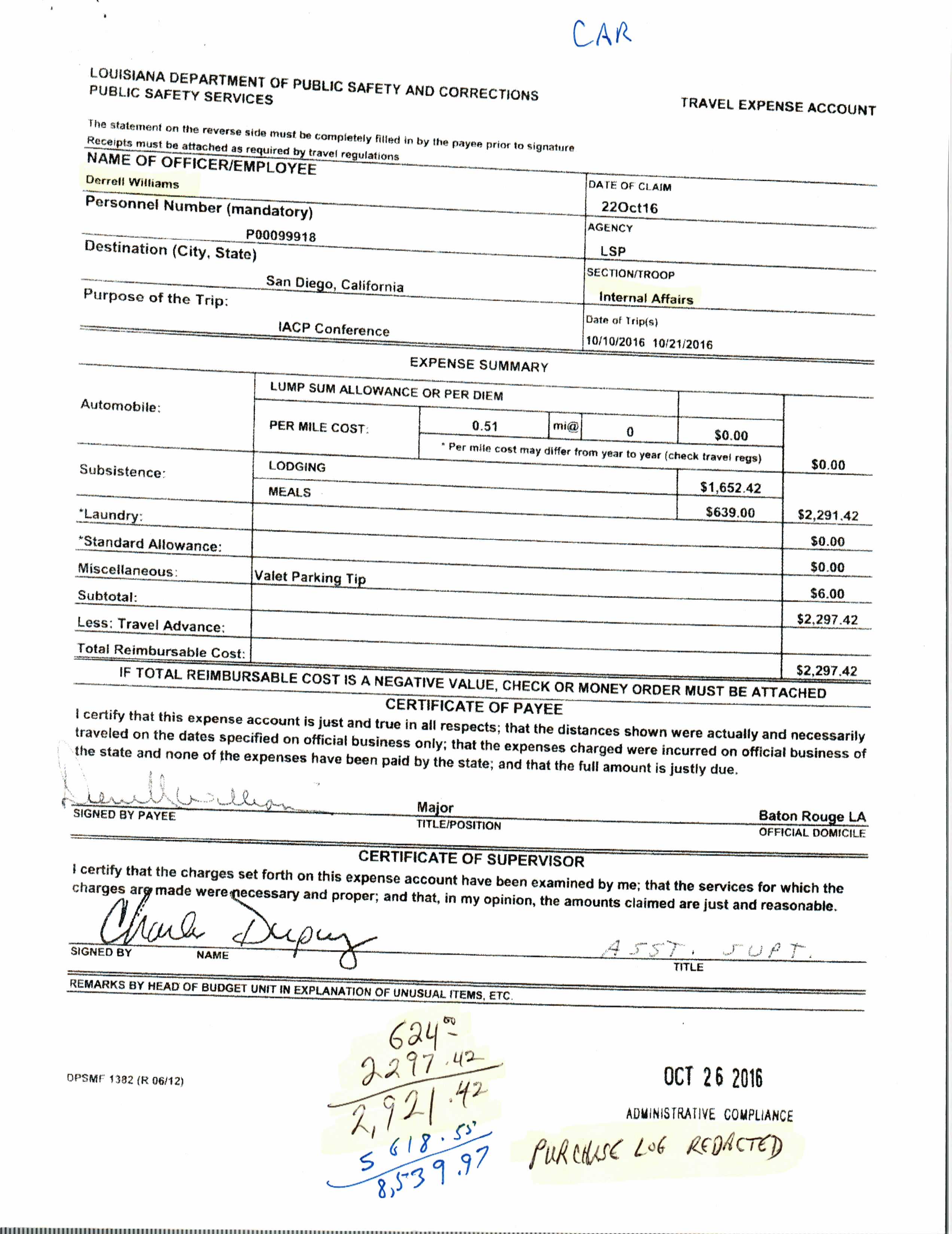
So much for the Loyalty part of that “Courtesy, Loyalty, Service” motto of the Louisiana State Police. If you’re going to give permission (as Edmonson did) for four men to drive to California and they take a state vehicle permanently assigned to your second in command, and that same second in command (Dupuy) signs off on the expenses of the senior member of the four (Williams), then it necessarily means that the top brass of Louisiana State Police (Edmonson, Dupuy, et al) were complicit and Edmonson can hardly discipline the four without coming down on Dupuy as well.
charles-dupuy

Sour grapes? You bet. No one likes being scooped on a story in which so much time and effort has been devoted. And this is not to be taken as criticism of The Advocate. In their shoes, I would not have done things any differently. And it’s certainly obvious that reporter Jim Mustian he did more than a little digging on his own as evidenced by his interview with a spokesman for the Metropolitan Crime Commission in New Orleans. We don’t begrudge participation of other media in a story such as this. Indeed, we welcome it. News is the exclusive domain of no one.

But it’s also just as evident that Edmonson had his PR machine cranked up full tilt in a desperate act of damage control.

He allowed those four State Troopers to make the trip in a State Police vehicle, a Ford Expedition—because, he said, it represented a savings to State Police. That was less than two months before he testified before members of the House Committee on Appropriations on December 6, 2016, that his department was in dire need of 658 additional VEHICLES (Scroll to the 7:40 point in the proceedings).

And he did it all on the state dime.

717,200 state dimes, to be precise, or as close as we can come, given the information provided by LSP was incomplete. That comes to at least $71,720 in taxpayer funds as the LSP assemblage partied even as the state barreled headlong toward yet another budgetary shortfall.

Gov. John Bel Edwards only last week issued a call for a 10-day SPECIAL SESSION of the legislature in an attempt to address a projected $304 million budget hole. That session began Monday at 6:30 p.m. and is scheduled to end by midnight, Feb. 22.

It’s not as though Edmonson needed validation badly enough to yank the honor from one of his subordinates. He has, after all, won other major awards:

  • FBI Washington DC, Top 25 Police Administrators Award, 2009
  • Sheriff Buford Pusser National Law Enforcement Officer of the Year Award, 2013
  • Human Trafficking, Faces of Hope Award, 2013
  • Inner City Entrepreneur (ICE) Institute—Top Cop Award, 2013
  • American Association of Motor Vehicle Administrators Martha Irwin Award for Lifetime Achievement in Highway Safety, 2014
  • New Orleans Convention and Visitors Bureau, Captain Katz Lifetime Award for Outstanding Achievement in Public Safety, 2015.

Edmonson’s expenses were paid by IACP as the organization’s “honored guest,” according to LSP Maj. Doug Cain, and the travel and lodging expenses of Lafargue, who submitted expense claims only for $366 in meals (though he did turn in a time sheet so he could be paid for attending the event), were apparently picked up by the Louisiana State Troopers Association (LSTA) as best we can determine.

Cain said the reason so many personnel made the trip was because there were two other national conferences being held simultaneously: the Association of State Criminal Investigative Agencies (ASCIA), and the National Safety Council Annual Conference. Edmonson said the conference is an annual event and was included in the LSP budget.

But that didn’t prevent everyone involved from taking time to party hardy. This happy hour group photo was snapped at a San Diego watering hole.

san-diego-happy-hour

That’s Mike Edmonson right up front, on the left. Third from left is his wife and standing behind him on the third row in the yellow shirt is his brother, State Police Maj. Paul Edmonson. When LouisianaVoice requested a list of those who traveled to San Diego, Paul Edmonson’s name was conveniently omitted from the list. Yet, here he is.

The entire affair more closely resembled a frat party than a professional function, given the side trip to Vegas and the barroom fellowship.

Here is the announcement of Edmonson’s award from the Louisiana State Police Facebook page:

Following a nomination process that included numerous highway and public safety leaders from across the country, Louisiana State Police Superintendent Colonel Mike Edmonson was awarded the “J. Stannard Baker Award for Highway Safety.” Colonel Edmonson was honored with the prestigious award during the International Association of Chiefs of Police (IACP) Annual Conference which was held from October 15-18, 2016 in San Diego, CA. The IACP Annual Conference has a reputation for providing quality education on pressing law enforcement topics, and at this year’s conference Colonel Edmonson served on a panel of law enforcement leaders from across the nation to discuss topics such as community and training.

At each year’s IACP Annual Conference, the J. Stannard Baker award is presented to recognize law enforcement officers and others who have made outstanding lifetime contributions to highway safety. The award is sponsored by the IACP, the National Highway Traffic Safety Administration (NHTSA), and the Northwestern University’s Center for Public Safety. For an individual to receive this award, they must be nominated by a law enforcement agency or other traffic safety group or official. They must also be a full time law enforcement officer of a state, county, metropolitan, or municipal agency or be an individual who has made a significant lifetime contribution to highway safety.

The IACP is a professional association for law enforcement worldwide. The IACP actively supports law enforcement through advocacy, outreach, and education. By establishing partnerships across the public safety spectrum, the IACP provides members with resources and support in all aspects of law enforcement policy and operations. The organization helps members to perform their jobs safely and effectively, while also educating the public on the role of law enforcement to help build sustainable community relations.

The glowing news release, however, does not tell the complete story.

Sources close to the story have told LouisianaVoice that New Orleans State Police Maj. Carl Saizan, a 33-year State Police veteran and former Louisiana State Trooper of the Year, was originally nominated for the award but that the nomination had to pass through Edmonson for his stamp of approval. Instead, Saizan’s nomination was mysteriously scratched in favor of….Edmonson. Department of Transportation and Development (DOTD) Secretary Dr. Shawn Wilson ultimately signed off on Edmonson’s nomination.

Repeated efforts to contact Saizan for a comment were unsuccessful but LouisianaVoice was told he was not a happy camper about Edmonson’s snub. In fact, he may well have voiced his displeasure to Edmonson because he has since been removed as Region One Patrol Commander over Troop A (Baton Rouge), Troop B (New Orleans) and Troop L (Mandeville) and placed over only Troop N, which is exclusively New Orleans.

Edmonson, for his part, denied any knowledge of Saizan’s nomination. “I don’t know anything about anyone else being nominated,” he said in a telephone interview on February 13. “This was a lifetime achievement award based on my 37 years with State Police, mainly my last nine years as Superintendent,” he said.

Maj. Doug Cain, LSP Public Information Officer, told LouisianaVoice that he submitted Edmonson’s name for nomination for the award in “early May” of 2016 but a chain of emails received by LouisianaVoice indicates that saizan’s nomination was in the works as early as April 7. That timeline coincides with the story we received that upon receiving communication that Saizan was being nominated, Edmonson, or someone on his behalf—and certainly with his blessing—decided that he and not Saizan should be the nominee.

Here is Cain’s email:

From: Doug Cain
Sent: Saturday, February 18, 2017 9:28 PM
To: Tom Aswell
Subject: Re: QUESTION

I submitted app early May.  Don’t know exact date off the top of my head.

For those who may not recall, remember in June of 2014, State Sen. Neil Riser (R-Columbia) tried to sneak an amendment onto a bill literally during the closing minutes of the regular legislative session that would have pumped up Edmonson’s retirement benefits by about $55,000 per year. In case you don’t remember, Edmonson feigned ignorance of that maneuver as well, saying he had no knowledge of any such attempt only to later admit differently that he gave the go-ahead to the attempt in the full knowledge he had chosen to lock in his retirement years earlier and that that decision was supposed to be “irrevocable.”

So someone acts on Edmonson’s behalf to benefit him and he then attempts to distance himself from the action by claiming ignorance.

Does anyone see a pattern here?

LouisianaVoice received corroboration of the Saizan story from six independent sources, all from law enforcement veterans—three active and three of whom are retired.

The 15 “guests,” along with their salaries, who traveled to California to witness the presentation at the three-day International Association of Chiefs of Police convention in San Diego on October 16-18 were:

  • Derrell Williams, of Internal Affairs, $132,800 per year;
  • Col. Jason Starnes, recently promoted into the newly-created $150,750 per year unclassified position of Chief Administrative Officer (CAO) to assist the Undersecretary in the administration of all programs and sections within the Office of Management and Finance. The job description states Chief Administrative Officer shall exercise the duties and responsibilities of the Office of Management and Finance in the absence of the Undersecretary at the direction of the Deputy Secretary. Perk – he receives Free housing at the State Police Headquarters compound (dorm) because he is separated;
  • Special Assistant Superintendent Charles Dupuy, Edmonson’s $161,300 per year alter-ego;
  • Paul Edmonson, Command Inspector of Special Investigations Section ($136,800). He is Mike Edmonson’s brother and was not included in the list provided by LSP of those making the trip but somehow showed up in a group photo of the contingent in a San Diego bar;
  • John W. Alario, son of Senate President John A. Alario, Jr., who pulls down $115,000 per year as Executive Director of the Louisiana Liquefied Petroleum Gas Commission;
  • Layne Barnum, Command Inspector, Criminal Investigations Division ($132,800);
  • Greg Graphia, Operational Development Section consists of the Planning, Public Affairs, and Research Units. The Section functions as staff for Mike Edmonson ($124,100);
  • Special Deputy Superintendent over Bureau of Investigations Murphy Paul ($150,750). The Bureau of Investigation is responsible for the investigation of criminal activity, intelligence gathering, and case and technical support in the State of Louisiana.
  • Chavez Cammon, Criminal Investigations Unit, New Orleans ($96,900);
  • Stephen Lafargue, Secretary-Treasurer of the Louisiana State Troopers’ Association (LSTA) and Bureau of Investigations for Troop D in Lake Charles ($112,300);
  • Rodney Hyatt, HQ President of the Louisiana State Troopers’ Association (LSTA) and Lt. of Operational Development Section ($99,800);
  • Master Trooper Thurman Miller, President of the Central States Troopers Coalition of Louisiana ($72,600);
  • Trooper Alexandr Nezgodinsky, Insurance Fraud Section, Baton Rouge ($50,900);
  • Charles McNeal, Investigative Support Section (ISS) LA-SAFE Director ($124,100);
  • Brandon Blackburn, an $18,700-per-year unclassified student/intern who is the son of the late Frank Blackburn who served as legal counsel to the Department of Public Safety (DPS). The younger Blackburn, along with his mother, Cindy Kreider Blackburn, and Mike Edmonson’s wife, Suzanne, paid their own expenses, records show.

With Edmonson, Dupuy and Starnes all in San Diego, it’s a good thing no major emergencies like floods, shootings or petro-chemical plant explosions occurred during their absence. But it nevertheless raises questions as to the wisdom of having the top three LSP administrators out of state at the same time. Cain, however, defended the decision, saying, Command and control is maintained 24/7.”

Yeah, like Bobby Jindal continued to run the state while campaigning for President in Iowa.

The decision to have LSP pay the salaries of such a large group of attendees, as well as travel, lodging, meal and conference registration expenses via state LaCarte credit cards, seems questionable enough. But the justification of having four troopers—Derrell Williams, Rodney Hyatt, Thurman Miller and Alexandr Nezgodinsky—drive a state vehicle from Baton Rouge to San Diego (with an overnight stopover in an expensive Las Vegas casino hotel)—was the most puzzling.

Miller is a member of the Retirement Board and President of the Central States Troopers Coalition of Louisiana, Inc. 

Traveling via Interstates 10 and 8 from Baton Rouge, the four would have had to go northwest from Phoenix about 250 miles for an overnight stay in Vegas and from there, 260 miles southwest to San Diego. The straight-line distance between Phoenix and San Diego via I-8, on the other hand, is 350 miles. That means the 510-mile detour taken by the four was about 160 miles longer than necessary.

The four logged seven days for the round trip—four days driving to California and three days on the return trip—plus the four days at the conference itself.

Not only did fuel for the trip cost $610.98, but the four troopers combined to log 249 total hours during the trip (12 hours per day each for three of the men except for the final day, when 11 hours were claimed by the same three) on their time sheets. Each man was paid for 56 regular hours (224 hours total) for the seven days on the road and for 27 hours each (81 total hours) in overtime pay for the trip. Each also was paid for attending the four-day conference, according to time sheets submitted by the troopers.

Maj. Derrell Williams was the only one of the four to claim no overtime for the 11 days that included the trip and the conference. That’s because those with the rank of captain or above cannot earn overtime pay. They can, however, earn straight compensatory time. His salary and expenses still came to $5,730.

Cain was asked for the justification for taking the vehicle and his email response was: More cost effective to transport 4 individuals and also provide local transportation in San Diego for departmental personnel.”

Edmonson likewise said by the time the cost of flying to San Diego and renting a car was tabulated, it was more economical to have the men drive.

But when their travel time (regular and overtime hours), meals and hotel bills were totaled, the cost of driving the vehicle came to more than $21,000, which does not appear to fit the “cost effective” justification given by Cain or Edmonson. In fact, each of the four could have flown first class for less than that. Edmonson said he would re-calculate the cost of driving the vehicle to California.

On Friday, he heaved the four men under the bus when he announced that they would be required to repay overtime claimed as well as hotel expenses for their overnight stay in Las Vegas. He said Maj. Catherine Flinchum who formerly worked in Internal Affairs, the section Williams now heads up, would conduct an investigation of the trip by the four men.

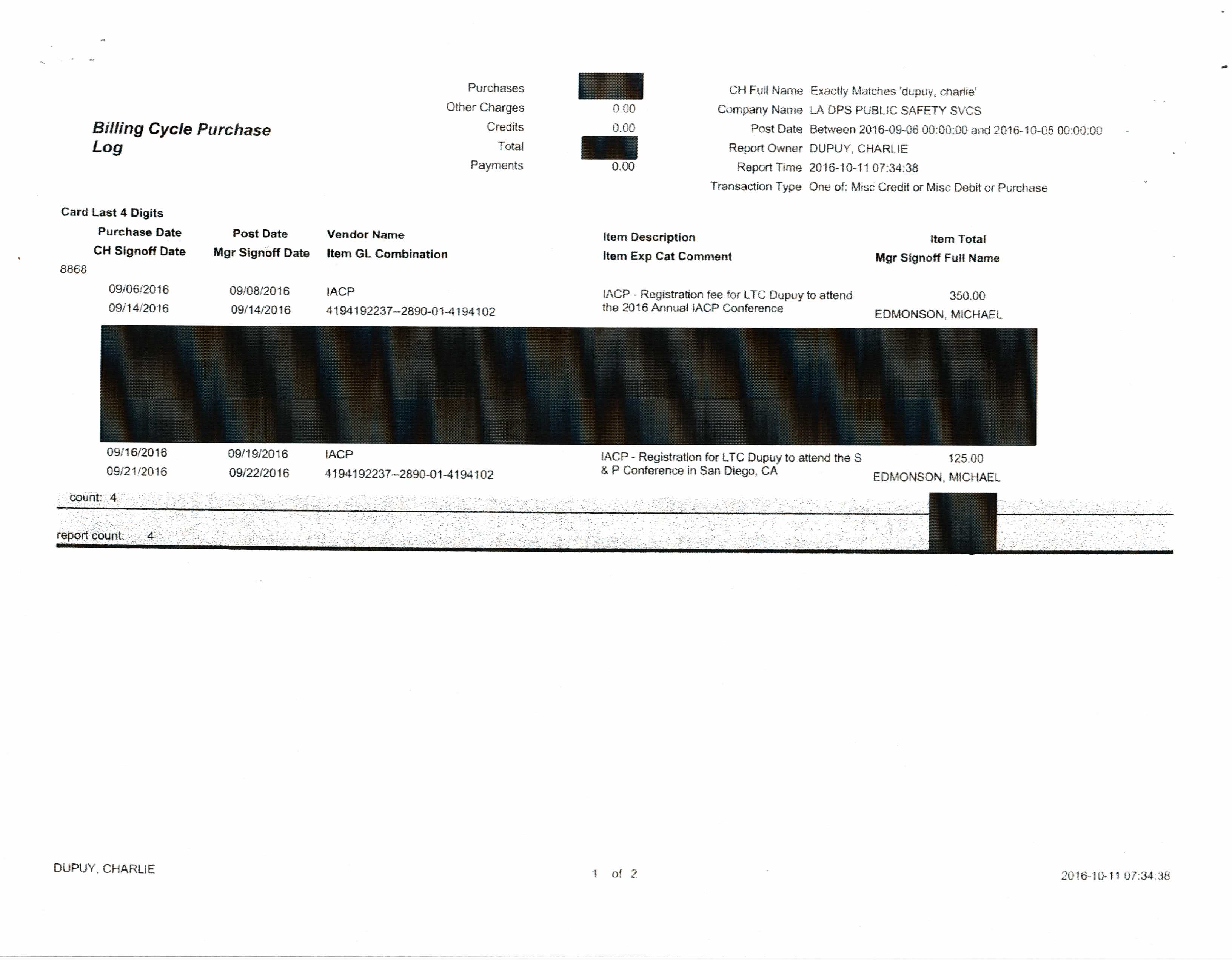
Interestingly, Williams’s supervisor who signed off on his $2,297.42 expense report was Lt. Col. Charles Dupuy, to whom the vehicle they drove is permanently assigned. That leaves unanswered the question of whether Edmonson’s investigation would extend to his second in command for approving the use of his vehicle and for approving the expenditures.

The bottom line here is that Edmonson knew of and approved taking the vehicle to San Diego and knew of the Las Vegas trip. His signature may not be on the approval for the expenses, but his fingerprints are all over this entire sordid affair. He owns it and no amount of public contrition can change that.

As for others who made the trip by auto, Capt. Gregory Graphia, who also was in San Diego, signed off on time sheets (including the overtime logged) of both Rodney Hyatt and Thurman Miller while Hyatt signed off on Alexandr Nezgodinsky’s time sheet even though he is not Nezgodinsky’s supervisor. A tight little incestuous circle of responsibility, to be sure.

Nezgodinsky, by the way, presents an interesting question in his own right. It seems he has been a State Trooper only since May 2014. So how did a trooper with so little seniority rate a free trip to San Diego? The answer to that may lie in the fact that he was a San Diego city police officer as late as 2012. Perhaps the Louisiana crowd needed a tour guide to the tourist hot spots.

As far as Cain’s somewhat questionable explanation of “local transportation for departmental personnel” goes, Enterprise, which has a contract with the state for discounted rates, still rents cars in San Diego.

One law enforcement official offered a third possible reason for taking the vehicle. “Any way you can check to see if booze for their private parties was transported out there?” he asked.

Cain denied that the Expedition transported anything other than the four troopers.

The total breakdown of costs to the state was almost evenly split between salaries and expenses, records show. Altogether, the salaries for all attendees came to nearly $34,800 and expenses for travel, lodging, registration and meals were $36,233, plus whatever unreported expenses were incurred by Paul Edmonson, according to incomplete records provided by LSP as a result of LouisianaVoice’s public records requests.

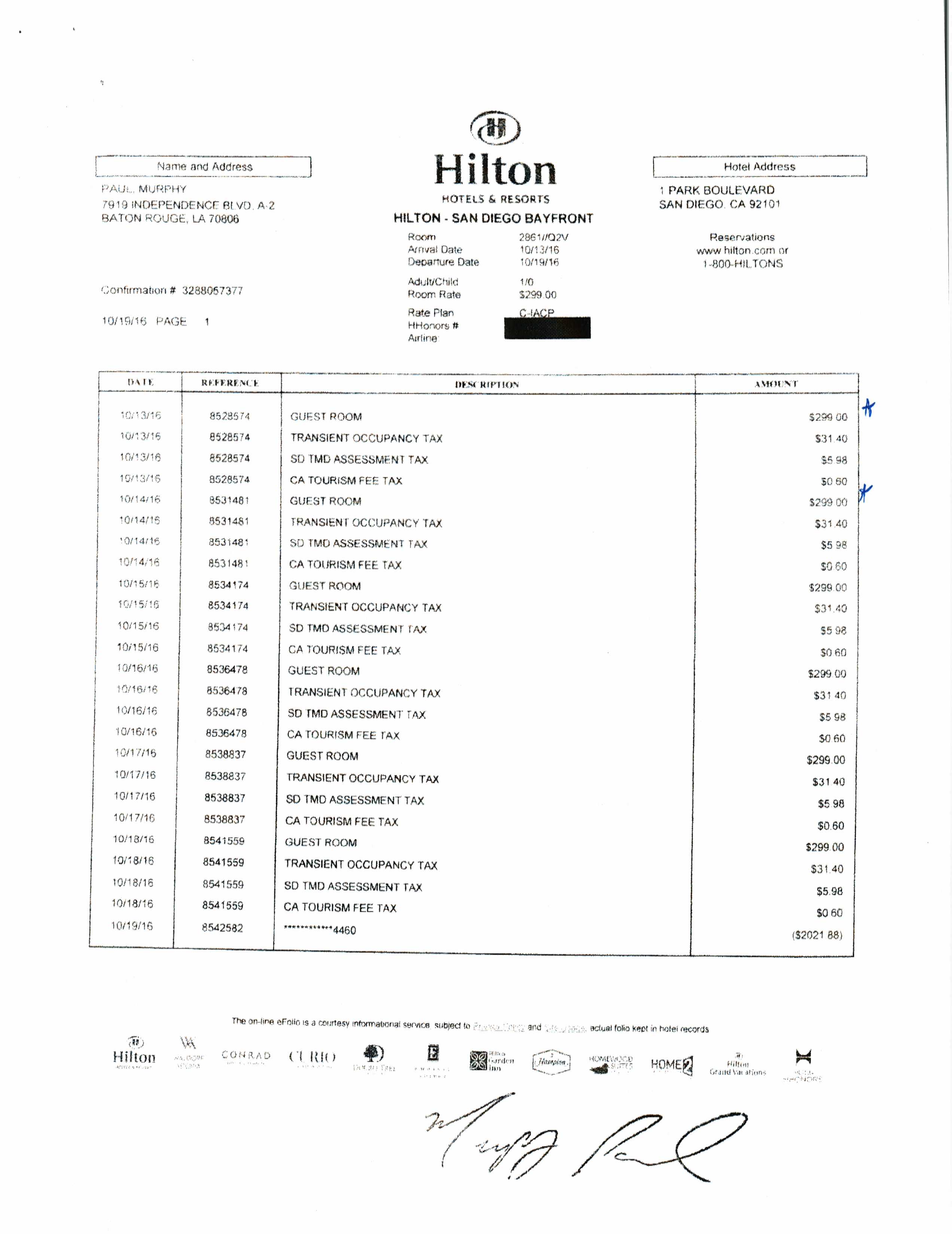
Among those costs were hotel bills far exceeding the maximum allowed by state travel guidelines. While several hotel bills were submitted for as much as $299 per night, state guidelines set a maximum limit of $126 per night for several listed cities, including San Diego.

Likewise, the $68-per-day limit for meals ($13 for breakfast, $19 for lunch and $36 for dinner) was routinely exceeded, sometimes just for breakfast. Three examples included meal expense statements of $60 and $72 for breakfast, $68 and $102 for lunch and $96, $120 and $193 for dinner.
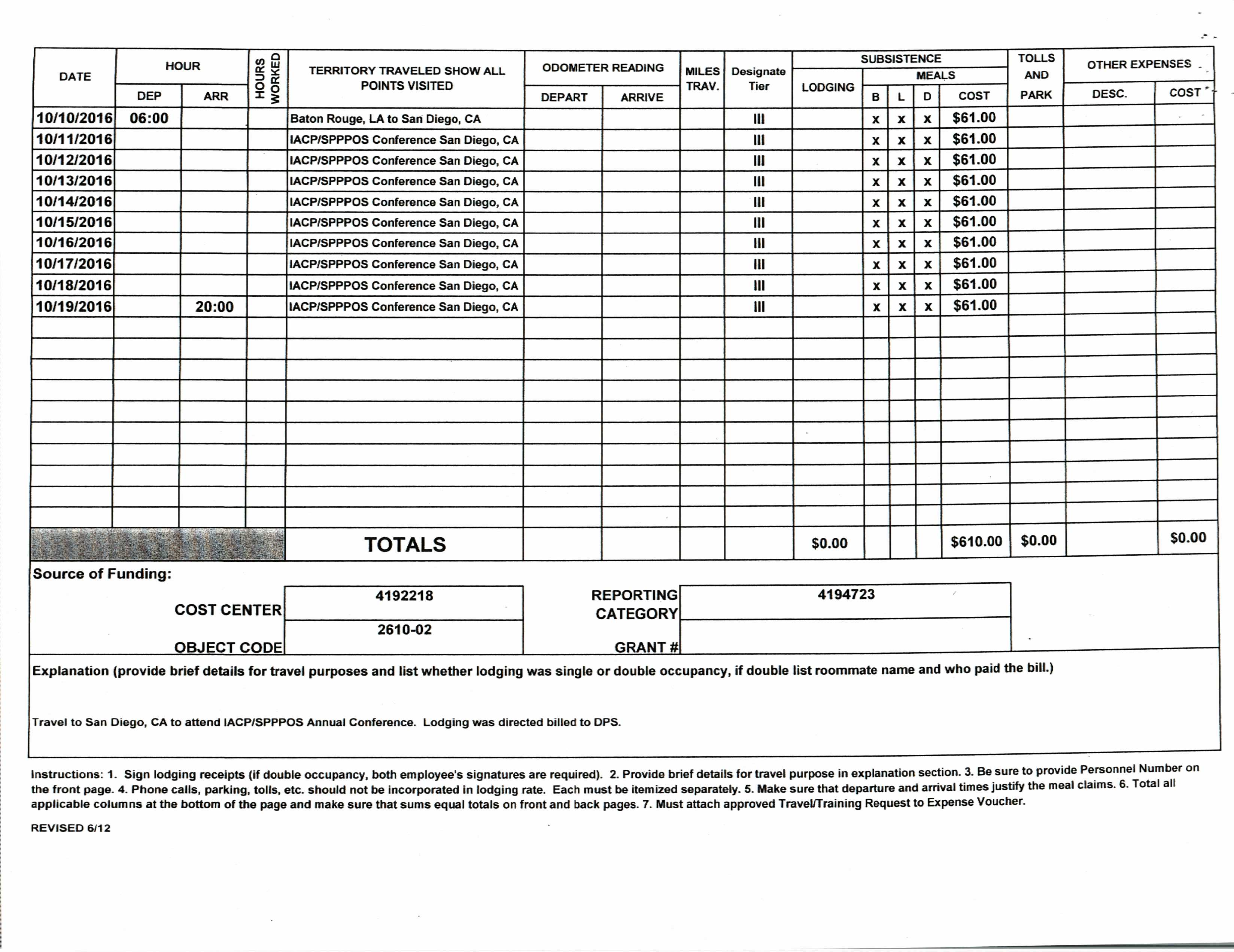
redacted-starnes-invoice

redacted-edmonson-invoice

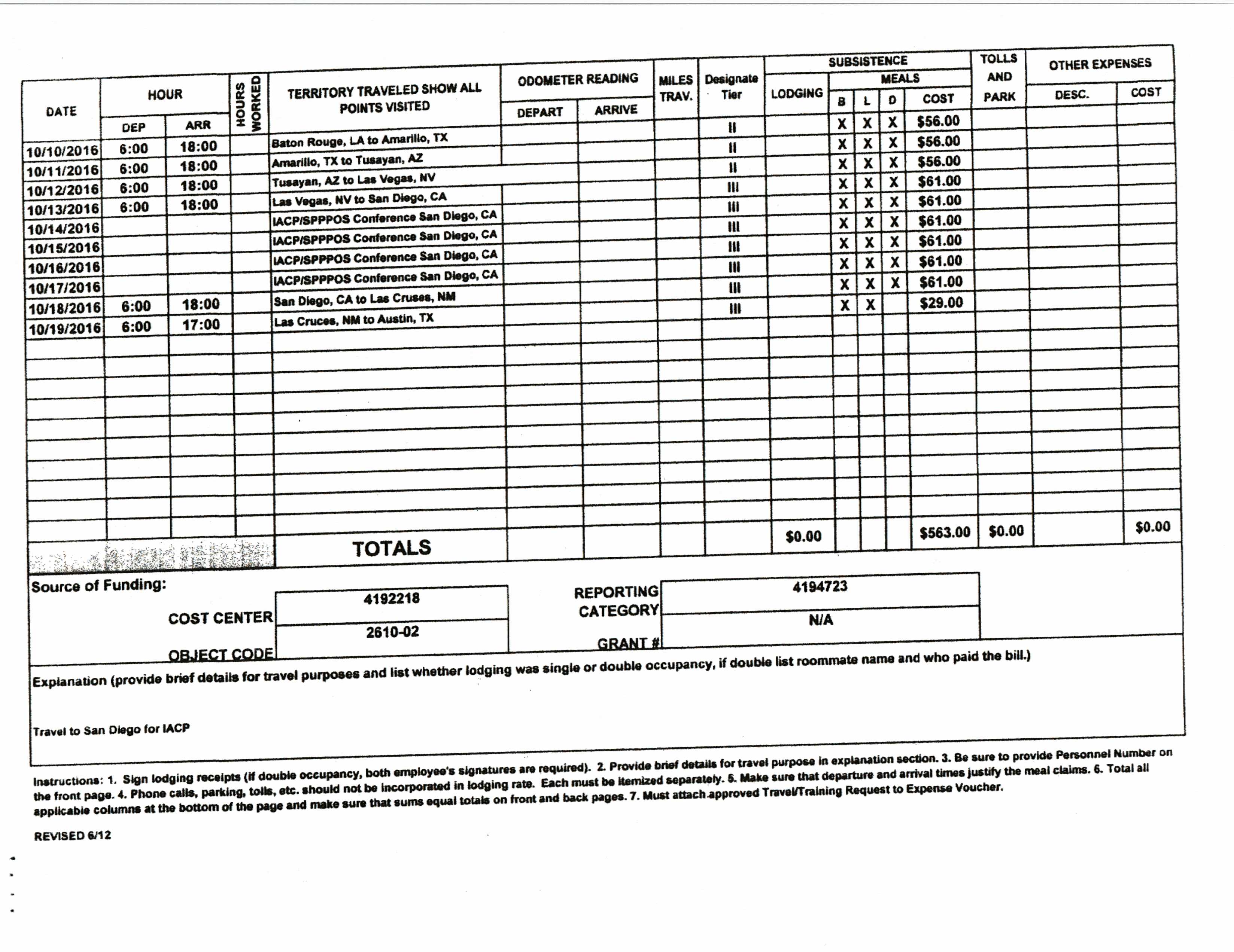
nezgodinsky-original-expenses

nezgodinsky-amended-expenses

hotel-bill

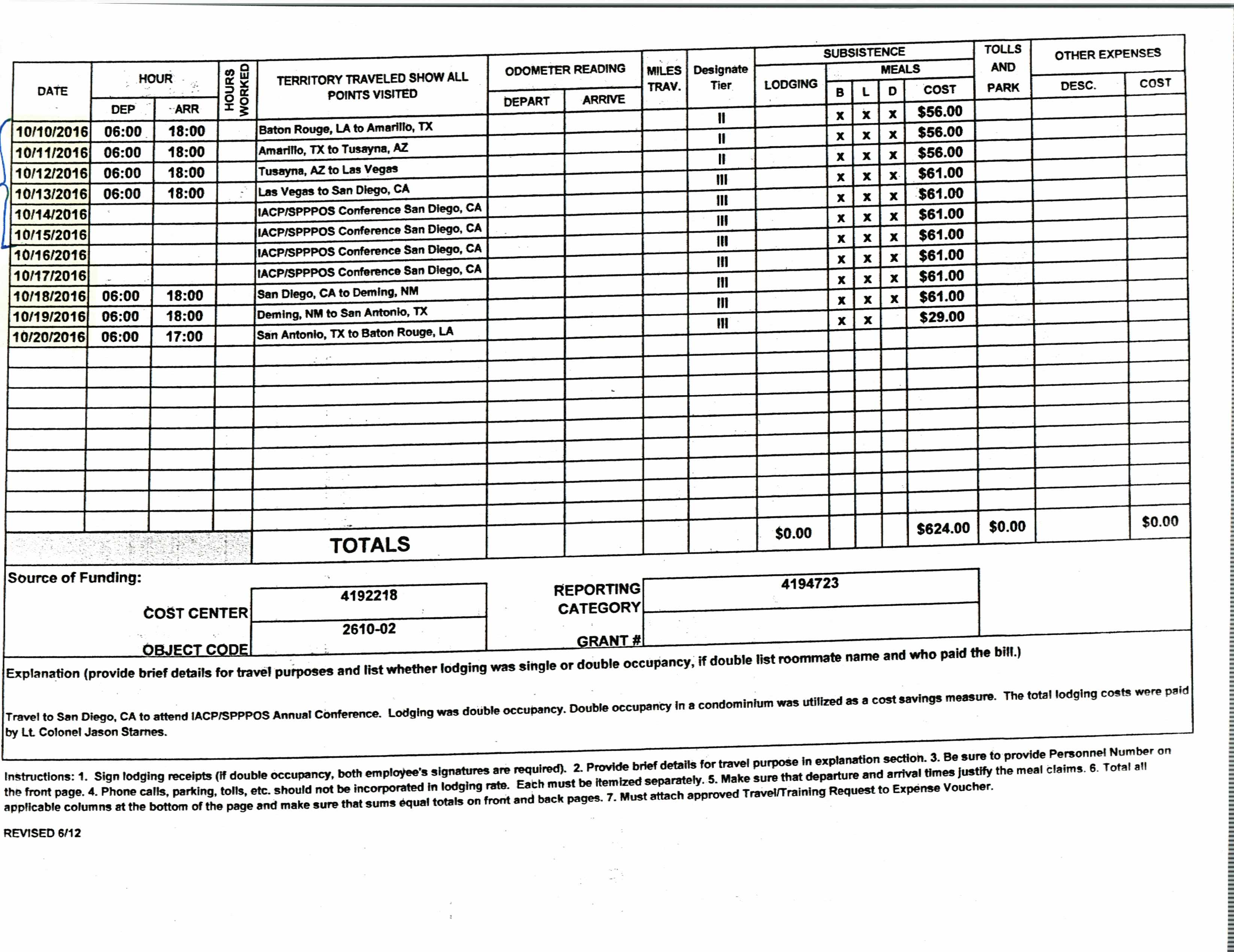
hyatt-expenses

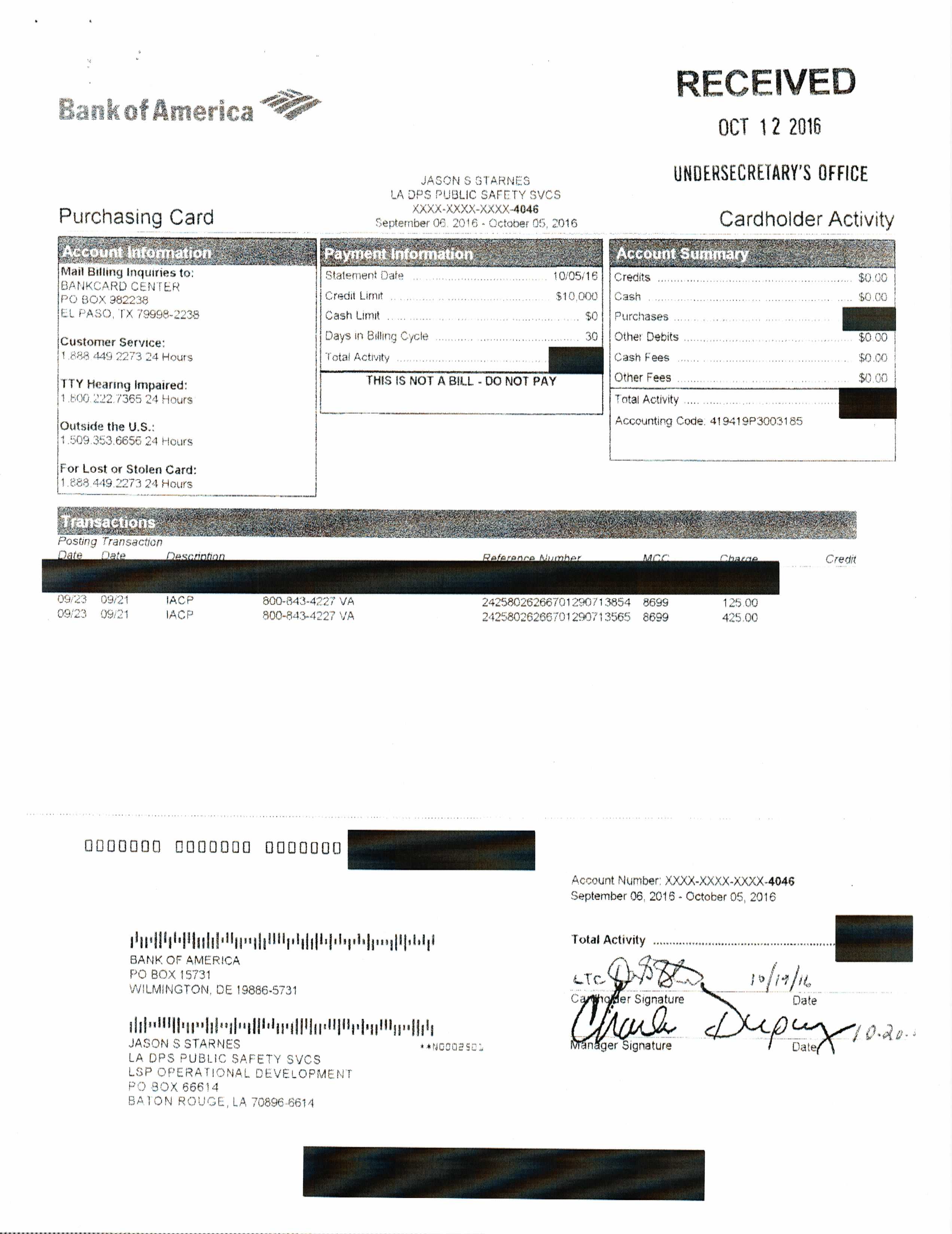
Note the redaction of costs on several of the documents provided by LSP and the overtime hours charged.

The trip could prove embarrassing for the governor who recently posted on his office’s web page his PLAN to “stabilize the FY17 budget deficit of $304 million.”

Included in that plan:

  • No money in the FY17 budget for inflation or merit pay for state employees (so many years now that we’ve actually lost count but a good guess would be seven or eight years—but State Troopers have fared a little better, getting two recent raises that gave some officers increases as much as 50 percent. Those raises, by the way, did not apply to officers of the Department of Public Safety.);
  • No funds for flood related expenses.

Proposed cuts to specific programs included:

  • Louisiana Commission on Law Enforcement—$251,674. The costs of the San Diego trip represented 28.5 percent of the cuts to this one program.
  • Louisiana Emergency Response Network Board—$27,625 (the San Diego trip cost two-and-one-half times this amount).
  • Office of State Police, Operational Support Program—$7.38 million;
  • Office of State Fire Marshal, Fire Prevention Program—$900,503;
  • Office of Juvenile Justice—$4.46 million;

Granted, $71,720 doesn’t represent a lot in the overall scheme of things when talking about a $304 million total deficit. Certainly not in any defense of Edmonson, but what if this is not an anomaly? What if this kind of fiscal irresponsibility is typical throughout state government?

If you have wastes of $71,720 here and $71,720 there, and $71,720 somewhere else, to paraphrase the late U.S. Senator from Illinois, Everett Dirksen, pretty soon you’re talking about real money.

And remember, that $71,720 doesn’t include airfare, lodging and meals for Paul Edmonson since LSP failed to include him on the list of individuals who traveled to San Diego. Moreover, LSP initially provided expense records that redacted purchase amounts charged to the state LaCarte cards but later, pursuant to LouisianaVoice’s follow-up request, provided copies that were not redacted. But there were still no itemized receipts provided that showed what those purchases were.

Asked for the total cost of the trip, Cain responded, “I don’t have this figure; you have all the relevant documents.”

Well, given the deletion of Paul Edmonson from the guest list, not quite all.

Given the timing of this, the incredible waste of state resources, and the fact that the state continues to grapple with budgetary shortfalls, perhaps the time has finally come for Gov. Edwards to take somebody to the woodshed for a lesson in discretion.

Because, Governor, we’re all “embarrassed” by Edmonson’s repeated lapses in judgment.
Read Full Post »

It’s not certain if Louisiana State Police Commission (LSPC) Chairman T.J. Doss is simply LSPC’s equivalent to Donald Trump or if he’s not seeking or getting sound legal advice from commission legal counsel Lenore Feeney.

Either way, the commission, already reprising author Jimmy Breslin’s Gang that Couldn’t Shoot Straight, just can’t seem to conduct a simple investigation into State Trooper political activity. Nor can Doss seem to get it right when seeking nominations to fill vacancies on the commission.

Article X, Part IV, Sec. 43 (c) of the 1974 Louisiana State Constitution says of nominations for appointment to LSPC:

The presidents of Centenary College at Shreveport, Dillard University at New Orleans, Louisiana College at Pineville, Loyola University at New Orleans, Tulane University of Louisiana at New Orleans, and Xavier University at New Orleans, after giving consideration to representation of all groups, each shall nominate three persons. The governor shall appoint one member of the commission from the three persons nominated by each president.

That should be plain enough. The presidents of the private universities are required to submit three names from the congressional district within which a vacancy occurs.

With four of the six schools located in New Orleans, that can become something of a problem if the vacancy is from, say the Third Congressional District which comprises much of Acadiana and Southwest Louisiana.

But if a vacancy occurs from the Fourth District, common sense says contact the President of Centenary in Shreveport for names of nominees. In the Fifth District, it would be the President of Louisiana College in Pineville.

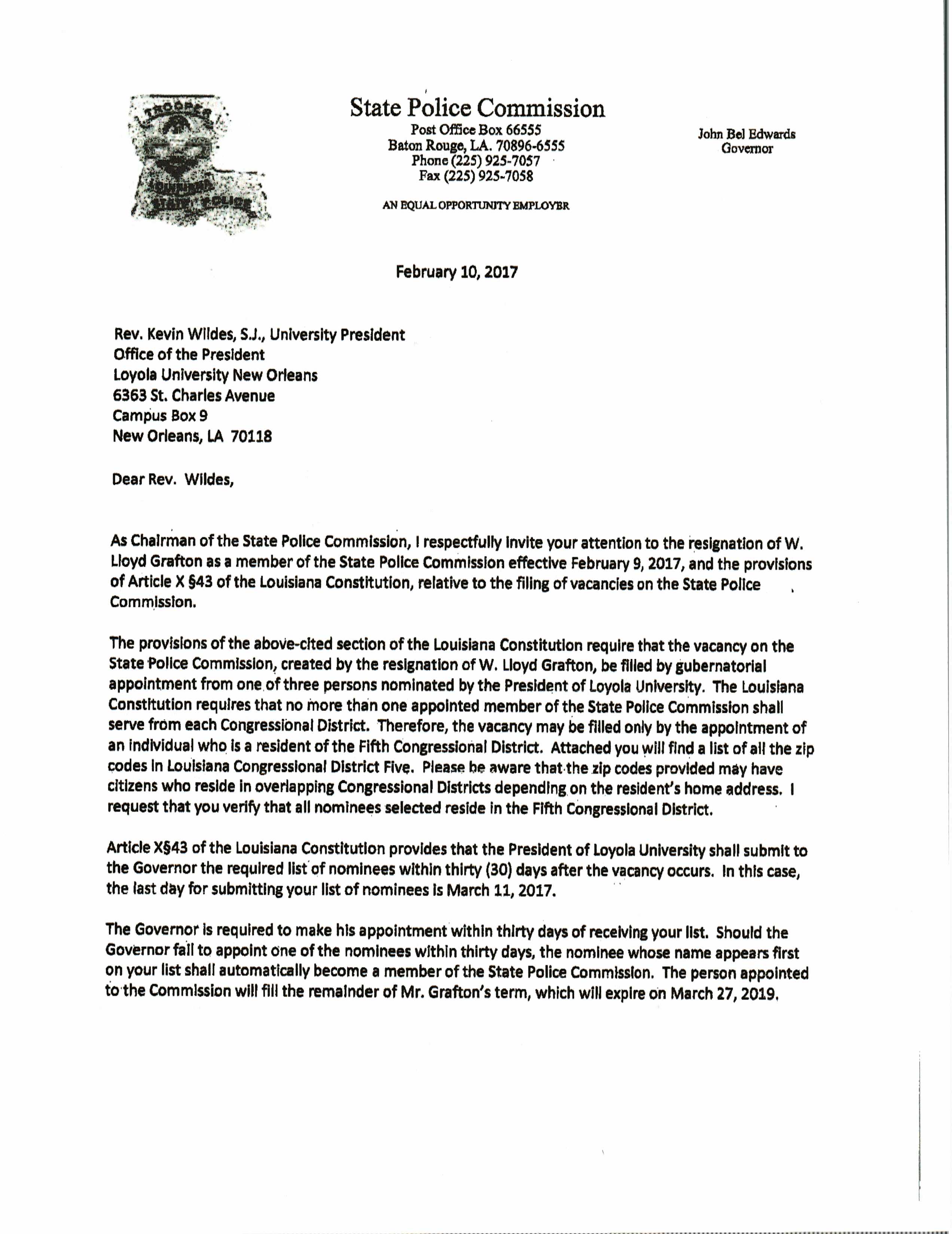
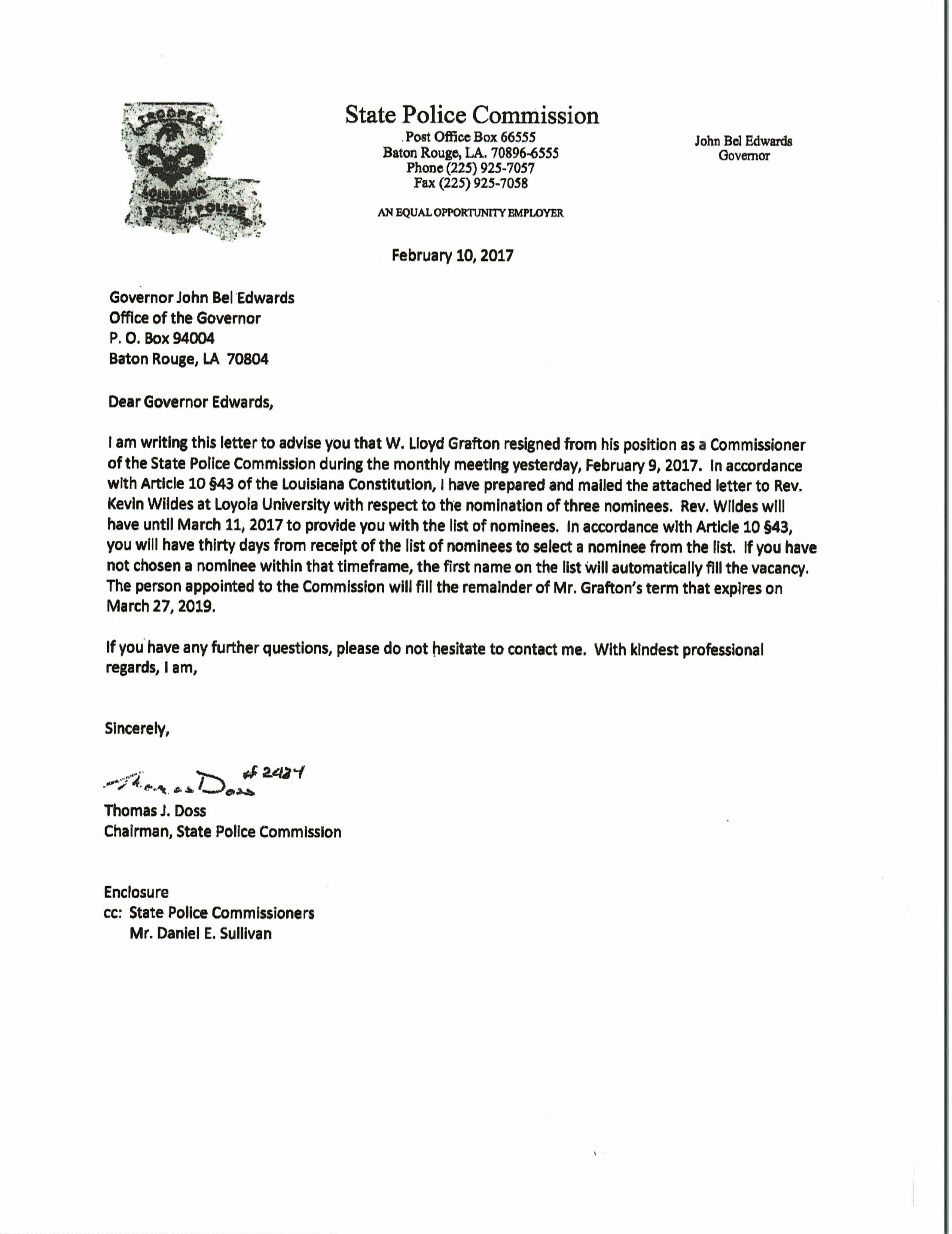
So, when Lloyd Grafton of Ruston resigned earlier this month, why did Doss contact Gov. Edwards on Feb. 10 to say he was soliciting names from the President of Loyola University in New Orleans? And why did he, on that same day, fire off a letter to Loyola President Rev. Kevin Wildes saying that the Louisiana Constitution requires that Grafton’s vacancy be filled by gubernatorial appointment “from one of three persons nominated by the President of Loyola University”?

imag2265

imag2266

imag2267

Doss was correct in saying the vacancy had to be filled by someone from the Fifth Congressional District, but there is no such requirement that the names of nominees come from Loyola. Louisiana College is in the Fifth Congressional District and that institution’s president should have been the one contacted for names.

Perhaps Doss has access to alternative facts when complying with the Louisiana Constitution.

Of course, if Feeney dared try to correct him, there is legal precedent for firing the messenger: There’s Trump and his dismissal of interim Attorney General Sally Yates. And there’s the LSPC itself with the manner it forced out former Executive Director Cathy Derbonne in January because she insisted on complying with the law.

Read Full Post »

One quit, another walked out and a third just said he wanted some answers and a fourth presented a witness who seemed a little too well-coached and in the end, nothing was accomplished because the fifth, aka the chairman, had the look of a Cervidae enrapt in the vehicular illuminating devices (deer caught in the headlights).

Just another routine meeting of the Louisiana State Police Commission (LSPC) on Thursday.

Well, maybe not so routine. There was the shouting match between members Jared J Caruso-Riecke (the “fourth” as referenced above) and Lloyd Grafton (the “one” above) with both men invoking words like “best face,” “integrity,” and “pontificate.” Oh, number four said “pontificate” a lot.

Meanwhile, the man around whom the entire controversy swirled, State Police Superintendent Mike Edmonson was off somewhere out of state collecting another award to go in his trophy case or schmoozing with Louisiana politicos at the Washington MARDI GRAS.

Caruso-Riecke, of Covington, brought Louisiana State Police (LSP) Human Resources Director Ginger Krieg before the commission to explain the smoke and mirrors concept of how the appointment of Jason Starnes to the role of retired Undersecretary of Management and Finance Jill Boudreaux (even though he possesses zero accounting experience) was accompanied by an immediate promotion to lieutenant colonel and a $25,000 per year pay increase without incurring any additional expense as promised by Edmonson.

The position was created last August when Edmonson asked for the creation of an unclassified position to oversee Management and Finance. At the time, he said there would be no addition expenses to LSP and that the position was not being necessarily for Starnes.

Krieg explained that Boudreaux had retired and her $100,000 per year position was never filled so the $25,000 pay increase for Starnes actually amounted to a savings to the state.

What Caruso-Riecke and Krieg failed to mention in their exchange (which seemed so well-rehearsed that one of them should receive an Oscar nomination) was that state statute says the governor “shall” appoint an Undersecretary of Management and Finance. So, if the law is followed and an undersecretary appointed….poof! There goes that savings.

Grafton reiterated what Edmonson had said in August and said Caruso-Riecke was just putting a “good face” on the duplicity of Edmonson, Starnes, and Edmonson’s supporters on the commission. Caruso-Riecke erupted, accusing Grafton of an “absolute falsehood.” He admonished Grafton to not “sit down there and say I’m trying to put a ‘best face’ on something when I’ve gone above and beyond in trying to get to the truth.”

Here is the video link to that EXCHANGE.

“What have you done other than pontificate for the press?” he asked, practically shouting.

Grafton, in a more subdued voice (relatively speaking), said, “I’ve tried to keep some integrity on this commission and there is none. You came on this board with an agenda and that agenda was fulfilled last month when (former Executive Director) Cathy Derbonne resigned from this commission because of the harassment and the crap she was having to put up with since (pointing to commission Chairman T.J. Doss, of Shreveport) a State Trooper was TDY’d (assigned temporary duty) to Baton Rouge to hang around her office every day and to find fault with her and (who) said at a public meeting that he was gonna get rid of Cathy Derbonne. He followed through with that (and) lived up to my low expectations of him and he managed to have this commission stuffed with people who want to endear themselves with State Police management who could care less about the civil service function of this board. The Louisiana State Troopers Association (LSTA) has absolutely helped destroy this commission.”

Grafton said the commission is supposed to investigate, among other things, claims of harassment brought by troopers but now those claims “go straight to management and that trooper doesn’t have a chance. That just destroys the civil service standing of this board.

“I have 55 years of law enforcement education experience. I know something about what is integrity and what is not. Wanting to go to a Christmas party is more important than holding management accountable and it’s going to come back to haunt you.

“The only salvation for this commission is for it to be dissolved and for the Civil Service Commission to take over the oversight of the State Police because right now we have no oversight whatsoever. The Colonel of the State Police (Edmonson) can do anything he wants to. He can lie, he can do anything and he does plenty of it and nobody holds him accountable.”

Caruso-Riecke interrupted Grafton, denying that Edmonson said there would be no pay raise for the new position. “Why don’t you listen to the tape instead of sitting up her pontificating (apparently he likes that word because he kept using it) for the press? For you to sit up here and act like you’re holier-than-thou and the only one with any integrity and character? That’s insulting to everyone else sitting here.”

“Anyone who joined in with that lynching of Cathy Derbonne has no character and I’ll stand by that,” Grafton replied.

“Last I checked, she resigned,” Caruso-Riecke shot back, conveniently forgetting that her fate had long been decided before her resignation.

But Grafton did not forget. “She resigned because she was told she was gonna be fired.”

Donald Breaux of Lafayette asked Grafton to identify those who said she was going to be fired. He had not opened his mouth to that point and probably should not have then since the worst-kept secret in the room was that there were four solid votes, a majority, to fire Derbonne just as Doss had indicated he wanted done. Derbonne was even told that during a 30-minute break in the January proceedings. “You bring up a lot of stuff, Grafton, but you have nothing to back it up with,” said Breaux, a former sheriff.

“When you say Grafton doesn’t know what’s going on in the State Police, you have underestimated my ability to get information,” he said.

Grafton, the most senior member of the commission, subsequently announced that he was attending his final meeting. “I’m through,” he said. “This commission has become useless and the only way it can ever be fixed is for the governor to get involved. I resign.”

His rant was followed in short order by member Calvin Braxton of Natchitoches who said he was not resigning but would refuse to participate in an executive session on the agenda about which he had no prior notice.

“I’m a reasonably intelligent person and I don’t like being kept in the dark and I am being kept out of the loop on this commission. You’ve got an item on the agenda calling for an executive session to discuss a trooper’s appeal. I was told nothing about this and I refuse to be a part of it.”

Here is the link to his part of the discussion:https://www.youtube.com/watch?v=SOMahyElYQ0&feature=youtu.be

Moments later, both he and Grafton were gone.

Then it was Eulis Simien, Jr.’s turn. The Baton Rouge attorney, who was appointed to the board last year, said like Grafton, it was his impression at the conclusion of Edmonson’s presentation last August that there would be no pay raise involved for the new position. “I said at a prior meeting that I would like for the person who said that to come to us and explain what he said,” he said. “Instead, we get the head of HR. That’s not who made the presentation to us last August. I asked for him to come before us and I want him to come before us.”

All the bantering, shouting and “pontification” of Thursday’s meeting comes on the heels of a 13-page report by the Louisiana Board of Ethics that investigated the practice by the LSTA of having its Executive Director David Young make political campaign contributions in his name to circumvent prohibitions against political involvement and then reimbursing Young for “expenses.”

It was LouisianaVoice’s initial story about the contributions more than a year ago that launched the investigation which resulted in three former LSPC members being forced to resign when it was learned that they, too, had contributed to campaigns.

The recent Ethics Board report only went back to 2014, so the $10,000 in contributions to former Gov. Bobby Jindal were not included in its investigation. It did, however reveal that LouisianaVoice‘s report that $10,000 was contributed to Gov. John Bel Edwards was considerably less than the $17,500 actually contributed to his campaign.

LSTA and Young got off extremely light with a fine of only $5,000, the document reveals. While state law allows an imposition of a penalty “equal to the amount of the contribution plus 10 percent ($35,000 plus $3,500 in this case), LSTA and Young were actually subject to fines of about $70,000, or twice amount of the total contributions, for “a knowing and willful violation.”

Young had admitted to the LSPC more than a year ago that the money was laundered through his personal account so as to allow the LSTA to get around the prohibition against such political activity. That constitutes “a knowing and willful violation.”

It was the embarrassment of the LSTA and Edmonson that forced the LSPC to conduct a sham investigation of the activity, an investigation that resulted in the recommendation that “no action be taken.” That recommendation was made by Natchitoches attorney and former State Sen. Taylor Townsend, a political supporter of Gov. Edwards who was paid $75,000 to issue an unwritten, “no action” recommendation.

And on Thursday, it culminated in the resignation of a conscientious commission member, the walkout of an honorable member, and further questions from another member who appears to want to do the right thing—if someone would just tell him what was said.

But there are four other votes on the commission and their interests obviously lie elsewhere.

Why else would the commission have as its chairman a State Trooper who conceivably could one day be called on to investigate his boss?

Read Full Post »

One thing we’ve learned about the Louisiana State Troopers Association (LSTA), the independent lobbying organization for Louisiana State Police (LSP), is that despite a recent $5,000 fine for illegally making political contributions, the organization was far from through.

At the 2016 LSTA retreat in New Orleans held at the Omni Hotel Jan. 18-20, former Speaker of the House Chuck Kleckley (R-Lake Charles), who was front and center on state police pay raise issues, was rewarded for his work on behalf of State Police while in office.

While retiring state troopers are usually given a watch, the LSTA board voted to purchase a handgun costing several hundred dollars for Kleckley.

Technically speaking, the presentation of a handgun by a grateful LSTA was not a “political” contribution, given the fact that term limited Kleckley had left office on Jan. 11, a whole week before he was given the gift.

It’s interesting to note that state ethics laws strictly prohibit the receipt of anything of value by state employees but do not apply to barely out of office legislators.

LSTA New Orleans / January 20, 2016

Meeting with Command Staff

Col. Edmondson, Major Jason Starnes and Col. Dupuy addressed the board of directors. Command Staff covered LSP issues, Legislative issues and LSTA issues.

A Motion was made by Mr. Rodney Hyatt for the LSTA to purchase a handgun for Mr. Chuck Kleckley, seconded by Mr. Badeaux with no objections, the motion passed.

Here is the State Board of Ethics agenda item dealing with the LSTA contributions:

Louisiana State Board of Ethics Agenda

Friday, January 20, 2017
Docket No. 15-1385

Assigned Attorney: Jennifer Land
Re: Consent opinion regarding the Louisiana State Troopers Association making campaign contributions in the name of its executive director and then later reimbursing him for those contributions.
Law: La. R.S. 18:1505.2A(1) provides that no person shall give, furnish, or contribute monies, materials, supplies, or make loans to or in support of a candidate or to any political committee, through or in the name of another, directly or indirectly.
Facts:The Louisiana State Troopers Association and its executive director, David Young, signed a consent opinion for violating La. R.S. 18:1505.2A(1) and paid a civil penalty of $5,000.

 *(Source: Louisiana Ethics Commission’s Internet web page)

It is well-documented here as it has been elsewhere that when Bobby Jindal refashioned the Louisiana Board of Ethics in 2008, ethics laws for public officials were effectively gutted and the Ethics Board rendered all but impotent. His ethics “reform” prompted mass resignation of ethics board members who were the only ones at the time to understand the significance of what he had done. Besides usurping the board’s enforcement powers, the move effectively dismissed outstanding ethics violations charges against several of Jindal’s legislative allies.

But even the Ethics Board in its weakened condition was able to do what attorney Taylor Townsend, hired to investigate the LSTA’s campaign contributions, could not. Townsend, hired to investigate what appeared to be a money laundering type of scam to conceal illegal political campaign contributions by Louisiana state troopers could find no reason to even file a written report, let alone take any definitive action against troopers involved in the decision to make the contributions.

So, perhaps Mr. Townsend, in light of the Ethics Board’s actions on Docket No. 15-1385 cited above, can tell us just what he did to earn that $75,000 stipulated in his contract. He certainly doesn’t appear to have investigated anything.

While Townsend may not have been able to find any reason for punishing those responsible for the decision to funnel Louisiana State Troopers’ Association’s (LSTA) funds through its Executive Director David Young in an obvious attempt to circumvent civil service or in this case, Louisiana State Police Commission rules, retired State Trooper Leon “Bucky” Millet isn’t giving up so easily.

Millet has filed a formal complaint with both State Police Internal Affairs and with the Louisiana Office of Inspector General.

In an apparent effort to held Inspector General Stephen Street prove that his office is something more than expensive window dressing and to assist him in any investigation his office may choose to pursue, Millet also included a 2001 decision by the U.S. 5th Circuit Court of Appeal. That decision upheld a lower court ruling that the City of Kenner was justified in firing members of the executive board of the Kenner police association for making political contributions.

Rather than read the entire ruling, the key passage in the court’s decision is highlighted in yellow on pages 1, 3, and 4.

Of course no good deed goes unpunished. When Millet and three other retired state troopers voiced their objections to the political contributions (which included $10,000 each to Bobby Jindal and John Bel Edwards over a period of two election cycles), they became marked men by their brothers in blue—at least by those on the LSTA board.

With only two “no” votes (by Troop Presidents Chris Brown of Troop B and Larry Badeaux of Troop C), the four retirees were unceremoniously kicked out of the LSTA, their combined memberships of half a century revoked—with no reason given other than that it could. So much for backing the blue from within. So much for any pretense of inviting, or even allowing differing opinions. Get caught laundering money and punish the whistleblowers. It’s the classic “shoot the messenger” type of action that LSP is supposed to be above.

Unfortunately, LSTA has shown it is run by petty, vindictive people unwilling to accept responsibility for their own actions.

Here is the portion of the minutes to the Nov. 2, 2016, LSTA Board meeting in which the votes were taken to expel the four retirees:

Louisiana State Troopers Association

November 2, 2016 Meeting Minutes

Meeting Title: Louisiana State Troopers Association Board Meeting

Date of Meeting: November 2, 2016

Where: LSTA Office, 8120 Jefferson Highway Baton Rouge, LA 70809

Start Time:          9:00 AM

The meeting was called to order by President Jay O’Quinn. The meeting opened with the pledge of allegiance led by Jay O’Quinn followed by a prayer by David Young.

Jay O’Quinn called roll as follows:

Derek Sentino, Troop A President

Chris Brown, Troop B President

Larry Badeaux, Troop C President

Chance Thomas, Troop D President

Chris Wright, Troop E President

Andy Stephenson, Troop F President

Hack Willis, Troop G President

Dale Latham, Troop I President (Absent)

Heath Miller, Troop L President

Rodney Hyatt, HQ President

Doussan Rando, Retiree Rep (Absent)

Jay O’Quinn, LSTA President

David Young, Executive Director

Old Business:

David Young updated the board on the Ethics Board investigation and its findings. The ethics board has ruled against the LSTA and fined the LSTA $5000.00.

A MOTION was made by Derek Sentino to accept the advice of our attorneys, acknowledgement of the facts of the Ethics Board ruling and pay the $5000.00 fine.  Seconded by Chance Thomas. No opposition.  The motion passed.

A MOTION was made by Derek Sentino to remove LSTA members Jesse Perry, Blaine Matte, Leon “Bucky” Millet and Tanny Devillier and for each removal of a member to be voted on separately. Seconded by Heath Miller. 

Roll Call Vote: Jesse Perry

Derek Sentino, Troop A President – Yes

Chris Brown, Troop B President – No

Larry Badeaux, Troop C President – No

Chance Thomas, Troop D President – Yes

Chris Wright, Troop E President – Yes

Andy Stephenson, Troop F President – Yes

Hack Willis, Troop G President – Yes

Dale Latham, Troop I President – Absent

Heath Miller, Troop L President – Yes

Rodney Hyatt, HQ President – Yes

Doussan Rando, Retiree Representative – Absent

Vote: 7-2, Passed

Roll Call Vote: Leon Millet. 

Derek Sentino, Troop A President – Yes

Chris Brown, Troop B President – No

Larry Badeaux, Troop C President – No

Chance Thomas, Troop D President – Yes

Chris Wright, Troop E President- Abstain

Andy Stephenson, Troop F President – Yes

Hack Willis, Troop G President – Yes

Dale Latham, Troop I President – Absent

Heath Miller, Troop L President – Yes

Rodney Hyatt, HQ President – Yes

Doussan Rando, Retiree Representative – Absent

Vote: 6-2, Passed

Roll Call Vote: Tanny Devillier

Derek Sentino, Troop A President – Yes

Chris Brown, Troop B President – No

Larry Badeaux, Troop C President – No

Chance Thomas, Troop D President – Yes

Chris Wright, Troop E President – Abstain

Andy Stephenson, Troop F President – Yes

Hack Willis, Troop G President – Yes

Dale Latham, Troop I President – Absent

Heath Miller, Troop L President – Yes

Rodney Hyatt, HQ President – Yes

Doussan Rando, Retiree Representative – Absent

Vote: 6-2, Passed

Roll Call Vote: Blaine Matte

Derek Sentino, Troop A President – Yes

Chris Brown, Troop B President – No

Larry Badeaux, Troop C President – No

Chance Thomas, Troop D President – Yes

Chris Wright, Troop E President – Abstain

Andy Stephenson, Troop F President – Yes

Hack Willis, Troop G President – Yes

Dale Latham, Troop I President – Absent

Heath Miller, Troop L President – Yes

Rodney Hyatt, HQ President – Yes

Doussan Rando, Retiree Representative – Absent

Vote: 6-2, Passed

A MOTION was made by Derek Sentino to send a letter to the four members who have been removed from the LSTA. Seconded by Chris Brown. No Opposition, the motion passed.

So no one on the board had the nerve to tell them to their faces. They were notified by letter.

Real class.

Read Full Post »

There are times when, after you break a major story about official wrongdoing and after the requisite denials by those involved, everything gets quiet and the story seems to have hit a dead end. Or at least been placed in a state of suspended animation.

But generally, if you are willing to be patient and wait long enough, the story gets new life with the surfacing of new information.

So it was a year ago when LouisianaVoice and New Orleans Fox8 News investigative reporter Lee Zurik simultaneously broke a STORY that Troy Hebert, former director of the Office of Louisiana Alcohol and Tobacco Control (and furtive candidate for the U.S. Senate last fall—he got one-half of one percent of the vote), was under investigation by the FBI for:

  • Extorting sex from a New Orleans woman, Sarah Palmer, in exchange for approval of a liquor license for the French Quarter restaurant she managed, and
  • Illegally steered applicants for liquor licenses to attorney Chris Young for representation through Young’s sister, Judy Pontin, executive management officer for the New Orleans ATC office.

Now, thanks to a wrongful termination lawsuit filed against Hebert by a former ATC agent, those same issues have surfaced again.

Documents concerning still another issue, the suppressing of an investigation into a Baton Rouge bar following a 2012 accident involving a patron of the bar who had a blood alcohol content of .307 when he struck and killed two cyclists, killing one and injuring the other.

LouisianaVoice wrote in a February 2016 POST that Hebert wrongfully took control of the investigation and personally exonerated the Bulldog Bar from any wrongdoing. Chris Young was legal counsel for the Bulldog.

The only problem for fired ATC agent Brett Tingle, who filed the lawsuit against Hebert, it’s possible that none of Hebert’s repeatedly invoking the Fifth Amendment in a deposition will be allowed into testimony.

Federal Judge John DeGravelles of Louisiana’s Middle District in Baton Rouge, currently has under advisement Hebert’s motion for protective order filed by attorney Renee Culotta which would, if granted, prohibit Tingle’s attorney, J. Arthur Smith, III, from posing any questions at trial about Hebert’s relationship with Palmer and/or Young.

In his deposition taken in December 2016 in preparation for trial in the Tingle matter, Hebert repeatedly invoked the Fifth Amendment when Palmer’s name was brought up by Smith, as illustrated by the following exchanges:

  • Smith: “Do you recognize this (redacted) document?”
  • Hebert: “I’m going to exercise my Fifth Amendment right.”
  • Smith: “Do you know a lady by the name of Sara (sic) Palmer?”
  • Hebert: “I’m going to exercise my Fifth Amendment right.”
  • Smith: “Have you engaged in any infidelity during your marriage to Dawn Vick?”
  • Hebert: “I’m going to exercise my Fifth Amendment right.”
  • Smith: “That’s not a Fifth Amendment matter.”
  • Smith” I’m going to show you Exhibit No. 9 (redacted). What is this document, sir?
  • Hebert: I will exercise my Fifth Amendment right.”
  • Smith: “So with respect to Exhibit No. 9, you’re exercising your Fifth Amendment right”
  • Hebert: “I answered the question.”
  • Smith: “I’ll show you (exhibit) No. 10 (redacted). Do you recognize the Exhibit No. 10?”
  • Hebert: “I will exercise my Fifth Amendment right.”

While the exhibits were redacted in Hebert’s Memorandum of Support for obvious reasons, the motion did note that exhibits eight and nine were “documents concerning” Louisiana Oyster House, dba Star Steak and Lobster (the restaurant managed by Palmer), notably a notice of violation and renewal applications. Exhibit 10, Culotta said, “concerned Chris Young documents previously attached to Hebert’s deposition as Exhibit 10-12.”

Interestingly, in his Memorandum in Support of his Motion for Protective Order, Hebert said that while he has not been indicted and there is “no active criminal case” against him… “It is clear Hebert has been under investigation by the FBI, and should he provide answers to these questions, he could face indictment and criminal prosecution.” (Emphasis added.)

And this memorandum, we should point out, was written by Hebert’s attorney, Renee Culotta, who is being paid thousands of dollars while under contract to the Attorney General’s office as a contract attorney—just as she was in a previous lawsuit against ATC, that of Lisa Pike, a former ATC employee who also sued Hebert. The terms of that settlement have been held confidential by the court.

LouisianaVoice has made a public records request for Culotta’s billing for legal representation in the Pike matter. Her billing in the defense of the Tingle lawsuit would not be made available because the case is ongoing.

Culotta said in the memorandum that allegations by Palmer against Hebert “occurred in January 2016, well after Tingle’s work for and termination from the ATC. Tingle did not participate in any issue concerning Sarah Palmer and/or Steak and Lobster, and no facts about Palmer or Steak and Lobster are contained in (Tingle’s) complaint.

“Likewise, the issues concerning Chris Young (i.e., whether Hebert gave preferential treatment to Young and/or referred clients to Young as part of an illegal scheme) are also not a part of this lawsuit and are not relevant to and have no bearing on whether Hebert allegedly retaliated against Tingle because of Tingle’s participation in the race discrimination charges and lawsuits filed by three African-American employees.

Tingle’s counsel’s questions and discovery concerning Chris Young and/or Sarah Parker were only meant to embarrass and harass Hebert,” Culotta said in her memorandum.

“Hebert cannot fully defend himself in the civil case (i.e., by explaining his position concerning Young, Palmer and (t)he Star Steak and Lobster license renewal) while the threat of criminal prosecution is looming.

“Plaintiff cannot have it both ways: if he intends to pursue this evidence, he then must agree to a stay in order that Hebert can defend himself without threat of criminal prosecution.

“Defendant Troy Hebert respectfully requests (that) this court issue a protective order forbidding plaintiff’s counsel from discovering, asking any questions about or referencing Chris Young, Sarah Palmer and/or the Star Steak and Lobster restaurant going forward in this litigation. To the extent plaintiff claims these issues are relevant, then Hebert respectfully asks the court to stay the proceedings until the statute of limitations has run on any criminal charges that could be brought in connection with these matters.” (Emphasis added.)

Now I don’t pretend to be a legal scholar. Journalism schools (or at least the one I attended) sadly do not require any courses in law even though any career journalist is going to be covering courtroom procedure at some point during his career.

That said, it appears to me that someone is one helluva lot more concerned with potential criminal exposure than any civil liability.

But then, that’s understandable. If a public official is convicted of criminal wrongdoing, he is the one who is penalized. If, on the other hand, a civil verdict is returned against that same individual, it is the taxpayer who ultimately pays whatever judgment is assessed.

Read Full Post »

« Newer Posts - Older Posts »