Feeds:
Posts
Comments

By James C. Finney, Ph.D.

Guest Columnist

(Editor’s Note: James Finney is one of two Louisiana citizens (Mike Deshotels is the other) who was named as a defendant in a lawsuit by State Education Superintendent John White in an effort to thwart efforts by the pair to obtain public records from the Department of Education. White has defended his action by pointing out he is not seeking monetary damages from Finney or Deshotel. He failed to mention, however, that it will cost them money from their personal funds to defend the lawsuit while White has the financial resources of the State of Louisiana at his disposal.)


Much has been written about the Student Scholarships for Educational Excellence Program, otherwise known as the Louisiana Scholarship Program, or the voucher program. To summarize: The Department of Education allows vouchers for almost any private school that wants them (or so it seems) and then performs minimal oversight.

The students are tested, but the Department works hard to make sure taxpayers don’t get to see any useful data. The program is based on a premise that it helps poor kids access private schools. But “poor” is 2.5 times the poverty level which, for a family of four, means an annual income of $59,625 is low enough to put a kid in a private school at taxpayer expense. And, of course, the state refuses to release any data about how many children are at which ends of that range of income. And the point is, allegedly, to allow kids to escape failing public schools.

Never mind that the students may have never attended a public school. Ever.

But this post isn’t about that voucher program. It’s about the sneaky alternative that funds private schools by way of tax rebates. The Tuition Donation Rebate Program allows donors to fund private school tuition and recoup most of that donation as a tax rebate.

As might be expected, there are middlemen taking their cut of the money. At the beginning of the program, there was only one such organization—Arete Scholars Louisiana. The registered agent, Gene Mills, he of the Family Forum, has apparently neglected the paperwork required to keep charter 41200779N active with the Louisiana Secretary of State.

Mills, founder of Louisiana Family Forum, was the centerpiece of an extraordinary post by Jason France on his Crazy Crawfish blog in October 2012. https://thecrazycrawfish.com/tag/louisiana-family-fourm/

Founded in 1998, Louisiana Family Forum included as its “Independent Political Consultant” and “Grassroots Coordinator,” former State Sen. Dan Richey. http://www.lafamilyforum.org/about/

As an example of the family values for which Family Forum supposedly stands, Richey, while serving as a state senator from Ferriday in the 1980s, gave his allotted Tulane scholarship to a Caddo Parish legislator’s daughter in exchange for that legislator’s awarding of his scholarship to Richey’s brother as a means of circumventing the informal prohibition against giving the scholarships to immediate family members.

Superintendent John White’s Department of Education, with the approval of the Board of Elementary and Secondary Education (BESE), thought it was critical that there be multiple organizations available to help people support private education rather than pay taxes. So they gave grants of up to $499,750 to ACE Scholarships Louisiana (charter 41590796K) and up to$500,000 for New Schools for Baton Rouge Excellence Scholarship Fund (charter41726088K) so that these limited-liability corporations could each set up their business of accepting donations, funneling them to private schools, and providing the documentation required for the donors to get tax rebates from the Louisiana Department of Revenue.

According to the Louisiana Nonpublic School Choice 2015 Annual Report, which was submitted to BESE but not accepted, the tuition donation rebate program started in 2013-14 with Arete.

Arete’s 2013-14 Arete’s 2014 Annual Report indicates that the organization disbursed 14 scholarships, worth a total of $60,975.02, and all funded by the Atlanta Falcons.

No, that’s not a typo: Those Atlanta Falcons. That amount was confirmed by the Louisiana Department of Revenue: One unnamed taxpayer was issued a rebate in the amount of $60,975.02 in tax year 2014.

According to the state’s 2015 annual report cited above, there were two Student Tuition Organizations active in 2014-15: Arete and ACE. Arete’s 2015 Annual Report confirms the number of scholarships reported by the state, 50, at 24 schools, with a total value of $180,381, while ACE Scholarships Louisiana LLC’s 2015 Annual Report reports 13 scholarships, three schools, and a total of $40,780.67.

The donors of note on Arete’s annual report include the Atlanta Falcons, Chik-fil-A, James Garvey and several other individuals. ACE’s donors were David George and Edward Rispone. According to the Louisiana Department of Revenue, the total of rebates awarded in 2015 was $101,659.85, and they ranged in size from $950 to $47,105.

The numbers exploded in 2015-16, though, especially for ACE.  The state’s voucher report indicates that Arete awarded (as of March 2016) 205 scholarships at 50 schools, ACE awarded 558 scholarships at 77 schools, and New Schools awarded 13 scholarships at four schools. The names of the schools, donors and dollar amounts likely won’t be available for several months, however.

The targets for total scholarship awards (remember those half-million dollar contracts a few paragraphs above) were 1,000 for this year and 1,250 for 2016-17 (ACE) and 75 and 125, respectively for New Schools. So apparently New Schools aimed low and shot lower. Perhaps that’s a good thing, in that taxpayers will see less revenue diverted away from the state’s coffers. On the other hand, this spreadsheet indicates that, as of the end of 2015, New Schools had already collected $300,000 on its contract, and ACE had already collected $249,874.98.

It’s interesting what a person can learn from availing themselves of their rights under Louisiana’s public records law (Title 44).

During the Bobby Jindal years in Louisiana, it was well documented that seats on prestigious boards and commissions were the rewards for generous campaign contributions.

Seats on the LSU Board of Supervisors, the Board of Supervisors of the University of Louisiana System, the Louisiana Stadium and Exposition District (Superdome), or various levee boards came at a price and those who wanted the seats ponied up. http://www.nola.com/politics/index.ssf/2013/11/bobby_jindals_political_appoin.html

Even the job of monitoring Louisiana’s hundreds of boards and commissions went to the director of the Committee to Re-Elect Bobby for an eight-month period from mid-October, 2012 to June 28, 2013, thus insuring that board appointees would do the bidding of the governor.

That, apparently, is the way politics work just about everywhere.

In Florida, a large enough campaign contribution can even buy justice—or stymie justice, as the case may be.

Pam Bondi, attorney general in the Sunshine State (talk about a misnomer), solicited—and received—a $25,000 contribution from the Donald Trump Foundation and once the check cleared, she promptly dropped her office’s investigation of Trump University, conveniently citing insufficient grounds to proceed. http://finance.yahoo.com/news/florida-ag-asked-trump-donation-075016133.html

And in Bossier City, less than $20,000 in campaign contributions has smoothed the way for the transfer of the city’s water and sewer department to a private Baton Rouge firm—at a first-year cost of more than $1 million to the city, and the loss of about 40 jobs in the department.

http://www.ksla.com/story/32159296/public-private-partnership-in-bossier-city-threatens-dozens-of-jobs

http://www.ktbs.com/story/32163755/bossier-city-council-considers-privatizing-water-sewer-operations

Word has been filtering down to LouisianaVoice for some time now that Caddo Parish is the new New Orleans in terms of political corruption. Apparently elected officials across the Red River have been paying attention to both Caddo Parish and to Bobby Jindal’s love of privatization as well as his thirst for campaign contributions.

The city council voted unanimously Tuesday (June 6) afternoon to approve the PUBLIC PRIVATE PARTNERSHIP AGREEMENT with Manchac Consulting Group out of Baton Rouge.

Typical of the seemingly growing penchant of public officials for operating out of earshot of the public, more than 100 employees of the Water and Sewer Department have been told nothing over the last several months of negotiations. City officials have refused to provide information to workers even though an organizational chart proposed by Manchac reflects half the current staffing in some departments.

On Tuesday, the vote was 7-0 to approve a five-year contract with Manchac Consulting to oversee the city water and sewer treatment plants, distribution lines and daily operations at a first-year cost of a little more than $1 million the first year, including $120,000 upon city officials’ signing the contract.

Campaign finance reports show that at-large council member David Montgomery received $2500 from Manchac, $2500 from its CEO Justin Haydel, $2500 from Atakapa Construction Group, which includes Haydel and Manchac President Kenneth Ferachi as officers, $2500 from Manchac Senior Project Manager Christopher LaCroix, and $999 from Ferachi—a total of $10,999.

Council member Scott Irwin received $500 each ($2000 total) from Atakapa, Ferachi, Haydel and Manchac Consulting Group.

Bossier City Mayor Lorenz “Lo” Walker received $6,644 total, including $2500 from Manchac Consulting, $3,144 from Haydel (including $2,144 in an in-kind contribution for a fundraising dinner in Baton Rouge), and $1000 from Atakapa Construction.

An Associated Press story pointed out that the Trump family foundation contribution, received by a political group supporting Bondi’s re-election, was received on September 17, 2013 and was in “apparent violation” of rules regulating political activities by charities.

But hey, what’s a little obstacle like a federal law when you’re trying to buy your way out of trouble? It was The Donald himself, after all, who is on record as saying he expects and receives favors from politicians to whom he gives money.

The commitment to pay Manchac more than $1 million over the next 12 months may be completely above-board—we hope so, anyway—but taken in context with the way city officials kept their own employees in the dark even as the mayor and two council members took contributions from the prospective vendor, it just doesn’t look good. And, as they say: perception is everything.

Public employees, after all, are prohibited—as they should be—from accepting anything of monetary value from vendors or contractors. So why should elected officials be held to a completely different (read: double) standard of ethical behavior?

Before we leave this topic, it should be pointed out that politicians will only do what they can get away with. If the voters lower the bar, then our public officials will respond accordingly. Only if we demand accountability, will officials be accountable. A compliant legislature not held accountable by voters allowed Jindal to rape this state for eight years. Likewise, our failure to insist on statesmanship instead of demagoguery, decorum instead of buffoonery, serious discussion of the issues instead of meaningless rhetoric, sanity instead of hysteria, has created candidates like Donald Trump.

If we consistently look the other say and say that’s just the way it is, that’s the way it will always be.

And we will have no one to blame but ourselves.

We will have done it to ourselves.


An official complaint over the appointment of Louisiana State Police (LSP) Maj. Jason Starnes as Interim Undersecretary of Management and Finance has produced another LSP major: a major CYA maneuver at State Police headquarters to backtrack and act as though the “promotion” never occurred.

At the same time, the Louisiana State Police Commission has rescinded last November’s action by the commission to approve a last-minute longevity pay increase plan for state police who last year received two separate pay increases totaling about 30 percent.

http://www.nola.com/politics/index.ssf/2015/07/state_troopers_get_hefty_back-.html

The longevity pay plan would have locked troopers into automatic pay raises based on years of service and was part of Bobby Jindal’s exit strategy as he headed out the door of the governor’s office near the end of his term.

But on June 1, Cathy Derbonne, LSPC Executive Director, published TRANSMITTAL SHEET NO. 58  on the LSPC Web page that pointed out that Article X, Section 48(C) of the Louisiana Constitution mandates that “any rule determination affecting wages or hours shall have the effect of law and become effective only after approval by the governor and subject to appropriation of sufficient funds by the Legislature (emphasis Derbonne’s).

“As of June 1, 2016, an approval by the Governor has not been received and there is currently insufficient funding to implement the revisions,” she wrote.

“The Revision of State Police Commission Rule Chapter 6 Uniform Pay and Classification Plan is hereby rescinded in its entirety,” she wrote (emphasis Derbonne’s). The pay plan approved by the LSPC last November is contained in GENERAL CIRCULAR 180

Starnes, a classified member of LSP, was recently transferred by State Police Superintendent Mike Edmonson to an unclassified non-state police service position as Interim Undersecretary, Custodian of Records of the Office of Management and Finance within the Louisiana Department of Public Safety and Corrections (DPS).

That move, the complaint says, was in violation of Rule 14.3(G), which says:

  • No classified member of the State Police shall be appointed, promoted, transferred or any way employed in or to any position that is not within the State Police Service.

In addition to the points cited in the official complaint, LouisianaVoice pointed out last month that the promotion of Starnes placed him in direct supervision of his estranged wife, Tammy, Audit Manager for LSP. https://louisianavoice.com/2016/05/16/mike-edmonsons-appointment-not-official-yet-senate-committee-set-to-consider-his-confirmation-on-tuesday/

LouisianaVoice also revealed that since his separation from his wife, Starnes had been residing in the LSP Training Academy’s VIP quarters. The VIP quarters at the academy is also known as the “Charlie Dupuy Suite,” so named because Edmonson’s Chief of Staff Charlie Dupuy also resided there during his own divorce from his first wife.

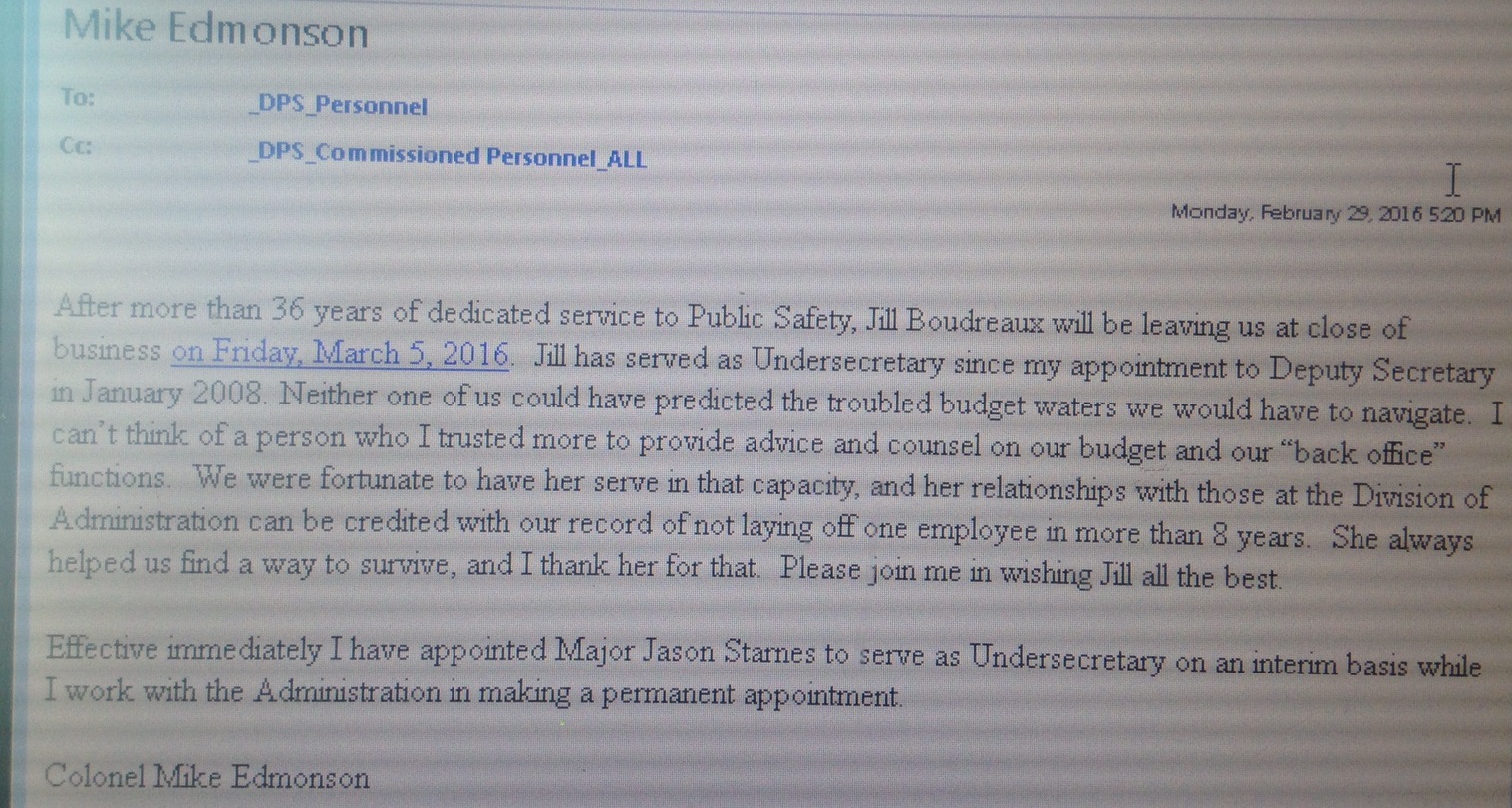
Starnes has since denied he is staying at the LSP Training Academy and more significantly, he has said he is not acting in the capacity of Undersecretary of Management and Finance despite this February memorandum from Edmonson announcing his appointment:

EDMONSON NAMED

(CLICK ON IMAGE TO ENLARGE)

Starnes’ name has since been quietly removed from the DPS Management and Finance Web page and replaced by that of Edmonson who is listed as Deputy Secretary and Custodian of Records. http://mfn.dps.louisiana.gov/

The Office of Management and Finance page contains a link to the undersecretary but when readers click on the link, a “Message from Undersecretary” heading pops up. Beneath that are only the words “Coming Soon.”

That has to be one of the more obvious moves by Edmonson to obscure a major departmental administrative blunder on his part.

The effort to promote someone in his inner circle illegally, Taken with his clumsy but almost successful effort to steer a bill amendment through the Legislature in the waning hours of the 2014 session that would have given him a retirement pay hike of some $30,000 and the documented cases of inconsistent and inadequate investigations and punishment (or outright ignoring) of wrongdoing within his agency, should give pause to the Senate and Governmental Affairs Committee which is scheduled to vote on his confirmation today (Monday, June 6).


It was only last Nov. 20 that a joint meeting of the House Committee on Appropriations and the Senate Committee on Finance was told that the Office of Group Benefits (OGB) was in improved financial condition.

By April 21 of this year, however, serious discussion had begun about a premium increase for state employees and retirees even as state workers have been told they will not get merit pay raises for the sixth straight year.

OGB Executive Director testified before the joint committee last November that the agency’s fund balance, nearly depleted by the reckless fiscal policies of Bobby Jindal, had recovered to $122 million at the end of the 2015 fiscal year (June 30, 2015) and was projected to be $146 million by the end of the current fiscal year. http://house.louisiana.gov/H_Video/VideoArchivePlayer.aspx?v=house/2015/Nov/1120_15_AP_SenFinance

Neither amount, of course, is anywhere close to the $500 million fund balance accrued by former OGB Executive Director Tommy Teague before he was teagued in April 2011. (for those who may have forgotten, the term coined by a reader for those who dared disagree with Jindal who were quickly fired or demoted).

It is, however, a significant increase from the low balance that came perilously close to double digits in 2014.

Jim Fannin (R-Jonesboro), at the time a member of the House and chairman of the House Appropriations Committee though he had already been elected to the Senate, asked West what the OGB “burn rate” (the amount paid out monthly in benefits in excess of premiums) was.

“It was $16.3 million,” West replied. “It’s now $7 million. Changes that were made have had a positive impact on the fund balance.”

She said OGB has held no public hearings “because there are no planned benefit changes for 2016.”

But wait. Her testimony does not quite jibe with the April presentation of OGB consulting actuary Arthur J. Gallagher & Co. in that OGB ESTIMATING CONFERENCE

At that estimating conference, Gallagher said a 7 percent rate increase would increase the fund balance to $156.9 million by the end of fiscal year 2017 (June 30, 2017), which it said was “within the target range” of $130 million to $240 million.

Gallagher recommended that the new rate increase go into effect in January 2017 “for ease of communication and administration due to annual enrollment timing.”

Gov. John Bel Edwards, then a state representative, openly opposed the 2014 OGB rate increase plan proposed by West and then Commissioner of Administration Kristy Nichols.

https://louisianavoice.com/2014/08/25/louisianavoice-learns-of-jindal-plan-to-force-state-retirees-out-of-ogb-by-raising-members-premiums-cutting-benefits/

Edwards even went so far as to request an attorney general’s opinion on the method by which Nichols and West were attempting to implement the new premium increase and when the Jindal administration learned in advance that the AG’s opinion would be detrimental to its premium increase plan, Nichols quickly shifted gears in saying that the state would go through the required rule-making process spelled out in the Administrative Procedure Act (APA).

That move only served to further invoke Edwards’ ire because, he said, the changes had already been implemented without the required public hearing. https://louisianavoice.com/2014/09/23/smackdown-attorney-general-opinion-on-ogb-proposals-hands-jindal-administration-another-stinging-legal-setback/

Now Edwards finds himself in the ticklish position of having to either uphold his original position of opposing a rate increase, which originally brought him to the attention of state employees as their White Knight, or backing his OGB Executive Director.

As our late friend C.B. Forgotston was so fond of saying: You can’t make this stuff up.

When John Georges purchased the Baton Rouge Advocate three years ago, he set about on an ambitious program of expansion into New Orleans and Lafayette.

Taking advantage of the New Orleans Times-Picayune’s contraction to publishing on three days a week, he began hiring reporters and editors from the New Orleans newspaper and it looked as though The Advocate might actually buck the trend of newsroom cutbacks plaguing publications across the country.

It looked for a while as if it might actually work but it turns out that a retired Advocate reporter was most probably correct when he recently said, “We’re all dinosaurs now.”

There’s no joy in this latest trend or in the retired reporter’s assessment of an industry in indisputable decline. And after having entered the profession 50 years ago at the Ruston Daily Leader, I certainly took no pleasure in watching the New York Times as it first sold its office building in 2004 and only last week announced buyouts to encourage early retirement in order to further cut costs.

The Advocate had already laid off some very good reporters and now LouisianaVoice has learned that additional cutbacks are expected to be announced at the end of this month.

The layoff syndrome has become a vicious cycle in the newspaper industry and the thinking behind it defies logic. http://www.pewresearch.org/fact-tank/2015/05/22/the-declining-value-of-u-s-newspapers/

Tom Kelly, the man who gave me my first newspaper job exactly 50 years ago, recently said that the one commodity a newspaper has to offer its readers is fresh, thorough and compelling news stories. “The ads pay the bills, but people buy a newspaper for news and it defies logic that they cut back on the one thing that sells their papers,” he said.

Kelly, who now publishes The Piney Woods Journal, a monthly publication geared mostly to the timber industry in Louisiana, Texas, Mississippi and Arkansas, also had some decidedly uncomplimentary words for Gannett, which he said is gobbling up newspapers at an alarming rate.

Gannett’s initial foray into Louisiana included The Shreveport Times and Monroe Morning World (now The News-Star) but it has expanded its reach into Lafayette (The Advertiser), Opelousas (The Daily World), and Alexandria (The Town Talk). Along the way, it gutted their news staffs to a fraction of their former size.

Besides its national publication, USA Today (referred to by critics as “McNewspaper”) Gannett now runs 117 newspapers in 33 states and Guam. “And now, Gannett is trying to buy the Chicago Tribune and the Los Angeles Times,” Kelly said. “Their news coverage is pitiful and they want to buy two of the largest papers in the country.” His voice trailed off as he just shook his head in disgust.

So now, one of only two major dailies left in private hands (The Lake Charles American Press is the other), is about to undergo yet another cut. It’s almost as if Bobby Jindal was making the decisions on how to heal an ailing industry. http://newspaperdeathwatch.com/

Advertising revenue is down as are subscriptions. That’s generally true at all newspapers. And just in case no one has noticed, the actual physical size of newspapers has shrunk from broadsheet (23.5 by 29.5 inches) to Berliner (12.4 by 18.5 inches) to save money on newsprint. http://www.papersizes.org/newspaper-sizes.htm

The Jena Times was perhaps the last Louisiana publication to switch to the smaller page, making the conversion only a few months ago.

So, in order to attract more advertising and increase subscriptions, the only logical thing for The Advocate to do is to lay off more personnel. http://www.journalism.org/2015/04/29/newspapers-fact-sheet/

At least the beat reporters may be spared this round. Word is the cuts will be to the copy desk. The reports we’re getting is that The Advocate will be converting to an updated automated system that will make much of the copy desk’s work obsolete. All the copy desk does is edit reporters’ stories, select the local and wire stories the paper will run, write the headlines for them and decided where in the paper they will run.

For the life of me, I can’t comprehend how automation will be able to make those decisions without benefit of the human element.

The demise of the Times-Picayune and the recent and future cutbacks at The Advocate are not something this old dinosaur subscriber takes pleasure in watching.

It’s like witnessing the slow, painful death of an old friend.
