Feeds:
Posts
Comments

By Robert Burns

With all parties acknowledging the need for an affirmation of her ruling Monday (June 13, 2016) by the First Circuit Court of Appeal, 19th JDC Judge Janice Clark denied multiple exceptions filed by the Louisiana State Office of Group Benefits (OGB) in response to a lawsuit filed by six retired state employees.

The lawsuit alleges that OGB, which provides health insurance coverage to nearly a quarter of a million state workers, teachers, retirees, and dependents, didn’t follow proper approval procedures calling for prior notice and public comment on significant changes to their health insurance coverage.

Winston DeCuir, Sr., who claimed in oral arguments before Judge Clark that the lawsuit was “moot,” explained that in June 2014, significant changes began to come under consideration for OGB benefits.

When an uproar began that the contemplated changes had not followed proper procedures, former Louisiana Attorney General James D. “Buddy” Caldwell’s Office issued a ruling on September 23, 2014 that, in fact, the rule-making process had been circumvented.

Pursuant to Caldwell’s ruling, DeCuir said, OGB sought an “emergency rule” to take effect because of the urgency of the situation. When Judge Clark inquired, “What triggered the need for the emergency rule?” DeCuir responded that the rapidly-shrinking balance in the reserve fund prompted OGB actuaries to say something had to be done as soon as possible.

DeCuir indicated that genuine concerns existed that, if the rate of decline wasn’t slowed, the system could literally deplete its reserve balance and be left with no funds with which to pay claims. He neglected to say the reserve fund was drawn down from its one-time high of $500 million by the reckless fiscal policies of the Bobby Jindal administration.

DeCuir explained that because of the looming impact the rule change would have on those covered by OGB benefits, on November 23, 2014, OGB issued the emergency rule but also provided simultaneous guidance entailing the additional costs to those covered.

He indicated that some costs would continue to be reimbursed until September 30, 2014 rather than August 1, 2014 as was originally planned.  He also emphasized that full implementation of the changes would not transpire until March 1, 2015 rather than January 1, 2015.

DeCuir noted that the final rule entailing full implementation was implemented on February 20, 2015 to replace the emergency rule. He said that with the required 180-day timeframe for going through normal procedures for rule changes, together with another 180 days to actually implement the changes, OGB’s reserves would have run a very serious risk of being fully depleted before the effects of the changes could take hold.

DeCuir said a public hearing was held on the changes but was “very, very poorly attended.”  He added, “In fact, I don’t know if any of Art’s (Smith, counsel for plaintiffs) clients were even present for the hearing.” Arthur Smith, III, dismissed the hearing as a “sham” designed to accomplish nothing but “window dressing with everything already done.”

Smith then focused his arguments on Jindal’s administration having “drained” OGB’s reserve balances. That statement prompted a sharp retort by DeCuir who said, “That statement simply is not accurate. There was not one dime transferred out of OGB’s reserves to the general fund. What transpired is that premiums charged to members declined. That, in turn, resulted in a decline in the State of Louisiana’s match in that it covers 75 percent of the cost of the coverage.  That is what caused the reserves to decline.”

Judge Clark then asked for reiteration of the fact that no funds were swept from OGB’s reserves to the general fund. Both DeCuir and Michael Adams, another defense attorney representing OGB, were emphatic in stating no such sweeps transpired.

What actually occurred was this: the administration lowered premiums so that its own 75 percent match would be reduced and the money saved from that maneuver was then used to cover some of the recurring budgetary shortfalls experienced by Jindal and a sadly incompetent but compliant Legislature for eight straight years. The decline in premiums, Mr. DeCuir, was not caused by fewer covered employees but by the clumsy shell game perpetrated by Jindal and Co. That statement, Mr. DeCuir, is accurate.

DeCuir indicated to Judge Clark that the plaintiffs may not be happy if they get what they’re ultimately seeking with their lawsuit. He explained that it’s conceivable that plaintiffs could end up owing OGB significant premium dollars if the plaintiffs do in fact ultimately prevail.

In making her ruling, Judge Clark stated: “The Court is of the opinion that plaintiffs have stated a valid cause of action within the four corners of the document.  It’s time for this matter to be presented to the First Circuit, which I understand is now returning from Sandestin, so that these plaintiffs can know whether they can move forward with their claim or have it drained.”

Adams then inquired about the prospect for him to assert Exceptions for Prematurity and Subject Matter Jurisdiction. Clark said that the Exception of Prematurity was too “intertwined” with DeCuir’s exception and therefore denied that exception as part of the day’s proceedings.  When DeCuir inquired if he could reassert the Exception of Subject Matter Jurisdiction, Clark indicated he could “have another bite at the apple, but it needs to be quick.”

Smith wrapped up the proceedings by inquiring about a Motion to Compel he’d previously filed, but Clark said, “Surely that matter can be resolved between the parties.” Adams then indicated that Smith had modified his discovery requests to make it far more narrow and that he believed that a mere meeting between him and Smith ought to be able to negate the need for any hearing on a Motion to Compel.

Adams said after the day’s hearing that he would appeal Clark’s ruling to the First Circuit Court of Appeal.

Judge Clark said if the whole matter proceeds to trial, “It will be a challenge to keep the jurors awake when all those actuaries start testifying.”


MAGNIFYING GLASS

By Ken Booth

Guest Columnist 

Under the provisions of Louisiana 44:1 et seq. (The Public Records Law), should any local or state government official raise questions as to whether requested records are public, the agency’s custodian of public documents is required to notify in writing the person making the request of the custodian’s determination and the reasons, including the legal basis. Said notice shall be made within three days of the request exclusive of Saturdays, Sundays, and legal holidays (emphasis added).

The law is pretty plain. It doesn’t say “may be made,” “might be made” or “should be made” within three days. The word used was shall.

MIKE EDMONSON PHOTO

But with the introduction of the new administration, elected and appointed officials in Louisiana seem to have decided they are exempt from provisions of the state law…one of them, the head of the State Police, of all people, even having “manufactured…own loophole for denying public records requests,” as reported by Louisiana Voice. https://louisianavoice.com/2016/06/01/lsp-stakes-out-claim-that-investigations-records-are-exempt-from-public-records-law-if-no-disciplinary-action-is-taken/

Are they perhaps taking their cues from federal officials?  Within the past week, for instance, the State Department told a federal court that processing a demand for documents relating to Hillary Clinton and her aides would take as long as 75 years and would stretch “generations.”

Besides Obama, of course, Nixon, both Bushes and Bill Clinton have regularly invoked executive privilege as a means of protecting documents from public scrutiny.

What brings this to mind are a series of demands for public records recently involving three areas of significant public interest but which have either gone unacknowledged or denied or even fought with lawsuits against the public seeking the records.  That’s a mean stretch even by Louisiana’s political and corruption standards.

When the weekly Ouachita Citizen sought to follow-up on a state audit that pointed to possible payroll fraud involving a law clerk for the 4th Judicial District Court, the court’s judges balked and denied the paper’s request for disciplinary action taken against court clerk Allyson Campbell over her alleged falsification of time sheets and other public documents.

When the newspaper filed a complaint with the District Attorney, the court filed a lawsuit against the newspaper which from a financial standpoint would effectively throttle further attempts to litigate the issue.

The paper has multiple public requests in at the office of state Attorney-General Jeff Landry which have for weeks gone unanswered.

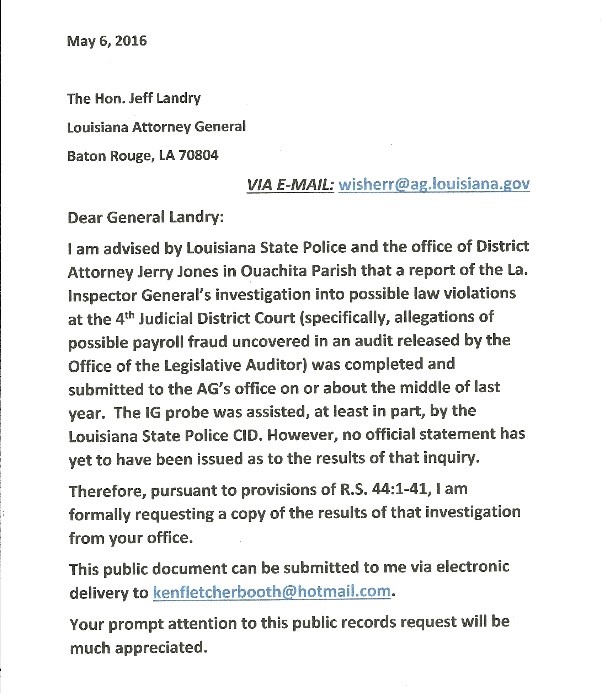
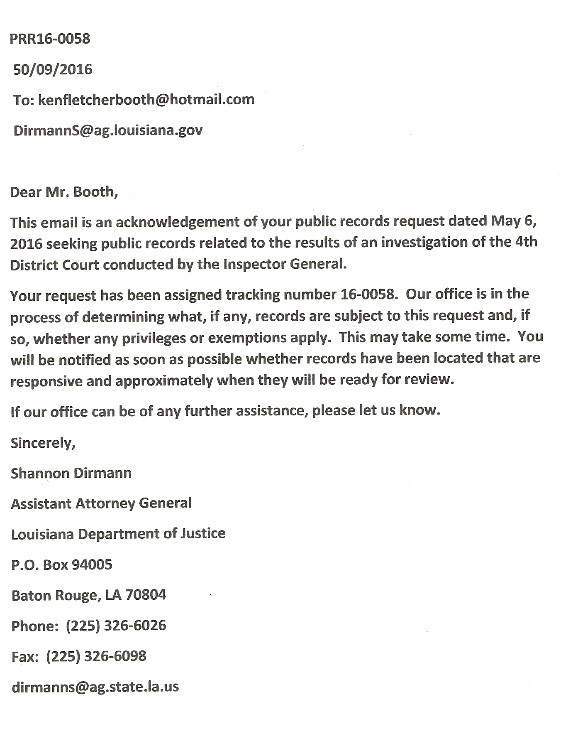
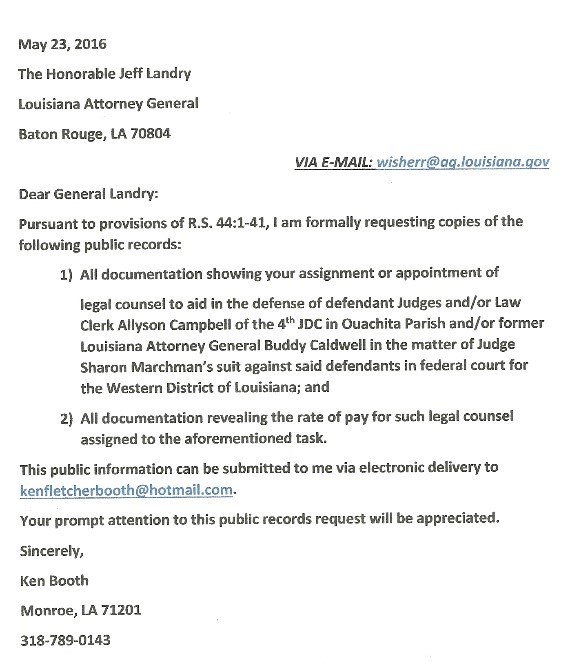
Similarly, a couple of my own requests (shown here) to the new “transparency-minded” and “aggressive” Republican Attorney-General remain without result except for one letter which said it “may take some time.”

In a June 7th E-mail to Landry’s office, I wrote: “I would very much appreciate either the documents requested sixteen days ago or an opinion from that office on why they cannot be produced. Please know this is a public records request that will not go away silently.”

Landry’s press secretary Ruth Wisher has made sure that reporters know that her boss doesn’t always return her texts. Well, that certainly makes everything hunky-dory.

BOOTH REQUEST

AG RESPONSE TO BOOTH

BOOTH FOLLOW UP REQUEST
           Known records requests to the AG’s office also demand access to a state police report on its investigation into the allegations of possible payroll fraud and destruction or concealment of court documents. A report on the findings from a companion investigation by the Inspector General’s office was released back on April 15th. The state police report is known to be in the hands of the Attorney General.

All of this is at odds with the very public Landry who has been throwing his weight around the capitol lately pushing for control of his agency’s own finances, making national headlines while trying unsuccessfully to crack down on illegal aliens, and squaring off (at least publicly) with the Gov. John Bel Edwards as if he hopes to succeed him some day.

But Landry and the 4th Judicial District Court in Ouachita Parish are not the only ones playing keep-away with public records.

LouisianaVoice has been repeatedly stymied by the Louisiana State Police with respect to sought after records.

In fact, as a recent LouisianaVoice post notes, Edmonson has manufactured his own loophole for denying public records requests after tiring, he suggests, of the public learning of “far too many instances of misconduct at LSP followed by a mindset of circling the wagons.”

Several high-profile cases of alleged improper State Trooper conduct have been determined to have been free of wrong doing and are therefore exempt  from public records laws if no diciplinary action is taken. That’s staking out a rather questionable claim by the Supertindent.

Curiously, however, his agency did release records showing payroll fraud had occurred at Troop D headquartered in Lake Charles when the lieutenant there was accused of having instructed the men under his command to pad their time sheets to reflect work that had not been performed.

Ironically, that’s the same charge investigated by the same LSP against the law clerk in Ouachita Parish, the report of which has been hidden from public scrutiny even amid growing speculation nothing will come of the charges against her or the Judges who approved her bogus time sheets. It should be noted that the Troop D lieutenant was found to have engaged in “no wrong doing” and access to any investigation findings with respect to him has been denied. However, a trooper he supervised and who figured in the padded time sheets was fired.

The Superintendent of the Louisiana State Police is appointed by the Governor with consent of the State Senate. Edmonson had—and continues to have—the support of Gov. Edwards.

Edwards is also credited with preserving through his influence, at least indirectly, the job of another Jindal administration hold-over department head, Education Superintendent John White. While White actually is appointed by the Board of Elementary and Secondary Education over which the governor has little control since most board members are elected, his stated support of White certainly didn’t hurt.

JOHN WHITE PHOTO

White, a 2012 BESE appointee, has been under considerable public fire over his steadfast defense of the Common Core program.

White has filed a lawsuit against two individuals seeking public records in five different requests from the Department of Education, presumably to block their access to dirty laundry in that agency as might be said of the lawsuit by the Judges in Monroe against The Ouachita Citizen.

Even considering Louisiana’s notorius reputation for politial scandals, suing private citizens or even the news media by government agencies has plunged the state’s standards to a new low.

As has been pointed out elsewhere the use of unlimited financial and legal resources—all paid for by the taxpayers—to block citizens with limited financial means is a dangerous threat to the very notion of checks and balances that are supposed to protect the public from abuse.

For those elected Louisiana officials to sit back and do nothing to put a stop to this unprecedented assault on the public’s right-to-know is pretty much tantamount to an endorsement of such actions.

And if the civilian public looks the other way when this kind of mess is exposed and doesn’t demand that it stop then expect the level of distrust to grow.


By James C. Finney, Ph.D.

Guest Columnist

(Editor’s Note: James Finney is one of two Louisiana citizens (Mike Deshotels is the other) who was named as a defendant in a lawsuit by State Education Superintendent John White in an effort to thwart efforts by the pair to obtain public records from the Department of Education. White has defended his action by pointing out he is not seeking monetary damages from Finney or Deshotel. He failed to mention, however, that it will cost them money from their personal funds to defend the lawsuit while White has the financial resources of the State of Louisiana at his disposal.)


Much has been written about the Student Scholarships for Educational Excellence Program, otherwise known as the Louisiana Scholarship Program, or the voucher program. To summarize: The Department of Education allows vouchers for almost any private school that wants them (or so it seems) and then performs minimal oversight.

The students are tested, but the Department works hard to make sure taxpayers don’t get to see any useful data. The program is based on a premise that it helps poor kids access private schools. But “poor” is 2.5 times the poverty level which, for a family of four, means an annual income of $59,625 is low enough to put a kid in a private school at taxpayer expense. And, of course, the state refuses to release any data about how many children are at which ends of that range of income. And the point is, allegedly, to allow kids to escape failing public schools.

Never mind that the students may have never attended a public school. Ever.

But this post isn’t about that voucher program. It’s about the sneaky alternative that funds private schools by way of tax rebates. The Tuition Donation Rebate Program allows donors to fund private school tuition and recoup most of that donation as a tax rebate.

As might be expected, there are middlemen taking their cut of the money. At the beginning of the program, there was only one such organization—Arete Scholars Louisiana. The registered agent, Gene Mills, he of the Family Forum, has apparently neglected the paperwork required to keep charter 41200779N active with the Louisiana Secretary of State.

Mills, founder of Louisiana Family Forum, was the centerpiece of an extraordinary post by Jason France on his Crazy Crawfish blog in October 2012. https://thecrazycrawfish.com/tag/louisiana-family-fourm/

Founded in 1998, Louisiana Family Forum included as its “Independent Political Consultant” and “Grassroots Coordinator,” former State Sen. Dan Richey. http://www.lafamilyforum.org/about/

As an example of the family values for which Family Forum supposedly stands, Richey, while serving as a state senator from Ferriday in the 1980s, gave his allotted Tulane scholarship to a Caddo Parish legislator’s daughter in exchange for that legislator’s awarding of his scholarship to Richey’s brother as a means of circumventing the informal prohibition against giving the scholarships to immediate family members.

Superintendent John White’s Department of Education, with the approval of the Board of Elementary and Secondary Education (BESE), thought it was critical that there be multiple organizations available to help people support private education rather than pay taxes. So they gave grants of up to $499,750 to ACE Scholarships Louisiana (charter 41590796K) and up to$500,000 for New Schools for Baton Rouge Excellence Scholarship Fund (charter41726088K) so that these limited-liability corporations could each set up their business of accepting donations, funneling them to private schools, and providing the documentation required for the donors to get tax rebates from the Louisiana Department of Revenue.

According to the Louisiana Nonpublic School Choice 2015 Annual Report, which was submitted to BESE but not accepted, the tuition donation rebate program started in 2013-14 with Arete.

Arete’s 2013-14 Arete’s 2014 Annual Report indicates that the organization disbursed 14 scholarships, worth a total of $60,975.02, and all funded by the Atlanta Falcons.

No, that’s not a typo: Those Atlanta Falcons. That amount was confirmed by the Louisiana Department of Revenue: One unnamed taxpayer was issued a rebate in the amount of $60,975.02 in tax year 2014.

According to the state’s 2015 annual report cited above, there were two Student Tuition Organizations active in 2014-15: Arete and ACE. Arete’s 2015 Annual Report confirms the number of scholarships reported by the state, 50, at 24 schools, with a total value of $180,381, while ACE Scholarships Louisiana LLC’s 2015 Annual Report reports 13 scholarships, three schools, and a total of $40,780.67.

The donors of note on Arete’s annual report include the Atlanta Falcons, Chik-fil-A, James Garvey and several other individuals. ACE’s donors were David George and Edward Rispone. According to the Louisiana Department of Revenue, the total of rebates awarded in 2015 was $101,659.85, and they ranged in size from $950 to $47,105.

The numbers exploded in 2015-16, though, especially for ACE.  The state’s voucher report indicates that Arete awarded (as of March 2016) 205 scholarships at 50 schools, ACE awarded 558 scholarships at 77 schools, and New Schools awarded 13 scholarships at four schools. The names of the schools, donors and dollar amounts likely won’t be available for several months, however.

The targets for total scholarship awards (remember those half-million dollar contracts a few paragraphs above) were 1,000 for this year and 1,250 for 2016-17 (ACE) and 75 and 125, respectively for New Schools. So apparently New Schools aimed low and shot lower. Perhaps that’s a good thing, in that taxpayers will see less revenue diverted away from the state’s coffers. On the other hand, this spreadsheet indicates that, as of the end of 2015, New Schools had already collected $300,000 on its contract, and ACE had already collected $249,874.98.

It’s interesting what a person can learn from availing themselves of their rights under Louisiana’s public records law (Title 44).

During the Bobby Jindal years in Louisiana, it was well documented that seats on prestigious boards and commissions were the rewards for generous campaign contributions.

Seats on the LSU Board of Supervisors, the Board of Supervisors of the University of Louisiana System, the Louisiana Stadium and Exposition District (Superdome), or various levee boards came at a price and those who wanted the seats ponied up. http://www.nola.com/politics/index.ssf/2013/11/bobby_jindals_political_appoin.html

Even the job of monitoring Louisiana’s hundreds of boards and commissions went to the director of the Committee to Re-Elect Bobby for an eight-month period from mid-October, 2012 to June 28, 2013, thus insuring that board appointees would do the bidding of the governor.

That, apparently, is the way politics work just about everywhere.

In Florida, a large enough campaign contribution can even buy justice—or stymie justice, as the case may be.

Pam Bondi, attorney general in the Sunshine State (talk about a misnomer), solicited—and received—a $25,000 contribution from the Donald Trump Foundation and once the check cleared, she promptly dropped her office’s investigation of Trump University, conveniently citing insufficient grounds to proceed. http://finance.yahoo.com/news/florida-ag-asked-trump-donation-075016133.html

And in Bossier City, less than $20,000 in campaign contributions has smoothed the way for the transfer of the city’s water and sewer department to a private Baton Rouge firm—at a first-year cost of more than $1 million to the city, and the loss of about 40 jobs in the department.

http://www.ksla.com/story/32159296/public-private-partnership-in-bossier-city-threatens-dozens-of-jobs

http://www.ktbs.com/story/32163755/bossier-city-council-considers-privatizing-water-sewer-operations

Word has been filtering down to LouisianaVoice for some time now that Caddo Parish is the new New Orleans in terms of political corruption. Apparently elected officials across the Red River have been paying attention to both Caddo Parish and to Bobby Jindal’s love of privatization as well as his thirst for campaign contributions.

The city council voted unanimously Tuesday (June 6) afternoon to approve the PUBLIC PRIVATE PARTNERSHIP AGREEMENT with Manchac Consulting Group out of Baton Rouge.

Typical of the seemingly growing penchant of public officials for operating out of earshot of the public, more than 100 employees of the Water and Sewer Department have been told nothing over the last several months of negotiations. City officials have refused to provide information to workers even though an organizational chart proposed by Manchac reflects half the current staffing in some departments.

On Tuesday, the vote was 7-0 to approve a five-year contract with Manchac Consulting to oversee the city water and sewer treatment plants, distribution lines and daily operations at a first-year cost of a little more than $1 million the first year, including $120,000 upon city officials’ signing the contract.

Campaign finance reports show that at-large council member David Montgomery received $2500 from Manchac, $2500 from its CEO Justin Haydel, $2500 from Atakapa Construction Group, which includes Haydel and Manchac President Kenneth Ferachi as officers, $2500 from Manchac Senior Project Manager Christopher LaCroix, and $999 from Ferachi—a total of $10,999.

Council member Scott Irwin received $500 each ($2000 total) from Atakapa, Ferachi, Haydel and Manchac Consulting Group.

Bossier City Mayor Lorenz “Lo” Walker received $6,644 total, including $2500 from Manchac Consulting, $3,144 from Haydel (including $2,144 in an in-kind contribution for a fundraising dinner in Baton Rouge), and $1000 from Atakapa Construction.

An Associated Press story pointed out that the Trump family foundation contribution, received by a political group supporting Bondi’s re-election, was received on September 17, 2013 and was in “apparent violation” of rules regulating political activities by charities.

But hey, what’s a little obstacle like a federal law when you’re trying to buy your way out of trouble? It was The Donald himself, after all, who is on record as saying he expects and receives favors from politicians to whom he gives money.

The commitment to pay Manchac more than $1 million over the next 12 months may be completely above-board—we hope so, anyway—but taken in context with the way city officials kept their own employees in the dark even as the mayor and two council members took contributions from the prospective vendor, it just doesn’t look good. And, as they say: perception is everything.

Public employees, after all, are prohibited—as they should be—from accepting anything of monetary value from vendors or contractors. So why should elected officials be held to a completely different (read: double) standard of ethical behavior?

Before we leave this topic, it should be pointed out that politicians will only do what they can get away with. If the voters lower the bar, then our public officials will respond accordingly. Only if we demand accountability, will officials be accountable. A compliant legislature not held accountable by voters allowed Jindal to rape this state for eight years. Likewise, our failure to insist on statesmanship instead of demagoguery, decorum instead of buffoonery, serious discussion of the issues instead of meaningless rhetoric, sanity instead of hysteria, has created candidates like Donald Trump.

If we consistently look the other say and say that’s just the way it is, that’s the way it will always be.

And we will have no one to blame but ourselves.

We will have done it to ourselves.


An official complaint over the appointment of Louisiana State Police (LSP) Maj. Jason Starnes as Interim Undersecretary of Management and Finance has produced another LSP major: a major CYA maneuver at State Police headquarters to backtrack and act as though the “promotion” never occurred.

At the same time, the Louisiana State Police Commission has rescinded last November’s action by the commission to approve a last-minute longevity pay increase plan for state police who last year received two separate pay increases totaling about 30 percent.

http://www.nola.com/politics/index.ssf/2015/07/state_troopers_get_hefty_back-.html

The longevity pay plan would have locked troopers into automatic pay raises based on years of service and was part of Bobby Jindal’s exit strategy as he headed out the door of the governor’s office near the end of his term.

But on June 1, Cathy Derbonne, LSPC Executive Director, published TRANSMITTAL SHEET NO. 58  on the LSPC Web page that pointed out that Article X, Section 48(C) of the Louisiana Constitution mandates that “any rule determination affecting wages or hours shall have the effect of law and become effective only after approval by the governor and subject to appropriation of sufficient funds by the Legislature (emphasis Derbonne’s).

“As of June 1, 2016, an approval by the Governor has not been received and there is currently insufficient funding to implement the revisions,” she wrote.

“The Revision of State Police Commission Rule Chapter 6 Uniform Pay and Classification Plan is hereby rescinded in its entirety,” she wrote (emphasis Derbonne’s). The pay plan approved by the LSPC last November is contained in GENERAL CIRCULAR 180

Starnes, a classified member of LSP, was recently transferred by State Police Superintendent Mike Edmonson to an unclassified non-state police service position as Interim Undersecretary, Custodian of Records of the Office of Management and Finance within the Louisiana Department of Public Safety and Corrections (DPS).

That move, the complaint says, was in violation of Rule 14.3(G), which says:

  • No classified member of the State Police shall be appointed, promoted, transferred or any way employed in or to any position that is not within the State Police Service.

In addition to the points cited in the official complaint, LouisianaVoice pointed out last month that the promotion of Starnes placed him in direct supervision of his estranged wife, Tammy, Audit Manager for LSP. https://louisianavoice.com/2016/05/16/mike-edmonsons-appointment-not-official-yet-senate-committee-set-to-consider-his-confirmation-on-tuesday/

LouisianaVoice also revealed that since his separation from his wife, Starnes had been residing in the LSP Training Academy’s VIP quarters. The VIP quarters at the academy is also known as the “Charlie Dupuy Suite,” so named because Edmonson’s Chief of Staff Charlie Dupuy also resided there during his own divorce from his first wife.

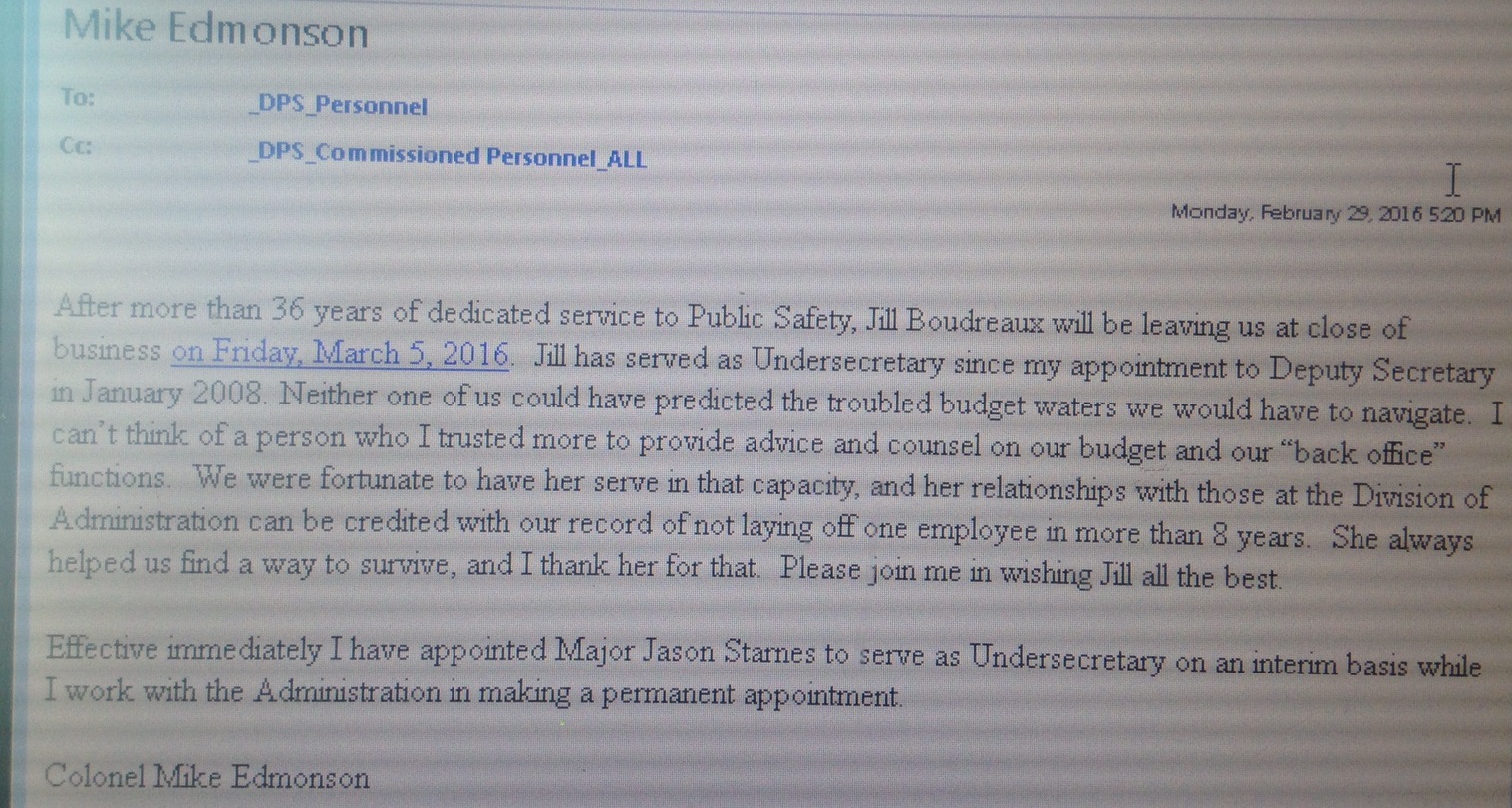
Starnes has since denied he is staying at the LSP Training Academy and more significantly, he has said he is not acting in the capacity of Undersecretary of Management and Finance despite this February memorandum from Edmonson announcing his appointment:

EDMONSON NAMED

(CLICK ON IMAGE TO ENLARGE)

Starnes’ name has since been quietly removed from the DPS Management and Finance Web page and replaced by that of Edmonson who is listed as Deputy Secretary and Custodian of Records. http://mfn.dps.louisiana.gov/

The Office of Management and Finance page contains a link to the undersecretary but when readers click on the link, a “Message from Undersecretary” heading pops up. Beneath that are only the words “Coming Soon.”

That has to be one of the more obvious moves by Edmonson to obscure a major departmental administrative blunder on his part.

The effort to promote someone in his inner circle illegally, Taken with his clumsy but almost successful effort to steer a bill amendment through the Legislature in the waning hours of the 2014 session that would have given him a retirement pay hike of some $30,000 and the documented cases of inconsistent and inadequate investigations and punishment (or outright ignoring) of wrongdoing within his agency, should give pause to the Senate and Governmental Affairs Committee which is scheduled to vote on his confirmation today (Monday, June 6).