Feeds:
Posts
Comments

It was suspicious enough when Stewart Cathey was arrested and handcuffed for a six-year-old seat belt violation exactly a month before the 2015 primary election for State Senate. But taken with events that have transpired with Louisiana State Police (LSP) and the agency’s former superintendent since that time, it seems less and less likely to have been mere coincidence.

Incumbent State Sen. Bob Kostelka (R-Monroe) was term-limited in 2015. Three-term Rep. Jim Fannin, a Jonesboro Democrat-turned-Republican, then serving as Chairman of the House Appropriations Committee, was also term-limited and looking to move to the upper chamber.

Cathey, a Monroe native, a graduate of the University of Louisiana Monroe, and managing partner of the Cathey Group, an information technology management consulting firm in Monroe, also had his eye on the District 35 Senate seat. The district includes all or parts of the parishes of Rapides, Grant, Winn, Ouachita, Lincoln, and Jackson.

A captain in the U.S. Army Reserve, the Republican Cathey had received a ticket for a seat belt violation in 2009 but soon after was deployed to Afghanistan where he managed more than $250 million in infrastructure development projects and, he says, he forgot about the ticket.

Fast forward to the 2015 campaign. Fannin, endorsed by Kostelka and a heavy favorite for the Senate, is pressed by the upstart Cathey. They are only a few percentage points apart when Cathey was arrested and HANDCUFFED on a bench warrant issued by Monroe City Judge Tammy D. Lee.

His arrest was on Sept. 24, exactly one month before the primary election. Cathey said he attempted to pay the ticket, if belatedly, but was denied the opportunity. He said he was told he would have to turn himself in, be arrested and bonded out. Quite naturally, considering the timing and all, Cathey quite naturally suspected that mischief was afoot.

“This is the ugly side of politics,” he said. “Career politicians will stop at nothing to get back to the good old boys’ club in Baton Rouge. This is nothing new to Jim Fannin and Bob Kostelka and their team. I’ve seen them do it in the past.”

But Kostelka, who retired as a state district judge before his own election to the District 35 seat back in 2007, was quick with a sincere “Who, me?” denial, saying he had “no control over Monroe City Court or Judge Lee.”

Fannin subsequently defeated Cathey by 6 percentage points to take the election.

Granted, all that has been written here to this point is old news that got plenty of ink at the time. The story might well have ended there had not Cathey gone one step further with something called a Freedom of Information Act (FOIA) request, better known in Louisiana simply as the garden variety public records request.

And that’s where the questions regarding actions by LSP, certain other unknown municipal and/or parish law enforcement agencies, and former LSP Superintendent Mike Edmonson come in.

On October 12, 2015, just 12 days before the primary election, Cathey submitted a public records request to State Police Lt. J.B. Slaton in which he requested:

  • Any and all emails with regards to the account: stacey.barrett@la.gov from September 28, 2015 through October 10, 2015.
  • Any and all emails, memos, or other writings discussing the findings from a Background Audit performed between September 28, 2015 and October 10, 2015 into the searches of Stewart Cathey, Jr.’s driving record as well as searches into the NCIC system for Stewart Cathey, Jr.’s record.

(LouisianaVoice has copies of Cathey’s request and the LSP response but because some of Cathey’s personal information is included on both documents, it was decided not to display copies of either.)

On Oct. 21, three days before the primary, LSP attorney Adrienne E. Aucoin responded—somewhat.

After recapping his request, Aucoin said any such searches on the Louisiana Law Enforcement Telecommunications System (LLETS) are privileged, “which exempts from the public view” records collected and maintained by the Louisiana Bureau of Criminal Identification and Information (LBCII).

A spokesperson for the LSP Legal Department explained to LouisianaVoice that it was LSP policy not to release information on searches. She implied there was usually a good reason for someone checking to see if they were being investigated. She said releasing such information could alert a suspect to an otherwise confidential ongoing investigation of criminal activity. “We would thank them for the tip, though,” she said.

Aucoin’s letter went on to say, “Attached hereto, please find emails that are responsive to your request. Please note that a section of these emails has been redacted. The redacted information pertains to records maintained by the Bureau of Criminal Identification and Information.”

(NOTE: The email chain below begins with the most recent communication and reads backward to the earliest. The text of the messages also makes it obvious that Cathey initiated his inquiries about the background checks almost a month before his formal FOIA request.)
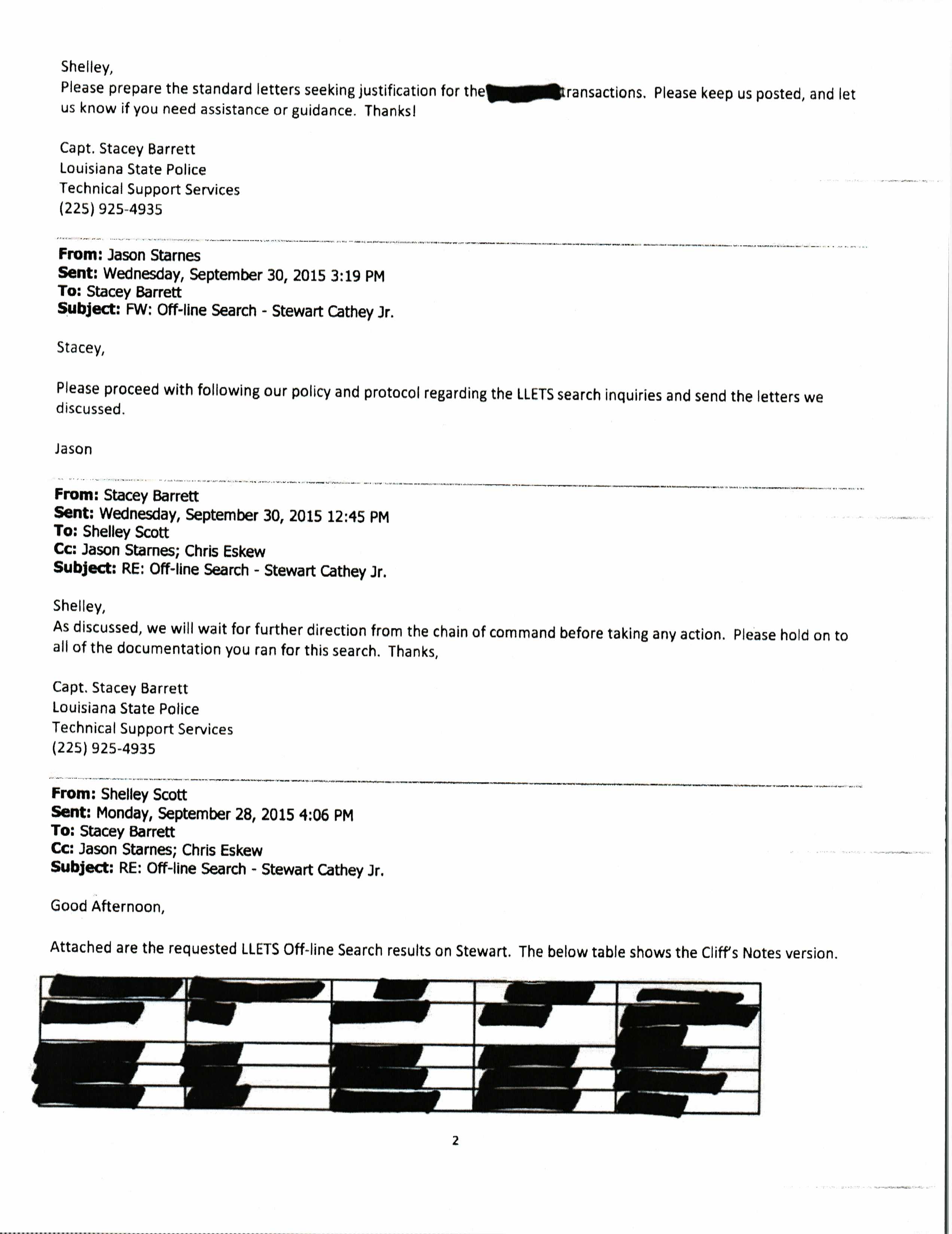
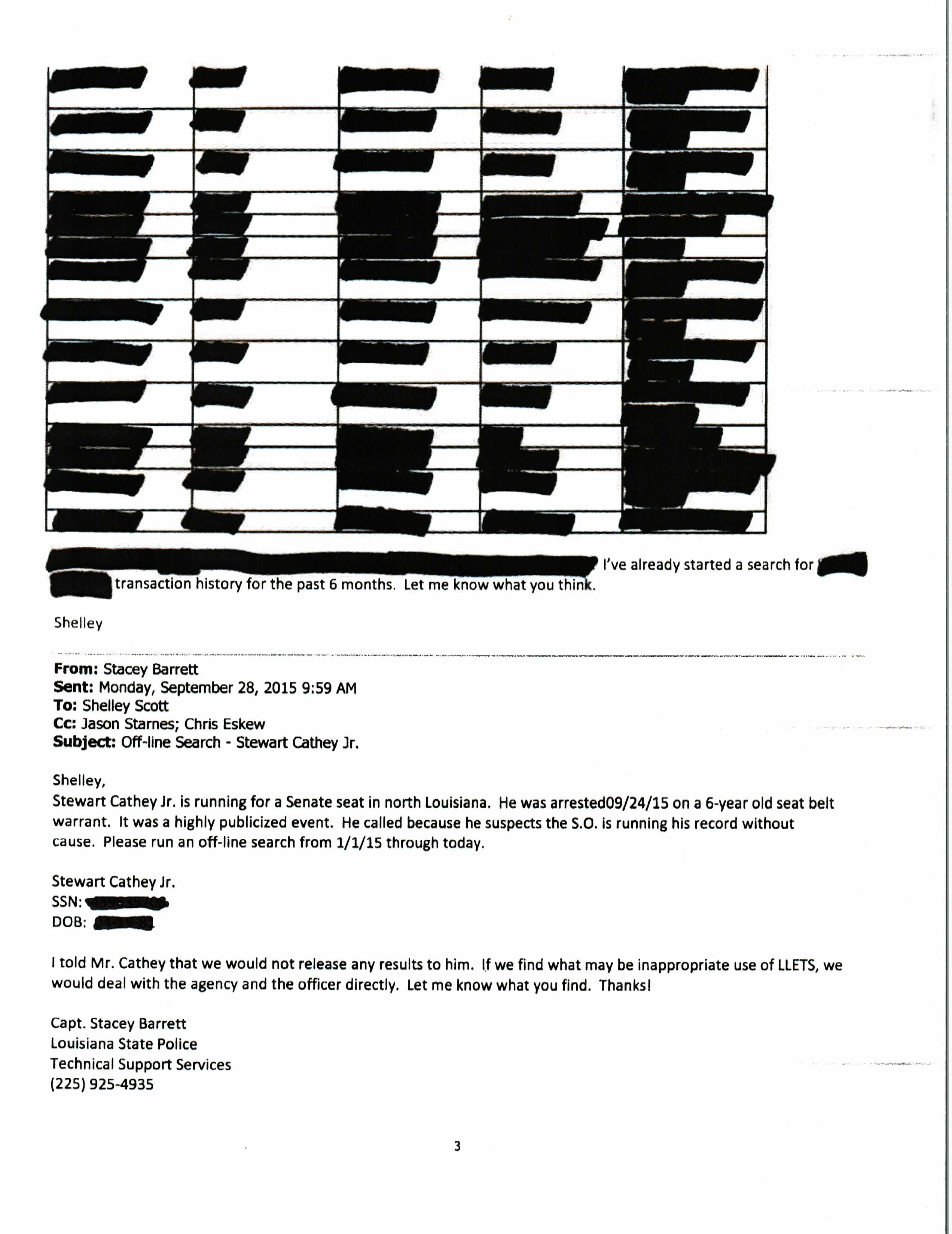
 

The email chain started with a message at 9:59 a.m. on Sept. 28 to criminal records analyst Shelley Scott from Capt. Stacey Barrett of LSP Technical Support Services:

“Stewart Cathey, Jr. is running for a Senate seat in north Louisiana. He was arrested on 09/24/15 on a 6-year-old seat belt warrant. It was a highly publicized event. He called because he suspects the S.O. (sheriff’s office) is running his record without cause. Please run an off-line search from 1.1.15 through today.

“I told Mr. Cathey that we would not release any results to him. If we find what may be inappropriate use of LLETS, we would deal with the agency and the officer directly. Let me know what you find.”

Maj. Jason Starnes and LSP Lt. Chris Eskew were also copied on that email.

At 4:06 p.m. that same day, Scott emailed Barrett, Starnes, and Eskew:

“Attached are the requested LLETS off-line results on Stewart. The below table shows the Cliff’s (sic) Notes version.”

What followed was the “section” alluded to by Aucoin as redacted. The redacted portion was a transaction history for a six-month period comprising about three-quarters of a page and containing 20 redacted lines which appeared to represent background searches or requests for same.

At 12:45 p.m. on Sept. 30, Barrett wrote to Scott, Starnes, and Eskew:

“As discussed, we will wait for further direction from the chain of command before taking any action. Please hold on to (sic) all of the documentation you ran for this search.”

At 3:19 p.m., Starnes responded to Barrett:

“Please proceed with following our policy and protocol regarding the LLETS search inquiries and send the letters we discussed.”

Finally, at 3:45 p.m., also on Sept. 30, Barrett emailed Scott and Eskew:

“Please prepare the standard letters seeking justification for the (redacted) transactions. Please keep us posted and let us know if you need assistance or guidance.”

The cryptic nature of the email communications is curious since routine public records requests do not normally attract such attention up and down the chain of command.

The timing of Cathey’s arrest, the reported discipline of an Alexandria municipal police officer for running a background check on Cathey, and the LSP emails and redacted reports, taken together, would seem to indicate there was some legitimacy to Cathey’s suspicions that someone deliberately sought to undermine his election campaign by initiating widespread background checks and even his arrest—complete with handcuffs—for an otherwise minor offense.

To add icing on the proverbial cake, Cathey said on Monday, Oct. 26, just two days after the Oct. 24 election, he was contacted by Monroe City Court and informed the charges against him for the seat belt violation were being dropped. He also said an investigation begun by the Office of Inspector General (OIG) was abruptly shut down with no explanation given.

No disrespect to the late Gertrude Stein, but there certainly appears to be a there there.

Edmonson had a reputation during his nine years at the helm of LSP as one who would dole out favors to legislators in efforts to ingratiate himself to lawmakers. A relay by state troopers to deliver football tickets to a legislator in New Orleans for an LSU national championship football game when she accidentally left her tickets in Shreveport is one example of that mindset.

Ordering background checks by LSP and/or requesting checks by other law enforcement agencies could be another example.

When contacted by LouisianaVoice about the possibility of an investigation into whether or not Edmonson had taken such action, Public Information Officer Doug Cain said unless a formal complaint was lodged by Cathey, LSP would not initiate an investigation.

After the OIG investigation was suddenly terminated, Cathey did not follow up with a formal complaint to LSP.

He is currently deployed to Puerto Rico where his unit is working on hurricane relief.
Legislators, like any member of society, can be incredibly stupid when they set their minds to it, as they all too often do.

But a story by Baton Rouge  ADVOCATE reporter Elizabeth Crisp, excerpted from a Washington Post column by writer Catherine Rampell, establishes a new low for stupidity, intolerance, and a propensity for shooting off at the mouth, the facts be damned.

Now let it be established here and now that I am a military veteran and that I stand and face the flag every time the National Anthem is played or sung at a public event, no matter how badly a singer may be singing his or her interpretation of the Star-Spangled Banner (and believe me, I’ve heard some incredibly bad renditions). I don’t care if I’m at the concession stand outside Alex Box Stadium for an LSU baseball game, when the PA announcer asks the fans to stand for the National Anthem, I stop what I’m doing, remove my LSU or Boston Red Sox cap, and hold it over my heart in my right hand until the song is finished. No big deal, just something I do.

Why don’t I take a stand? Well, I do. I stand for the anthem and I respect those who choose, for whatever reason, not to. That’s because this is still America where freedom of expression is guaranteed in the First Amendment and every person in that ball park has that right, whether I happen to agree with them or not.

For that matter, how is taking a knee any less respectful than those who continue to talk or who refuse to remove their caps during the anthem? And believe me, there are literally dozens all around me who (a) continue with their concession stand purchases, (b) continue talking, or (c) do not remove their caps/hats. Taking a knee is an act of protest. Any one of the other three is indifference and just as disrespectful in its own way.

So, please, don’t waste my time telling me how unpatriotic it is.

But back to Elizabeth Crisp’s recap of the Washington Post column which, as the Saints stumble into the playoffs and LSU prepares to meet Notre Dame in the Citrus Bowl, is more than a little timely:

According to Post writer Rampell, a group of Louisiana legislators (much to their relief, LSU has refused to divulge their names, thus saving them considerable embarrassment) got their shorts in a wad and called LSU President F. King Alexander just before football season to threaten additional cuts to the higher-ed appropriations if any player took a knee in protest during the playing of the National Anthem before any LSU games.

King had to find a tactful way to remind the dumb-asses that LSU players remain in the locker room during the anthem and are not even on the field. If the legislators had ever used their free tickets to attend a game, they should have realized that.

Not that this is really relevant to this particular issue, but those brain-dead legislators apparently forgot how they kowtowed to Bobby Jindal and slashed higher-ed funding year after year for a cumulative 43 percent reduction in funding since 2008. Apparently, they had no problem taking a knee before Jindal so they could kiss his ring. And make no mistake, they are every bit as complicit as Jindal for the fiscal morass the state finds itself in today.

Interim Vice President of communications Jason Droddy told Crisp last Friday, “I can confirm the phone call occurred, but we won’t name the person, as that was an unfortunate comment that is better left in the past. We hope that in the future, LSU’s state appropriations will be tied to its performance in the classrooms and laboratories and its economic contributions to our state.”

It should also be hoped that in the future, legislators won’t be afflicted with diarrhea of the mouth just for the benefit of political grandstanding, but don’t bet the farm on that happening. Politicians, by their very nature, are grandstanding, running-off-at-the-mouth self-promoters who seldom let facts stand in the way of political expediency.

State Rep. Kenny Havard, for instance, wanted to pull state subsidies for the New Orleans Saints after Saints players knelt during the anthem before a pre-season game. “If it’s a state-subsidized sporting event, that’s not the place to protest,” he said.

And while I support pulling state subsidies for the Saints for an entirely different reason (mostly having to do with my distaste for supporting a billionaire owner’s hobby—and the requirement that state agencies rent expensive office space from that same billionaire), I would pose this question of Havard:

If a sporting event is not the place to protest, then is it the proper place to honor military personnel? While public support of our men and women in uniform is a noble gesture, it is, nevertheless, just as much a political statement as a protest. You can’t have it both ways, Rep. Havard.

I happen to support both the right to protest injustice and the right to honor our military personnel, even if I happen to disagree with our reasons for invading another sovereign nation. That is my right under the First Amendment. And it’s consistent.

I would suggest that Rep. Havard and those anonymous legislators who made that embarrassingly inadvisable call to Dr. Alexander step back and digest the words of my college classmate TERRY BRADSHAW who, in an NFL pre-game show on (appropriately enough) Fox Sports, a division of Fox Network, had this to say about Donald Trump’s tirade against NFL players who took a knee during the anthem:

It’s hard to believe that I’m going to say something about the most powerful man in the greatest country in the world, but probably like a lot of you, I was somewhat surprised that the President—the President of the United States came out attacking NFL players for them exercising the Freedom of Speech.

While I don’t condone the protesting during our National Anthem, this is America!

If our country stands for anything, folks—it’s freedom. People died for that freedom. I’m not sure if our president understands those rights—that every American has the right to speak out, and also to protest. (emphasis added)

 Believe me—these athletes DO love this great country of ours.

 Personally, I think our president should concentrate on serious issues like North Korea and healthcare rather than ripping into athletes and the NFL.”

Like Bradshaw, I feel legislators also have a few more pressing problems to address than football players taking a knee.

Louisiana is on the precipice of a $1 billion budgetary shortfall. This is largely attributable to the actions of the legislature in falling all over themselves for eight years to do the will of Bobby Jindal, the American Legislative Exchange Council, and Grover Norquist—and for failing in their responsibility to face up to the looming crisis. That, after all, is their job—not monitoring knee-bends at a football game.

So, do your damned job.

Instead, you’re worried about some college football player taking a knee and in a frantic effort to prevent that, you make a wildly reckless threat to cut funding even further.

And I thought Roy Moore was an idiot…


When Judge Robert James moved to senior status on the U.S. District Court for the Western District of Louisiana on May 31, 2016, State Judge Terry Doughty of the 5th Judicial District Court (Franklin, Richland and West Carroll parishes) made one call.

That call, to U.S. Rep. Ralph Abraham, a fellow member of the First Baptist Church of Rayville, to express his interest in a federal judgeship, proved productive, but not right away. He was interviewed by U.S. Sens. Bill Cassidy and David Vitter but his nomination was not taken up by the Obama Administration.

But following the elections of Vitter’s successor John Neely Kennedy to the Senate and Donald Trump to the presidency, things changed. Follow up interviews took place, this time with Cassidy and Kennedy, and upon the recommendation of Cassidy and Abraham, Doughty was interviewed by the White House in April 2017 and officially nominated on Aug. 3.

If one follows the connections between Doughty, Abraham, and former 5th JDC Judge James “Jimbo” Stephens (since elected to the Second Circuit Court of Appeal) back far enough, some old familiar names start to pop up.

Names like former State Legislator (both the House and Senate) and now Legislative Director for Gov. John Bel Edwards NOBLE ELLINGTON, Bobby Jindal and Vantage Health Plan.

(Major League Baseball, which once held franchise rights on recycling coaches and managers, has nothing on Louisiana politicians. Edwards, when in the legislature, was a thorn in the side of Jindal but when he became governor, he couldn’t resist reappointing many of Jindal’s foot soldiers—people like like Jimmy LeBlanc, Burl Cain, Mike Edmonson, Butch Browning and Ellington.)

Now Ellington’s son, Noble Ellington, III, whose own home health care BUSINESS failed, now works as Director of Shared Savings for Vantage Healthcare in Monroe. Could politics have played a part in his hiring? We will probably never know, but the pieces were certainly in place.

AFFINITY HEALTHCARE, an affiliate of Vantage Health Plan, Inc. and which shares the same address at 130 DeSiard Street in Monroe, purchased the medical practice of Abraham’s MEDICAL CLINIC, formerly of 261 Hwy. 132 in Mangham (now the address of Affinity Health Group).

So, what’s the big deal about Vantage Healthcare?

Nothing much except back in October 2014, LouisianaVoice did a fairly comprehensive STORY about how the Jindal administration and Sens. Mike Walsworth (R-West Monroe), Rick Gallot (D-Ruston), Neil Riser (R-Columbia), and Francis Thompson (D-Delhi) conspired to circumvent the state’s bid laws in order to allow Vantage to purchase a state office building in downtown Monroe on the cheap even though there was another serious buyer interested in the property.

That building, the old Virginia Hotel, constructed in 1935, is a six-story, 100,750-square-foot building that cost $1.6 million when built. It underwent extensive renovations in 1969 and again in 1984 and was being used as a state office building when it was sold to Vantage for $881,000, a little more than half its cost when it was built more than eight decades ago. One might have expected the building, if properly maintained, to appreciate in value over the years, not depreciate by 45 percent.

The state could afford to unload the building because it owns another six-story office building containing nearly 250,000-square-feet of floor space a couple of blocks away, at 122 St. John Street in Monroe, but that seems little justification for selling the Virginia at fire sale prices.

But even with 109,000 square-feet of vacant office space available in the building on St. John, where do you think Judge Stephens and fellow Appeal Court Judge Milton Moore chose to locate their offices?

In the Vantage Healthcare building, of course.

NELASOB REPORT

LouisianaVoice has made public records requests to determine the cost to the state of housing the judges in the Vantage building instead of the state-owned building with all that available space but those records have not been forthcoming yet.

Regardless, someone in Baton Rouge needs to explain why the state is paying rent to a private entity for office space in a building which that entity received at bargain basement prices—from the state—as some sort of underhanded political favor—orchestrated by the Jindal administration’s circumvention of the state bid laws, aided and abetted by four North Louisiana legislators.

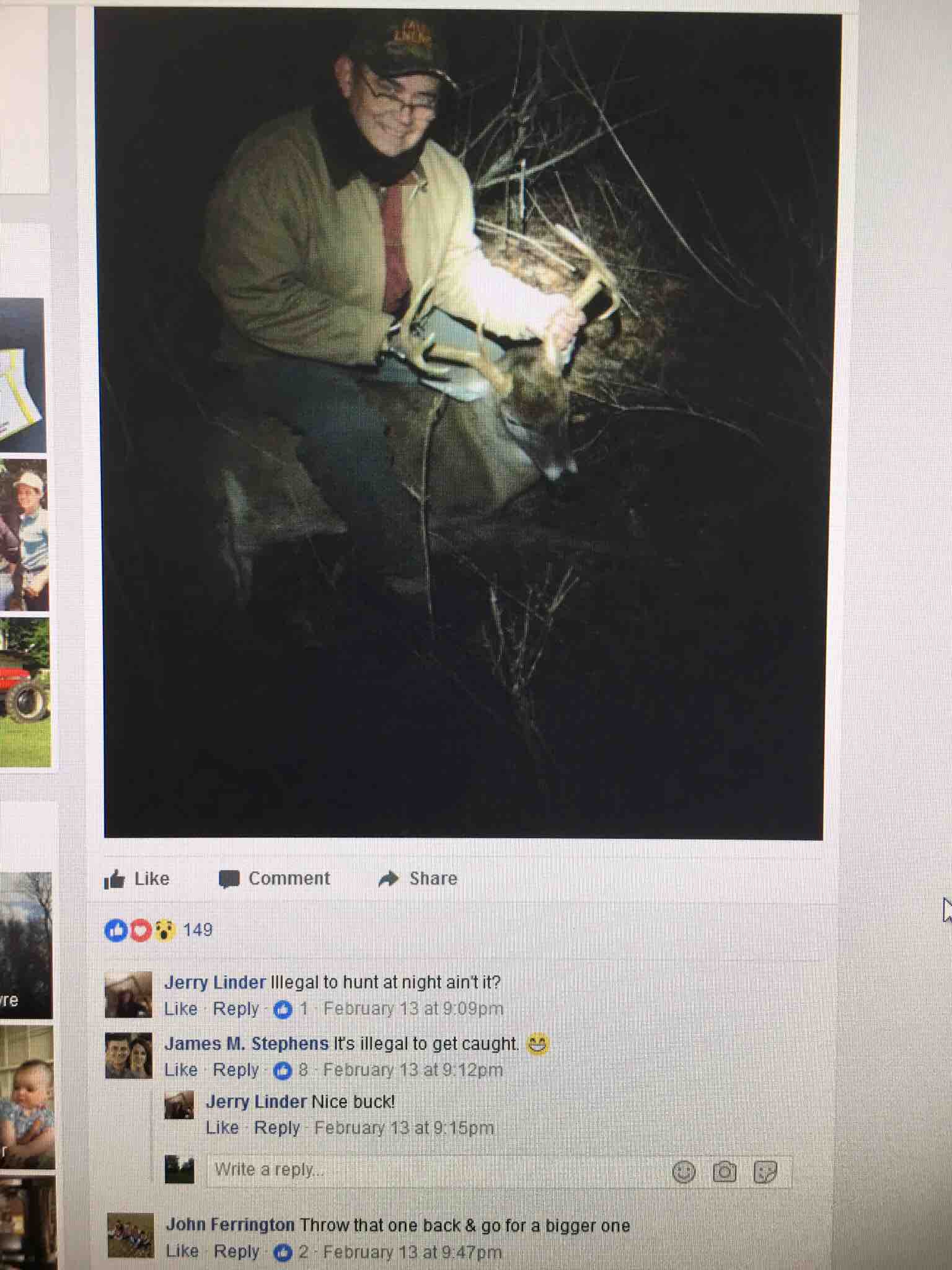
But the minor issue of where his office is housed doesn’t seem to be the type of thing that would bother Stephens anyway. After all, there is a photo, apparently posted on his Facebook page that shows him holding up the antlers of a deer he shot—at night? One person commented, “Illegal to hunt at night, ain’t it?” to which Stephens replied, “It’s illegal to get caught.”

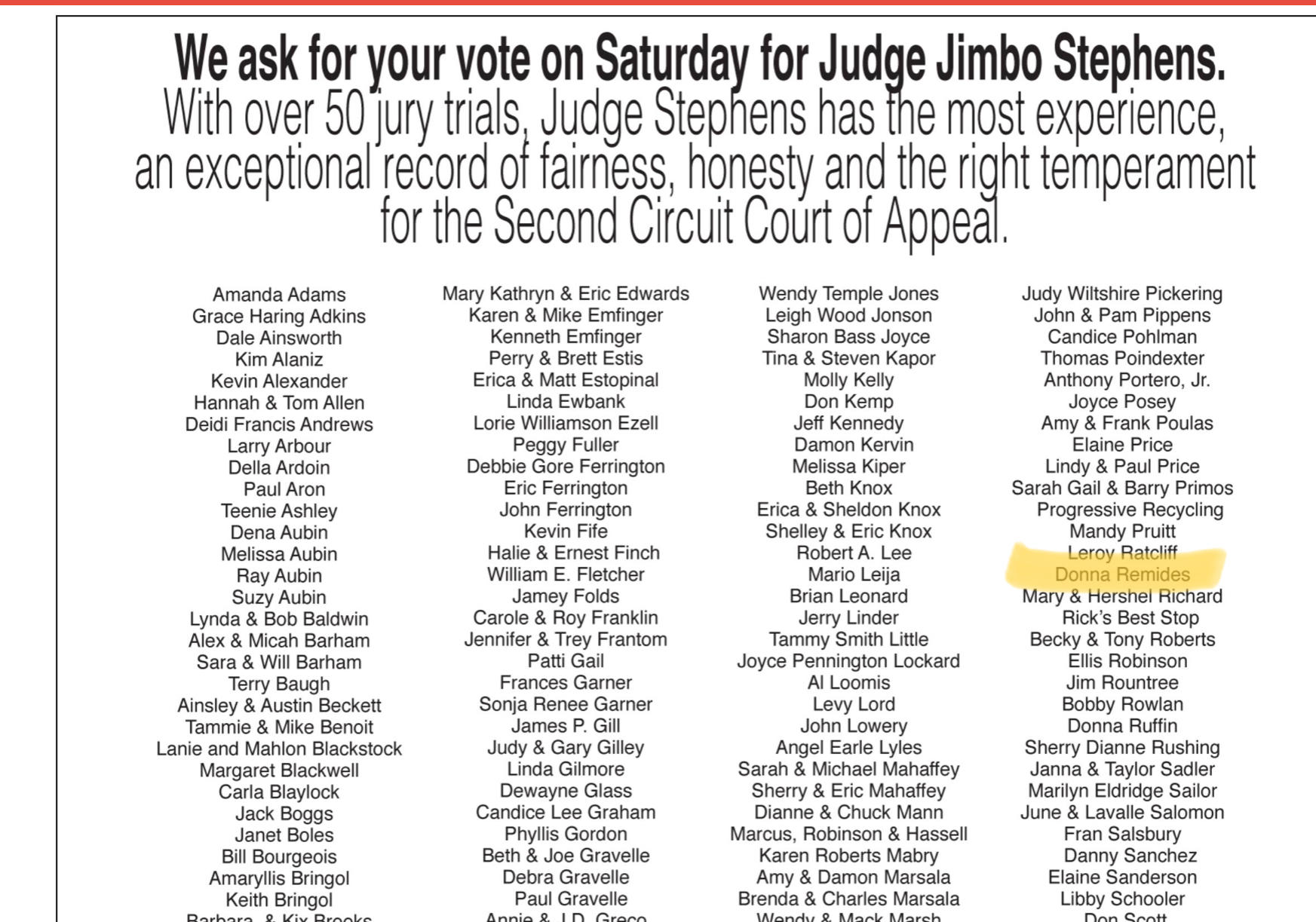
And when he was running for the appellate court in 2016, there were more than 160 people who signed onto a newspaper ad endorsing his candidacy. Among them was one Donna Remides.

(CLICK ON IMAGE TO ENLARGE)

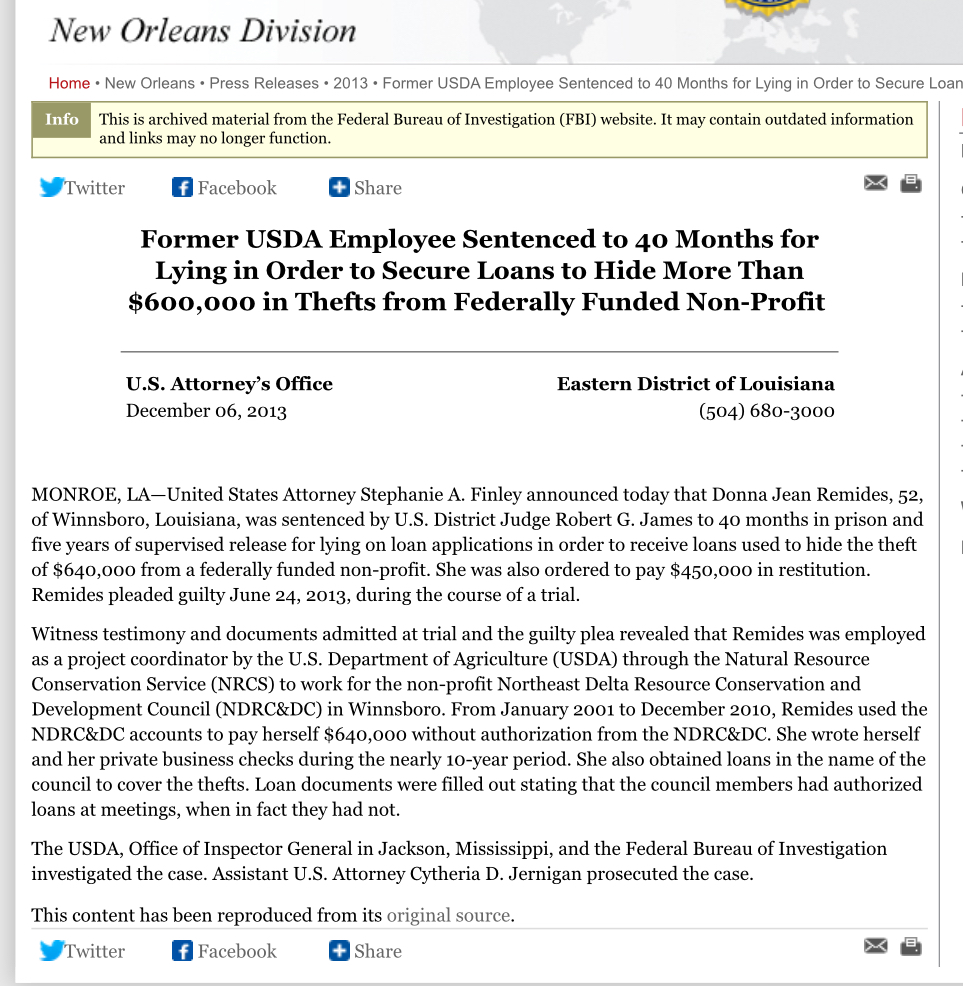
In December 2013, a press release from the U.S. Attorney’s Office in New Orleans said Ms. Remides was sentenced to 40 months imprisonment for lying in order to secure loans to hide more than $600,000 in thefts from the federally-funded non-profit Northeast Delta Resource Conservation and Development Council (NDRC&DC).

She was employed as a project coordinator by the U.S. Department of Agriculture (USDA) through the Natural Resource Conservation Service (NRCS) to work for the council in Winnsboro. From January 2001 to December 2010, she used the NDRC&DC accounts to pay herself $640,000 without authorization. She wrote herself and her private business checks during the 10-year period and obtained loans in the name of the council to cover the thefts.

Granted, Stephens has no control over who purchases a newspaper advertisement to endorse his candidacy. But that, coupled with the controversy over his refusal to recuse his pal Doughty from a trial involving a LAWSUIT against a bank with some questionable links to Doughty, the flippant remark about illegal night hunting, the office space at Vantage, the same personalities tying both judges to Vantage, Abraham and Ellington…

But then again, maybe that’s what qualifies both judges for their positions in the political climate in which we currently find ourselves.

When U.S. Sens. John Kennedy and Bill Cassidy went on record before the Senate Judiciary Committee as supporting the nomination of 5th Judicial District Court Judge Terry Doughty to the U.S. District Court for the Western District of Louisiana, they put themselves, by extension, squarely at odds with the doctrine of separation of church and state.

That doctrine, Alabama’s Judge Roy Moore notwithstanding, is a cornerstone of American democracy but one which Doughty, like Moore, has chosen to ignore when dealing with defendants who come before him in his drug court.

While many of the DECISIONS dealing with the separation of church and state handed down by the U.S. Supreme Court border on the ridiculous, there is one that stands out. In the 1971 decision in Lemon v. Kurtzman, the court established a three-part test for determining if an action of government violates the First Amendment’s separation of church and state provision:

  • The government action must have a secular purpose.
  • Its primary purpose must not be to inhibit or to advance religion.
  • There must be no excessive entanglement between government and religion.

It’s important to note that in his confirmation hearings, Doughty boasted of the work of his drug court and that if confirmed, he would be interested in developing a drug court PROGRAM at the federal level patterned on the one he established in the 5th JDC, which is comprised of the parishes of Franklin, Richland, and West Carroll.

So, what’s so wrong about the district’s drug court?

Only that Doughty mandates that defendants enter into either Alcoholics Anonymous or CELEBRATE RECOVERY, both of which are faith-based recovery programs.

In September 2007, the 9th U.S. Circuit Court of Appeals ruled that it was unconstitutional to order a parolee to attend AA or affiliated programs because requiring attendance at a religion-based treatment program violated the First Amendment.

In handing down its RULING, the court said what while it “in no way denigrate(s) the fine work of (AA and Narcotics Anonymous), attendance in their programs may not be coerced by the state.”

While LouisianaVoice takes no position as to the merits of AA or Celebrate Recovery, we do recognize that the Bill of Rights calls for the separation of church and state. By that, it simply means the State shall neither establish a specific religion nor prohibit the practice of such. And the only way to ensure that is for the government to take a hands-off approach to the observance of any religious practice, be it Christianity, Buddhism, Islam, Judaism, or any other belief.

Doughty doesn’t seem to get that and it is his close association with Celebrate Recovery that gives us pause.

In his questionnaire he completed for submission to the Senate Judiciary Committee, Doughty falls woefully short of any published writings, reports, or policy statements but does include numerous references to his affiliation with Celebrate Recovery. Those references include:

  • August 11, 2011: Guest Speaker, “Inventory, Lesson 10,” Richland Celebrate Recovery, Rayville, Louisiana.
  • January 11, 2012: Guest Speaker, Richland Celebrate Recovery Program, Palmetto Addiction Recovery Center, Rayville, Louisiana.
  • September 9, 2012: Speaker, Richland Celebrate Recovery Program, Delhi United Methodist Church, Delhi, Louisiana. “I discussed how the Richland Celebrate Recovery program works with the church.”
  • January 3, 2013: Presenter, “What to Do When You Get Out,” Celebrate Recovery Inside, Richland Parish Detention Center, Rayville, Louisiana.
  • January 27, 2014: Speaker, “Starting a Celebrate Recovery Program,” Richland Celebrate Recovery, Olanchito, Honduras.
  • February 14, 2014: Guest Speaker, Celebrate Recovery Graduation, Richland Parish Detention Center, Rayville.
  • June 10, 2014: Guest Speaker, Celebrate Recovery Graduation, Richland Parish Detention Center, Rayville.
  • August 5, 2014: Presenter, “Starting a Celebrate Recovery Program,” Richland Celebrate Recovery, Olanchito, Honduras.
  • September 17, 2015: Speaker, Welcome Address, Richland Celebrate Recovery, Rayville.
  • December 3, 2015: Speaker, “Lesson 10—Spiritual Inventory Part I,” Richland Celebrate Recovery, Rayville.
  • June 27, 2016: Presenter, “Maintaining a Celebrate Recovery Program,” Honduras Celebrate Recovery, Olanchito, Honduras.
  • July 28, 2016: Speaker, “Spiritual Inventory Part I,” Richland Celebrate Recovery, Rayville.
  • August 14, 2016, Presenter, Report on Celebrate Recovery Honduras Mission Trip, Richland Celebrate Recovery, Rayville.
  • August 28, 2016: Presenter, Report on Celebrate Recovery Honduras Mission, Richland Celebrate Recovery, Rayville.
  • March 16, 2017: Speaker, “Lesson 10—Spiritual Inventory Part I,” Richland Celebrate Recovery, Rayville, Louisiana. I discussed the benefits of making a spiritual inventory.

So, exactly what is Doughty’s affiliation with Celebrate Recovery? Why Honduras? And who paid for his trips to that country? Why is there nothing in his questionnaire responses to indicate that he ever spoke at an AA event? There are, after all, AA MEETINGS in all three parishes in the 5th JDC.

There was no immediate information available as to who paid for his three trips to Honduras in 2014 and 2016 to speak on behalf of Celebrate Recovery but if Celebrate Recovery paid for his trip and/or his lodging and meals, it could present a potential ETHICS violation for Doughty.

Under General Prohibitions as set out in Louisiana R.S. 42:1111-1121, the Code of Governmental Ethics prohibits the “receipt of a thing of economic value by a public servant for services rendered to or for the following:

  • Persons who have or are seeking to obtain a contractual or other business or financial relationship with the public servant’s agency;
  • Persons who are regulated by the public employee’s agency;
  • Persons who have substantial economic interests which may be substantially affected by the performance or nonperformance of the public employee’s official duties.

Celebrate Recovery would obviously have a “substantial economic interest” in the performance of Doughty’s official duties as a judge mandating that defendants in his court enter into programs offered by Celebrate Recovery.

U.S. Rep. Ralph Abraham may have been a bit premature in pushing for Doughty’s nomination and Sens. Cassidy and Kennedy might have been wise to vet the judge a little better before testifying on his behalf before the Judiciary Committee. Kennedy was dogged in his questioning of Matthew Spencer Peterson, whose nomination was subsequently withdrawn. Peterson, of course, is not from Louisiana, so Kennedy could afford to pepper Peterson with embarrassing questions without any risks to his political future.

But Kennedy might have served his Louisiana constituents better if he had been a little more thorough in his examination of Doughty’s qualifications.

Former Trooper Jimmy Rogers is ready to don the uniform of a Louisiana State Trooper again.

This is the same Trooper who worked LACE while serving a suspension in violation of state police policy.

His friend and commander, Capt. Chris Guillory, allowed him to work LACE while serving a 240-hour suspension. Rogers was suspended for threatening people and using state police resources for personal use such as criminal background checks on persons he was threatening. Sources tell LouisianaVoice the threats were issued to the boyfriend of a woman he was having an affair with and impregnated.

Rogers was the target of an investigation of charges that he used his state police position to influence criminal charges against Dwight Gerst. Internal Affairs investigators obtained a statement showing Rogers getting a witness to go along with him which in turn resulted in criminal charges against Gerst.

Rogers was cleared in that investigation. Gerst was acquitted of the unwarranted criminal charges. Gerst currently has a lawsuit for civil damages pending against Rogers.

LouisianaVoice previously reported former Trooper Jimmy Rogers was suspected of claiming LACE hours which he did not actually work. In the midst of the investigation, he suddenly resigned. LSP repeatedly denied our requests for the investigation file leading up to his resignation claiming they are not subject release because Rogers was not punished.

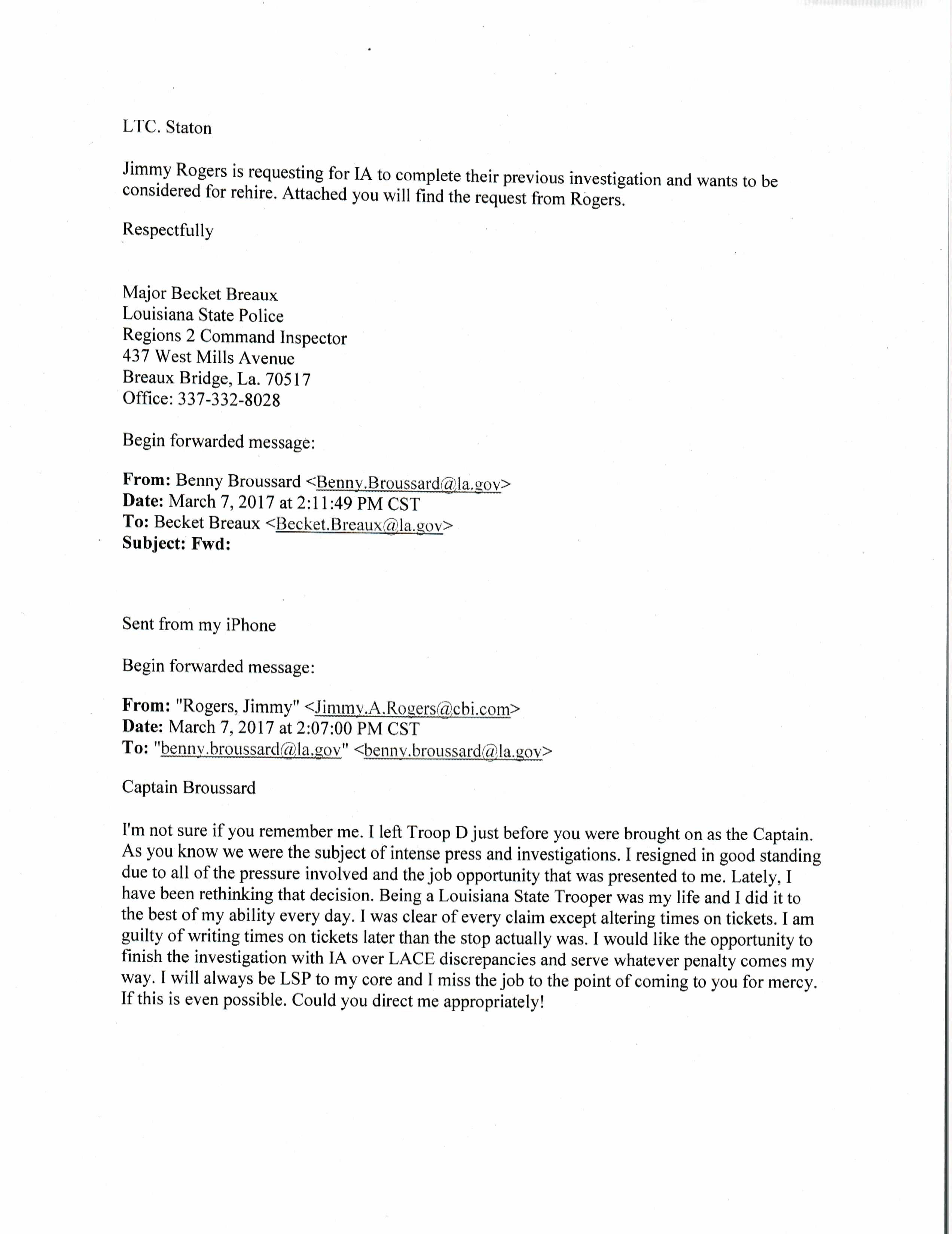
LouisianaVoice received information that Rogers has requested to return to LSP on March 7 of this year. Several Troopers are concerned that he might be rehired. Under former State Police Superintendent Mike Edmonson, this was a legitimate concern. We find it highly unlikely that he would be hired under Col. Reeves. We made a public records request for the email sent by former Trooper Rogers. Here is the email:

Captain Broussard

Rogers, Jimmy <JimmyARogers@cbi.com>

Tuesday, March 07,2017 2:07PM

 Benny Broussard

I’m not sure if you remember me. I left Troop D just before you were brought on as the Captain. As you know we were the subject of intense press and investigations. I resigned in good standing due to all of the pressure involved and the job opportunity that was presented to me. Lately, I have been rethinking that decision. Being a Louisiana State Trooper was my life and I did it to the best of my ability every day. I was clear of every claim except altering times on tickets. I am guilty of writing times on tickets later than the stop actually was. I would like the opportunity to finish the investigation with IA over LACE discrepancies and serve whatever penalty comes my way. I will always be LSP to my core and I miss the job to the point of coming to you for mercy. If this is even possible. Could you direct me appropriately!

(Check on images to enlarge for easier reading):


Check out the privacy notice at the bottom of that email. Rogers sent the message from his work computer. He went begging for his old job at 2:07 p.m., while on duty at his current job. His employer, Chicago Brick and Iron, should really appreciate that.

Broussard responded tactfully to Rogers, telling him he was directing his request “up the chain of command.”

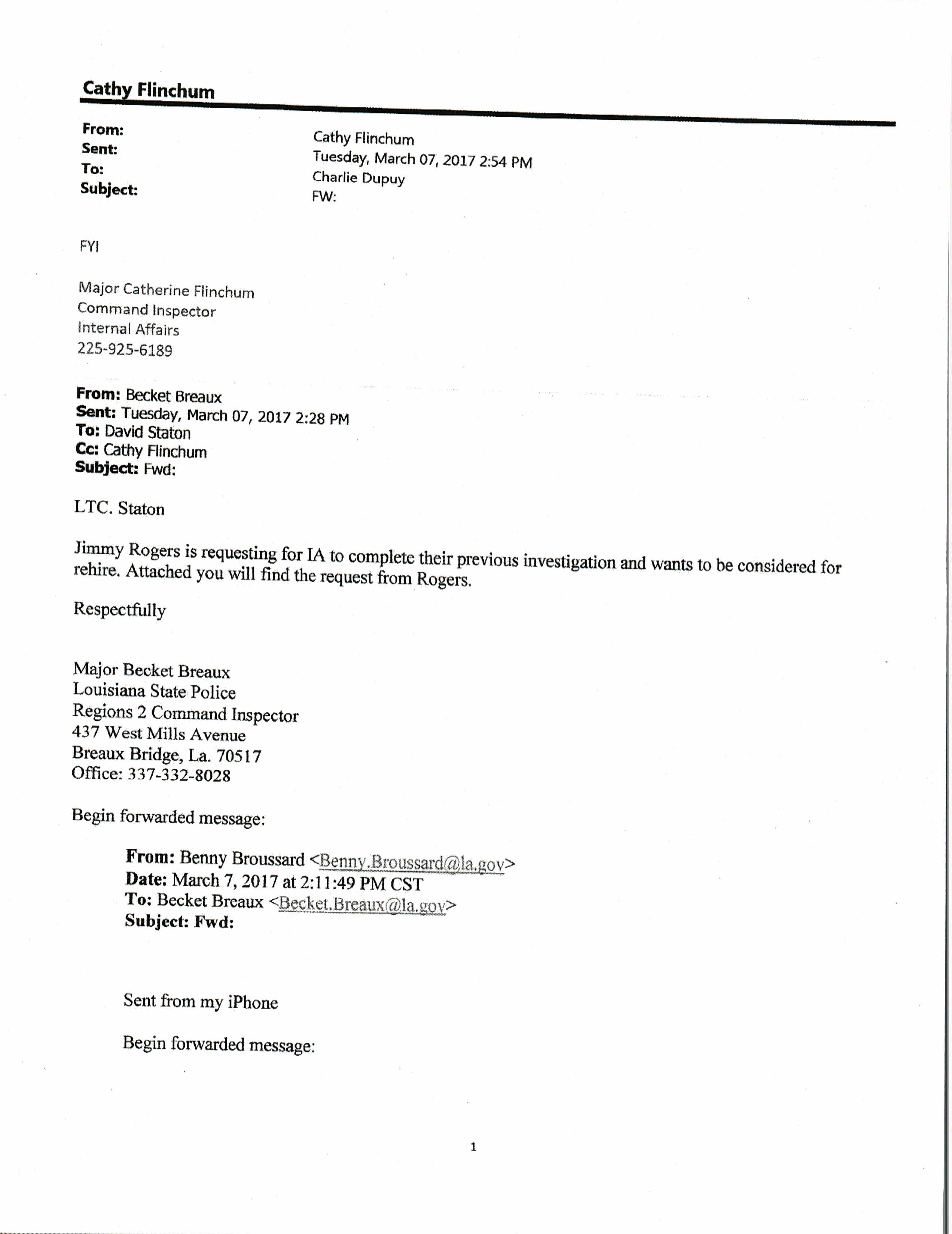
Broussard forwarded the request to Region 2 Commander Maj. Becket Breaux, also on March 7:

From Breaux, the email from Rogers went up the line to LSP headquarters in Baton Rouge:

…And finally, to former LSP Chief of Staff Charlie Dupuy:

That, apparently, is where the matter rests. There were no other communications provided to LouisianaVoice by LSP.

But for the moment, let us focus for a moment on this statement: “I am guilty of writing times on tickets later than the stop actually was.”

Criminal investigators call this a confession. It is a usable confession made voluntarily and not subject to any Miranda limitations. The email sent to Troop D Commander Capt. Benny Broussard asking for his job back suggests he committed the following crimes.

14:138 Public payroll fraud (felony)

14:133 Filing or maintaining false public records (felony)

14:134 Malfeasance in office (felony)

Our sources say that Rogers’ dash camera footage, witnesses, citations, radio logs, and time sheets will further prove he was abusing the LACE program. We have attempted to get this information but were denied. We have reissued our public records requests to the new LSP administration in hopes of compliance with the law or a valid denial based on the records are now part of an ongoing criminal investigation.

LSP has the same information on Rogers as was discovered by Lee Zurik in the investigation of other troopers. Zurik’s information has resulted in criminal investigations. The only difference is when LSP finds it, they have covered it up. It is time for LSP to do the right thing for the citizens of Calcasieu Parish who paid for services that were not provided.

Troopers should not be afforded the opportunity to resign for the purpose of stopping a criminal investigation. LSP does not offer this option to other agencies or individuals. It is time for LSP to do the right thing on their own and stop making the media do their investigations for them.

Better yet, comply with Rogers’ request and complete the investigation.