Feeds:
Posts
Comments

Well, I don’t have any silver or gold decals to hand out nor can I offer any leniency if you’re pulled over for speeding in Louisiana.

But if you could find it in your heart to contribute to LouisianaVoice, I can promise you to keep investigating corruption, malfeasance, and unethical behavior on the part of Louisiana’s elected and appointive officials—just as I have done for the past eight years.

As I wrote on Monday, I do this with no compensation from anyone. I don’t accept advertising (with the exception of Cavalier House Books because John Cavalier initially set up this blog page for me (plus pop-up ads over which I have no control and for which I receive nothing). Nor do I charge a subscription fee. I want LouisianaVoice to be available to anyone who wishes to read it.

I love Louisiana but I detest Louisiana politics. I really don’t care if my subject is Democrat of Republican; if he’d doing wrong, it’s wrong. My grandfather used to tell me, “If it ain’t altogether right, then it’s altogether wrong.” He saw things in black and white, not shades of gray. Unfortunately many of our officials don’t share that philosophy.

There’s only one way to keep our officials honest: the good, old-fashioned way.

I do have have expenses involved in chasing down public records, court costs, gasoline, vehicle upkeep, etc. It is because of this that I humbly ask that readers who appreciate what I do help keep the stories coming with whatever contribution they feel they can afford.

You may contributed by clicking on the yellow DONATE button to the upper right (above the illustration of my Bobby Jindal book) or by sending a check or money order to:

Capital News Service/LouisianaVoice

P.O. Box 922

Denham Springs, Louisiana 70727


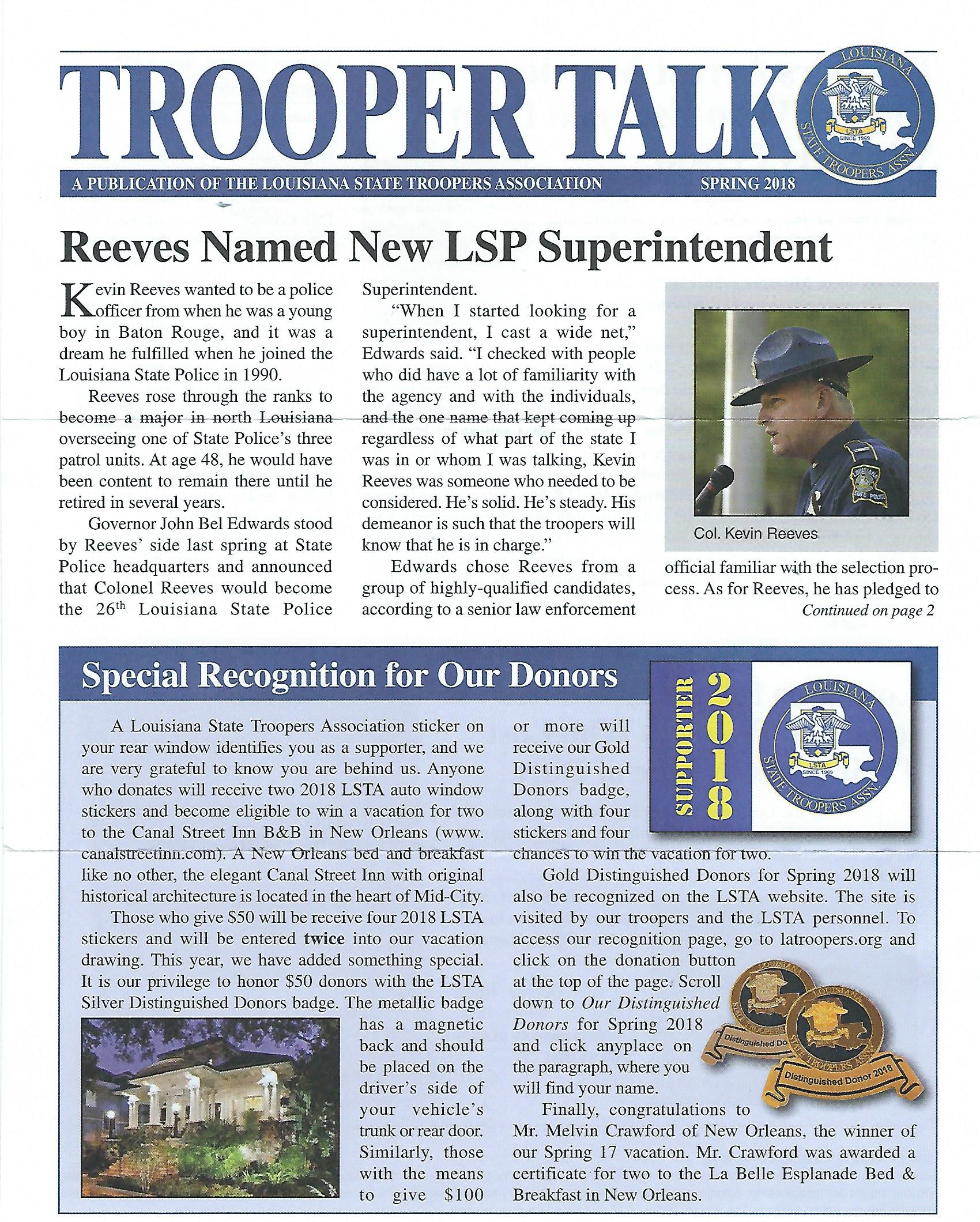
“The metallic badge has a magnetic back and should be placed on the driver’s side of your vehicle’s trunk or rear door.”

—Louisiana State Troopers Association suggestion in its fundraising letter for those who give $50 or more, which appears to be a subtle message that the decals might serve as a “get out of jail free” card for traffic offenders.

Just when you thought enough had been written about the Louisiana State Troopers Association (LSTA), wouldn’t you know that the organization sent out solicitation letters to three members it had kicked out a couple of years back because they questioned the group’s political activity?

Talk about adding insult to injury.

But that isn’t really the story here. What’s interesting about this solicitation is that the Spring 2018 edition of Trooper Talk actually appears to sending out a not-so-subtle message that if you contribute enough money, you will get a handy little magnetic decal to stick on your vehicle to alert troopers that you gave and probably shouldn’t get a ticket for doing 85 in a 65.

Full disclosure: the story at the top of the page is an LSTA story about the appointment of Col. Kevin Reeves as Superintendent of State Police. Reeves is in no way connected to the LSTA fundraiser. This bulletin is published independent of Louisiana State Police.

And while the LSTA loves to point out how many wonderful projects it supports via its fundraisers, this time the solicitation seems to go out of its way to assure donors that, except for the cost of the newsletter and the decals, 100 percent of the money stays with the LSTA.

Maybe that’s because the LSTA is confident that the State Police Commission, the state police equivalent to the Louisiana Civil Service Commission, won’t lift a finger to investigate the association for its POLITICAL ACTIVITY even though such activity is clearly illegal.

The commission already has hired Natchitoches attorney Taylor Townsend under a $75,000 contract to conduct a non-investigation investigation of tens of thousands of dollars of LSTA political contributions funneled through the private bank account of its executive director David Young.

So, now there’s this Trooper Talk which informs potential donors that any contribution will get them a couple of window stickers that will, in case you are pulled over for a traffic violation, tell troopers that you are a cheapskate who wouldn’t even pony up $50. But if you give between $50 and $100, you will get a dandy “Silver Distinguished Donors badge.” Those donors will also be entered twice in a drawing for a vacation for two in the Canal Street Inn Bed and Breakfast in New Orleans.

Now this is just any old silver distinguished donors badge. It has a genuine magnetic back “and should be placed on the driver’s side of your vehicle’s trunk or rear door.” (emphasis added.) (Now, why would they suggest placing them there? For better trooper visibility perhaps, hmmm?)

What about those who give $100 or more? Good question. Those generous supporters will get a “Gold Distinguished Donors badge” and four chances at that dream vacation in New Orleans. Those benefactors will also be recognized on the LSTA website. (The site is visited by our troopers and the LSTA personnel,” the solicitation letter said (wink, wink).

And while the letter stresses that the money will remain with the LSTA, it would be unfair not to point out that the organization does do considerable charitable work with children and the families of troopers killed in the line of duty.

On the other hand, however, the LSTA recently announced that it was providing monetary assistance to members who were victims of the 2016 floods in Louisiana. But several retired troopers who also victims of the same floods complained that they received no assistance whatsoever.

Some of those same retirees have filed a complaint with State Police headquarters in Baton Rouge about the latest fundraising solicitation and its indirect suggestion that a large enough donation might help donors avoid a ticket.


State Rep. Dustin Miller (D-Opelousas) has filed HOUSE BILL 724 that would provide an exception to certain provisions of the state ethics code that would allow a Louisiana Department of Health physician to skirt a conflict of interests—in other words, to circumvent the very situation ethics rules were put into place to prevent.

Miller’s bill would allow the physician, Dr. Harold Brandt, to perform in a dual capacity that has already been rejected by the ethics board in a 2016 RULING.

The ruling of July 18, 2016 informed Dr. Sreyram Kuy that he could not accept employment with a healthcare provider that accepted Medicaid payments for medical services because of her position as Medicaid Medical Director, Chief Medical Officer of the Bureau of Health Services Financing (BHSF) within the Department of Health and Hospitals (DHH), now LDH.

The decision, written by Jennifer T. Land, read, “The Board concluded…that the Code of Governmental Ethics prohibits you from being employed as a surgeon for OLOL (Our Lady of the Lake Regional Medical Center), other Louisiana licensed hospitals and other healthcare providers that accept Medicaid payments for medical services while you serve as Medicaid Medical Director/Chief Medical Officer of BHSF.”

Land cited the specific section which said the code “prohibits a public servant from receiving compensation for services rendered to the following persons: (1) those who have or are seeking to obtain a business, contractual or financial relationship with the public servant’s agency, (2) those who conduct operations or activities that are regulated by the public servant’s agency, and (3) those who have a substantial economic interest that could be affected by the performance or non-performance of the public servant’s official duty. OLOL, other Louisiana licensed hospitals and other healthcare providers that accept Medicaid payments for medical services are regulated by your agency, BHSF. Therefore, as the Medicaid Medical Director/Chief Medical Officer of BHSF, you are prohibited from being employed by or from providing compensated services to these entities.”

What makes Miller’s bill particularly interesting, however, is that both Dr. Kuy’s predecessor, LDH Secretary Dr. Rebekah Gee, and his successor, Dr. Harold Brandt, each worked in that same position without bothering to request an ethics ruling, apparently falling back on the Nike slogan “Just do it.”

In fact, in the case of Dr. Brandt, LouisianaVoice has been informed that he was reappointed to the position with the proviso that Miller’s bill would be introduced in order to change the existing law to accommodate him. This despite the fact that an ethics review was requested of LDH legal to determine if such an arrangement was acceptable, and the answer was no, according to sources.

On Jan. 25, LouisianaVoice published a story in which it was revealed that Dr. Brandt previously served as Medical Vendor Administrator (Medicaid Medical Director) for LDH from April 7, 2016 to Sept. 2, 2017 at a rate of $156.25 per hour while he simultaneously served on the staff of BATON ROUGE CLINIC, which received $83,000 in PAYMENTS from LDH during Dr. Brandt’s tenure at LDH.

the Medical Director serves as chairman of the Medical Quality Review Committee, so LDH legal was asked for a second opinion whether any ethics concerns existed in regards to that capacity.

The response was the following potential issues identified under the Code of Governmental Ethics. The Medicaid Quality Committee (Committee) of the Louisiana Department of Health, Bureau of Health Services Financing, fulfills the role of the Medical Care Advisory Committee required by 42 CFR 431.12.  According to its Bylaws, the Committee provides focus and direction for Medicaid program quality activities that assure access and utilization of quality, evidence-based healthcare that is designed to meet the health needs of all Louisiana Medicaid and Children’s Health Insurance Program (CHIP) recipients through:

  • Establishing and maintaining sound business and clinical practices/benchmarks that ensure a system of internal controls and support optimal performance within established thresholds;
  • Driving meaningful and measurable collaboration between the LDH agencies BHSF, Office of Behavioral Health (OBH), Office of Public Health (OPH), Office of Aging and Adult Services (OAAS), and Office for Citizens with Developmental Disabilities (OCDD), with a focus on demonstrating improved care and service for Medicaid recipients by using evidence-based guidelines;
  • Creating and sustaining a vibrant evaluation process for Louisiana Medicaid benefits and services and health care delivery systems that is based on integrity, accountability, and transparency;
  • Offering expertise and experience of Committee members to recommend improvements to BHSF that will serve to better meet the healthcare needs of recipients in a cost efficient manner;
  • Sharing Committee recommendations with recipients, providers and policy leaders; and
  • Forming subcommittees to address specific areas of care, as needed.

The Committee’s functions are advisory and shall include:

  • Monitoring ongoing metrics and ensuring findings are reported on a regularly scheduled basis (quarterly or annually);
  • Ensuring key quality initiatives are identified to align with regulatory and business requirements;
  • Overseeing quality improvement projects and ensuring coordination and integration of the quality improvement activities;
  • Reviewing performance results and providing feedback and recommendations to the MCO action plans; and
  • Participating in the evaluation of the Medicaid Quality Program by evaluating the quality, continuity, accessibility, and availability of the medical care rendered within Louisiana.

The Secretary of LDH appoints all non-permanent Committee members, which must include board-certified physicians and other health professionals familiar with the medical needs of low-income population groups and with the resources available and required for their care, in accordance with 42 CFR (Code of Federal Regulations) 431.12(d).  Additionally, the members of the standing subcommittees are appointed by the Louisiana Medicaid Medical Director, who serves as the permanent Chair of the Committee.

La. R.S. 42:1113B prohibits an appointed member of any board or commission, member of his immediate family, or legal entity in which he has a substantial economic interest from bidding on or entering into or being in any way interested in any contract, subcontract, or other transaction which is under the supervision or jurisdiction of the agency of such appointed member.

As such, La. R.S. 42:1113B would prohibit Medicaid providers from serving, despite 42 CFR 431.12(d) effectively requiring they be appointed to the Committee or subcommittees. LDH should consider proposing an amendment to the Code of Governmental Ethics to provide an exception for Medicaid providers appointed to serve on the Medicaid Quality Committee or any of its subcommittees.

Unconfirmed reports said that Brandt prevailed upon Gov. John Bel Edwards to write Dr. Gee to request that he be allowed to continue serving as Medical Director for LDH.

An attempt was made to reach Dr. Brandt at LDH but his phone line was forwarded to a non-working number. The Department of Civil Service has no record of his employment after last Sept. 2.

LouisianaVoice has made a public records request of LDH for all correspondence between Dr. Brandt and Edwards, between Dr. Brandt and Dr. Gee and between Edwards and Dr. Gee relative to Brandt’s employment.

LDH received an email today (April 3) from LDH to the effect that it would take 30 days to provide such records. It takes only a simple keystroke to retrieve such messages from email files, however. They can be produced in a matter of seconds.

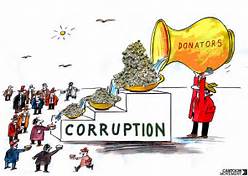
Like most starving writers, I do this blog not for financial reward and certainly not to make myself feel good.

I write LouisianaVoice for one reason: to inform readers about ways our elected and appointed officials let us down every day by betraying the trust we place in them. And far from making me feel good, sometimes what I write infuriates me.

It upsets me when I see poor people, old people, disabled people and anyone else unable to speak up for themselves taken advantage of. It makes me very angry when people in positions to help their fellow man choose instead to ignore those in need in order to help themselves.

It angers me to my core to know that lobbyists for the special interests have the ear of our elected officials while those of us who carry the heaviest tax burden are ignored.

I’m no saint and I have my faults, God knows. But LouisianaVoice was born out of frustration and indignation and I will continue to try and be a voice for the voiceless, a spokesman for the unrepresented, an advocate for the forgotten.

To do that, however, it is an inconvenient truth that financial backing is a necessity. I have to pay for the web page, for public records, for gasoline and auto repairs, and for meals when I’m on the road chasing down a story. From time to time I even have to defend a so-called SLAPP (strategic litigation against public participation) lawsuits aimed at silencing LouisianaVoice. We’ve won every time but it costs money. (I guess when they start suing, I must be hitting a few nerves.)

I do two fundraisers per year—in October and April. April is an awful time, I know, because of federal income taxes, but those are the times.

I depend on the generosity of readers to keep LouisianaVoice going.

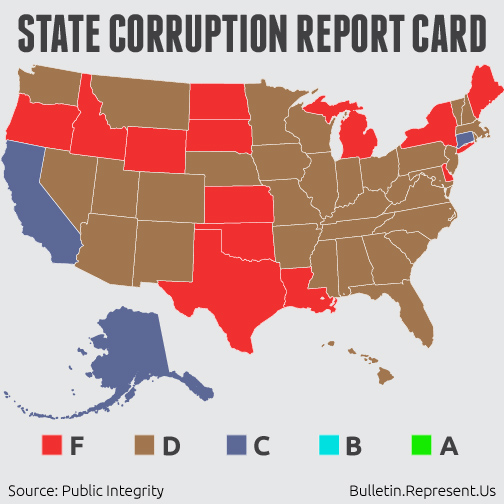
And so it is that I humbly ask for your continued assistance in keeping LouisianaVoice your source of news about mismanagement, corruption, unethical behavior, unscrupulous public officials, and governmental waste.

I’ve been doing this for eight years now. I have survived a major flood, what I thought was a heart attack (it was an angina attack, thankfully).

Please help me continue via credit card by clicking on the yellow DONATE button (on the right, above the illustration of my Jindal book) or by sending a check or money order to:

Capitol News Service/LouisianaVoice

P.O. Box 922

Denham Springs, Louisiana 70727