Feeds:
Posts
Comments

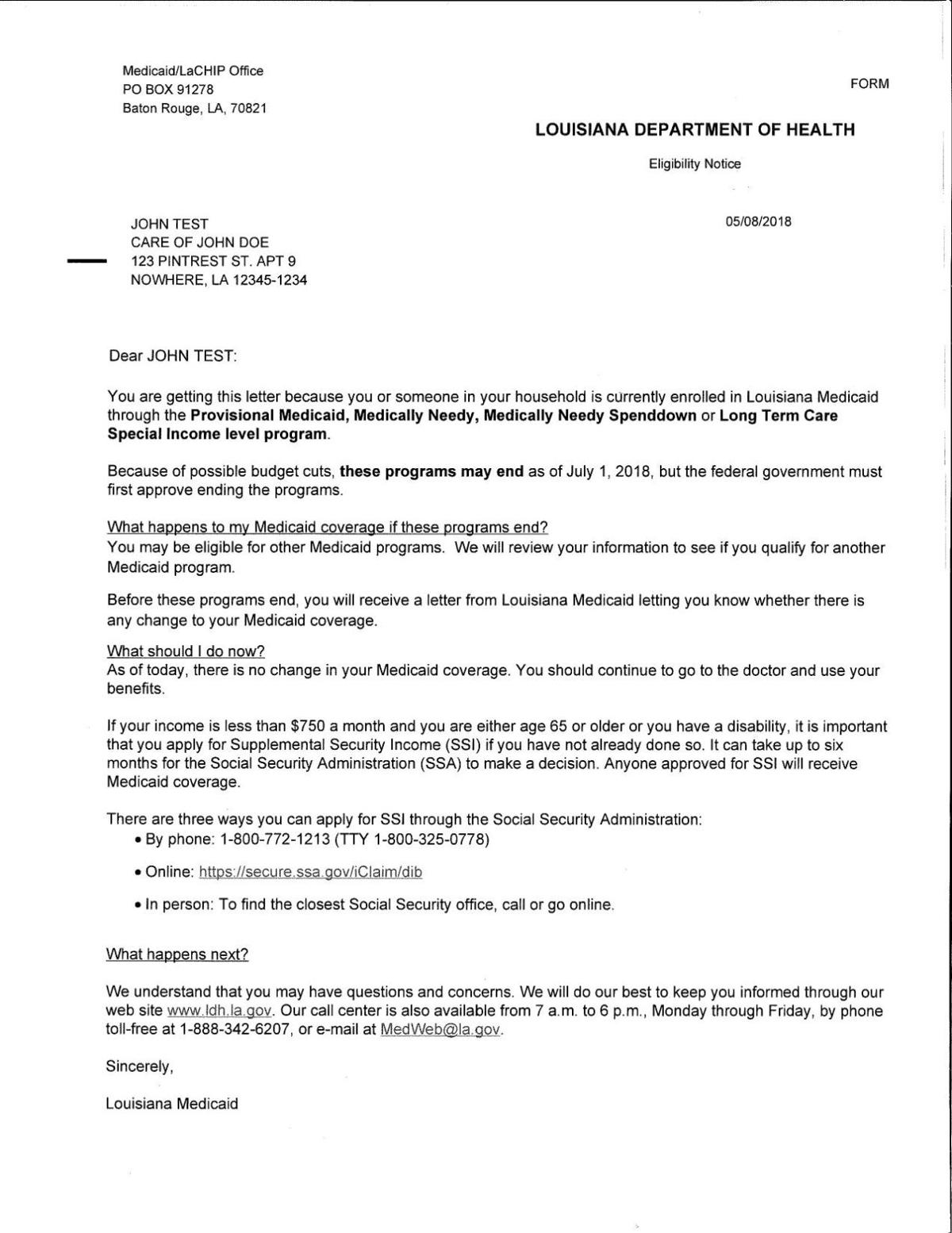
If you like political posturing, puffery, bombast, and breast-beating, then the reaction to that LETTER being sent out to 37,000 nursing home patients in Louisiana is tailor-made for political junkies like you.

The letter, sent out by the Louisiana Department of Health, got the desired reaction. CBS Evening News featured the story prominently in its Wednesday newscast, complete with a brief interview with Jim Tucker of Terrytown, operator of about a dozen nursing homes.
It’s interesting that Tucker was sought out for camera face time. He was Bobby Jindal’s Speaker of the House who abetted Jindal for eight years in gutting the state budget of services for the elderly and mentally ill. And now the roll him out in front of the cameras to cry wolf.

The Edwards administration tried to assure us, through Commissioner of Administration Jay Dardenne and LDH Secretary Dr. Rebekah Gee, that this is not Chicken Little, that the sky really will fall if budget cuts are not restored by July 1, the date that the state is projected to fall over the metaphorical fiscal cliff when $650 million in tax revenue falls off the books.

Typically, the reaction by Republicans in the legislature, the same ones who have steadfastly refused to face fiscal reality since the beginning of the Jindal accident in 2008, was to scream foul to anyone who would listen—and there were plenty who did.

Dr. Gee, of course, did her part, even tearing up as she explained to the TV cameras that hearts “are breaking over the need to do this. We can’t provide services with no money to pay for them.”

Dardenne added his bit, saying, “This letter is scary, but it’s not a tactic. This is the reality that we are facing.”

But House Appropriations Committee Chairman Cameron Henry (R-Metairie) gave the best performance. With a lock of hair hanging down over his forehead a-la the late Bobby Kennedy, he bleated, “This is premature at best, reckless at worst,” adding that the letter was designed “to scare the elderly of this state, and that is an embarrassment.” No, Cameron, you’re an embarrassment.

Ditto for Rep. Lance Harris (R-Alexandria), chairman of the House Republican Delegation, who called the letter an “unnecessary political scare tactic done to intimidate and frighten the most vulnerable people into believing they will be kicked out onto the streets if the governor doesn’t get everything he wants in the form of revenue.”

And Cameron Henry should understand that the legislature as a body is no less an embarrassment to those of us who have been forced to observe its collective ineptitude on a daily basis for 10 years now. To quote my grandfather, they couldn’t find a fart in a paper bag.

Lost in all the rhetoric is the hard fact that the administration might not have found it necessary to send out the letter—regardless whether it’s a scare tactic or reality—had the legislature made any effort to face up to its responsibility to the 4.5 million citizens of this state.

But here’s the real reality—and just remember where you read it:

Not a single nursing home patient is going to be evicted. Not one.

Want to know why?

Money.

And I don’t mean money to be appropriated by the legislature to properly fund state government, nursing homes included.

I’m talking about campaign money.

Lots of it. Tons of it.

Since 2014, individual nursing homes, nursing home owners, and nursing home political action committees have contributed more than $750,000 to Louisiana politicians, primarily legislators. Here is just a partial list of NURSING HOME CONTRIBUTIONS

And that’s just over the past four years.

More than $50,000 was contributed the campaign of Edwards.

Henry, the one who called out the administration for its “scare tactics,” received more than $10,000 since 2014.

Senate President John Alario also received more than $12,000 over the same time span.

Louisiana Public Service Commission member Foster Campbell said on the Jim Engster show on Louisiana Public Radio earlier this week that since he first ran for the legislature more than 40 years ago, the cost of seeking political office has become cost prohibitive. Foster said when he first ran for the State Senate in 1975, he borrowed $7,500 to finance his campaign. “Now, it costs hundreds of thousands of dollars” and the average person who wants to serve cannot afford to do so, he said.

I’ve always wondered why corporations and the wealthy who seem so concerned about “good government” don’t use their money to help others rather than lavish it on politicians. The money they throw at politicians and lobbyists could be put to such more productive use—but they don’t try because they don’t really care about good government. And every now and then, I can’t help wondering why that is.

But I don’t wonder about it long. The answer is obvious: power and influence.

And that’s a sorry commentary on our political system, from the local level all the way to the very top of the political pyramid.

And it’s for that reason that not a single nursing home resident will be evicted. By some miracle, repeated every year, it seems, extra money will be “found” to do what is politically expedient.

Because the money has already been spread around by those who buy influence and legislators.

Remember where you read it.

Editor’s note: The following (with added comment) is a guest column provided to LouisianaVoice by the Healthcare Alliance for Regulatory Board Reform (HARBR):

By Christian Wolff

Louisiana Senate Bill 286, dubbed the Physician’s Bill of Rights, fell into a “coma” before the Louisiana Legislature on last Wednesday but not before an outburst over the testimony of the bill’s author.

Sen John Milkovich (D-Shreveport) was in the middle of explaining the obvious conflict of interest on the Louisiana State Board of Medical Examiners when he was interrupted by New Orleans attorney Jack Stolier who twice shouted that Milkovich’s testimony was a “bald faced lie.” (Milkovich’s testimony and Stolier’s off-camera interruption can be heard beginning at the 7:15 MARK of this video of the House Health and Welfare Committee.)

Milkovich had just referenced an “affair” between Dr. Cecilia Mouton, then an investigator for the board of medical examiners, and Stolier, who represented physicians before the board in disciplinary matters.

But hey, the brief flareup was by far the most interesting—and probably the most intelligent—moment of this session sadly marked by legislative ineptitude, indecision, and concerted efforts to bow to the will of special interests st the expense of constituents and Louisiana (See the disgraceful Senate passage of the Payday Loan bill. How anyone can hold out one scintilla of hope for this bunch is beyond comprehension).

After Stolier was escorted from the committee room by Capitol security personnel, Milkovich read from a March 18, 2016, LouisianaVoice post which alluded to the relationship between the two. He also cited a letter from a board director which acknowledged a “personal relationship” between the two. Mouton, now Director of Operations for the board, and Stolier have since married but Milkovich called the romantic link between Mouton, who was prosecuting doctors, and Stolier, who was defending them, a blatant conflict of interest.

This, folks, is typical of the manner in which both the Board of Medical Examiners and the Louisiana State Board of Dentistry disregard due process and run roughshod over members of the medical profession who are charged and deemed guilty without even a nod at procedure. Guilty until proven innocent turns legal procedure on its head and is the very reason why some sort of checks and balances are desperately need to bring these rogue board under control.

But instead, the board, without objection, agreed that the bill be involuntarily deferred, meaning that for all practical purposes, it is dead for this session. (This, by the way, is the same Board of Medical Examiners that has defied a court order and continues to refuse to allow the legislative auditor to see its records so the auditor can do his job.)

Typically, the House does not entertain motions to override/hear bills that were involuntarily deferred in a committee.

This is the same legislature that is on the verge of approving (the Senate already has, by a 20-17 vote) an increase to 167 percent in interest rates payday loan predators can charge, along with doubling loan origination fees. Looks like the American Legislative Exchange Council (ALEC) has been busy this session—as it has in past years.

Advocates of SB 286 praised it on May 2 as an excellent piece of legislation. It was referred to it as “landmark” bill with implications for the due process reforms of healthcare licensing boards in every state in the nation.

Legislators’ indifference—not unlike their indifference to solving the state’s fiscal ills—could open the state up to litigation, leaving it to Attorney General Jeff Landry to try and defend the state, an interesting proposition in itself. Such potential litigation already has a precedent: a recent U.S. Supreme Court decision, North Carolina Board of Dental Examiners v Federal Trade Commission. In that decision, SCOTUS laid out conditions by which licensing and regulatory boards could and could not act as agents of their respective states.

In order to be considered a “state agency,” boards now need to show that they have a voting minority of “market place participants” in the profession being regulated. The other means by which a state regulatory or licensing board may come into compliance with the SCOTUS decision, and now, the Federal Trade Commission (FTC) mandate, is to have demonstrable and meaningful state oversight by an entity or entities which are not marketplace participants in the profession regulated by the board over which they are providing oversight.

The concern of SCOTUS and the FTC is that without meeting at least one of these two conditions, licensing and regulatory boards might act in their own interests rather than in the interest of the public. Moreover, SCOTUS and FTC, are concerned that beyond acting in the interest of their own professions over the interest of the public, boards may act in the interest of boards themselves over the fair and equal interest of given licensees or classes of licensees. This might be called “market capture via regulatory capture” and would be to the detriment of patients, the public, and licensees alike.

States whose regulatory boards do not comply with the conditions set forth in North Carolina Dental Board leave every member of every board including administrative staff and legal counsel legally exposed in their professional capacities and as individuals. Suits might be based in the violation of anti-trust laws, or on injury against persons (such as licensees) who were harmed without the benefit of due process of law.

Healthcare licensees in every state across the nation are being awakened to the injustices which have befallen physicians, and increasingly, other healthcare providers, since the passing of the short-sighted Healthcare Quality Improvement Act in 1986.

Louisiana is not alone by any stretch. It was foolish and immature for the Louisiana House Health and Welfare Committee to put SB 286 to rest in the way it did. When the Physicians’ Bill of Rights awakens from its “Involuntary Deferment” it may well be in a different state already positioned to make the proper move. The first state will set the landmark precedent and if the precedent does not affect national policy, it will be followed by every state in the nation.

My post last week about HB 602 that would allow anyone with a concealed permit enter a public school got the expected response, both from those in favor of the bill by Rep. Blake Miguez (R-Erath) and Sen. Neil Riser (R-Columbia) and those opposed.

In legislators’ frenzy to cozy up to the NRA and thus solidify their re-election chances among Louisiana’s hunters and gun enthusiasts, 59 House members VOTED in favor of the bill.

At least they can support the potential for schoolhouse slaughter even if they can’t find it in their conscience to solve the state’s financial woes.

Harsh words? Yep, and I stand by them despite comments to last week’s post such as this one:

Concealed weapons permit holders are the cream of the crop when it comes to individuals. They are professionals, business owners, and even grandmas. Trust me when I say you want me being able to defend you against those that wouldn’t get a permit and probably obtained their gun without a background check. Criminals are not the ones that abide by the rules. That’s something that liberals have yet to figure out.

No, Sunshine, I most certainly do NOT want you defending me. And yes, you are correct that criminals are not the ones who abide by the rules. But by your logic, you’re advocating that we simply dispense with the rules for everyone. Some people speed, litter, rob, loot, expose themselves in public, and cheat at cards and since they do, just eliminate the rules against those offenses and let everyone do it. Problem solved, right?

Here’s another brilliant observation:

In the first place, schools should not be gun free zones. Most mass shootings have occurred in gun free zones. I am for arming willing teachers and for allowing licensed concealed carriers to go onto school grounds. They have been vetted and trained. It is an insult to these fine people to trash talk what they “might do” in a chaotic situation. I’d rather for my grandchildren to know that somebody was on their side beside one resource officer way on the other side of the campus and not having to cower in a classroom corner waiting in horror as they hear the shots coming closer. I applaud the legislators who voted for this and am waiting for the Governor and the Sheriffs’ Association to strongly back this bill.

And then there is this comment which went far in exposing the thought processes employed by those 59 representatives who voted for this insanity:

I immediately checked with my Representative who voted yes on this bill. I asked him to explain his vote. I asked if his vote was influenced by NRA, ALEC or the Small Business group, specifically. He answered very quickly…however, his answer was a rambling discourse on why he is a licensed concealed carry person because of security at the Capitol, etc. He repeated this several times. Then he launched (into) the part where any school district can opt out of this bill. He stressed this over and over. He never really answered my question and by not answering my question, he actually answered my question. His reasons for voting for this bill, according to his own response, has nothing at all to do with school safety. As far as I can tell, from his response, it has mostly to do with pleasing the NRA, ALEC and that Small Business group. He will not be getting my vote.

Now, let’s examine those “cream of the crop” and the “vetted and trained” claims and see how they play out in actual, NON-EMERGENCY SITUATIONS involving “vetted and trained,” “cream of the crop” personnel:

  • A school police officer accidentally fired his gun in his Virginia office, sending a bullet through a wall into a middle school classroom.
  • A teacher (who moonlights in law enforcement) was demonstrating firearm safety in California when he mistakenly put a round in the ceiling, injuring three students who were hit by falling debris.
  • A sheriff left a loaded service weapon in a locker room at a Michigan middle school, where a sixth-grader found it.

An Associated Press review of news reports collected by the nonprofit Gun Violence Archive revealed more than 30 publicly reported incidents since 2014 involving firearms brought onto school grounds by law enforcement officers or educators. Guns went off by mistake, were fired by curious or unruly students, and were left unattended in bathrooms and other locations.

Several years ago, a teenage girl was killed in a horrific accident when a rifle in a gunrack inside a truck in the parking lot of Simsboro High School in Lincoln Parish discharged.

And then there’s this factor to consider:

Some insurance companies have even refused coverage for schools that allow non-law enforcement personnel to be armed.

Of course, Donald Trump could be counted on for his usual reversal of position during his speech Friday to the NRA convention in Dallas.

Trump, who initially voiced his support for tighter control of access to assault weapons in the wake of the Parkland, Florida, shootings, did his customary flip-flop when he called for allowing “trained” teachers to carry concealed weapons in schools, along with more security guards.

In his best Trumpgasm rhetoric, he crowed that the best deterrent to a shooter would be “the knowledge that their attack will end their life and end in total failure. When they know that, they’re not going in.”

It’s unclear if he was still talking about school shootings or if Stormy Daniels flashed through his mind with that last statement.

But here’s a news flash for you, Trumpster: Your cockamamie theory that a shooter won’t enter a school if he knows a teacher is armed because they know to do so “will end their life” is pure wishful thinking at best, B.S. at worst.

Give this some thought Thumper: How many school shooters have come out alive in the past? In fact, how many of any of the mass shooters have survived? A hint: damn few.

Frump, you should be able to figure out, with your self-proclaimed “incredibly high IQ,” that there is something mentally askew with these people or they would not gun down innocent children or classmates or concert-goers or church members or cops randomly in the first place.

They go into the schools, hotels or churches to kill with the express purpose of dying themselves—while taking as many with them as they can before they die, usually by their own hand.

So, just how does arming teachers or allowing a concealed carry permit holder to enter a school building deter a would-be shooter?

Somebody—specifically Miguez or Riser and 57 other House members—please answer that question.

And oh, please don’t resort to the tired, worn-out “liberal” argument. It’s not about liberal or conservative; it’s about common sense. It’s about finding a real solution, not re-creating the Gunfight at the OK Corral. To argue otherwise only illustrates that you don’t really have an answer other than name-calling.

If you would like a crystal-clear example of the disdain with which elected officials hold their constituency, those people whose interests they are elected to serve, you need look no further than SENATE BILL 365 by Sen. Rick Ward (R-Port Allen).

The bill, which gives Louisiana’s payday loan industry an opportunity to dig its spurs a little deeper into the very people who can lease afford it, was passed in the Senate on Monday by a 20-17 VOTE, with two members not voting.

Of the 20 who voted in favor of the bill, 13 have received campaign contributions totaling $43,250 (an average of $3,327 each) since 2011. Three of those, Daniel Martiny, R-Metairie ($9,500), Body White, R-Central ($9,000) and Gary Smith, D-Norco ($7,950), averaged $8,817 each.

Other recipients included:

  • Conrad Appel, R-Metairie: $4,000;
  • Wesley Bishop, D- New Orleans: $1500;
  • Norby Chabert, R-Houma: $2500;
  • Dale Erdy, R-Livingston: $1000
  • Ronnie Johns, R-Lake Charles: $3000;
  • Eric Lafleur, D-Ville Platte: $1500;
  • Beth Mizell, R-Franklinton: $500;
  • Barrow Peacock, R-Bossier City: $1500;
  • Ed Price, D-Gonzales: $1000;
  • Rick Ward, R-Port Allen: $2300.

Fourteen of the 17 senators who voted against the bill also received a combined total of $34,500, or an average of $2,464 each, campaign finance records show.

They included:

  • Senate President John Alario, R-Westwego: $7000;
  • Dan Claitor, R-Baton Rouge: $1000;
  • Page Cortez, R-Lafayette: $4500;
  • Jack Donahue, R-Mandeville: $500;
  • Jim Fannin, R-Jonesboro: $2000;
  • Gerald Long, R-Winnfield: $2500;
  • Dan Morrish, R-Jennings: $2500;
  • Jonathan Perry, R-Kaplan: $1500;
  • Neil Riser, R-Columbia: $2500;
  • John Smith, R-Leesville: $5000;
  • Leon Tarver, D-Shreveport: $1000;
  • Francis Thompson, D-Delhi: $1500;
  • Mike Walsworth, R-West Monroe: $2000.

Good on them for not cratering to the influence of campaign bucks but the overriding question remains: Why do candidates even accept money from these type sources when they know full well their motives?

The bill, if approved by the House and signed by Gov. Edwards who received $6,500 himself from payday loan contributors, would create the Louisiana Credit Access Loan Act, which would allow lenders to issue new payday loans from $500 to $875 for terms of three to 12 months. Present law limits loans to $350 for up to 60 days.

The bill also doubles the annual percentage rate on loans that can be made.

Proponents of the bill say that payday lenders provided a needed service to low-income borrowers who are unable to obtain traditional loans. But what they do not say is that such loans carry a $131 origination fee and 85 percent APR. Ward’s bill would increase the fees to $270 and the annual interest rate to 167 percent.

Jan Moller, director of the Louisiana Budget Project argues that Louisiana’s lower-income citizens upon whom payday loan companies prey, cannot afford triple-digit interest rates, adding that the bill is being pushed by more than a dozen “well-connected lobbyists” who he said are selling “a false narrative.” He said the bill is an example of “greed and arrogance at the highest level.”

The finest legislators money can buy, folks.

The latest news coming out of Lake Charles regarding one of four state troopers charged with malfeasance and 74 counts of injuring public records is the defense offered up by his attorney, the same attorney who loves to file SLAPP lawsuits against a Welsh city alderman.

Oh, and there’s the revelation that former State Trooper Jimmy Rogers, who resigned in the middle of a Louisiana State Police (LSP) internal affairs investigation, still holds—or recently held—a commission from the DEQUINCY POLICE DEPARTMENT.

Rogers attempted to return to LSP when he sent an email to Troop D Commander Benny Broussard on March 7 in which he (a) claimed he had resigned in “good standing,” and (b) said he would like to return to his former job. Ironically, in that email he said, “I was clear (sic) of every claim except altering times on tickets. I am guilty of writing times on tickets later than the stop actually was.”

Yeah, well, actually, those altered tickets are exactly what those 74 felony counts are all about and about which Calcasieu Parish DISTRICT ATTORNEY John DeRosier says he is “in the process of preparing formal charges.”

DeRosier said he was “going to assume that there’s a financial benefit” to Rogers’s practice of jotting an incorrect time on all those tickets ostensibly written while working Local Agency Compensated Enforcement (LACE) patrol. LACE is a cooperative program in which local district attorneys pay state police for beefed-up patrol to catch traffic offenders.

The financial benefit to Rogers, at least theoretically, would be that he wrote his tickets early in his shift but put later times to make it appear he worked his entire shift when in reality, he would go home early after writing a few tickets. DeRosier might be taking that offense a little personally since it is his office that pays for those hours that Rogers is accused of not working.

But no matter. Rogers apparently has this captivating voice that should be sufficient to beat the rap. You see, according to his attorney, Ron Richard, Rogers is a man “who probably sang the national anthem at more events in this town than anyone else” and is confident “both in himself and his faith in God that he will be vindicated and all will be made right in the end.”

Good to know. But…but…but Rogers put it in writing back on March 7 that he was guilty of falsifying the times. Which brings up the obvious question: Will Richard have him sing the national anthem on the stand during his trial? Apparently, Richard thinks that is important.

This is the same attorney who filed a so-called SLAPP (Strategic Litigation Against Public Participation or, if you will, frivolous or harassment) LAWSUIT against Welsh Alderman Jacob Colby Perry on behalf of four separate clients—the Welsh mayor, her daughter, her son, and the town’s police chief.

They lost and had to pay Perry’s legal fees of some $16,000.

If convicted, Rogers could be facing up to five years in prison and a fine of up to $5,000—on each count.

Now, Dequincy, about that Louisiana Commission on Law Enforcement commission you issued to Rogers when you hired him as a reserve police officer….
