Feeds:
Posts
Comments

For those who prefer the fast-paced action of James Patterson, John Grisham or James Lee Burke, In Sullivan’s Shadow isn’t for you.

But if you are a political junkie with an eye for a scholarly work about a landmark U.S. Supreme Court case that was key to the simultaneous support of the First Amendment and the American civil rights movement, then you will definitely fine In Sullivan’s Shadow riveting reading.

Author Aimee Edmondson, a native of East Carroll Parish, never really appreciated the stark reality of having grown up sheltered from exposure to blacks, attending as she did, an all-white private school, until she bumped into an African-American student from her home town her freshman year at LSU. Only then did she realize that even in a small town like Lake Providence, they had grown up worlds apart. When she innocently observed that she didn’t attend public school back home, he simply shook his head and said, “No s**t.”

Edmondson, who teaches journalism at the E.W. Scripps School of Journalism at Ohio University, has crawled back through the legal archives of civil rights litigation to give us a long-awaited examination of SLAPP (Strategic Litigation Against Public Participation) lawsuits used as weapons against national publications like Time, The New York Times, Look, Life, The Saturday Evening Post, and even The Ladies’ Home Journal and bold local editors who saw resistance to the civil rights movement for what it was: a desperate attempt to keep blacks “in their place” while preserving the comfortable—and separate—lifestyles of whites.

While local television stations in the South would display “Technical Difficulties” on viewers’ screens whenever their networks would air footage of blacks being beaten in Southern bus stations, the national publications—and to a lesser extent, courageous small town editors like Hodding Carter, Buford Boone and Hazel Brannon Smith—were providing graphic coverage that left people like Lester Sullivan, Theophilus Eugene “Bull” Connor, Lawrence A. Rainey, and retired Army Gen. Edwin Walker in a litigious mood.

Sullivan was Commissioner of the Police and Fire Department of Montgomery, Alabama, Connor was Birmingham Police Commissioner, and Rainey was Sheriff of Neshoba County, Mississippi.

In a series of separate SLAPP filings, they launched a full-scale attack on the national publications, CBS News, CBS reporter Howard K. Smith, himself a native of Ferriday, Louisiana, and local newspapers that dared to take a stand against arrests, beatings, arson, and even murders. And of course, black newspapers and civil rights leaders were not exempt from the costly litigation.

Edmondson calls up some familiar names when she describes how the struggle for equality made its way to Baton Rouge. Names like Police Chief Wingate White, U.S. District Court Judge E. Gordon West, 19th Judicial District Court Judge Fred LeBlanc, and District Attorney Sargent Pitcher, Jr., Mayor John Christian, and Rev. Arthur L Jelks surface in her recounting of the volatile struggle.

She even manages to provide us with a brief account of the ongoing battles between blacks and Iberia Parish Sheriff Louis Ackal.

But more than just a rehashing of police dogs, fire hoses and clubs, Edmondson’s book focuses more on the legal struggles that came out of the multitude of SLAPP actions brought by Sullivan, Connor, Rainey, and Walker.

In frightening detail, she shows how these lawsuits bullied CBS into a public apology for Smith’s reporting and how editors at The New York Times genuinely feared for the financial existence of the publication should it lose its landmark case brought by Sullivan.

But then, in 1964, the U.S. Supreme Court ruled that even if a publication had factual errors in its reporting on a public official, that public official must show that the publication new its story was false and published it anyway, with malice and reckless disregard for the truth.

But then, when Gen. Walker sued over stories that he instigated rioting during the integration of the University of Mississippi, the Supreme Court went a bit further in declaring that Sullivan protected publications from litigation not only from public officials, but from public figures, as well, thus cementing the right of freedom of the press.

In Sullivan’s Shadow is a must-read for political junkies, especially in a time when the adversarial relationship between the media and public officials–particularly on the national stage—is more acrimonious than it’s been since Montgomery, Birmingham and Neshoba County.

 

John Paul Funes walked into federal district court in Baton Rouge on Thursday, not in an orange prison jump suit but in a dark business suit with a nicely-pressed blue shirt accented by a pink tie, for his sentencing in connection with his EMBEZZLEMENT of nearly $800,000 from a Baton Rouge hospital foundation—a children’s hospital foundation at that—and received a whopping 33 months in prison.

Funes, 49, was already receiving more than $350,000 per year in salary from the foundation he headed but that, apparently, was not enough.

He could have been sentenced to up to 20 years in prison for his transgressions but U.S. District Judge John deGravelles, who earlier accepted Funes’ guilty pleas, apparently felt that 33 months was punishment enough for the white-collar crimes of wire fraud and money laundering.

Contrast that, if you will, with the sentence handed down to one BERNARD NOBLE, an African-American not pulling down $350 thou a year.

Back in 2010, he was arrested while biking in New Orleans—a bicycle, mind you, not a Lexus or BMW—for possession of three grams of marijuana. It would be seven years before he saw his family again.

Sentenced to 13 ½ years in prison at hard labor without the possibility of parole as a habitual offender—he did have previous drug arrests, none of them violent and none which involved stealing from cancer-stricken children—he spent seven years behind bars before being finally freed on parole, thanks in large part to the efforts of billionaire New York hedge fund manager Daniel Loeb who spent years lobbying courts and Louisiana elected officials to reverse Noble’s sentence.

Three grams. Enough for two whole joints.

Meanwhile, Funes pilfered gift cards intended for cancer patients. He flew family and associates to LSU and Saints football games on charter flights he labeled on the books as “outbound patient transports,” and funneled nearly $300,000 to the parents of two former LSU football players–$107,000 to the mother and sister of former quarterback Rohan Davey (they kicked back $63,000 to Funes) and $180,000 to James Alexander, father of former LSU offensive lineman Vadal Alexander.

But for DEREK HARRIS of Abbeville, an unemployed Gulf War veteran, things didn’t turn out so well. He’s currently serving life imprisonment for selling $30 worth of weed to an undercover agent.

After posting bond following his 2009 arrest, Harris, who also happens to be African-American, waited three years for his trial to start. He chose a trial by judge rather than facing a jury. On June 26, 2012, the judge found him guilty and imposed a 15-year sentence.

But that apparently wasn’t enough for the district attorney, who then filed a habitual offender bill of information based on Harris’s prior arrests and on Nov. 15, 2012, he was sentenced to life imprisonment without the possibility of parole—his service to his country be damned. For $30 worth of marijuana, which shouldn’t rise to the level of taking hundreds of thousands of dollars from a foundation intended for children suffering from cancer and giving it to football players’ families.

Did I mention that Funes got just 33 months for that? Or that he was making $350,000 a year when he went off the rails?

Noble was riding a bicycle and Harris was unemployed and were sentenced to 13 ½ years and life, respectively, for pot. Funes stole from sick babies. And he’ll serve maybe half of those 33 months before he’s a free man again. Maybe.

Following Noble’s conviction, two district court judges attempted to lower his sentence to five years because of his lack of a violent record but Orleans Parish District Attorney Leon Cannizzaro put the kibosh on those attempts. Loeb, a major supporter of criminal justice reform efforts, eventually learned of his case and became involved.

Appeals to then-Gov. Bobby Jindal fell on deaf ears and it wasn’t until John Bel Edwards became governor and efforts were begun to reduce maximum sentences for marijuana possession. Finally, through the combined efforts of Loeb, Nobel’s attorney Jee Park of the Innocence Project of New Orleans (IPNO), Cannizzaro finally relented and he was re-sentenced to eight years.

Funes, however, received 33 months for embezzling from a charitable foundation to which people contributed in good faith in the belief they were helping sick children, some of them terminally ill.

Of course, Funes did help a couple of LSU football players and he did make restitution of $796,000, which is equivalent to little more than two years’ salary for him, so that must make it all right.


Eddie Rispone, who will face incumbent John Bel Edwards in the Nov. 16 general election for governor, calls himself a political outsider. In fact, that appears to be about the only position he has taken in the entire campaign other than proclaiming ad nauseam that he is a “job creator.”

And if running for public office for the first time serves as the barometer for which the term is defined, then yes, he is a political outsider.

But if you include participation behind the scenes—as in pouring hundreds of thousand of dollars into various political campaigns in order to make one’s influence felt in the halls of the Louisiana Legislature—then no, Eddie Rispone is anything but a political outsider.

If allowing someone like Baton Rouge contractor Lane Grigsby control your campaign—even to the point of boasting that he will chair your transition committee following your election (as claimed Wednesday over a Baton Rouge radio program)—then Eddie Rispone would have to be considered the consummate political insider.

Rispone, by necessity, had to participate in the gubernatorial debates because he was pitted not against Edwards in the first primary, but against Congressman Ralph Abraham, to see who would face Edwards in the general election.

And now that he’s in the runoff, he seems to be dodging any face-to-face confrontation with Edwards. Just last night (Tuesday), he was a no-show at a statewide forum sponsored by the Baton Rouge Area Chamber of Commerce, leaving Edwards alone to field questions.

It’s a strategy, regrettably, that may be in Rispone’s favor. With no real proposals forthcoming from him other than his repeated claim that he is a “job creator,” and knowing that as the only Republican candidate in a very red state, he need only keep his head down and avoid major gaffs for the next three weeks.

The two are scheduled to participate in one final debate one week from today. We’ll see if Rispone keeps that date.

Since 2003, the first year that Bobby Jindal ran for governor, Rispone and various family members have forked over more than $944,000 in political campaign contributions to various candidates—including $19,000 to Jindal and $35,000 to David Vitter’s 2015 campaign for governor.

Rispone and family have also contributed:

  • $72,600 to Citizens for a Better Baton Rouge Political Action Committee (PAC);
  • $50,000 to Education PAC;
  • $100,000 to Empower Louisiana PAC (chaired by Grigsby);
  • $250,000 to the Louisiana Federation for Children PAC;
  • $40,000 to the Republican Party of Louisiana;
  • $175,000 to the Fund for Louisiana’s Future.

Like his protégé, Grigsby likes to play behind the scenes, preferring to act not as a king, but as a kingmaker. And by holding the purse strings, he wields far more power than many office holders do themselves but without the pesky necessity of answering to constituents.

As such, he has been the chief “sponsor” of Rispone’s candidacy, hoping to install his own candidate in the fourth floor of the House that Huey Built so that he, like the man behind the curtain in The Wizard of Oz, can call the shots without being subjected to voters’ scrutiny.

And now we have Donald Trump spewing disinformation about John Bel Edwards on behalf of Rispone. Trump’s TV ads, which are peppering the airwaves, claim that Edwards is pro-abortion and anti-Second Amendment. Nothing could be further from the truth. If anything, Edwards has alienated the Democratic Party with his Pro-Life stance, based on his Catholic background—and don’t forget, he supported and signed a strong anti-abortion bill into law that is presently before the U.S. Supreme Court.

And his pro-Second Amendment record is out there everyone to see—even Donald Trump. But in a political campaign, anything goes—even outright lies.

Grigsby’s campaign contributions dwarf those of Rispone. He and his family members have poured more than $2 million into various political campaigns since 2003, meaning that between him and student Rispone, they have spent just a shade under $3 million on a wide array of candidates and causes.

Unsuccessful U.S. Senate candidate Rob Maness was on the Jim Engster Show on Wednesday morning and he made the claim that Grigsby is already spreading the word around Baton Rouge that he will chair Rispone’s transition committee after he’s elected governor on Nov. 16.

But Grigsby recently may have crossed an ethics line, assuming such a line even exists anymore—or ever did—in the world of Louisiana politics.

In the Oct. 12 primary election for State Senator from Baton Rouge’s 16th District, Democrat Beverly Brooks Thompson led a five-candidate field with 14,213 votes (34 percent) while incumbent Republican Steve Carter and Republican challenger Franklin Foil finished in a tie for second place.

With a three-candidate runoff looming, which would have been in favor of Thompson since only a plurality would be needed to win, Grigsby, desperate to install a Republican, tried to entice Foil into dropping out by promising him a judgeship.

As it turned out, that was unnecessary because a re-count gave Foil a four-vote win over Carter, placing him in the Nov. 16 runoff alone against the Democrat.

But Grigsby’s offer brings into sharp focus the problem with big money in political races. It is indisputable that any candidate—whether he has anything to offer or whether he is just an empty suit—with sufficient money for enough sound-bite television ads has a tremendous advantage over a candidate with plenty of substance but no money.

No one should be able to purchase a judgeship—or any other office. That flies in the face of everything this country is supposed to stand for, but apparently no longer does.

Kris Kristofferson wrote a beautiful song entitled Me and Bobby Magee. There’s a line in that song that says “Freedom is just another word for nothing left to lose.”

To paraphrase that line, “Free elections is just another term for plutocracy.”


One of LouisianaVoice’s readers cautioned me not to back off coverage of political miscreants now that we are a 501(c)(3) non-profit.

Not to worry. The only restriction on non-profits is a prohibition against political endorsements or political partisanship.

That is not to say, however, that we can’t continue to report political corruption, ethics violations, abuse of power, or any other type of misbehavior on the part of our elected and appointed officials.

And we most assuredly will.

In fact, there are a couple of major political stories in the hopper as I write this. I deliberately waited until after the state elections so that I could not be accused of political favoritism.

One of the stories involves a statewide elected official and we will have more on that in the weeks to come.

In the meantime, we are still conducting our Fall Fundraiser and we need your help. Please contribute what you feel comfortable giving to support solid investigative reporting that other media do not cover, for whatever reason.

LouisianaVoice has had several significant exclusive stories: The attempted corner of the potable water market in Florida by a state appointed official; mismanagement at the State Alcohol and Tobacco Control Office, lax management at Louisiana State Police, stories about prisoner work-release program that profit private prisons and sheriffs; corruption in four separate parish sheriffs’ offices in Louisiana; shenanigans by Superintendent of Education John White, the effects of draconian budget cuts by Bobby Jindal, lawsuits by public officials in attempts to discourage requests for public information, and the list goes on. In all, more than 2,100 posts totaling more than 2 million words in nine years.

Help us continue to do what we do best: expose wrongdoing at every level of government.

You may contribute by credit care by clicking on the yellow oval button in the column to the right of this post. It looks like this:

Donate Button with Credit Cards

But Don’t click on the one in the body of this post; it won’t work. Use the one in the column to the right.

Or you may contribute by sending checks to:

LouisianaVoice

P.O. Box 922

Denham Springs, Louisiana 70727

Remember: those who contribute $100 or more will received a free signed copy of my latest book, Louisiana’s Rogue Sheriffs: A Culture of Corruption.

As always, thanks for your continued support.

The titles of their hits are familiar to anyone with a passing knowledge of Southern Rock:

GIMME THREE STEPS

SIMPLE MAN

CALL ME THE BREEZE

DON’T ASK ME NO QUESTIONS

FREE BIRD

And their biggest hit of all: SWEET HOME ALABAMA.

Of course, I’m referencing one of the greatest Southern Rock Bands of them all: Lynyrd Skynyrd, so named in honor (sort of) of a P.E. teacher, (real name: Leonard Skinner) at Robert E. Lee High School in Jacksonville, Florida, the hometown of band leader Ronnie Van Zant.

Three members of the band, including Van Zant, were killed 42 years yesterday October 20) when their plane went down near Gillsburg, Mississippi, which abuts the Louisiana-Mississippi line, a few miles north of Greensburg, Louisiana. The pilot, co-pilot and sister of one of the band members were also killed.

The band was on its way from a show in Greenville, South Carolina en route to an engagement at LSU in Baton Rouge.

The crash and death of Van Zant did not generate the headlines it should because the nations was still in a state of disbelief over the death of Elvis Presley just two months earlier but its hard-core fans were stunned at the news.

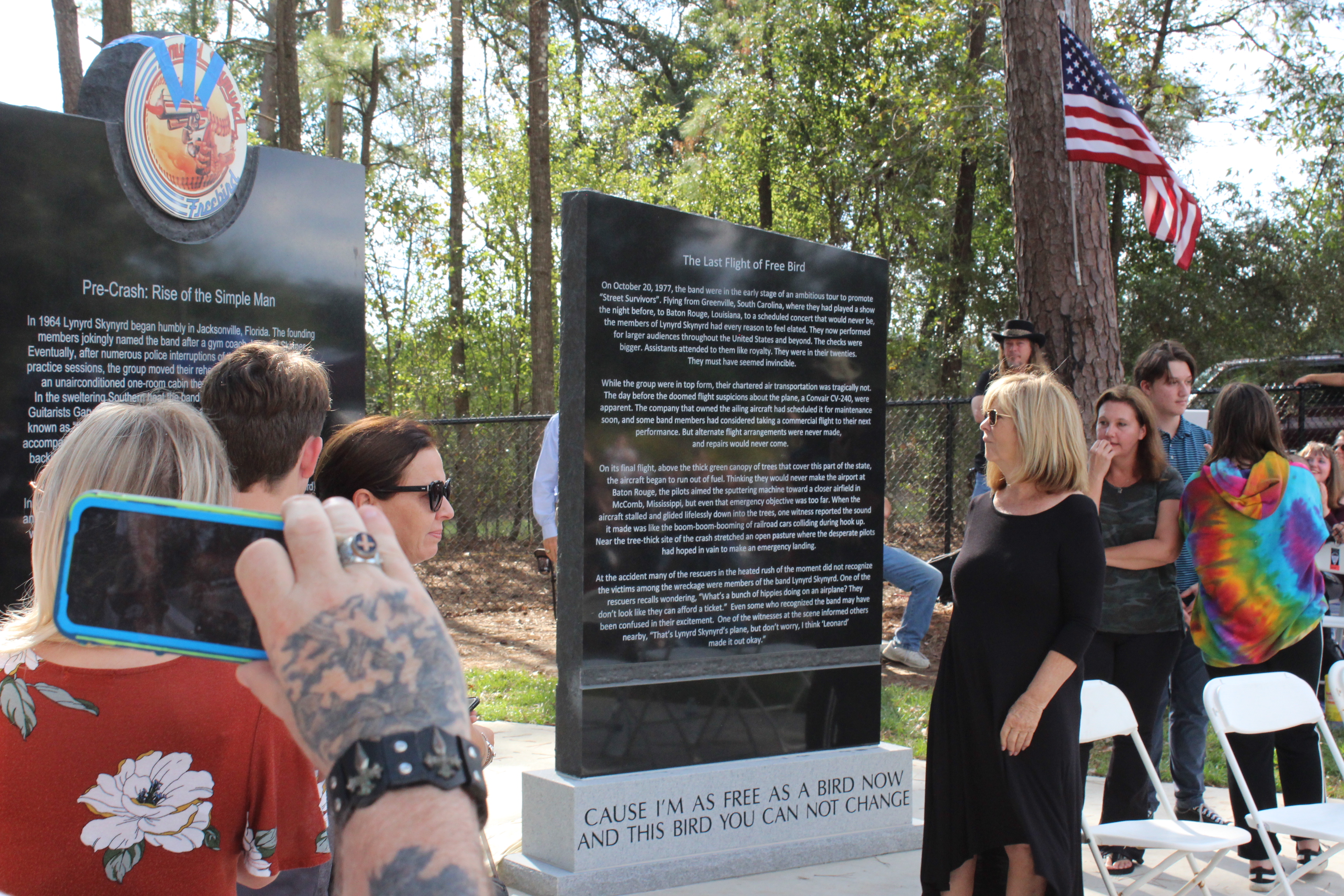
Yesterday, several hundred people gathered for the unveiling of a large MONUMENT honoring members of the group.

Judy Van Zant, widow of Lynyrd Skynyrd band leader Ronnie Van Zant,  reads the inscription on a monument Sunday commemorating the 42nd anniversary  of the plane crash that killed six people, including Van Zant and two other members of the band. (Photos and coverage by James Minton)

Van Zant’s widow, Judy Van Zant, and other relatives of the group’s  members, participated in the unveiling of the three laser-etched black granite panels that tell the story of the band, the crash and the effort by Amite County, Miss., rescuers to locate the crash site and get medical help to the crash survivors.

Several of the crash survivors attended the ceremony and a Saturday night concert by the tribute band, Nuthin’ Fancy, at Southwest Mississippi Community College in Summit, Miss.

The project was the brainchild of Bobby McDaniel and other area residents who responded to the report of the crash. McDaniel said the group raised $65,000 to design and erect the monument, which is on private property on Easley Road, off Miss. Hwy. 568. The monument is open to the public without charge.

Ironically, the band Aerosmith had been considering purchasing the same plane, a 30-year-old Convair CV-240, that Lynyrd Skynyrd was leasing for the tour to promote its fifth album, Street Survivors, released just three days before the crash, but passed on it over safety concerns. Band drummer would later say they were flying in a plane “that looked like it belonged to the Clampett family.”

The right engine sputtered throughout the flight and finally died. Before the pilot could turn back toward the McComb-Pike County Airport in nearby McComb, Mississippi, 17 miles behind them, the left engine died and all the band could hear as the plane went into a free-fall at 4,500 feet, was an eerie silence, broken only by the wind. Band members began praying silently.

Attempts at a soft landing vanished as the plane began striking pine trees at 90 miles-per-hour, ripping apart as it did so. The cockpit and tail were torn away and the rest of the cabin was buckled into an L-shape. Even though everyone was wearing seat belts, the seats themselves were ripped from the floor, hurtling everyone forward into the wall panels.

Van Zant, suffering blunt force trauma to the head, died instantly. Two passengers, both alive, found themselves ten feet above the wreckage, stuck in a tree.

Souvenir hunters converged on the crash scene, stealing anything they could: wallets, jewelry, purses, suitcases, band merchandise, airplane seats, seat belt, pillows, cash, and pieces of debris from the plane itself. Band security chief Gene Odom said, “They took my watch, my wallet, my ring and my money as I lay bleeding on the ground.”

But on Sunday, the only ones to appear were devoted fans of Lynyrd Skynyrd.

No souvenir seekers, just well-wishers holding on to fond memories.

(Thanks to James Minton for his coverage of the event.)

