Feeds:
Posts
Comments

“I (elected or appointed individual) do solemnly swear (or affirm) that I will support the constitution and laws of the United States and the constitution and laws of this State; and I will faithfully and impartially discharge and perform all the duties incumbent upon me as (elected or appointed position), and according to the best of my ability and understanding. So help me God.”

The foregoing is the so-called “loyalty oath” to which all Louisiana State hires or elected officials must fill out—in writing as a condition of employment or elective office.

The second part of the oath reads, “A person may be temporarily employed for fifteen days, and if the above statement is not filed by the fifteenth day, he shall be discharged.”

The loyalty oath has been around since the end of the Civil War and were first adopted by state and federal governments as “test oaths” which the Supreme Court said exceeded a pledge of future loyalty when it struck down the law in 1867. That decision established the principle which continues today: loyalty oaths cannot be used o punish people retroactively for past beliefs or associations. The court considered that a violation of the First Amendment.

With the advent of the Cold War, the most aggressive expansion of loyalty oaths was undertaken with a demand that public employees swear they were not members of the Communist Party or any organization advocating the violent overthrow of the U.S. government. That, it turned out, was called a “negative oath” which led to a wave of litigation with the so-called “affirmative oath,” which ask for a pledge of future support of the Constitution and the law, emerging as the oaths administered today. The difference is that today’s oaths do not typically demand that one disclaim membership in any group.

State Sen. Tony Guarisco of Morgan City attempted in 1986 to scrap the oath because of what he considered as a violation of the First Amendment.

“It never got out of committee,” he remembers. “I was the only ‘yes’ vote. Committee members ridiculed a young LSU professor who was the only person to testify. He testified in favor of the bill.”

The loyalty oath was weaponized as a result of the House Committee on Unamerican Activities, which in turn was spawned by McCarthyism and his Red Scare tactics. Two of the members of the HCUA were from Louisiana: U.S. Reps. Ed Willis of St. Martinville, the committee chair, and F. Edward Hebert of New Orleans.

Since the [State Senate] committee wanted to keep the law in place, I asked the governor’s appointees who required [Senate] confirmation, “Are you now or were you ever…”

One appointee, he said, stormed out of the committee room yelling that Guarisco had called him a communist.

“The loyalty oath is still in effect,” Guarisco said, “but it’s hidden as part of R.S. 42:52 (ed seq) that people such as college professors have to sign.

“Years ago, a young, highly sought-out English professor from another state was recruited by USL (not ULL). He declined to sign the oath and was not hired.”

Guarisco, 87, served in the Louisiana State Senate from 1976-1988. He received his law degree from Loyola University in New Orleans.

First elected in 1975, he sponsored a bill to permit physicians in Louisiana prescribe marijuana for therapeutic treatment of glaucoma and in treatment by chemotherapy. Gov. Edwin Edwards signed his bill into law and the Marijuana Control Board was created to monitor the law but the panel never functioned and was abolished in 1989 by Gov. Bubby Roemer who eliminated many other inactive boards and commissions.

He was an early supporter of the failed Equal Rights Amendment and he created and served as the first Senate parliamentarian, designing a process for confirming gubernatorial appointees. He founded the Endowed Chairs for Eminent Scholars program in higher education and the LSU Endowment for Excellence, pioneered admission standards for LSU, and laws regarding open meetings and public records. He was the lead author on legislation to prevent punitive damages against the press. In 1981, he was the floor manager for the impeachment and removal of state Senator Gaston Gerald of Greenwell Springs, convicted of extortion.

He was succeeded in the State Senate by future Gov. Mike Foster in 1988.

“I hate to say it, but loving our country is starting to sound like an abused spouse saying they love their abuser.”

—Actor Robert De Niro, commenting on state of the U.S. under Trump

She won’t receive anything approaching the award but the verdict handed down by a Bossier Parish jury in the case of a woman who claimed her late stepfather sexually abused her beginning when she was just four years old, should be a shot across the bow of abusers everywhere.

The jury awarded Pamela Elaine Lockridge $500 million for pain and suffering, $600 million in punitive damages and $585,000 for past and future medical and psychological treatment costs—more than $1.1 billion—an astounding award for any individual who is not a corporate CEO, according to a story in THE GUARDIAN, a British publication that has done a stellar job of tracking child sex abuse cases.

Her lead attorney, former state legislator Ryan Gatti, who admitted that Lockridge’s case was the first he had actually tried in more than a quarter-century of practicing law, said neither he nor Lockridge expected to collect the full award from her stepfather’s estate. Instead, Gatti said he expected to reach an undisclosed settlement.

Should that indeed be the case, there would be no appeal. If no such settlement is reached, it is within the presiding judge’s discretion to reduce the award or the defendants may appeal.

Regardless, the verdict is seen as a warning to future defendants in childhood sex abuse cases that juries are fed up with predators who seek out children for sexual abuse and that smaller verdicts like the $2.4 million in damages awarded last year to a man who sued the Holy Cross Catholic religious order in New Orleans for childhood sexual abuse. Those awards may now be a thing of the past with juries leaning toward larger awards like Lockridge’s.

If you would like to know more about the horrors of child sex trafficking, you may order my latest book, The Dinosaur Club. It’s a historical fiction book about a group of retired newspaper reporters who call themselves The Dinosaurs who stumble upon a child sex-trafficking operation and set out to bring it down. You may order the book from Amazon by clicking on the image below:

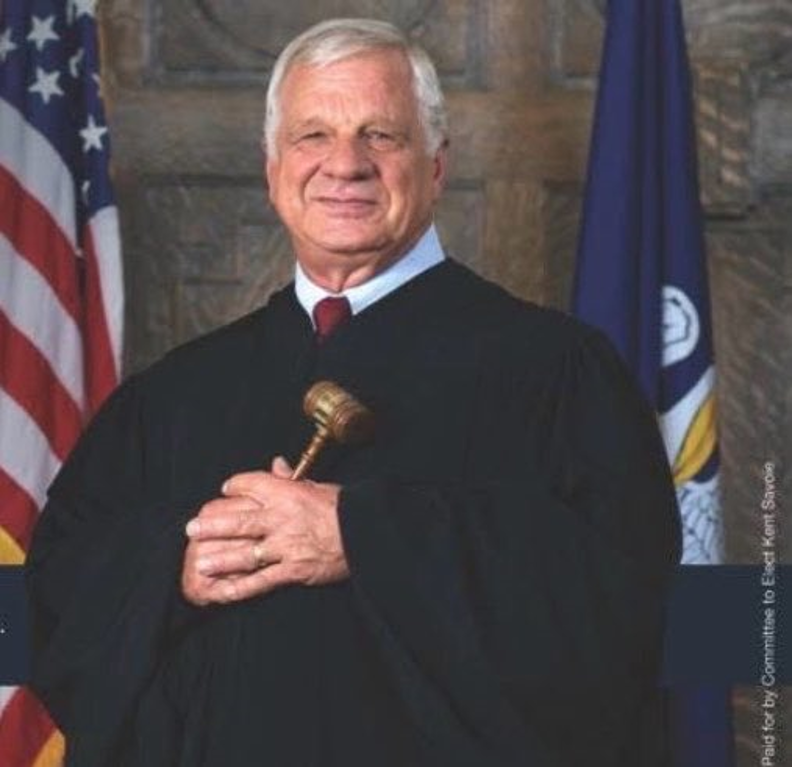
At least U.S. 3rd Circuit Court of Appeal Judge (Ret.) Kent Savoie meted out a severe sentence to convicted murderer Demetric Cornell Savoy when he was on a three-judge panel that UPHELD a life imprisonment.

Judge Kent Savoie

That’s in sharp contrast to the sentence he handed down to Misty Roberts, WHO GOT 90 DAYS and a suspended five-year term.

You might remember the story a few weeks back about Roberts, the erstwhile mayor of DeRidder who was caught diddling her son’s 16-year-old friend at a pool party at Roberts’s home. Making matters even worse, the two were busted by two of Roberts’s children and a nephew.

She was CONVICTED in March on two felony counts—carnal knowledge of a juvenile and indecent behavior with a minor—in connection with the 2024 liaison with the underaged boy. She resigned as mayor just days before her arrest for the incident.

Her brother, BRANDON LEE ROBERTS, was sentenced to prison in 2025 after entering a guilty plea to sexually assaulting a girl beginning when she was around 13.

So, how did she get off so lightly? Well, that’s a story in itself.

Savoie was supposedly informed by Roberts’s defense attorney Adam Johnson that hizzoner might be unpopular on social media if he only rendered a suspended sentence. “If you give her a suspended sentence, you’re not going to get as many likes,” Johnson told the judge, casting some doubt as to whom he was representing—Roberts or Savoie.

Savoie, contacted by a Lake Charles TV station, said he had researched how other similar cases were handled in the parish.

Guess he missed that matter involving Brandon Lee Roberts last year.

Just another example of how even-handed justice is in Loozeraner.

By guest columnist Paul Spillman

College football is having the off-season from hell. Not only has NIL, revenue sharing, and an endless transfer portal caused everyone from the casual fan to the occupant of the White House to demand change but recently a “visiting judge” in Lubbock, Texas has managed to do what no person, group, or legislation has until now – unite every interested party in college athletics. Visiting Judge Ken Curry ruled earlier this week Texas Tech quarterback Brendan Sorsby is eligible to play this season with only a two-game suspension after having been suspended and ruled ineligible by the NCAA for gambling on college football and on his own team.

Briefly, Sorsby began his college career at Indiana but transferred after one year to Cincinnati. He started at quarterback for Cincinnati for two years before transferring this past winter to Texas Tech. LSU also pursued Sorsby. In late April Sorsby checked himself into rehab and admitted to placing over $90,000 in bets on college football including 40 times on his own team and using various means to avoid detection. Shortly after the NCAA ruled Sorsby ineligible. But Sorsby, with the support of Texas Tech, filed suit. District Judge Phillip Hayes recused himself without comment but Hayes did his undergraduate work at Texas Tech and attended law school there. Curry was assigned the case by the 19th Judicial Region presiding judge.

Since the infamous Black Sox Scandal throwing the 1919 World Series and the resulting ruling by the newly appointed commissioner of baseball Kenesaw Mountain Landis issuing lifetime bans to players for gambling the one sacrosanct rule in sports is you do not bet on your own team. Literally no one has questioned the wisdom of that rule. Maintaining the integrity of the competition would be impossible without it.

Yet Judge Curry has found that Sorsby would suffer “irreparable harm” if ruled ineligible citing “breach of contract,” a lack of institutional support for his gambling addiction, and the necessity to play in order to make an informed decision about the NFL draft. The last is dubious at best as it is questionable whether any NFL team would sign Sorsby, much less draft him. It’s also questionable whether there has been any lack of institutional support as Sorsby went to some effort to conceal his actions.

To be fair the NCAA is not at fault in this. It is correct in ruling Sorsby ineligible. Any competition he is involved in would be suspect. Even if his team wins the contest there are a number of ways money can be made on a football game and the skepticism would be too great to overcome.

The Big 12 conference, of which Texas Tech is a member, is considering its options. Other schools, such as Nebraska, have already instructed their Athletic Directors to not schedule Texas Tech in any sport. Almost everyone with an interest in college sports is dumbfounded with this decision and opposes it. Also, this ruling has lit a fire to pass the Protect College Sports Act which would probably do nothing as far as this issue is concerned. The legislation would grant the NCAA a limited antitrust exemption, but only to rule on matters covered by the legislation. As it is currently written there is no language on gambling in the bill and student athletes would still be allowed to sue for eligibility. As previously stated Congress is a solution, but not the best solution.

The NCAA has asked for an “accelerated appeal” and a ruling from the Court of Appeals for the Seventh District of Texas is expected soon. All four justices on the appeals court who will hear the case have law degrees from Texas Tech.

Stay tuned. We’re still 80 days from kickoff.