Feeds:
Posts
Comments

Archive for the ‘Governor’s Office’ Category

Gov. John Bel Edwards hasn’t even issued the call yet for a special legislative session to deal with the state’s budgetary woes and already state lawmakers appear to have the collective attention span of a gypsy moth.

A couple of years ago, a person who knows me well (my wife) commented that after Bobby Jindal leaves office, I would have nothing to write about. She’s dead-on with most of her evaluations but with this one, she failed to take into account we still have a legislature.

That’s the body that allowed Bobby Jindal to run roughshod over this state for eight long years with hardly a peep of protest. And that’s the body that must, in the final analysis, be held accountable for the damage inflicted by Bobby.

The legislature allowed Jindal to rape higher education. It looked the other way when he gave away the state hospitals. It was shamefully mute when he closed or privatized mental health hospitals and cut funding for the developmentally disadvantaged.

No questions were asked when it was revealed on this blog that Department of Public Safety Undersecretary Jill Boudreaux picked up an extra $46,000 in spare change by taking advantage of a retirement incentive offer (along with an additional $13,000 in unused leave) in April of 2010 only to return to work the next day—at a promotion from deputy secretary to undersecretary (Funny, when Sally Clausen did that at the University of Louisiana System, the mainstream media was apoplectic).

Lawmakers blindly went along with a last-minute amendment to a bill in the closing hours of the 2014 session that would have given State Police Superintendent Mike Edmonson an additional $50,000 or so in retirement income in violation of an irrevocable decision he had voluntarily made years before that locked in his retirement. Only when LouisianaVoice stumbled upon the amendment and publicized it was action taken to rescind the amendment.

So now here we are in January of 2016, staring down the barrel of a $2 billion-plus budgetary shortfall for next fiscal year and about $700 million just to make it to the end of this fiscal year (June 30).

I’m about to make citizens angry at legislators’ lack of focus. I’m going to make women furious at lawmakers’ lack of sensitivity towards equal pay for them. I’m about to make those struggling to feed a family on minimum wage wonder (actually, they’ve never stopped wondering) if anyone in elective office even cares. And I’m about to send state employees who have gone for years without a pay raise into orbit.

And no matter which group you fall into, you can look to the legislature as the cause of your continued struggles.

And just so you don’t forget, I want to remind you that it is legislators like Senate President John Alario (R-Westwego) who use not their own money, but campaign contributions to dine at the finest New Orleans restaurants, purchase season tickets to LSU athletic events and to Saints and Pelicans pro football and basketball games, and to lease luxury vehicles like BMWs and Mercedes. Others use funds to pay fines for campaign violations (the ultimate irony) and to even pay personal federal income taxes as well as to purchase season tickets to athletic events.

The Baton Rouge Advocate on Wednesday (January 13) ran a front page story about Legislative Fiscal Officer John Carpenter’s attempt to convey to House members just how severe the state’s financial plight really is.

So the House members were riveted to Carpenter’s presentation, hanging onto every word, right?

Wrong. Elizabeth Crisp, writing for The Advocate, said the budget talk was “met with mild interest” from members “who mingled about and talked throughout the more than two hours of presentations.” http://theadvocate.com/news/14553820-123/state-house-members-hear-gloomy-budget-outlook

The chamber was called to order, she said, in an attempt to quiet the “loud chatter” and some members posed questions in an attempt to get fellow members’ attention, “though it had little effect,” she wrote.

What the hell? I mean, WHAT THE HELL?

Did we send a bunch of juvenile delinquent dumbasses to Baton Rouge to party and have a good time at taxpayer expense? Apparently so.

If these legislators had kids who got their hands on dad’s credit cards and maxed them out and the kids started chattering and laughing during the lecture on fiscal responsibility that followed, dad would—and should—jerk a half-hitch in them. We, in our parental roles, should remind these jerks, these spoiled brats in no uncertain terms why they were elected.

Remember State Sen. Neil Riser (R-Columbia)? He’s the one who slipped the infamous Edmonson Amendment in during the closing hours of the 2014 session. That was the amendment that would’ve kicked Edmonson’s retirement up by some $50,000.

Well, guess what? Though he was frothing at the mouth to get Edmonson his money in 2014, he went on record today (January 13, 2016) as opposing any increase in the minimum wage. Greg Hilburn, writing for the Monroe News-Star, quoted the incoming chairman of the Senate Labor Committee as justifying his opposition to an increase: “The Louisiana economy is struggling,” he sniffed.

Well, DUH!

Yes, Senator, the economy is struggling. When you have people trying to exist on $7.25 an hour, they’re going to struggle. They won’t be able to purchase appliances, cars, or homes, the very consumer products that drive the economy. Where did you get your economics degree, Senator? Oh, that’s right, I forgot. You run a couple of mortuaries. Do they teach economics in embalming school? I bet you don’t pass up an opportunity to increase prices on those shiny coffins, do you? How much do you charge for a funeral today as compared to say, ten years ago? Five years ago? One year? Betcha a dollar to a doughnut those rates haven’t remained stagnant.

There was no one in Louisiana more skilled than C.B. Forgotston at chronicling the antics of those he referred to as the leges. C.B. sadly is no longer with us, so it falls to those of us who can only aspire to his observational skills to keep Louisiana’s citizens abreast of the shenanigans of the 144 members of the Louisiana House and Senate.

With that said, here’s another reason the economy in Louisiana is struggling: Women in Louisiana, on average, make 66 cents for every dollar paid a man for the same job. Where is the equity in that, Senator?

Here’s a news flash for you. Politico Magazine has just issued its annual “States of our Union” report. Any guesses as to where Louisiana ranks?

If you said 50th, you would incorrect. We’re 51st. It seems the District of Columbia was also included in the rankings (coming in at 39th overall).

There’s a thing called the Gini coefficient, or Gini index, factored into the rankings. The Gini coefficient is a measure of statistical dispersion intended to represent income distribution, or more accurately, to reflect income disparity (the gap between the haves and the have-nots).

In that measure, the District of Columbia is the worst but we’re not far behind. We have the nation’s fourth-worst income inequality. But Neil Riser doesn’t want to increase the minimum wage.

Here are a few other rankings that contributed to the state’s overall anchor position:

  • Per capital income: 11th worst at $24,775;
  • Unemployment rate: 6th worst at 6.3 percent;
  • Percentage of population living below poverty level: 3rd worst at 19.8 percent;
  • Percentage of high school graduates: 3rd worst at 83.6 percent;
  • Life expectancy at birth: 4th worst at 75.7 years;
  • Infant deaths per 1,000 births: 5th worst at 7.49.

And just for good measure, another survey shows that Louisiana is the sixth most violent state in America with 514.7 violent crimes per 100,000 population. The state’s murder rate (10.3 per every 100,000 residents) is the highest in the nation and more than double the national rate (4.5 per 100,000 people). http://247wallst.com/special-report/2016/01/12/the-10-most-dangerous-states/2/

Statistics provided by the U.S. Department of Justice show a direct correlation between poverty and crime. http://www.bjs.gov/index.cfm?ty=pbdetail&iid=5137

But let’s not raise the minimum wage, Senator.

Here’s the real irony with Riser: he represents one of the poorest senatorial districts in the state which means he is undermining the interests of his own constituents. Could it be he does not want to pay his employees more?

At least Edwards has signed an executive order expanding Medicaid which will provide health care to some 300,000 citizens who were denied it under the Jindal administration.

And finally, for those state employees who have gone without raises, I’m sure by now you are well aware that state troopers received back-to-back raises totaling some 30 percent over a six-month period last year. http://theadvocate.com/news/legislature/12940806-123/state-troopers-get-hefty-back-to-back

But did you know that Edmonson is working quietly behind the scenes to implement an automatic annual pay increase for state troopers in addition to the usual merit raises (which, we need not remind you, have been denied other state employees)?

That’s right. He calls it a “longevity” increase and if he is successful, it will give state troopers, many of whom already make six-figure incomes, automatic raises each and every year, merit be damned. Longevity means by virtue of hanging onto one’s job, troopers get automatic raises.

While state employees may belong to a union (The American Federation of State, County and Municipal Employees—AFSCME—is the main player), state civil service rules prohibit state employees from striking. But why not a state employee association? That’s a pretty benign term. We have RSEA, the Retired State Employees Association of Louisiana. Members pay their own dues and a state employee association could be set up in the same manner. No one has the authority to ban an employee association—especially if there is no payroll deductions for dues. And for the more sensitive types, it removes the stigma of the word union from the discussion. (People forget, however, that it was unions’ efforts that ended child labor in oppressive sweat shops. Unions gave us the 40-hour work week. They fought for a minimum wage and for our retirement and medical benefits. And it was unions that led the fight for equal rights for women and minorities. We should never lose sight of those facts because unions, like ’em or not, were instrumental in creating America’s middle class that Republicans seem hell-bent on eliminating.)

An association, after all, would only be a large social club—sort of like that other organization…what’s it called? Oh, yeah, the Association of Louisiana Lobbyists. Or maybe the Fraternal Order of Police.

And such an association would never call for a widespread sickout of state employees in order to make a point (wink, wink) on an issue like say, longevity pay increases for state police while civil service employees continue without even cost of living increases for years on end.

Seriously, if leges (with apologies to C.B.) don’t get their collective heads out of… (and we’re not talking about sand here), they will end up creating just such an organization. People (teachers, state employees, women, minorities—all voters, mind you) are tired of being dumped on. They’re tired of patchwork budgets, tired of legislators turning deaf ears on their problems, tired of the elitist attitudes and campaign-funded perks of the power structure.

They want solutions and the leges would be wise to pay attention in class and to take their jobs seriously—or get out so someone else will.


Read Full Post »

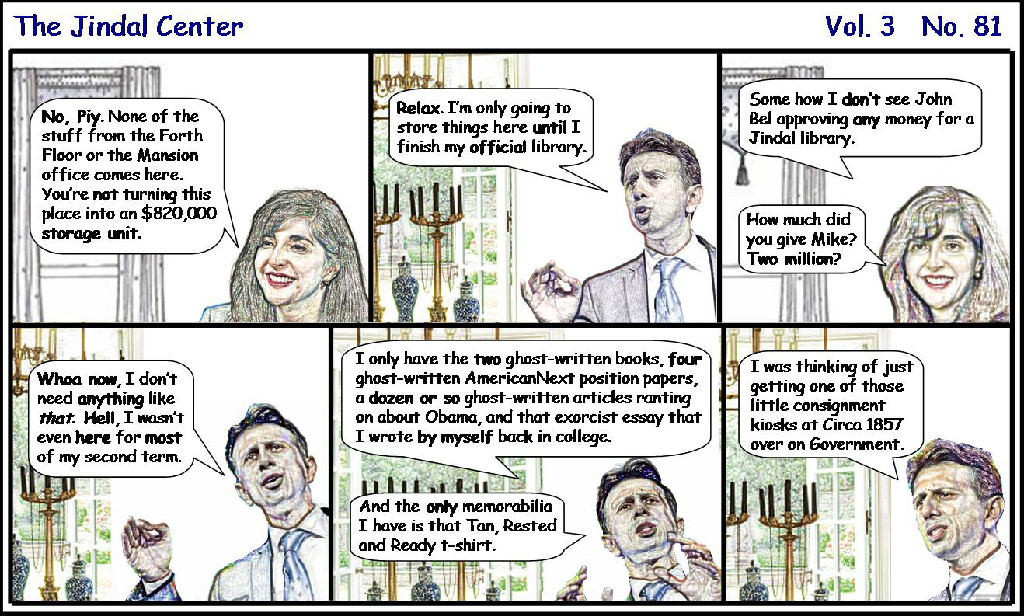
JINDAL MEMENTOES

(CLICK ON IMAGE TO ENLARGE)

Did Bobby Jindal take one last opportunity to defy a state law on his way out the door this week?

Technically, he may have.

Consider the wording of Senate Bill 190 by State Sen. Dan Claitor (R-Baton Rouge):

The legislature recognizes that it is essential to the maintenance of a democratic society that public business be performed in an open and public manner, and that the citizens be advised of and be aware of the performance of public officials and the deliberations and decisions that go into making public policy. Toward this end, the provisions of this Section, as well as the rest of this Chapter, shall be construed liberally so as to facilitate, rather than hinder, access to public records.

SB 190 was signed into law by Bobby Jindal as Act 145. The bill was designed to lift the veil of secrecy on documents originated by Louisiana’s governors. The new law applies to all documents generated by the governor, his chief of staff, deputy chief of staff and his executive counsel. http://www.legis.la.gov/legis/ViewDocument.aspx?d=959869

Records of the office of the governor relative to fiscal or budgetary matters, Including, but not limited to records of communications between the legislative auditor’s office and the office of the governor relative to fiscal or budgetary matters, shall be public records.

It exempts for eight years intra-office communications by the governor’s staff.

Record(s) of the office of the governor relating to intra-office communications of the governor and his internal staff may be privileged from disclosure.

But after eight years, even those intra-office communications between staff members shall become public, according to the act.

Any exemption granted by this Section shall lapse eight years after the creation of the record to which the exemption is applicable. After the lapse of eight years, the records of the office of the governor, as maintained by the state archivist and deposited with the state archives program pursuant to R.S. 44:417, shall be public record.

Most important of all, the bill, which became law effective at 12:00 noon on Monday, requires that the governor and his staff preserve all records generated and originated within the executive branch and to transfer all records to the archives division of the secretary of state.

The governor and his internal staff shall preserve all records to which this Section is applicable and at the conclusion of his term of office, the governor shall transfer all such records to the custody of the archives division of the secretary of state. For purposes of this Section, “internal staff” of the governor includes the governor’s chief of staff, deputy chief of staff, executive counsel, and director of policy, but shall not include any employee of any other agency, department, or office.

All this sound well and good. Others had tried and failed to shed the light of public disclosure on the governor’s office. Similar bills had either died a quiet death in committee or, if passed, were vetoed by Jindal.

So how did Claitor’s bill manage to obtain Jindal’s signature enacting it into law?

Well, for starters, it was passed as Jindal’s term was winding down. But even then, word is that Jindal said he would veto Claitor’s bill if it were to take effect while he still occupied the fourth floor of the State Capitol.

So in effect, what Jindal was saying was transparency was a grand and wonderful thing so long as it did not apply to him. It was fine and dandy for his successor to be held accountable but he was determined to veto the bill if it took effect while he was still in office.

No problem, he was assured. The bill would go into effect at precisely 12:00 noon on Monday, January 11, 2016. Jindal was scheduled to leave office exactly one minute later.

The only problem was, the program ran a little late on inauguration day and John Bel Edwards did not actually take the oath of office until 12:25 p.m.

Meanwhile, throughout the weekend leading up to this week’s inauguration ceremonies, Jindal’s minions were frantically deleting thousands of emails in the governor’s office at across the street at Division of Administration.

Obviously, Jindal felt he would no longer be in office when the bill became law and thus exempt from its provisions.

But technically, he remained in office for nearly a half-hour after the new law took effect. Therefore, he was bound by the dictates of the new statute and by deleting those thousands of emails, he was in flagrant violation of the very bill that he signed into law a scant six months earlier.

The provisions of this Act shall be given prospective application only. Any record having been used, being in use, possessed, or retained for use by the governor in the usual course of the duties and business of his office prior to the effective date of this Act shall be subject to the provisions of (the law) as it existed prior to the effective date of this Act.

Granted, many of the emails may well have been mundane in nature. Who cares, after all, what the office staff will order up to the fourth floor of the State Capitol for lunch? But others were certainly germane to the administration of state government and by deleting them, it can only make the job of Jindal’s successor more difficult.

Claitor, contacted about the procedural violation, said he was not surprised. “The administration’s pages on the state website were disappearing, too,” he said.

“In my mind,” he said, “his actions certainly violate the spirit, if not the letter of the law.”

It seems somehow ironic that Jindal’s devious, scheming tactics would in the end expose him to potential prosecution for the illegal dumping of eight years worth of emails.

The term poetic justice also comes to mind.

Read Full Post »

Our “Bye-Bye Bobby Bash,” the inspiration of reader Earthmother, was a huge success on Sunday (Jan. 10), just about 24 hours before Jindal leaves office as one of the most reviled governors in Louisiana history.

Before getting down to our celebration, we observed a moment of silence in honor of the late C.B. Forgotston. Those of you who read LouisianaVoice regularly know that I quoted him often. He was an inspiration to me and he will be missed. He may not have been with us in body, but he was certainly with us in spirit.

In attendance were Jerel Giarrusso (Earthmother) and husband Ted Hansen, Stephen Winham and wife Betty, several of our loyal readers, and our mystery cartoonist. Also on hand was Murphy Painter who was persecuted and prosecuted by the Jindal administration. It was LouisianaVoice and LouisianaVoice alone that said long before his federal criminal trial that Painter was not only innocent, but a target of reprisals by Jindal for Painter’s refusal to knuckle under to a major Jindal campaign contributor (Saints owner Tom Benson). Not a single news outlet, other than LouisianaVoice, peeled back the layers to look beneath the façade of lies and fabricated charges against Painter, to examine the real reasons for the administration’s actions. Painter was not only acquitted of all charges but the state then had to reimburse some $300,000 in legal fees incurred by Painter who, instead of taking his licks and walking away as the Jindalites apparently thought he would do, stood and fought for his honor and integrity. In the end, he prevailed.

We handed out special party favors as a memento of the absurdity of Jindal’s tenure.

When we arrived at Superior Grill, there were 12 state police officers having a late lunch. I offered them our party favors but they refused, either out of loyalty to or fear of State Police Superintendent Mike Edmonson. One of the officers, an administrative type, dismissed my offer with a curt, “I’m good.”

Oh well, I offered.

I want to take this opportunity to offer a special word of deep appreciation to all who attended and to all my readers who were unable to attend. Without you, LouisianaVoice has no meaning. With your support, however, we managed to expose a lot of wrongdoing and even change a couple of things (the Edmonson amendment which attempted to sneak in a $50,000 increase in Edmonson’s retirement comes immediately to mind).

With your continued support, we will continue to keep watch over the incoming administration and especially over the legislature which is no less responsible for our present fiscal mess than Jindal because it was those 144 men and women who enabled him.

Below are a few photos taken at today’s event. Click on the photos to enlarge them.

Enjoy.

LEFTOVER SIGN FROM 2011 CAMPAIGN

She brought her 2011 campaign sign all the way from Ruston. (Sorry but I lost your name but I knew your father, Peewee Edwards well. He ran Village Plaza Cinema in Ruston and Mrs. Edwards ran Fran’s Book Nook for years.)


SOMEBODY BROUGHT A CAKE

Somebody (Earthmother) brought a cake.


A PRETTY DIVERSE GROUP

Part of our diverse group.


EARTHMOTHER'S PINATA

Jerel Giarrusso, aka Earthmother, made this inspirational piñata. Unfortunately, the proprietor of Superior Grill said his insurance policy would not allow us to actually break it, so we simply acted out our attacks for the camera.


JEREL GIARRUSSO, AKA EARTHMOTHER TAKES HER TURN

Earthmother got her pretend licks in.


NO ONE WAS MORE DESERVING AT POKING THE PINATA THAN MURPHY PAINTER

After what the Jindal administration did to him in its futile attempt at destroying his reputation and its unsuccessful prosecution of him, no one was more deserving of taking a whack at our Jindal piñata than Murphy Painter.


YOURS TRULY TAKES A WHACK AT EARTHMOTHER'S PINATA

Yours truly gets his turn.


Read Full Post »

“The petty thief is imprisoned but the big thief becomes a feudal lord.”

Zhuangzi


There it was, splashed across the Metro page of Tuesday’s Baton Rouge Advocate:

“OMV audit: More than $200,000 stolen”

The entire matter is heavily weighed down by irony but you’d never know it from reading the story.

It seems that a new audit of the Department of Public Safety and Corrections (DPS) has revealed that two employees of the Louisiana Office of Motor Vehicles (OMV) misappropriated more than $211,000 before being arrested.

The two, Heather Prather of Baker in East Baton Rouge Parish and Angelle Temple of Marksville in Avoyelles Parish were actually arrested in early 2015—nearly a year ago—and fired for felony theft, injuring public records and malfeasance in office.


“Steal a little and they throw you in jail. Steal a lot and then they make you king.”

Bob Dylan


“Upon investigation, OMV management determined that the OMV employees had diverted public funds for personal use and violated state laws,” according to the Legislative Auditor’s Office.

Apparently the two issued receipts to paying customers but then either altered, voided or simply did not post the transactions. There was no indication as to whether or not the two knew each other or if they conspired together or acted separately in misappropriating the funds.

And yes, $211,000 is a lot of money and nothing in this post should be interpreted as excusing the women’s actions.

But isn’t it odd that the media would give such prominence to this story while overlooking official misappropriation of public funds?

Take, for example, the lingering case of high ranking State Police official Jill Boudreaux and the unmet demand that she repay nearly $60,000 in money she received to which she was not entitled. That little matter is still unresolved after almost six years.

And then there is Bobby Jindal. He allowed the taxpayers of Louisiana to pick up the tab for the cost of more than $3 million for State Police security details. Those costs were incurred while he spent more than two-thirds of his final year in office campaigning out-of-state for the Republican presidential nomination. A reasonable person would assume his campaign would have paid for that protection since his travels had zero to do with his job as governor of Louisiana.

But few lately have accused Jindal of being reasonable. The cost of flights, taxis, auto rentals, lodging, laundry and meals cost Louisiana taxpayers more than $640,000 in addition to the salaries of state troopers assigned to his out-of-state security detail. None of that has been refunded by Jindal’s campaign.


“He who uses the office he owes to the voters wrongfully

and against them is a thief”

Jose Marti

Boudreaux, Undersecretary for DPS, which has management oversight responsibility for OMV, first said the office would consider a policy of no longer accepting cash as a safeguard against theft by employees.

Later, however, she and the Auditor’s Office agreed that OMV only needs a better system of controls over accepting cash. State Police public information officer Doug Cain said the goal of OMV was to continue to provide convenience to the customer while at the same time, assuring “due diligence to have accountability on the process.”

Due diligence appears to have been lacking in efforts to have Boudreaux repay the $59,000 she was paid as part of an early retirement incentive offered nearly six years ago.

In April of 2010, the Jindal administration, in an offer to implement across the board savings, made a one-time incentive package offer to various state agencies as a means to encourage state employees to take early retirement.

Handled properly, it appeared at the time—and still does appear—to have been an economical and compassionate way to nudge employees who wanted out but who could not afford to retire, into making the decision to walk away, thus reducing the number of state employees which in turn translated to long-term savings in salaries and benefits paid by the state.

On April 23 of that year, DPS Deputy Undersecretary Jill Boudreaux sent an email to all personnel informing them that the Department of Civil Service and the Louisiana State Police Commission had approved the retirement incentive as a “Layoff Avoidance Plan.”

In legal-speak, under the incentive eligible applicants would receive a payment of 50 percent of the savings realized by DPS for one year from the effective date of the employee’s retirement.

In simpler language, the incentive was simply 50 percent of the employee’s annual salary. If an employee making $50,000 per year, for example, was approved for the incentive, he or she would walk away with $25,000 in up-front payments, plus his or her regular retirement and the agency would save one-half of her salary from the date of retirement to the end of the fiscal year. The higher the salary, the higher the potential savings.

The program, offered to the first 20 DPS employees to sign up via an internet link on a specific date, was designed to save the state many times that amount over the long haul. If, for example, 20 employees, each making $50,000 a year, took advantage of the incentive, DPS theoretically would realize a savings of $1 million per year thereafter following the initial retirement year.

That formula, repeated in multiple agencies, could produce a savings of several million—not that much in terms of a $25 billion state budget, but a savings nonetheless.

The policy did come with one major caveat from the Department of Civil Service, however. Agencies were cautioned not to circumvent the program through the state’s obscure retire-rehire policy whereby several administrative personnel, the most notable being former Secretary of Higher Education Sally Clausen, have “retired,” only to be “rehired” a day or so later in order to reap a monetary windfall.

“We strongly recommend that agencies exercise caution in re-hiring an employee who has received a retirement incentive payment within the same budget unit until it can be clearly demonstrated that the projected savings have been realized,” the Civil Service communique said.


“A man with a briefcase can steal millions more than any man with a gun.”

Don Henley


Basically, to realize a savings under the early retirement incentive payout, an agency would have been required to wait at least a year before rehiring an employee who had retired under the program.

Boudreaux, by what many in DPS feel was more than mere happenstance, managed to be the first person to sign up on the date the internet link opened up for applications.

In Boudreaux’s case, her incentive payment was based on an annual salary of about $92,000 so her incentive payment was around $46,000. In addition, she was also entitled to payment of up to 300 hours of unused annual leave which came to another $13,000 or so for a total of about $59,000 in walk-around money.

Her retirement date was April 28 but the day before, on April 27, she double encumbered herself into the classified (Civil Service) Deputy Undersecretary position because another employee was promoted into her old position on April 26.

A double incumbency is when an employee is appointed to a position that is already occupied by an incumbent, in this case, Boudreaux’s successor. Double incumbencies are mostly used for smooth succession planning initiatives when the incumbent of a position (Boudreaux, in this case) is planning to retire, according to the Louisiana Department of Civil Service.

http://www.civilservice.louisiana.gov/files/HRHandbook/JobAid/5-Double%20Incumbency.pdf

Here’s the kicker: agencies are not required to report double incumbencies to the Civil Service Department if the separation or retirement will last for fewer than 30 days. And because State Civil Service is not required to fund double incumbencies, everything is conveniently kept in-house and away from public scrutiny.

On April 30, under the little-known retire-rehire policy, Boudreaux was rehired two days after her “retirement,” but this time at the higher paying position of Undersecretary, an unclassified, or appointive position.

What’s more, though she “retired” as Deputy Undersecretary on April 28, her “retirement” was inexplicably calculated based on the higher Undersecretary position’s salary, a position she did not assume until April 30—two days after her “retirement,” sources inside DPS told LouisianaVoice.

Following her maneuver, then-Commissioner of Administration Angelé Davis apparently saw through the ruse and reportedly ordered Boudreaux to repay her incentive payment as well as the payment for her 300 hours of annual leave, according to those same DPS sources.

It was about this time, however, that Davis left Gov. Bobby Jindal’s administration to take a position in the private sector. Paul Rainwater was named to succeed Davis on June 24, 2010, and the matter of Boudreaux’s payment quickly slipped through the cracks and was never repaid.

Granted, $59,000 is not a lot in the over scheme of things—especially with the state facing a budgetary shortfall of nearly $2 billion. But as the late Sen. Everette Dirksen said, “A million here and a million there and pretty soon you’re taking about real money.”

Well, no matter the amount, it’s real money.

Perhaps when Jay Dardenne takes over as the incoming Commissioner of Administration, he may wish to take another look at the manner in which Boudreaux took $59,000 in extra cash and then defied the directive by Davis to repay the money.

Read Full Post »

I am certain that I will not agree with every move John Bel Edwards makes as governor. The re-appointment of Mike Edmonson as Superintendent of State Police comes immediately to mind. Such is the nature of politics. No man alive can please everyone every time.

And when I do disagree, as in the Edmonson re-appointment, I will say so. I believe Edwards understands and respects that.

In the meantime, I am willing give him a chance. He has a monumental task before him in his efforts to help the state overcome eight years of Bobby Jindal’s reign of error. He must form coalitions with Republicans in the legislature in order to even approach a successful administration. But I certainly don’t expect legislators to be the whipped puppies they were during Jindal’s misrule.

I gave Jindal that same benefit of the doubt. If I am to be honest, I have to admit that I voted for Jindal not once, but twice. I voted for him in 2003 when he lost to Kathleen Blanco and again in 2007 when he won. I honestly thought he meant it when he said he supported state employees and that he stood for transparency and a high ethical bar. I believed him when he said his appointments would be based on “what you know, not who you know.”

Well, we all know how that went down. He tried to gut state retirement, he destroyed the Office of Group Benefits, gave away the state charity hospital system, drove higher education to the brink of exigency (bankruptcy), and worse, he set a new low in the areas of transparency and ethics. And one only has to examine his appointments to the myriad state boards and commissions. They are dominated (and that’s putting it lightly) with major donors to his various political campaigns. http://www.huffingtonpost.com/entry/bobby-jindals-biggest-donors-benefited-from-his-administration_55e9e976e4b002d5c075fb17

https://louisianavoice.com/category/campaign-contributions/

Moreover, “what you know” didn’t go too far in other areas, either. The number of state employees and legislators he teagued for daring to disagree with him is a very long list. And his “deliberative process” catch-all denial of public records threw a heavy blanket on any hopes of transparency.

So, it was with some surprise that I read Rolfe McCollister’s diatribe in his Baton Rouge Business Report this week. https://www.businessreport.com/article/publisher-whats-big-secret

Of all the ones to whine about any lack of transparency on the part of the governor-elect who has yet to even take office, Rolfe stands alone as the singular standard-bearer of double standards.

He contributed $17,000 to Jindal’s campaigns in 2003, 2006, and 2008. He was treasurer of Jindal’s 2007 gubernatorial campaign and served as chairman of Jindal’s transition team after his 2007 election. He served as director of Jindal’s first fundraising organization, super PAC Believe in Louisiana, and most recently served as treasurer of Believe in Louisiana as it raised funds for Jindal’s presidential campaign.

His Louisiana Business, Inc. partner, Julio Melara also was a player. Melara and his wife contributed an additional $8,500 to Jindal campaigns

And what did Rolfe and Julio get in return for all that?

Well Julio wound up with a pretty nice appointment to the Louisiana Stadium and Exposition District (Superdome Board), complete with all the perks that go with the appointment.

McCollister was named to the LSU Board of Supervisors and that’s where the hypocrisy really boils to the surface. Board members get choice tickets to LSU sporting events (including a private suite in Tiger Stadium). http://forgotston.com/2013/07/16/need-a-lsu-tuition-break/

And until the quota was reduced earlier this year, each member could award up to 20 tuition-free scholarships to LSU. Even after the reduction, they still get 15 scholarships each. http://theadvocate.com/news/11898955-123/lsu-board-revamps-number-of

Those perks could mean more than $100,000 per year per board member. In 2012 alone, the board handed out $1.3 million in scholarships to their friends—even as college tuition was skyrocketing for the average student with no contacts on the board. http://thelensnola.org/2013/07/11/lsu-board-of-supervisors-awards-1-3-million-through-little-known-scholarship-program/

Rolfe didn’t invent the perks and though he tied with two other members for the fewest scholarships awarded—five. But you never heard him raise a single objection to their abuse.

Rolfe, as publisher of the Business Report, purports to be an objective chronicler of political news. You would think that as such, he would champion all efforts to obtain records of a public body.

You would think wrong. He, along with four other members, did not respond to an email from reporter Tyler Bridges, then writing for The Lens of New Orleans, seeking comment. How’s that for transparency?

He certainly came off as a bit petulant this week when he went on a rampage about Edwards’s education transition team’s meeting in private “at least four times.”

There’s more. “McCollister notes it was Edwards who proclaimed at a Public Affairs Research Council forum in April that his administration would be more transparent than previous administrations, saying ‘a scope of secrecy’ has been allowed to exist,” his staff wrote today (Wednesday, Dec. 23). https://www.businessreport.com/article/publisher-gov-elect-edwards-transition-committees-discussing-public-education-big-issues-behind-closed-doors?utm_campaign=dr_pm-2015_Dec_23-15_05&utm_medium=email&utm_source=dr_pm

“But what does conducting all of the discussions of the transition committees behind closed doors in secret do for the citizens? What I haven’t seen yet is an editorial from The Advocate or The Times-Picayune objecting to the discussion of ‘public’ education in private. Why not? I thought transparency was their big issue.

Rolfe has a very short memory. I can’t recall the Jindal transition team over which Rolfe presided ever holding a public meeting prior to Jindal’s taking office. And when The Advocate, the Times-Picayune and the LSU Reveille were demanding the release of the names of all the candidates for the LSU presidency, where was he?

It’s hard to tell because the very one who should have been front and center in championing the right of the public to know who those candidates were, was strangely mute.

Not a peep out of Rolfe who was in a unique position to reason with the boy blunder to release the names.

Likewise, when the LSU Board agreed to that hospital privatization contract with the 50 blank pages, he should have been the first one on his feet shouting that a blank contract was not just questionable, but also not a legal document. Instead, he sat quietly as the contract was approved, laying the groundwork for the litigation over state hospitals in Shreveport and Monroe now winding its way through the courts.

Likewise, not one word of protest when the contract was awarded to a foundation in Shreveport whose CEO was…(wait for it)…a fellow member of the LSU Board.

“The public knows very little in specifics about what Gov.-elect John Bel Edwards will propose and how far he will take some issues,” McCollister wrote. “Transition teams are made up of a majority of his friends, advisers and supporters—or those who think like he does (and Jindal’s wasn’t, Rolfe?). While this exercise is often ceremonial, it can reflect the views and direction of the new governor—and his closest friends and allies who will be whispering in his ear for the next four years (and of course, you never once “whispered in Jindal’s ear, right?). The public education committee has had five meetings in secrecy. What did they talk about, and who said what? We won’t read or hear about it in the media because they weren’t allowed inside—and the press never uttered a peep (Perhaps they learned from your example on the LSU Board, Rolfe.).

To those who don’t know your history, you sound like a champion of pure, open government.

Unfortunately, your words fall far short of matching your actions. Those indignant protests would carry a lot more weight if you had the track record to back them up.

That’s called hypocrisy, Rolfe. And that’s unfortunate, though not necessarily unexpected.

Read Full Post »

« Newer Posts - Older Posts »