Feeds:
Posts
Comments

Archive for May, 2015

You have to hand it to Inspector General Stephen Street. When he finds Bobby Jindal in violation of the law, he comes down hard. With all the force of a powder puff.

Reacting to a complaint from C.B. Forgotston over Jindal’s use of his office’s taxpayer-funded web page and public salaried employees of the governor’s office to issue a press release critical of Republican presidential nomination candidate Sen. Rand Paul on Thursday, Street took all of two days is issue a less than scathing report on the matter. Statement from Inspector General 5-29-2015

Jindal, who is expected to announce his candidacy next month, issued the press release that said Rand was “unsuited to be Commander-in-Chief” for saying American foreign policy was instrumental in the creation of ISIS.

Louisiana Democratic Party Executive Director Stephen Handwerk called for an investigation by Attorney General Buddy Caldwell and Forgotston filed a complaint with Street’s office.

Jindal, for his part, defended the release through mouthpiece Mike Reed who offered one of the lamest of the lame in defenses in saying, “Matters of national security are very important to Louisianians, and Louisiana is home to many American soldiers. The suggestion that the governor of Louisiana cannot or should not comment on matters of national security is without merit.”

What? Mudslides, drought, forest fires and earthquakes are important to the folks in California. Floods are important to those unfortunate people in Texas and Oklahoma and at least a dozen states have been plagued with tornadoes. Why doesn’t he issue a press release criticizing nature?

It wasn’t the first time Bobby defended a really bad idea. Remember those $250 million berms he insisted on building in the Gulf to catch all that oil from the BP Deepwater Horizon disaster? Despite advice from all the experts that the idea was a bad one, he plunged ahead (no pun intended) and what happened? The berms and the bulldozers hauled in to build them up simply disappeared into the depths of the Gulf waters. And even after all that, he continued to insist the berms were a good idea.

Too bad Jindal has not been as tuned in to the matters of fiscal insecurity that are also important to Louisianians. If he were, perhaps the state wouldn’t be finding it necessary to slash higher education and health care budgets. Health care, after all, is pretty important to Louisianians, too—especially to those who don’t have it because of Bobby Jindal. So are our roads and bridges and coastal erosion—things a sitting governor should be devoting his attention to instead of remarks by a potential political rival.

Forgotston, prior to Street’s crushing blow to Jindal, wrote, “While you are working on the response to my complaint about the governor violating the state constitution, please include your position on his violation of this felony statute:

  • R.S. 18:1465.  Prohibited use of public funds
  • A.  No public funds shall be used to urge any elector to vote for or against any candidate or proposition, or be appropriated to a candidate or political organization.  This provision shall not prohibit the use of public funds for dissemination of factual information relative to a proposition appearing on an election ballot.
  • B.  Whoever violates any provision of this Section shall be fined not more than one thousand dollars or be imprisoned, with or without hard labor, for not more than two years, or both.

Street, for his part, showed all the backbone of a jellyfish in his Friday release that followed his thorough, two-day investigation of Jindal’s taxpayer-funded campaign release tirade.

After reprinting Jindal’s statement, Street went on to say, “It is a matter of record that Senator Rand Paul has announced his candidacy for President of the United States and has a website…through which he is raising money to support his campaign. However, as qualifying for the Louisiana Presidential Primary will not take place until December of 2015, it is unclear at this time whether Senator Paul is a “candidate” as contemplated by …the Louisiana Constitution.

“Louisiana Revised Statute 18:451 reads, in pertinent part, as follows:

  • A person who meets the qualifications for the office he seeks may become a candidate and be voted on in a primary or general election if he qualifies as a candidate in the election.

He also cited a statute which, while defining the word candidate, “specifically excludes those seeking the Presidency of the United States from the definition.” He said inasmuch as that provision is in the chapter dealing with campaign finance, it is unclear how broadly it applies to the Louisiana Constitution).

Street, while dancing around the issue, did acknowledge that the applicable section of constitution “is intended to protect public funds and therefore raises questions about the use of public funds in this instance that resulted in the complaints filed with this office. The governor’s office could have easily avoided such questions by issuing the statement through means that did not involve the use of public funds or employees,” he said, adding that his office “recommends that in order to avoid confusion and any appearance of impropriety in the future, any such statements by the governor be issued through non-publicly funded means rather than through his publicly funded and maintained state website.”

Wow. Jindal must feel like Street jerked a half-hitch in his neck with that devastating report.

Read Full Post »


Honorary Supporter(CLICK ON IMAGE TO ENLARGE)

Read Full Post »

No sooner did we call U.S. Sen. David Vitter out for potential improprieties for using his Senate franking privileges to gain an edge over his three opponents in this year’s gubernatorial election than our old friend C.B. Forgotston send us evidence of an even more flagrant misuse of his office for similar reasons.

It’s enough to make you wonder what the hell goes through these politicians’ minds except that we already know: they are so convinced they are above the law that they couldn’t care less what the great unwashed think about their flaunting of the rules.

We’ve previously reported Jindal’s acceptance of tainted campaign contributions from the Horsemen’s Benevolent and Protective Association (non-profits are prohibited from making campaign contributions), laundered money from a St. Tammany Parish bank board of directors (without the 11 directors’ awareness they were “contributing” $5,000 each to Jindal) and the head of Florida’s largest-ever Ponzi scheme who funneled $30,000 in contributions to Jindal from himself, his wife and his law firm.

Within an hour of posting the story about Vitter’s use of franking privileges to promote his gubernatorial campaign, LouisianaVoice’s email exploded with messages about Jindal’s latest post on the governor’s web page, paid for by Louisiana taxpayer dollars.

The first email was from Forgotston, who has fired off a letter to Inspector General Stephen Street demanding an answer to his inquiry as to the legality of Jindal’s “press release” on Tuesday.

So what, exactly, is all the fuss about?

Quite simply, Jindal used the state computer and web page (and presumably a state employee) to gin out a “press release” personally attacking one of Jindal’s probable opponents for the Republican nomination for president under the headline “Gov. Jindal: Senator Paul unsuited to be Commander-in-Chief.” http://www.gov.louisiana.gov/index.cfm?md=newsroom&tmp=detail&articleID=4965

Paul, a U.S. Senator from Kentucky, is an announced candidate for the Republican nomination. https://randpaul.com/

And what did Paul do or say that prompted Jindal to ignore legal constraints on the use of state web pages? Apparently, Paul said something to the effect that ISIS exists because of the U.S. hawkish foreign policy—a claim, by the way, that we cannot entirely disagree with.

“This is a perfect example of why Senator Paul is unsuited to be Commander-in-Chief,” Jindal whined.

Except he did his whining on a state-funded web page and that immediately invoked the wrath of a number of readers and Forgotston, who once worked as a legal counsel for the legislature, is not the one you want to tick off when it comes to matters concerning the state constitution.

In his email to Street, Forgotston began by describing the Jindal press release as “a violation of Louisiana Constitution, Article XI, 4.”

In case you don’t want to take the time to open the link, it says that while there is no prohibition against the use of public funds to disseminate factual information about a proposition appearing on an election ballot, “no public funds shall be used to urge any elector to vote for or against any candidate or proposition, or be appropriated to a candidate or political organization.”

“It (the press release) clearly urges a vote against U.S. Senator Rand Paul for President of the United States,” he said. “The press release was issued by state employees (the release contained the names of Shannon Bates Dirmann and Shannon, Deputy Communications Director for the Governor’s Office) and has no disclaimer that public funds were not used.

“If this is not a violation of the law, please advise why it isn’t,” Forgotston said. He ended his email by writing, in all caps, “A RESPONSE IS REQUESTED,” which he said “is not directed to any recipients of his email other than the State Inspector General.”

In case any of our readers also would like to submit a similar question to the OIG, here is Street’s email address: stephen.street@la.gov.

Forgotston said he will also share his concerns with Legislative Auditor Daryl Purpera.

As Forgotston himself is fond of saying: you can’t make this stuff up.


Read Full Post »


U.S. Sen. David Vitter could be setting himself up for a repeat of ethics complaints over a perceived use of his Senate franking privileges in his campaign for governor.

The congressional franking privilege, which originated in 1775, allows members of Congress to send official notices, brochures and updates to constituents back home under their signature without having to pay postage. Congress, through legislative appropriations, reimburses the U.S. Postal Service for franked mail it handles.

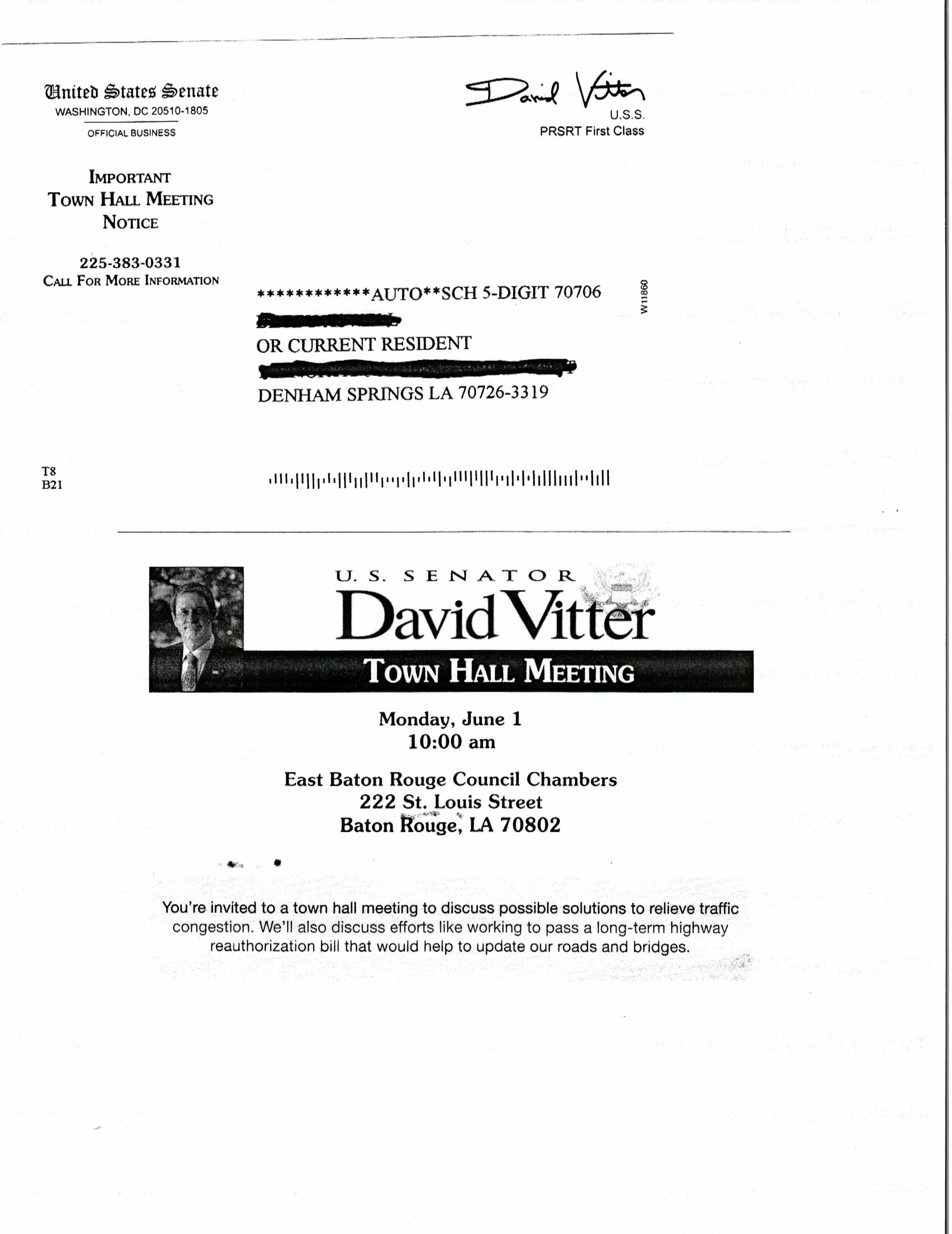
Vitter is not a candidate for re-election in the 2016 election but instead is running to succeed Bobby Jindal as governor against three other candidates. He is making full use of his franking privileges to announce town hall meetings across the state to address local issues. One such mail-out has caught the attention of LouisianaVoice.

Reform efforts over the past two decades have reduced overall franking expenditures from $113.4 million in fiscal year 1988 to $16.9 million in FY 2014 and even then, many of the mail-outs are simply tossed unread by recipients back home. Much of that reduction can be attributed to a shift to electronic communications rather than any real reform of the practice.

Franking has come under wide criticism by opponents of the privilege who say it:

  • Is financially wasteful;
  • Has become outdated with the introduction of other forms of communication, i.e. e-mail;
  • Is abused for private and political gain;
  • Gives unfair advantages to incumbents in congressional elections.

The last two could be cited as giving Vitter an unfair edge in this fall’s governor’s race. While he is not running for re-election, he is a candidate for governor and his Senate franking privileges could be looked upon as an unfair advantage over fellow Republicans—Public Service Commissioner Scott Angelle and Lt. Gov. Jay Dardenne—and Democrat State Rep. John Bel Edwards who are also running for governor.

Franking rules strictly prohibit incumbents from actually soliciting votes when the mail-outs are done on the taxpayer dime but they do not preclude addressing hot button issues like immigration, social security, veterans’ benefits, etc.

In 2009, Louisiana Democratic Party Chairman Chris Whittington filed an official ethics complaint against Vitter for his verbal attacks on U.S. Rep. Charlie Melancon, an eventual opponent in Vitter’s 2010 re-election campaign. Those attacks were made in local meetings pursuant to mass mail-outs by Vitter via the franking privilege.

Whittington said Vitter, by explicitly invoking the name of Melancon in his so-called town hall meetings, publicized in advance by franking mail-outs, crossed the line from official business (the supposed purpose of franking) to campaigning.

Though the words “vote for…” never appeared in any of Vitter’s mailings, reports from his town hall meetings across the state made it clear that he mentioned Melancon often. Vitter in turn charged that the Democrats were trying to “shut down the debate and suggest that it’s somehow out of bounds. Well, it’s not out of bounds because this is still America,” he said.

http://www.dailykos.com/story/2009/08/22/770585/-LA-Sen-Louisiana-Dems-File-Ethics-Complaint-Against-Sen-Vitter#

In Vitter’s most recent franking mail-out, he issued an invitation to one of his town hall meetings on Monday, June 1 in the chambers of the East Baton Rouge Council “to discuss possible solutions to relieve traffic congestion. We’ll also discuss efforts like working to pass a long-term highway reauthorization bill that would help to update our roads and bridges,” the announcement said. IMAG0721(CLICK ON IMAGE TO ENLARGE)

While strictly interpreted, such a discussion could easily be passed off as a federal concern with federal roads and highways crisscrossing East Baton Rouge Parish. That, along with the unquestioned problem of traffic congestion experienced by local motorists, could easily be construed by Vitter as a Senate-related issue.

We have no way of knowing at this point, but it would seem a safe bet that similar town hall meetings have been or will be announced by Vitter via franking in other parts of the state to discuss other pressing problems.

But coming as it does in the middle of what promises to be a heated election season in Louisiana, it would appear to give Vitter a decided—and unfair—advantage over his three opponents who do not have the luxury of free campaign mail-outs.

Nor would it be the first time Vitter has skated on the edge of campaign rules.

In January of 2014, Vitter was up against a state law that prohibited him from using his seven-figure campaign funds amassed as a federal office-holder for a state campaign.

No problem for a manipulators like Vitter and Charlie Spies, a Republican lawyer who was instrumental in launching Mitt Romney’s largest super PAC. In early 2013, Spies created the Fund for Louisiana’s Future and registered the super PAC both federally and in Louisiana in order “to support Sen. Vitter whether he ran for re-election to the Senate or for governor.”

Thus did Vitter become perhaps the first politician in the U.S. to be the largest single funder of his own super PAC.

A former general counsel for the Federal Election Commission said Vitter’s funding of his own super PAC, unprecedented to that point, raised the issue of the separation of super PACs and a candidate’s campaign “to a new level.”

Another observer, Paul Ryan, senior counsel for the Campaign Legal Center, said the existing Louisiana prohibition of the use of federal campaign funds in a state campaign was the only plausible reason for a candidate ceding control of his own campaign funds by transferring cash from his federal campaign to his gubernatorial campaign.

http://www.nationaljournal.com/politics/how-david-vitter-shattered-another-campaign-finance-rule-20140601

Stand by, folks. This election campaign promises to be a tad out of the ordinary, even by Louisiana’s unique standards.

Read Full Post »

State Treasurer John Kennedy on Tuesday told the House Appropriations Committee that the Division of Administration exerts extortion-like tactics against legislators and takes the approach that it should not be questioned about the manner in which it hands out state contracts and that the legislature should, in effect, keep its nose out of the administration’s business.

Kennedy was testifying on behalf of House Bill 30 by State Rep. Jerome Richard (I-Thibodaux) which provides for reporting, review and approval by the Joint Legislative Committee on the Budget (JLCB) of all contracts for professional, personal and consulting services totaling $40,000 or more per year which are funded exclusively with state general fund (SGF) or the Overcollections Fund. HB 30

HB 30 FISCAL NOTES

Kennedy, in a matter of only a few minutes’ testimony, attacked figures provided by three representatives of the Division of Administration (DOA) who objected to the bill because of what they termed additional delays that would be incurred in contract approval and because of claimed infringement upon the separation of powers between the legislative and administrative branches of government.

Here is the link to the committee hearing. While Kennedy spoke at length on the bill, the gist of his remarks about DOA begin at about one hour and 13 minutes into his testimony. You can move your cursor to that point and pick up his attacks on DOA. http://house.louisiana.gov/H_Video/VideoArchivePlayer.aspx?v=house/2015/may/0526_15_AP

That argument appeared to be a reach at best considering it is the legislature that appropriates funding for the contracts. It also appeared more of a smokescreen for the real objections: DOA’s, and by extension, Bobby Jindal’s wish that the administration be allowed to continue to operate behind closed doors and without any oversight, unanswerable to anyone.

DOA representatives tried to minimize the effect of the bill by downplaying the number and dollar amount of the contracts affected (which raises the obvious question of why the opposition to the bill if its impact would be so minimal). The administration said only 164 contracts totaling some $29 million would be affected by the bill.

Kennedy, however, was quick to jump on those figures. “The numbers the division provided you are inaccurate,” he said flatly. “The Legislative Auditor, who works for you,” he told committee members, “just released a report that says there are 14,000 consulting contracts, plus another 4600 ‘off the books.’

“The fiscal notes of 2014 by the Legislative Fiscal Office—not the Division (DOA)—said the number of contracts approved in 2013 by the Office of Contractual Review was 2,001—not 160—professional, personal and consulting service contracts with a total value of $3.1 billion,” he said. “I don’t know where DOA is getting its numbers.

“To sum up their objections,” he said, “it appears to me that DOA and more to the point, the bureaucracy, is smarter than you and knows how to spend taxpayer dollars better than you. That’s the bottom line. They don’t want you to know. This bill will not be overly burdensome to you. Thirty days before the JLCB hearing, you will get a list of contracts. If there are no questions, they fly through. If there are questions, you can ask.”

Kennedy tossed a grenade at DOA on the issue of separation of powers when he accused the administration of blackmailing legislators who might be reluctant to go along with its programs.

“Let’s talk about how the division’s advice on contracts has worked out,” he said. “The Division advised you to spend all the $800 million in the Medicaid Trust Fund for the Elderly. Now they have zero in that account. In fact, they pushed you to do that. Some of you were told if you didn’t do that, you’d lose your Capital Outlay projects. How’s that for separation of powers? How’d that work out for you?

“My colleagues from Division who just testified against the bill are the same ones who told you to take $400 million out of the (Office of Group Benefits) savings account set aside to pay retirees’ and state employees’ health claims. How’d that work out?”

Kennedy didn’t stop there. He came prepared with an entire laundry list of accusations against the administration.

“My colleagues from Division are the ones who told you, ‘Look, we need to privatize our health care delivery system,’ which I support in concept. They sat at this table and I heard them say we would only have to spend $600 million per year on our public-private partnership and (that it would be) a great deal ‘because right now we’re spending $900 million.’ I thought we’d be saving $300 million a year. Except we’re not spending $600 million; we’re spending $1.3 billion and we don’t have the slightest idea whether it’s (the partnerships) working. How’d that work out for you?

“I sat right here at this table and I heard my friends from Division say we need to do Bayou Health managed care. You now appropriate $2.8 billion a year for four health insurance companies to treat 900,000 of our people—not their people, our people,” he said. “There’s just one problem: when the Legislative Auditor goes to DHH (the Department of Health and Hospitals) to audit it (the program), they tell him no.”

Kennedy said that pursuant to orders from DOA, “the only way they can audit is if they take the numbers given him (Legislative Auditor Daryl Purpera) by the insurance companies.

“This is a good bill,” he said. “It’s not my bill. My preference is to tell Division to cut 10 percent on all contracts and if you can’t do it, you will be unemployed. But this bill allows you to see where the taxpayer money is being spent.

“I have more confidence in you than I do in the people who’re doing things right now,” he said.

Kennedy said he was somewhat reluctant to testify about the bill “but I’m not going to let this go—especially the part about separation of powers.

“You want to see a blatant example of separation of powers?” he asked rhetorically, returning to the issue of the administration’s heavy handedness. “How about if I have a bill but you don’t read it. You either vote for it or you lose your Capital Outlay projects. How’s that for separation of powers?”

That evoked memories from November of 2012 when Jindal removed two representatives from their committee assignments one day after they voted against the administration’s proposed contract between the Office of Group Benefits and Blue Cross/Blue Shield of Louisiana.

“Everything they (legislative committees) do is scripted,” said Rep. Joe Harrison (R-Gray), speaking to LouisianaVoice about his removal from the House Appropriations Committee. “I’ve seen the scripts. They hand out a list of questions we are allowed to ask and they tell us not to deviate from the list and not to ask questions that are not in the best interest of the administration.” https://louisianavoice.com/2012/11/02/notable-quotables-in-their-own-words-142/

Rep. John Schroder (R-Covington) asked Kennedy what his budget was to which Kennedy responded, “Less than last year and less that year than the year before and probably will be even less after this hearing. But you know what? I don’t care.

“There’s nothing you can say to get Division to support this bill,” he said. “They’re just not going to do it.

“You can’t find these contracts with a search party. But if you require them to come before you, you can get a feel for how money is being spent that people work hard for and you can provide a mechanism to shift some of that spending to higher priorities.

“Next year, you will spend $47 million on consulting contracts for coastal restoration. I’m not against coastal restoration; I’m all for it. But these consultants will not plant a blade of swamp grass. Don’t tell me they can’t do the job for 10 percent less. That $47 million is more than the entire state general fund appropriation for LSU-Shreveport, Southern University-Shreveport, McNeese and Nicholls State combined.

“Under the law, agencies are supposed to go before the Civil Service Board and show that the work being contracted cannot be done by state employees but that is perfunctory at best,” Kennedy said.

To the administration’s arguments of delays in contract approvals and infringements on the separation of powers, Rep. Brett Geymann (R-Lake Charles) dug in his heels. “This is not a bad thing,” he insisted. “We’re not going to go through every page of every contract unless someone calls it to our attention. It doesn’t matter if it’s 14,000 or 14 million contracts. The number is immaterial. If there’s an issue with a contract, we need to look at it.”

For once, the administration did not have its way with the legislature. The committee approved the bill unanimously and it will now move to the House floor for debate where Jindal’s forces are certain to lobby hard against its passage.

Should the bill ultimately pass both the House and Senate, Jindal will in all likelihood, veto the measure and at that point, we will learn how strong the legislature’s resolve really is.

But for Kennedy, the line has been drawn in the dust.

Read Full Post »

Older Posts »