Feeds:
Posts
Comments

The Daily Kingfish blog http://dailykingfish.com/tag/superpac/, with an inadvertent assist from the Baton Rouge Advocate, http://theadvocate.com/columnists/6061634-55/around-washington-for-monday-may has given us an interesting angle on the new Super PAC set up on U.S. Sen. David Vitter’s behalf which conceivably could bring him some problems with the Federal Elections Commission (FEC).

LouisianaVoice also has come across an interesting bit of speculation beginning to make its way through the rumor mill that involves a possible Vitter run for governor.

It’s a tangled web that started with a demand by Washington attorney Charles Spies that the Louisiana Board of Ethics should fall in line with the U.S. Supreme Court’s 2010 Citizens United decision that removed the limits that may be contributed to Super PACs.

Spies chairs the Fund for Louisiana (FFL), the Super PAC set up to help Vitter with either a run for governor in 2015 or for re-election to the Senate in 2016.

Spies, also co-founder of Restore Our Future PAC for Republican presidential nominee Mitt Romney, said in his filing with the Louisiana ethics board that if the U.S. Supreme Court’s opinion abolishing the contributions to Super PACs is not granted and it is later determined by the courts that the state’s $100,000 limit “impermissibly infringe on constitutional rights, Fund for Louisiana’s Future will have suffered irreparable harm” and that “FFL’s political speech—and the political speech of others like it—is being burdened and chilled.”

But The Daily Kingfish noted that while Spies is the mover and shaker behind the effort to remove the state’s contribution cap, the Louisiana address for FFL is 6048 Marshall Foch Street in the Lakeview area of New Orleans.

That’s the address at the bottom of FFL’s web page and it just happens to be the home of Bill Callihan, a director at Capital One Bank.

Okay, nothing wrong with this picture so far.

Vitter is prohibited by federal election rules from coordinating for the Super PAC and does not personally participate in fundraising activities.

Again, nothing wrong so far.

FFL has scheduled its Louisiana Bayou Weekend for Sept. 5-7, 2014 with Vitter as “special guest.” Invitees will have the opportunity to participate in Cajun cooking, an airboat swamp tour and an alligator hunt.

While Vitter can appear at the Super PAC event, he is prohibited from soliciting contributions.

And this is where the picture becomes somewhat muddled.

Courtney Guastella Callihan—Callihan’s wife—is listed on invitations as the contact person for the Bayou Weekend.

She also served as Vitter’s campaign financial director, a dual role that blurs the distinction between her function with the Super PAC and Vitter’s Senate campaign.

Citizens United legalized independent groups raising unlimited funds but it did not legalize politicians establishing dummy organizations to evade campaign finance laws.

So the question now becomes is Courtney Callihan on the payroll of both Vitter’s Senate campaign committee and FFL?

If so, that could conceivably bring real legal problems with the FEC.

Now, having said all that, here is a real zinger we came across in the rumor mill. Mind you, everything is speculation at this point, but the report appears to have a certain validity that warrants a mention here.

Even if it proves to be untrue, it’s still interesting to speculate.

It is no secret that Jindal and Vitter are not the best of friends. Jindal even refused to endorse Vitter in his re-election campaign three years ago even though Vitter, in an apparent effort to be the better man (that being a relative term), did endorse Jindal for re-election the following year.

But it is also true that politics makes for strange bedfellows and this would rate right up there with the most bizarre of them all.

Should Vitter be elected governor in 2015, he would take office in January of 2016 with still a year left on his Senate term.

He would have to vacate his Senate seat, of course, and as governor would name his successor.

Sources say that the two have buried the hatchet and talk already has Jindal moving into the Senate office for the duration of Vitter’s term, thus providing him a stepping stone, so to speak, for his anticipated longshot run for the GOP presidential nomination. (should we have bold-faced, capitalized, underlined and italicized longshot?)

Of course, if Public Service Commissioner and former Secretary of the Department of Natural Resources Scott Angelle should run, that in turn would create a dilemma for Jindal. Would he throw his Protégé under the bus for a shot at a U.S. Senate seat?

Stranger things—including outlandish political marriages—do occur in politics (see JFK/LBJ, 1960).

(CLICK ON IMAGE TO ENLARGE)bd9cc1263b6030f8ec7e55e3fa8a691e_knpz[1]

© 2013

You’d think that John White would’ve learned from others’ mistakes.

He is, after all, the Louisiana Superintendent of Education and one of the definitions of education is the act or process of educating or being educated, according to our handy dandy Free Online Dictionary which also defines education as the knowledge or skill obtained or developed by a learning process.

Education.com further defines education as “the act or process of imparting or acquiring general knowledge, developing the powers of reasoning and judgment, and generally of preparing oneself or others intellectually for mature life.”

It was only four years ago that the news broke that Paul Vallas, White’s predecessor at the Recovery School District had taken 30 personal trips to his hometown of Chicago between 2007 and 2009 in a state-owned Dodge Durango in violation of state regulations governing use of state-owned vehicles.

He even took one of those trips to appear on a Chicago TV station to announce his intent to run for governor and while he did make the announcement, he never ran for that office. He currently is a candidate for lieutenant governor in next year’s election.

The use of the Durango for personal trips did not become public knowledge until the vehicle was involved in an accident in Chicago and the Louisiana Office of Risk Management received a claim for damages from the Department of Education (DOE). Vallas was en route to a press conference to discuss a constitutional convention for Illinois at the time of that accident.

Then-State Education Superintendent Paul Pastorek, Vallas’s superior, said he was unaware that it was against regulations for Vallas to use the state vehicle for such trips, an incredulous claim at best.

Vallas subsequently moved on to Hartford, Conn., (where he would ultimately be deemed by a state judge to be unqualified and directed out of office) and was replaced by Gov. Bobby Jindal’s choice, John White. When Pastorek was booted, White was then promoted to State Superintendent.

So, the precedent was clearly there for White to see and to learn from. Certainly he was perceptive enough to avoid that particular pitfall. Pastorek, after all, had to pony up about $4,000 (an amount that also covered $946 in fuel costs) in reimbursement to the state on Vallas’s behalf though it was never made clear why Vallas himself was not held accountable for the costs.

So White would never repeat that mistake, would he? Of course not. We’re not going to catch DOE employees running all over creation in state-owned vehicles, no siree.

That’s what Enterprise Car Rental is for.

John White’s expenditures on Enterprise rental cars make Vallas look like Ebenezer Scrooge.

Remember that Vallas accounted for an estimated $4,000 in documented personal travel in a state vehicle over a period covering nearly three years, including fuel costs.

Seven current DOE unclassified employees with combined annual salaries totaling north of $1 million have tallied more than $63,700 in car rental fees in just over a year—and that does not even include fuel.

And while state regulations stipulate that only compact or intermediate vehicles may be rented by state employees at monthly fees not to exceed $680, some employees have been cruising around town in vehicles like Jeep Grand Cherokee, Jeep Liberty, Jeep Compass, GMC Terrain, Nissan Murano, Chevrolet Yukon, and Cadillac Escalade at monthly rentals as high as $1,450.

And with the exception of a couple of skipped months, the vehicle rentals, while charged on a monthly basis, would appear to be on a permanent basis for the employees, each of whom has been on the job for less than two years.

The records could be incomplete because LouisianaVoice initially requested the records on Oct. 18 only for the months of July 1, 2012 through Oct. 18, 2013. The records were only made available on Wednesday, Dec. 11, nearly two months after they were first requested.

State law requires that public records be produced on demand unless they are unavailable. In such case, the state must respond immediately as to when the records will be available within three working days of the request.

LouisianaVoice has made a supplemental request for Enterprise car rental records for each of the seven employees for their entire tenure at DOE as well as a complete record of fuel costs for the rental vehicles.

Neither White nor his Chief of Staff Kunjan Narechania responded to an email request from LouisianaVoice asking them to justify the issuance of permanent rental cars to state employees in light of the state’s ongoing budgetary problems.

Of course no story of DOE chicanery would be complete without the participation of our old friend David “Lefty” Lefkowith.

He is, as might be expected, one of the Enterprise Seven.

You will remember the ubiquitous Lefty as the motivational speaker who worked with pre-collapse Enron and Jeb Bush’s administration in an ambitious but unsuccessful effort to corner the market on drinking water in the state of Florida.

He next showed up first as a contract worker for DOE and then as the head of the Office of Portfolio for the department at $146,000 per year. He currently works with the department’s course choice program which has had its own image problems.

Despite Jindal’s oft-proclaimed goal of keeping the best and brightest Louisiana citizens in Louisiana, the administration seems hell bent on going outside the state for its talent and Lefty is no exception. He has maintained his residence in Los Angeles and actually commutes from that city to his day job at DOE. He apparently works only four days a week and heads west on Fridays and returns Sunday night or Monday morning.

Of course when he is in town he needs a vehicle to get around Baton Rouge and to take him to and from New Orleans International Airport each weekend. Records show he rents his Enterprise vehicles on a weekly basis, usually for four days at a pop (Monday through Friday) with sometimes a couple of hours extra thrown in.

Incomplete records show that he has spent about $6,000 on car rental fees (not counting fuel, of course) since Oct. 14, 2012. LouisianaVoice has requested complete records dating back to his date of employment with the department and including the cost of fuel for his vehicles.

To his credit, it should be pointed out that Lefkowith generally stuck to the compact car requisite rate of $32 per day for his rentals. On those occasions when he did upgrade, it was only to $36 per day—unlike some of his co-workers who did not appear to even attempt to stay within the state-approved rate mandates.

Following is an itemized list of the remaining six employees, number of months they have driven an Enterprise rental car, the type cars and the total cost (In some cases, the make of vehicle was not provided):

  • Kerry Laster, Executive Officer ($135,000)—nine months, from Nov. 2, 2012 through Aug. 20, 2013 (no record for Feb. 9 to Mar. 4, 2013): GMC Terrain, Hyundai Tucson, Cadillac Escalade (four months), Grand Cherokee, Ford Explorer (two months)—$11,205;
  • Melissa Stilley, Liaison Officer ($135,000)—12 months, from Aug. 13, 2012 to Sept. 5, 2013: Malibu, Jeep Liberty, Jeep Compass, Dodge Journey (three months), Chevrolet Tahoe, Ford Edge (four months)—$13,550;
  • Warren Drake, Liaison Officer ($160,000)—12 months, from Sept. 10, 2012 to Sept. 5, 2013: Honda Accord, Kia Sorento, Ford Flex, Grand Cherokee (nine months)—$8,160;
  • Gayle Sloan, Liaison Officer ($160,000)—12 months, from Sept. 4, 2012, to Sept. 30, 2013 (no record for December of 2012); Chevrolet Impala (three months), Toyota Camry, Jeep Liberty (seven months), Jeep Patriot—$9,060;
  • Francis Touchet, Liaison Officer ($130,000)—15 months, from July 11, 2012, to Sept. 16, 2013; Nissan Altima (two months), Nissan Murano (seven months)—$11,800;
  • Gary Jones, Executive Officer ($145,000)—12 months, from Sept. 17, 2012 to Sept. 13, 2013; Nissan Sentra (nine months), Ford Fusion (three months)—$7,980.

The free use of a rental car on a year-round basis could pose another problem besides the obvious criticism that might come from the Legislative Auditor.

These Enterprise rentals are not the occasional rentals for quick one- or two-day trips on departmental business; they are perks by every definition of the word—used year-round, nights and weekends, for personal use as well as the occasional business-related trip.

And perks are taxable in-kind income.

Or at least they should be…unless DOE neglected to report the in-kind payments and the employees neglected to report them on their tax returns.

If that is the case, then DOE and the seven employees could have some explaining to do to the IRS and the Louisiana Department of Revenue, that is if Revenue Secretary Tim Barfield should be inclined to pursue the matter.

But don’t count on that.

Washington attorney/political fundraiser Charlie Spies wants to make it even easier for those with the financial resources to continue to buy elections in Louisiana to the increasing detriment of the rest of us.

So what else is new?

Spies, chairman of The Fund for Louisiana’s Future (FLF), the Super Pac created earlier this year, says Louisiana should voluntarily remove the $100,000 limit on contributions to political action committees.

As if it weren’t difficult enough already for the average voter to make his voice heard in our legislative halls.

Spies, it should be noted, also served as chairman for the Restore Our Future PAC for Republican presidential nominee Mitt Romney.

While the U.S. Supreme Court ruled in its 2010 Citizens United decision that third-party groups may spend unlimited amounts on political campaigns, Louisiana still has a maximum cap on individual contributions to PACs of $100,000 per election cycle.

Spies, with an eye to bankrolling the 2015 governor’s race on behalf of an as-yet unnamed candidate (but most probably U.S. Sen. David Vitter),  has written a letter to the Louisiana Board of Ethics asking the state to conform with what he calls “clear constitutional precedent.”

To quote our friend and Livingston Parish Poet Laureate Billy Wayne Shakespeare, “A skunk by any other name stinks just as bad.”

What Spies and all those PACs that have proliferated since the 2010 Citizens United decision really want is the unfettered ability to buy future elections in Louisiana on a scale unprecedented in the state’s history. That would include not only the governor’s election but in all likelihood other statewide races and key legislative contests as well.

In his letter to the ethics board, Spies said that such limits on political committees that make independent expenditures run afoul of the First Amendment “are unconstitutional on their face and should no longer be enforced by the board.”

He said FLF could suffer “irreparable harm” if the issue is litigated and courts subsequently find that the limits infringe on constitutional rights. He said FLF and others’ political speech is being “burdened and chilled.”

What he doesn’t seem to realize is that in Louisiana, raising the limit isn’t really necessary: Louisiana politicians have historically sold out on the cheap.

In his otherwise persuasive argument (lawyers love to wax eloquent and I like saying that), Spies conveniently ignored how ordinary citizens have their political speech “burdened and chilled” by the ability of super PACs to drown out the voices of the electorate.

A person who gives his hard-earned $50 contribution to a candidate should be heard just as easily as the big donor after the election. But when that person’s interests clash with those of a super PAC that poured $100,000 into the candidate’s campaign, who do you think will get the ear of that elected official?

It’s not as if the $100,000 cap is really enforced in Louisiana. Nor for that matter is the $5,000 on individual contributions particularly sacred. Take Lee Mallett of Iowa, Louisiana, for example. Mallett, a member of the LSU Board of Stuporvisors, has contributed nearly $160,000 to Gov. Bobby Jindal through personal contributions and those of seven of his corporations. And both he and his son each have made four contributions between them, each for the maximum allowable amount of $30,800 to the Republican National Committee. Other LSU board members contribute personally and through spouses, children and their companies to easily circumvent the $5,000 contribution limit.

FLF has already raised more than $700,000, thanks in large part to separate $100,000 contributions by the Chouest family-owned Galliano Marine Services and the Van Meter family-controlled GMAA, LLC. Both families were major contributors to Jindal campaigns.

Here are a few examples of contributions to Gov. Bobby Jindal by the Chouest family and corporations of Galliano since 2003:

  • Chouest Offshore: $5,000;
  • Carol Chouest: $5,000;
  • Damon Chouest: $5,000;
  • Ross Chouest: $7,500;
  • Andrea Chouest: $5,000;
  • Casey Chouest: $5,000;
  • Dionne Chouest: $5,000;
  • Dino Chouest: $5,000;
  • Joan Chouest: $5,000;
  • Carolyn Chouest: $5,000;
  • Gary Chouest: $5,000;
  • Chouest Offshore Services: $5,000;
  • Gary Chouest: $5,000;
  • C-Port: $5,000;
  • C-Port 2: $5,000;
  • Offshore Support Services: $5,000;
  • Martin Holdings: $5,000;
  • Martin Energy Offshore: $5,000;
  • Galliano Marine Services: $5,000;
  • Alpha Marine Service: $5,000;
  • Beta Marine Services: $5,000;
  • Vessel Management: $10,000.

Grand total: $117,500.

Things were only slightly less obscene for the Bollinger family of Lockport and its corporations:

  • Chris Bollinger: $5,000;
  • Bollinger Algiers: $10,000;
  • Bollinger Gretna: $5,000;
  • Bollinger Shipyards: $9,850;
  • Bollinger Calcasieu: $5,000;
  • Charlotte Bollinger: $12,000;
  • Bollinger Fourchon: $5,000;
  • Bollinger LaRose: $6,000;
  • Bollinger Morgan City: $6,000;
  • Donald Bollinger: $1,500;
  • Andrea Bollinger: $1,500;
  • Southern Selections: $1,000;
  • Gulf Crane Services: $4,000;
  • Ocean Marine Contractors: $500.

Grand total: $73,350.

And that doesn’t even include money contributed to Jindal’s wife’s foundation, the Supriya Jindal Foundation for Louisiana’s Children or to Jindal’s Believe in Louisiana nonprofit organization which in reality is a PAC that exists solely for political fundraising.

Nor does it include any other candidates, legislative or congressional, to whom these families—the Malletts, the Chouests and the Bollingers—and their corporate entities may have contributed.

What does all this mean to the average voter?

Quite simply, it means he cannot compete with that kind of money. Period. He does not enjoy the luxury of voting for the candidate of his choice—because he doesn’t have a choice. He really never did.

It is the rare candidate today who can eschew PAC money and win.

The glut of money being poured into PACs is used to buy slick mailers and expensive TV time which tend to drown out the voices of the lesser-financed candidates. Catch the disclaimer at the end of those TV ads or read those mailers closely to see pays for them. The billionaire Koch brothers’ Americans for Prosperity, for example, pays for all those Mary Landrieu-bashing ads you see on TV these days. Landrieu’s performance, good or bad, is not really the issue; it’s repetition of negativity that counts and only money can buy that.

Even though you may think you are an informed voter, you are so inundated with propaganda from PAC money that your will to resist political rhetoric is beaten down and you end up believing in their candidate because you saw more TV ads saying he was the one who is best qualified to lead the state or nation.

The PAC money drowns out the other candidate who may have great ideas for solving political problems but who can never be heard above the white noise enabled by Citizens United because his campaign war chest is dwarfed by that of the Super PAC.

But it doesn’t matter if he is the better candidate because the money says it doesn’t. PACs long ago purchased the candidates and have since purchased Congress and now Spies and his ilk want to purchase Louisiana (and yes, we know that may be redundant).

To put it in simple mathematical terms that are easy to comprehend, let us say a Super PAC dumps $100,000 into to a candidate’s campaign on behalf of say, the credit card special interests. You happen to like that same candidate so you stretch your financial resources to give him $50.

Long after the election and well after the congressman is ensconced in office, a bill comes up that prohibits credit card companies from charging monthly fees on gift cards, thereby diminishing the value of the cards. As it happens, you received a $100 gift card for your birthday but didn’t get around to using it for a few months. Remember your surprise when you learned it no longer had a value of $100 because of the monthly fees you were charged unbeknownst to you?

Irate, you write your congressman, urging him to support the bill that favors consumers. You may even remind him of your $50 contribution.

But congressmen are busy people. Under the present system, they’re already running for re-election the moment they begin their terms. That Super PAC, remember, gave him $100,000 on behalf of the credit card company. Who do you think gets his ear on this? In this case, the odds are 2,000-1 in favor of Visa.

And that’s the goal of Charlie Spies and The Fund for Louisiana’s Future.

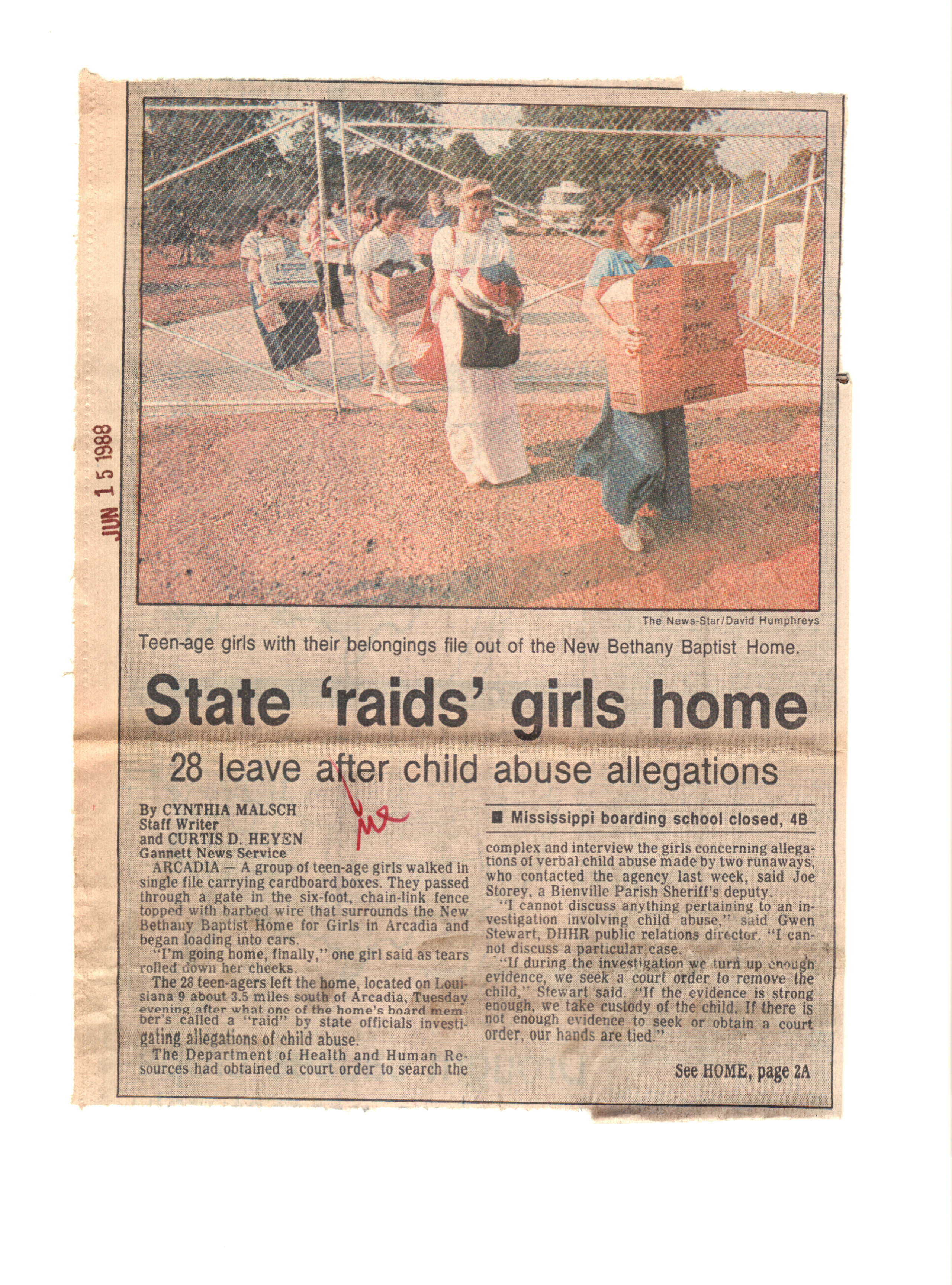
The decades-long controversy surrounding New Bethany Home for Girls in Bienville Parish was renewed last Friday, Dec. 6 when seven former residents of the home returned to Arcadia so that two of the women could file formal charges of sexual assault against the now-defunct home’s owner, Rev. Mack Ford.

(CLICK ON PHOTOS TO ENLARGE):

100_0824

A seventh arrived on Saturday to file her complaint.

Although only two of the six who flew in from North Carolina, Nevada, Florida and Texas, claimed to been sexually abused while living at the home, the others said they were there to lend moral support to the two, one of whom is said to be terminally ill with an inoperable brain tumor.

Sheriff John Ballance, who had his own experience with the home during his career as a state trooper some 30 years ago, met with the women, took the statements of the two claiming sexual abuse, and promised to do everything possible to resolve the matter.

An earlier statement of one of the alleged victims was turned over to state police in Bossier City in October, Ballance said.

In September, Ballance told LouisianaVoice he had picked up a runaway from the home decades ago when he was a state trooper. Instructed by the sheriff’s department to return her to the facility, he said he refused to force her to go back because of her claims of abuse.

Allegations about beatings, handcuffing and other forms of punishment of girls at the home first came to light when the Baton Rouge Advocate began an investigation of the home in 1974. Editors, however, quickly killed the investigation before any stories could be written and the issue lay dormant until the late 1980s when the Louisiana Department of Health and Human Resources began looking into abuse allegations. In 1988, the state raided the unlicensed home located south of Arcadia on LA. 9 and removed 29 girls from the facility.

PTDC0139

Simultaneous to that raid, the Bethel Home for Wayward Children in Lucedale, Mississippi, was closed down by officials in that state. Six months after the New Bethany raid, however, it remained open and was not closed down until 1992.

There were claims of girls at New Bethany having to clean toilets with their bare hands, being locked in isolation with only a bucket for a toilet, girls being handcuffed to their beds and being made to stand all day with no restroom breaks, beatings with wooden dowels, PVC pipe, paddles, belts and limbs.

A state game warden, interviewed by the Advocate in 1974, said he would take confiscated deer that had been killed illegally by hunters to the home. “On one occasion,” he said, “Ford asked if he could have my handcuffs.”

100_0784

New Bethany Baptist Church (foreground); girls’ windowless dormitory (background).

The public face of New Bethany, however, was quite different. Girls’ quartets would be clad in long dresses and paraded before church congregations to sing, figuratively and literally, the praises of New Bethany in efforts to generate “love offerings” from church members.

A father who pulled his daughter out of the home said, “He (Ford) would have those little girls sing hymns and give testimony to churches and the church members would hit the floor with their knees while reaching for their wallets” to give Ford money for his home.

The claims of physical abuse and rape are not new to the Independent Fundamentalist Baptist (IFB) Church with which New Bethany and Ford are affiliated.

The First Baptist Church of Hammond, Indiana, received a great deal of notoriety over the sexual trysts two of its ministers had with female church members over a period of several years. Their misconduct was subsequently repeated at other churches where they ministered.

And when their behavior was revealed, it was the women victims who were required to stand before the congregation and apologize and ask forgiveness for tempting the men, who invariably went unpunished and indeed, continued to receive near idol status from the congregation.

Likewise, group homes where abuse has been documented tend to receive devout support from area churches. Instead of asking those who run the homes to explain their behavior, their accusers are routinely treated as pariahs while the accused are welcomed as heroes at church rallies on their behalf.

Adherents to IFB dogma, for example, discourage intermarriage or even any contact with those of other religious beliefs, distrust government, favor home schooling, and believe that spankings should commence as early as 15 months of age.

Tampa Bay Times reporter Alexandra Zayas last year was allowed to do what the Advocate refused to do. She wrote a lengthy investigative series on claims of physical abuse at several group homes in Florida. http://www.tampabay.com/faccca/

Just as she found in Florida and as had been found earlier in Texas, Louisiana homes are unlicensed and unregulated by the state, thus allowing the operators free rein in the areas of discipline and education—so long as it is done in the name of religion.

The group homes employ the same textbooks that rely heavily on the Accelerated Christian Education (ACE) and BJU (Bob Jones University) Press curricula—the same resources used by many of Louisiana’s voucher and charter schools being approved by the Louisiana Department of Education. The textbooks eschew traditional science and history courses, choosing instead to apply Old Testament interpretations in their teachings.

100_0770

Encaged walkway over public road discourages thoughts of escape while walking from one area of New Bethany to another.

Following their meeting with Sheriff Ballance, the women drove to New Bethany and attempted to confront Ford, who instead, refused to talk to them and walked away.

100_0779

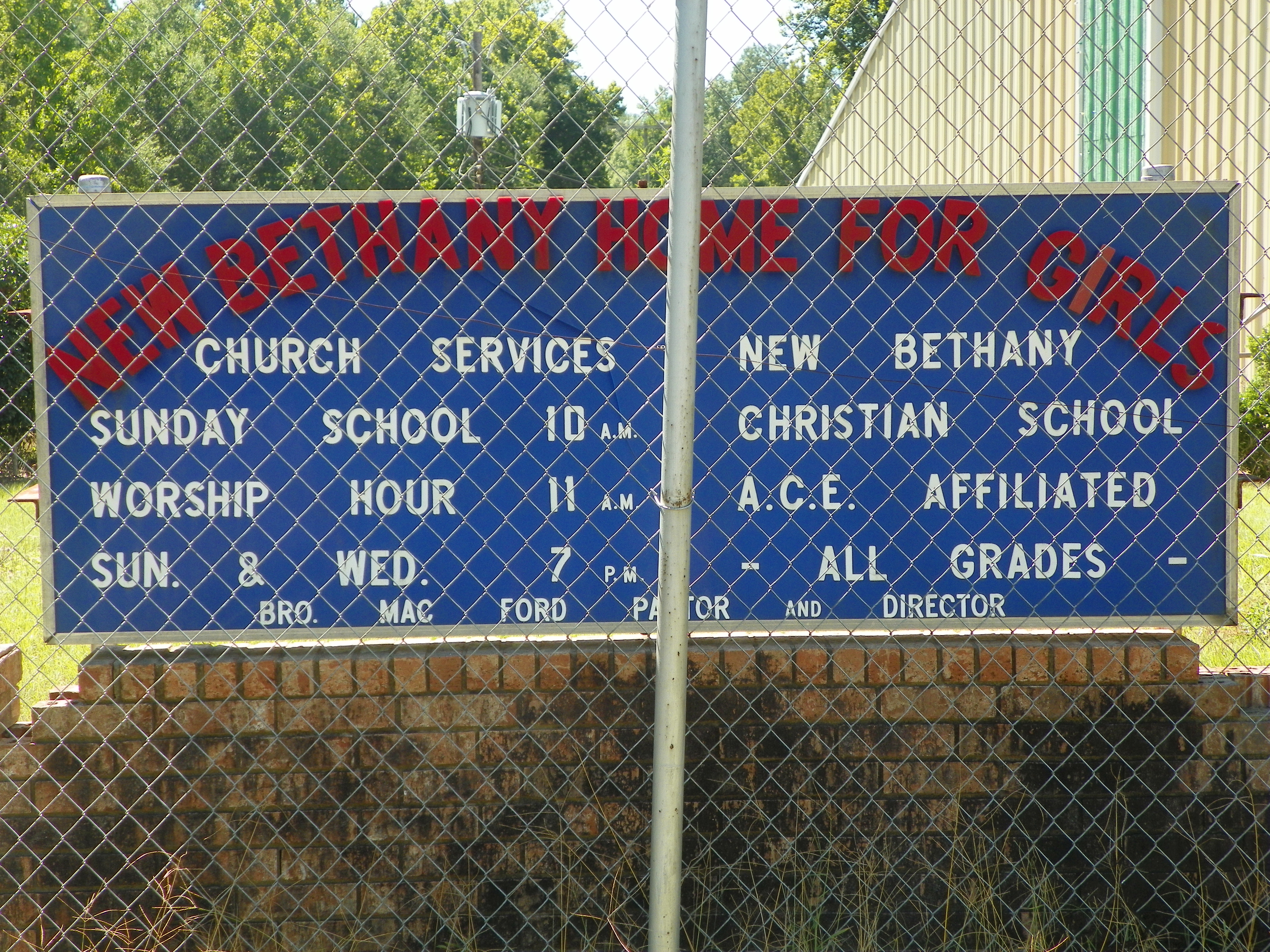
Sign displaying times of services remains outside church 21 years after New Bethany’s closure.

100_0778

Clear message that visitors are no longer welcome at New Bethany Home for Girls or at New Bethany Baptist Church.

100_0775

And just in case one misses the sign…

Something’s not quite right over at the Louisiana Workforce Commission (LWC).

Conflicting dates of employment of an unclassified employee, the awarding of a contract to a vendor whose bid was nearly twice that of two competitors, and appearances on behalf of a state contractor at a Florida convention by a state legislator have flown under the radar until now.

Wes Hataway is Director of the Office of Workers Compensation Administration but the question is just when did he join LWC?

Department of Civil Service records and minutes of the Worker’s Compensation Advisory Council simply do not match up.

Civil Service records indicate that Hataway was hired as an unclassified Assistant Attorney General on Jan. 25, 2010 at $93,600 per year and 13 months later, on Feb. 21, 2011, moved over to LWC as an unclassified Assistant Secretary to then advisory council Chairman Chris Broadwater at an annual salary of $105,000.

Here is what we received from the Department of Civil Service:

“See information below on Wes Hataway. Let me know if you have any questions or need more information.”

Begin Date End Date Agency Job Title Annual Pay Rate
1/25/2010 2/20/2011 Office of the Attorney   General Unclassified Asst Attorney   General 90,000.04 (begin)93,600.26 (end)
2/21/2011 Present LWC-Workforce Support &   Training Unclassified Assistant   Secretary 104,998.40

And indeed, there is a paper trail that appears to support that time frame. A two-page score sheet that evaluated proposals for a fraud detection contract with LWC dated June 22, 2010, includes the signature of Hataway and identifies him as one of the four-member team that evaluated and made recommendations for the contract. It also identifies him as representing the Attorney General’s Office—six months after he was ostensibly named as legal council for the Office of Workers’ Compensation (OWC).

(To enlarge, left click on image):

PTDC0124

PTDC0125

But another document dated Jan. 28, 2010, casts doubts as to Hataway’s status at LWC.

Minutes of the Jan. 28, 2010, meeting of the Workers’ Compensation Advisory Council contain an entry on the fourth and final page which says, “Director Broadwater introduces newly hired AG attorney, Wes Hataway. Wes will serve as General Counsel, and also work on the prosecution of fraud cases.”

MinutesAdvisoryCouncilJan2810

Hataway has since replaced Broadwater as Director of OWC but he regularly consults with Broadwater on pending matters coming before him, according to court documents, according to legal documents.

Broadwater, a Republican from Hammond, was elected to the Louisiana House of Representatives in 2011 but continues to represent workers’ comp insurance companies before the Office of Workers’ Compensation, the agency he once ran.

Broadwater also appeared in a four-minute video at an SAS Institute conference in Orlando, Florida. In that video, he praised the work of the company, which won that 2010 contract with a high bid of nearly $4.3 million.  http://www.allanalytics.com/video.asp?section_id=3427&doc_id=269491#msgs

The three-year contract, which was officially approved on Oct. 7, 2010 retroactive to Aug. 31, 2010, ended last Aug. 30.

The SAS bid was nearly double the bids of IBM and Ultix, each of whom had bids of $2.2 million.

Broadwater, Vice Chairman of the House Labor and Industrial Relations Committee, said in a letter to LouisianaVoice, “My service as vice chair of the Labor & Industrial Relations Committee in no manner alters my duties or the constraints placed upon me under the Code of Governmental Ethics.”

And while claiming that he is prohibited from receiving compensation “from a source other than the legislature for performing my public duties,” he admitted in a legal deposition that he represented insurance clients before OWC and he even admitted that he discussed with Hataway the pending appointment of his former law partner and that he has discussed with Hataway on several occasions matters pending before OWC.

Broadwater also related that Hataway had sought his advice on whether or not he (Hataway) had the authority as director to issue a stay of pending cases without involving the judges to whom the cases were assigned. Broad said in his deposition that he was of the opinion that Hataway did have such power.

Broadwater and Hataway are friends of long standing but that does little to explain why Broadwater would introduce him to council members as a new hire a full year before Civil Service Records and the RFP evaluation and recommendation form reflect any change from his employment status at the Attorney General’s office.

Calling the conflicting dates a clerical error doesn’t fly but then again, it could be just another aspect of the current administration that defies explanation.