Feeds:
Posts
Comments

Bobby Jindal just won’t go away.

The best explanation we can come up with is the psychiatric definition of denial: “A primitive-ego defense–mechanism by which a person unconsciously negates the existence of… stress-producing reality in his environment by disavowing thoughts, feelings, wishes, needs, or external reality factors that are consciously intolerable.”

The stress-producing reality in this case is:

  • He is no longer governor;
  • He was a disastrous laughingstock of a presidential candidate;
  • In the last two presidential nomination sweepstakes, he has endorsed candidates (Rick Perry and Marco Rubio) who failed to capture voters’ interest;
  • He has been reduced to just another talking head spouting misrepresentations about his miserable eight years of botched fiscal policies.

And so it was that last Thursday (March 24) Bobby Jindal was the featured speaker at something called the Mary Elizabeth Babcock Lectureship in the American Conservative Tradition at Denison University in Granville, Ohio.

It was enough that Bobby the Boy Blunder spoke at the event that in the past has showcased such conservative notables as William F. Buckley, Jr., James Kilpatrick, George Will, Zbigniew Brzezinski, David Gergen, Jack Kemp, Robert Bork, Bob Dole, and J.C. Watts.

But in terms of pure, undiluted B.S., the advance press release from Denison on Jindal’s “Challenges and Opportunities in America’s Political Landscape: the 2016 Election and Beyond” was way over the top.

Some examples of the drivel contained in that press release:

  • Bobby Jindal has a well-earned reputation as one of America’s most successful public sector executives and one of the boldest innovators in the health care and education sectors.
  • Jindal used his two terms as Governor of Louisiana to rebuild and diversify the state’s economy and financial footing in the aftermath of Hurricanes Katrina and Rita.
  • Jindal’s agenda included top-to-bottom reformation and privatization of the state-run charity hospital and the state’s healthcare payer systems. Fiscally, Jindal reduced the state budget by 26 percent, reduced the state employee headcount by 30,000, and implemented the largest income tax reduction in state history. With a bipartisan consensus, Jindal implemented statewide school choice programs and moved the state from the bottom five in ethics laws to the top five.
  • Jindal’s dramatic rework of Louisiana’s policy structure paid measurable dividends in the form of eight credit upgrades, $60 million in private capital investment and a ranking in the top ten in the nation for job creation and the highest ever per-capita income ranking in state history.
  • Despite being the nation’s youngest governor when he was elected in 2007, Jindal had been well-prepared to become the state’s CEO, with stints as the head of the state Department of Health and Hospitals, as president of the University of Louisiana System, assistant secretary of the U.S. Department of Health and Human Services, and executive director of the National Bipartisan Commission on the Future of Medicare—all before his 30th birthday.
  • In the private sector, Jindal advised senior management of Fortune 500 firms as an associate at McKinsey & Co. Jindal analyzed potential acquisition targets, assisted with product launches, and evaluated manufacturing processes versus best practices. Jindal managed teams of clients and consultants and aided health care payer, pharmaceutical, manufacturing and information technology clients.

Of course, Denison’s fairy tale press release, obviously written either by Jindal, Rolfe McCollister or some other delusional member of his team, neglected to say that:

  • He served less than a year with McKinsey & Co.—not exactly supportive of all the accomplishments claimed in the news release;
  • That “well-earned reputation as one of America’s most successful public sector executives” is pure fiction, concocted by someone likely smoking some really good stuff.
  • “…rebuild and diversify the state’s economy and financial footing” after Katrina and Rita? Jindal, for once in your miserable, deceitful career, tell the truth: You squandered a $1 billion surplus you inherited when taking office, thanks to federal funds for Katrina and Rita recovery, and left office with a $2 billion black hole of a deficit.
  • As far as his “top-to-bottom reformation and privatization” of the charity hospital system and his school choice programs, we’ll just let the record speak for itself. Ethics? That word isn’t even in his vocabulary.
  • “Well-prepared” to become the state’s CEO? The only thing he was well-prepared for was racking up frequent flyer miles in pursuit of higher office and running up monumental costs in the use of State Police security—a tab picked up by the taxpayers of Louisiana.

No, Jindal just won’t go away and he is doing everything he can to perpetuate the myth that he was an innovator who pulled the state from the brink of disaster.

That’s denial of the obvious.

For the real story of how his administration was rotten from top to bottom, you can pre-order a signed copy of my latest book, Bobby Jindal: His Destiny and Obsession.

After a couple of delays in the editing process, the book is now on track to be released around mid-April.

You may pre-order by clicking on the illustration of the book cover located on the upper right side of this post. You will be placing your order through Cavalier House Books of Denham Springs, which is only about three blocks from my home. When the books are received by Cavalier, the owner will summon me to the bookstore to sign each book to each purchaser before they are mailed out.

I can promise a much more accurate picture of our former governor, presidential wannabe than was provided in the Denison press release. The book, unlike that claptrap, is rooted in reality.

ETHICS DILEMMA

(CLICK ON IMAGE TO ENLARGE)

The “investigation” by the State Police Commission of political contributions funneled by the Louisiana State Troopers Association (LSTA) through its executive director has taken a most interesting twist. And suffice it to say that the folks over at LSTA aren’t raising their champagne glasses in a celebratory toast.

Remember our story of March 10 that revealed multiple political contributions by three commission members, their wives and business interests? https://louisianavoice.com/2016/03/10/state-police-commission-members-probing-lsta-appear-to-have-committed-similar-campaign-contribution-violations/

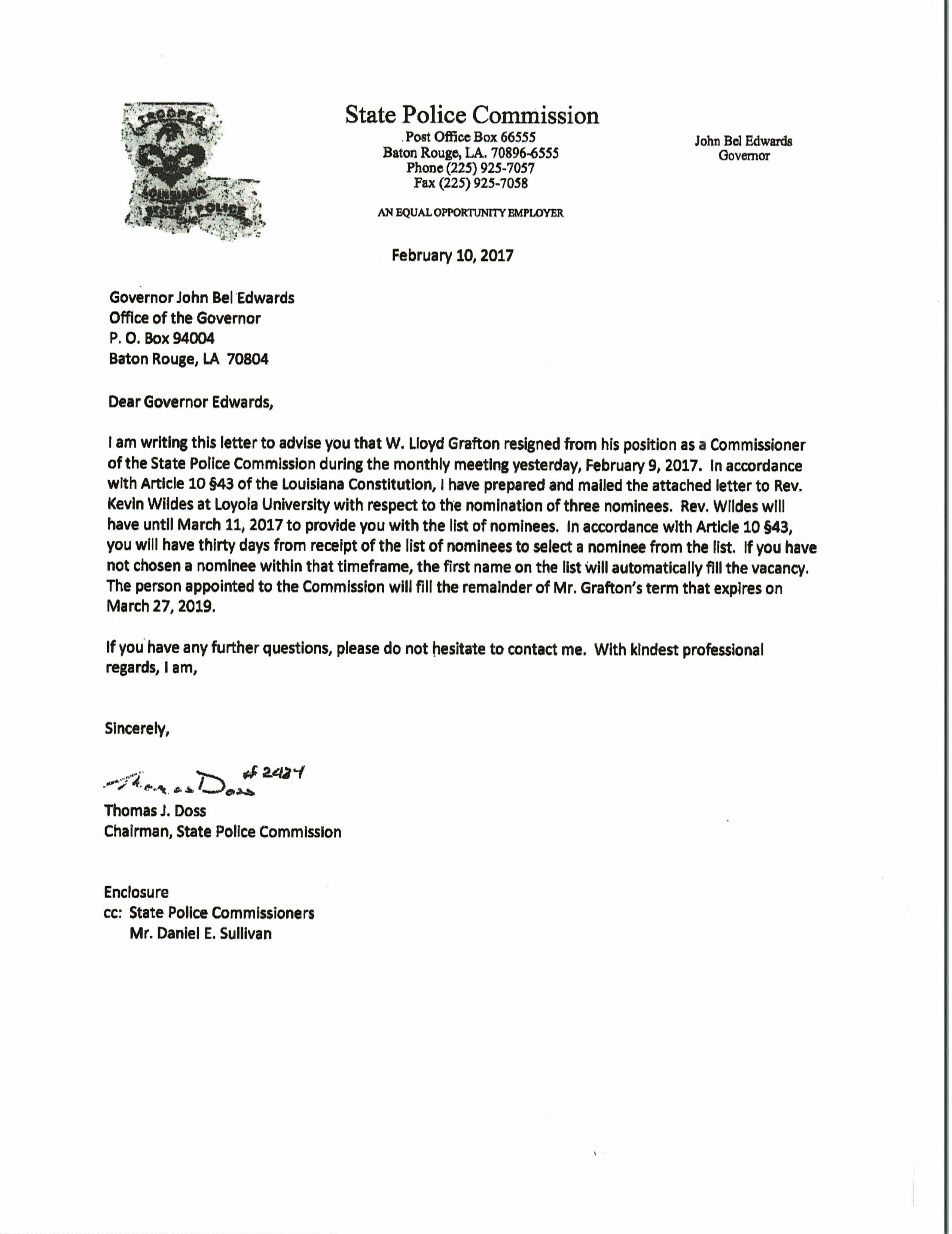
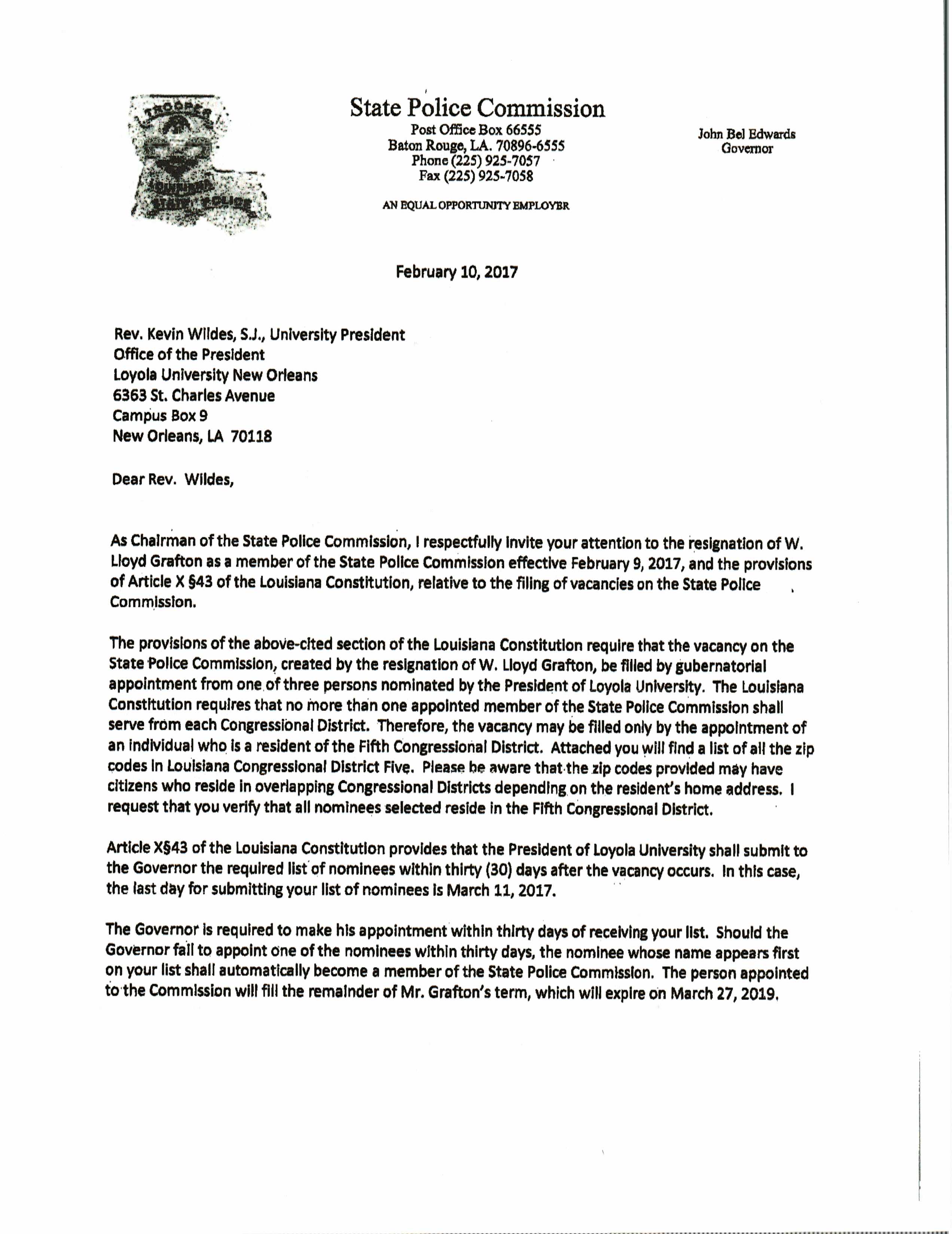
Well, that bit of information has resulted in the probability that three commission members will be told that they must resign or be removed by Gov. John Bel Edwards, according to a story by Baton Rouge Advocate reporter Maya Lau. http://theadvocate.com/news/15297801-173/three-members-of-louisiana-state-police-commission-may-be-ousted-over-campaign-contribution-issue

In addition, LouisianaVoice has learned that two of the three have never complied with State Ethics Board requirements that they complete an annual one-hour ETHICS course. That information comes on the heels of a similar story that several members of the State Board of Dentistry had never taken the ethics training. https://louisianavoice.com/2016/03/25/dentistry-board-members-fail-to-take-required-state-ethics-training-board-policy-attracts-unwanted-attention-of-ada/

Debora Grier, Executive Secretary of the Louisiana Board of Ethics, said ethics training became a requirement for employees, contractors and board and commission members in 2012. Section VII of the Louisiana Code of Governmental Ethics says, “Each public servant shall receive a minimum of one hour of education and training on the Code of Ethics during each year of his public employment or term of office.”

A public employee “means anyone, whether compensated or not, who is…appointed by elected official to a position to serve the government or government agency” or who is “engaged in the performance of a governmental function.”

The one-hour training consists of an online course accessed through the Ethics Board’s Web page and the Web page also keeps records of those who have taken the course in a timely manner and there is where the three members of the State Police Commission appear to have a problem in addition to the one involving their political contributions.

Commission Chairman Franklin Kyle of Mandeville, appointed in 2013, and William Goldring of New Orleans have never taken the required training, according to Ethics Board records. The third member, former appellate court judge Freddie Pitcher of Baton Rouge, who has already indicated he will step down, took the online course in 2013 and 2014 but failed to do so in 2015. He and Goldring were appointed to the commission in 2010.

Commission member Thomas Doss, appointed last year, has taken the 2015 course but Donald Breaux, appointed in 2014, and Calvin Braxton, appointed in 2015, have not. Commission Vice-Chair Lloyd Grafton of Ruston, appointed in 2013, took the training that year and in 2014 but did not in 2015, records reflect. Neither of those four members has made any campaign contributions.

LouisianaVoice has also learned that Kyle and Goldring were also active in making political contributions at the federal level.

 http://www.campaignmoney.com/finance.asp?type=in&cycle=10&criteria=Kyle&fname=franklin

http://www.campaignmoney.com/finance.asp?type=in&cycle=12&criteria=Kyle&fname=franklin

http://www.campaignmoney.com/political/contributions/william-goldring.asp?cycle=16

Even as news of the likely exit of the three members was learned, the commission has hired Natchitoches attorney Taylor Townsend to lead the investigation into why the LSTA board allowed Executive Director David T. Young to give more than $45,000 to various political campaigns and to be reimbursed for “expenses.”  https://louisianavoice.com/2015/12/09/more-than-45000-in-campaign-cash-is-funneled-through-executive-director-by-louisiana-state-troopers-association/

That procedure was a major sticking point at the commission’s February meeting when member Calvin Braxton Sr. objected to approval of the January minutes because the minutes did not accurately reflect much of the discussion at that January meeting.

The key point, which was eventually incorporated into revised minutes, involved an exchange between LSTA attorney Floyd Falcon and commission vice chairman Lloyd Grafton of Ruston. In that exchange, Grafton said, “It (the method of making the contributions) almost makes me think there was something suspect here because of the check writing.”

http://theadvocate.com/news/14849801-128/state-commission-to-see-if-state-troopers-okd-money-for-political-candidates-including-gov-edwards

As an aside, there is no record of Falcon, who accused LouisianaVoice of being a “common complainer,” having ever taken the Ethic Board’s online ethics training.

Civil service employees and state troopers are prohibited from engaging in political activity, including making political contributions to candidates. In the LSTA case, the Code of Governmental Ethics, Section VIII of R.S. 18:1505.2(B) also lists the making of contributions or loans “through or in the name of another” as a prohibited practice. http://ethics.la.gov/Pub/Laws/cfdasum.pdf

The commission, the State Police equivalent to the State Civil Service Board, is charged with investigating wrongdoing on the part of state troopers but has no jurisdiction over the LTSA, a private organization.

Commission Chairman Franklin Kyle of Mandeville said on March 3 that a rule to show cause was issued to two retirees who have openly challenged the contributions “to produce the names of Louisiana State Troopers who allegedly violated State Police Commission rules in addition to any evidence they have that supports the allegations. Those gentlemen have until March 18, 2016, to do so, and additional subpoenas may be issued for any additional evidence that will assist the investigation. Upon receipt of sufficient evidence, a public hearing will be scheduled. There will be more information at the April meeting of the (commission), as well as subsequent meetings, until this investigation is completed.”

Kyle was putting the onus on two retired state troopers to come up with the names of LSTA members who may have initiated the contributions, a responsibility that would seem to be the job of the commission as an investigative board. The retirees have sought records from LSTA and their efforts have been thwarted at every turn, yet Kyle charged them with procuring the evidence need to conduct the investigation.

That apparently is not the way the administration wanted things done and the solution was quick in coming.

The attorney who had been spearheading the “investigation” was relieved of that responsibility and Townsend brought in. Townsend, a Democrat, is the nephew of former State Senator Donald G. Kelly and served as a state representative in his own right from 2000 to 2008.

He did not seek a third term but instead chose to run for an open state Senate seat formerly held by Kelly from 1976-1996. In something of an upset, he was defeated by Gerald Long (R-Natchitoches).

On March 10, LouisianaVoice revealed that Kyle and fellow commission members Freddie Pitcher, William Goldring, the wives of Kyle and Goldring and one of Goldring’s companies (Magnolia Marketing) had been active in making their own political contributions during their time of service on the commission.

We noted at that time that it would be interesting to see how the investigation of LSTA contributions would be handled in light of their own participation in political activity. We asked if they might recuse themselves, leaving the investigation to the four remaining board members.

Now that question has been answered. They will not be asked to recuse themselves, but may be asked to resign from the commission altogether.


Even as the Office of Inspector General conducts its ongoing investigation of the Louisiana State Board of Dentistry, the board’s unorthodox practices have come to the attention of the American Dental Association (ADA) and the American Dental Education Association (ADEA).

At the same time, LouisianaVoice has learned that all but two members of the Board of Dentistry, including its executive director, may also have a problem with state ethics.

LouisianaVoice learned last Tuesday (March 21) that the Office of Inspector General was conducting an investigation into substantial fines levied against dentists for minor offenses. https://louisianavoice.com/2016/03/21/louisianavoice-learns-of-simultaneous-federal-and-state-investigations-of-lsta-la-state-board-of-dentistry/

On Friday, we obtained a copy of a Feb. 26, 2016, LETTER letter from the two national associations to State Dentistry Board President Dr. Russell Mayer of Hammond. The letter expressed a “high level of concern” of the ADA, its Licensure Task Force, the Council on Dental Education and Licensure, and the American Dental Education Association (ADEA).

The upshot of the letter appears to be a subtle message for the Louisiana board to cease in its efforts to bar competition from out-of-state dentists.

That concern is “with regard to the status of licensure for dentists in the U.S., particularly for dentists attempting to relocate to other states. The letter said that the Louisiana board engages “in conduct that restricts, rather enhances, that portability.”

The three-page letter was signed by Carol Gomez Summerhays, ADA President; Gary L. Roberts, President-elect; Gary E. Jeffers, Chair, ADA Licensure Task Force; Daniel J. Gesek, Jr., Chair, Council on Dental Education and Licensure; Huw F. Thomas, Dean of Tufts University’s School of Dental Medicine and Chair of the ADEA Board of Directors; Cecile A. Feldman, Dean of Dental Medicine, Rutgers University, Chair-elect of the ADEA Board of Directors, and Lily T. Garcia, University of Iowa College of Dentistry Associate Dean for Education and Immediate Past Chair of the ADEA Board of Directors.

The ADEA Allied Dental Program Directors’ Conference is scheduled to be held in New Orleans June 4-7, which makes the timing of the letter especially significant.

In addition to Dr. Mayer, copies of the letter were sent to Arthur Hickham, Jr., Executive Director of the State Board of Dentistry; Dr. Henry Gremillion, Dean, LSU School of Dentistry; Dr. L. King Scott, President of the Louisiana Dental Association; Ward Blackwell, Executive Director, Louisiana Dental Association; Dr. Raymond A. Cohlmia, 12th District ADA Trustee; Dr. Kathleen O’Loughlin, ADA Executive Director and Chief Operating Officer, and Dr. Richard Valachovic, ADEA President and CEO.

The letter pointed out that there are five clinical test administration agencies for dentistry:

  • The Commission on Dental Competency Assessments;
  • Central Regional Dental Testing Service, Inc.;
  • Council of Interstate Testing Agencies, Inc.;
  • The Southern Regional Testing Agency, Inc.;
  • The Western Regional Examining Board.

“The ADA…has come to the conclusion that these examinations adhere to a common set of core design and content requirements that renders them conceptually comparable,” the letter said. “It has been a longstanding policy of the ADA that it represents unnecessary and meaningless duplication to require a candidate seeking licensure in different states to demonstrate his or her theoretical knowledge and clinical skill on separate examinations for each jurisdiction, especially when it is clear that the core requirements, administration, and outcomes are virtually indistinguishable between each examination,” it said.

“It is our understanding that your state affirmatively elects not to accept the examination results from all of these test administration agencies. The decision of your board… to accept the test results of only a select number of clinical test administration agencies appears highly arbitrary. Moreover, those decisions have an arguably anticompetitive effect in restricting the mobility of dentists wishing to move from one state to another.”

“…We respectfully request that your board pursue the necessary steps to accept successful completion of all of the clinical test administration agency examinations for dental licensure in your state,” the letter said. “Recognizing that the dental board’s primary mission is protecting the public in your state, we believe that the board has the authority and autonomy to pursue this change. It will increase portability of dental professionals and access to quality dental care for patients.”

The letter is in addition to the controversy swirling around the board’s policy of forcing dentists to pay the costs of investigating them in addition to absurd monetary penalties that can run into six figures.

The most outrageous example is the board’s forcing a surgeon into bankruptcy because the oral surgeon, who “never filled a tooth, made a denture, made a crown, cleaned teeth, restored a tooth, or anything that anyone would consider a dental practice, did not have an anesthesia permit from the board.

The doctor, Randal Wilk, whose patients were mostly cancer victims, was told by the board that he could sign a consent decree and pay the board $5,000 and the matter would be resolved. When Wilk refused to pay the $5,000, he was told the board could levy fines of more than $100,000—a tactic that can be considered nothing other than extortion.

But a regulation that had been in place since 2012 could be the eventual undoing of board members.

Debora Grier, Executive Secretary of the Louisiana Board of Ethics, said ethics training became a requirement for employees, contractors and board and commission members. Section VII of the Louisiana Code of Governmental Ethics says, “Each public servant shall receive a minimum of one hour of education and training on the Code of Ethics during each year of his public employment or term of office.”

A public employee “means anyone, whether compensated or not, who is…appointed by elected official to a position to serve the government or government agency” or who is “engaged in the performance of a governmental function.”

The one-hour training consists of an online course accessed through the Ethics Board’s Web page and the Web page also keeps records of those who have taken the course in a timely manner and there is where several board members appear to have a real problem.

Beginning with former board investigator Camp Morrison who was paid hundreds of thousands of dollars for drumming up charges against dentists, never took a single ethics course.

Others either on the board or employed by the board for whom there is no record of their ever having taken the ethics course as required include Dr. Isaac House of Haughton, Dr. Leonard Breda, III, of Lake Charles, Board Vice President Dr. Claudia Cavallino of Metairie, Dr. Mohammad Zadeh of Chalmette, Dr. James Hargrove of Baton Rouge, and Dr. Robert Foret of Thibodaux.

Moreover, there were several others who have taken the ethics training only one of the required years. Those include Dr. Wilton Guillory, Jr., of Alexandria (2014), Dr. Ronald Marks of Alexandria (2014), Dr. Jerome Smith of Lafayette (2013), Dr. Richard Willis of Monroe (2014), and the board’s Executive Director, Arthur Hickham (2014).

If that were not enough, Board President Dr. Russell Mayer of Hammond took the course in 2013 and 2014, but did not in 2015

So now we have a rogue board that:

  • Contracted with a private investigator whose sole responsibility was to hang some unsuspecting dentist out to dry for some obscure infraction;
  • Served as accuser, prosecutor, and judge in a special kangaroo court with the outcome of cases already predetermined;
  • Extorted backbreaking fines from dentists who balked at the lower fines by threatening to “find” other offenses;
  • Forced dentists to pay for the board’s and Camp’s investigations against them;
  • Maintained office suites in an expensive office building on Canal Street in the heart of the New Orleans Central Business District—and allowed non-state employee Morrison to enjoy a rent-free office in those suites.

And, while protecting the good citizens of Louisiana from those law breaking dentists who dared use lettering in their advertisements larger than the board permitted, somehow managed to look the other way as eight of its board members to neglect taking the required annual one-hour ethics course and six others, including its executive director to get by with taking the course only once.

Just another example of Louisiana politics at its finest, folks.

As our late friend C.B. Forgotston was so fond of saying, you can’t make this stuff up.

People like John Alario, Scott Angelle, Chris Broadwater, Jay Dardenne, and Bobby Jindal may want to get their checkbooks out and start writing refund checks from their election campaign funds.

LouisianaVoice has learned from sources within State Police headquarters in Baton Rouge that “subpoenas have been served” and the FBI is actively investigating the method in which the Louisiana State Troopers Association funneled money to political candidates, including Gov. John Bel Edwards, through the organization’s executive director David Young.

More than $45,000 in campaign cash is funneled through Executive Director by Louisiana State Troopers Association

At the same time, LouisianaVoice also learned that the State Office of Inspector General is conducting its own investigation into the Louisiana State Board of Dentistry over the way in which it fines dentists for such offenses as too large lettering in its advertisements to bankrupting a surgeon who treated diseases of the head and neck but who had the misfortune of also having a dental license but no anesthesia permit from the dental board—even though he has “never filled a tooth, made a denture, made a crown, cleaned teeth, restored a tooth, or anything that one would consider a dental practice.” https://louisianavoice.com/2015/04/16/13976/

Both investigations come after LouisianaVoice published numerous stories about both LSTA’s campaign contributions and the dental board’s harsh investigatory and punishment methods.

Edwards, who received six separate contributions totaling $10,000 from the LSTA, refunded his contributions when he deemed the method in which the money found its way into his campaign was questionable.

The method used to transfer LSTA money into the various political campaigns saw Young make the actual contributions with the LSTA, with its board’s approval, reimbursing Young for “expenses.”

The Code of Governmental Ethics, Section VIII of R.S. 18:1505.2 (B) also lists the making of contributions or loans “through or in the name of another” as a prohibited practice.

http://ethics.la.gov/Pub/Laws/cfdasum.pdf

Young even admitted the maneuver was an attempt by LSTA to attempt to circumvent civil service and commission rules when he told the commission he made the contributions as a non-state employee so “there could never be a question later that a state employee made a contribution.”https://louisianavoice.com/2016/01/15/louisianavoice-exclusive-at-long-last-it-can-be-disclosed-that-the-reason-for-all-the-problems-at-state-police-is-us/

So why would the FBI concern itself over violation of state laws, something that would appear to fall under the purview of the local district attorney?

Simply this: The LSTA is organized under section 501(c) (5) of the Internal Revenue Code and the Louisiana Troopers Charities run by LSTA is a 501(c) (3) charitable organization. https://www.latroopers.org/about

All 501(c) (3) organizations are strictly prohibited from any type of political activity, including endorsing candidates or contributing to political campaigns. LSTA, in addition to contributing to 28 different political candidates and two political organizations, also officially endorsed John Bel Edwards for governor in his runoff election against U.S. Sen. David Vitter.

And while 501(c) (5) organizations may participate in political campaigns, there are strict limitations as to what type of activities are approved. For example, any expenditures it makes for political activities may be subject to tax under section 527(f). https://www.irs.gov/pub/irs-tege/eotopicl03.pdf

The feds probably have a lot of questions about why the contributions were made in the manner they were. Like why send Young to make the contributions and then reimburse him? Even LSTA legal counsel Floyd Falcon said he did not know why the checks to various political candidates were made in Young’s name. And they probably want to see if any of the charity’s funds were co-mingled with the money that went to political candidates.

Lloyd Grafton of Ruston, vice chairman of the State Police Commission, said the way the contributions were made “almost makes me think there was something suspect here because of the check writing. Why wouldn’t the association have made the contribution? It looks like someone was trying to circumvent something,” he said

“LSTA wasn’t set up for this kind of activity,” one retired trooper said. “Its main purpose is to provide support for trooper who have suffered misfortune, such as when a child has a major illness or when a trooper’s home burns down. We’re not supposed to get all involved in politics.”

Another source said it was not Young’s idea for the LSTA endorsement of Edwards or to make the political contributions and that in fact, he advised against the endorsement. “He (Young) has tried his best to keep Edmonson out of the LSTA’s operations. He and Frank (former President Frank Besson) butted heads constantly over that issue (the endorsement). But when it came down to it, Frank was President and David did as instructed.”

Promoted to the rank of captain several months ago, Besson was named commander of Troop C in Gray in Terrebonne Parish earlier this month. Troop C covers all of the parishes of Assumption, Terrebonne and Lafourche and the west banks of St. James and St. John the Baptist.

LouisianaVoice has also learned that the “punishment” meted out to former Troop D Commander Capt. Chris Guillory apparently was more for appearance sake than for any actual punishment.

We originally reported that he had been relieved of his command after lying that he had not refused a complaint from a Lake Charles citizen. Internal Affairs initially found Guillory had not violated any state police regulations and ruled the complaint by Dwight Gerst but LouisianaVoice published a recording of Guillory telling Gerst he would not accept Gerst’s complaint. https://louisianavoice.com/2015/08/17/state-police-headquarters-sat-on-complaint-against-troop-d-trooper-for-harassment-captain-for-turning-a-blind-eye-to-it/

But shortly after being relieved of command and transferred to Baton Rouge, Guillory was quietly given statewide control of the State Police Transportation and Environmental Safety Section (TESS) which, in the final analysis, appears to be more of a lateral transfer than a demotion.

That, of course, raises the obvious question that must be asked of State Police Superintendent Mike Edmonson: What does it take for an officer already found guilty of prescription drug addiction, who allowed a suspended officer to keep working during his suspension and who lies to his superiors about a citizen’s complaint to be terminated?

And what does it take to rein in rogue regulatory boards like the Board of Dentistry? The board has been accused of operating like a crime syndicate, responsible for harassment, extortion, money laundering, and fraud of its agents. https://louisianavoice.com/2015/11/16/dentistry-board-facing-difficult-future-because-of-policies-contracts-with-attorney-private-investigator-are-cancelled/

LouisianaVoice said last November that state and federal criminal charges are expected and at least one legal expert said he expected federal racketeering laws to be used to prosecute former dentistry board agents.

While it is not a federal investigation, at least three separate sources told LouisianaVoice on Monday that the Louisiana Office of Inspector General is actively investigating the board.

Inspector General Stephen Street would not confirm or deny those reports when contacted.

LouisianaVoice will continue to follow developments concerning the LSTA, the dentistry board and the emerging issues surrounding the Louisiana State Board of Medical Examiners.

Every now and then I invoke personal privilege in order to get something—usually some insignificant something important only to me—off my chest. I can do this because I pay for this Web site and we all have our pet peeves and this is my way of airing mine. (Sometimes, I write these for me.)

My gripe is with the otherwise splendid team of LSU play-by-play announcer Chris Blair and analyst Doug Thompson. They add a whole new dimension to listening to LSU baseball with Blair’s professional and descriptive play-by-play and Thompson’s insightful running analysis of the many subtleties of the game (and make no mistake, baseball is many games within a game, all going on simultaneously and it takes a student of the game like Thompson to convey that).

Having said that, please understand that I have had a lifelong passion for baseball, going all the way back to when Ted Williams and Stan Musial were in the twilights of their careers.

I thought I would never live to see the Red Sox win a World Series after seeing them take the Cardinals (1967), the Reds (1975) and the Mets (1986) to the seventh game each time only to lose the deciding game. Then came 2004 when the Red Sox looked like they had a real chance.

When the hated Yankees won the first three games of the League Championship Series, I fell into despair only to see the Sox rally and tie the series at three games each. Great, I thought. They’ve come all the way back just so they can break my heart again by losing the seventh game. But they didn’t and they swept the Cardinals to win the World Series for the first time since 1918. They won again in 2007, sweeping the Rockies in four straight. Then they won a third time this century when they again dispatched the Cardinals, this time in six games in 2013. Life is good.

I also am a huge fan of LSU baseball and I attend every game I can and I listen whether I’m at the game or at home. (Yes, I’m one of those who watches the game live with a headset on so I can hear the radio broadcast to pick up statistics, sidebar stories, and scores of other games.)

I cherish all six LSU College World Series titles. Framed copies of commemorative Baton Rouge Advocate sports pages heralding the victories, including the one with the photo of pitcher Doug Thompson (yes, the current analyst on the radio broadcasts) after the last out is recorded in the LSU win over Alabama in the championship game, on my home office wall are testament of my devotion. The 1996 College World Series, however, was especially magical and anyone who has ever set foot in Alex Box Stadium on the LSU campus knows all about Warren Morris’s first-pitch, two-out, two-run, home run in the bottom of the ninth that converted a potential 8-7 loss into a 9-7 championship. (Has it really been almost 20 years?) An enlarged framed photo of Morris circling the bases at the old Rosenblatt Stadium as Miami Hurricanes shortstop Alex Cora lies face down in the infield grass also adorns the wall of my home office.

So you see, I love baseball. I always have, always will. To me, it’s the purest sport of them all. Ken Harrelson said it’s the only sport that when you’re on offense, the other team has the ball. It’s also one of only two sports I know (tennis is the other) when the ball hits the white line, it’s not out of bounds (except on serves in tennis). And it was either Joe Schultz or Jim Bouton who said, “It’s a round bat and a round ball and you gotta hit it square.”

But I have a real aversion to sports announcers who violate the most basic of the rules of English grammar. One of the most prevalent errors among sports announcers is the improper usage of the personal pronoun “I.” This is where my one and only complaint about Blair and Thompson comes into play. It seems that they are worse than most in the misuse of “I” in lieu of the correct pronoun “me.”

Just today (Sunday), it was Chris, I believe, who said Ben McDonald “tells Doug and I” that Mississippi State has a strong bullpen.

Only 18 games into the season, I have already lost count of the times I have heard one or the other say (and I’m paraphrasing all but the “I” part), someone “tweeted Chris and I,” or “they cooked up some good ribs for Doug and I,” or “tag Chris and I about your favorite memory” of the former player being featured during a particular game.

Any time one makes a personal pronoun the object of a verb or preposition, it requires the objective form. “I” is subjective; “me” is objective. If you’re confused, try dropping the first name and saying something like “He told I,” or, “If you ask I,” or “Tweet I,” it starts to sound pretty stupid, right? It should be “He told Chris and me,” or “Tweet Chris and me,” or “They cooked up some good ribs for Doug and me.” The same goes for sentences like, “She told Robert and he.” It should be, “She told Robert and him.”

There is a handy Web page that addresses nearly every conceivable question of proper language usage. It’s called Common Errors in English. http://public.wsu.edu/~brians/errors/errors.html#p

For the proper use of “I” and “me,” you can go to this link: http://public.wsu.edu/~brians/errors/myself.html

E-mails to LSU sports and LSU radio have been ignored, so I am using this medium to plead with Chris and Doug to address that bothersome little habit.

Yes, I know, in the overall scheme of things, this really isn’t very important.

Except it is.

School kids listen to the games. Chris and Doug are not only the voices of LSU baseball (and Chris, of course, will next move on to football and basketball with the retirement of Jim Hawthorne), they are, in a very real sense, the voice of higher education; and not just higher education, but Louisiana’s flagship university….and LSU is still an educational institute.

Unlike the massive budget deficit facing the legislature, this is a simple issue to correct.

So, a final word to Chris and Doug: Please try a little harder to sound as though you represent an institution of learning and quit embarrassing your high school English teachers.