Feeds:
Posts
Comments

More information on Brant Thompson’s back-door waiver application for homicide investigator reveals that because he had no homicide investigator training, he was up against a deadline for the granting of the waiver that would allow him status as a lead homicide investigator.

The application he submitted, signed by his boss, State Fire Marshal Butch Browning, claimed Thompson had worked as a homicide lead investigator for more than 20 years and that he had worked more than 100 homicide investigations as either the lead investigator or as supervisor.

Both numbers are suspect in light of Thompson’s apparent lack of both training and certification in his past work experience with the attorney general’s office, six years at the Department of Revenue and his five years at the State Fire Marshal’s office—none of which involved his participation in any active homicide investigations.

The application instructed that applicants “attach a list of ALL training, dates, and locations relevant to homicide investigation training” and to “attach copies of the training certificates or documentation of attendance at these courses.”

LouisianaVoice then made a public records request to the Louisiana Commission on Law Enforcement for copies of those certificates.

Bob Wertz, Law Enforcement Training Manager, replied by email, “There were no documents responsive to your second request. No training dates and/or locations were attached to the original waiver request for Mr. Thompson.

Wertz then referred LouisianaVoice to Act 152 of the 2015 legislative session which says, in part:

“…On and after January 1, 2017, only peace officers who successfully complete the homicide investigator training program or receive a waiver of compliance based on prior training or experience as a homicide investigator shall be assigned to lead investigations in homicide cases…” (Emphasis Wertz’s).

Wertz said all waivers are reviewed by the Homicide Curriculum Committee and that recommendations are made to the POST (Peace Officers Standards and Training) Council. The curriculum committee, comprised of board members of the Louisiana Homicide Investigations Association, advise the council and make recommendations regarding any waivers.

“While the POST Council issues a certificate for completion of the lead Homicide Investigator training course, no investigators are deemed ‘certified’ by the council,” he added.

Browning signed off on Thompson’s application on December 13, 2016, or just 18 days before the January 1 deadline, thereby conveying upon Thompson the status of lead homicide investigator even though he is apparently lacking in experience and training for the position.

In addition to Thompson, nine other State Fire Marshal employees received homicide waivers. They were:

Captains Chris Anderson, Keith Reed, Nicholas Heinen, Chad Robichaux and Brian Mashon and Senior Deputies Jason Johnston, Kristen de la Bretonne, Ronnie Sellers and Travis Goudeau.

In all but Anderson’s case, Browning, just as he had done for Thompson, signed the waiver request forms on December 13, 2016. He signed Anderson’s request form three weeks earlier, on November 23, 2017.

At least most of the nine were sufficiently creative as to not all claim 100 homicide investigations–except for de la Bretonne; she did claim 100 investigations, 35 of which she claims to have been the lead investigator. But she had worked Hurricane Katrina, including Lafon Nursing Facility of the Holy Family where there were 36 deaths and the St. Rita’s Nursing Home where 32 perished, according to one of her former co-workers. As for Goudeau, he apparently encountered a mini-crime wave in Bunkie where he previously worked as a patrolman for the city police department. He claimed four homicide investigations, serving as lead investigator on three.

Click here for HOMICIDE WAIVER REQUEST FORMS

The designations are apparently part of Browning’s grand scheme of cross-training whereby all employees are classified in all facets of the fire marshal’s office that in other states are separated as specific areas of expertise such as boiler inspections, amusement ride inspections, arson investigators, nursing home and hospital inspections, etc.

Browning was forced to rush the waiver requests through before the impending January 1, 2017, deadline because, apparently, none of the ten met the criteria that went into effect on that date.

The cross-training program has come under harsh criticism by those familiar with inspections and investigations who are either still active in or retired from the State Fire Marshal’s Office. Their primary concern that cross-training in each area of fire marshal operations weakens all disciplines and leaves the Fire Marshal’s Office prone to key mistakes that in turn leaves the office and the individual employees vulnerable to civil and criminal liability.

And while the example is extreme, the diffusion of responsibilities among all employees could conceivably create a repeat of the 1911 Triangle Shirtwaist fire in New York City in which 146 workers, mostly teenage women, either burned to death or plunged 80 feet to their deaths to escape the flames that engulfed the building.

News reporter William Shepherd, who just happened to be walking past the building when he noticed smoke, described a “more horrible sound than description can picture,” the impact of 62 speeding human bodies smacking into the sidewalk. “Thud-dead, thud-dead, thud-dead…” he would write for United Press as the only way he could describe the scene of broken, twisted bodies.

Investigators found that even though the Triangle building had passed fire codes prior to the fire, several doors in the building were either jammed shut or locked in order to ensure that the girls stayed at their jobs. Trapped in a building that had passed inspections, they were forced to choose death from the flames or by jumping.

Again, an extreme case but yet an example of what can happen when an amusement ride, a boiler or hot water heater, or a nursing home or hospital is given a once-over inspection by someone not properly trained as an amusement ride inspector, a boiler inspector, or a hospital/nursing home inspector.

And on top of all that, Browning wants those trained as fire code inspectors, ride inspectors and boiler inspectors to double as cops investigating homicides.

This is a situation that begs for the immediate attention of the governor’s office.

How well did the Louisiana Commission on Law Enforcement vet the application of Louisiana Fire Marshal Fire Chief Brant Lamar Thompson’s application for a training waiver that qualifies him as a certified homicide investigator for the Louisiana Office of State Fire Marshal (SFM)?

The answer, according to the commission’s Law Enforcement Training Manager Bob Wertz, is it didn’t.

That’s because the only thing the commission goes by is the application submitted by Thompson and signed off on by his supervisor, in this case State Fire Marshal Butch Browning.

While Thompson’s qualifications for certification as a homicide investigator are iffy at best, a little trickeration and massaging of the rules may have slipped him past requirements put in place to ensure qualified personnel occupied top administrative posts at the Office of SFM.

Thompson has worked for the fire marshal’s Office since June 20, 2011, first as Deputy Chief of Investigations until his promotion to Fire Chief on June 16 of last year. Along with his promotion went a 31 percent pay increase, from $95,500 to his current salary of $125,000 (Browning, at the same time, received a 32 percent pay bump, from $104,000 to his current salary of $137,500, without benefit of a promotion.)

Around that same time (June 27), former State Rep. Bryan Adams, a former Terrytown fire chief, left the legislature and began work at the fire marshal’s office for $120,000 per year, an indication of how SFM administrators received pay increases and high salaries while rank and file employees have gone for years without raises. Adams later resigned.

He worked for the Louisiana Department of Revenue (DOR) from February 7, 2005, until June 3, 2011. From January 30, 2006, until August 15, 2010, and from November 23, 2010 until June 3, 2011, as Deputy Commissioner of the Office of Alcohol and Tobacco Control (ATC). For the three months between stints at that position, he worked as Assistant Secretary of DOR.

Brant Thompson:

Begin Date End Date Agency Job Title Biweekly Pay Rate
06/16/16 Present DPS-Office of State Fire Marshal Fire Chief $4807.70 (6/16/16 to present)
6/20/11 6/15/16 DPS-Office of State Fire Marshal Deputy Chief-Investigations $3672.00 (7/1/15 to 6/15/16)

$3530.40 (10/1/13 to 6/30/15)

$3394.40 (6/20/11 to 9/30/13)

6/4/11 6/19/11 RESIGNATION
11/23/10 6/3/11  

DOR-Office of Revenue

ATC Deputy Commissioner $3394.40 (11/23/10 to 6/3/11)
8/16/10 11/22/10  

DOR-Office of Revenue

Assistant Secretary $4148.00 (8/16/10 to 11/22/10)
1/30/06 8/15/10  

DOR-Office of Revenue

ATC Deputy Commissioner $3394.40 (8/7/09 to 8/15/10)

$3264.00 (8/7/08 to 8/6/09)

$3138.40 (8/7/07 to 8/6/08)

$3017.60 (7/1/07 to 8/6/07)

$2960.00 (8/7/06 to 6/30/07)

$2846.40 (1/30/06 to 8/6/06)

2/7/05 1/29/06  

DOR-Office of Revenue

Executive Management Officer 2 $2640.80 (8/7/05 to 1/29/06)

$2538.80 (2/7/05 to 8/6/05)

In none of those positions did he ever conduct a homicide investigation.

Prior to going to work for DOR, he did work for the Attorney General’s office during the investigation of the Baton Rouge serial killings, an investigation that led to the arrest of Derrick Todd Lee.

Thompson, however, was not the lead investigator for that case. That distinction was held by the late Danny Nixon.

Yet, on his waiver application, he answered “Yes” when asked if he’d worked on a homicide investigation and he entered “20 years” when asked how long he had worked as a homicide investigator.

And while the accuracy of those answers is something of a stretch, the answer to the next question is dubious at best. To the question, “…approximately how many homicide investigations has the officer worked as an investigator,” he indicated more than 100.

On question 4, “Has the above officer worked as the LEAD investigator in a homicide case?” Thompson answered “Yes.”

On the next question, “…how long has the officer worked as a LEAD homicide investigator?” Thompson indicated more than 20 years.

Finally, in pushing the envelope, he again indicated more than 100 as “Lead and/or Supv.” to the question, “…approximately how many homicide investigations has the officer been assign as LEAD investigator?”

He’s has conducted more homicide investigations than Columbo and Kojak combined.

The application was initialed by Butch Browning on December 13, 2016.

BRANT THOMPSON WAIVER REQUEST

Besides the veracity of his answers on the waiver request, Thompson barely qualifies for his position as Browning’s second in command and then only by the process of selective appointment and promotion.

R.S. 40:1561 lists the requirements to hold the position of Fire Marshal, among which are:

A college degree or a minimum of 10 years’ experience in the fire service with five of those years as a district chief or higher position or chief of a fire prevention bureau or equivalent experience;

At least two years’ experience in management and personnel supervision;

Have been continuously engaged in the fire protection field for at least five years.

R.S. 1562 says the fire marshal may appoint a first assistant who “shall have the same qualifications as are required of the state fire marshal.” (Emphasis added.)

While Thompson does not have 10 years in the fire service, he does have a college degree and Browning may have gotten around the requirement of being engaged “in the fire protection field for at least five years” by first appointing Thompson as Deputy Chief-Investigations for (ahem) five years before elevating him to the second highest position at SFM.

But the cold hard facts are he has never worked a homicide. A source at the attorney general’s office said he was assigned only to review cold cases, which is a far cry from investigating a homicide. Nor has he ever even been the lead investigator of a fire, much less a homicide. In fact, he has never worked a fire or testified in court about a fire.

While he may be certified as a fire “investigator,” all that is required for that designation is to sit through a short class presented by the National Association of Fire Investigators and to pass a Certified Fire Investigator exam.

And, of course, there remains that application for the homicide waiver signed by Browning, who by signing, was attesting to the truthfulness of Thompson’s answers…

Governor, are you paying attention? Do you really desire a repeat of the Edmonson debacle? Better yet, can you afford that?

Terrebonne Parish Sheriff Jerry Larpenter does not tolerate criticism and he will go after those who dare to step over that line.

The raid on the Houma police officer’s home has been well documented (CLICK HERE) as was the ruling (CLICK HERE)  by the First Circuit Court of Appeal which said the raid was clearly unconstitutional.

Earlier this year, the officer and his wife filed a lawsuit in federal court against Larpenter and about half of Terrebonne Parish’s political power brokers. (SEE HERE).

But long before the fireworks between Larpenter and former deputy and Houma police officer Wayne Anderson, Larpenter went after his own brother and sister-in-law, proving that, in this case, at least, blood is not thicker than water. That dispute has been non-stop for at least 12 years now.

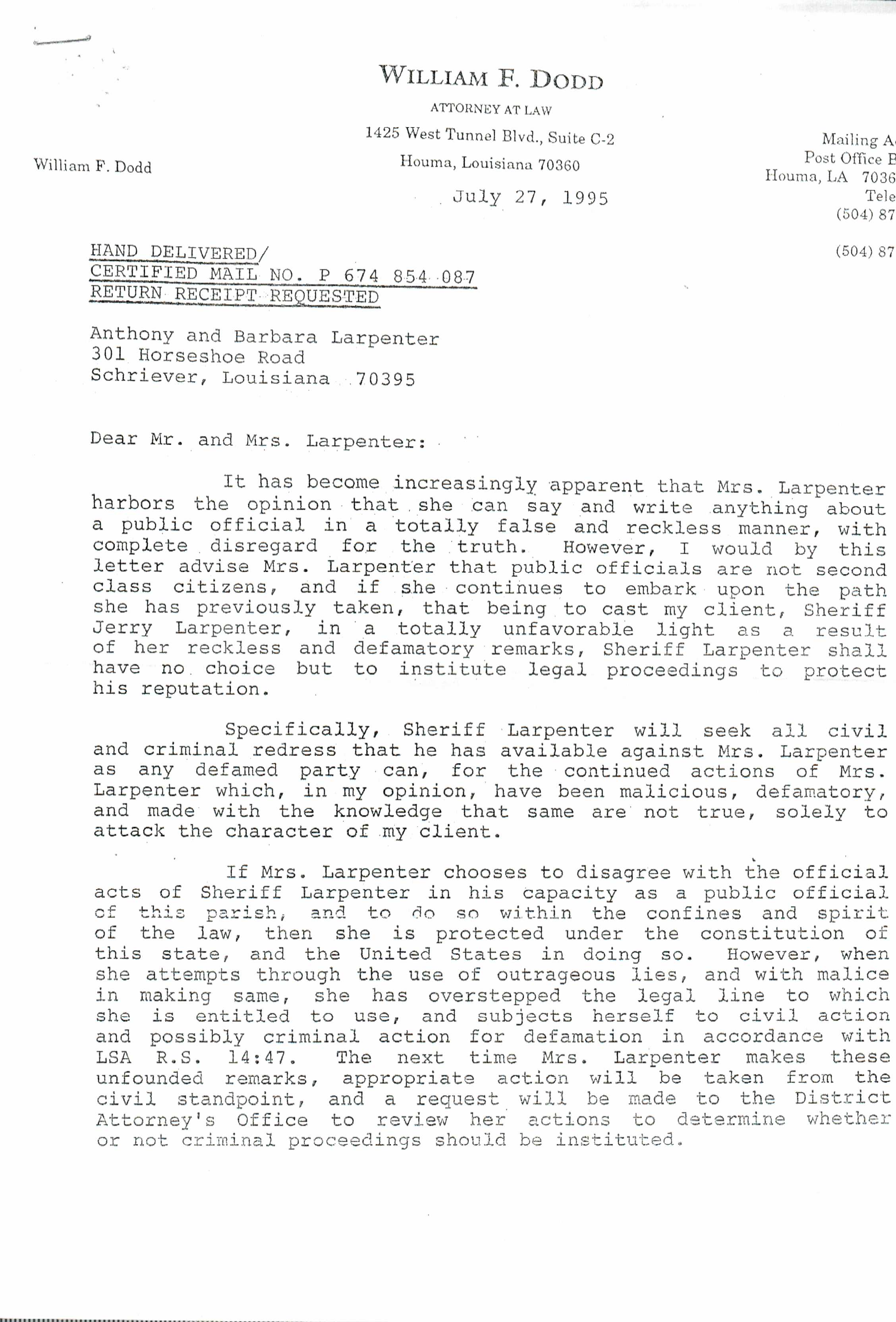
It was July 27, 1995, when Larpenter called upon his legal counsel, Houma attorney William F. Dodd (if that name seems familiar, it’s probably because his pappy, William J. Dodd, served as state auditor, lieutenant governor, and state superintendent of education and twice ran—and lost—for governor) to fire off a two-page threatening letter to brother Anthony Larpenter and his wife, Barbara.

There are those who are going to accuse LouisianaVoice of dredging up old news but the letter and the subpoenas that followed less than two months later represent a mindset in the Terrebonne Parish Sheriff’s Office, a pattern, if you will. Let’s face it, you have to have a pretty thin skin to call down the powers of your office on ordinary citizens whose most grievous offense was criticism of the manner in which you run that office.

The letter is the typical letter of legal intimidation, filled as it was with the usual attorney bluster, demands and threats but in the end, nothing but a loud, bullying, cheap tactic to stymie free speech.

“…I would by this letter advise Mrs. Larpenter that public officials are not second-class citizens, and if she continues to embark upon the path she has previously taken, that being to cast my client, Sheriff Jerry Larpenter, in a totally unfavorable light as a result of her reckless and defamatory remarks, Sheriff Larpenter shall have no choice but to institute legal proceedings to protect his reputation,” Dodd wrote.

“…The next time Mrs. Larpenter makes these unfounded remarks, appropriate action will be taken from the civil standpoint, and a request will be made to the district attorney’s office to review her actions to determine whether or not criminal proceedings should be instituted,” Dodd said.

There is an obscure state statute (R.S. 14:47)under which criminal charges may be brought against an individual for defamation. The maximum penalty under that statute is a fine of $500 or imprisonment of up to six months, or both.

Now I’m not an attorney, but I have to believe that criminal prosecution for defamation, libel or slander under this statute—unless, that is, you are making written or verbal physical threats against the well-being of someone—would be an extremely risky move for any politician. And Dodd’s letter makes no mention of any such threats, so it’s a little puzzling how he thinks he can morph disparaging remarks against an elected official into criminal action.

Once that precedent is set, television campaign ads will cease to exist since distorted attacks and outright lies are all they consist of and no one would ever be allowed to talk about an elected official again. That’s a slippery slope that can only lead to a totalitarian form of government.

Of course, Dodd’s letter also could have been nothing more than legal puffoonery, which is far more likely.

Less than two months later, on September 12, Larpenter, as a precursor to what the Andersons could expect 11 years later, had subpoenas served on his brother and sister-in-law. The subpoena demanded that they “produce the original taped conversation between deputy Gary Sanders and Deputy Jed Boquet on or about January 6, 1995.”


There was no indication as to what the conversation between the two deputies was about but it obviously was of considerable concern to Sheriff Larpenter.

Dodd ended his July letter on a really ugly and sinister note when he wrote, “I would point out that in the event a civil action is filed, and Sheriff Larpenter is successful, this being a community property state, and assuming that Mrs. Larpenter has no separate property agreement, any judgment that might be obtained in favor of Sheriff Larpenter, could be entered against this total community property owned by both of you.”

Translation: Mr. Larpenter, you’re the man of the house; you need to shut your wife up.

Well, Sheriff, those days are long gone. Forever. You’re still living back in the 1940s and ‘50s if you think this still plays. Women have a loud voice today and they do not have to ask permission to speak. Edith Bunker doesn’t exist anymore.

But you and Mr. Dodd would be wise to listen.

LouisianaVoice has been informed that State Fire Marshal Butch Browning has been summoned to a meeting in the governor’s office next week.

There was no immediate indication what that meeting will be about but if the report is accurate, there are a couple of items the administration may wish to ask Browning about:

  • Why did the office of State Fire Marshal (SFM) spend $4,649 in May 2015 to “up fit” the office’s special food service trailer for the purpose of supporting “events and emergencies with equipment for field food services when necessary,” but when the August 2016 flood struck South Louisiana, SFM agents say they had to fend for themselves because that food service trailer was nowhere to be found?
  • Why did the SFM spend $4,900 in May 2015 as a deposit for LR3 Consulting of Baton Rouge to create a website for Louisiana Firefighter Proud when Louisiana Firefighter Proud is a private entity not affiliated with any state agency?
  • Why is it that the SFM claims to have no record of purchasing drones for $7,500 each from a New York vendor when SFM agents insist they were purchased and training records for at least one SFM deputy lists an eight-hour course in drone training and safety compliance?

LouisianaVoice has attempted—unsuccessfully—to obtain answers to these questions.

When I inquired into the 10 washers and 10 dryers and the drones, I received the following response from the SFM’s legal department:

From: (Name redacted by LouisianaVoice)
Sent: Thursday, August 17, 2017 9:11 AM
To: Tom Aswell <azspeak@cox.net>
Subject: PRR: Louisiana Voice Request dated 8/8/17

Mr. Tom Aswell

PRR: Louisiana Voice Request dated 8/8/17

SFN: 00000-77

Dear Mr. Aswell:

With regard to the email below, your request to view ten clothes washers and dryers, the Office of State Fire Marshal has no washers and/or dryers at 8181 Independence Blvd., Baton Rouge, Louisiana.  

Additionally, in your request you asked for receipts for four drones from B&H of New York at approximately $7,500 each. No such documents exist.   

Please feel free to contact me if you have any questions.   

Best Regards,  

(Name redacted by LouisianaVoice)

Office of State Fire Marshal

8181 Independence Blvd.

Baton Rouge, LA 70809

So, if those washers and dryers are not at 8181 Independence Blvd. (SFM headquarters), where exactly are they and why can’t I be allowed to view them?

I posed that follow up question to the SFM’s office but have yet to receive a response.

It took a former employee of the SFM to clear up that little mystery. The washers and dryers, he explained, were not purchased but leased from Broad Base Service and Rentals in Harvey for $4,999.99, one cent below the minimum purchase amount that requires quotes from vendors. They were rented, he said, to wash the uniforms of deputies working the August 2016 flood of South Louisiana. The September 6 transaction date would seem to substantiate that explanation.

That same individual said he, too, had heard that Browning had been notified to appear at the governor’s office next week.

He also said no one at SFM is minding the store as concerns purchases on the state credit card. “You’re on the right track in checking those credit care purchases. There is absolutely no control over the expenditures in that office.”

I did receive a response to some of other public records requests, namely training certificates for four deputy fire marshals.

Without naming the individuals, I can say that some of the training courses appear to have little to do with inspections of amusement rides, boilers, nursing homes, hospitals, jails, or mobile homes, all of which are part of the SFM’s responsibilities.

In other states, each of those areas would be assigned to deputies specifically trained in those respective areas but in Louisiana, deputies under Browning are “cross-trained,” meaning they are expected to be proficient—and certified—in all inspection disciplines.

In examining the record of one deputy, I found a certificate for an eight-hour course in “Law Enforcement Chaplaincy” from an organization identified on his certificate as Compassion Ministries.

While this is by no means meant to disparage a deputy’s faith, there appears to be little connection between that certificate and building, ride, boiler or fire inspections or investigations.

I also found certificates for all four for such courses as ethics, preventing sexual harassment and defensive driving. As one who has taken each of these courses during my 20 years with the state, I can attest to their absolute uselessness—with the possible exception of the ethics course, which is only slightly more comprehensive. Still, those courses appear to be of little benefit to a SFM deputy working in the field, investigating fires, inspecting buildings, rides, and boilers.

Conversely, there were courses listed in that make it appear that Browning is attempting to turn the fire marshal’s office into a full-blown police force on a par with State Police:

  • Drug enforcement training (16 hours);
  • Narcotics investigations (48 hours);
  • Hostage negotiation (four hours);
  • Military police training (a five-month course);
  • Traffic radar operation (four hours);
  • Advanced criminal patrol tactics (eight hours);
  • Chemical weapons familiarization (four hours);
  • Use and handling of stringer spike strip systems (one hour);
  • Shotgun familiarization (four hours);
  • Drugged driver detection (four hours)
  • Chemical testing for intoxication (16 hours);
  • Police driving (24 hours);
  • Taser certification (four hours);
  • Unspecified FEMA training;
  • Introduction to cultural diversity.

By contrast there were courses that seemed to be a bit more relevant, though the four deputies whose records we reviewed did all not seem to have the advantage of taking the same courses:

  • Effective Investigation and Testimony (three hours);
  • Investigating Fatal Fires (four hours);
  • Commercial Building Code Fundamentals;
  • Hazardous Materials Awareness (four hours);
  • Firestop Seminar (three hours);
  • Sprinkler Seminar (three hours)
  • National Electrical Code Seminar (16 hours);
  • Scientific Method of Fire and Explosion Investigation (three hours);
  • Electrical Safety (three hours);
  • Residential Electrical Investigation for the Fire Investigator (24 hours);
  • Post Blast Investigators School (40 hours);
  • Critical Thinking Solves Cases (four hours);
  • Investigating Natural Gas Systems (three hours);
  • Investigation of Commercial Kitchen Fires (eight hours);
  • Residential Natural Gas Systems (three hours).

While there were records of only four deputies to review, it seemed odd that for a department stressing cross-training as does the SFM, there were no courses listed in boiler inspections, amusement ride inspections, nursing home or hospital inspections, or mobile home inspections for any of the individuals.

Both the chair and co-chair positions on the Louisiana State Police Commission (LSPC) are now vacant with the resignations of the seventh and eighth members from the commission in the past 12 months.

Commission co-chair Monica Manzella is the latest to step down from the commission. There has been no official announcement but both her name and that of former chairman, State Trooper T.J. Doss, have been removed from the names of commissioners listed on the LSPC Internet home page.

LouisianaVoice also has learned that Doss may have claimed he was working during the time he was in a movie and later in a Baton Rouge hotel with Manzella.

Doss resigned last Friday after being called into the office of State Police Superintendent Kevin Reeves after he and Manzella were observed emerging from a movie while he was on the clock. When they exited the theater, Doss was carrying two mugs which the theater gives to patrons when they purchase beer. Soft drinks are sold in plastic cups.

Doss and Manzella were recorded on video and still camera last Thursday as they first exited Baton Rouge’s Movie Tavern and less than an hour later as they checked into front desk of the Watermark Hotel in downtown Baton Rouge. Manzella was filmed putting her arm around Doss as they checked into the hotel and then the pair immediately got on an elevator, presumably to their room.

https://louisianavoice.com/2017/08/10/chair-co-chair-of-state-police-commission-apparently-share-more-than-a-professional-relationship-check-into-br-hotel/

Although neither is married, the fact that both served on the commission that hears trooper disciplinary appeals and which approves the Louisiana State Police (LSP) pay grid, could pose as problematic because of their potential influence on each other’s votes on those and other issues that come before the commission.

Doss’s time sheet, obtained by LouisianaVoice via a public records request, indicates he claimed to be in last Thursday’s (August 10) LSPC meeting for five hours, from 7 a.m. to noon, when in fact, the meeting, which did not begin until 9 a.m., lasted less than an hour. Those five hours were listed on his time sheet as “shift differential pay hours.”

Additionally, he claimed 10 hours, from 1 p.m. to 11 p.m. Thursday. During at least part of that time, from 3 p.m. until 5 p.m., he and Manzella were in Movie Tavern and from there, were in the hotel until almost 7 p.m.

T.J. DOSS TIME SHEET

Photos taken by LouisianaVoice document that the last photo, of Doss’s state vehicle parked in a city police parking space curbside opposite the hotel entrance, was taken at 6:29 p.m., which means he was on the clock and being paid while he was with Manzella from 3 p.m. until at least 6:30 p.m.

His time sheet indicates that he was traveling from Baton Rouge to Shreveport, where he lives, from 6 p.m. until 11 p.m.

After publication of the photos of the two leaving the theater and later checking into the hotel, he was called back to Baton Rouge and met with Reeves from noon on Friday until 2:30 p.m. and submitted his resignation from the LSPC shortly thereafter.