Feeds:
Posts
Comments

“The Law is for Protection of the People“

—Kris Kristofferson

The late John Hays had a popular column in his weekly Ruston newspaper The Morning Paper that he called The Rumor Mill. Getting a mention in his Rumor Mill was something about as thrilling as having Mike Wallace show up at your door for a 60 Minutes interview.

LouisianaVoice would like to briefly reprise that column with the reliable rumor that Felicia Williams, chief judge for the Second Circuit Court, will be a candidate in the special election to fill the unexpired term of Louisiana Supreme Court Justice Marcus Clark, who has submitted his retirement to the Secretary of State, effective June 30, less than four years into his 10-year term. (Read Clark’s resignation story HERE.)

It’s important to note that Judge Williams assumed the mantle of chief judge by default in October, succeeding Judge Henry Brown, Jr., who was forced from the bench by the State Supreme Court. Technically, Brown “retired” a week after the Supreme Court ordered him to vacate the appeals court building. (Read that story HERE.)

LouisianaVoice has written numerous stories about the manner in which the state, abetted by the Second Circuit, screwed over contractor Jeff Mercer, a Mangham subcontractor on several construction projects for the Department of Transportation and Development (DOTD).

(Read those stories HERE, HERE, HERE, HERE, and HERE.)

And while LouisianaVoice was the only one pursuing this story for a while, it was just a matter of time before the twisted, incestuous series of sordid events would produce serious questions of alleged misappropriation, impropriety and ethics violations to such an extent that others would be drawn to the story.

Ruston’s Walter Abbott of the web blog Lincoln Parish News Online has done a great job of constructing a media timeline of news stories on the Jeff Mercer’s David vs. Goliath battle for justice. (Read his story HERE.)

Gary Hines, a former co-worker during my brief stint at the Shreveport Journal, and Jamie Ostroff have done a good job on an in-depth story for KTBS-TV of Shreveport that reads like a scaled-down version of the J. Howard Marshall/Anna Nicole Smith saga of 20 years ago. (You can read the KTBS story HERE.)

That story, instead of taking place in the city of Houston, involves the estate of a man named Houston and even the LSU School of Veterinary Medicine got drawn into the controversy.

You see, a woman named Hahn Williams (no relation to Judge Williams) was Houston’s financial adviser and it just happened that Judge Brown and Hahn Williams were tight.

When the LSU Vet school learned it was beneficiary of much of Houston’s estate, officials there naturally wondered why (a) they hadn’t been informed and (b) they hadn’t received any of the money.

So, the vet school did what anyone would do. It sued Hahn Williams.

Hahn Williams was subsequently ordered by a Caddo First District Court to pay the vet school $1.5 million. Broke, she sold her house to Judge Brown who (a) allowed her to remain living there and (b) eventually became her attorney in her legal efforts to fight off forced bankruptcy—raising the question obvious to most as to why Brown is even allowed to practice law at all in light of his egregious transgression while on the bench. In other words, why wasn’t he disbarred outright in light of of such a serious ethics breach?

Before Brown became her attorney, she appealed her adverse verdict to the Second Circuit where Judge Brown recused himself, but apparently attempted to lean on other judges, which eventually brought the wrath of the State Supreme Court down upon him, forcing his “retirement.”

Added to that, his law clerk, Trina Chu, was also Williams’s longtime friend and she downloaded documents to her own flash drives and emailed legal advice to Williams who then forwarded portions of those communications to Judge Brown via his Second Circuit court email address.

And here’s the real kicker: The Caddo Parish Sheriff’s Department concluded no criminal charges were warranted in the computer hacking.

The Caddo Parish District Attorney’s Office, however, was not quite satisfied and decided more work was needed as it took over the investigation. But DA James Stewart is himself a former judge on the Second Circuit Court of Appeal and worked with Chu and served on the court with Judge Brown, which would seem to give him a built-in conflict of interest in any investigation.

All of which may explain why the Louisiana Attorney General’s Office is now involved. But, given Attorney General Jeff Landry’s track record, that’s where criminal investigations go to die unless they can directly promote his political career.

Meanwhile, Mercer is seeking the entire case file, convinced it will aid him in his own pursuit of justice. He filed the appropriate public records requests which both the sheriff’s office and the DA’s office are fighting on the grounds the computer hacking is an ongoing investigation.

Of course, Mercer’s case is ongoing as well and the contents of those files could conceivably help him but no one in a position of authority seems to give a damn about that.

And, it turns out, the DA’s office got involved only after Mercer made his public records request, thus giving the DA justification for refusing his records request on the grounds that there was this “ongoing investigation.”

While district court judges would have to resign their positions to run for the Supreme Court, Judge Williams, as a member of the Court of Appeal, would not, giving her a distinct advantage.

Still, she would have one disadvantage in running.

Jeff Mercer will do everything within his power to legally see to it she is never elected.

And that goes, he said, for the other judges who served on the panel that overturned the unanimous trial court $20 million verdict in his favor.

Stay tuned.
 

Every now and then, you stumble across a story that simply must be told. This is one of those.

It’s a story about how a thriving business idea was born in the house where I grew up in Ruston from 1945 to 1968.

Unfortunately (for me), the idea was hatched by someone I never met after I married and no longer lived there.

And the craziest part is I had no idea of the origins of the business until a recent visit to Alexandria to sign copies of my new book, Louisiana’s Rogue Sheriffs: A Culture of Corruption.

It was at the book signing that a man stepped up to purchase a copy of the book and to thrust a copy of another book under my nose. “Remember this book?” he asked, smiling knowingly.

The book was a hardbound copy of a 1968 book (more accurately, a pamphlet, or magazine devoted to a single subject) entitled simply Bonnie and Clyde.

It was a copy of my very first book which, in reality, was just a reprint of articles I’d written for The Ruston Daily Leader in an effort to capitalize on the popularity of the Warren Beatty-Faye Dunaway movie of the same name. (The outlaws had been ambushed in 1934 in nearby Bienville Parish, 25 miles to the west, and the couple they kidnapped in real-life and in the movie was from Ruston, so the movie and my book carried considerable local interest.)

“Where in the world did you get this?” I asked. I hadn’t seen a copy of the book for at least 30 years and didn’t even possess a copy of my own.

“Out of a house on Fielding Drive in Ruston,” he replied.

Well, there was only one house on Fielding Drive in Ruston and that was the house where I grew up under the watchful eyes of two of the greatest grandparents a boy could ever have. They’d taken me in when I was abandoned by their ex-daughter-in-law (my mom) in Galveston, Texas, when I was 18 months old. When my grandfather passed away in 1971 (and believe me, I still miss him dearly), my grandmother moved in with my oldest uncle where she remained until she, too, passed away (and I miss her must as much) 21 years later as Bill Clinton was locking up the Democratic nomination for president.

When she moved out, we rented the house on Fielding Drive to Louisiana Tech students and one of those tenants, my new friend informed me that day in Alexandria, was one David Ervin, a forestry student who really didn’t care that much for forestry but did have a talent for marketing.

Unfortunately, neither the street nor the house is any longer there or the building might well be a shrine today for a novel business idea that had its genesis in that little three-bedroom frame house—an concept which seemed at best a mere fantasy of some starry-eyed college kid at the time:

Drive-thru daiquiris.

“David came up with the idea right there on Fielding Drive,” the man told me. I was incredulous, to say the least.

The irony of ironies was Lincoln Parish at the time was dry. Add to that the fact that my grandfather held franchise rights to the term teetotaler. The man despised alcohol almost as much as he despised organized religion and the Klan (I honestly believe the rankings of his detestation trifecta was subject to fluctuations, depending on the particular day in question).

He had a strict moral code that would not allow for compromise, no matter whom it affected. I still remember the day my dad was arrested in Monroe for DWI and called our house to have his dad (my granddad) to bail him out of jail. I had the unpleasant duty of delivering the request to my grandfather who was working in the garden. His response: an emphatic and unequivocal, “Hell, no! He made his bed, let him sleep in it!”

End of discussion. And for a full year, my dad did just that, cooling his heels in jail.

No compromise. No exceptions.

My mortal fear of the consequences probably had a lot to do with my refusal to even drink a beer in the military; I was morbidly afraid of incurring the man’s wrath from 600 miles away.

But I digress.

The story of David Ervin and his Fielding Drive conceived drive-thru daiquiri shops was chronicled in a Daily Beast story last July. To read that story, click HERE.


Baton Rouge attorney J. Arthur Smith, III, has been named president of a new political action committee (PAC) founded in an attempt to stem the growing trend of economic, religious, gender, racial and healthcare discrimination against American employees.

Stand Up for Workers (SU4W) “was established by people who care about the basic rights of the American worker. We seek to protect the right to a fair and livable wage and benefits; to receive fair and humane treatment in the workplace, including work with dignity; and to have full access to justice, including the right to trial by jury,” according to its web page.

A little background is in order here.

The formation of the new PAC is realistically challenged with overcoming nearly a 50-year head start by big business and business-backed Republican elected officials who, indebted to corporate PACs, have given their tacit approval to the more subtle means of employee discrimination. At the same time, open endorsement has been given the so-called Powell Memorandum of 1971 by then-corporate attorney Lewis Powell, Jr., who shortly after writing his memo, was appointed to the U.S. Supreme Court by President Nixon.

The MEMORANDUM, written specifically for the U.S. Chamber of Commerce, was entitled “Attack on the American Free Enterprise System” and served as a master plan for conservative business interests to retake America from the so-called New Deal era. It was supposed to have been confidential, but was discovered an published by columnist Jack Anderson following Powell’s appointment to the Supreme Court.

Powell, who had served as corporate attorney and director on the board of Phillip Morris until his appointment to the Supreme Court, was an unabashed champion of the tobacco industry during his term on the court as well as an opponent of reforms to the automobile industry prompted by Ralph Nader’s expose’ Unsafe at Any Speed, which revealed the auto industry’s higher priority on profits than on safety. Powell called Nader the chief antagonist of American business.

The memo, which foreshadowed several of the Powell court’s opinions served as the blueprint for the rise of the American conservative movement and the formation of a spate of right-wing think tanks like the American Legislative Exchange Council (ALEC) and lobbying organizations and also inspired the U.S. Chamber of Commerce to become more active in the political arena.

Conversely, as the chamber’s and other conservative organization’s influence gained strength in Washington, the political clout of organized labor weakened, further silencing the voice of American workers.

Following is the full press release announcing the formation of SU4W, as well as a link to the organization’s web page:


A group of worker advocates from across the nation has announced founding of a specialized political action committee, “Stand Up for Workers” (SU4W), dedicated specifically to the needs and concerns of American workers.  https://standupforworkers.org/    SU4W is a hybrid PAC, comprising both a traditional PAC and a super PAC.

“Despite recent promises of improvements in work life conditions for working Americans, the plight of middle and lower income workers has, if anything, become more dire,” said Baton Rouge attorney J. Arthur “Art” Smith, III, President of SU4W.

Mr. Smith is a 47 year veteran employee-side litigator in Louisiana. He has litigated numerous trials and appeals in labor and employment on behalf of both employees and unions. He is a fellow of the College of Labor and Employment Lawyers, and has served in numerous positions with the Louisiana Association for Justice, including membership on the Board of Governors, and chair of both its employment and civil rights committees.

SU4W Vice President James Kaster, a Minneapolis, MN attorney, is an experienced trial lawyer who concentrates on representing plaintiffs in employment cases. He is one of only a few plaintiffs’ lawyers who is a member of both the College of Labor and Employment Lawyers and the American College of Trial Lawyers, a group limited to one percent of America’s trial attorneys.  Mr. Kaster has also been a frequent lecturer at continuing legal education seminars and has been active in bar activities, including serving as President of the National Employment Lawyers Association.

“Until now there has been no group specifically dedicated to supporting political candidates committed to sponsoring and voting for legislation aimed at concrete measures that will produce better conditions for the American workers whose labor has formed the backbone of our country’s prosperity,” Mr. Smith said. SU4W will support candidates for all federal offices and will engage in other activities in support of working Americans, such as providing accurate information about candidates, proposed legislation and policies.

Most lower- and middle-income American workers have seen stagnant wages for decades, while executive and professional income has risen astronomically, Smith noted. Efforts to better the lives of workers through measures such as affordable health insurance have been consistently attacked and undermined by the current administration in Washington.

SU4W focuses on three goals:

  • more equitable pay for workers;
  • fair and humane treatment in the workplace, and
  • full access to justice, including trial by jury. Trial rights have been substantially eroded by the advent of arbitration agreements extracted from workers through the threat of not being hired.

SU4W will solicit applications for support from candidates, and will engage in a careful vetting process to ensure that the candidates selected satisfy a clear set of criteria showing they will include support for workers among their top priorities.  SU4W will study recent election returns to identify districts where pro-worker candidates will have the best chance of success.

The need for advocacy on behalf of workers extends beyond the issues of income and access to affordable health care, Smith noted. Incidents of degrading treatment at work, including racial, religious and sexual discrimination, are on the rise, and many employers have failed to prevent  abuse or act against it.

Founding members of SU4W are from California, Colorado, Connecticut, Louisiana, Massachusetts, Minnesota, New York, North Carolina, Ohio and Texas.  Among its leadership are some of the country’s most prominent attorneys whose legal practices are committed to enforcing employee rights.

For more information about SU4W, to make a donation, or find out how to apply for support, visit the website at https://standupforworkers.org/

Did physical therapist Philippe Veeters have a guardian angel watching over him, protecting him from an aggressive investigation by Baton Rouge authorities after he was accused of inappropriate touching of female patients and inappropriate comments about their bodies?

Veeters, you may recall from LouisianaVoice’s story last month, was first arrested last February on the basis of complaints from several female patients but the East Baton Rouge Parish District Attorney’s office didn’t get around to submitted a bill of information against him until Nov. 1.

See that story HERE.

Veeters, it turns out, besides operating his own facility, Dutch Physical Therapy, also has an affiliation with The Spine Diagnostic Promotional, LLC.

Louisiana Secretary of State corporate records indicate that The Spine Diagnostic Promotional has two officers—Veeters and Dr. J. Michael Burdine.

The association with Burdine is significant in that until recently, Burdine was President of the Louisiana State Board of Medical Examiners.

To be clear, the State Board of Medical Examiners has no direct authority over physical therapists who are licensed and regulated by the Louisiana Physical Therapy Board.

But both the State Board of Medical Examiners and the Louisiana Physical Therapy Board operate under the umbrella of the Louisiana Department of Health. That, and the business relationship between Veeters and Burdine creates at least a perception by one woman who has complained about Veeters of too much coziness between the two boards.

The two boards even shared a common legal counsel until attorney George Papale was TERMINATED by the physical therapy board following complaints about the board’s handling of….sexual misconduct cases involving physical therapists.


Business: THE SPINE DIAGNOSTIC PROMOTIONAL, L.L.C.
Charter Number: 35730933K
Registration Date: 6/28/2004


Domicile Address
  5408 FLANDERS DR.
  BATON ROUGE, LA 70808


Status: Active
File Date: 6/28/2004
Last Report Filed: 7/5/2018
Type: Limited Liability Company


Agent: J. MICHAEL BURDINE
Address 1: 5408 FLANDERS DR.
City, State, Zip: BATON ROUGE, LA 70808
Appointment Date: 6/28/2004


Officer: J. MICHAEL BURDINE, M.D.
Title: Member
Address 1: 5408 FLANDERS DR.
City, State, Zip: BATON ROUGE, LA 70808


Officer: PHILIPPE VEETERS
Title: Member
Address 1: 10343 SIEGEN LN.
City, State, Zip: BATON ROUGE, LA 70810


Here is the biographical information on Dr. Burdine prior to his leaving the Board of Medical Examiners:

Board Members

J Michael Burdine, MD – President

Dr. Burdine grew up in Lafayette, LA attending high school at Acadiana High and received his bachelor of science at LSU in Baton Rouge.  He attended medical school at LSU New Orleans graduating in 1983.  He completed his internship at the University of Southern California in Los Angeles and after, worked emergency medicine for four years in the Acadiana area.  He attended the University of Arkansas in Little Rock studying Anesthesiology and moved to the University of Cincinnati to complete his fellowship in Pain Management.  He worked in Oklahoma City providing outpatient regional anesthesia and pain management for eleven years before returning to Baton Rouge in 2002 to practice pain management exclusively.

Since returning to Baton Rouge Dr. Burdine has been an active member in the Louisiana State Medical Society, the President of the Capitol Area Medical Society, and the President of the Louisiana Society of Interventional Pain Physicians.  He was an Executive Board Member of the Arthritis Association of Louisiana and was its volunteer of the year in 2006.  He serves on the Louisiana Medicare Carrier Advisory Committee; is an Executive Board Member of the Louisiana Society of Anesthesiologists; and the LSIPP Delegate to the Calcasieu Prescription Drug Task Force.

In 2008 he was voted Medtronic’s Patient Access Advocacy Hero and has twice been a CRC of America Top 100 Physicians in Pain Management.

Dr. Burdine is Board Certified by the American Board of Anesthesiology and holds added Certification in Pain Management in 1996 and 2006 by the ABMS.  He is a member of multiple National and State wide physician organizations.  He is currently in full time private practice at the Spine Diagnostic and Pain Treatment Center of which he is the founder in Baton Rouge, LA.


It seems I owe Steve Pylant an apology.

I left him out of my book Louisiana’s Rogue Sheriffs: A Culture of Corruption.

Please know it was an oversight and was never an intentional slight of the former three-term Franklin Parish sheriff and current lame duck state representative.

Please consider this my feeble attempt to atone for that glaring omission.

After all, his voting record in the House was consistently that of a staunch law-and-order, lock-‘em-up-and-throw-away-the-key hard-liner.

Except, of course, when he decided to come to the rescue of four former meth felons caught with weapons in neighboring Catahoula Parish.

In case you may not remember that story I wrote last January, you can read it HERE.

But my reason for bringing him up again is not only to express my contrition for omitting him from the book.

My reason this time concerns a couple of incidents just a couple of months ago which might leave the mistaken impression that Pylant is still the high sheriff—or thinks he is.

Pylant apparently feels he has the right to attempt to enter private property and question occupants without a warrant or even a badge.

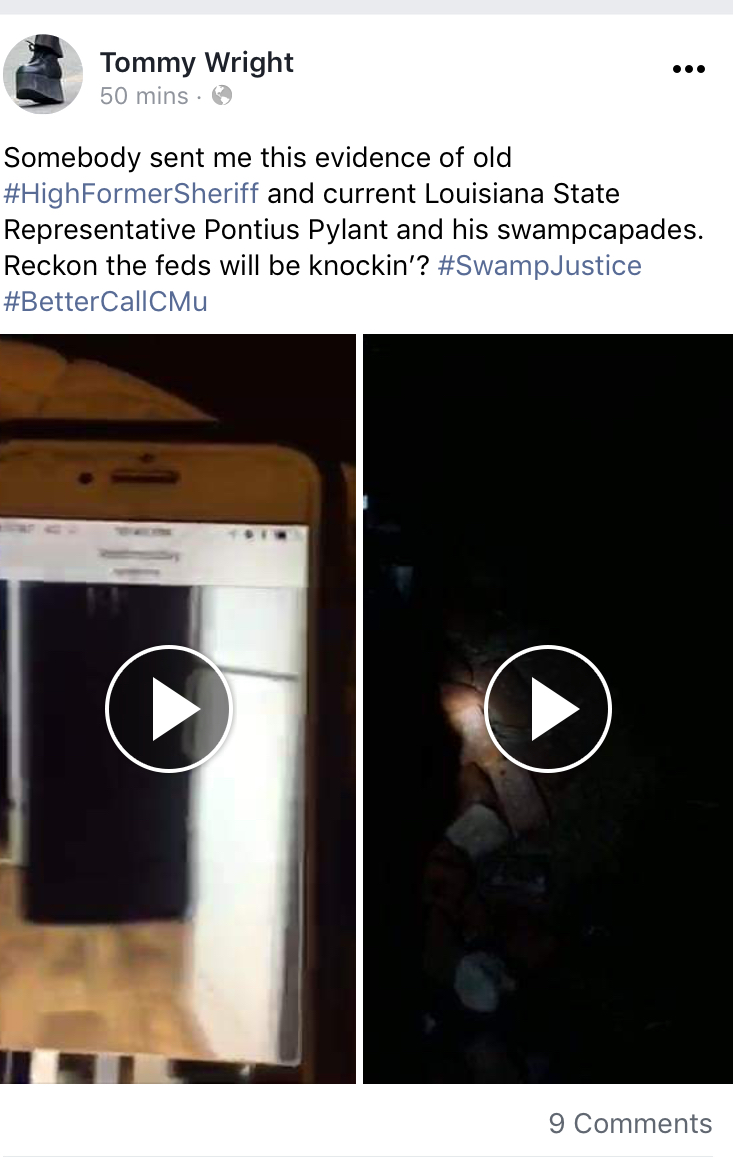
In fact, he seems to feel he can even brandish a weapon and force two women driving alone at 10 p.m. to pull over on a darkened Franklin Parish roadway.

April Franks says she and her friend, Amber Conley, were stopped by Pylant and a man named Steve Drane, 50, of Gilbert on the night of Oct. 16. “It was a dark road,” said Franks, who said she believed Pylant, who was waving a gun, was drunk. “[He] grabbed the door window and slammed his pistol against it, telling us we could not leave.”

Drane was one of four convicted felons for whom Pylant secured a $90,000 property bond to spring them from jail in Catahoula Parish in December 2018. Another of those arrested for hunting on private property in Tensas Parish on that occasion was Michael Linder, whose brother, Bryan Linder, was—and still is—an employee of the Franklin Parish Sheriff’s Department.

Each of the four men had prior drug convictions as well as other assorted convictions spread among them and each was armed at the time of the arrests even though convicted felons are prohibited by law from possessing firearms.

None of which deterred Pylant from stepping in to conduct his own traffic stop despite lacking the proper credentials to do so.

“He had no right to pull us over,” Franks said. “He and Steve Drane were sitting in a curve 200 yard from where we pulled out – right past the boat landing they had been watching us from for two hours. He was in the middle of the road waving his hands in the air and was holding a pistol. We had no choice but to stop. Amber, my friend, was driving and thought they must need help …. that was not the case at all. In the video I sent you he (Pylant) is saying he didn’t ‘point the pistol as us I had it in the air.’  He was visibly and audibly drunk that night.”

Franks said she subsequently called the police department and “told them some man stopped us with a pistol and was drunk and they told me that there was already an officer out there to talk to him.

“A few days later, I went to get a copy of the police report and (Deputy) Bryan Linder (brother of Michael Linder) took me to his office, acted like he was looking for it and then told me that he didn’t have one, that he doesn’t require his officers to write up every little call and if I didn’t like his response, I could go across the hall to (Sheriff) Kevin Cobb’s office and talk to him.”

No record of a report of a man waving a gun and pulling motorists over in the middle of the night? Seriously? That begs the question of just what would a person have to do to generate an incident report? Once, when I was running police beat for the Baton Rouge State-Times, I saw an incident report of a “deceased chicken.”

Cobb, of course, was Pylant’s chief deputy before succeeding his former boss as sheriff.

The traffic stop by an unauthorized individual brandishing a weapon (drunk or sober) would be bad enough but just minutes later, Pylant and Drane appeared alongside a houseboat on the Tensas River owned by Frank’s friend Amos “Gene” Kenney of Gilbert.

Pylant, claiming he smelled meth cooking. Kenney responded that he was running trot lines and was cooking only beans on his boat.

Pylant then referred to another boat in the river, indicating the smell was coming from that direction. “It may be,” Kenney said, “but that ain’t my boat. This is my boat here and I’m cooking a pot of beans.”

Pylant insisted on searching the boat but Kenney demanded to see a search a warrant, which, of course, neither he nor sheriff’s deputy Brandon Boxx, who eventually showed up on the scene, happened to have on them. When Franks alluded to Pylant’s pointing a pistol at her car earlier, he denied it, saying, he was holding the pistol “in the air.”

At one point, Pylant said to Franks, “I’m gon’ tell you, baby, you piss on somebody’s foot…” Without completing what almost certainly was a profound thought, he switched gears, telling “Baby”, “I been in law enforcement for 30 years. I was sheriff here a long time.”

Pylant, harking back to his glory days as sheriff of Franklin Parish, boasted, “I was sheriff here a long time. I been retired eight years. I been in the state legislature.” Claiming he knew what meth smells like, he said, “I took the first meth lab down in northeast Louisiana in 1996 and I know what it smells like.”

Then he said, “I’m interested in seeing what we gonna find on that houseboat out there ‘cause I done seen y’all go back and forth out there twice.”

“We were on a trot line,” Franks protested.

“Naw, you wasn’t on no damn trot line,” Pylant said. “Somebody’s probably still in the houseboat.”

“I hope so,” Franks said. “Then there won’t be any question.”

“Well I heard y’all get out and get on it and ever’thang,” Pylant said.

After more back and forth accusations and denials, Franks said, “Well, I’m not going to argue with you…”

“There ain’t no need,” Pylant said, sounding like a true southern redneck sheriff that he seemed to think he still was. “It’s a damn shame,” he said, “a damn shame.”

I couldn’t have said it better, Rep. Pylant.

The folks in House District 20 must be so very proud.

And folks dare wonder why our legislature is so dysfunctional?

For your viewing enjoyment:

