Feeds:
Posts
Comments

If we’re lucky, we get to encounter someone who leaves a lifelong impression on us and who challenges us to become person we aspire to be, both professionally and personally. Whether we care to admit it or not, we all need that special someone to help us navigate the treacherous roads we travel throughout our lives, to dare us, to goad us, to drive us. That person, if we are fortunate enough to live in his or her shadow, will continue to influence our decisions and actions long after we have parted ways.

Such a man was Troy Thomas Kelly, aka Tom Kelly, longtime publisher of the Ruston Daily Leader where I began my career in journalism 55 years ago with no small amount of trepidation and doubt.

It was 1966 and Southern Bell Telephone Co. was just as tired of me as I was of climbing telephone poles in the hot summers and cold winters of north Louisiana. I saw an ad in The Leader that said they were looking for an advertising salesman. I walked in off the street and applied for the position – and got it. The starting pay was $65 a week, a five-dollar-a-week cut from what I was making climbing telephone poles.

What a mistake. For Tom Kelly, it was a colossal case of poor judgment. It took him about a nano-second to realize I was not born to sell. The obvious solution was for him to either fire me or find something else around the office I could do – like cleaning toilets. I’d been writing a sports column as the only real contribution I ever made as an ad rep, so he figured “What the hell” and “promoted” me to sports editor.

To make a long, boring story a little shorter, I worked for Tom on four different occasions. Each time he asked me to return, it was at a little higher position until in 1976, he brought me back a last time – as managing editor.

Things would go sour with The Leader’s absentee ownership in Panama City, Florida, and first I left and then Tom. He eventually ended up back where he started his journalism odyssey: Winnfield, where he published the monthly Piney Woods Journal, a delightful publication geared toward the timber industry but with an eye and ear to Louisiana politics.

I was retired and writing this political blog, occasionally contributing stories for Tom’s publication until he sold the paper a few of years back to the Natchitoches Times and retired.

I sent him the following message upon learning of his retirement:

Tom, this truly saddens me on so many levels. Obviously, I share your sentiments about the death throes of news publications and I, too, place much of the blame on the Gannet and Facebook mentality. It’s an industry that I literally grew up in—as a man and as a journalist. But more than that, you and I have a connection that goes back more than 50 years and nothing can ever replace that. You took me under your wing and taught me about journalism. How you managed to have enough patience to do that I will never know, but know this: I will be forever grateful for that education and your tutorship and guidance. You are one of only a handful of people whom I admire and look up to and you will always be an inspiration and a source of encouragement to me. At the risk of sounding too maudlin, your announcement makes me feel as though I’ve lost something very personal—and I have.

Take care, my friend.

az

This was his response:

My greatest pride in the personal achievements in this profession that we follow are not in the words I write, but in the people I have been fortunate enough to bring in and help to grow as practitioners of our craft. Bill Davis. Eric Mahaffey. Nick Drewry. Jerry Pye. Derwood Brett. Buddy Davis. David Widener. David Specht. Several whose names have slipped my mind. And a brash, talented, industrious achiever of the writing arts named Tom Aswell. We called him Az. If I have left anything behind, it is in the talents of those who carry on even now. They all made me look better than I could have been alone.  Several of a new generation joined up as contributors for this latest enterprise, which has provided me a new level of satisfaction. 

Keep the faith. 

TK 

Two years ago, he was honored by the Louisiana Press Association for 50 years of service to the newspaper industry. I was fortunate enough to attend along with another former employee who was also nurtured and taught so much by Tom: Jerry Pye who started out at The Leader as a carrier and ended up as publisher of his own newspaper.

Tom was 88 when he received that honor from the LPA. He was 90 when he died last Saturday and a part of his protégées like Jerry Pye, Derwood Brett, David Widener, Eric Mahaffey and me died with him.

It’s getting more and more difficult to write these stories as more and more of the people I love and cherish pass on and leave me to contemplate life’s cruel twists and turns.

To be sure, Tom and I had our disagreements. Anyone who works that closely together and who has ideas of their own will have differences. But there’s one thing Tom Kelly taught me about local journalism I will never forget. He drilled it into my head that there are three major events in a person’s life: when they are born, when they marry and when they die. Those are the stories you’d better not mess up.

He was demanding, a perfectionist, and he was driven. He could be hard to please but when I came across a really controversial story that involved money laundering, he backed me to the hilt even in the face of threatened lawsuits that in the end, never materialized.

One year he gave me the assignment of gathering graduation photos of seniors from high schools in Lincoln and Union parishes. I took them to my then-fiancée’s home to sort them out, placed them in a box and placed the box on the roof of my car as I told her goodnight. You know what happened next and when the photos were published, we had students from the dozen or so classes scattered randomly – and incorrectly – throughout all the schools. It was an awful mess and Tom should’ve fired me on the spot. But he didn’t; he just threw up his arms in pure disgust at my stupidity and stomped back to his office and slammed the door. I think I’d have felt better if he had fired me.

But he had a sense of humor, too. For New Year’s Day 1977, Tom Kelly sent out special invitations to the inaugural All-American Redneck Male Chauvinist Spittin’, Belchin’, and Cussin’ Society and Literary Club’s All-Day Poker Game and Dinner on the Grounds.

There were few rules but some of the most important ones:

  • Lots of music by Willie, Waylon, and Hank Williams;
  • No guns, knives, or other sharp objects allowed at the poker table;
  • The only hand to beat a Royal Flush was a real good redneck bluff;
  • Wimmenfolk was invited to do the cookin’ and bridge playin’, but they was forbidden to come into the poker room, sigh heavy, roll they eyes or say it was time to go.

As it turned out, the women and Dr. Rudolph Fieler, a retired Tech professor who was then writing editorials for The Leader that were filled with such prose that the average person never knew what the hell he was saying, played bridge while we menfolk were playing draw and stud poker (Texas Hold ‘em had not been popularized as yet). Doc Fieler, taking a break from his bridge game, stopped by our table and Tom offered him his seat at the table. Doc declined, saying he knew nothing about poker.

Seeing a sucker ripe for the taking, the rest of us eagerly volunteered to teach him as we played, assuring him that we’d tell him when he won. Of course, you know the story: Doc Fielder literally cleaned us out, walking away with our combined wealth of some $17.85.

My point is, you can’t buy those kinds of memories. Tom Kelly was more than a boss. He was an extension of my family, a father figure to me, a talentless kid who desperately needed a strong guiding hand as I embarked on what turned out to be my life’s work.

I’ve worked with some talented newspaper editors: Wiley Hilburn, Jimmy Hatten, Jim Hughes, and Tom Kelly. And while Tom Kelly and he were professional foes, John Hays has to be included in that group of outstanding editors, for he was a helluva investigative reporter in his own right.

And now they’re all gone and again, I feel I’ve lost something very personal – and I have. What you leave behind, Tom, is a legacy that no journalism class could ever hope to teach. You taught integrity, dedication, and a love for the written word to dozens of fortunate reporters, editors and interns who had the good fortune to walk through the door of the Ruston Daily Leader. I was one of those and I will be forever richer for the experience.

Below is a poem I wrote when Hilburn died in 2014. I believe it is just as relevant today as it was seven years ago:

THE COFFINS THAT PASS ME BY

As I pass from middle age to my golden years,

And contemplate how time can fly,

It’s not the setting sun that brings the tears,

But the coffins that pass me by.

Whether ’twas friend or foe matters not a flip,

For one and all, life’s wells run dry;

And it’s not that I fear making that trip,

It’s those coffins that pass me by.

Friends and loved ones will pay their respects

As they share stories and laugh and cry;

And each one standing there quietly reflects

On the coffins that pass us by.

Whether ’tis loved one or stranger who goes first,

Our own fate is to one day ride

On that dreaded journey we all have cursed

In that coffin that once passed us by.

Go in peace, my friend.

On May 29, one of LouisianaVoice‘s readers sent $17.95 for the purchase of Murder on the Bayou.

I won’t reveal his name because he knows who he is, but the problem is he neglected to provide a mailing address, so it’s impossible to send the book.

I’ve sent him a couple of emails to no avail so, I’m hoping he will see this and send me his mailing address to:

louisianavoice@yahoo.com so that I can send him his book.

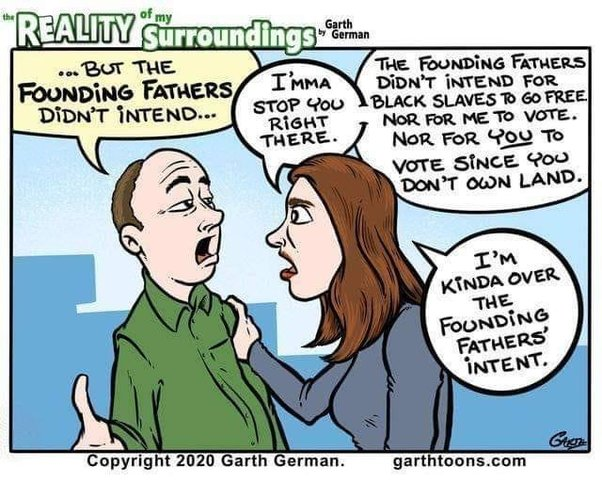
The AMERICAN LEGISLATIVE EXCHANGE COUNCIL (ALEC) is pushing hard to ban it and obedient state legislators across the American landscape are obligingly introducing ALEC-written bills to outlaw the teaching of so-called CRITICAL RACE THEORY, aka the plain, unvarnished American history.

Louisiana is no exception, thanks to the efforts of State Reps. Raymond “Slavery Wasn’t All Bad” Garofalo (R-Chalmette) and Mark “Let’s Study It to Death” Wright (R-Covington). I will return to them in due course.

But first, for those who still believe that “in 1492, Columbus sailed the ocean blue” and “Remember the Alamo” are all we need to impart upon our students as representative of all they need to know in learning what this country is all about, there are a few inconvenient facts that seem to have been lost along the way.

In the 100-year period dating from the Revolutionary War to the years following the Civil War, there were approximately 370 TREATIES signed between the United States government and the various Native American tribes.

The United States government broke every single one of those treaties. Let me say it another way: Without exception, the U.S. government broke its promises to Native Americans 368 times as westward expansion demanded more and more concessions from the indigenous Americans who were relegated to barren lands with little promise. The Black Hills of Dakota, considered useless to the whites, was ceded to the American Indians in the Treaty of Fort Laramie in 1868. But when gold was discovered, it was decided the land was pretty good after all, and the natives were again pushed aside.

Before that, in 1830, there was President Andrew Jackson’s Indian Removal Act that resulted in the infamous Trail of Tears which an estimated 10 to 25 percent of Cherokee Tribe members would die during the 1,200-mile journal from 50 million acres in the American Southeast (Alabama, Florida, Georgia, Tennessee, Mississippi, Kentucky and North Carolina) to Oklahoma.

But ALEC, Garofalo and presumably Wright would prefer that part of American history not be taught in our classrooms because it might be considered racially “divisive.”

It’s not clear how ALEC and its like-minded legislators would have schools teach about the Civil War. I suppose they could revert to the old War of Northern Aggression and omit any reference to slavery – even those so-called good aspects alluded to by Garofalo.

But it’s pretty much a given that other significant events will never see the light of day in a history class if they have their way. Even without their proposed restrictions, little has ever been taught about two such events right here in Louisiana or the real origins of private prisons which can be traced directly to the Bayou State.

Thousands of African-Americans were killed by outlaw outfits like the Ku Klux Klan during Reconstruction immediately following the Civil War. One of the worst such incidents occurred in central Louisiana in the little town of Colfax.

In 1872, Louisiana had a disputed election for governor. When President Grant intervened by dispatching troops to Louisiana to support the Republican candidate, an armed contingent calling itself the ”WHITE LEAGUE” was formed and began attacking blacks and white Republicans across the state.

Grant Parish was carved out of sections of Rapides and Winn parishes and named for President Ulysses Grant. The parish seat of Colfax was named for his Vice President, Schuyler Colfax.

When an all-black militia took control of the local courthouse in April 1873, a similar group of more than 150 White League and KKK members and former Confederate soldiers surrounded the courthouse. Following a brief battle, the blacks surrendered but were cut down as they exited the courthouse. Those who weren’t shot were hanged. Estimates of from 60 to 150 African-Americans died at the hands of the local vigilantes. Three whites also died in the fighting.

Historian ERIC FONER called it “the bloodiest single instance of racial carnage in the Reconstruction era.”

But that would never be taught in history classes in Louisiana – or anywhere else – if ALEC and Repugnantcan legislators across the country have their way.

But the Louisiana Department of Commerce and Industry made sure that its take on events would be remembered when it erected a historic marker that says, “On this site occurred the Colfax Riot in which three white men and 150 negroes (lower cased) were slain. This event on April 13, 1873 marked the end of carpetbag misrule in the South.”

Richard Robin, writing in THE ATLANTIC, said he had studied the Civil War and Reconstruction “quite extensively,” but had never heard of the Colfax Riot. “Neither had the half-dozen history professors and the dozen Louisianans from New Orleans, Baton Rouge and Alexandria I’d asked about it since I’d first read that marker.”

And there are those who would like to keep it that way. And, ironically, they are the ones raising all manner of hell over Democrats’ so-called “cancel culture.”

But I digress.

Just a few years later, on Nov. 23, 1887, and 212 miles southeast of Colfax, a mass shooting of African-American farm workers would become known as the THIBODAUX MASSACRE and would prompt local planter Mary Pugh to write, “I think this will settle the question of who is to rule – the nigger or the white man for the next fifty years.”

Their sin? They were attempted to form a union in order to gain higher wages for harvesting sugar cane. With no land or own or even rent, workers were forced to live in former slave cabins and to harvest cane for as little as 42 cents per day for 12-hour shifts.

When workers banded together to demand wages of $1.25 per day or $1 per day if meals were included, growers refused. Republican Gov. William Pitt Kellogg, under pressure from the Louisiana White League, backed the growers.

In October, the union again sent demands of $1.25 per day to growers who retaliated by firing the union members. One of the planters was Edward Douglass White who ordered workers off his land and directed that any who stayed be arrested. White would go on to serve as the Chief Justice of the U.S. Supreme Court.

As the cane ripened, growers asked Samuel D. McEnery, Democratic governor and former planter, to compel the Blacks to harvest the cane. McEnery, who had succeeded Kellogg, called on several all-white Louisiana militias under the command of ex-Confederate General P. G. T. Beauregard. A hand-cranked .45 caliber Gatling gun machine gun was parked it in front of the Thibodaux courthouse and an army cannon was set up in front of the jail.

Martial law was declared by Lafourche Parish Judge Taylor Beattie who, despite being a Republican, was a White Leage member and a former Confederate soldier. When two white guards were wounded by gunshots that came from a cornfield, the response was a massacre.

Mobs of whites roamed the streets “night and day shooting colored men who took part in the strike,” said Thibodaux minister Rev. T. Jefferson Rhodes.  At least 35 Blacks who offered no resistance were killed outright, including young and old, men and women. Survivors hid in the woods and swamps as the killings continued on plantations. Bodies were dumped into a site that became a landfill.

Whites cheered the Jim Crow victory as workers returned to the fields. The New Orleans Daily Picayune blamed the violence on the black unionizers as their killers went unpunished. Union efforts throughout the South died with the strikers just as the industrial age was emerging.

But don’t look for this ugly chapter in our history of ALEC, Garofalo, et al have their way.

Garofalo introduced House Bill 564 which would have banned the teaching of anything that might be considered racially divisive. Fortunately, the bill was voluntarily deferred by Garofalo when it became evident that it would never get out of the House Education Committee.

Wright, with his House Study Request 3 just wants the Education Committee to “study” critical race theory.

Had Garofalo’s bill passed and been signed into law (Gov. John Bel Edwards likely would have vetoed it), it would have crippled the curriculum for elementary and high school history classes by simply deleting important events in the history of this country and state – things like the racial killings in Colfax and Thibodaux.

Nor will your kids ever learn about the real origins of the private prison industry that warehouses people for profit.

The first prison was privatized in LOUISIANA in 1844. The prison used inmates to manufacture cheap clothing for slaves.

Following the Civil War stricter laws were enacted that were weighted against Blacks. Nathan Bedford Forrest, the first Grand Wizard of the KKK, for a while controlled all convicts in Mississippi, leasing them out to private companies for cheap labor. In Tennessee, Thomas O’Conner forced convicts to work in mines and when they died from exhaustion or disease, he would sell their bodies to a medical school in Nashville for students to practice on.

Companies preferred using convicts because, unlike free workers, they could be “inspired” by torture technique that included “watering” in which a prisoner was strapped down, a funnel forced into his mouth, and water poured in. The action would distend the stomach and put pressure on the heart, making the prisoner feel that he was going to die. Another punishment was “stringing up” which involved wrapping a cord around the men’s thumbs. The cord would then be flung over a tree limb, and tightened until the men hung suspended, sometimes for hours. Whipping was common. An Alabama government inspection showed that in a two-week period in 1889, 165 prisoners were flogged. Arkansas didn’t abolish the lash until 1967.

To ensure the continuance of private prisons, lessees gave a cut of the profits to the states. Between 1880 and 1904, profits from leasing convicts comprised up to 10 percent of Alabama’s state budget. A federal report revealed that revenues from leasing out inmate labor were nearly four times the cost of running prisons.

It took 100 years for the Tulsa massacre to penetrate the American conscience and by next week it will be forgotten just as we have either forgotten or ignored altogether the East St. Louis race riots of 1917, the Chicago race riot of 1919, the Birmingham church bombing in 1963, Bloody Sunday in 1965 Selma, the shooting by a white supremacist at Charleston’s Emanual African Methodist Episcopal Church or even the assassination of Rev. Martin Luther King.

And if ALEC and the Raymond Garofalos of the world have their way, that’s the way it will remain.

Paul Mainieri won 1,501 games against 774 losses in a 39-year coaching career, a winning percentage of .660.

Those 1,501 wins made him the winningest active coach in Division I and only the fifth coach to win 1,500 games and win a national championship.

But it wasn’t enough.

He took his Tiger teams to the College World Series five times in his 15 years at LSU. LSU won the 2009 College World Series in dramatic fashion by defeating the University of Texas Longhorns, 11-4 and made a strong run in 2017 before losing to Florida in the title game.

But it wasn’t enough.

Since that 2009 title year, there have been too few Alex Bregmans, Leon Landrys, Jared Mitchells, Aaron Nolas, Mikie Mahtooks, Louis Colemans, DJ LeMahieus or this year’s phenom, first baseman Tre’ Morgan.

There has been little evidence of the gregarious enthusiasm of Landry, Mahtook or Mitchell, an emotional trait that, combined with considerable talent, propelled that 2009 team to the national championship. Instead, there has been a parade of assorted injuries to key players, most significantly at the all-important pitcher position.

Since arriving at LSU from Notre Dame in 2007, Mainieri’s Tiger teams have compiled a record of 637-282-3, a staggering winning percentage of .693. That consistency would win any division in the Major Leagues.

But at LSU, it wasn’t enough.

This is a program that, since the arrival of legendary coach Skip Bertman, is used to winning it all.

In 18 years, Bertman won more national championships (5) than Mainieri’s SEC regular season championships (4). Bertman won as many national titles as Mainieri’s total CWS appearances (5). Bertman won seven SEC titles and his .754 winning percentage in NCAA baseball tournament play is the best ever in college baseball.

Yes, it’s unfair to compare Mainieri to Bertman. I know that. But whether it’s fair or not, fans, who are notoriously fickle, do just that. Always have, always will.

Probably the biggest factor that makes it unfair is the evolution of baseball at the college level since Bertman came to LSU from Miami way back in 1984.

What was once the undisputed domain of the Big Three – Southern Cal, Arizona State, and the University of Texas – is now spread out over the map. We have seen schools like Fresno State, Coastal Carolina (remember them? They trashed LSU in a Super Regional en route to a CWS title), and Rice shoving their way into the CWS title spotlight and the center of power and consistency in the SEC has shifted from Baton Rouge to Nashville.

Yes, Mainieri has failed to measure up to the high bar set by Bertman and yes, LSU fans are spoiled on winning, so any coach that has the misfortune to follow Bertman (there was one coach, Smoke Laval, between Bertman and Mainieri, and he was doomed from the get-go) was certain to be under enormous pressure.

The late hall of fame basketball coach Ken Loeffler once said, “There are only two kinds of coaches – those who have been fired, and those who will be fired.”

Paul Mainieri knows what Loeffler meant.

Oh, he said all the right things when he made his “retirement” ANNOUNCEMENT. He has not been well, he said. He has suffered growing discomfort in his neck following a disc replacement and spinal fusion, he said. But the pain has remained, he said, affecting the way in which he has been able to coach “for the last couple of years.”

No one is questioning his description of the pain he has endured. I have had two neck surgeries similar to his and three lumbar surgeries and my back and neck pain also persists, though it much improved over the pre-surgery pain in each of the five times I went under the laser. Still, it is a nagging pain that’s with you constantly and severely restricts your activity.

But Mainieri knows that athletes play with pain all the time. Mickey Mantle and Ted Williams are two prime examples and the numbers they put up over their careers are most impressive. Willis Reed led the Knicks to an NBA title on one leg. And what baseball fan can forget the performance of Curt Schilling in 2014? You’d think a coach could certainly do his job while withstanding pain. A high school coach I knew coached his basketball team while dying of cancer.

The neck surgery was the reason given but it was not the reason for Mainieri’s departure, according to an individual close to the story out at LSU.

But Mainieri played along like the team player he is, like the class act he is.

LouisianaVoice’s sources say that he was told some time ago that it was time for him to go.

Hello, Ken Loeffler.

So, rather than make a scene, he went along even though there were three years remaining on his $1.125 million per year contract.

No one has said so, but it’s more than a little likely that the TAF was involved in some sort of financial inducement in order to convince Mainieri to go along with this silent coup.

And Mainieri is a gentleman and, regrettably, it seems that his sort of personality doesn’t fit in with the coaching fraternity at LSU anymore. He has had no restraining orders filed against him. He has had no barroom encounters. He is a fatherly type – not the kind to try and lure young women to his apartment. Nor has he been accused of recruiting violations or of covering up improprieties within his program which, by the way, also has a pretty impressive graduation percentage among his players, especially when compared to football and basketball.

Simon Cameron, Abe Lincoln’s Secretary of War, once described an honest politician as one who “when he is bought, will stay bought.”

Harry Truman said, “If you want a friend in Washington, get a dog.”  

John “No Relation” Kennedy may or may not have many friends in Washington – I don’t really know or care – but you have to give him credit for being a model of consistency in a town where allegiances and alliances only count where the most important consideration is the next election cycle.

He sold his soul when he first ran for the Senate back in 2016 and it has remained sold. He just doesn’t give a damn what one faction of Louisiana voters want from him in the nation’s capital; the one-time liberal Democrat sold out to Trump, the NRA and the big money that underwrites the Repugnantcan Party and never looked back.

He wraps himself in some sort of blanket of homespun philosophy that borders on a cheap imitation of Walter Brennan from The Real McCoys sitcom of the late ‘50s and early 60s – even to the point of appearing semi-literate with his misspelling of the word “believe” in a TV spot he made on behalf of the NRA. He apparently thinks everyone is laughing with him instead of at him.

But behind that aw-shucks veneer lies a ruthless cutthroat politician who doubtless knows his constituency. A big majority of Louisiana voters love that crap and he knows it – even if it means metamorphically turning his back on the mother of a slain police officer, which he did on Thursday.

So much for his proclaimed support of law enforcement.

Gladys Sicknick, mother of Capitol Police officer Brian Sicknick, killed in the Jan. 6 storming of the U.S. Capitol by Trump supporters, appeared in Washington to plead with senators to support an investigation into the riots that attempted to halt the confirmation of the November election defeat of Trump.

Several Repugnantcan senators met or spoke with her, including Trump sycophants Ted Cruz, Lindsey Graham and Wisconsin’s Ron Johnson, of all people. Others, including Mitch McConnell, Rick Scott and John Cornyn offered to have staff members meet with her even though some said it was unlikely they’d change their minds. At least give them credit for candor, if not for empathy.

Louisiana’s senior Sen. Bill Cassidy also met with her.

Guess who was among senators who refused to meet with her?

You guessed it: John “No Relation” Kennedy, Louisiana’s junior senator.

On Friday, the Senate finally got around to voting on House Resolution 3233 which called for the establishing of a “national commission to investigate the Jan. 6 attack on the United States Capitol Complex.”

Now, bear in mind that Repugnantcans had just a while back spent 28 months “investigating” Benghazi in an attempt to bury Hillary Clinton.

Not this time.

Needing a three-fifths vote, or 60 of 100 senators, on “cloture,” which means to end debate so that an up-or-down vote can be taken, the Senate voted in favor by a 54-35 vote, but not enough for the needed 60 votes.

Again, Cassidy voted in favor, which, along with his earlier vote in favor of impeachment, is almost certain to cost him dearly when he runs for reelection (though that isn’t until 2026, sufficiently far enough away, he hopes, for voters to forget – or for Trump supporters to come to their senses).

But John “No Relation” Kennedy voted against the resolution, apparently sending the message that he’s not interested in knowing what – or who – prompted the riotous mob to swarm over the People’s House like the deranged, murderous criminals they were. It also sent a somewhat callused message to Mrs. Sicknick.

Yep, John “No Relation” Kennedy has sold his soul and once bought, he’s staying bought.

But you want to know what’s more disgraceful?

Eleven cowards, including two Democrats, didn’t vote at all. Remember the final tally fell just six votes short. With those two Democrats and four of the nine Repugnantcans who pulled a no-show, the outcome might have been different and at least give Mrs. Sicknick some faith in our democratic system. (Of course the expectation of four of nine Repugnantcans displaying any form of courage is just a fantasy anyway.)

The Democrat senators who took a walk were Patty Murray of Washington and Krysten Sinema of Arizona.

Repugnantcan senators who might’ve wet their pants had they been forced to actually display some semblance of a spine included Richard Shelby of Alabama, James Risch of Idaho, Roy Blunt of Missouri, Richard Burr of North Carolina, Jim Inhofe of Oklahoma, Pat Toomey of Pennsylvania, Mike Rounds of South Dakota, Marsha Blackburn of Tennessee and Mike Braun of Indiana.

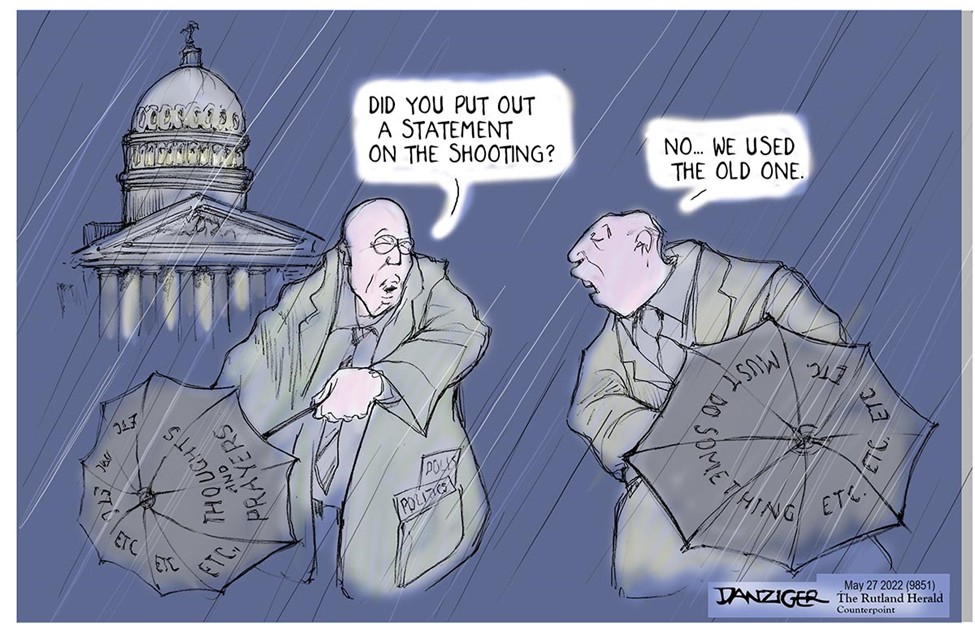
I watched a movie on Netflix last night entitled Miss Sloane. It’s about a struggle by competing powerful lobbyists in Washington over the issue of gun control. At one point during congressional testimony, the protagonist of the movie, Elizabeth Sloane (played superbly by actress Jessica Chastain) tells senators, “Our system is broken.”

Left unasked – and unanswered – was the obvious question: who broke it?

  • Was it the politicians who will do whatever necessary to remain in office?
  • Was it the lobbyists who will go to any ends necessary to win?
  • Or was the voters who are too lazy to examine the issues and to cast their ballots intelligently, without regard to 15-second sound bites, neatly coiffed hair or banal platitudes?