Feeds:
Posts
Comments

Archive for the ‘Public Records’ Category

It looks as though Bobby Jindal’s former commissioner of administration Kristy Nichols will finally have to comply with state regulations. Or maybe not.

The Louisiana Board of Ethics, in typical fashion first put the kibosh on any effort by Kristy Kreme to lobby state government on behalf of her new employer—and then promptly withdrew the opinion.

The board was essentially neutered by Jindal during his rush for ethics “reform” in his first days in office back in 2008. Because of those “reforms,” the board lost considerable steam and all its enforcement powers and it now appears it is missing a spine.

And one has to wonder if the Jindalistas had any influence on the decision to withdraw the unfavorable opinion.

Nichols served as Jindal’s commissioner of administration for three years, from October 2012 to October 2015. Those years were marked by consistent budgetary shortfalls, cuts to higher education and health care, the contentious revamping of premiums and benefits for state employees, retirees and dependents through the Office of Group Benefits and the equally controversial privatization of the state charity hospital system.

She also was sued twice by LouisianaVoice over her failure to produce public records in a timely manner. It was in that area that she enjoyed her greatest success by breaking even. She prevailed in the first lawsuit but lost the second one. She still owes a judgment of $800, plus attorney fees and court costs. She chose to spend even more state money in appealing the decision to the First Circuit Court of Appeal.

She announced in September that she would be going to work for Ochsner Health System as a lobbyist. Well, technically, her new title is vice president of government and corporate affairs. While state law precludes her lobbying the legislative or executive branches for two years, there appears to be no prohibition to her lobbying local governments (parishes and municipalities) on the part of Ochsner.

She contacted the ethics board on Nov. 5 through attorney Kimberly Robinson of the Baton Rouge law firm Jones Walker.

Robinson was recently named by Gov-elect John Bel Edwards to be the new secretary of the Department of Revenue and Taxation.

The board last Thursday (Dec. 17) addressed six specific areas about which Robinson sought opinions. The board shot down four of those and took no position on the remaining two because of what it termed insufficient information, according to Walter Pierce of the INDReporter Web site. http://theind.com/article-22377-Ethics-Board-blocks-Nichols.html

A spokesman for the ethics board, however, told LouisianaVoice on Monday that the opinion has been “withdrawn” and the entire matter re-scheduled for the board’s Feb. 19, 2016, meeting.

The opinion initially would have barred Nichols for two years from:

  • Direct transactions or communications with the Division of Administration;
  • Participating in any transaction, researching or preparing materials for use in or in support of a direct act or communication with a legislator;
  • Communicating or having a transaction with the Department of Health and Hospitals, and
  • Assisting Ochsner in communications or transactions with LSU. The LSU Board of Supervisors currently oversees the public-private partnerships between the state-run hospitals and private health care providers.

There was no immediate explanation of what the remaining two questions from Robinson concerned.

There are several areas of concern in allowing Nichols to lobby state government on behalf of Ochsner, not the least of which is the agreement between the state and Ochsner during her term that allowed Ochsner to partner with the state in running the Leonard J. Chabert Medical Center in Houma.

In 2013, the LSU Board of Supervisors signed off on the contract containing 50 blank pages. That contract handed over operation of state-owned hospitals in Lake Charles, Houma, Shreveport and Monroe. The blank pages were supposed to have contained lease terms. Instead, the LSU board left those details to the Jindal administration (read Commissioner of Administration Kristy Nichols).

Eventually details emerged about the contracts, including that of the Leonard J. Chabert Medical Center in Houma. And, thanks to the Louisiana Public Affairs Research Council, the picture began to come into focus.

Leonard Chabert Medical Center was opened in 1978 as a 96-bed facility with 802 employees but by the time it was privatized, it was down to 63 beds.

In 2008, a hospital-based accredited Internal Medicine residency program was begun. In 2011, the hospital’s revenue was 47 percent uncompensated care for the uninsured, 29.5 percent Medicaid, 13 percent Medicare, 5.5 percent state general fund and 6 percent interagency transfer from other departments with only 1 percent being self-generated.

When the Jindal administration moved to unload state hospitals, Chabert was partnered with Southern Regional Medical Corp., a nonprofit entity whose only member is Terrebonne General Medical Center (TGMC).

TGMC is slated to manage Chabert with assistance from a company affiliated with Ochsner Health System, Louisiana’s largest private not-for-profit health system with eight hospitals and forty health centers statewide. Terms of the agreement call for a five-year lease with an automatic renewal after the first year in one-year increments to create a rolling five-year term.

Though Southern Regional is not required to pay rent under terms of the agreement, the Terrebonne Parish Hospital Service District No. 1 is required to make annual intergovernmental transfers of $17.6 million to the Medicaid program for Southern Regional and its affiliates.

The cooperative endeavor agreement (CEA) calls for supplemental payments of $31 million to Ochsner. Small wonder then that the Houma Daily Courier described the deal as “a valuable asset to Ochsner’s network of hospitals” and that the deal expands Ochsner’s business profile.

Between 2009 and 2013, Ochsner’s revenue doubled from $900 million to $1.8 billion and the deal would mean more revenue for Ochsner, the Daily Courier said. http://www.houmatoday.com/article/20140325/articles/140329692?p=3&tc=pg

There has never been a reasonable explanation as to why the LSU Board signed off on a blank contract that the Jindal administration would fill in after the fact. Was it just by chance that Nichols, as Commissioner of Administration, was responsible for that task? And was it just happenstance that two years after Ochsner received that $31 million, it saw the need to bring Nichols aboard just as her employment with the Jindal administration was winding down?

LSU Board of Supervisors handed over University Medical Center in Shreveport and E.A. Conway Medical Center in Monroe to the Biomedical Research Foundation (BRF) even though the CEO of BRF was a sitting member of the LSU board at the time.

Within two years, that deal fell apart and the board and BRF are now involved in complicated litigation.

Meanwhile, the Center for Medicare and Medicaid Services has yet to approve the Jindal/Nichols privatization plan.


Read Full Post »

LSP TOMMY LEWISTOMMY LEWIS

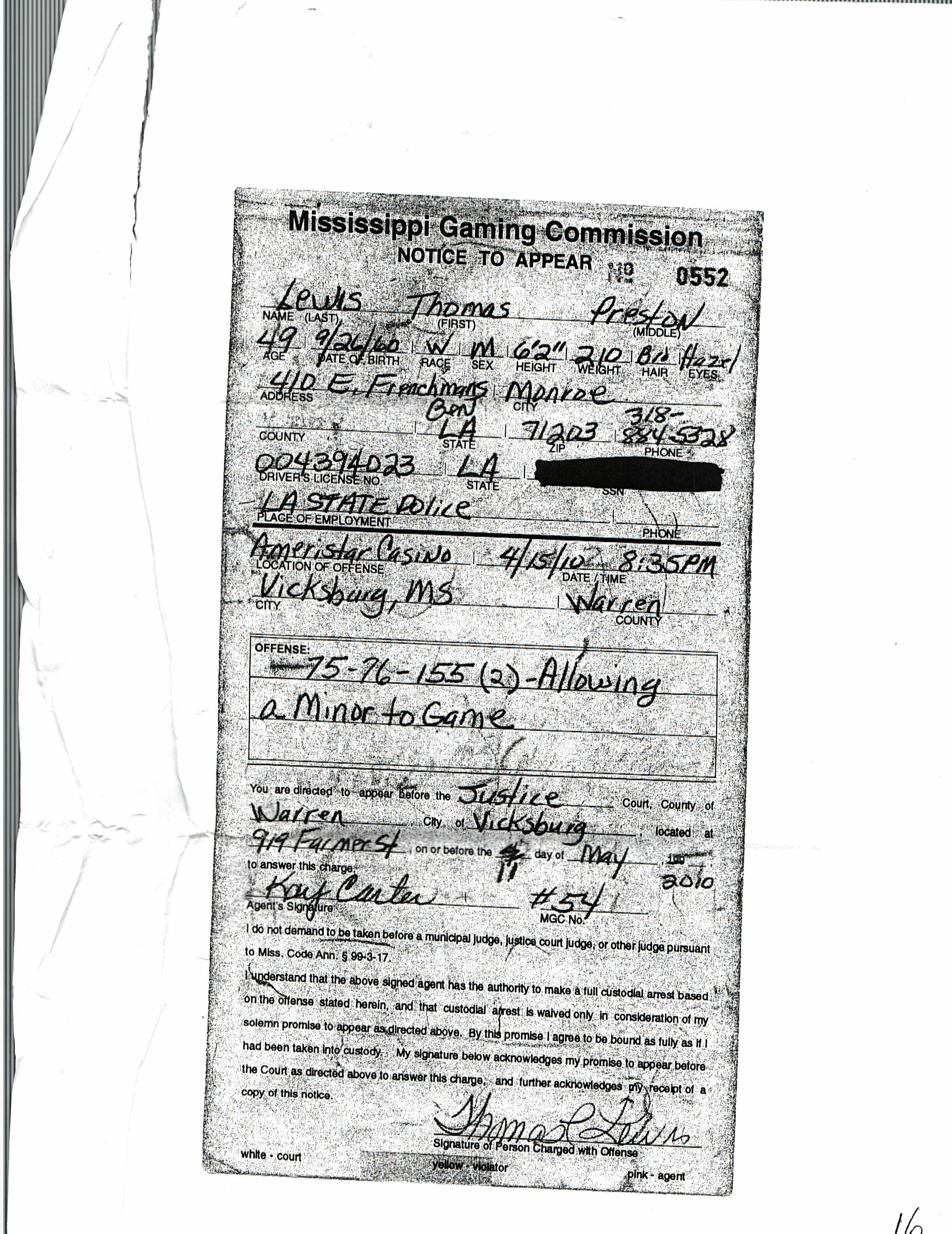
Tommy Lewis, a high-ranking state police lieutenant in Troop F in Monroe was cited by the Mississippi Gaming Commission in April of 2010 for sneaking an underage woman who was not his wife into the gaming area of Ameristar Casino in Vicksburg. He apparently did so in defiance of state law barring anyone under the age of 21 from entering the playing area, according to documents obtained from both Louisiana State Police, the Mississippi Gaming Commission, and from Warren County (Mississippi) Justice Court.

He was subsequently promoted to commander of Troop F by State Police Superintendent Mike Edmonson.

Lewis, who upon being caught, attempted to use his position as a law enforcement officer to “work something out,” was fined $627 by a Vicksburg justice of the peace and was suspended 40 hours without pay by Edmonson.

A trip to Vicksburg by LouisianaVoice turned up nothing. A Helpful deputy we encountered at the courthouse there, however, made several calls on our behalf and learned that the court record had been expunged. But the Mississippi Gaming Commission in Jackson still had records of the citation and Lewis’s court appearance at which he entered a guilty plea. Those documents were mailed to us pursuant to our public records request.

Expunging court records is a costly process. The person seeking the action must pay attorney fees and court costs which, together, can total several hundred dollars.

Three years later, Edmonson promoted Lewis to the rank of captain and named him commander of Troop F. He currently makes $131,000 per year in that position. Lewis was among higher ranking state police officers whom Edmonson assured legislators earlier this year would not be among those getting 30 percent pay increases as a result of two separate pay raise bills for state police passed within six months of each other.

In fact, Lewis, a native of Ferriday and a distant relative of rock and roll singer Jerry Lee Lewis, went from $83,640 per year at the first of the year to $124,150 with the first pay raise on March 1 and then to his current salary on June 24, an overall pay increase of 56.6 percent.

Troop F includes the 12 northeast Louisiana parishes of Jackson, Lincoln, Union, Ouachita, Caldwell, Morehouse, East and West Carroll, Madison, Richland, Tensas and Franklin.

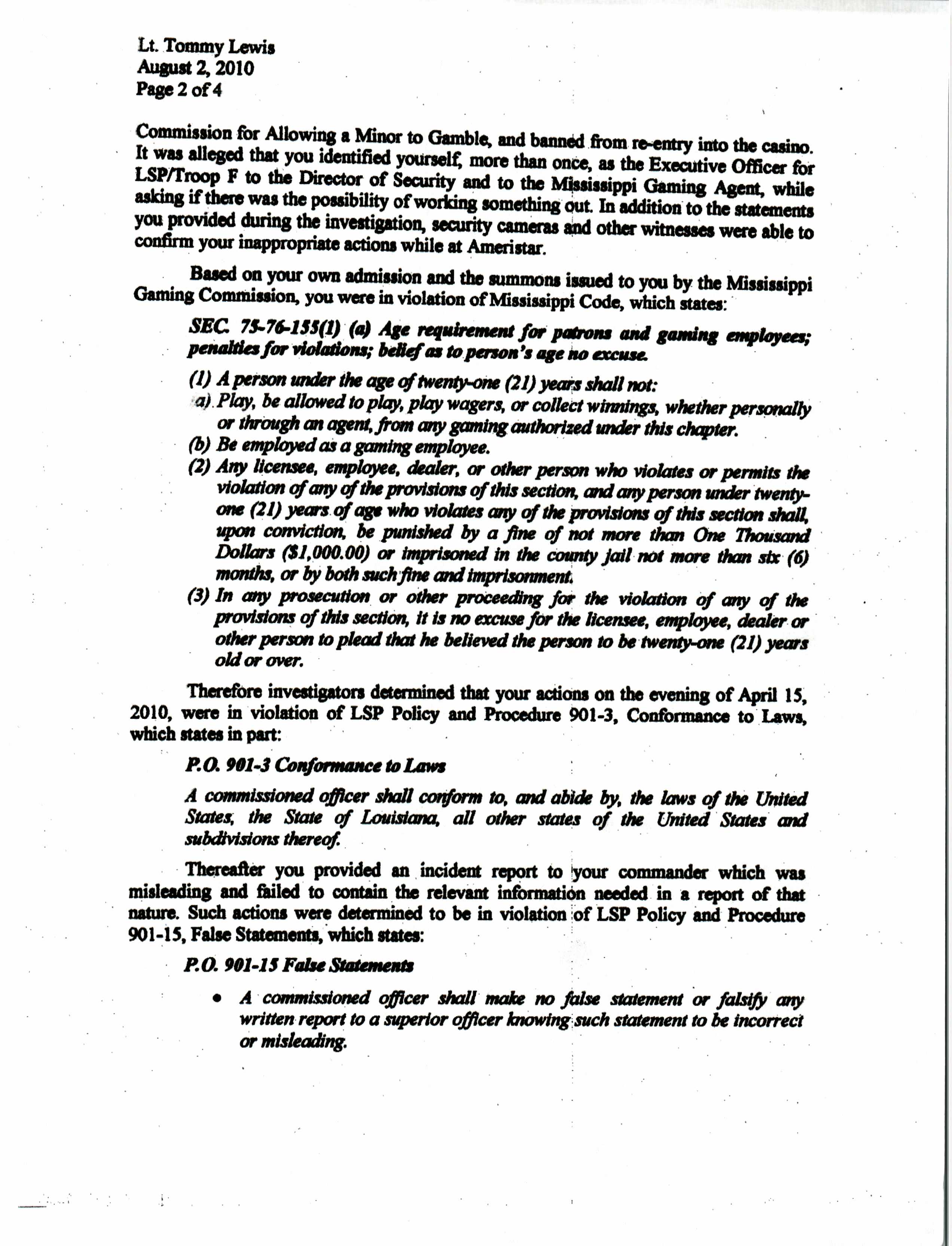
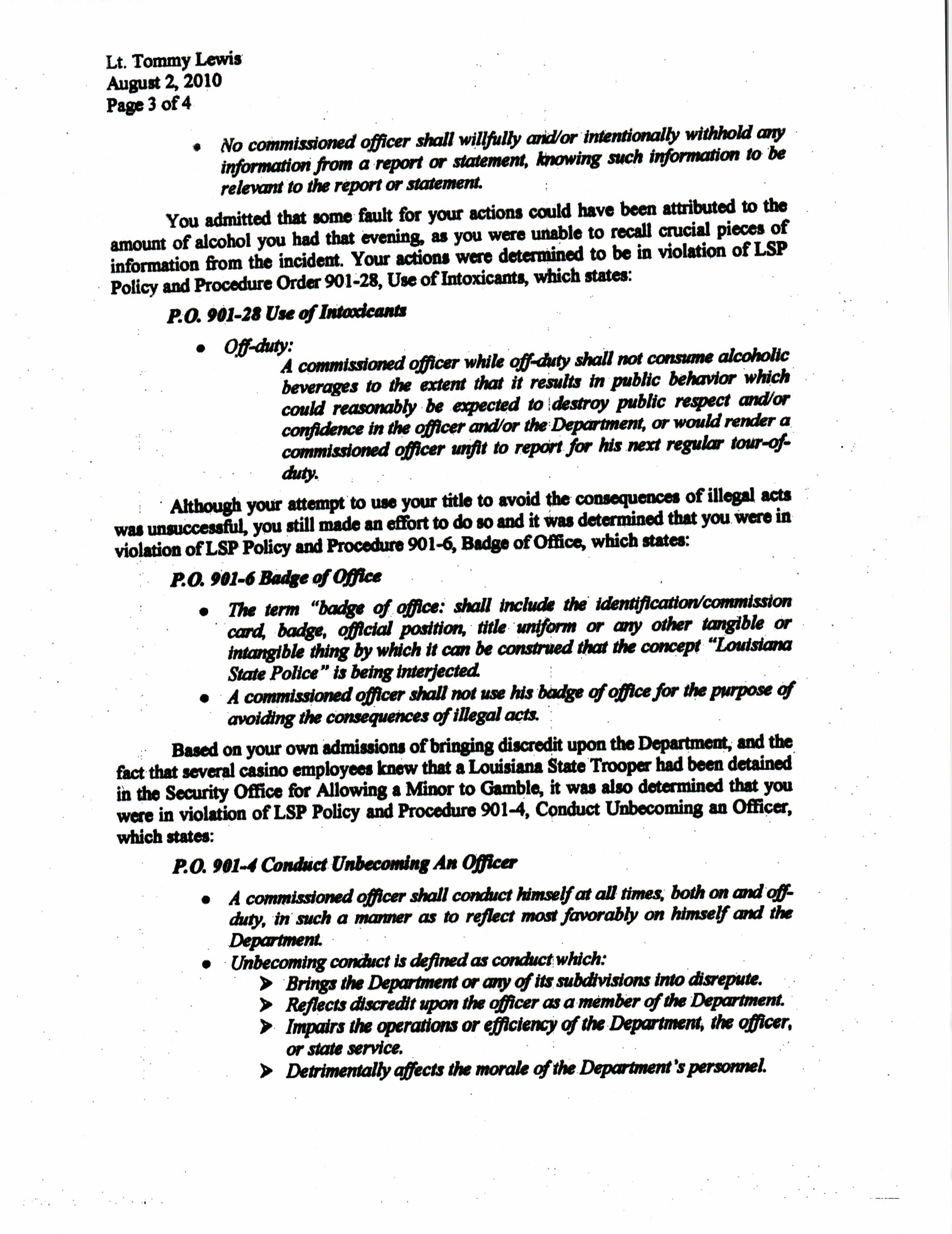
LouisianaVoice obtained a four-page letter of August 2, 2010, in which Edmonson reviewed the events of April 15, 2010, when Lewis, then making $74,200 per year as Executive Officer of LSP Troop F, traveled with seven friends by limousine on a “guys” trip from Monroe to the Ameristar Casino in Vicksburg.

Also obtained were records of the Mississippi State Gaming Commission and Warren County (Vicksburg) Justice Court. Those records were damaged in the mail and at first, only a damaged but empty envelope was received. Days later, the damaged but still readable letter arrived.

Copies of all documents may be examined at the bottom of this story. The damages to the Mississippi documents is readily discernable.

The Edmonson letter further noted that the men were “accompanied by three young ladies hired by the owner of the limo to tend bar during the trip.”

A check of four separate companies in Baton Rouge and New Orleans by LouisianaVoice failed to turn up any limousine services that provide bartenders, female or otherwise. “None of the limo services that I’m aware of provide that service,” said a representative of a New Orleans limo service. “The bars in the limos are very small. That sounds more like escorts than bartenders,” she added.

“Upon entering the casino it was announced that one of the young ladies…was 20 years old and underage, with regard to admission into the casino,” Edmonson wrote. Lewis would have been in his early to mid-40s at the time, according to one source.

Edmonson said Lewis admitted to drinking “during the limo ride and at least two more times in the casino” and that he further admitted that he was aware that the woman was only 20 and that he “accepted the ‘Under 21 minor card’ that was provided for her at the entrance of the casino.

Edmonson said Lewis told investigators that he and the woman “pretended to comply with the security officer’s instructions” regarding the woman’s not being allowed in the playing area of the casino but that the two “had full intentions to enter the playing area anyway” and that they subsequently threw the minor card away “while moving onto the casino floor” with the woman where she proceeded to play blackjack for “a couple of hours” before proceeding to the slot machines “where you inserted money and encouraged her to play the machine.”

Here is where things really got sticky:

After being issued a summons by an agent of the Mississippi Gaming Commission for allowing a minor to gamble and being banned from re-entry into the casino, “it was alleged that you identified yourself more than once as the Executive Officer for LSP/Troop F to the Director of Security and to the Mississippi Gaming Commission agent while asking if there was the possibility of working something out,” Edmonson wrote (emphasis ours). “In addition to the statements you provided during the investigations, security cameras and other witnesses were able to confirm your inappropriate actions while at Ameristar,” he said.

Lewis subsequently “provided an incident report to your commander which was misleading and (which) failed to contain the relevant information needed in a report of that nature,” Edmonson wrote, adding that his false statements placed Lewis in violation of LSP policy which says, “No commissioned officer shall willfully and/or intentionally withhold any information from a report or statement, knowing such information to be relevant to the report or statement.” (Emphasis Edmonson’s).

Edmonson said investigators sustained each of five allegations against Lewis, including:

  • (Failure) of conformance to laws;
  • Making false statements to his commander,
  • Use of intoxicants;
  • (Use of his) Badge of Office (for the purpose of avoiding the consequences of illegal acts);
  • Conduct unbecoming an officer.

“Investigators sustained all five allegations against you,” Edmonson said in his letter. Lewis was also ordered to appear before the Justice of the Peace in Vicksburg, Mississippi, where he was fined $627 for the summons he received from the Mississippi Gaming Commission.

“You are hereby suspended without pay and allowances for 40 hours,” Edmonson wrote. “Your suspension will begin at 0800 (8 a.m.) on Monday, August 30, 2010, and end at 1630 hours (4:30 p.m.) on Friday, September 3, 2010. You will report back to your assigned duty station at 0800 hours on Tuesday, September 7, 2010.

Less than three years later, on July 11, Edmonson promoted Lewis to captain and installed him as commander of Troop F in Monroe in much the same manner that he promoted Lt. Harlan Chris Guillory to captain and made him commander of Troop D after it was learned that Guillory was abusing prescription drugs while on duty. https://www.facebook.com/LouisianaStatePolice/posts/676564355693491


Below are documents from LSP and the Mississippi Gaming Commission received by LouisianaVoice. Click on the documents to enlarge them for easier reading:

TOMMY LEWIS LETTER PAGE 1TOMMY LEWIS LETTER PAGE 2TOMMY LEWIS LETTER PAGE 3TOMMY LEWIS LETTER PAGE 4IMAG1521IMAG1522IMAG1523

Read Full Post »

Now that Bobby Jindal has confronted reality and “suspended” (as opposed to terminated; the two terms are not the same) his moribund presidential campaign, several questions linger about his future and that of his hangers-on, not that anyone in Louisiana—or Iowa—really cares anymore.

There are also questions about how he will dispose of the approximately $261,000 remaining in his mostly depleted campaign fund. http://www.fec.gov/fecviewer/CandidateCommitteeDetail.do

Contributions had slowed to a mere trickle in the last quarter of his campaign which, combined with his inability to climb above 1 percent in the polls, prompted him to finally admit what everyone has known for some time now: “This is not my time.” Hell, even his kids knew that when he staged that creepy announcement to them that he put up on this campaign web page back in June and then immediately took down after national ridicule of the awkwardness of the entire video.

Campaign manager Timmy Teepell apparently remains flummoxed as to why his boy was banished to the standup comedy/concert equivalent of warmup act in the Republican debates. Well, Timmy, it shouldn’t have been a secret to anyone with a clue. Bobby simply had nothing to bring to the table.

So, what does Timmy do now? Given his disastrous handling of a disastrous campaign for a disastrous candidate, it would seem his options in future political endeavors are seriously limited.

As for Bobby, he probably won’t miss a beat. In fact, the rhetoric is not likely to be altered one iota as he eases back into his role as head of America Next, his nonprofit think tank.

He started America Next as a vehicle for all those self-righteous op-eds to support his ultra-right wing exclusionary philosophy that he attempts to pass off as policy papers on issues ranging from immigration to health care to lowering taxes for the rich and for corporations.

Which brings us to the question of what he will do with that $261,000 hanging around in his campaign bank account.

Time was a retiring office holder or losing candidate for office could simply convert leftover campaign funds to his personal bank account provided he reported the money as income and paid income taxes on the money.

No more. But other than that one prohibition, the rules are pretty loose as to what a politician can do with surplus funds.

He can hold on the money in case he ever decides to seek office again or he can contribute to his party or other candidates.

Or he can “donate” the extra campaign cash to his own nonprofit organization. http://www.thedailybeast.com/articles/2014/05/22/ex-politicians-keeping-100-million-in-private-slush-funds.html

Like America Next. http://believeagain.gop/

Or leadership political action committees (PACs) http://classroom.synonym.com/left-over-campaign-funds-after-elections-17435.html

Like Believe Again. http://believeagain.gop/

Both the brainchildren of Bobby Jindal, America Next and Believe Again basically serve the same purpose—to promote the aspirations and agenda of Bobby Jindal.

And, like Dave Vitter’s Fund for Louisiana’s Future (FLF) and Vitter’s campaign committee, the two share a key player. With Vitter, it is Courtney Guastella Callihan who serves as his campaign finance director and as head of FLF.

With Jindal, it’s Jill Neunaber who ran the day-to-day operations of America Next and Believe Again.

“When I say super PAC, how many people think of a nameless, faceless, shady organization that bombards your television with commercials?” Neunaber asked, adding that Believe Again was a “different kind of super PAC.” https://www.washingtonpost.com/politics/inching-up-in-iowa-bobby-jindal-leaves-no-room-on-his-right/2015/10/17/0aea955e-745c-11e5-8d93-0af317ed58c9_story.html

But aren’t nonprofits like America Next supposed to leave the politics to PACs like Believe Again?

Well, yes and no. So, how does one draw the line distinguishing the two?

Nonprofits like America Next which generally support a single candidate have proliferated since the 2010 U.S. Supreme Court’s Citizens United decision. They perform a variety of functions from helping develop polity to underwriting the costs of advertising.

They differ from candidates’ own campaign committees or super PACs in one major aspect: They are not required to publicly disclose their donors.

AMERICA NEXT FINANCIAL REPORT

Even so, the Center for Public Integrity learned that the Pharmaceutical Research and Manufacturers of America (PhRMA) last year contributed $50,000 to America Next. http://www.publicintegrity.org/2015/11/17/18867/drug-lobby-gave-50000-pro-jindal-nonprofit

So, while Jindal the presidential aspirant has faded into oblivion, Jindal the opportunist is alive and well, poised to write even more op-eds that promote the tax, health, education, and economic policies that made his eight years as governor such an unqualified success and which established him as a presidential candidate to be reckoned with and an inspiration to Republicans everywhere.

The obvious next step for him, according to longtime political observer Stephen Winham, is to move for a hostile takeover of The 700 Club from fellow failed Republican presidential candidate Pat Robertson. There may be more than a grain of truth in Winham’s prognostication. After all, he has already gotten his foot in the door with multiple appearances on Robertson’s Christian Broadcast Network (CBN) http://www.cbn.com/tv/1386878899001?mobile=false#

http://www1.cbn.com/content/gov-bobby-jindal-leading-through-crisis

http://www1.cbn.com/cbnnews/politics/2014/April/Bobby-Jindal-Gearing-Up-for-Presidential-Run

http://www.cbn.com/tv/4313608240001?mobile=false

http://www1.cbn.com/cbnnews/politics/2014/August/Growing-Up-Bobby-Jindals-All-American-Dream

We heard a rumor that on one of his appearances, he admonished Robertson’s audience to “stop being the stupid Christians,” but we were unable to locate that link. Nor were we able to find the link to a video taken of Jindal and his family from an overhanging tree limb as he told his children of his plans to succeed Robertson.


Read Full Post »

Imagine your dentist boss comes to you with a proposition:

Why don’t you help the board investigator do investigations for the board of dentistry? You can make some extra spending money by posing as a patient and presenting fake symptoms and false medical histories in hopes of gaining information and diagnosis that could be used against dentists in board hearings. The board can really use your help in putting the bad guys away.

What could go wrong, right? Your boss is a long-time member of the Louisiana State Board of Dentistry. He assures you this is done all the time. He even nicknames you “The Pink Panther” for your investigative efforts. Your thoughts go to all the extra money you will have for Christmas gifts this year.

A similar scenario happened with Karen Moorhead when she worked as a dental assistant for Dr. White Graves, a long-time board member, in Monroe. Moorhead testified that she worked “six or seven” undercover operations for board investigator Camp Morrison. She even testified to working undercover as an employee in an office that was under investigation by the LSBD.

The only problem is that no one told Ms. Moorhead what she was doing was against the law. Louisiana requires anyone getting paid to do undercover investigations have a valid private investigator’s license. Anyone caught doing this type of work without one is in violation of Louisiana criminal law, subjecting the offender for fines of up to $10,000 and up to a year in jail.

R.S 37:3507.2

http://law.justia.com/codes/louisiana/2011/rs/title37/rs37-3507-2

It shall be unlawful for any person knowingly to commit any of the following acts:

(1) Provide contract or private investigator service without possessing a valid license.

(2) Employ an individual to perform the duties of a private investigator who is not the holder of a valid registration card.

http://lsbpie.com/lawregulations.aspx

ETHICS AND PRIVATE INVESTIGATOR LAWS

Ms. Moorhead has found herself a defendant in an ongoing civil trial since 2011 because of this highly questionable and unethical, if not illegal, activity. Instead of hiring an independent attorney, she relied on the attorney provided by the board of dentistry, the very organization that got her in trouble in the first place. In fact, the board had the legislature change the law in order to cover her defense. She now claims attorney-client privilege with the Louisiana Attorney General’s office, and claims insurance coverage underwritten for state civil service employees. Never mind that Moorhead was an independent contractor doing work for a board contractor. Morrison’s contract specifically required him to hold an errors and omissions (E&O) insurance policy for such purposes that indemnifies the state against his actions. One former board member contends that the LSBD has spent over $500k on this suit. (Any state employee who is the subject of a civil lawsuit for actions taken in the scope of his or her employment is entitled to legal representation provided at the state’s expense. In the case of criminal prosecution for job-related actions, the employee may retain legal counsel of the employee’s choice and is entitled to have those legal costs reimbursed in the event of an acquittal. Moorhead, as a contractor, should not be entitled to legal representation provided by the state.)

More troubling, however, is the advice that her attorney has given her. The attorney Professional Rules of Conduct prohibit representing multiple clients when a conflict of interest exists between them. Barbara Melton, law partner to infamous Jimmy Faircloth, is a contract attorney for the board of dentistry—and she is defending both board investigator Camp Morrison and Moorhead at the same time. According to some legal analysts, that’s a major conundrum. One legal expert laid it out like this, “It’s apparent that Moorhead and Morrison may not share the same best interests. If I was hired to do a completely illegal job and was told that it was legal by supposedly reputable people and then found myself sued over it that would be a problem. I wouldn’t hesitate to sue the investigator, the board of dentistry, and possibly the boss that suggested the employment and got me into this mess in the first place.”

However, that’s not the advice that Melton seems to have given her. How could she recommend suing the board of dentistry and Morrison, who are both her clients? That recommendation should be off the table. Because of this conflict and lack of sound advice, Moorhead could find her troubles just beginning.

Several dentists have come together and are planning to file a civil class action suit against the Board of Dentistry and its agents. Moorhead’s involvement in “six or seven” cases, makes her the glue that ties this class action together. Moorhead may also have perjured herself in at least one deposition and during a board hearing. Finally, a recent affidavit from a Kenner dentist and Camp Morrison’s own billing records have Moorhead working undercover in an office that the board was investigating.

Although Moorhead originally bragged about working in this office, her story has changed and she remembers seeking but never being offered the job. This stands in stark contrast to the affidavit and billing records in hand. It’s possible that Moorhead may now risk jail time for perjury and continued ligation from multiple sources. She may have also committed tax fraud by not properly listing the income from these undercover jobs. Many believe the trouble Moorhead may be facing stems from the questionable legal advice she has been given. Meanwhile, the board attorney Barbara Melton has never missed a paycheck. She continues to represent the board of dentistry as a contract attorney.

Moorhead may want to check on her legal options, which some insist should include possibly adding her attorney to the list of people to sue. Moorhead certainly doesn’t appear to be innocent of the claims against her. But instead of stopping and ceasing to dig, her attorney appears to have helped her dig the hole deeper. It now appears to be one which she may not be able to escape.

The question must now be where the Attorney General’s office is in all this mess.

Buddy Caldwell is quick to issue press releases about child porn arrests, consumer fraud and CNSI. But he has been shamefully silent on the issue of going after offending power-mad, ego-driven Board of Dentistry members. These members have repeatedly demonstrated their intent to persecute dentists not in response to legitimate complaints but pursuant to board-initiated complaints generated by investigators and legal counsel. There is more than ample evidence to show that the board is set not on cleaning up the industry but in extracting hundreds of thousands of dollars from dentists denied the opportunity to properly defend themselves before a kangaroo court comprised of the same board members who bring the charges.

And while the attorney general’s job is to represent state agencies, he could be doing the board a service by offering his counsel to refrain from tromping on dentists’ due process rights. After all, should a class action lawsuit ensue, it’s going to cost the state a boatload of money to defend—and to pay any adverse judgment if that is the result. For no other reason than preventive maintenance, Caldwell should be offering his advice.

What has transpired thus far comes nowhere near the concept of due process. An attorney general committed to doing the job he was elected would have addressed this glaring problem long ago.


Read Full Post »

Interspersed in all the venomous political rhetoric in the gubernatorial campaign that is now moving toward its merciful final week are some real issues that affect our lives and which should warrant closer inspection by the voting public.

Unfortunately, given the public’s taste for voyeurism and salacious gossip, that probably won’t happen. Besides, time is short and the sordid half-truths, distortions and details of political black ops are just heating up. There just isn’t time for the things that matter.

But at least one group is taking U.S. Sen. David Vitter to task for a letter he wrote last April to U.S. Army Corps of Engineers Commander Lt. Gen. Thomas Bostick and Assistant Secretary of the Army for Civil Works Jo-Ellen Darcy.

In that otherwise routine five-page letter, dated April 16, 2015, Vitter addressed a number of issues concerning levees, flood control, storm surge protection, past due payments from the Corps to the State of Louisiana for freshwater diversion projects, a request to complete the Southeast Louisiana Urban Flood Control Project (SELA) in Orleans, Jefferson and St. Tammany parishes, deauthorization of the West Pearl River Navigation Project, a request for increased negotiation efforts to approve the Lower Mississippi River Management proposal, and bank stabilization along the Ouachita River in north Louisiana.

Buried at the bottom of page three of the letter was item number 7: Helis Oil and Gas Permit MVN (Mississippi Valley New Orleans)-2013-02952-ETT.

Issue: “The aforementioned permit application is currently awaiting approval within MVN, but has stalled due to several pending lawsuits,” Vitter’s letter said. “The State of Louisiana, Department of Environmental Quality issued the water quality certification (WQC 140328-02) on March 19, 2015. Issuance of the 404 permit is the last remaining action needed to begin construction of the test well.”

Request: “Immediately approve and issue the 404 permit.”

VITTER LETTER TO CORPS

In his April 16 letter, Vitter did what he does best: intimidate with not-so-subtle threats.

“As the U.S. Army Corps of Engineers moves forward with leadership transitions and promotions in the coming months, I’d like to take this opportunity to ensure that you—as the two primary Corps leaders—continue strengthening your commitment to improve communication and issue resolution with non-Federal stakeholders who depend on the Corps to provide necessary flood protection, reliable navigation, and restored ecosystems,” he wrote.

“…However, it’s critical that Corps leadership understand there remain several significant Louisiana issues that need to be addressed and resolved in an expeditious manner. In light of those issues, I can’t support the transition or promotion of new leadership until I know that a constructive approach will be taken to address and resolve these serious problems.”

As if on cue, the Corps on June 8 approved the permit application by Helis Oil & Gas Co. http://www.nola.com/environment/index.ssf/2015/06/wetlands_permit_approved_by_fr.html

Vanishing Earth, a new political blog that concentrates on environmental issues, obtained the Vitter letter to the Corps that contained Vitter’s heavy-handed approach to resolving issues, particularly the approval of the Helis permit.

That permit, since approved, will allow Helis to drill an exploratory well for the purpose of oil drilling and controversial hydraulic fracking in St. Tammany Parish. Parish residents have resisted fracking in St. Tammany and have even filed a lawsuit in district court to stop the practice there because of legitimate concerns about air and water pollution, damage to the aquifer that supplies drinking water, and the industrialization of the parish.

The irony is that St. Tammany is considered a strongly Republican parish and represents one of Vitters’ strongest areas of support.

But, as is always the case in politics, money speaks much louder than loyalty to constituents and Helis has seen to it that Vitter’s campaigns, both federal and more recently, state, are remembered fondly.

On May 8, less than a month after Vitter wrote his letter to the Corps, Helis made a $5,000 contribution to Vitter’s gubernatorial campaign. Additionally, on that same date, Helis CEO David Kerstein made an identical maximum allowable contribution of $5,000. Then, on Nov. 6 of this year, less than two weeks after the first primary, Helis chipped in an additional $5,000. The company also contributed $15,000 in three separate contributions to lieutenant governor candidate Billy Nungesser.

https://coraweb.sos.la.gov/CommercialSearch/CommercialSearchDetails.aspx?CharterID=442768_VAE52


Moreover, Kerstein contributed an additional $7,500 to Vitter’s U.S. House and Senate campaigns from 2000 to 2008, according to Federal Election Commission records. Corporations are prohibited from contributing to federal campaign. http://docquery.fec.gov/cgi-bin/qind/

KERSTEIN, DAVID New Orleans ATTORNEY  VITTER FOR CONGRESS 05/01/00 1000.00
KERSTEIN, DAVID New Orleans SELF VITTER FOR CONGRESS 09/22/03 1000.00
KERSTEIN, DAVID New Orleans SELF DAVID VITTER FOR US SENATE 07/07/05 2000.00
KERSTEIN, DAVID New Orleans SELF VITTER FOR US SENATE 02/21/08 300.00
KERSTEIN, DAVID New Orleans SELF DAVID VITTER FOR US SENATE 02/21/08 2200.00
KERSTEIN, DAVID New Orleans SELF/ATTORNEY VITTER FOR CONGRESS 04/18/01 1000.00

Helis apparently is not an equal opportunity donor; no contributions could be found by the company or its CEO to Democrats John Bel Edwards or Nungesser’s opponent Baton Rouge Mayor Kip Holden.

What David Vitter is essentially saying in his letter to Secretary Darcy and Lieutenant General Bostick is that if they do not perform certain acts, issue the permit, then he will punish them by taking away something of personal value to them which, in this case, are the “transitions and promotions,” wrote Vanishing Earth publisher Jonathan Henderson. “In other words, he blackmailed them.” http://vanishingearth.org/2015/11/05/senator-vitter-corruption-reaches-st-tammany-parish-fracking-fight/

Henderson is encouraging his readers to call on the U.S. Senate Select Committee on Ethics “to immediately investigate Senator David Bruce Vitter.”

Additionally, one source said some residents of St. Tammany were considering filing a complaint with the State Board of Ethics. LouisianaVoice inquired of the state board whether or not such a complaint had been filed. This was the response we received:

In response to your public records request of Nov. 12th, please be advised that all complaints and documents prepared or obtained in connection with an investigation are deemed confidential and privileged pursuant to R.S. 42:1141.4 K&L which also provides that it is a misdemeanor for any person, including the Board’s staff, to make any public statement or give out any information concerning any confidential matter.

LouisianaVoice has begun an investigation into fracking operations in Lincoln Parish as well. Residents there are concerned about the drain on the Sparta Aquifer which supplies drinking water to several north Louisiana parishes. We will bring you more details on those operations as we receive them.

Read Full Post »

« Newer Posts - Older Posts »