An Update — Third Installment
A memorial is not a burial ground
The threat of litigation has finally produced action at the Grant Parish Courthouse. After more than 150 years in which the burial ground of Black men killed in the Colfax Massacre remained unmarked and unacknowledged, the Grant Parish Police Jury authorized what it called a “beautification” project where people can sit and reflect on the events of April 13, 1873.
That is a first step. But beautifying the courthouse grounds is not the same thing as acknowledging, protecting and honoring a burial site. The central problem remains: a Louisiana state district court continues to administer justice at the site of the Colfax Massacre, on and among the unmarked remains of Black men killed there.
A brief refresher
As related in detail in the earlier installments, at least 54 of the Black defenders killed on Easter Sunday, 1873, while defending the Grant Parish Courthouse from what Justice Samuel Alito has referred to as a “white mob,” were buried in a trench adjacent to the courthouse — a trench they had dug as a defensive position against a force attacking under the banner of white supremacy.
The courthouse burned during the battle. After years of dispute over where it should be rebuilt, Grant Parish rebuilt its “temple of justice” in 1882 at the massacre site, on ground the local newspaper described as “baptized in blood.” Subsequent courthouses were built or expanded at the same site.
Bones were repeatedly unearthed there, including during work on the present courthouse in 1965.
As early as 1878, the local newspaper reported that the remains were “in the way” and being “abused” and suggested that they be removed and reburied. That never happened. The Black burial ground was never properly identified, protected or treated as a sacred place. By contrast, the three white men killed in the fighting were memorialized in the Colfax Cemetery by a monument erected in “loving remembrance” to men who “fell in the Colfax Riot fighting for white supremacy.”
From silence to the threat of a lawsuit
I concluded that this situation could not be reconciled with the appearance of fair and impartial justice. A state district court was sitting not only at the site of one of the largest episodes of Reconstruction-era racial violence, but on and adjacent to the burial ground of at least 54 of the Black men killed there.
I wrote more than 40 letters to public officials, bar associations, courts, law schools, religious organizations, civil-rights groups and others asking that the burial ground be acknowledged and appropriately treated. There were some exceptions, but the predominant response was silence. I came to regard the subject as a “third rail.” Some people expressed fear of becoming involved; others did not want to “rock the boat,” believed the political time was wrong, or regarded the massacre as too remote in time — even though some of its victims remain in and around the courthouse grounds today.
It took the threat of a lawsuit
The response changed when I presented the State and Parish with a draft lawsuit naming both as defendants and seeking a declaratory judgment that the site selected for the district court was unsuitable under Louisiana law for use as a state district courthouse.
The reaction was almost immediate. I met with three attorneys from the Attorney General’s office. Communications came from the Grant Parish District Attorney. I met with parish representatives and then addressed the Police Jury in public session.
I presented historical evidence and the account of a living eyewitness establishing that bodies were buried at the courthouse, including beneath the area where the Police Jury meets. I reminded the jurors that bones had been found during construction in 1965 and that the Black burial ground had never been acknowledged or marked. I contrasted that treatment with the Parish’s past financial support for the white-supremacy monument and its payment to remove one of the white dead to the Colfax Cemetery, where his grave was marked and protected.
I asked that the burial site at the west end of the courthouse be identified, marked, protected, maintained and treated as sacred ground under contemporary moral standards and Louisiana law. I also offered to contribute up to $100,000 for appropriate original statuary and a proper marker.
A “beautification project”
The State subsequently went silent. Emails went unanswered and telephone calls were not returned. Several months after my Police Jury presentation, however, the District Attorney informed me that a “memorial/garden” area would be constructed on another part of the courthouse grounds, away from the area where the burial site was known to be.
The Police Jury agenda described the matter only as item 17: “discuss courthouse beautification project.” The minutes stated that jurors discussed a beautification project for the front of the courthouse “to serve as a memorial garden for those who died in the events of April 13, 1873” and authorized the Parish Manager to proceed.
A recording of the meeting provides considerably more context. What was described as “just an improvement project” was discussed with reference to advice from the jurors’ legal team and the possibility that, if the matter went to court, the Parish could lose control over the project. It was also said that their attorney regarded the patio as a step in the right direction, and jurors described what they were doing as a “beginning point.” The cost of the project was projected at $10,000.
The jurors were told that the plaque would read: “In memory of those who died in the events of April 13, 1873, in Colfax, Louisiana. Tradition has it that some of whom remain buried in this area to this day.”
The only news coverage I have located about the Police Jury approving a “memorial garden” appeared on the front page of the September 10, 2026, issue of The Chronicle, Grant Parish’s newspaper of record. Its photograph and accompanying caption are reproduced here because they show both what the Parish constructed and how the project was presented to the public with no mention of the burial ground or the dead buried at the courthouse.
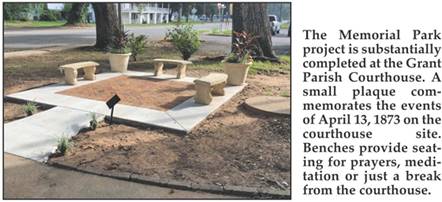
The Grant Parish courthouse memorial project as reported on the front page of The Chronicle, September 10, 2026.
The new memorial, however, is not located at the west end of the courthouse, where human remains were encountered during courthouse construction and where the former “Colfax Riot” marker stood until the State removed it in 2021.
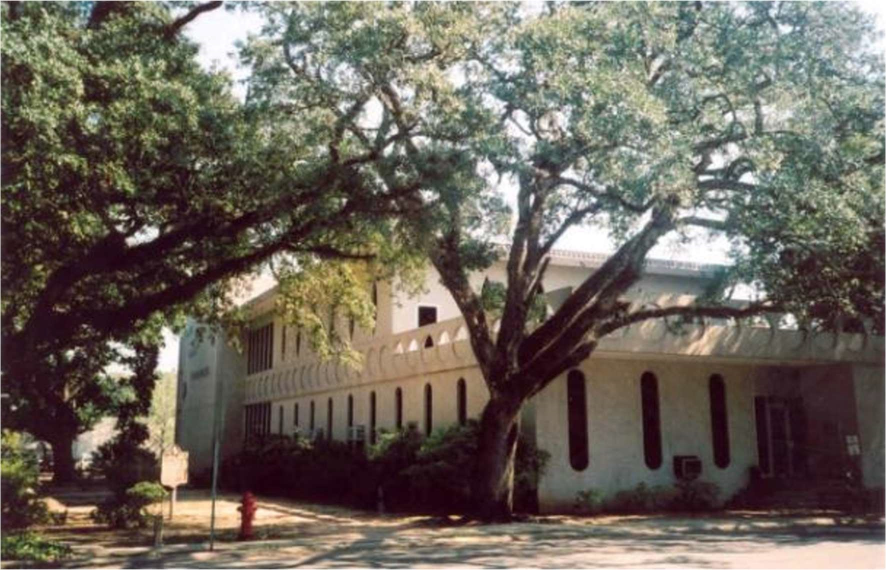
The west end of the Grant Parish Courthouse, where human remains were encountered during courthouse construction. The former “Colfax Riot” marker can be seen to the left of the red fire hydrant. Although the State removed the marker in 2021, this photograph remained on the Grant Parish Police Jury website after its removal. The “memorial garden” is located on the far end of the courthouse. Photograph from the Grant Parish Police Jury website.
A memorial is not a burial ground
Given Colfax’s racial history and the fact that the burial ground has been ignored for more than 150 years, the memorial is a step toward what needs to be done. But it falls far short and misses the central point. Except for the small marker shown in the photograph above, no one would know that the area was meant as a “memorial” rather than a place to sit and have lunch on a pleasant day. The event memorialized—a mass murder of historical proportions—is neither named nor described even though in the past a marker at the courthouse marked the spot, improperly calling it a riot. Those “memorialized” are not identified, and the circumstances of their deaths are not stated. The marker does not even state that the dead buried at the courthouse are Black men.
The burial ground is not directly acknowledged and the ground where the Black dead lie is not identified. Neither the new marker nor the Police Jury acknowledges that the courthouse sits on and among the unmarked remains of men executed in the Colfax Massacre. Most importantly, Grant Parish has not accepted the burial site as a sacred place to be identified, protected and respectfully maintained. That is particularly important in light of the bones repeatedly unearthed during construction projects on the courthouse grounds. The burial site therefore remains unacknowledged and unmarked while a Louisiana state court continues to administer justice at the site of a racial massacre and among the remains of its victims.
Rather than confront the history directly, the Parish’s memorial minimizes both what happened at Colfax and the continuing presence of the mass burial ground at the 35th Judicial District Court.
A local resident wrote to the Colfax Chronicle in the 1950s that the Colfax Cemetery—“this most sacred place”—should be maintained in a manner that showed “proper respect to our dead.” The courthouse burial ground is no less sacred. Yet the Colfax Cemetery contains a 12-foot white marble monument to men who fought for white supremacy, supported by Parish funding, while the Black men killed at the courthouse remain in an unmarked, unprotected and unacknowledged burial ground. The contrast shows how differently the Black dead have been treated from the three White men who died.
Louisiana must make it right
Grant Parish has taken what it describes as a “good step in the right direction.” The State of Louisiana, however, remains largely silent. This is not solely a Grant Parish problem simply because the Parish owns the building. The court in Colfax is a State court exercising the judicial power of Louisiana. The question is whether the place in which that state power is exercised is suitable for the administration of impartial justice. When the appearance of justice is compromised at one district court, confidence in the judicial system itself can be undermined, to the detriment of all.
Governor John Bel Edwards recognized this principle in another context when his administration removed the discredited “Colfax Riot” marker in 2021. Edwards said that leaving the marker in place made Louisiana complicit in sending Black citizens the message: “stay in your place because if you don’t, this could happen.”
The old marker told that story in words. The bodies at the courthouse tell it in fact. Black men killed in the name of white supremacy remain beneath and around a courthouse where Louisiana promises equal justice. Removing the riot marker did not remove that contradiction. So long as the burial ground remains unacknowledged and unprotected, an injustice of the past continues to affect the appearance of fair and impartial justice today.
Some have suggested that the courthouse should be torn down and the court moved elsewhere. I believe there is another course that should be considered. With the agreement of the State and Parish, the Louisiana Supreme Court should appoint an independent commission of men and women of good will, including representatives from Grant Parish, to determine how the burial ground should be identified, marked, protected, maintained as sacred ground and appropriately memorialized.
Lack of money should not be an obstacle. I remain willing to contribute up to $100,000 toward an appropriate marker and original statuary.
What is needed now is not another effort to beautify the courthouse grounds. It is time for Louisiana to acknowledge the burial ground, honor the dead and make it right. So long as the burial ground remains unacknowledged and unprotected, Louisiana remains complicit in sending Black citizens the very message of the massacre that Governor Edwards condemned: stay in your place.
Charles R. Moore
Mr. Moore requests comments and suggestions about what further action might be taken. He can be contacted at crm@CharlesRMoore.com.
Discover more from Louisiana Voice
Subscribe to get the latest posts sent to your email.






Leave a Reply