When you dot every i and cross every t and still cannot get authorities to give your complaints serious consideration, you have to wonder what the purpose might be in establishing an avenue to register complaints in the first place.
Cases in point: the Louisiana Attorney Disciplinary Board and the Office of the Disciplinary Counsel.
Without advocating for one party or the other, it just seems when a party to a legal dispute has what appears to be a legitimate concern, there should be a legitimate response—like a real inquiry into those concerns as opposed to a superficial one-size-fits-all dismissal with no resolution of the perceived problem.
In the matter of Ragland v. Ragland, it appears that repeated (4) requests for and (4) granting of continuances at considerable attorney fees to Katherine Ragland would merit more than cursory rejections by the disciplinary counsel’s office of Ms. Ragland’s complaints of unnecessary and costly delays in her case, not to mention the continued smearing of her character.
To her most recent complaint, the response said, in part, “Our burden of proof is clear and convincing evidence…”
“Clear and convincint evidence?” It would seem that would not necessarily be a prerequisite for an investigation of the complaint; that, I was always taught, was a requirement of an actual conviction. And without an investigation, there’s not much chance of a conviction.
Perhaps that’s the objective; avoid serious investigations to avoid the nasty process of embarrassing a fellow member of the bar.
The background of this case is extensive and, admittedly, complicated, but essentially, Ms. Ragland is contending:
Attorney Ebony Cavalier repeatedly appeared on behalf of the IRIS Domestic Violence Intervention Center “and requested continuances resulting in renewed temporary restraining orders (TROs) remaining ‘in full force and effect’” despite an IRIS spokesperson’s assertion that the agency was in no way involved in her case and that Cavalier’s participation was merely a “courtesy to the court” for docket-management purposes.
“This contradiction is extraordinarily serious,” Ms. Ragland wrote. “IRIS Domestic Violence Intervention Center is not an ordinary private entity. It is a specialized domestic violence organization carrying institutional credibility, implied expertise, victim advocacy authority, and perceived professional evaluation regarding allegations of abuse. Accordingly, repeated official representations that an attorney was appearling “on behalf of IRIS” in domestic abuse TRO proceedings naturally conveyed to the court, opposing parties, appellate courts, and the public that an independent domestic violence organization had some substantive basis for participating in, supporting, or legitimizing continuation of the TRO proceedings. ‘Under Louisiana law, continuances extnding TRO proceedings require “good cause.” The repeated use od ITIS’s name and institutional status in connections with continuances and TRO renewals created the appearance that an independent domestic violence organization had reviewed he matter and supported continuation of amergency abuse-related resrictions, when representations asserted IRIS was not actually involved in the case in any substantive capacity. This conduct materially prejudiced me, contributed to the prolonged continuation of TRO restrictions, reinforced abuse allegations through institutional appearance rather than competent evidence, and contaminated both the trial court and appellate record with the false appearance of independent domestic violence agency involvement.”
Ms. Ragland also wrote, “These repeated appearances and requests for continuances became part of the permanent appellate record. Accordingly, the repeated representation that Ebony Cavalier was appearing ‘on behalf of IRIS Domestic Violence Intervention Cener’ was not an isolated clerical issue. It became embedded in the official procedural history of the case and was later repeated and reinforced by the appellate court itself.”
Back to that “burden of proof”: It would seem if the Office of the Disciplinary Counsel wanted some sort of proof, it needed only consult the court records. Instead, Ms. Ragland received a four-paragraph letter that said, among other things, “The ODC appreciates your concern for the maintenance of professional standards by all attorney in our state…” In other words, take a hike.
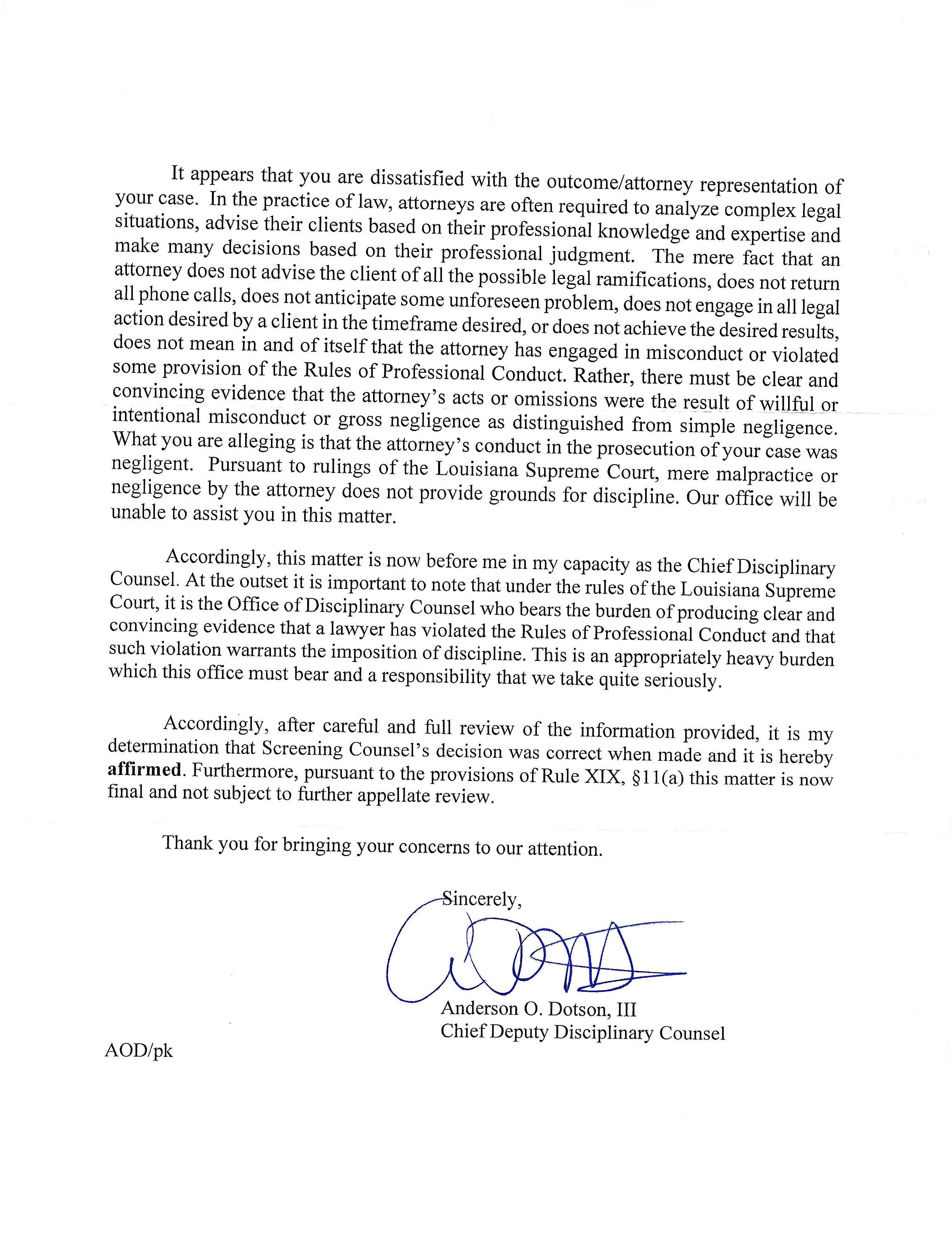
She received a similar generic rejection from the Louisiana Attorney Disciplinary Board’s Chief Disciplinary Counsel Anderson O. Dodson, III who was kind enough to include Supreme Court Rule XIX, which said in part (in boldface type), Objections to screening decisions shall be reviewable by the Chief Disciplinary Council (Dotson, III), but are within counsel’s discretion and not otherwise subject to appellate review.”
Dotson III then took the occasion to lecture Ms. Ragland as though she were a toddler:
LouisianaVoice has from time to time questioned the interminable delays, the appearance of bias against or for certain attorneys in family court and the unwillingness of some judges to hear both sides of an issue before making decisions that seem to defy all logic.
This brief record of Ms. Ragland’s frustrations and the offhand manner in which the disciplinary board and disciplinary counsel treated her complaints, no matter how well-constructed they might be, only reinforces the appearance that protection of their own is of paramount concern to the board—even at the expense of emotionally and financially-strapped victims of the courts.
The exchange is enough to prompt this question:
If a detailed, item-by-item complaint outlining the sequence of events in minute detail is not sufficient to warrant a full-scale investigation, just what are the criteria for action?
Discover more from Louisiana Voice
Subscribe to get the latest posts sent to your email.






Leave a Reply