As a followup to the story about the prospects of a data center coming to the Walker area and the manner in which it was approved by the Livingston Parish Council, some additional information is in order.
At least one member of the council is now claiming he never signed a nondisclosure agreement in connection with the rezoning of 691 acres south of Walker ostensibly to the location of a data center controlled by Microsoft.
Significantly, this member, at the same time, never conceded to either being unaware of what the rezoning was for or being told what it was for and not informing constituents. We sent him two messages on Monday, one saying it was urgent that he contact LouisianaVoice but he never called back.
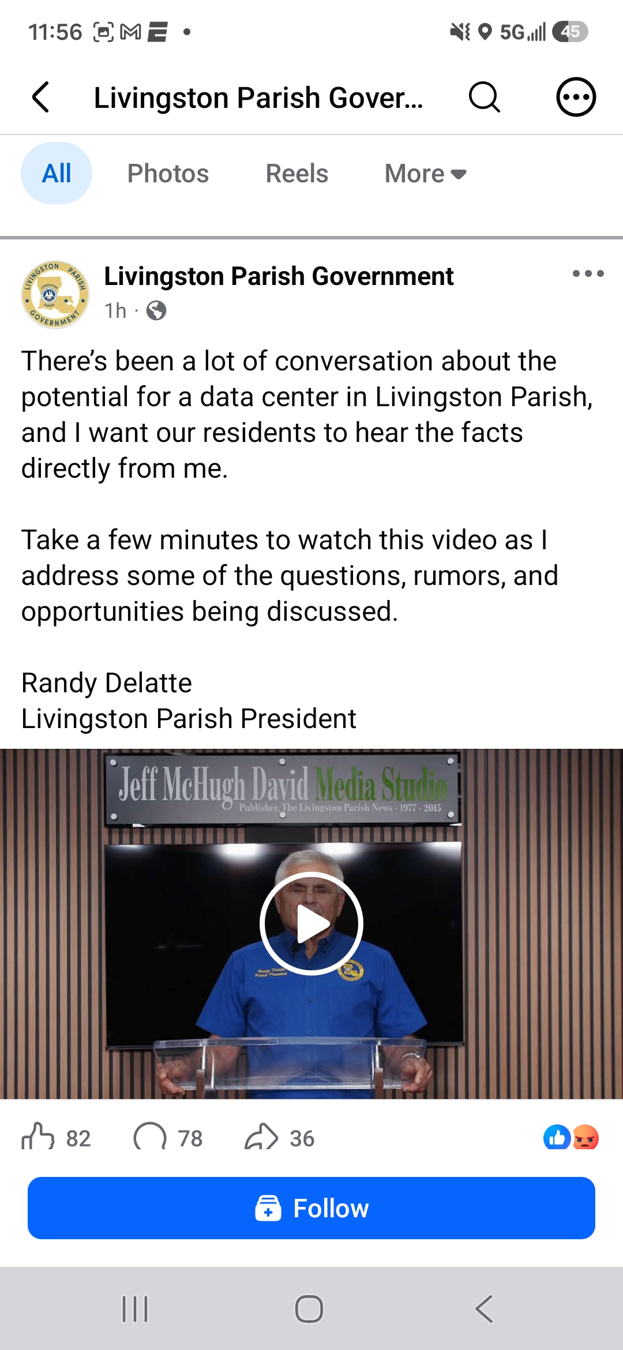
Likewise, Parish President Randy DeLatte posted a Facebook denial/confirmation of the data center while also denying he’d signed an NDA. In fact, he said, “To my knowledge, no elected official in Livingston Parish has signed one regarding a business coming here.”
Council member Ricky Goff said at a november 2025 meeting of the parish zoning commission that he had signed an NDA.
While not admitting that a data center was in the parish’s future, he did nevertheless eerily parrot Donald Trump’s pitch for data centers. Both called them matters of national security and both invoked China in citing the need for them. “President Trump has made AI a national priority,” he echoed. “This is about our economic security. I Believe Livingston Parish should have a seat at that table.”
What he did not say was on average, RESIDENTIAL ELECTRICITY COSTS nationwide have risen by 42 percent over the past five years and while data centers aren’t the only reason for that, they’ve been a major driver in some places where costs have risen the most.
That Meta Hyperion data center in Richland Parish, for example, will pull some 2 gigawatts of power—and it’s ONLY THE 29th-LARGEST datacenter in the nation. There are a couple in Utah and Ohio that will have a capacity of 10 GW each. To put that in perspective, one megawatt is sufficient to meet the power demands of about 1,000 homes. A gigawatt is 1,000 megawatts.
We don’t yet know the size of the one coming to Livingston Parish nor do we know the gigawatt demand for power.
But here’s the thing: There was a wall of silence that shielded this project from the public. Did any of the council members or DeLatte, know in advance what the proposed purpose of the tract was before agreeing (unanimously) to the zoning change for the property? For that matter, did any of the members of the parish zoning commission know what was in store for the property?
If so, there had to be some sort of agreement (formal or informal—it doesn’t matter) between parties to keep a tight lid on all details. That would mean some sort of arrangement was made in secret in advance of decisions to rezone the property from residential to heavy industrial use.
Under Louisiana’s OPEN MEETING LAW (LA. R.S. 42:14(A), every meeting of a public body “shall be open to the public” and public bodies cannot use proxy voting or secret ballots to avoid transparency.
There are exceptions for executive sessions, BUT there must be a two-thirds vote of members president during an open meeting before a public body may enter into closed session. Once in executive session, no action may be taken by the body; it must re-enter open session before taking any action.
Any discussion about a project such as this data center should never have been held by council members or zoning commission members without convening public sessions. To do so behind a veil of secrecy, whether an NDA is signed or not, is a violation of the law.
Oh, there were “public hearings” in both instances—on votes by the zoning commission and the parish council. But there was scant information available to the public for there to be any “public hearing” of real substance. It’s difficult to hold a public hearing when the public is kept in the dark. No disclosure meant no questions from pesky citizens wanting information.
Moreover, a request was made by LouisianaVoice of the Livingston Parish Council on Monday for a copy of any NDA signed by members or by DeLatte. We were told, incredulously, that any such document would not be in possession of the parish council but instead, would be held by the party with whom such NDA was agreed. Whether that was intentional or not, it appeared to be some type of admission that NDAs do exist somewhere.
This is incomprehensible and strains credulity, to say the least. An NDA is a contract and in the case of signing any contract, it would be unthinkable for all parties not to have a copy of the document.
Discover more from Louisiana Voice
Subscribe to get the latest posts sent to your email.






Tom “Fake News” Aswell strikes again. Your nurse needs to bring you a little extra oatmeal tonight to help with that quickly fading mental capacity of yours.
Gee, thanks, Ron (or whatever your real name is). It’s not so bad having a “fading mental capacity.” I get to plan my own surprise parties, hide my own Easter eggs and I meet new friends every day. But you’re wrong about the oatmeal. Don’t like it.
This is NAUSEATING.
Thanks Tom, now I understand the old term, about a dummy, as in all Repugs, “bet his brain would not lite up a 10 watt bulb…..”