Meet West Monroe’s version of Donald Trump:
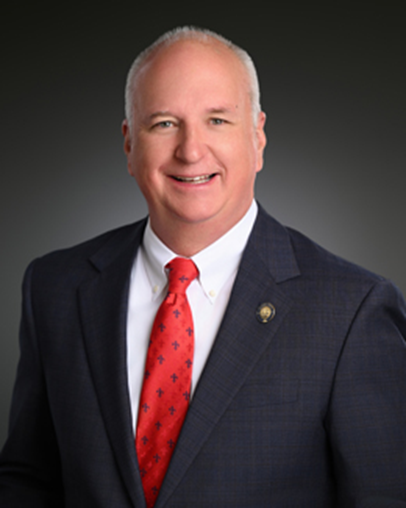
State Sen. John C. “Jay” Morris (R-West Monroe)
State Sen. John C. “Jay” Morris may not be a billionaire, he’s not POTUS and there’s no evidence he’s a philanderer.
But he is a member of the Trump Party (formerly called the Republican Party) and he seems to have this thing about wanting to suppress/dilute/eliminate the African-American vote and to carry out a political vendetta-type campaign against the (Orleans Parish, at least) judicial system.
And there is enough circumstantial evidence—despite his claims to the contrary—that he used his office as a state senator to his financial benefit and that he sponsored (and voted for) legislation that worked to strengthen his bottom line. There was enough smoke to attract the attention of Britain’s most prestigious publication, THE GUARDIAN, which boldly goes where most Louisiana media dare not go.
Call it business smarts or opportunism or even brazen insider-trading, but don’t call it coincidence.
It can’t be all happenstance that Morris:
- Signed on as co-sponsor to a pair of senate bills that would make him even richer;
- That he co-sponsored legislation that freed up a state agency to enter into deals that would benefit him financially;
- That he lobbied the Public Service Commission for approval for Meta to build one of the largest datacenters in the world in Rayville, just outside his senatorial district;
- That he neglected to inform anyone of his business connections to the legislation;
- That he would subsequently become a vendor for one of the entities he lobbied for, making him even more money in the process.
So, the skeptic might ask, why would he co-sponsor legislation in another senatorial district?
Well, you see, there’s this one last thing: he owns a lot of land over in Richland Parish and he’s been buying and selling acreage to all the right people since the datacenter project began. In fact, much of it (80 acres, in fact) is just across the street from the project site. Less than two months after Morris signed the deed to purchase the land, a senate committee he sits began considering a second bill that would give the Louisiana Economic Department the authority to sell state-owned property and within a month or so, Morris had signed on as cosponsor and voted for passage of the 2024 bill. That was SB 494 by Sen. Beth Mizel (R-Franklinton). The bill had smooth sailing in the HOUSE, passing by a 91-3 vote and by a unanimous 37-0 vote in the SENATE and Gov. Landry signed it into law (Act 590).
Morris, undeterred by the appearance of impropriety, instead of recusing himself, voted for both bills despite his business interests in their passage. He subsequently monetized the deal even more by turning the property into a dirt quarry for use on the Meta job site. Wow. How fortunate for him to have been in the right place at the right time.
During the entire process of legislative proceedings, Morris never once mentioned that he had a financial interest in what was—and is—the state’s largest economic development project. “A lot of my colleagues know that I have land holdings in Richland Parish, some of which are near the Meta site,” Morris sniffed. But no…I didn’t put it in the record and announce it. But there was nothing to require me to do that and I don’t know why I would need to do that.”
Wait. What? “A lot of his colleagues” knew of the connections and yet no one in the Loozeraner Legislature asked a single question about what appears to one important person to be an obvious conflict of interest. That speaks volumes about the ethos of his “colleagues” and sounds very much like the way Republicans in Congress address the ethical lapses of Trump. Funny how that works. Must be a Republican thing—or maybe just a Louisiana thing.
La Koshia Roberts, a former chair and the longest currently-serving member of the Louisiana Board of Ethics which investigates potential ethical misconduct by government officials (investigates, yes, but does nothing for the most part since being rendered virtually powerless by former Gov. Bobby Jindal way back in 2008), said, “The fact that he actually voted and didn’t recuse himself is a major concern of mine. He should not have voted for it.
Morris even reached way back to the mid-29th century when he described those who have complained about dust from the construction project as being “from out of state” a-la local politicians’ claims of “outside agitators” during the Civil Rights struggles of the 1950s and ‘60s.
Morris lobbied PSC member Jean-Paul Coussan for approval of a $3.2 billion plan by Entergy to construct 100 miles of high-voltage transmission lines for the datacenter. The commission approved Entergy’s proposal by a 4-1 vote and four weeks later, Morris and his business partners signed agreements to sell nearly 300 acres to Entergy for construction of one of the company’s methane-fueled power stations for the datacenter which is named Hyperion.
Morris said he didn’t reveal his dealings with Entergy “because I was under an NDA (nondisclosure agreement).”
Well, that’s a pretty convenient escape hatch.
That, of course, is the very purpose of NDAs: to shield the activities of public officials from public scrutiny—and sadly, it’s working.
NDAs have increasingly become a sore point with Louisiana voters and a state district judge recently ruled that Ascension Parish must open its NDAs for public disclosure, a decision that is being appealed. The fact that they hide from public view agreements such as that between Morris and Entergy and his property investments with the datacenter is the driving force behind the opposition to the documents which state and local officials have signed in every one of the state’s 64 parishes.
Morris, if you will recall, is also the one who has introduced the new congressional redistricting map that eliminates one of the state’s two Black congressional districts, diluting African-American representation to one-sixth of the state whose population is one-third Black.
He likewise is the senator who introduced legislation to reduce the number of judges and to eliminate one elected clerk of court position in Orleans Parish despite being located some 300 miles from New Orleans.
Both The Guardian and The Illuminator are exemplary in what real investigative reporting should be and in their coverage of the dark underbelly of Louisiana politics. Good to know that outstanding journalism still exists.
Discover more from Louisiana Voice
Subscribe to get the latest posts sent to your email.






Leave a Reply