Feeds:
Posts
Comments

Archive for 2015

For a time, when Bobby Jindal or some other nut case Republican like Todd Akin opened their mouths, each utterance was more outlandish, more implausible than the last.

No more.

Even with Donald Trump, it appears we have reached a saturation point in absurdity with their inane rhetoric that plays to their constituency but does nothing to solve real problems. I mean, a wall constructed along our southern border? Seriously, Donald? When we have crumbling infrastructure (as already pointed out by Goldie Taylor, writing for http://bluenationreview.com/u-s-bridges-and-roads-are-failing-but-trump-wants-to-build-you-a-great-wall/), you want to build a wall?

It was kind of funny when Dan Quayle had a student add an “e” onto potato back in 1992. Reporters had a field day with that. Even though he was the incumbent vice-president under Bush, they lost that election to Clinton-Gore. The student, William Figueroa, then 12, spoke with wisdom beyond his years when he later commented that rumors that Quayle was an idiot were true.

Then there was that inconceivable claim by Todd Akin, the Republican running unsuccessfully for the Senate in Missouri back in 2012. Akin actually went on record as saying women who are raped cannot become pregnant. The full quote: “From what I understand from doctors, that’s really rare. If it’s a legitimate rape, the female body has ways to try to shut that whole thing down.”

He was defending his anti-abortion position and while there are those who hold to the belief that life is sacred, that has to be one of the strangest defenses of a religious tenet on record. (There are some who, weighing the GOP’s general antipathy toward helping those less fortunate, say that Republicans believe life begins at conception and ends at birth.) Akin was ahead in the polls at the time he made his ill-fated observation but that gaffe cost him the election.

But for the most consistent blathering of pure banal nonsense while on the campaign trail to oblivion, you have to hand the trophy to Bobby Jindal. No one does it better. The man obviously has never learned to heed the sage advice that when you find yourself in a hole, quit digging.

From his European “no-go” zones to his letter to President Obama in which he attempted to press Obama to delete any mention of global warming in his upcoming New Orleans speech to commemorate the 10th anniversary of Hurricane Katrina, Jindal has been a most unfunny joke.

He has even gone so far as to criticize the use of private emails by Hillary Clinton while requiring his staff to use private email accounts and even passing a law that closed off any semblance of transparency for his office. Granted, U.S. State Department classified emails are a tad more serious than those of a governor but perhaps Jindal would’ve been wise to let that one slide.

Let’s face it, folks, he makes Quayle look like a towering intellect, Trump like the epitome of reason, Hillary like a paragon of honesty, and Akin like….well, never mind. We really don’t have a comparison for that one other than to observe that Jindal pleads ignorance on the subject of evolution because he is “not a scientist,” despite holding a biology degree from Ivy League Brown University that says he is.

On the one hand, Jindal tells us he hid in a closet with a flashlight to read his Bible while in high school so his parents would not know of his conversion from Hindu to Christianity. On the other, he tells his adoring audiences in Iowa, “One of the things my dad told me every day was, ‘You should thank God every day you were born in America.’”

So, Bobby, if that’s the case, why didn’t you just come out of the closet?

If we didn’t know better, we might well believe the entire presidential campaign for both parties is being scripted by Mel Brooks. And who knows? Maybe all we need to round out the race is Gov. William J. Le Petomane.

One thing about Bobby Jindal, though. When he gets on one of his asinine rhetorical crusades, you couldn’t drag him off with a team of Budweiser Clydesdales. Our hyphenated-governor (as in part-time hyphenated) wants to eliminate hyphenated-Americans. “We’re not Indian-Americans or African-Americans or Asian-Americans,” he insists. “We’re all Americans.”

Well, Bobby, all those Indian-Americans who poured cash into your gubernatorial campaigns in the fervent hope that you would be their voice have turned their backs on you because you walked away from them first. You have alienated an entire bloc of voters and they’re not without influence—or money. But their campaign money has dried up for you. Like it or not, they are were your identity. But you lost your 2003 race for governor because the good Protestants of north Louisiana wouldn’t vote for you because of your dark skin and that, admittedly, was a poor reason. So your solution was to whiten your image right down to your official portrait hanging in your office and in the Old State Capitol and preaching the white gospel of smug superiority.

Now you’re running around hitting all 99 Iowa counties saying things like, “Immigration without assimilation is invasion” and “We’re not a melting pot anymore.” You say immigrants should “learn English, adopt our values, roll up your sleeves and get to work.”

That last part would fall under your definition of “American Exceptionalism,” I suppose. That would be where we embrace such idealistic values as instigating the war with Mexico so we could grab South Texas and herd Native Americans onto barren reservations in the name of Manifest Destiny. Or maybe it was the provoking of the Spanish-American War or the manufacturing of the Gulf of Tonkin Incident so as to give us a reason to plunge full-bore into a civil war in Vietnam where we had no business being and where we sacrificed 58,000 American lives and millions of Vietnamese lives.

And speaking of Vietnam, our friend and fellow Ruston native, retired newspaper editor Bill Brown posed an interesting question on Facebook today: Why is it, he asks, that the same people who wanted so badly to send draft resisters to prison for breaking the law during the Vietnam war now want to defend a Kentucky clerk of court for defying the law?

Perhaps Jindal’s idea of “American Exceptionalism” extends to the quagmire we’ve gotten ourselves into in the Middle East. Refresh me: whose side are we on this week? I support our military but I can’t support the politicians who send young men and women into conflict to die for oil and Haliburton. That’s not my definition of patriotism. And when the wounded return, they’re discarded like last week’s newspapers. Don’t believe that? Google the problems and delays in obtaining care for wounded veterans at VA hospitals.

American Exceptionalism is just another term for tunnel vision or blind, unquestioning faith in the motives and morals of our elected officials who buy their way into office on the bankrolls of corporate interests, defense contractors, Wall Street and lobbyists while doing everything possible to destroy labor unions and social services. American Exceptionalism is spending enough on the trouble-plagued F-35 fighter jet to have purchased a $600,000 house for every homeless American or to send thousands of low-income kids to Harvard. American Exceptionalism is screaming to the mountain tops about socialized health care when the real problem is socialized wealth care.

As for Jindal’s admonition to immigrants to adhere to the other two conditions—“learn English” and “roll up your sleeves and get to work,” consider this:

Perhaps, in applying those principles across the board, we should all be speaking Iroquois, Apache, Comanche, Cree, Sioux and other native tongues while hunting bison and making birch bark canoes and respecting the land and our natural resources.


Read Full Post »

Even as grieving friends, relatives and fellow state troopers were gathering to say goodbye to slain Troop D State Trooper Steven Vincent in Lake Charles last weekend, a State Police Internal Affairs investigation was well underway into alleged payroll irregularities on the part of Troop D Commander Capt. Chris Guillory.

One report received by LouisianaVoice indicates that Guillory reassigned a supervisor to administrative duties after he and his subordinates declined to participate in what they felt was payroll fraud stemming from travel to Baton Rouge for new firearms qualification.

Meanwhile, a potential confrontation between Guillory and the man who filed a complaint against him was averted when a sheriff’s deputy escorted Dwight Gerst from a visitation for Vincent at the Rosa Hart Theater at the Lake Charles Civic Center on Friday, Aug. 28.

Gerst, who was friends with and who was trained by Vincent, attended the wake but said he was cursed by Guillory while he was standing in line and a sheriff’s deputy subsequently escorted him from the visitation. “I was there to honor and pay my respects to a friend,” Gerst said.

LouisianaVoice published a story on Aug. 17 about Guillory’s refusal to accept a formal complaint about threats Gerst said Trooper Jimmy Rogers made against him. Gerst then took his complaint to State Police headquarters in Baton Rouge but it was never followed up by Baton Rouge, he said.

But now, Internal Affairs is conducting what appears to be a full-blown investigation into a number of allegations involving Guillory, including but not limited to the payroll irregularities and prescription drug abuse.

One of the payroll issue stems from a trip Troop D troopers made to Baton Rouge earlier this year to qualify with new weapons issued the troopers. LouisianaVoice has learned that troopers were instructed to charge extra hours for the round trip and time spent qualifying.

Guillory is said to have reassigned one supervisor to administrative duties after he and his subordinates declined to participate in padding their time sheets.

LouisianaVoice in late July made a public records request of State Police for an opportunity to review all time sheets for the pay period that Troop D personnel traveled to Baton Rouge to fire the newly issued weapons.

On Aug. 18, State Police Attorney Supervisor Michele Giroir notified us by letter that the time sheets, along with numerous other requested public records had become the subject of an ongoing investigation being conducted by Louisiana State Police. “Therefore, these records are not subject to release at this time,” Giroir wrote.

It appears the request by LouisianaVoice for the records sparked the investigations into the suspected payroll irregularities. Reporting sources indicated they had not wanted to take information to LouisianaVoice but did so after reporting the problems internally only to see the investigation focus more on discovering the source of the reporting than in identifying and stopping misconduct.

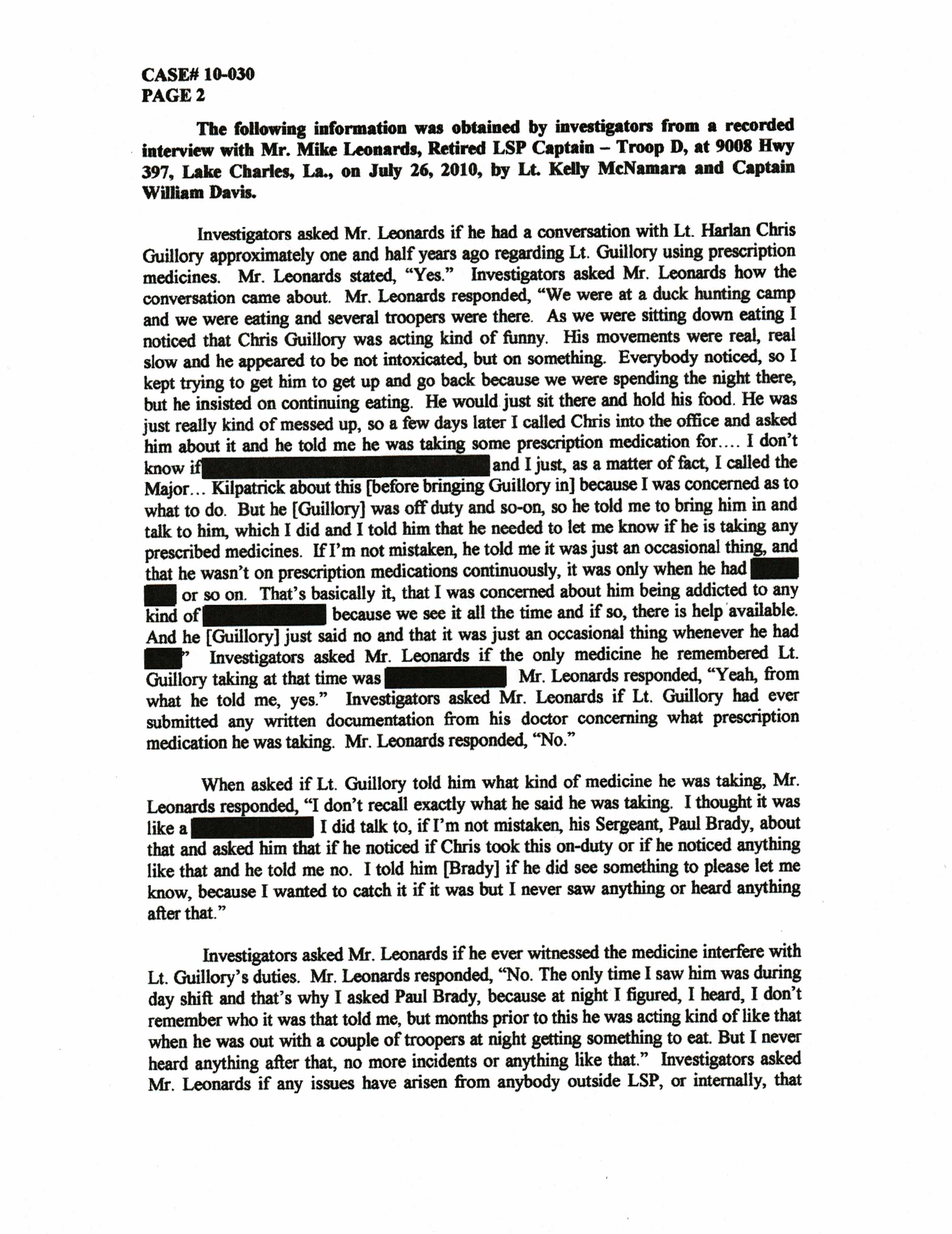
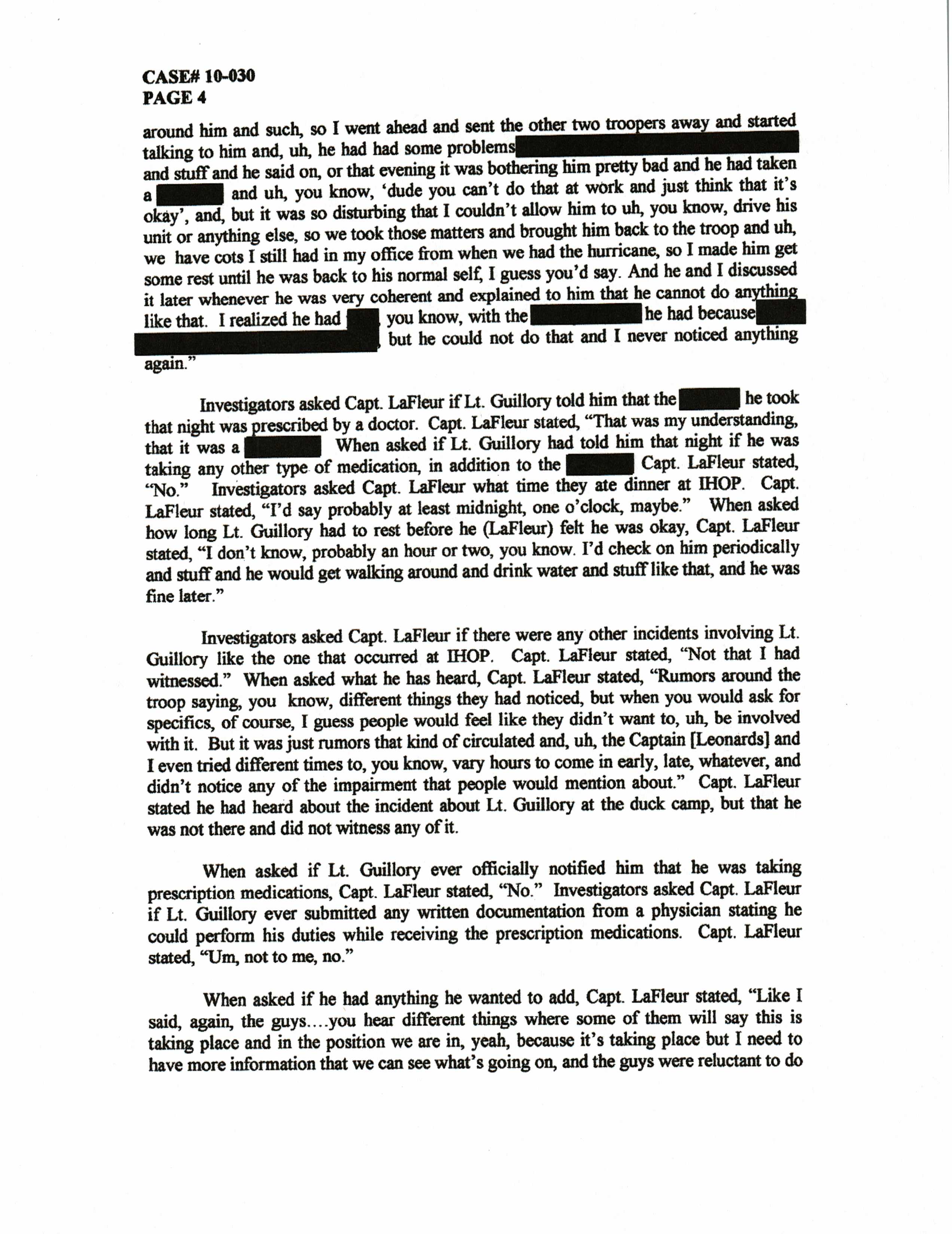
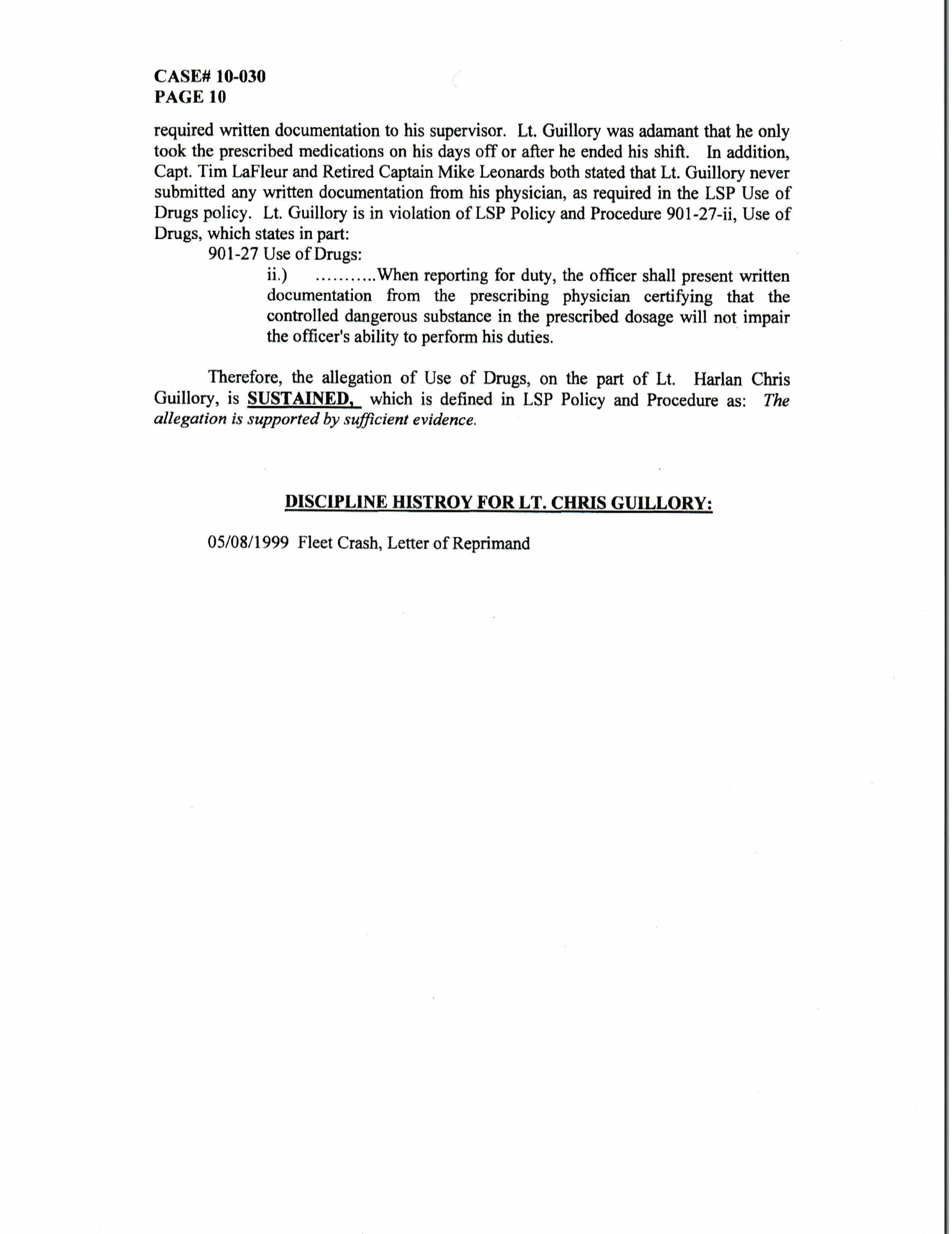
Giroir did, however, release a 10-page investigative report of an investigation of the possible abuse of prescription drugs by Guillory. “…Guillory may have taken, or is currently taking, a prescribed controlled dangerous substance, which is required to be reported as per LSP Policy and Procedure…,” the report said.

The report alluded to instances of Guillory’s being observed driving erratically in his patrol vehicle. One state police official reported that Guillory was at a restaurant and had to be driven back to Troop D to sleep on a cot until returning to normal. Guillory denied to investigators that he slept on the cot. It was also reported he experienced difficulty manipulating utensils at a restaurant while eating in a restaurant with other troopers.

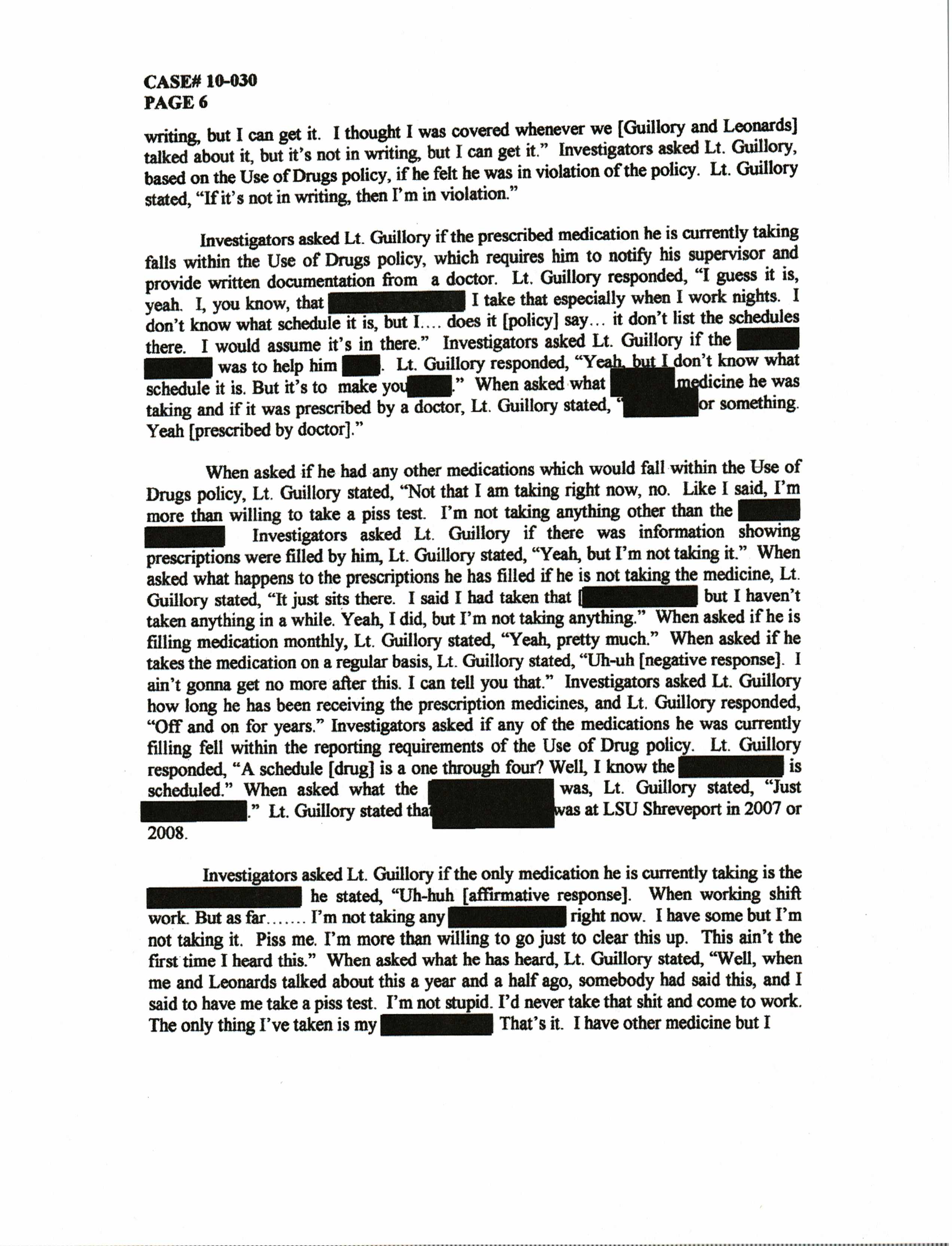
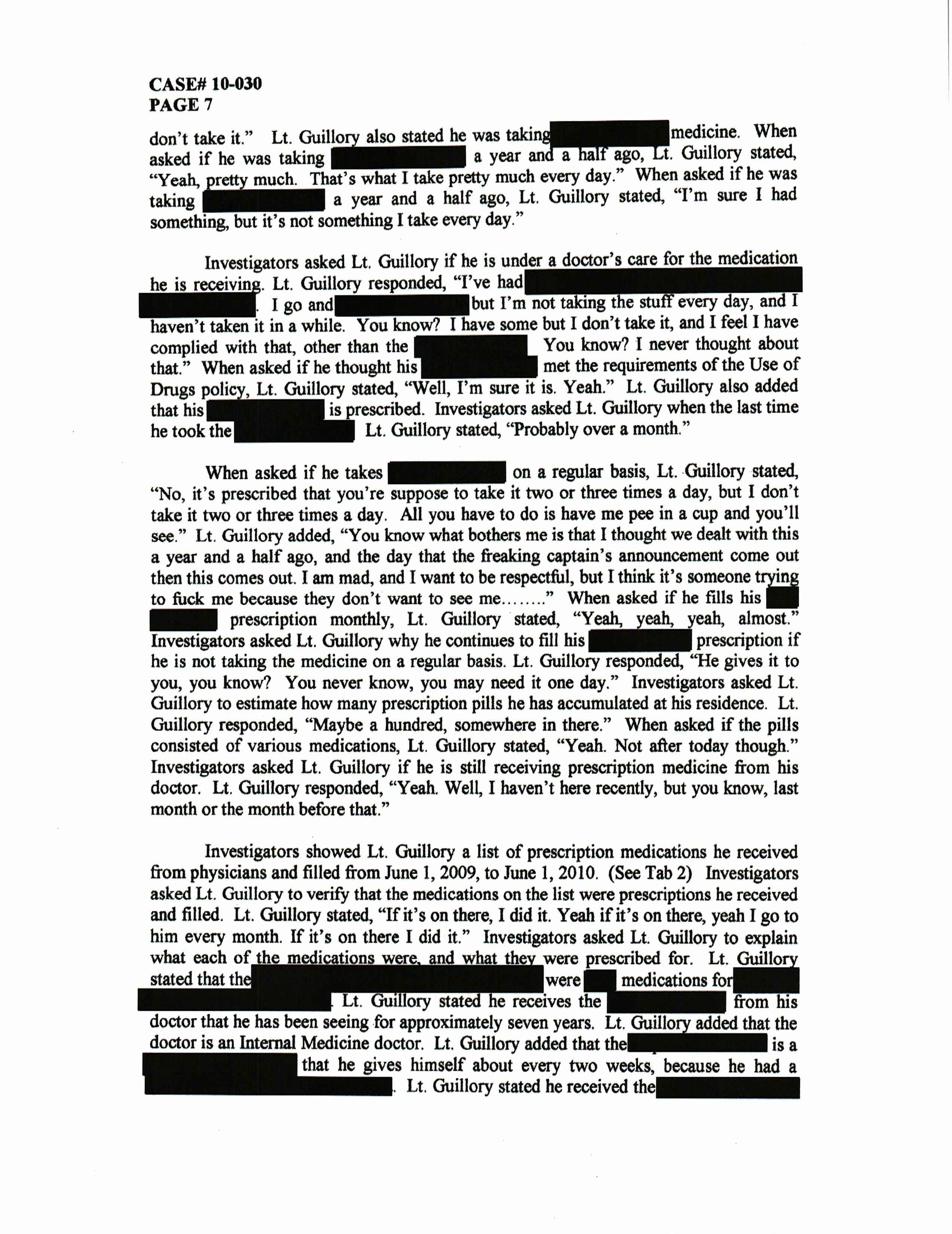
The 10-page investigative report was heavily redacted, but it was evident that Guillory first told investigators he was in compliance with LSP drug use policy but later admitted he was not. He told investigators he was obtaining prescriptions from three different doctors and that he had accumulated “maybe a hundred” pills at his home. He admitted to investigators that he occasionally doubled up on his dosage but that it was not an everyday thing.

The type pills prescribed to Guillory was redacted, but LouisianaVoice has learned that they were believed to be OxyContin which is normally prescribed for only 15 days because of addiction risks and is intended for use by terminal cancer patients and chronic pain sufferers.

State police investigators described the drugs as a “the cocktail.” According to law enforcement experts, the cocktail is a combination of pain killers, muscle relaxers, and anti-depressants.

Guillory reported that he flushed the medications after being interviewed by Internal Affairs. Shortly after the investigation was concluded, he was reprimanded for violating the State Police drug use policy. He was promoted to the rank of captain and became commander of Troop D subsequent to the investigation but later received a letter of reprimand for violation of prescription medication notification regulations from State Police Superintendent Mike Edmonson.

Here is the 10-page redacted report, along with the letter informing the Region II Command Inspector of the investigation, followed at the very bottom by a link to Edmonson’s letter of reprimand to Guillory—after he was promoted to captain. (CLICK ON EACH IMAGE TO ENLARGE):

IMAG1108

IMAG1110IMAG1111IMAG1113IMAG1114IMAG1115IMAG1116IMAG1117IMAG1118IMAG1119

Here is the GUILLORY REPRIMAND letter of Sept. 28, 2010.

Read Full Post »

The Louisiana Auctioneers Licensing Board doesn’t like former board member Robert Burns. Neither does the board’s attorney, convicted felon Larry Bankston.

That’s understandable. They haven’t like him since he uncovered payroll fraud and other irregularities and was bounced off the board by Bobby Jindal, whose idea of accountability is to hold whistleblowers fully accountable. When he was shown the door, Burns began video recording board meetings. During one meeting he even captured the board’s attorney saying Jindal’s office had advised the board not to worry about a legislative auditor’s report critical of illegal payments and illegal pay raises to part time executive assistant Sandy Edmonds.

Burns can be much like a canker sore when he puts his mind to it—irritating, always there, and impossible to ignore. But there’s nothing in the state public meeting statutes that says spectators—or media—must be liked. In fact, when the media (and Burns, through his newly-launched Web blog, is a member of the media whether that fits the board’s definition or not) become too cozy with public officials, then they no longer serve their purpose as the public watchdog.

Today (Aug. 31), we received a disturbing email from Burns. The Louisiana Auctioneer Licensing Board is considering turning off and removing his video recorder if he leaves it unmanned to go to the restroom or leaves the room for any other reason. “Frequently I am the only one in attendance” at board meetings, Burns wrote. True, the Auctioneer Licensing Board flies pretty much under the radar and attracts little to no media attention other than from Burns.

“If I need to go to the restroom or something,” he continued, “I leave the video camera running while on its unipod.” (I still don’t know why he doesn’t invest in a tripod which, unlike a unipod, is free-standing, but that’s another story.)

The AGENDA released for Tuesday’s (Sept. 1) meeting contains item number 8, which says:

  • Revision of Board Meeting Rules- In the event that the public videos or records the proceedings, such equipment must be manned at all times. Any equipment left unattended will be removed and turned off.

Now I am no attorney, though Mr. Bankston is, or at least he has been since he got the Louisiana Supreme Court to reinstate his licenses after his release from prison.

In 1994, then-State Sen. Bankston (D-Baton Rouge), chairman of the Senate Judiciary Committee (appropriately enough), met in his law office with one Fred Goodson, owner of a video poker truck stop in Slidell. There followed a discussion of a plan to manipulate the legislative process so as to protect the interest of video poker companies.

And what did Bankston get as quid pro quo? Well, it seems he owned a beachfront condominium in Gulf Shores, Alabama, so Goodson agreed to pay Bankston $1,555 per month for the “non-use” lease of the condo—a bribe, as it were.

Indicted on October of 1996, he was convicted on two counts of racketeering the following year and sentenced to a 41-month sentence in federal prison and ordered to pay a $20,000 fine.

He was released on Nov. 6, 2000, and served the remainder of his term in a half-way house in Baton Rouge. He was disbarred on March 9, 2002, retroactive to Nov. 19, 1997, but on Feb. 5, 2004, with only one dissenting vote, the Supreme Court’s disciplinary committee recommended that he be re-admitted to the bar.

So today, he provides legal advice to the Auctioneer Licensing Board—a board that winks and looks the other way at payroll fraud on behalf of one of its part time employees.

“If the proposed rule passes,” Burns wrote, “the board apparently believes it has the right to ‘remove and turn off’ any video recording equipment left running. I see nothing in the statute that requires any equipment to be manned, nor do I see where they have any authority to tamper with my video equipment, much less ‘remove it.’

“This is just another effort by a public body hell-bent on deterring public transparency,” he said, adding that he was going to go on the assumption that Attorney General Buddy Caldwell “has been perfectly willing to aid and abet” in the proposed action.

Duly indignant over this flagrant violation of state law, I fired off my own email to the board which first cited the applicable state law on public meetings:

  • The law grants the public the right to attend and record the deliberations of public bodies including city and parish governing bodies; school boards; levee boards; port commissions; boards of public utilities; planning, zoning and airport commissions; other state, local or special district boards, commissions or authorities with policy making, advisory or administrative functions; and committees or subcommittees of those bodies. Judicial proceedings are exempted.

After providing that remedial lesson on the law, I wrote:

I am given to understand this item is to discuss a new rule which would allow the board to turn off Mr. Burns’ video recorder should he have to leave the meeting for a few minutes for any reason. I have a problem with this and I am personally prepared to take you to court over both.

First of all, you have no right to tamper with his video equipment. It is perfectly within the law for him to record the meetings as per the section on public meetings laws highlighted above. Whether he happens to be in the room at the time or not is irrelevant. It is his equipment, not yours, and he has every right under law to record any open meeting.

Moreover, if you follow through on this action, I will pay the costs of Mr. Burns’ filing a lawsuit holding the board chairperson and its legal counsel personally liable for all applicable fines and legal costs. Mr. Burns will not only file suit for damages under the open meetings laws but for harassment and intimidation, as well.

There’s another twist in this sordid soap opera. Item 2 on the agenda calls for a discussion of Burns. He recently lost a public records lawsuit against the board, not because he was wrong in his contention, but because, in the presiding judge’s words, the office of Attorney General Buddy Caldwell gave the board bad advice.

Be that as it may, the agenda said that the discussion of Burns may require an executive session.

Not so!

The only reason for an executive, or closed session is to discuss ongoing negotiations, pending litigation or personnel matters. In the case of Burns, he is not an employee of the board, so any claim of discussing personnel would be invalid as would any claim of ongoing negotiations. As for pending litigation, it is no longer pending. The ruling has been made and the case is over, so all excuses for executive session are out the window. So, if there is to be a discussion of Burns, he has every right under law to insist that all such discussion be done in open session for all (including video cameras) to see and hear. If the board does otherwise, it will be yet another claim in future litigation.

In fact, the board is now skating dangerously close to civil rights violations, which would throw any lawsuit into federal court.


Read Full Post »

While the candidates for governor try to turn our eyes away from the circus in Iowa long enough to make their case of why they should be chosen to clean up the Bobby Jindal mess, there is another statewide race that is quietly flying under the radar which deserves our attention.

If ever there was a case to be made for prohibiting campaign contributions from industries and individuals the candidates would be regulating once in office, it would have be with the races for Louisiana Insurance Commissioner, Public Service Commission, and Louisiana Attorney General. An examination of contributions to candidates for those offices stands as the poster child for campaign reform.

Matt Parker is trying to change that. The Monroe native owns and operates an auto body shop and it his experience with insurance companies through his business that has led him to defy all political odds and run against incumbent Insurance Commissioner Jim Donelon. http://mattparkerforlouisiana.com/

The single biggest black mark against Parker’s name is that he was an All-State football player at Neville High School in Monroe. Being an alumnus of district rival Ruston High (Magna Cum Barely, class of 1961), long a bridesmaid to the stellar football program of Neville, first under Bill Ruple and later Charles Brown, I find that to be a tough personal negative for Parker to overcome.

His entry into the cesspool of Louisiana politics stems from major problems independent body shops were having and continue to have with auto insurance companies. https://louisianavoice.com/2014/05/07/unlike-a-good-neighbor-state-farm-may-be-undermining-choice-of-auto-repair-shops-same-for-the-good-hands-folks/

Insurance claims departments were said to have had this nasty habit of steering claimants to shops of their own choosing, shops the complainants said that that while cheaper, were turning out inferior work and using sub-par after-market parts. This, said the shops being shut out, was endangering the lives of the motoring public.

The merits or qualifications of Parker are not up for discussion here. What is open for examination, however, is the list of campaign contributors for each of the two candidates. (A third candidate, Baton Rouge attorney Charlotte McDaniel McGehee, a Democrat, has just announced as a candidate but there are not campaign contributions records available for her as yet.)

Both Donelon and Parker are Republicans but you’d never know that from the campaign finance reports of the two candidates.

Donelon’s report is dominated by big money flowing into his campaign from insurance companies and individuals in the industry. No fewer than 75 such companies and individuals from out of state contributed nearly $130,000 to Donelon. That’s $50,000 more than all of Parker’s campaign contributions combined.

In all, Donelon has attracted about half-a-million dollars since January of 2014 while Parker has pulled in $76,800 total.

Sixteen Donelon contributors kicked in $5,000 each, exactly half of those from other states. Thirteen were from the insurance and banking industries.

One of those, Michael Karfunkel of New York City, is a co-founder, along with his brother, of AmTrust, described by the Southern Investigative Reporting Foundation (SIRF) as “a high-flying insurance company.” SIRF found that while Michael Karfunkel and brother George were active grant-makers to synagogues and institutions linked to Brooklyn’s Haredi Judaism community, they reaped huge benefits from using their foundations to maintain family control of AmTrust.

Several years of IRS Form 990s, the annual report for tax-exempt foundations, showed that the Karfunkel brothers funneled AmTrust stock into their foundations in violation of IRS rules governing “excess business holdings.”

Basically, a foundation’s “disqualified persons,” an IRS term for foundation managers, family members, directors and key donors, are limited to stock ownership of 20 percent . The Karfunkel insiders owned more than 59 percent of AmTrust’s shares.

Michael Karfunkel and AmTrust each contributed $5,000 to Donelon.

Other insurance companies, attorneys, bankers, and individual in the insurance industry who contributed the $5,000 maximum to Donelon included GMAC Insurance Management, LUBA, USAA, Anchor Insurance Managers, the Republic Group, Joseph Kavanagh of New York City, and Greenberg Traurig of Miami.

Here is the complete list of JIM DONELON CONTRIBUTIONS of $1,000 and more.

Parker, who says on his Web page that he will not accept any contributions from the insurance industry, has received only three individual contributions of $5,000. One of those from Daniel Parker, presumably a relative. Another is from the Louisiana Collision Industry, which has had its cause taken up by Attorney Buddy Caldwell and which had its fight with insurance companies featured on CNN’s Anderson Cooper 360.

Of his 83 contributors, 41 gave $1,000 or more. By contrast, 282 of Donelon’s contributors gave $1,000 or more. Here is the list of MATT PARKER CONTRIBUTIONS

We have long maintained that no elected regulator should be allowed to receive so much as one dollar from individuals or industries they regulate. While the official may be incorruptible and the epitome of virtue and integrity, the perception is, and always will be, that their decisions will always come down on the side of the contributor. That is one facet of campaign reform that should be—must be—addressed before we can ever say with a straight face that we live in a democracy where everyone gets the same consideration.

The best example of this is that of the billionaire brothers Farris and Dan Wilks who amassed their fortunes in the West Texas fracking boom. The brothers ponied up $15 million to Cruz’s Super PAC. Now let’s say Cruz somehow, God forbid, becomes President. Later, West Texas residents become concerned about health issues associated with fracking. Their drinking water suddenly becomes contaminated and undrinkable and their livestock suddenly become sick or start dying. Should they even bother appealing to a President Cruz’s humanitarian side for help?

We all know you can check that box “No.”

1de860b7f87d9e7b14f5e5a00dbb9b49[1]

Does anyone truly believe it was coincidence that State Farm’s increasing homeowners’ deductibles from $500 and $1,000 to 5 percent of the home’s value for named storms in 2014? (If you have a home valued at $150,000, for example, your deductible for damage from a named storm just went from $500 or $1,000 to $7,500. Donelon’s “Oh, well” response? “I wish it were not happening, but it is the world of hurricane deductibles that we live in.” http://www.nola.com/business/baton-rouge/index.ssf/2014/07/state_farms_5_hurricane_deduct.html

Does anyone believe it was coincidence that Allstate kept two separate sets of rates for home repair, depending on whether or not the claims coverage was paid by the National Flood Insurance Program (NFIP) or by Allstate? Following Hurricanes Katrina and Rita, Allstate deemed the cost of repairing Allstate-covered damage thusly: 76 cents per square foot for drywall, $23.48 per square yard for carpet, and 80 cents per square foot for painting. But when it came to administering claims under NFIP, claims that were paid by U.S. taxpayers, those same costs were estimated by Allstate as $3.31 per square foot for drywall, $28.43 per square yard for carpet and $1.15 per square foot for painting. (It should be pointed out here that Allstate received a fee for administering NFIP claims, but only if the claim was closed. Thus, it was to Allstate’s benefit to settle quickly—at the higher rates—since the money didn’t come out of Allstate’s pocket.

And does anyone think it coincidence that Allstate and State Farm, applying the tactic taught them by McKinsey and Company (the only private sector firm Bobby Jindal ever worked for) practiced the “delay, deny, defend” method of fighting claims of those who lost everything they owned in the hurricanes? Or that claims for homes where the only thing left was the slab on which the houses sat were denied because the homeowner was unable to prove the home had been destroyed by wind (covered) rather than rising water (not covered)? Or that Katrina blew shingles off roofs in Jackson, Mississippi, 180 miles north of New Orleans, but insurance companies denied similar claims in New Orleans because of a lack of proof that shingles weren’t damaged by rising water instead of wind? Allstate adjusters, worked under strict guidelines to protect the bottom line or risk losing their jobs. http://stlouis.legalexaminer.com/automobile-accidents/allstate-you-are-not-in-good-hands/

Does it seem strange to anyone that insurers were so easily able to pull these scams on premium-paying homeowners in Louisiana?

Or does it seem to be only politics as usual in a state where insurance companies and those affiliated with insurance, banking and defense attorney firms could virtually finance the political campaigns of an insurance commissioner who could be expected to grease the skids when the time came for the companies to employ these tactics against devastated homeowners desperate to settle—even for pennies on the dollar?

Parker or McGehee probably won’t win. The odds are stacked too heavily against them. If it even begins to look as if either one will make a dent in Donelon’s base, you can look for the attack dogs to take over the campaign ads.

But this state deserves better. Donelon might well be as honest as Abe, as righteous as Atticus Finch, as moral as Gandhi and as compassionate as Mother Teresa. I’m in no position to say otherwise.

But as long as the Commissioner of Insurance, Public Service Commission and the Attorney General campaign donations are dominated by regulated industries and individuals affiliated with those interests, the perception will always be there that the offices are bought, owned and run by special interests.

Read Full Post »

Finally.

A national ranking in which Louisiana can take pride in finding itself 10th from the bottom.

As an added bonus, all those rabid LSU fans can be more than a little smug in the knowledge that Alabama is number one.

If you’re a bit confused, if up seems down, if day appears as night, don’t fret.

We’re talking about the latest ranking in per capita expenditures and Alabama is at the top of the list and Louisiana is way down there at number 42.

But that’s not a bad thing. Just ask Josh Duggar. The oldest of the TV reality show 19 Kids and Counting and a former employee of the Family Research Council headed up by Bobby Jindal pal Tony Perkins. Josh is the one, you may remember, who was outed several months ago for having molested his little sisters, a sin attributed to the actions of a young boy.

But he’s no longer a young boy and now he’s been outed again. This time, it has been learned that he has been an active client of that Ashley Madison internet services that guarantees you an extra-marital affair or your money back. Of course, he’s back out there making public apologies all over again.

It was also revealed on Friday that federal employees, including employees right there in the White House, had at least logged onto the website, though not all actually subscribed to the service and actively sought affairs the way young Josh did.

Still, Washington, D.C. ranked third on the list with per capita expenditures of a little less than $4.50 at the website, ranking just behind second-place Colorado and top-ranked Alabama.

But we digress.

Some enterprising person or persons has gone to the trouble of charting payments to Ashley Madison on a state-by-state basis and that’s the crux of our story.

ASHLEY MADISON RANKINGS

It seems that in the gret stet of Alabama, football, while immensely popular, may have a little competition for the entertainment dollar. Maybe those football-crazed ‘Bama Crimson Tide and Auburn Tiger fans need something to get them through the off-season. Whatever the explanation may be, the rankings chart shows an expenditure of nearly $6 per capita from Alabama residents on the Ashley Madison website to lead the list of “Most Unfaithful States in America.” Based on a population of nearly 4.9 million, that equates to an expenditure of $28.8 million.

Louisiana, by comparison, spent only a tad more than a buck-fifty per capita despite having a population base and demographics closely aligned with those of Alabama. Using the same methodology, Louisiana residents spent “only” $7 million, or one-fourth that of Alabama.

A disclaimer: We do not know over what time period these expenditures were tracked. It could have been a year, two years, or more. Also, the numbers represent only a fraction of Ashley Madison’s entire data bank. But the rankings encompass the same time frame for all states, so by that standard, they are fair.

Mississippi, wedged between the two states, was next-to-last in per capita cheating spending at just a nudge over $1, which equates to about $3 million for the entire state.


Read Full Post »

« Newer Posts - Older Posts »