Feeds:
Posts
Comments

The movies Dawn of the Planet of the Apes, Terminator, Jurassic park 4, Ender’s Game, and G.I. Joe: Retaliation were all shot in New Orleans. More specifically, they are all filmed in the Big Easy Studios in New Orleans. http://www.bigeasystudiosneworleans.com/aboutus.php

Geostorm, starring Gerard Butler as a satellite designer who goes into space to thwart climate-controlling satellites from creating catastrophic storms, just started shooting in the Big Easy Studios which are housed, appropriately enough, in the Michoud Assembly Center which once built the space shuttle’s external tanks before the shuttle project was scrapped by NASA.

All of which begs two single overriding questions: did Big Easy Studios receive favorable treatment in landing the lease of the 1.8 million-square-foot facility and were other Louisiana-based studios afforded the same opportunity to compete for a similar deal with NASA?

Taking the questions in reverse order, we will probably never know what chances, if any, other studios had to vie for the space but at least one competitor said there was no open competition for the facility.

The answer to the first is shrouded in secrecy as lease terms, including rental and payments, as well as the very signatures of Big Easy principals signing the lease were redacted throughout the 28-page lease document. We suppose lease payments may be some kind of protected state secret which fall under the heading of national security.

IMAG0384

(CLICK ON IMAGE TO ENLARGE)

Still, with conspiracy theorists out there who continue to insist the 1969 moon landing was staged, one would think NASA would be a little skittish about leasing out its facilities for movie making.

But there are more serious issues involving NASA’s decision to lease the gigantic facility to a movie production company. For openers, NASA’s rules say that any deal with an outside entity must serve the agency’s mission. NASA’s response was that anything that brings the federal government revenue serves NASA’s mission. Taking that logic to its extreme, it would seem safe to say a meth lab or house of ill repute could conceivably qualify under that definition.

NASA rules also dictate that any lease agreement must recover the full cost of the rented space and must not create unfair competition with the private sector by undercutting its lease terms. Yet, competing studios maintain that first, they were not given the opportunity to compete for the lease and the lease arrangements with Big Easy Studios and second, that they pay higher rent per square foot than Big Easy Studios.

So just how did Big Easy gain such an advantage, if indeed it did?

To answer that, we must take a look at the two principals of Big Easy Studios.

Herbert W. Gains, an independent filmmaker, was in New Orleans in 2010 to film Green Lantern, much of which was shot at the Lakefront Airport.

At the same time, The Lathan Co. of Mobile, Alabama, was under contract to perform major repairs and restoration work to the airport which had been heavily damaged by Hurricane Katrina. http://www.lathancompany.com/portfolio/lakefront.html

Lathan Co. President Jerry Lathan, a member of the Alabama Republican Party’s State Executive Committee who had worked in the presidential campaigns for Bob Dole and both Presidents Bush as well as other local, state and national Republican candidates, also had contracts for restoration of a number of other structures, including four others in New Orleans and one at East Louisiana Hospital in Jackson.

http://www.lathancompany.com/projects.html

Lathan, who reportedly likes to boast of his political contacts, would probably have had connections at the U.S. Space & Rocket Center in Huntsville, Alabama, through which he could have assisted Gains in acquiring access to NASA.

http://algop.org/jerry-lathan/

Big Easy Studios was incorporated on Nov. 9, 2011, with Gains and Lathan as the only officers, and the lease with NASA was signed by an unidentified officer of the new company (remember, that name was redacted) 16 days later, on Nov. 22, 2011. An amendment to the contract was signed less than three months later, on Feb. 14, 2012, by Robin Henderson of the George C. Marshall Space Flight Center but again, the names and signature of the Big Easy officer were again redacted.
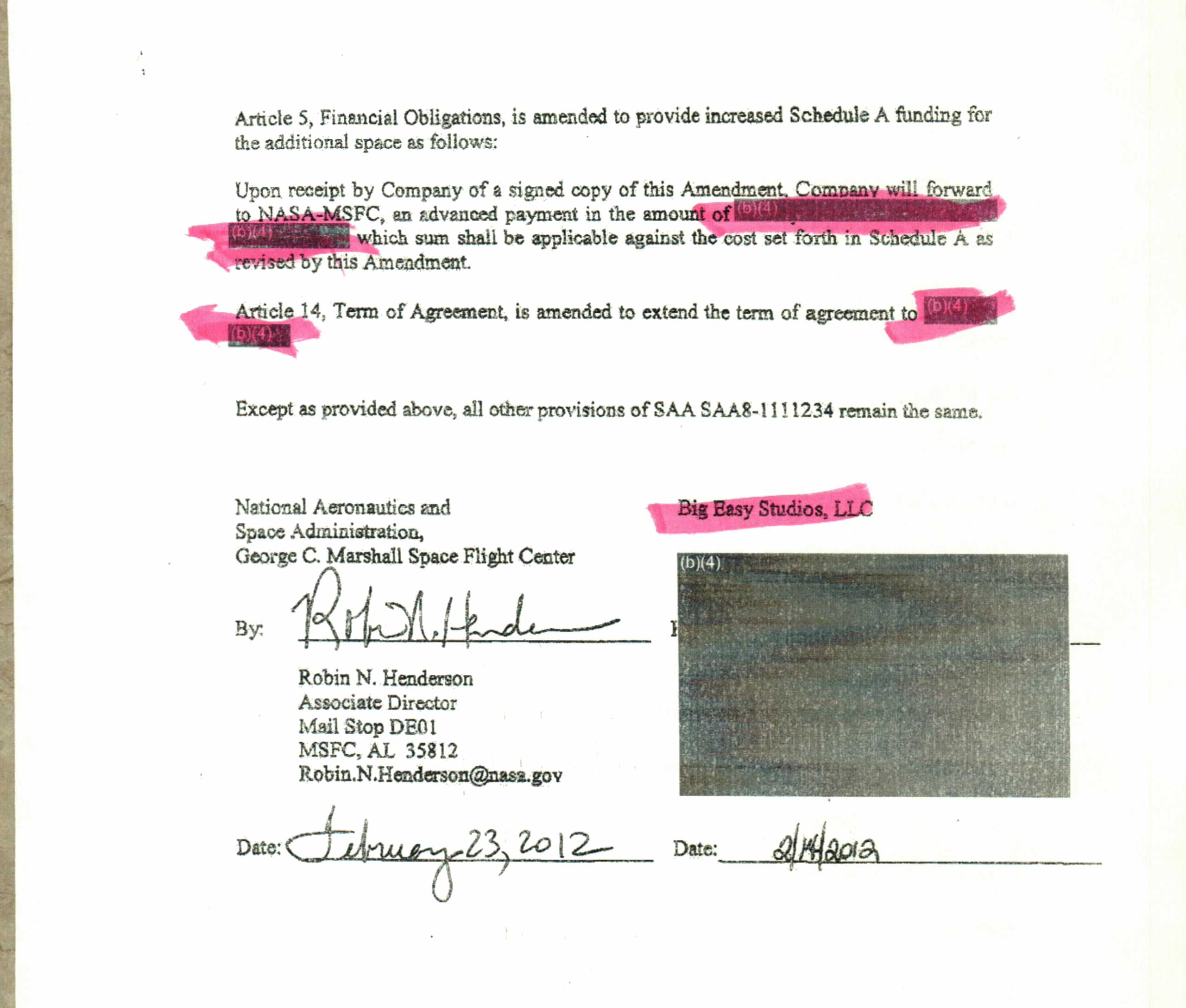
IMAG0386

(CLICK ON IMAGE TO ENLARGE)

Stephen Moret, secretary of the Louisiana Department of Economic Development (LED), said his office had “many conversations” with NASA about the need to offer more competitive lease rates at Michoud to better position the facility to attract “advanced manufacturing projects.”

The director of operations for one competing studio told the Baton Rouge Business Report in 2012 that he had heard from producers that Big Easy received lease rates more favorable than his studio. “The taxpayers didn’t fund Michoud to make movies,” he said. “The lease with Big Easy Studios was a done deal before we even knew the facility was available.”

http://businessreport.com/article/20120917/BUSINESSREPORT0112/120919831/

While, studios located in Louisiana once received 40 percent infrastructure tax credits—discontinued in 2009—the movies filmed in those studios still receive movie production tax credits and the system quickly led to widespread abuses that prompted the conviction and a 70-month prison sentence for for Martin Walker of Baton Rouge for his activity involving the buying and selling of Louisiana motion picture investor tax credits. He also was ordered to pay more than $1.8 million in restitution to 24 victims of his fraud.

In 2009, revisions to state incentives guaranteed a tax credit of 30 percent of expenditures provided a production spends more than $300,000 in Louisiana. Major productions like Twilight: Breaking Dawn can receive state tax credits of $10 million to $30 million.

Because most productions don’t owe any taxes in Louisiana, there is no need to claim the credits but they can transfer those credits to the state and the state will cut the companies a check for 85 percent of the face value of the credits. Thus, if a production company earns $1 million in Louisiana tax credits, those credits can be transferred back to the state and the state will issue the company a check for $850,000.

Another option, a variation of which landed Walker in hot water, allows production companies to sell their credits to individuals or corporations who do owe taxes in the state at a discount. Should an individual or corporation owe the state $1 million, for example, and a production company holds a $1 million tax credit, the production company may sell its tax credit to a speculator for say, $500,000 and that person in turns sells the credit for $750,000 to the individual or corporation owing the $1 million in taxes who then receives a $1 million tax credit—and each party profits $250,000.

That means when production companies sell their credits to the private sector, state taxpayers end up subsidizing tax breaks for high income individuals and corporations.

In Walker’s case, though, he sold bogus tax credits with a face value of more than $3.8 million to 24 investors for $2.5 million.

Louisiana Inspector General Stephen Street said of the Walker matter, “This sort of blatant fraud undermines the entire tax credit program and cannot be tolerated. We will continue working with the FBI and United States Attorney to make sure that those who engage in this sort of corruption face criminal consequences.”

Former State Film Commissioner Mark Smith described the movie industry in Louisiana as “smoke and mirrors.” He said in Los Angeles and New York, “I can see the headquarters and see who the real players are. In places like Louisiana, who can see it?”

Nearly seven years into his administration, it’s no surprise that Gov. Bobby Jindal (R-Iowa/New Hampshire/Florida—anywhere by Louisiana) would be losing many of his top appointees. After all, the ride is nearly over and they have to be looking for opportunities beyond the inevitable unemployment line once Jindal’s term ends in January of 2016.

A few left early on, barely two years in, causing raised eyebrows among some political observers. Lobbyist Luke Letlow bolted early from his position as Special Assistant and Director of Intergovernmental Affairs as did Ethics Administrator Richard Sherburne and Department of Transportation and Development (D)TD) Secretary William Ankner. Sherburne’s departure came after Jindal stripped the State Ethics Board of its adjudicatory authority, giving those responsibilities to a set of administrative law judges who have proved largely ineffective. Ankner left after a controversy arose over the awarding of a $60 million contract for a highway construction to high bidder Boh Brothers Construction.

Others, like Department of Health and Hospitals DHH) Secretary Bruce Greenstein and Office of Group Benefits (OGB) CEO Tommy Teague were shown the door—Teague for his reluctance to jump on board Jindal’s privatization train that ultimately carried OGB to the brink of bankruptcy before a controversial restructuring of OGB’s benefit package and Greenstein under the cloud of a federal investigation over the awarding of a contract by DHH to Greenstein’s former employer, CNSI. That cloud has since turned into a nine-count state grand jury indictment brought against Greenstein for perjury.

Still others bided their time until the right opportunities came along. Michael DiResto, a Jindal budget spokesman, left nearly 14 months ago to become Vice President for Economic Competitiveness for the Baton Rouge Area Chamber and DNR Secretary Scott Angelle resigned to run for—and win—a seat on the Public Service Commission and recently announced he would be a candidate for governor next year.

And then there are those who walked for no apparent reason other than to get away from a struggling administration that has been virtually rudderless, thanks to a largely absent and detached governor. Jindal seems to be more preoccupied with running for president than completing his job, which he repeatedly called “the only job I ever wanted” before beginning his second term in 2012 and redirecting his attention from the Governor’s Mansion to the White House.

His first Commissioner of Administration, Angéle Davis, left shortly after attending a meeting in which Jindal’s then Chief of Staff Timmy Teepell directed Teague to draft a “tightly written” request for proposals (RFP) for a state employee health coverage plan in such a way that only one vendor would be qualified to bid. Vantage Health Plan of Monroe ultimately was awarded the $70 million contract.

Her successor, Paul Rainwater, was eventually moved over to serve as Jindal’s Chief of Staff but he, too, resigned last February without giving a reason other than to say he wanted to pursue opportunities in the private sector.

Another recent departure who did not explain her reason for leaving was Division of Administration (DOA) Executive Counsel Liz Murrill. Unconfirmed reports have surfaced, however, that she has confided to friends that she felt she could no longer legally carry out some of the duties assigned to her as the DOA attorney.

Over the ensuing 15 months left in Jindal’s floundering administration, there are certain to be other departures as appointees begin jockeying for positions in the private sector or attempt to latch onto the campaigns of candidates who have already announced for governor in the hope of landing another prestigious job in the next administration.

Among those we might expect to see jump ship between now and January 2016 include Jindal’s Chief of Staff Kyle Plotkin, the governor’s Communications Director Mike Reed and Deputy Communications Director Shannon Bates, and perhaps even a few cabinet-level appointees, including Commissioner of Administration Kristy Nichols.

Question: What’s more dangerous than Bobby Jindal as governor?

Answer: Bobby Jindal with an automatic weapon in his hands.

Question: What’s more dangerous than Bobby Jindal with an automatic weapon in his hands?

Answer: Bobby Jindal as president.

Question: What’s dumber than Bobby Jindal holding an automatic rifle at a target range?

Answer: Jindal holding an automatic rifle at a target range with no ammo magazine.


 http://www.youtube.com/watch?v=-p51Ic7kgpA

(From: http://www.thelibertypapers.org/)

10b92e29ed5e08ad7149226b74d9351b_o5gh[1]

(Click on image to enlarge)

This artist is obviously a state employee or surely he would come forward and take credit for his brilliant work! Perhaps someday, after he retires, he can make his identity known so that we may pay him proper homage.

In reading Destiny’s Anvil, a novel about Louisiana politics by New Orleans writer Steven Wells Hicks, one sentence near the end of the story was so profound that it jumped off the page at us:

  • The responsibility for building and maintaining our way of open and honest government belongs in the hands of those who elect our leaders and not the leaders themselves.

The very simplicity of that one sentence, so succinct and straightforward a summation of what our government should aspire to, should be the credo which dictates the acceptance of every campaign contribution, every promise made and every action carried out by every elected official in America.

Sadly, it does not. And most certainly, it does not in Louisiana, especially where generous donors to the campaigns of Gov. Bobby Jindal (R-Iowa, R-New Hampshire, R-Florida, R-Anywhere by Louisiana) are concerned.

LouisianaVoice has learned that one major donor and its principals not only benefitted from several contracts worth more than $240 million, but also appear to have been given preferable treatment in the purchase of a state building at a bargain price at the expense of taxpayers.

The electorate of this state has capitulated in that responsibility, choosing instead to acquiesce to backroom deals fueled by campaign contributions and to actions concealed in secrecy and carried out for political expedience or personal gain instead of for the common good of the citizenry.

Remember last month when we wrote that Timmy Teepell in 2010 issued a directive to Tommy Teague, then the CEO of the Office of Group Benefits that a request for proposals (RFP) be crafted in such a way as to favor a specific vendor and that then-Commissioner of Administration Angéle Davis resigned shortly thereafter?

At the time, Teepell was Jindal’s Chief of Staff. The RFP was for vendors to provide health care coverage to state workers primarily in northeast Louisiana. Vantage Health Plan of Monroe subsequently landed the 26 month, $70 million contract, effective July 1, 2010. Six months later, on Jan. 1, 2011, a second one-year contract of $14 million awarded to Vantage to provide a Medicare Advantage plan for eligible OGB retirees and on Sept. 1, 2012, Vantage received yet another four-month $10 million contract under an emergency rule to provide an HMO plan to OGB members.

Since Jindal took office in January of 2008, Vantage has been awarded six contracts totaling nearly $242 million.

In addition to the claim of the 2010 directive to Teague to “write a tightly-written” RFP, LouisianaVoice has learned the Jindal administration may have deliberately circumvented the usual procedure for selling state property in order that Vantage could purchase a six-story state office building in Monroe last year.

By legislative fiat, the administration was within its legal rights to sell the State Office Building in Monroe to a chosen buyer without going through the bid process but it may have done so at a cost to state taxpayers.

Senate Bill 216 of 2013 by Sens. Mike Walsworth (R-West Monroe), Rick Gallot (D-Ruston), Neil Riser (R-Columbia) and Francis Thompson (D-Delhi) passed overwhelming in both the House and Senate and was signed into law by Jindal as Act 127, clearing the way for the sale of the former Virginia Hotel at 122 St. John Street.

By law, if a legislative act is passed, the state can legally bypass the public bid process but there are several indications that the administration may well have gone out of its way to accommodate Vantage and its President, Dr. Patrick Gary Jones through the Louisiana Department of Economic Development (LED).

The cooperative endeavor agreement between Vantage and the state was executed by Vantage Executive Vice President Mike Breard and LED Undersecretary Anne Villa on Aug. 28, 2013.

Vantage paid the state $881,000 for the six-story, 100,750-square-foot building and an adjoining 39,260-square-foot lot and one-story office building. The cost breakdown was $655,000 for the hotel and $226,000 for the adjoining property.

The Virginia Hotel was constructed in 1925 at a cost of $1.6 million and underwent extensive renovations in 1969 and again in 1984, according to documents provided LouisianaVoice by DED.

But LouisianaVoice has learned that there was at least one other potential buyer interested in the Virginia Hotel/State Office Building and indeed, documents obtained from LED contained no fewer than three references to fears by Vantage officers that if the building were put up for public auction, the bids might make the costs prohibitive to Vantage.

Melody Olson and husband Kim purchased the nearby Penn Hotel for $341,000 and poured $2 million into converting it into condominiums.

The late Shady Wall, a colorful state representative from Ouachita Parish, lived in the Penn’s penthouse. (Wall once wedged a pencil between a stack of books and the “yes” button at his House desk and went home for the day, officially casting “yes” votes on every matter that came up in the chamber after his departure.) The Olsons now reside in that same penthouse.

Melody Olson told LouisianaVoice that she and her husband wanted to purchase the Virginia and convert it into a boutique hotel but were never given the opportunity.

“It was sold through the Department of Economic Development and never was offered for public bid,” she said. “We never got the chance to make an offer.”

One internal LED memorandum said that Vantage Health Plan (VHP) “approached LED to help arrange the sale in order to avoid typical State surplus real property requirements of public bidding. VHP fears that public bidding would allow a developer utilizing various incentive programs to pay an above market price that VHP would find hard to match.” (Emphasis added.) IMAG0379

(CLICK ON IMAGE TO ENLARGE)

Another document appears to be an internal memorandum that provides an overview of a 2012 meeting about the sale. It indicates that LED Secretary Stephen Moret, Sen. Walsworth, LED Legislative and Congressional Liaison Mandi Mitchell and LED Director of Contract Performance Shawn Welcome were in attendance on behalf of the state and Dr. Jones and his son-in-law Michael Echols, Director of Business Development, representing Vantage.

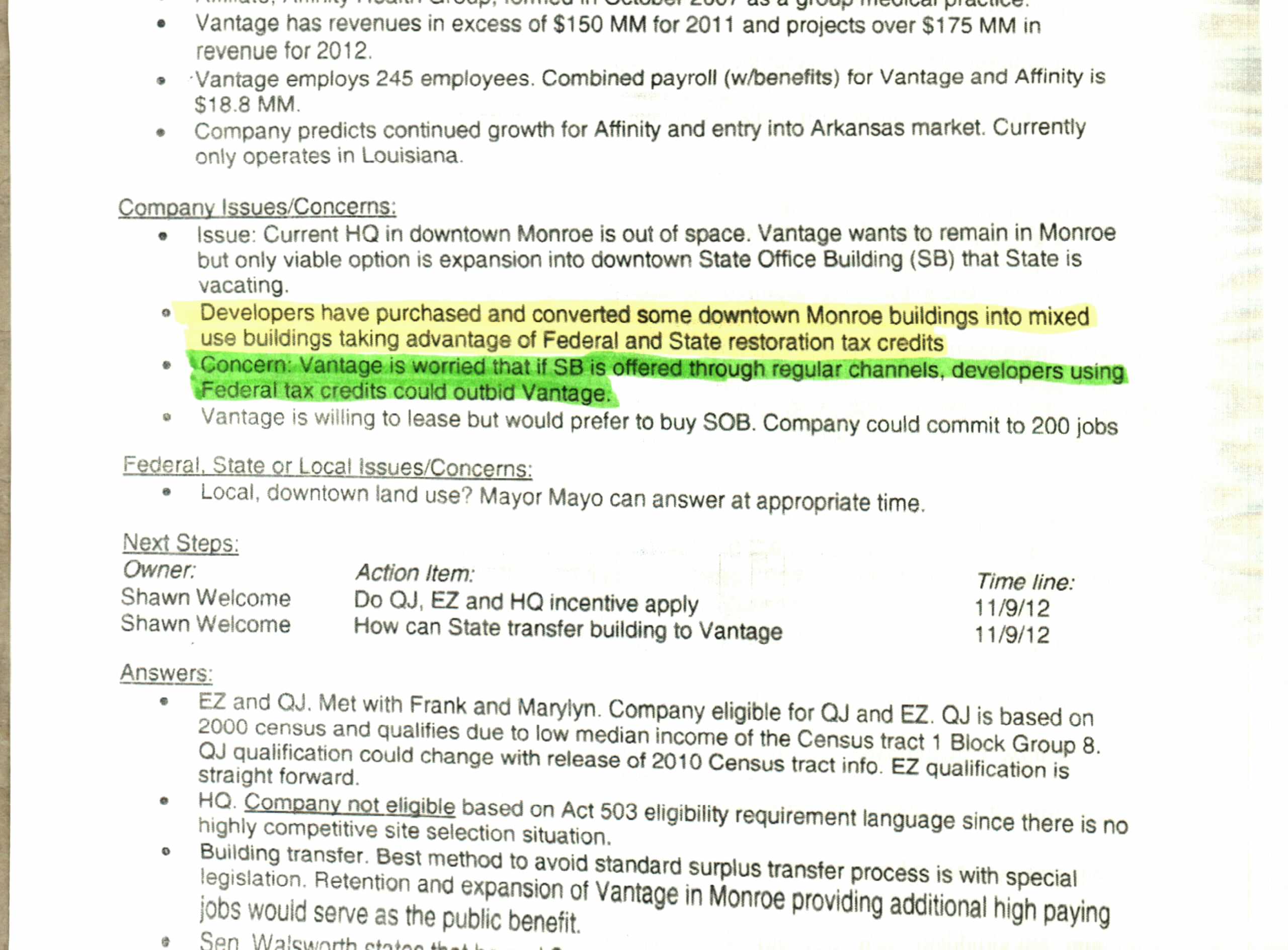
Under a heading entitled Company Issues/Concerns there were these two notations:

  • “Developers have purchased and converted some downtown Monroe buildings into mixed use buildings (by) taking advantage of federal and state restoration tax credits.”
  • “Concern: Vantage is worried that if SB (state building) is offered through regular channels, developers using federal tax credits could outbid Vantage.” IMAG0377

(CLICK ON IMAGE TO ENLARGE)

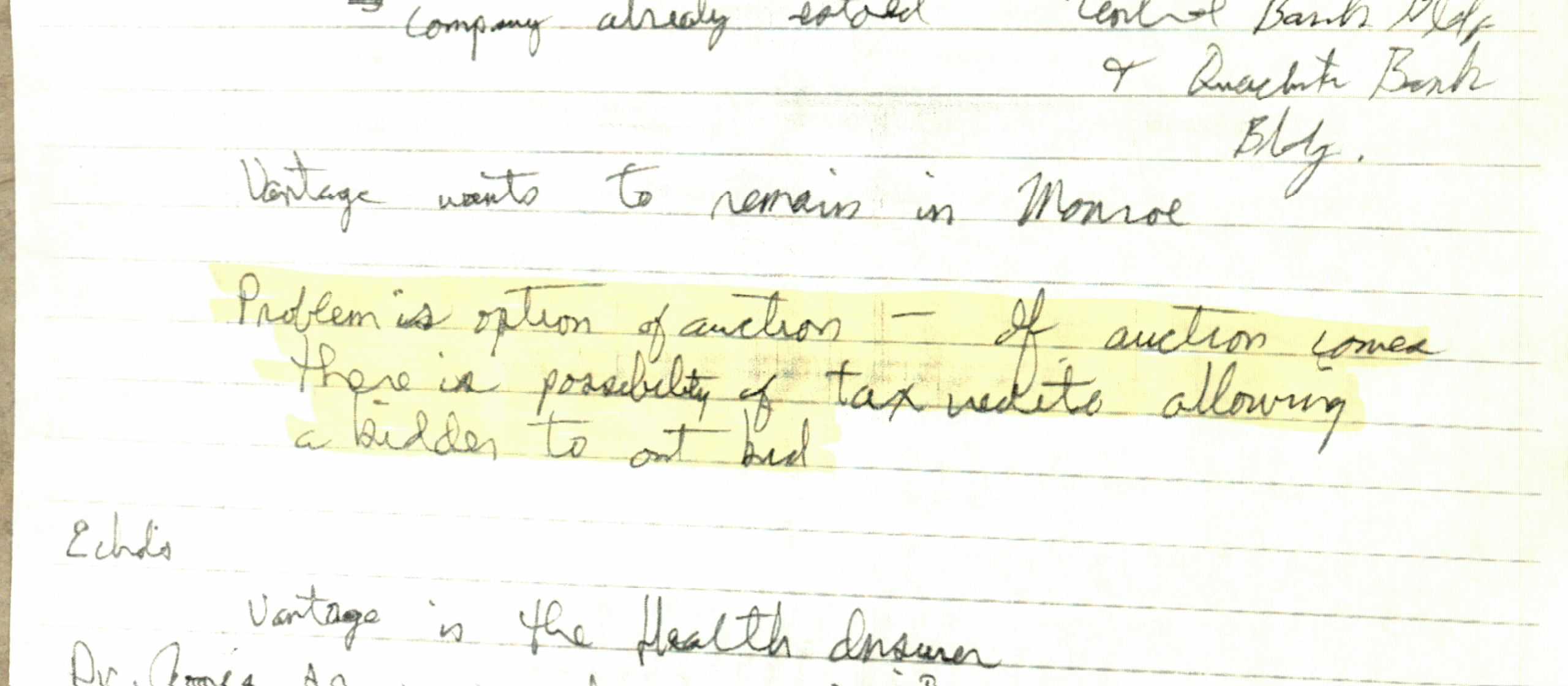
Finally, there was a handwritten note which described another meeting on Nov. 1, 2012. Besides the notation that “Sen. Riser supports,” there was this:

  • “Problem is option of auction—if auction comes there is possibility of tax credits allowing a bidder to out-bid.”

IMAG0378

(CLICK ON IMAGE TO ENLARGE)

Finally, there was a hand-scrawled notation at the bottom of a typewritten page containing employment estimates by Vantage through 2024 which directed that an “approach” be written “specific to Vantage.”

And while Vantage repeatedly cited concerns about other potential buyers obtaining state and federal incentives which they might use to thwart their purchase plans for the building, Vantage was not shy about seeking incentives from the state for its own benefit.

Documents obtained from LED show no fewer than 20 applications or notices of applications for various state incentive programs, including Enterprise Zone, Quality Jobs Program and property tax exemptions for renovations to existing offices in Monroe or expansion into new offices in Shreveport, Mangham, West Monroe, New Orleans and even into Arkansas.

Nor were Vantage and its corporate principals shy about flashing cash for political campaign contributions.

Campaign finance records show that Vantage its affiliate, Affinity Health Group, their corporate officers and family members combined to contribute more than $100,000 to various political campaigns, including $22,000 to Jindal and $11,000 to three of the four Senators who authored the bill authorizing the sale of the Virginia Hotel to Vantage: Thompson ($5,400), Walsworth ($4,500), and Riser ($1,000.