Feeds:
Posts
Comments

Archive for the ‘Politics’ Category

Much media attention has been focused, and rightly so, on whistleblower Frances Haugen calling out Facebook for placing profits over integrity. But there’s a whistleblower lawsuit pending in Louisiana’s Middle District Federal Court in Baton Rouge that potentially could have a direct impact on the physical safety and lives of tens of thousands of people living in proximity to dozens of petrochemical plants in South Louisiana.

Johnny Taylor’s lawsuit, claiming that his termination by Union Pacific Railroad was in violation of the Federal Railroad Safety Act (FRSA) because he was fired for engaging in activities protected under that statute, is scheduled to be heard Nov. 1.

Basically, Taylor is claiming that he was fired because he took one rail line out of service and issued a slow order on another section of track because of safety concerns and refused orders to return them to service.

Union Pacific disagreed, contending that Taylor was terminated for disrespectful conduct surrounding those actions and that Taylor had “significant performance issues” and a history of “insubordination and outright refusal to alter his behavior.”

A motion for summary judgment (dismissal) by Union Pacific was denied by U.S. District Court Judge Shelly Dick, allowing the lawsuit to move forward.

In her ruling, Judge Dick noted cited a requirement of FRSA which said that a railroad or its representatives “shall not discharge, demote, suspend, reprimand, or in other way discriminate against an employee” for reporting in good faith a hazardous safety or security condition.

Taylor took the Avondale “Tail Track” out of service on March 28, 2017. Approximately 20 derailments had occurred in the Avondale yard during Taylor’s tenure. On Nov. 2, 2017, he took “No. 1 Mainline” track in Avondale out service, based on his impression that it was defective and could result in a derailment. Three derailments occurred at the “Switch 16” track in Avondale in October and November 2017, Taylor says.

Similarly, he took the “Switch 16” track at Avondale out of service on Jan. 10, 2018, because the track was “severely out of alignment” and ran the risk of causing a derailment. He issued a “slow order” on a track on White Castle on Jan. 22, 2018.

She further noted that an employee’s refusal is protected under several provisions which applied in Taylor’s case.

Taylor cited four examples of his claimed protected activity:

  • Taking tracks out of service;
  • Refusal to put “Switch 16” back into service;
  • Issuance of a slow order in White Castle, Louisiana (in an area along the Mississippi River in Iberville Parish where dozens of petrochemical plants are located), and
  • Cooperation with Federal Railroad Administration (FRA) and of reports to Union Pacific’s EEO Department.

Taylor, who was employed by Union Pacific on Se.t. 12, 2007, said in his petition that he was responsible for railroad tracks from Avondale to Livonia.

On March 5,2014, Taylor says a supervisor threatened to fire him if he reported “any additional safety issues regarding tie clusters in the tracks under his management.”

Taylor says Union Pacific “falsely reported” the cause of several derailments to the FRA.

He says that he was cited for his attitude but otherwise received only positive evaluations and quoted from one evaluation in which his supervisor said, “You lead your team in a positive way from what I have seen so far. Make sure that everyone above you knows and understands the good things that you are doing. Don’t be afraid to brag on yourself.”

Taylor said he qualified for a performance bonus for 2017 and received a letter in October 2017 from Superintendent Cliff Bowman commending him on his “diligence, dedication, professionalism, and continued commitment to safety.”

The trial is scheduled for 9 a.m. in the Russell B. Long Federal Building in Baton Rouge.

Taylor is represented by J. Arthur Smith, III, and Robert M. Schmidt of the Smith Law Firm of Baton Rouge.

Read Full Post »

It was difficult to tell if it was just an artful dodge or sheer ineptness on the part of Stephen Russo when he appeared before the Joint Medicaid Oversight Committee to testify about the placement of nursing home patients in a Tangipahoa Parish warehouse but whichever it was, it was a pathetic performance by someone in his area of responsibility.

Russo is executive legal counsel for the Department of Health which regulates nursing homes. What’s more, he was appointed INTERIM SECRETARY of the department during the time between the resignation of Dr. Rebecca Gee and the appointment of her successor, COURTNEY PHILLIPS.

Despite his high level of authority, Russo danced the bureaucratic shuffle under questioning from legislators who, had they done their own research, could have – should have – known of Russo’s background well in advance. Instead, they preferred to appear outraged and infuriated as opposed to the more realistic and accurate ill-informed and grandstanding over the treatment of the 853 patients from seven nursing homes who were evacuated into that warehouse in Independence as Hurricane Ida approached.

If the legislators had done their homework, they would have known that Russo (1) got PERSONALLY INVOLVED in Dr. Gee’s efforts to retain her tenure at LSU  Health Science Center while simultaneously serving as DHH secretary – in apparent violation of the Governmental Code of Ethics (you may remember when we used to have an ethics board that actually meant something).

If the legislators had not been so intent on posturing for the TV cameras, they might have taken the time to learn how Russo had PROTECTED  Attorney Supervisor Weldon Hill by intimidating and humiliating – and demoting – the woman who complained of Hill’s sexual harassment – a complaint that eventually resulted in DHH’s quietly SETTLING with the complainant.

And while that settlement was “only” $45,000, a little deeper drive by legislators might have revealed how much taxpayers actually HAD TO PAY to defend that lawsuit.

Perhaps they might have taken the time to peruse Russo’s DEPOSITION  in that case – just to get a little background going into those hearings so they might anticipate how he would respond under questioning.

What Bob Dean allowed to take place in his nursing homes was deplorable. He’d already had one facility shut down by inspectors and now he has lost his license for the seven involved in the evacuation that resulted in at least 12 deaths. His cavalier attitude about the “acceptable” number of deaths didn’t help his public image – if, indeed, he was ever worried about his public image.

And, true enough, Russo wasn’t the one on trial for the unspeakable tragedy. But his agency is the one charged with nursing home oversight so, the buck must stop there. And he is the executive legal counsel for DHH.

So, why the hell did he refuse to answer some of the questions put to him “on the advice of counsel”

What counsel? He IS the counsel.

And he WAS, for a time, at least, secretary of the entire agency.

If Russo can’t – or won’t – answer questions, who, then, will?

His performance was wholly unsatisfactory and unacceptable.

Legislators need to press on with their inquiry.

And they need to do their homework in advance so they won’t look so addle-brained.

Faux indignation doesn’t play well anymore.

Read Full Post »

Richard Sharp says he was threatened and coerced into a plea bargain in a court action in order to get out of jail and the cast of characters surrounding his case back in 2015 would seem to support that.The first meeting of GDH International shareholders was held on that same date. Sharp, a member, attended by telephone.

The initial directors of the corporation named at that meeting included:

  • Riecke: Chief Executive Officer
  • Bruce Cucchiara: Chief Financial Officer
  • Sharp: Chief Operating Officer
  • Dudley Geigerman, III: Director of Housing
  • Daniel E. Buras, Jr.: Director

Cucchiara, who previously served as President of Resource Bank in Mandeville, had been prohibited by the Federal Deposit Insurance Corp. (FDIC) from participation in banking in July 2005. He would be murdered in New Orleans East on April 24, 2012, less than a year after formation of the GDH operation. His killer has never been found.

Another officer, Geigerman, has been linked to organized crime figure Anthony Tusa, who in turn, was affiliated with Carlos Marcello. Geigerman’s grandfather was New York gangster Frank Costello’s brother-in-law and the elder Geigerman worked as a collector for Costello’s slot machines installed in bars across Louisiana.

Sharp, in a federal lawsuit against Riecke, the Covington Police Department, and others in October 2012, indicated that he agreed to the plea bargain and made those concessions under duress.

Sharp filed his own lawsuit in federal court in Louisiana’s Southern District on Oct. 8, 2012, naming Riecke, 22nd Judicial District Judge Peter Garcia, then-District Attorney Walter Reed (another unsavory character in this drama who would later go to prison on unrelated charges), GDH International, and several others, claiming collusion on the part of the defendants to extort money and property from him.

First of all, he said, the arrest warrant was signed by Garcia, who Sharp said signed an injunctive relief order attaching and seizing Sharp’s personal property in Plaquemines Parish in order to prevent Sharp from making bail which resulted in his being held for 81 days on what he says were “fabricated charges” despite an apparent conflict of interest on Garcia’s part.

Garcia was not present for Sharp’s plea but was involved in the certification of Riecke’s civil suit against him and did not allow Sharp to have an attorney present when he certified the lawsuit, Sharp said.

Garcia failed to recuse himself, Sharp said, even though he had a close personal relationship with Riecke and Cucchiara and had officiated at Riecke’s wedding on Aug. 22, 1998.

Garcia and Cucchiara also had purchased property together, Sharp said, further solidifying the cozy relationship between the judge and the defendants and seemingly stacking the deck against Sharp.

Sharp also contended in a formal complaint to the Judiciary Commission of Louisiana on Aug. 13, 2012, that Garcia held ex parte conversations with Riecke and associates about Sharp’s criminal and civil matters.

Predictably, the Judiciary Commission did not act on Sharp’s complaint.

Even more ominous, Sharp claimed in his petition that he was threatened with direct physical harm “in order to extort his consent to settle the civil suit they had filed against him.”

Sharp said that Riecke and Geigerman visited him in jail and told him they would drop all the criminal charges if he would settle the civil case in their favor. “Riecke and Geigerman told Sharp that if he did not sign the settlement agreement, he would not get out of jail and hinted that Sharp just might be harmed while incarcerated,” Sharp’s lawsuit said.

The detective who appeared before Judge Garcia to seek the arrest warrant on Sharp was Stephen Culotta who would experience his own problems after becoming chief of police for the city of Covington. Culotta resigned as chief in May 2021 when his deputy chief, Joseph “Trey” Mahon was arrested on five counts of child pornography. He said his resignation had nothing to do with Mahon’s case.

Garcia and Reed’s motion for dismissal from Sharp’s lawsuit was granted in a 16-page ruling by 22nd Judicial District Judge Sarah Vance on Nov. 8, 2013.

Five months later, she “discovered” that her husband, an attorney with the New Orleans law firm Jones Walker, “has represented and continues to represent GDH International in bankruptcy litigation in Texas, which involves parties in this case, as well as subject mater that could overlap with an issue in this case.”

Having made that late “discovery,” she recused herself and ordered the clerk of court to reallot the case to another judge.

In another head-scratcher there’s the case of E-Housing Solutions, LLC, et al versus GDH International filed in 22nd JDC on February 19, 2016, which included the following default judgment claims:

  • E-Housing Solutions v. GDH International: $32,204.25;
  • GDH Housing Solutions v. GDH International: $23,017.50;
  • Global Disaster Housing v. GDH International: $48,708;
  • Dudley Geigerman v. GDH International: $39,636;
  • Jared Riecke v. GDH International: $36,396.

GDH International, of course, is the company with which Sharp was involved with Riecke, Cucchiara, Geigerman, and a Covington lawyer named Daniel Buras, Jr.

And here’s where it gets a bit sticky and you’ll probably need a program to decipher it all. Records on file with the Secretary of State’s office show:

  • Dudley Geigerman and Patrick Gros are the only E-Housing officers and Jared Riecke is the only officer of GDH International. He is also GDH’s registered agent.
  • JD2 Industries, Inc. is the only officer of GDG Housing but Jared Riecke and Step Three Ventures are listed as officers of JD2. Gros is the registered agent and an officer for Step Three Ventures.
  • E-Housing Solutions and Iron Construction are the listed officers of Global Disaster Housing and Jared Riecke is the registered agent for Global Disaster Housing and is both the registered agent and the only officer for Iron Construction.
  • David Buras or the Buras Law Firm, LLC, meanwhile, is the registered agent for E-Housing Solutions, LLC, GDH Housing, and JD2 Industries;
  • Geigerman, Riecke or a company with Riecke’s name on it shows up in the corporate records of each of the entities above.

A default judgment is when a defendant does not bother to respond to the initial lawsuit which in this case, was filed on October 22, 2015.

But with everyone suing themselves, it’s not surprising that no one filed an answer.

But 22nd JDC Judge Allison Penzato smelled a rat. Apparently suspecting a ruse of some sort in which the court would be complicit, she wrote in longhand across the face of the filing for the default judgment on March 17, 2016: “Denied – insufficient evidence. Oral testimony required.”

The intent of the legal maneuver by E-Housing, GDH, Riecke, et al, is unclear. Court awards in a case such as this one are not tax exempt, so a tax dodge can be ruled out, especially since the total of the sought-after judgments was only $180,000.

Again, the total of the judgments is comparatively small if the intent was to liquidate the assets of GDH International.

But, as the cheesy TV commercial says, there’s more.

On Feb. 29, less than two months before her revelation of a possible conflict, Judge Vance ruled on another matter involving a business associate of Riecke when she denied a motion by Slidell businessman Bay Ingram to quash five grand jury subpoenas issued in connection with a criminal investigation of Ingram’s attempt to defraud BP following the Deepwater Horizon oil spill in April 2010 (more about that in our next installment).

Another litigation case demonstrated how risky doing business with Riecke can be.

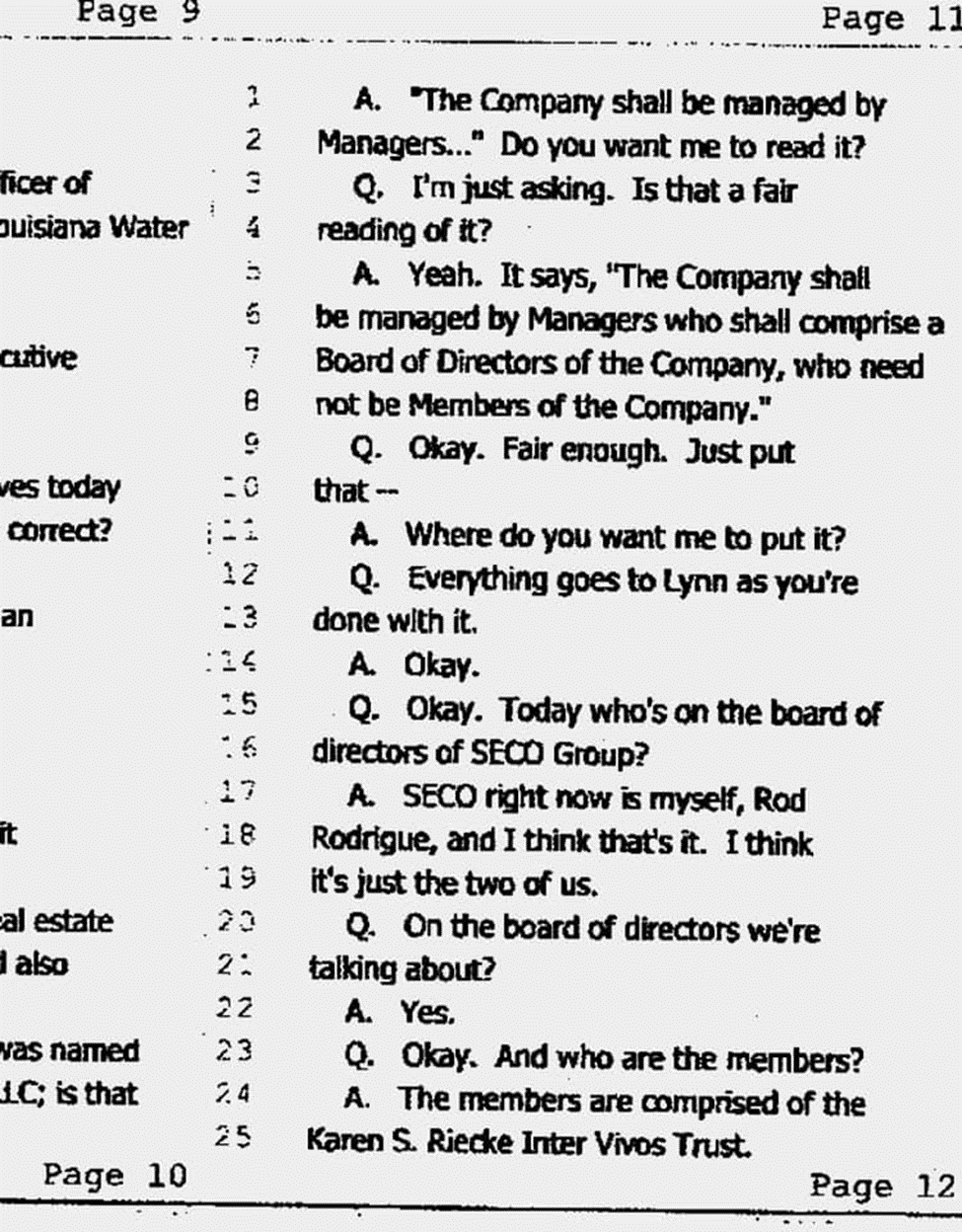
Electrical Engineer Kenneth Dutruch was retained by letter dated Nov. 15, 2004, to act as “exclusive agent to secure a sale for SELA (Southeastern Louisiana Water & Sewerage Co.),” but the agreement ended up in court when Riecke failed to pay Dutruch after SELA was sold.

In a deposition taken on Aug. 9, 2011, Riecke was asked to read a sentence from the agreement which said, “Should a commitment to purchase be obtained by you or by us from any source you introduce, SELA agrees to pay your fee on the total amount of the sale price.”

Asked to read the next sentence, Riecke did so: “For these services, you are to be paid five percent of the total amount of the sale.”

On Jan. 13, 2010, SELA’s assets were sold to the parish of St. Tammany for a total price of $39 million, well below the $50 million to $55 million that Riecke wanted for the company but nevertheless a potential $1.95 million commission for Dutruch, a commission Riecke did not pay because, he said, the sale was consummated after the contract with Dutruch expired.

“So, in your view,” asked attorney Alex Peragine, “if an agent earning a commission working for you brings you a firm commitment to purchase, you fire him the next day, you close two weeks later, you don’t have to pay him? That’s your view, correct?”

Peragine asked Riecke later in the deposition if he recalled in January 2007, he offered Dutruch $500,000 at the closing of the deal “in an effort to renegotiate the contract that you signed in November 2004?”

Riecke said that he did attempt to renegotiate the contract because the price received for SELA was far below what he’d anticipated and because the sale to the parish wasn’t consummated until two years after Dutruch’s contract had expired.

The 22nd JDC granted Riecke’s request for a summary judgment (dismissal), saying that Dutruch had failed to establish that his efforts were the procuring cause of the March 2010 sale of SELA’s assets. A three-judge panel of the First Circuit Court of Appeal affirmed the lower court decision, meaning Dutruch received nothing for his work.

Read Full Post »

Five years, some 175 stories by LouisianaVoice , at least two beatings. one death and a slew of retirements since I first started writing about Louisiana State Police and we finally get our first – and only – indictment.

And it was a federal indictment at that – over the beating of a Black man with a metal flashlight in Ouachita Parish in May 2019, more than two years ago. The killing of George Floyd and the subsequent arrest, trial, conviction and sentencing of officer Derek Chauvin took less time than that.

District Attorney John Belton, an announced candidate for attorney general, didn’t see fit to bring an indictment in the Greene death, even though it occurred in Union Parish, which is part of his 3rd JDC, along with Lincoln Parish.

Nor did Attorney General Jeff Landry dirty his hands in either case. He is, after all, the “law and order” AG, so why would he go after a state trooper who hit a Black man in the head 18 times with a metal flashlight in a span of 24 seconds?

It appears that a tight, well-constructed “wall of silence” was erected around the Bowman and Greene beatings, a conspiracy of sorts that required the cooperation of two district attorneys, a state attorney general, Louisiana State Police administrative personnel and, to an extent, if not participation in a coverup, at least an uneasy silence from the governor’s office.

I’m currently working on another book about sheriffs and one of the things I keep coming across is the idea of the so-called CONSTITUTIONAL SHERIFF,” who is the final authority on law enforcement in a given county or parish. That being the case, where were the sheriffs in the investigations of these incidents? They seem to have been MIA.

Assistant U.S. Attorney Luke Walker seems to have at least taken his job seriously. He’s the one who will be prosecuting the case after today’s announcement that former State Trooper Jacob Brown had been INDICTED by a federal grand jury for using excessive force against an arrestee.

Brown was a member of the trouble Troop F, headquartered in Monroe and once commanded by Kevin Reeves who was serving as Superintendent of State Police at the time of both the Ronald Greene fatal beating and the AARON BOWMAN beating less than three weeks after Greene’s death at the hands of troopers.

Odd that Louisiana State Police didn’t get around to investigating the two beatings for more than 500 days and then only after the incidents were brought to the attention of media.

But then again, after 175 stories about problems in the agency, maybe it isn’t so odd.

Read Full Post »

In 1934, New York Mayor Fiorello La Guardia put the kibosh on Mafia boss Lucky Luciano consigliere Frank Costello’s slot machine operations in New York City when he confiscated thousands of the machines and had them dumped into the East River.

Facing a major cash flow problem from La Guardia’s actions, Costello cut a deal with Louisiana Sen. Huey Long giving Long 10 percent of the gambling revenue if Costello cared to move his slots to New Orleans. Thus, with the Kingfish’s blessings, Costello and Philip Kastel of Stamford, Conn. and New York City, came to New Orleans in early 1935 and organized Bayou Novelty Co as a front to spearhead what would eventually be a statewide gambling operation.

In 1937, the manager of Bayou Novelty died and Costello’s brother-in-law Dudley Geigerman took over the operation which by 1939, accounted for annual profits of $800,000, according to Baton Rouge State-Times newspaper files. But in October of that year, a federal indictment charged six men of evading $529,456 in income taxes, according to then-U.S. Attorney Rene Viosca.

That amount would equate to about $10.4 million in today’s dollars.

Named in the indictment were Costello, Dudley Geigerman, Harold Geigerman (the Geigermans’ sister was married to Costello), James Brocato (alias Jimmie Moran), Kastel, and Jacob Altman (alias Jake Altman). All but Costello and Kastel were from New Orleans.

Moran, it should be noted, had once served as a bodyguard for Long.

The indictment, which identified Altman as the organization’s bookkeeper and the Geigermans as the collectors, claimed the tax evasions for the years 1936 and 1937 totaled nearly $2.6 million ($51 million in 2021 dollars).

Kastel and associate Alfred “Freddie” Rickerfor of New Orleans petitioned the court in December 1947 to return the slot machines seized earlier that year after police had already destroyed 390 of the 652 confiscated machines. The two obtained a restraining order preventing the destruction of the remaining 262 slots. A lawsuit against Mayor deLesseps Morrison was dismissed in July 1949 despite Dudley Geigerman’s testimony that the machines could not be used as gambling devices without manipulation or the addition of special features. Under cross examination, however, he admitted that they could be fixed so as to make payoffs.

By 1954, Costello himself was on trial for evading $73,437 in income taxes on income from his 22½ percent ownership of Louisiana Mint Co., a slot machine rental firm in New Orleans. Costello’s accountant testified that the Beverly Country Club in Jefferson Parish was a partnership divided between Kastel (25 percent), Costello and crime syndicate chief Meyer Lansky (20 percent each) and Carlos Marcello (15 percent), Rickerfor (17 ½ percent) and Dudley Geigerman (the remaining 2 ½ percent).

The IRS claimed at the same time that Marcello owed $13,600 additional income tax for the years 1943 through 1947, plus fraud penalties totaling more than $6,000.

Gambling, of course, was illegal all this time in Louisiana and continued that way until the state lottery was approved in 1990. Video poker was authorized the following year and the first casino was given a thumbs-up in 1993. Yet, the IRS was issuing gambling stamps here as late as 1968 in order to legally claim taxes on illegal income.

Because gambling was taboo, the $50 stamps were sold as “operational tax stamps,” and one of the first persons to purchase them as the ’68 football season approached was Dudley Geigerman, Jr., son of the man responsible for most of the illegal slot machines in the state and who was not only a brother-in-law to, but a business partner with gangster Frank Costello a generation earlier.

When Costello died in February 1973, his wife of 59 years moved to New Orleans to live with her brother, Dudley Geigerman, Sr. Geigerman Sr. died in August 1985. Newspaper accounts of his death noted only that he was a golf pro and said nothing of his family and business relationships with organized crime figures.

Fast forward to today and we have one Dudley Geigerman, III, who, at various times, has partnered in business with Marcello associate and convicted organized crime figure Anthony Tusa and Louisiana State Police Commission member Jared Caruso-Riecke.

Business enterprises in which Dudley Geigerman III was involved – and his partner(s) – included:

  • Crown Entertainment, Metairie (Anthony Tusa, partner);
  • Decatur Entertainment, Slidell (Tusa);
  • Southeastern Louisiana Entertainment, Houma (Tusa);
  • Video Village, Slidell (Tusa);
  • Mr. Binky’s Video Store, Kenner (Tusa);
  • Paradise Video, Kenner (Tusa);
  • GDH International. Covington (Jared Caruso-Riecke).

The first six businesses were video stores that specialized in pornographic videos and literature as well as various sex toys while GDH was a real estate investment company. Other officers in GDH besides CEO Riecke and Director of Housing Geigerman were Director Daniel E. Buras, Jr., Chief Operating Officer Richard Sharp and Chief Financial Officer Bruce Cucchiara.

Cucchiara was MURDERED in an apartment complex parking lot in New Orleans East on April 24, 2012, while looking for investment property. His killer has never been found.

Caruso-Riecke had four life insurance policies totaling $5 million on Cucchiara with New York Life. Three policies were for $1 million each and named Caruso-Riecke as beneficiary. The fourth, for $2 million, named Southern Louisiana Water and Sewerage, a company they owned together at the time of Cucchiara’s death. Such policies are not unusual with partners or key employees in the business world. Neither is it unusual for insurance companies to delay paying benefits when the beneficiary has not be cleared as being implicated in a murder.

Caruso-Riecke, despite not having been eliminated in the investigation, nevertheless filed suit against New York Life on March 19, 2013, a month before his claim would have prescribed and 11 months after the murder, which was still under investigation. Inexplicably, he filed his lawsuit in state court in Baton Rouge instead of St. Tammany which would have normally been the proper venue for a St. Tammany Parish resident and/or a St. Tammany Parish corporation. The insurance company opted not to contest the policies and paid Caruso-Riecke.

Cucchiara had also had signed a promissory note as security on some real estate property to Caruso-Riecke only 20 days before he was killed.

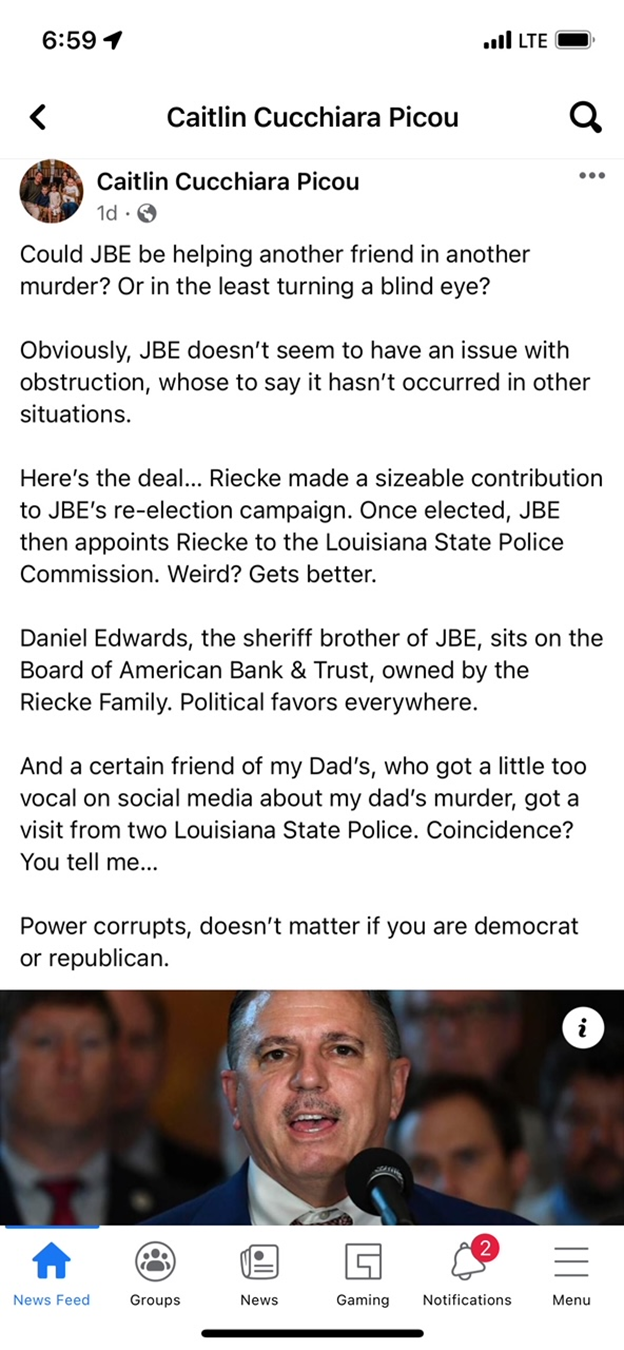
Caitlin Picou, Cucchiara’s daughter, said Caruso-Riecke gave an initial statement to investigators but since then, the investigating detective “has reached out to him but he declined to speak. They’ve reached out to his lawyer, as well, and he’s declined as well,” she said in February 2019.

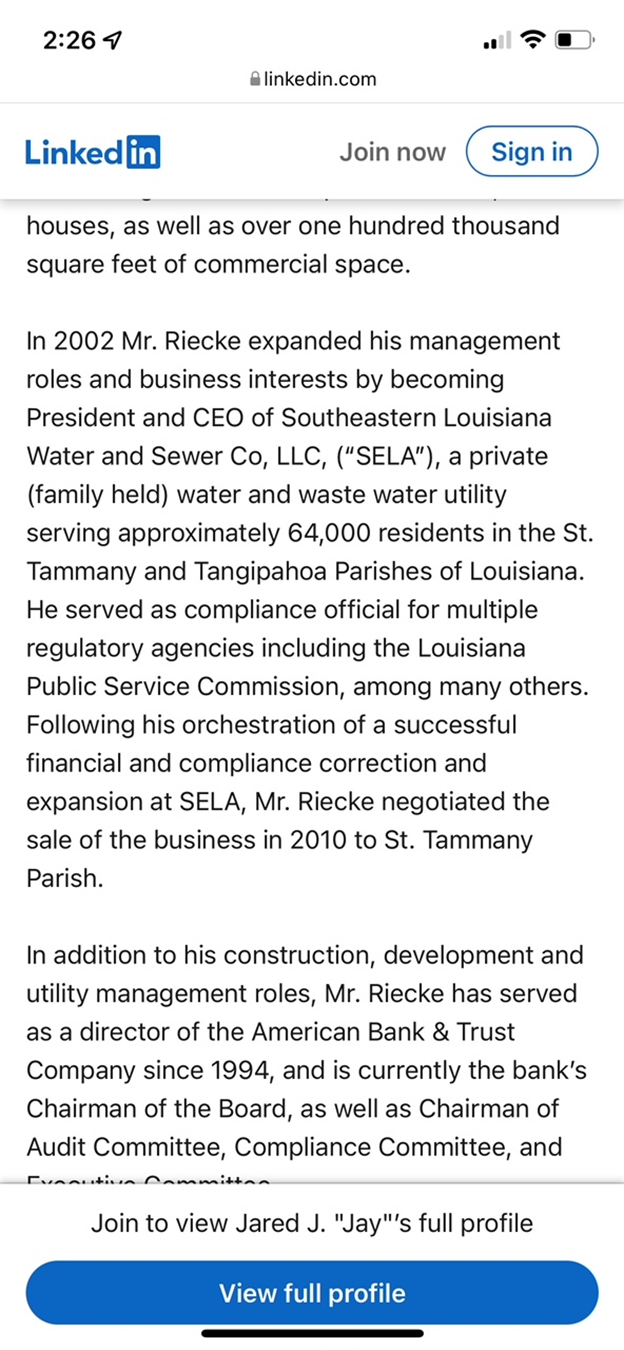
Caruso-Riecke, his family members and business enterprises were – and are – politically active, contributing tens of thousands of dollars to both Republican and Democratic candidates, including Gov. John Bel Edwards and his brother, Tangipahoa Sheriff Daniel Edwards. On Jan. 8, 2019, Gov. Edwards named him to the State Police Commission, a seven-member body “that has exclusive jurisdiction and final authority over the administration of the state police service,” according to the commission’s Web page. “The Commission serves as an impartial review board that enacts and adjudicates State Police Commission Rules to regulate state police personnel activities, and hears appeals from commissioned full-time law enforcement officers,” the Web page says.

It has, however, been mired in controversy as has Louisiana State Police, particularly Troop F, headquarter in Monroe, where media attention has been focused on state trooper beatings of Black motorists, including the beating death of Ronald Greene in May 2019.

It’s not entirely clear what Geigerman’s role is as housing director of GDH International or why Caruso-Riecke would enter into a business partnership with an individual tied to persons linked to the Marcello, Costello and Gambino families and organized crime. There is no indication that Caruso-Riecke is in any way involved in illegal activities, but there can be no question that there is at least an indirect if somewhat questionable link from him to Geigerman and by only a degree of separation, to Tusa and Marcello, which in turn raises questions about his membership on the State Police Commission.

Geigerman and Anthony Tusa together purchased Video Village, located at 1797 Hwy. 190 West in Slidell, on March 15, 2002, for $50,000. That same day, the two also negotiated a lease of the building at that address to be used as a video rental store and for the “sale of novelties, periodicals and refreshments and snacks.”

In something of a plot twist, two men were arrested on suspicion of simple arson in the Sept. 11, 2007, stemming from a fire that burned Mr. Binky’s video store at 96 West 27th Street in Kenner. One of the man, Jesse Acosta, was manager of Paradise Video only a few blocks away at 41 West 24th Street in Kenner, and the other man, Rashad Clark, was a part-time employee of Paradise Video.

Both stores were jointly owned by Geigerman and Tusa.

Despite the arrests, no one was ever prosecuted.

The Tusa name has a long history of organized crime connections. In 1991, when Louisiana legalized VIDEO POKER, brothers Anthony and Victor Tusa, along with Sebastian Salvatore, were CONVICTED under the Racketeer Influence Corrupt Organization (RICO) Act of mail fraud for conspiring to act as “front men” or “straw men” to obtain video poker licenses on behalf of the Marcello and Gambino organized crime families through Bayou Casinos, Inc, a corporation controlled by Anthony and Victor Tusa and whose agent of record was listed as Alan B. Tusa.

NEXT: Caruso-Riecke business dealings examined

Read Full Post »

« Newer Posts - Older Posts »